The journalism films you should watch if you want to be a journalist (Part II)

The other day, I went through the five films I thought would be good for journalism students to watch. Today, we go through what the Hivemind had to say about which journalism films you should watch and why. Here are ten more films to consider:

All the President’s Men (1976) – Let’s talk about the 200,000-pound elephant in the room. This one popped up on everyone else’s list, and for good reason. It’s the gold standard of journalism and film, it showcases how a newspaper brought down a president and it inspired generations of writers to do more reporting and less stenography when it came to covering famous people. The story behind this movie is important, valuable and incredible as a turning point in American and journalistic history.

It didn’t show up on my list for three reasons:

  1. At 2 hours and 18 minutes, it’s a hell of a slog and it literally typifies almost everything that Meyers talks about when it comes to movie cliches. Sure, ATPM did it first and it was real, so calling it cliche in retrospect is unfair but it goes back to the third point on my rationale list. I have personally found myself drifting off watching this thing and I know I shouldn’t. Every year or so, this movie becomes a point of debate among a bunch of us on a college media listserv, so I know both sides have their supporters here.
  2. The piece lacks historical perspective for a lot of students in today’s day and age. Watergate is just as relevant as Washington crossing the Delaware in their lives. People over 50 remember Watergate happening, so it’s relevant to them, but many students are barely old enough to remember the 9/11 attacks and they weren’t even born when Nixon died. Because the film was made in 1976, it doesn’t include the “backstory” elements that current retrospectives do. In 1976, everyone KNEW the outcome because Watergate happened four years before the movie came out, so it was more about the story behind the story. That approach leaves the current generation a bit lost.
  3. OK, this is a cheap shot, but it lost the Academy Award for “Best Picture” that year to “Rocky.”

Still, overall, if you want to really dig in and watch this, go for it. I’d recommend it the same way I recommend eating vegetables: It’s good for you, but it’s not as fun as some other things you could do. Like watching “Rocky.”

The Post (2017) – This takes a look back before the Watergate scandal and showcases another huge story the Washington Post covered: The Pentagon Papers. Truth be told, the main reason it didn’t make my list was that I haven’t seen this yet. Everyone in the Hivemind who saw it thought it was perfect in its approach and its historical value, while still setting the stage well enough for people in this generation who didn’t live through it. It might be a top-five for me once I eventually find time to see it a couple times.

The Insider (1999) – Another great story of a journalist and a big story. Russell Crowe is a whistleblower in the case against Big Tobacco and Al Pacino is journalist Lowell Bergman, who is determined to make sure the story gets told.  As one of my colleagues noted it “is a great primer on the reporter-source relationship.”

Good Night, and Good Luck (2005) – This is another look back at an important clash in history between the government and journalism. David Strathairn stars as journalist Edward R. Murrow, who takes on Sen. Joseph McCarthy during the 1950s “Red Scare.” The work Murrow and producer Fred Friendly do to push back against a seemingly invincible opponent at a time of heightened nationwide fears was incredible. The use of news footage featuring McCarthy, as opposed to an actor playing him, adds realism and provides an even greater sense of what these journalists faced. What you are willing to do when you see nothing but risk all around you is a valuable question at the core of this film.

The Front Page (1931) – I hadn’t heard of this one, but it was suggested to me by a colleague who teaches a history of journalism as well as a “lit and film” journalism class. A comedy film, the piece looks at journalism in ways that are still relevant: Investigative reporter Hildy Johnson plans to leave his job at a tabloid to get a better-paying advertising gig when he comes across the scoop of a lifetime. A convicted killer escapes and Johnson pays off someone to get the story. Later, he comes across the killer on the lam and Johnson hides him in the newsroom until he can get the story from him. A 1974 remake starring Walter Matthau and Jack Lemmon is also out there if you’re interested.

Almost Famous (2000) – This is a great film, even though I never really thought of it as a journalism movie. That said, two others in the Hivemind posted it, so here we go. The semi-autobiographical tale of a young Cameron Crowe, “Almost Famous” sends a 15-year-old William Miller (Patrick Fugit) on tour in the 1970s with the band Stillwater so he can write a piece for Rolling Stone. It’s a fun movie, runs a little long and is more of a character study than anything else, in my mind. However, it does contain the world’s greatest lead for a band profile: “I’m flying high over Tupelo, Mississippi with America’s hottest band and we’re all about to die.”

I Am Jane Doe (2017) – A film that combines the “I haven’t seen it” and “I hadn’t thought of it as a journalism movie” issues discussed earlier. The story is about sex-trafficking and the website Backpage.com. The question it asks in the trailer is “How can it be legal to advertise children online for sex?” The answer sits at the core of something called Section 230 of the Communication Decency Act of 1996, which has broad implications for journalism. I trust the faculty colleague who recommended this one.

Network (1976) –  This is a great, great movie, but it just didn’t make the cut for my five. (In retrospect, it probably should have, but I don’t know what to cut, and don’t you dare suggest “The Paper.”) Veteran news anchor Howard Beale (Peter Finch) finds his ratings falling as younger journalists and “catchier” stories undercut his traditionalism. When he finds he is about to be fired, he says that he’ll kill himself on the air one week from now. This announcement leads to a ratings spike, the network’s decision to ride the story and perhaps one of the best-known moments in journalism-movie history:

Even all these years later, this piece is SO on the money in terms of where we are today with reality TV, media quality, corporatization of news and more that it essentially made a comeback when Aaron Sorkin did his version of it with “Studio 60” in 2006:

Or even when Sorkin did it again in “The Newsroom” in 2012:


As one person in the Hivemind called it it is “a favorite and works well with discussions about media dependency, conglomeration, reality TV…” It’s a real keeper. (Oddly enough, this lost out on the “Best Picture” Oscar to “Rocky” as well… “Why this fighter of such limited ability has gained such popularity is such a mystery…”)

His Girl Friday (1940) – I have a love of Howard Hawks films, due in large part to his rapid-paced dialogue and his desire to just bang out the story. Of course, my favorite Hawks movie was “Rio Bravo,” which has nothing to do with journalism, but does include John Wayne. Watching everyone else working in “Hawks speed” while Wayne is still lumbering along at his own pace of dialogue is incredible. In any case, “His Girl Friday” showcases Cary Grant as a newspaper editor trying to get his ex-wife and top reporter, Rosalind Russell, from leaving the paper and getting remarried. The movie doesn’t age well, particularly in terms of sexism, but it is still a classic film worthy of a look if you can look past some of the historical failings it contains.

The Killing Fields (1984) – Another one I need to add to my NetFlix list. Sam Watterson plays a New York Times journalist who goes to Cambodia in search of a story during Pol Pot’s “ethnic cleansing” of the country.  One of the Hivemind called it “excellent for discussion of US reporters covering war, use of local sources/handlers and ethics.” 

So, what else did we miss? Feel free to drop us a comment below.
 

The journalism films you should watch if you want to be a journalist (Part I)

Journalism films are all over the place lately, as are documentaries about journalists. It seems like if a film can include a typewriter, somebody smoking indoors and a sense of “taking on The Man,” it’s on a screen these days. Seth Meyers did a fantastic send up of this on his late-night show:


In the 1970s, “All The President’s Men” became the “must-watch movie” for journalism students. When I was in college, we gravitated to “The Paper,” as we all seemed to know random guys like Randy Quaid’s character who bordered on insane. (One of my newsroom friends started calling me “Hackett” after Michael Keaton’s Coke-guzzling, workaholic character.) Now? It could be one of a dozen or more fictional, documentary or “based on a true story” films, so I dug back through IMDB and put out the question to the Hivemind on what was “required” watching for budding journalists.

Below are my “Top Five” films in no particular order with some rationale behind my picks. I tended to consider three things in each pick I made:

  1. Did I watch it more than once because I liked something about it?
  2. Does it give viewers something important in it, regardless of the genre or format?
  3. Do I think students would actually watch this if they weren’t forced to and actually enjoy it?

Those considerations knocked out a couple films for me that others picked up on. I’m also quite certain it will have people screaming at me that I’m wrong.

In any case, here we go:

1) Judging Jewell (2014, ESPN: 30 for 30) – At shade under 22 minutes, this story packs a lot of lessons into a short space. In 1996, a bomb shattered the peace of the Olympics in Atlanta, Georgia, killing 2 people and injuring more than 100 others. This could have been much worse had it not been for the heroic actions of Richard Jewell, a security guard who was working at the Games for AT&T. Jewell spotted the package and began moving people away from that area before the bomb detonated.

Jewell was originally considered a hero, but the media turned on him when public sentiment held that Jewell was likely the bomber. What followed was an 88-day “trial by media” that demonstrates what can happen when the race to get the story becomes all-consuming. (My favorite lesson comes from the Atlanta Journal-Constitution, which ran a line about how Jewell “fits the profile of the lone bomber,” and why attribution matters so much in news writing.) Jewell was eventually exonerated, as terrorist Eric Robert Rudolph was captured and confessed to the bombing. However, Jewell never really recovered. This is a sad story and yet a good cautionary tale for journalists.

2) Spotlight (2015) – Critics have compared this film to the classic “All The President’s Men,” in that it shows how reporting can bring down a powerful institution. It also has similarities in the ways in which the journalists had to engage in real “shoe leather” reporting to make this happen. The critical nature of sources, fact checking, working around problems and other things journalists pride themselves on are on full display here. One of the more interesting things is the early resistance from within the paper when it comes to “going after” the church. Although, like most “based on a true story” movies, we know how it will end, the tension that comes from the fear of being wrong makes this both a tale of aspiration and one of caution.


3) Shattered Glass (2003) – In between his stints as a young Anakin Skywalker, Hayden Christensen portrayed another character drawn to the dark side. Stephen Glass was a young, well-liked journalist at The New Republic when he engaged in a series of fraudulent behaviors that shook the magazine to its core in the late 1990s. Glass started by faking a few quotes here and there before eventually writing pure fiction and passing it off as fact. The epilogue of the film notes that 27 of the 41 pieces he published during his time at the magazine were partially or completely made up, not to mention fabrications he freelanced to a number of other publications.

Some aspects of the film, which is now 15 years old and based on an incident that happened two decades ago, don’t age well for younger viewers. The idea of having to use “every search engine on the web” to get information seems quaint, as does the discussion of the fear associated with an “internet publication going after a giant.” That said, the lessons are fantastic.

At some point in life, almost everyone has wanted to be “the cool kid.” Glass fell into that trap, as you can see in the “60 Minutes” interview below. He loved the attention and would do anything to get it, including wandering down a path of self-destruction.

I would also wager, most people also have found themselves in a jam at some point and thought, “If I just cut a corner here, I could get out of this alive.” Some do it and convince themselves they’ll “only do it this once.” Like most other things that are horrible for you, it’s never just once. If you take the Red Pill, you never hit the bottom of the rabbit hole. Even today, Glass is still dealing with his past.

https://vimeo.com/30824692


4) The Paper (1994) – It’s fiction, it’s ridiculous in spots and yet it is one of the few films that captures the complete randomness of life in a newsroom. From the A/C that breaks to the guy who swears he has “Watergate” on every story, this is a funny story with a great cast. If nothing else, this scene just nailed it for me:

“Who the hell took my stapler?”

If I had a dollar for every time something in a newsroom made me laugh, I’d be able to fund all the newspapers in the world forever. This movie reminds me of that every time I watch it. Probably a biased pick, but give it a look and tell me I’m wrong.

5) Nobody Speak: Trials of the Free Press (2017) – A wrestler, a sex tape and sleazy internet publication are at the central junction point of this film and perhaps the most important free-press case in decades. The movie looks at the trial of Bollea v. Gawker, which pits wrestling star Hulk Hogan (aka Terry Bollea) against an internet gossip magazine. Gawker was a publication that a lot of people hated for being mean-spirited and snotty, but it also went after “true things about bad people” to quote a former worker. However, at the heart of this case and this film are several crucial questions including, if a sex tape is news, who gets to decide that and what forces are at play behind all of this.

The film goes beyond the “guess who saw the naughty stuff” issue and digs into who was funding Hogan’s legal team, what other multi-millionaires are out there potentially undercutting press freedoms and what this means going forward.


Feel free to tell me I’m wrong about everything, if you so choose.

Tomorrow: The answer to “How can a list like this NOT include ‘All The President’s Men!’ as well as the suggestions of the Hivemind.


Four reasons I care about what the student government is doing to The Sunflower (and why you should, too)

(Editor’s note: The situation at Wichita State University, in which the student government is cutting funding to the student newspaper, The Sunflower, is one of those horrible situations that needs hope:

EIC Chance Swaim said that sharing the message made sure that, “If a tree falls in the forest, I want everyone to hear.” Make sure people hear it loud and clear.)

—

Allison Hantschel Sansone, who has written for us here occasionally and runs a massively successful political blog, would occasionally confront a colossally lousy situation with a call for hope. She would call for her readers to donate coats for homeless kids, kick in to a GoFundMe for high school journalism kids or to give money for food to support hurricane victims. Her motto is one to which I aspire:

“Hi, we’re from the internet and we’re here to help.”

The responses she got often stunned her in terms of speed and help, as they did me yesterday. If you took any two posts I’ve written since I started this blog, added the views together and doubled them, you wouldn’t get as many hits as the post on The Sunflower got in 12 hours on Wednesday. (And that includes one post where I was basically giving people stuff for free.) More people bought T-shirts (or at least clicked on the link to buy them) than I had visitors for any post during the rest of the week.

You all are from the internet and you are here to help, so thank you.

For people who are still asking (and they’re out there), “Why do you care so much about a college paper in a state you never even visited and people you never met?” here are four simple reasons why I care and why I think everyone else should too:

1) Student media outlets matter: I know that this seems like a self-serving statement, but it has turned out to be more true than I could have imagined. If you skip past all the standard answers of why they matter (They shine a light on sketchy campus situations, they provide students with a voice, they train future journalists who can make an even bigger difference etc.), you can find other bigger reasons they matter.

Students who find the courage to enter the newsroom where it seems like everyone has a place and knows what they are doing tend to find their own place and their own purpose. I often joke that we’re a family, in that we all drink and yell at one another, but I mean it more honestly as well. I have yet to have students come back to me to reminisce about that “great midterm you gave us” or “remember the time in class when I raised my hand?” However, I have found they’ll come back, sometimes decades later, to talk about the paper and their time there. It is really a part of their lives.

2) Bullies suck: If you ask my mother the first time she ever saw me REALLY upset about something, she’ll likely tell you that I used to watch “Peanuts” TV specials when I was 3 or 4 years old and rail about how everyone was so mean to Charlie Brown. There is something about bullies that just drives me around the bend and I imagine I’m not the only one to feel that way.

What is happening at WSU is nothing more than bullying. And it really ticks me off.

Over the course of the past couple months, WSU student government President Paige Hungate has stated she can close a meeting when she wants, called the university president a coward, proposed draconian cuts to the student paper’s budget, told the faculty senate she is in charge and said the university president had no choice but to agree with her on cutting The Sunflower’s budget. Does that sound like someone versed in the nuance of collaborative governance?  It sounds like Loki:

Why are Hungate and others at WSU so interested in bullying the paper into submission? It could be that the paper has done a lot of investigative work that has caused the administration some consternation. It could be that the paper covers the SGA closely and it would be so much better for Hungate and the rest of the group if the paper were put on a leash. It could also be that the paper reported on Hungate’s parents who were “under criminal investigation for battery and anti-black, hate “fighting words” following an altercation at a student government banquet.” The former SGA president, Joseph Shepard, pressed charges following the event. It could be anything…

This isn’t an attack on Hungate, but rather an attempt to point out that bullying the paper into silence is something nobody should abide. Speaking up makes that point clear.

3) Feeling alone sucks worse: A big reason we take staffers to student media conferences goes beyond the writing, photography and design stuff they learn. The reason is to show them they’re not alone in their problems at the paper. A campus usually has ONE editor in chief or ONE managing editor who has to wonder, “Is all of this stuff normal or are we weird?” That “stuff” can be anything from “Why can’t the sports desk ever make deadline?” to “How do you deal with a photo editor who is trying to sleep with all his photographers and creeping everyone out?” When you think you’re the only one in the world who deals with this, it can be daunting.

The first thing Swaim asked me for wasn’t advice on how to defeat the SGA or how to fix the financial situation. He asked me to get the message out about what was happening. In other words, “Tell the story. Let people know.” When I did, he got back what he wanted to hear: “We see. We know. You are not alone. We are behind you.”

When I was fixing the finances at my student newspaper about 112 years ago, I’d be up until 4 a.m., tearsheeting a year’s worth of ads wondering where the hell everyone else was who “swore” that this place meant “so much” to them. When we asked for help to retire our debt, people wrote checks from all over the country and others who couldn’t sent letters and notes of support. It was that outpouring that told me the most important thing:

You are not alone.

4) The Hole Story: The person I can sympathize with the most is Amy DeVault, the adviser of The Sunflower. She is a long-time WSU faculty member, a top-notch journalist with a good amount of field experience and an adviser with passion for student media. The last thing she, or any good adviser, wants is to BE the news. Even more, advisers always walk the fine line of being helpful and taking over when things get rough. She saw this coming for more than six months and has been working quietly behind the scenes to try to avoid this rock-and-a-hard-place moment that seemed inevitable.

(Side note: The only way I’ve ever been able to explain the adviser-editor relationship adequately is through “The Godfather” movies: The editor is the “don” of the family and the adviser is the “consiglieri. The adviser offers all the advice and solutions possible, but at the end of the day, the don makes the call. That’s the way things are set up in student media at public institutions, thanks to this thing called First Amendment.)

I’d like to say that I can’t imagine what she’s going through right now or what Swaim is enduring, but unfortunately I can. Two years ago, the student government here decided to come after the paper. Making things worse, they came after me directly, putting together a formal resolution demanding that I resign as adviser and if I didn’t, that the chancellor fire me.

The students not only had to deal with the issue of how to fix the paper’s funding and the student government’s attacks on the paper/me, they also had to COVER this as NEWS. There is no more sickening feeling than having to leave your own newsroom because you didn’t want the students to feel awkward writing a story in front of you about an attempt at your ouster.

Every day feels like you’re getting the crap kicked out of you. You fear every email, every phone call and every text message because it might be the one that ends everything. I remember being unable to sleep and feeling like my heart was going to leap out of my chest at various random points. The world feels like it’s collapsing all around you and you have no idea how to stop it.

You also fear what it’s doing to your staff. My editors were constantly on the edge of a nervous breakdown. It got so bad that I told my editor, “Look, if it will make life easier on you, I’ll just quit.” She looked at me and without hesitation said, “Even if it did make life easier, there’s no way I’m letting you quit.” (See point one. We were family.) DeVault sent me a message telling me that Swaim is in constant fear that what is happening here will cost DeVault her job. My students worried about that as well. Those were the worst professional days of my life.

Two years later, those student government… um… people… have graduated, the paper is fine (ish) and life is better. The only thing I have to remind me of all this is the resolution they signed to oust me, which I framed and put on my wall next to an autographed picture of Mary Beth Tinker. That’s why I want to help people like Swaim and DeVault. It’s the personification of “The Hole Story” I love to tell:

I’ve been in this hole, and I know there’s a way out.

If you have too, keep supporting these people. They deserve it.

3 lessons beginning sports writers should learn from the 16-seeded UMBC Retrievers win over No. 1 Virginia

Sports journalism thrives on record-setting performances, amazing finishes and moments when the impossible occurs. As the NCAA men’s Division I tournament began last week, one “unbreakable” record appeared safe: No 16 seed in that tournament had ever defeated a 1 seed in the tournament. In 135 chances, the 16 seed was 0-135.

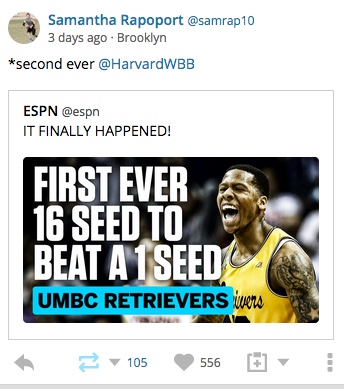
The Retrievers of the University of Maryland Baltimore County ended that streak on Friday, defeating the top-ranked team in the tournament, the Virginia Cavaliers, by 20 points. People poured on to social media to relish the moment and celebrate the “David” who just took down “Goliath.” However, in calling the Retrievers the “first 16 seed to ever defeat a 1 seed,” people were factually inaccurate.

The women’s team at Harvard came to the NCAA tournament in 1998 as a 16 seed and defeated the number one team from Stanford, 71-67. Thus, the Retrievers were the first men to accomplish this task and yet not the first team to pull it off.

This leads to three simple lessons to take forward:

  • Don’t assume only men play: In a number of sports, men and women participate and women have the edge when it comes to records. For example, the person with the most open-era singles wins at Wimbledon isn’t Roger Federer with eight, but rather Martina Navratilova with nine. The person with the most goals in Olympic soccer history is Cristiane, a player for the Brazilian women’s national team. If you think something is a first, a last or an only, make sure to check both sides of the gender ledger before calling it a one-of-a-kind event.


  • Don’t assume  your level of competition is the only level out there: Sports have multiple divisions at the collegiate level (D-I, D-II and D-III), so just because a D-I team hasn’t pulled something off, don’t assume no one else ever has. When an NFL record is broken, keep in mind it isn’t the only “pro” league to ever exist, so if you are making a statement about all professional football history, make sure to check back on things like the WFL and the USFL. Or, just stick to calling it an NFL record.


  • Don’t assume that because “everybody said” something that “everybody is right: Watching the “first-ever 16 seed” (a redundancy that was almost as bad as the error itself) story fly around the internet had people piling on until someone decided to set the record straight:Harvard2


This leads to the main point of this post and the bigger overall lesson: Say ONLY what you KNOW for SURE. Don’t get caught up in the hype or assume something has NEVER happened just because you don’t know that it happened before or because “everyone knows” that something hasn’t happened. Instead, write what you can prove: No 16-seeded men’s team in this history of the NCAA D-I tournament had beaten a 1 seed in 135 attempts before UMBC defeated Virginia.

Your readers will still enjoy your work, the outcome is still impressive and you will have the benefit of being accurate.

The five conversations journalism professors have in hell.

Growing up as a Catholic kid, who spent way more time near nuns than is now recommended by the FDA, I found the concept of hell horrifying. Conceptually speaking, it was a place of fire, brimstone and evil where you went after you had sinned without repenting, angered God through evil acts or accidentally ate a Slim Jim on a Friday during Lent.

Later in life, I asked a priest who was a little more “new school” about the faith for his views on eternal damnation. He told me it was probably more of never-ending sorrow and sadness than the torture outlined by those who grew up before the Vatican II era. It was a a longing and pain for better things and regret over what we should have been. In other words, hell is more individualized and accounts for what we did and who we were.

If hell hits somewhere in that “sweet spot” between those points, I’m sure I know exactly what I’ll be getting myself into if I’m not a decent human being. Since I’ve invested most of my life in teaching and journalism, I know that hell will involve reliving certain conversations I’ve had with students over the past 20 years that continue to sap my will to go on.

So without further ado, I bring you the five conversations journalism professors have in hell and how you can help us avoid them while we’re still alive:


CONVERSATION 1: SO WE NEEDED THE BOOK?

Look, I get it. Textbooks are expensive. In fact, the entire premise of this blog is that textbooks cost too much, change too often and usually have the lifespan of a mayfly. That said, we assign them for a reason: They actually contain stuff you’ll need to know. This is particularly true for books like the AP style guide. Here was an actual conversation I had with a student half way through the semester:

Student: How much are these books?
Me: What do you mean?
Student: This AP book, how much does it cost?
Me: About $20-25. Why?
Student: It must not have been listed on the criteria for the class. I think I’ll go buy it though.

OK, let’s pretend that I hadn’t mentioned it about 10,002 times already and that I didn’t include it as a required book in the syllabus and that I didn’t mention this as a MUST HAVE for the class (as in, “If you are broke, don’t buy the textbook, but buy the AP book.) AND that it wasn’t stocked at the book store.

Every other student in that class had the book. What, they were clairvoyant and just figured I wanted them to have it?

Making things weirder, a student in the very next section of that class, sitting in that very same seat asked the EXACT SAME QUESTION about the AP book, swearing he had no idea that this thing would be important. I think I need to call in some sort of holistic medicine person to burn sage on that chair or something…

Still, this pales in comparison to the year I told the students in WEEK 12 that they should bring their AP style guides to class, only to have one student reach into his backpack and whip his out. “GOT IT!” he said, proudly displaying the book he was supposed to have read by that point in time.

It was still shrink wrapped.

HOW TO PREVENT THIS: Buy the books and read them. If you are REALLY broke (as in, stacking pennies for Ramen broke) and you CAN’T afford them, talk to the professor and see what is absolutely essential and what you might be able to dodge. However, do this somewhere before the midterm.

CONVERSATION 2: I LOOKED EVERYWHERE!

The constant yelling of old people (read: me) about “damned kids these days” come from the fact that we often wonder how hard students really tried before giving up all hope and saying, “Just give me the answer.”

Damned Kids

Case in point, here was a conversation I had about a midterm question in which students were asked to rewrite a lead on one of four stories. Each story included a specific time peg, so I told students to use the day specified in the story (e.g. The game happened Saturday, so use “Saturday” as your “when” element.) when they wrote their lead. About an hour into the test, here was the conversation:

Student: I know you said that there is a time element we need to use with each of these stories, but I honestly can’t find one in this story I’m using.
Me: OK, pull it up and let me see. (he does)
Student: I looked through this whole thing and there’s no time element.
Me: Really?
Him: Yes, I can’t find it anywhere.
Me: Read the first sentence out loud for me.
(Silence)
Him: Oh.

Yep. Right there in the lead was that elusive time element he sought. I suppose I was lucky the student didn’t have trouble finding his pants before showing up in class…

HOW TO PREVENT THIS: Don’t give up so easily on figuring things out. There is something to be said for figuring stuff out on your own. Print it out or magnify the text or whatever you need that will help you consume the content. Also, if you really CAN’T find the content, when you ask, do so in a way that doesn’t immediately insinuate your professor is an idiot who failed to include the content.

Trust me, this is a great fear of many instructors and there are days we can’t remember what we ate for lunch, so screwing up a test is always a possibility. We then panic when you are “so sure” that whatever it is you’re looking for isn’t actually there. Finding out that, no, it actually is present and, no, we don’t have early onset dementia, is both a relief and a moment of “What the hell is wrong with kids these days?”


CONVERSATION 3: I KNOW YOU SAID X, BUT…

Rules are put in place to assure fairness, standardize procedures and give everyone guidance on how to proceed with a test, an assignment or a project. If you want to curdle a professor’s soul, explain to him or her that, yes, you understand rules exist for all those reasons, but the rules really only apply to other people.

Student: I know you said we can’t interview relatives for this assignment, but I was wondering if I could interview my mom.
Me: OK, what does your mom have to do with (the story topic)?
Her: Well, she’s a parent of a college student…
Me: But that’s really not what the story is about and even if it was, there are like 14,000 students on this campus, many of whom have parents. Does she have some special insights that none of the others would have had?
Her: Um… I don’t understand what the problem is. Why can’t I just interview my mom?
Me: Again, she has nothing to do with the story and I need you to get out of your comfort zone and interview people that you don’t know. It’s a skill you’re going to need as a reporter.
Her: So that’s a no?
Me: Yes. That’s a no.

HOW TO PREVENT THIS: Start by assuming that the rules, however arcane, have a reason behind them. Envision that “Karate Kid” moment where Daniel realizes that he hasn’t just been an indentured servant, but rather has been learning karate:

Also, realize that we WILL give people special dispensation for certain things, but it has to be germane to what we’re doing and provide a rare glimpse into something no one else could provide. If you’re doing a story on what it’s like to be an NFL referee and your uncle is an NFL referee, we might think, “That would actually work.” However, if you’re doing a story on how bad parking is on campus and you want to interview your best friend because he owns a car, think twice before asking on that one.

Nothing sounds worse to a professor than a student essentially saying, “Look, I know you told me what to do here, but you have to understand that rules don’t really apply to me because I want to do it my way and obviously that’ll be better for me, so can you just rubber stamp my demands? Thanks!”

CONVERSATION 4: HEY, DID I MISS ANYTHING?

Professors have a ton of stuff to do and most of them feel like they’re not doing it well enough to make anyone happy. The ability to focus well enough to deliver a two-hour lecture on something you will need to know to succeed in the class is the Educational Dream of the Millennium.

When you blow it off, fail to take notes or get way too into a SnapChat battle with your roommates during lecture, it can be irritating to us. When you then ask us to “fill you in” on what you “missed,” We tend to have this reaction:

Actual email:

I was just wondering what exactly the group interview project is again and what needs to be turned into you by Friday! I don’t quite remember everything you said at the end of class yesterday so if you could remind me that would be great.

At least that guy showed up, unlike the student who blew off class, skipped an assignment she knew about and then sent this:

Sorry, I was not able to attend class today. What did I miss? When is the interview paper due?

Perhaps my favorite one was years ago when I had a student tell me she spent six hours in the ER with a kidney infection and that she was way too sick to attend my 3 p.m. class. I explained I understood and that these kinds of things happen.

Later that night, my wife and I were at the local journalism bar and guess who walked in? Yep. The student.

She saw me, got a freaked-out look on her face and practically dove into the party room next to the entrance.

The conversation that followed the next class period was epic:

Her: Hi, I was wondering if I missed anything in class…
Me: Well, it’s been said that the appearance of impropriety is worse than impropriety itself, which is what I thought about when I saw you walk into the Heidelberg the other night, four hours after skipping my class.
Her: Oh! I can explain that!
Me: I’d love to hear it.
Her: Well, it was my friend’s birthday and I was feeling much better at that point so I just stopped by for a drink.
Me: With a kidney infection?
Her: Oh, yeah! I have my doctor’s note for you. Let me get that!
Me: (feeling aneurysm building in my brain, fueled by her complete lack of self-awareness) Um… That’s OK… Let’s just start class.

HOW TO PREVENT THIS: Go to class. If you don’t go to class, get notes from somebody before asking us to rebuild a lecture for you. If you went to class and forgot to write something down, ask a classmate. If you are going to class, writing stuff down and still failing to remember major things, seek help immediately.

CONVERSATION 5:

Me: Hello? Anyone out there?
Voice: Welcome to hell. I am Lucifer, the fallen one, evil incarnate, the lord of the underworld. Do you know who you sinned against to land you here?
Me: Do you mean, “Do I know against WHOM I sinned to land here?”
Voice: Oh great. Another journalism professor. Y’all are down the hall, third door on the left.


The “Tragic Trib” and learning how to compete in an old two-newspaper town

In every phase of my news career, I was lucky enough (relatively speaking) to work in two-newspaper environments. As much as we didn’t like the idea that TV would occasionally beat us to the punch, we always feared what the afternoon edition of our competing paper would bring. It has been years since I had to worry about getting scooped, but I could easily recall that fear this week when a story began popping up in my social media. Several former students from the Columbia Missourian shared this story about the “tragic” gutting of the paper’s competitor, the Columbia Daily Tribune.

When I took an editing job at the Missourian, the city’s a.m. paper, we’d send someone running down the street around 2 p.m. to a newspaper box that contained still-moist editions of the Tribune. When the reporter would return with the paper, we’d tear the thing into sections, looking for stories that we had that were absent from the paper or something “they” got that “we” didn’t.

When the internet became more prevalent, the Tribune would post all of its stories online just before we had our news budget meeting. Our newsroom would be filled with reporters at computers, clicking the “refresh” button on their web browsers, trying to get the first look at what the Trib had. More often than not, we were on the short end of the stick and we had to scramble to catch up.

Working for the Missourian presented a unique challenge. The University of Missouri owned the paper and staffed it with professional-practice faculty as editors and students at the J-school as reporters, photographers and other staffers. The Tribune, on the other hand, was a professional, family-owned publication.

Reporters there had years of experience under their belts, along with an extensive set of relationships with sources throughout the area. Our staffers had trouble figuring out how to transfer a phone call.

Making things worse, sources on certain beats actively undermined some of our student reporters. It was infuriating to have a reporter catch a rare tip, work on it for days and then get a “no comment” or some other denial from a source, only to have the source turn around and give the story to a Tribune staffer. It was a sick feeling to read “your story” on the front page of the Trib with the writer slathering “told the Columbia Daily Tribune” attributions all over it.

As much as I really, really hated getting our butts handed to us on a semi-regular basis, it really helped me drive the reporters working for me on the crime beat to hustle like crazy. Living with the Tribune was like being a little brother: Your older sibling kicked your keester over and over and over again at EVERYTHING you both did. But, when you managed to pull off a win, it was like a Christmas miracle, a first kiss and hitting a game-winning home run all at once.

I know that the media environment is much more diverse these days when it comes to social media, citizen journalists and news-driven websites. Turf battles over a city or town by two monolithic traditional news operations doesn’t happen anymore and there’s something good to be said about a more diverse set of niche voices gaining volume.

However, the competition that existed between the two papers in that town helped shape and grow some of the best journalists I’ve ever been lucky enough to know. The Missourian reporters knew nothing would be easy, nothing would be handed to them and they had to hustle just to tie that damned Tribune every, single day.

I don’t know if it’s possible to replicate that kind of environment any more and I think in many ways, news consumers are the worse for it.


How to avoid promoting the most racist sweatshirt in the world (or 3 things to help you avoid looking stupid, insensitive or worse when you publish something.)

monkey
(Yes, this actually ran as an ad. No, it did not go over well…)

Clothing manufacturer H&M found itself scrambling Monday when the advertisement above went viral on social media, leading many people to accuse the company of racism. The image of a black child wearing a “coolest monkey in the jungle” sweatshirt was pulled from all of the company’s advertising and company officials issued an apology. (As the article notes, this isn’t the first time an advertiser has manged to pump out a racially tone-deaf advertisement.)

The stereotyping of black people as “monkeys” or “apes” is not a new phenomenon, nor is it germane only to the United States, so attempting to give the Swiss-based company a pass on this racially insensitive ad doesn’t hold water. That said, the goal of this blog isn’t to beat up on people who make mistakes but to help you figure out how to avoid making mistakes like this in the first place. Here are three simple tips to help you avoid something like this:

  • Paranoia is your friend: Murphy’s Law includes the famous line about “whatever can go wrong, will go wrong” so it’s always best to plan for the worst. When you find yourself putting together ANYTHING that will be disseminated to the general public, you want to engage in some active paranoia. Read every word as if it might have a double meaning or if a misspelling might lead to an awkward moment (e.g. “Bill Smith, a pubic librarian, reads…”). Look at every image you have to see if anything could be misconstrued in a negative way or would cast aspersions on an individual or group. Go through every potential stereotype you can think of in your head and see if something looks like it might be playing into that stereotype (e.g., Is a blond woman shown to be less intelligent? Did you put a person of color into a “monkey” sweatshirt?). For example, check out this University of North Georgia course catalog cover:

    Notice anything particularly problematic? Like the white guy is winning the race, the other white guy is coming in second and the woman and the only person of color included in the image are coming in far behind?
    If you come across something that could cast a negative light on you or your organization, rethink your approach before publishing it.


  • Diversity is not a buzzword: One of the main reasons why having a broad array of people from various backgrounds and experiences in a media organization (or any organization for that matter) is because it help the organization gain a more diversified view of reality. Unfortunately, some places see diversity as a “check box” item in terms of race, gender or other demographic elements.
    In organizations that embrace this wider view of societal understanding, people can put ideas out there and open the floor for discussion. If the person who put the kid in the “monkey” sweatshirt didn’t see how this could be a negative stereotype, (and I’m not sure how this is possible, but still…) someone else in that organization who might have dealt with this kind of negative language could raise the issue. In the end, this likely would not have seen the light of day and thus we could have had a “cute kid in a sweatshirt” ad that didn’t lead people to think of the company as racially insensitive.


  • Know where the landmines are: As the famous Filak-ism notes, you will screw up at some point. Your face is not on a lunchbox. That said, some screw-ups are bigger deals than others, whether you know it or not. Case in point: I was interviewing for a job at a university in the southwest, so my wife and I went out and bought me some newer shirts and ties. When I got there, I got the stink-eye from some of the students and more than a few faculty members.

What I didn’t find out until much later in the interview was that my new shirt and tie combo was in the colors of that university’s most hated in-state rival. It probably wasn’t the only reason I didn’t get the job, but I’m sure it didn’t help.

When you are putting content out for public display, you should know what specific topics, ideas and issues are most sensitive to anyone in your audience. In the United States, pretty much anything having to do with race, gender or sex will have some pretty sensitive tripwires. In some cases, companies don’t pay enough attention to these possibilities, like when Bud Light got into a jam for using the phrase “The perfect beer for removing ‘no’ from your vocabulary for the night.” Critics charged it accentuated the ties between alcohol and rape culture.

It’s not easy to catch every mistake or avoid every public snafu, but it’s not hard to do a little research to figure out exactly where the biggest landmines might be and avoid them.

The horrifying revisions of my textbooks: Chapter by chapter, shooting by shooting

The first draft of what would become the “Dynamics of News Reporting and Writing” featured a sample chapter written in 2008, discussing at length the Virginia Tech shooting. I was pitching a reporting book to another publisher when the rep for that company asked for two chapters that could help her sell the book to her acquisitions committee.

Kelly Furnas, then the adviser at the student newspaper at VT, had done a session at a student media conference about his newsroom’s efforts in the wake of the attack. I knew Kelly through friends and helped book him for that session. I also was able to talk to him after the session for this chapter, assuming that the magnitude of this event would never be equaled.

It turned out I was wrong about that, much to my continuing dismay.

The arguments of when is the right time to discuss broader issues are beginning to emerge in the wake of Monday’s attack in Las Vegas. So are the calls for all sorts of regulations, restrictions, restructuring and more. It is hard to see the carnage wrought upon the citizens of this country and remain dispassionate or above the fray when it comes to the continually evolving topic of attacks like this one.

As a reporter and then an editor and then an adviser, I always believed in the simplest of ideas when it came to covering something like this:

  • Show, don’t tell.
  • Provide facts and let them speak for themselves.
  • Don’t try to oversell it.
  • Just let the readers know what happened.

This blog isn’t a podium or a pulpit, nor will I use it to advance whatever agenda or whatever “side” some displeased readers would disparagingly note I must be on as a professor, a journalist or whatever other label was convenient.

That said, it struck me tonight as I thought about the morning post that the two books featured here, “Dynamics of Media Writing” and “Dynamics of News Reporting and Writing,” catalog the expansive nature of violent outbursts, here and abroad. Even more, they do so in a way that shows me something exceedingly painful: My continual endeavors to update these volumes in a meaningful way as they relate to these horrific events is an ongoing, losing effort.

After a few years of discussions, the book in which the Virginia Tech shooting story was included did not come to fruition. The proposal was scuttled when the publisher decided to “go another way,” corporate-speak for “we didn’t really think this was worth the time.”

About three years after that happened, I met a rep from SAGE while at a journalism convention. I was looking for a book to use in my writing across media class, while Matt was trying to convince me to write one instead. In writing the pitch, I built two chapters for him, one of which was on social media. I included a reference to the Aurora, Colorado shooting, in which a gunman shot up a theater during the midnight showing of the Batman film, “The Dark Knight Rises.” The point there was not to show the magnitude of the attack, but rather what can happen when people are inept at social media: The hashtag used (#aurora) to keep people abreast of the unfolding situation was co-opted by a fashion boutique to promote the Aurora dress.

After reviewing the pitch and the chapters, Matt came to the conclusion that I really had two books: one for general media writing and one for news reporting, so he signed me to both. This was 2014 and I had already written several chapters for each book. Almost by accident, I had layered in references to additional shootings.

In my initial discussion of the importance of geographic referents in the audience-centricity chapter, I tried to explain how a reference to a “Cudahy man” who had killed six people at a Sikh Temple in Wisconsin drove me to a fit of anxiety. My mother taught grade school and middle school in that town for 40-odd years at the time, so I feared some level of connection between Mom and a monster. (As it turned out, there was none as he had moved to the area more recently. In addition, the whole explanation was overly complicated, so I cut it during one of the draft chapters.)

In the reporting book, I referenced the Charlie Hebdo attack in my discussion of hashtags. In the media writing book, I included a reference to Sandy Hook in discussing magnitude. In a law chapter for one of them, I discussed the Boston Marathon Bombing and the “Bag Men” cover that essentially libeled two guys who just happened to be at event.

At one point, I added and cut references to the Northern Illinois shooting, in which a grad student killed five and injured 17. I knew the DeKalb area, as my grandfather had been a police chief there for years and I had interviewed for a job there about four years before the shooting. The adviser at that student paper was also a friend of mine at the time.

I remember thinking when I cut it that it was because it hadn’t been “big enough” for people to easily recall it. It galls me to think that five dead and 17 wounded could be prefaced by the modifier “only.” Unfortunately, it was accurate: Sunday’s attack in Las Vegas had fatalities ten times that one and injuries scores and scores beyond that attack.

Somehow, and I honestly don’t know how this happened, I was between edits or editions of both books when the Pulse nightclub shooting happened in 2016. I could find no reference to this in any draft chapters and it defies logic that the murder of 49 people somehow slipped past me or didn’t make the cut in one of these books.

However, in finalizing the Reporting book, I ended up coming back around to the story Kelly Furnas told me all those years ago. I was building a section on obituaries and realized I never actually published the story he told me about how his staff wrote literally dozens of obituaries for a single issue of the paper. He had long left VT, but I found him and got his permission to finally publish this incredible explanation as to how his extremely green reporters gritted their teeth and met this challenge.

That book is currently in press and is already out of date as a result of the attack in Las Vegas. However, the Media Writing book is in the completed draft phase of a second edition, so this information will likely supplant some previous horrifying event and make the cut. At the very least, I’m going to include the Jack Sins incident to outline the importance of fact checking, even when it feels almost slimy to do so.

In looking back, it’s not so much the number of these incidents or the magnitude of them that disturbs me in an inexplicable way. Rather, it’s that I have recounted these events not by impacted memory but rather a search through my hard drive, using key terms like “shooting,” “dead,” “killed” and “attacked.”

Each time I added one of these “recent events,” it was fresh, clear and horrifying. As I review them now, it is more like looking through a photo album that provided refreshed glimpses and renewed recollections of vague people and places.

Each incident wasn’t so much of a “I’ll never forget” moment as a “Oh, now I remember” one.