As we’re all panicking to put our stuff online and kids are now starting to grind out work at home, I thought this would be an appropriate post for Throwback Thursday.
Parents are now figuring out that teachers weren’t lying about their kids’ behavior at school. They also have figured out that it takes a lot of “staying on top of things” to make sure students get work done. Teachers are doing Herculean work to get everything figured out and make sure these students aren’t worse for wear when they move on to the next grade.
Also, students at the college level are now starting to understand that professors really do care about them and are willing to make tremendous personal sacrifices to make that happen.
I wrote this for teacher appreciation week a few years back, thanking a teacher that, without whom, I’d never be anywhere. I’m also quite certain I’d probably have fewer books written and at least two fewer carpal tunnel surgeries under my belt.
Hope it inspires you a bit as we all move forward in this mess.
—
Thanks, Mrs. Shebesta. (An ode to teachers for Teacher Appreciation Week.)
If you can read this, thank a teacher.
If you’re being forced to read this, blame Mrs. Shebesta.
Cheryl Shebesta taught typing at my high school, back when you learned how to type on top-of-the-line IBM Selectric typewriters that required you to use correction film when you made a mistake and pull out the “ball” of text when you wanted to change fonts. My freshman year, students were given an elective option for their schedule and my parents figured that, given my atrocious handwriting, typing might be beneficial to me.
Digital StillCamera
(Yes, these things really existed, and they taught me to appreciate computers…)
I learned how to type by banging out pages of a’s and s’s and d’s and f’s on those old clunky machines as Mrs. Shebesta cranked up the latest Duran Duran songs, so we learned how to type in rhythm. When she would time us, I could bang out upwards of 55 words per minute without an error. I learned how to keep my eyes off my fingers, as looking at your hands was an unforgivable sin.
Over the years, I became like a lapsed Catholic of typing. Without Mrs. Shebesta’s watchful eye, I often would peek at my fingers or make more errors than I cared to. My speed lapsed a bit, as I was more often typing from my own thoughts than I was copying from a book page or a letter I needed to replicate. Still, without her, there is no way I’d be anywhere in life and I sure as heck wouldn’t be a journalist, a blogger, a teacher and an author. Typing is a skill I use every day and it’s one with which I could not live without.
I thought about the most influential teachers I ever had today because this is National Teacher Appreciation Week. I often refer to Steve Lorenzo, who taught my first journalism class in college and was a man whom I desperately wanted to impress. I also think back on people like Esther Thorson, who advised me throughout my doctorate and would constantly beat the heck out of my work for my own good. Many others provided me with “a moment” at a time I needed it to move forward and eventually get where I am today.
My mom taught grades 3 through 8 for 45 years at a school that often served the kids of factory workers, immigrants and the working poor. Teachers at other, richer schools often talked about their lavish Christmas or end-of-the-year gifts, while mom taught more than a few kids who wore the same clothes to school every day and at least one who slept on the couch of a drug house. Still, the times a student would stop by and thank her or provide her with a tiny token of appreciation meant the world to her. I still remember how she treasured a box of candy canes a young Hmong girl bought from a dollar store and gave to Mom for Christmas one year. It literally was the thought that counted and it counted a lot.
I know it can seem self-serving here to say, “Thank a teacher this week,” but the truth of the matter is that most of us do this job because we believe in it and we hope we helped you in some way. For the longest time, two of my diplomas were stuffed under my bed next to some old football cards and my doctoral “sheepskin” was stuck on a bookshelf under some old Sports Illustrateds. However, the thank you notes I got from students were pinned to my walls, covering every inch of wall I could give them.
This week, as our students are getting ready for the summer or to graduate, a number of them have stopped by to say goodbye. The kids I thought I had little more than a tangential affect on have told me how much the writing class they took with me helped them. The students who groused about me CONSTANTLY have said things like, “I really hated your grading, but you REALLY made me better at this.” You don’t have to turn in an Academy Award performance when you say “thanks.” Just be honest and let the teachers who mattered know they did so.
I honestly don’t know where Mrs. Shebesta is right now. Last I heard was Florida, but that might be wrong. However, as I type this up, I can still hear this song playing in my head, so I learned to type on rhythm, even though I literally have none of my own to speak of. Also, every time I make a mistake typing, I think back to that wretched correction film we had to use, thus spurring me on to think before I type (another maxim of Mrs. Shebesta).
So thanks, Mrs. Shebesta. I appreciate you more than you know. And so do all the teachers after you who could read my papers, thanks to your hard work with me in typing class.
After reading Tracy Everbach’s excellent review of, “Richard Jewell,” the Clint Eastwood film that looks at the 1996 Olympic Centennial Park Bombing, it became clear that the film missed the opportunity to provide a new generation with important lessons.
I have long used the Richard Jewell story as an example of what can happen when “EVERYBODY KNOWS!” becomes, “Um… Whoops…” in journalism.
I show, and will continue to show, the ESPN 30 for 30 Short “Judging Jewell,”as it covers the case from all angles, including having representation from the AJC. It’s about 30 minutes and it’s worth the time. So is the “60 Minutes” piece on Jewell from 2002:
I have not seen the “Richard Jewell” movie yet, so I can’t say what it actually did or did not do. What I can say is that the film’s approach has enough people upset about the issues listed above (and a few others) that several key things got lost along the way:
It wasn’t one reporter or one publication that created this clustermess: The focus on Kathy Scruggs and the Atlanta Journal-Constitution makes the media coverage feel like a game of one-on-one between Scruggs and Jewell. It wasn’t even close to that.
The Olympics were in town and you had participants from 197 countries present. That put thousands of journalists in that area at the time of the bombing, thus leading to a giant pack of TV and print reporters chasing one big question: “Who did it?”
Pictures and video taken outside Jewell’s mother’s apartment had photographers, videographers, reporters and more swarming the area as Jewell went to work the day after the attack. As the FBI showed up to interview him, and later to search the apartment, the media was all over the place with all sorts of equipment. (In one interview, Jewell said there were at least five satellite trucks in the apartment’s parking lot.)
(Scruggs wasn’t even the only reporter from the AJC to be on the story. In a review of the news coverage that came out after the infamous, “FBI suspects `hero’ guard may have planted bomb,” story, I found nearly a dozen names of journalists attached to stories about the attack.)
People everywhere seemed to be piling on. Entertainers and tabloids called Jewell, “Una-Doofus” and “Una-Bubba,” a reference to the recently captured Unabomber, Ted Kaczynski. This was a global story.
To pin any one thing on any one journalist or one publication is more than a stretch. As Henry Schuster, a former producer at CNN, noted, “This thing just goes nuclear.”
Attributions matter, so use them: The courts that heard Jewell’s cases against the Atlanta Journal-Constitution reviewed statements made in several articles in which Jewell was identified as the key suspect in the bombing. In a 2011 Appeals Court Ruling in favor of the AJC’s reporting, the court noted:
On July 31, in an article entitled “`Hero’ denies planting bomb,” the AJC reported that, “[i]nvestigators now say… they believe [Jewell] placed the 911 call himself.” Likewise, in the same August 4 article referenced in Division (III)(A), the AJC stated that “[i]nvestigators have said they believe Jewell … phoned in a warning to 911.”
Again, we cannot agree with Jewell that the challenged statements are actionable. Although the July 31 article repeats the opinion of investigators who reportedly believed that Jewell may have placed the 911 call, it includes within its text the factual premise of that reported opinion.
In other words, the reporter properly attributed the information to an official source, who was acting in an official capacity, thus giving the paper protection against a claim of libel. (This concept is often referred to as “qualified privilege.”) Several other sections of the court’s ruling note similar attributions protecting several of the paper’s other stories.
This is one of the many reasons why I often write “SAYS WHO?” on statements my students make in their stories and why I’m a major pain in the keester about attributing information to a source. It can keep you out of a hell of a lot of trouble.
You are a reporter, not God: The one story I kept looking for was the original piece Scruggs and fellow reporter Kent E. Walker published in that July 30 “Extra” edition of the paper that declared, “FBI suspects `hero’ guard may have planted bomb.” I noticed it wasn’t mentioned in the appeals and it wasn’t in the archives I had access to. Jewell stated in multiple interviews that this was the piece that really started the entire whirlwind of controversy about him.
After paying for access to the AJC’s archives, I found it and I could better understand why he thought so. If attributions are like armor and shields against an attack, this story was butt-naked. Consider the first three sentences:
The security guard who first alerted police to the pipe bomb that exploded in Centennial Olympic Park is the focus of the federal investigation into the incident that resulted in two deaths and injured more than 100.
Richard Jewell, 33, a former law enforcement officer, fits the profile of the lone bomber. This profile generally includes a frustrated white man who is a former police officer, member of the military or police “wannabe” who seeks to become a hero.
This whole opening gives me hives, and I’m guessing I wasn’t the only one afraid of it. CNN actually read the paper’s piece live on air, making absolutely certain to be clear they were just telling people what the AJC reported.
Who made up this “profile?” How was it conceived? How many other people might “fit” that profile? Who says Jewell is “frustrated?” A “wannabe?” Not a single sentence here is attributed to anyone, least of all an official source acting in an official capacity. Also, by not having ANY attribution, the story reads as if the paper itself is saying the guy is not only the focus of the investigation but he fits the profile of a bomber.
Journalists only get away with those kinds of statements when they are of the “water is wet” variety, so when the AJC states this, it’s like, “Water is wet, the sky is blue and Richard Jewell, a man who ‘found’ a bomb, fits the pattern of the kind of guy who would plant one.”
Walter decided that Scruggs should use what the paper calls the “voice of God” approach when it came to attributing the information. The voice of God approach means that the paper would not attribute the story to unnamed sources. Rather it would take the responsibility on itself, implying that not only has the paper learned these things, but vouches for their accuracy.
As Walter explained later, he didn’t think attributing the story to unnamed sources “was fair.” The reason, he said, is that “once you start introducing sources, then you can have those sources do anything you want. They can speculate wildly. And so I felt safe, I felt better without that word in there.” In other words, if the paper took the responsibility itself, because it had multiple sources and was confident it was right, it was more authoritative than if it hung it on some anonymous source who might or might not be someone with real authority.
A couple things:
I have always found the “Voice of God” approach to be stupid as hell, as it essentially says, “Look, just take my word for it. I’m a journalist and I know stuff.” It removes possible protections you might have and it really does put the media outlet at risk for anything that might go wrong.
I reread Walter’s explanation a dozen times and found it to have the same internal logic as saying, “I smelled gas in a dark room and I didn’t feel safe not knowing where it was, so I felt it was important to light a match and see what I could find.” It reminded me of the way in which our student newspaper editors at Ball State would say stuff like, “Oh that photo/graphic/story is way to bloody/naked/unproven to run in the print paper. Just stick it online.”
You’re not God. You’re a journalist. Act like it.
Again, this wasn’t just the AJC who decided to play God when it came to laying out information. NBC, which ended up settling out of court with Jewell, ran several pieces in which Tom Brokaw took on the “Voice of God,” including one particular exchange he had with Bob Costas, live on air:
“The speculation is that the FBI is close to making the case, in their language. They probably have enough to arrest him right now. Probably enough to prosecute him but you always want to have enough to convict him as well. There’s still some holes in this case.”
Brokaw explained to Mike Wallace in a 1996 “60 Minutes” interview his reason for making the statement he did on air. It sounded like a word salad that a drunk puked onto a passing bus:
Brokaw later in the interview said that he had multiple sources in high places in law enforcement telling him they were focusing on Jewell.
Fine. Then say THAT:
“I spoke with multiple law enforcement officials who said Jewell is the primary suspect in the bombing. They also told me they plan to arrest him if and when they get enough evidence together to convict him of the bombing.”
How hard is that to say?
In short, don’t let a sense of either self-importance or general knowledge get in the way of nailing down your facts. If you have a “water is wet” fact, tell it to me straight up. If it’s a “Vince Filak is a great professor” fact, you need an attribution on that thing because, God knows, a lot of folks are going ask, “Says WHO?”
A key court ruling about Jewell’s status made a huge difference: Lost in the argument about the accuracy of the reporting was the courts’ decision that Jewell was viewed as a limited-purpose public figure. The initial court ruling, as well as the 2001 appeals court decision, explained why this mattered:
The central issue presented by this appeal is whether Jewell, as the plaintiff in this defamation action, is a public or private figure, as those terms are used in defamation cases. This is a critically important issue, because in order for a “public figure” to recover in a suit for defamation, there must be proof by clear and convincing evidence of actual malice on the part of the defendant. Plaintiffs who are “private persons” must only prove that the defendant acted with ordinary negligence. Jewell contends the trial court erred in finding that he is a “public figure” for purposes of this defamation action. We disagree.
Had Jewell won this point, all he would have needed to show to win the case was that the AJC should have done a better job than it did during its reporting on him. His standing as a limited-purpose public figure meant he had to prove actual malice, which means that the paper knew what it was doing was wrong and did it anyway because the folks there wanted to mess with him.
Private citizens get a lot more protection than public figures in a lot of ways. For example, journalists have frequently reported on allegations that President Donald Trump cheated on his wife with a porn star and then paid her $130,000 to keep it quiet. As a public figure (and maybe the MOST public figure in the United States), this kind of stuff is fair game for journalists.
If I, as a private citizen, were to cheat on my wife like that today, the first time the media would be justified reporting on it would be in my obituary that would run the day after Amy found out about it, or in a story about her being charged with murder.
Regardless of who was right or wrong, the Jewell case is an important cautionary tale: The movie has a lot of stakeholders trying to shore up their positions: The producers, the AJC, other media outlets, the FBI, Jewell’s family/attorneys and more. When that happens, we tend to find ourselves arguing about what kind of bark is on the tree in front of us instead of seeing the entire forest.
The FBI was under pressure to get this situation resolved, but folks who dealt with the Jewell investigation knew that some agents cut corners they shouldn’t have. In several interviews, Former US Attorney for the Northern District Kent Alexander noted that the FBI tried to trick Jewell into admitting things he didn’t do under the pretense of creating a “first-responder video.” Alexander and journalist Kevin Salwen outline a lot of this in their book, “The Suspect.”
The AJC didn’t settle its case while other outlets quickly folded and paid off Jewell. The paper was convinced it reported the news in a legitimate and legally protected fashion and the courts agreed. However, the folks at the paper stated, in retrospect, that there were issues in how everything came together in the reporting. Former Senior Managing Editor Bert Roughton explained in his “Judging Jewell” interview that he still isn’t entirely comfortable with the way attributions were or weren’t used, as well as some of the choices the paper made in terms of phrasing.
Last month, Roughton wrote a first-person essay about the movie, the book and his own experiences and it really does leave journalists and journalism students with something to take with them every time they ply their trade:
For the rest of my career, however, the lessons of the Jewell story remained with me. The most important one is that journalists must never forget that we are writing about flesh-and-blood people whose lives may be changed forever.
While every other source on earth seemed to be screaming about what was or wasn’t in the new movie about the 1996 Olympic Park Bombing, Tracy Everbach did the thing all good journalists should:
She went to the source and saw things for herself.
Everbach, a professor of journalism at the University of North Texas, got an early, first-hand look at the movie, “Richard Jewell,” which recounts the way in which Jewell, a security guard at the Olympics, went from hero to bombing suspect overnight. One of the key points of contention in the film is the portrayal of Kathy Scruggs, the Atlanta Journal-Constitution reporter who broke the story about Jewell being a suspect. In the film, Scruggs is shown agreeing to trade sex for the news tip from an FBI agent.
Everbach’s review does what so many others haven’t: It helped me see what ACTUALLY HAPPENED in the film so I can see what it is that people are upset about. It not only lays out exactly the exchange in question, but also adds context on the actual bomber, Eric Robert Rudolph.
The short version of this was that Oliver did a big piece on the coal-mining industry, in which he called out Murray’s company and made fun of the 79-year-old for a variety of things he did and said. Murray filed suit in West Virginia, claiming Oliver defamed him and seeking not only damages (to be specified by the court), but also a permanent injunction barring Oliver from ever broadcasting the piece again. It also sought to eliminate all copies of the “Last Week Tonight” story from public viewing.
A year ago, the state threw out the case against Oliver and HBO, stating that this was satire in some cases and free speech in all cases. (I still think the greatest legal argument came from the amicus brief filed by the West Virginia ACLU that noted, “Anyone Can Legally Say, ‘Eat Shit, Bob.'”) When the court tossed the case, Oliver let his fans know about it in a truly “Last Week Tonight” fashion:
Contrary to the title of that clip, however, Murray hadn’t given up the ship quite yet. He appealed the decision to the state’s supreme court before eventually dropping the case recently. Oliver then finally made good on his 2-year-old promise to tell us “the whole story” about what happened with the suit.
(Normally, I would upload the link to the piece here, but I think my publisher would kill me in this case if I did so. I have been told repeatedly that “students at small religious institutions” read this blog as part of their homework. Let’s just say that the dancing and singing number at the end is “a lot.” Feel free to find it on your own on YouTube.)
Oliver, however, didn’t spend all 25 minutes of the main story on a self-congratulatory Broadway-style number that pushed satire into a completely incredible stratosphere. His main point was about the way in which people with money can engage in ridiculous lawsuits to crush dissent, which is something of serious concern to journalists these days.
Strategic Lawsuits Against Public Participation, or SLAPPs, use the legal system as a sword as opposed to a shield. The goal of these, according to the Public Participation Project, is to crush free speech with lawsuits that have no merit:
SLAPPs are used to silence and harass critics by forcing them to spend money to defend these baseless suits. SLAPP filers don’t go to court to seek justice. Rather, SLAPPS are intended to intimidate those who disagree with them or their activities by draining the target’s financial resources.
In Oliver’s case, it cost about $200,000 to defend the coal piece and led to a tripling of his libel insurance premiums. And that was BEFORE he ran his giant Broadway number that went even further in talking crap about Bob Murray.
About 30 states have anti-SLAPP laws on the books now, which try to cut this kind of nonsense off at the pass. Although they vary from state to state, the gist of anti-SLAPP laws is that the person being sued can ask the court to view the story in question as being in the public interest (or at least free speech). It then is the plaintiff’s job to show that the suit has merit.
If those folks can’t meet that burden and it becomes clear it’s a SLAPP suit, the case gets tossed. In some cases, the law calls for the plaintiff to cover all legal bills derived from this stupid exercise.
However, not every state has these laws (Murray sued Oliver in West Virginia for precisely that reason) and not all laws are equally helpful to journalists. This makes life a little dicey for you if you want to take a shot at someone who has probably done something wrong but is likely to be extremely litigious.
Every time you ply your trade, you run the risk of being sued, regardless of if you did something wrong or if someone is just being a chucklehead. With that in mind, here are a few things to think about when it comes to SLAPPs:
IT’S NOT A SUIT UNTIL IT’S FILED: My good buddy Fred Vultee used to say this a lot on the copy desk when a story about someone threatening to sue would come across his desk. His point, and it’s a good one, was that anyone can threaten anything. Until paperwork is filed, all this huffing and puffing does is create a lot of wind.
As we pointed out in earlier posts, you shouldn’t panic and try to run away whenever someone threatens you with a suit. Instead, you should see what it is that is upsetting that person, if that concern has merit and if something needs to be done to resolve the concern before it gets too far down the road. If you’re wrong, an anti-SLAPP law isn’t going to help you.
As the Reporters Committee for Freedom of the Press points out, anti-SLAPP laws aren’t meant to solve every legal problem for journalists. They are just one more tool in your toolbox that can be helpful when a specific situation comes up.
If you’re right, and it become clear this person is just trying to mess with you, then you can start thinking about lawyers, laws and SLAPP stuff.
DOES SOMEONE HAVE YOUR BACK?: When we talked to Alex Crowe of The Great 98 a year or so ago, he found himself in the middle of what could be considered a SLAPP case. He reported on a messy police situation, which included a reference to a drug bust and a cop’s kid. The officer involved threatened to sue unless the station scrubbed its website of all stories involving this.
Although point one really applies here, sometimes, just the threat of a suit is enough to make people up the chain nervous about sticking their necks out for you. In Crowe’s case, the first inclination of the people around him was to back off. He did, however, know that if he could protect himself and the station without draining every resource from the organization, he would still be in decent shape. That’s where the RCFP came into play. The folks there provided him with legal advice, some pro-bono counsel and a chance to push back at the threats. That was enough to put the kabosh on the whole thing.
Organizations vary as do bosses. I’ve worked for people who would step in front of a bus for me. I’ve also worked for people who would not only push me in front of a bus, but would be more than glad to drive it over me a couple times if it kept their keesters out of the fire. This was the determining factor for a lot of what it was that I was doing in terms of fighting with angry sources, disgruntled subjects and other folks who were potentially litigious.
If you know where you stand with the people who might or might not stand with you on a situation, you at least have a sense of how scared you should be going forward. For all of his zany antics, something tells me that Oliver had more than a few conversations with his bosses at HBO about what might happen as a result of going after Murray before he aired the piece.
IS THE JUICE WORTH THE SQUEEZE?: In employing this “Filak-ism,” I’m likely to earn the ire of many old-school news journalists. In the idealized world of news, the goal is to tell the truth, consequences be damned. You HAVE to tell the truth and you MUST push back against powerful forces. In the movies, it always looks like this:
There’s that sense of “Damn the torpedoes! Full speed ahead!” that brings vigor to journalism and that is trumpeted as “this is why we do what we do.” I’ll never argue that in a perfect world, the bad guys get punished, the truth gets told and Gary Cooper always rides off into the sunset with Grace Kelly.
We don’t live in a perfect world and if you need any proof of that, go look at the approval ratings of journalists these days.
My friend Allison and I used to ask when we would deal with difficult situations or plan those Quixotic efforts, “Is this the hill you’re willing to die on?” In other words, if everything goes to hell in a speedboat and you don’t end up winning the day and Gary Cooper gets run over by a horse while Grace Kelly runs off with the blacksmith instead, are you OK with that? Was this worth it?
In the case of Crowe’s story, he felt it was worth it and he ran the risk of losing the fight, the ability to do good news and maybe even his job. In the case of the “Spotlight” story, the Boston Globe eventually got the pieces in front of the public and unveiled some of the darkest elements of the powerful force that was the Catholic church.
In the case of John Oliver, well, we got another awesome moment or 12 from Mr. Nutterbutter, so I guess that was good as well.
The point is, if you’re going to take on someone who will likely torture you with legal stuff and drain your piggy bank of every last cent, make sure you feel it’s a worthwhile endeavor. If you don’t, then let it go and be OK with the fact someone is getting away with lousy behavior because of your choices.
As we noted in an earlier post, the Junk Drawer is usually full of stuff that didn’t fit anywhere else but you still need, so here are a few bits and bites of things that are helpful or at least somewhat amusing:
Whittaker was in a tough spot: He didn’t control the paper (as is the case with almost all colleges and universities, despite what many administrators like to think) and yet the students running the place were most likely kids in his program. The paper’s actions reflected poorly on the school, even though the school itself had nothing to do with the paper. People wanted him to say SOMETHING, although anyone who has ever worked in crisis communication knows that rarely do statements in times like this satisfy everyone. (And, in many cases, these statements end up doing the PR equivalent of trying to extinguish a fire with gasoline…)
Whittaker put out a statement that, in my view, covered the bases and nailed the key points. It also did so in a way that didn’t throw anyone under the bus and yet moved the school beyond the hand-wringing point most alumni seemed to be stuck on. In reading it, I found that his points tended to mirror some of the concerns we raised here, but he did it with an eloquence that I couldn’t pull off at the time. This paragraph covered the three unpleasant truths I outlined in the post in a much tighter and with better language:
And to the swarm of alums and journalists who are outraged about The Daily editorial and have been equally rancorous in their condemnation of our students on social media, I say, give the young people a break. I know you feel that you were made of sterner stuff and would have the fortitude and courage of your conviction to fend off the campus critics. But you are not living with them through this firestorm, facing the brutal onslaught of venom and hostility that has been directed their way on weaponized social media. Don’t make judgments about them or their mettle until you’ve walked in their shoes. What they need at this moment is our support and the encouragement to stay the course.
Again, this is why I couldn’t be a dean. Well, that and I’d have to wear a tie…
YOU LEARN A LOT ON THE WAY TO 500: In listening to all the people talk about the Daily Northwestern’s position and how they were “much tougher back in the day,” I found myself going back to this Vin Diesel clip from “Knockaround Guys:”
Rarely do the words “Vin Diesel,” “stronger journalism” and “great philosophy” converge in a single sentence, but they all seem to work here. If those previous generations of journalists were tougher, it was because they got started earlier on their 500 fights. It’s the battles, the mistakes and the ability to live through everything that happens that gives you that toughness. That’s how you develop thicker skin, as so many people kept telling the staffers at the DN to do. It’s how you learn to tough out certain things and acquiesce in other situations.
You learn a lot of things on the way to 500, but none more important than this: You will survive and you will get better at fighting.
COME FOR THE ABUSE, STAY FOR THE LOW PAY!: Why journalists do what they do is often beyond explanation. In some cases, we find a calling, like a priest or a rabbi would. In other cases, we see how our skills match up with what news organizations need and we go for it. In many more cases, we realize we stink at math, so we figure this is the best field for us.
However, even if you’re bad at math, you can tell pretty quickly that the salaries of journalists aren’t among the highest in the world. Anecdotes often filled the ears of students who were working their way through college that, hey, you’d be better off working a fry machine at Hardee’s than doing this. Still, getting people to talk about money is really rough, so no true salary database existed in this area.
Journalists doing anonymous journalism about journalism, in the shape of Google docs, is a new development in form. And examples like the SMM list definitely bring up ethical implications that should be considered. But in the long run, we would probably all be better off if the salary list sparked a healthy conversation about who is paying whom how much, and for what.
Today’s world of anger, mistrust and public friction is a lot like the era in which Mary Beth Tinker went from being a scared teenage girl to being the namesake of a landmark Supreme Court decision, the First Amendment icon said Friday.
“We live in mighty times,” she said. “These times are so much like the times were when I was growing up. It does make life a little more interesting.”
Tinker spoke at UW-Whitewater as part of the Kettle Moraine Press Association’s scholastic journalism conference, in which she told students about her free-speech activities and urged them to find something that matters to them.
“The press is so important to our democracy…,” she said. “You hold government accountable. You hold those in power accountable.”
In 1963, she first wore an arm band to school to protest racists who had been bombing black churches to keep segregation in place, she said. (“They’re back again,” she added.) However, it was her decision to take part in a larger protest against the Vietnam War in 1965 at the age of 13, that brought her to the forefront of the free-speech movement. The school suspended Tinker and several others, including her brother, John, for the actions.
“A lady called on the phone and threatened to kill me,” Tinker said. “She told me, ‘Kids don’t know anything about Vietnam. Guess what I found out? Adults didn’t know anything about Vietnam. They couldn’t find it on the map.”
The Tinkers and other sued the district and lost at every level of appeal except the one that mattered most: The U.S. Supreme Court. In its 1969 decision, the court ruled 7-2 in favor of Tinker, with Justice Abe Fortas famously noting that “It can hardly be argued that either students or teachers shed their constitutional rights to freedom of speech or expression at the schoolhouse gate.”
At the time, Tinker said she wasn’t thinking about being a free-speech icon.
“We lost at the district level and we lost at the appeals level,” she said. I went on with my life. I went rollerskating and I went back to my classes… I had no idea how important that case was.”
Fifty years later, Tinker continues to preach the importance of student activities that serve the best the First Amendment has to offer. She told the audience of student journalists that they should find something that matters to them and speak out about it.
“The number one reason for censorship?” she asked rhetorically. “An article reflects poorly on the school… Without controversy we have no democracy, we have no education. We can deal with controversy in ways that are respectful.”
One of the biggest things that came out of the entire legal fight, Tinker said, was that the courts opened the door to more speech from traditionally suppressed sources.
“The court ruled sometimes students have something to teach our teachers,” she said. “It said, ‘Students are persons.'”
A number of people I know have been dealing with a number of losses in their lives: family members, friends, pets and more. The grieving process is different for everyone, so it can be difficult for people who want others to “get on with life” when those folks clearly aren’t ready to do so.
This may seem stupid to some people, but even though I wasn’t in frequent contact with Susie as much as I once was, I miss knowing that she’s there. It’s hard to explain, I guess, but maybe revisiting what I wrote will help make more sense of it.
—
Had it not been for Susie Brandscheid, I probably would have been a pretty decent reporter for the Baraboo News Republic.
Susie was the assistant to the director for UW-Madison’s School of Journalism as well as the graduate student adviser there for decades before retiring a few years back. She also was the keeper of knowledge, the fixer of foul-ups and the soother of students’ battered souls during her decades of service in and around Vilas Hall. Faculty, staff and students sought her advice, her insight and her help each and every day.
She always had the answers we all needed and she seemed to be effortless in her ability to get them for us. It was like having a computer crammed with every conceivable solution to any potential problem mixed with a treasure trove of institutional knowledge.
And she was damned funny, to boot.
She had a special sense of humor that defies explanation. I would camp out in her office whenever possible and trade amusing anecdotes. She would tell me stories about her husband, Pete, a man I never met but whose Quixotic endeavors had me laughing until I cried some days. I would tell her about the weird police-beat stuff I had to cover for the State Journal and she’d turn those dark moments into even darker humor.
There was always something bitingly humorous when it came to Susie. I can still remember one “sympathy” card she had pinned to the cork board on the wall behind her desk. It was black with red lettering that read, “Sorry to hear you’ve been depressed…”
Taped to the inside of the card was a razor blade.
Of all the people who worked in School of Journalism during my six years there, she was the only one I invited to my wedding. She came and it turned out to be another funny story we shared.
About six months after the wedding, I get a call out of the blue from Susie.
“I wanted to tell you I’m sorry,” she said.
I had no idea what she was talking about. It turns out, she had spent the previous few months wondering why she never got a “thank you” card or a note or anything for the card and the check she gave us. I never expected a gift from her, as her showing up was more than enough for us. Also, we were moving, I was finishing my doctorate and we must have sent off a jillion cards, so it never really dawned on me that I hadn’t sent one to her.
A day or two before she called me, she went to put on the outfit she wore to the wedding and she realized she had stuck the card in her jacket pocket instead of dropping it on the gift table. She asked for our address so she could send it out in the next day’s mail.
We had a long laugh about that one.
Any time spent with Susie was like going to confession, visiting a psychiatrist and getting a mental reboot. She kept me sane. She kept me focused. She kept me happy.
She also kept me out of Baraboo.
I was in the first six weeks of my master’s program, and things were not going well. I was working multiple part-time jobs to keep my head above water financially. I was living in a one-room hovel on the end of Bassett Street that was essentially one giant building-code violation. A chunk of the ceiling fell into my bed during a rain storm one night, and the plumbing turned my water so brown that I begged for a Brita pitcher for Christmas.
I also didn’t understand any of my coursework. Each day, I entered a certain professor’s class, swearing up and down that I was going to comprehend him and his theories on the media. Each day, he lost me in the first three minutes and I spent the next hour or so doing the crossword in the student newspaper.
Out of frustration, I applied for a job at the Baraboo News Republic, a daily paper for the hometown of the Circus World Museum (among other things). The editors met with me on a Saturday and the offered me a full-time gig with benefits and a salary that would get me off the “Ramen and such diet.” All I had to do was drop this pointless degree and go to work.
That Monday, I went to tell Susie that I needed to drop my classes and see what I could do about getting some of my tuition money back. Instead, we started talking about why I was going to Baraboo and why I even got into the grad program in the first place.
“I did this so I could teach,” I told her in frustration. “I wanted to see what it would be like to run a classroom and I know I can’t do that without a master’s.”
She paused for a moment and then said, “What if I could give you your own 205 class to teach next semester? Would you stay with the program?”
J-205 was news writing and reporting class of about 15 students, taught in one of the school’s computer labs. Teaching gigs like that were impossibly difficult to get. They went to doctoral students for the most part. Even more, most TA jobs were essentially indentured servitude for professors who taught giant pit classes. A boatload of grading coupled with no actual teaching was basically the gig. Handing a J-205 class to a first-years master’s student wouldn’t just ruffle feathers; it would be like putting an ostrich in a blender.
“I would do anything for that kind of chance,” I told her. “Can you really do that?”
She told me she would make it happen somehow. I believed her. Later that day, I called Baraboo and turned down the job.
It is a rare moment when a person can say with absolute certainty that someone completely changed his or her life without even a hint of hyperbole. That’s what Susie did for me at that point.
Without her, I’m not a college instructor at the age of 22.
Without that experience, I don’t get the job at Mizzou or the doctorate the followed.
Without those two things, I don’t get a tenure-track job at Ball State and my first newsroom advising gig.
I sure as hell don’t end up a tenured professor, a textbook author or an award-winning anything.
Instead, I get to be the most popular cops reporter in Baraboo, Wisconsin.
I have a really hard time trying to quantify how monumental Susie was in giving me the life I have today. I also can’t even begin to imagine how many thousands of other people have a “Susie saved my life” story just like that.
Maybe that’s the thing that made her so special: Even though I was one of 100 things she had to deal with on any given day, she had this knack of making me feel like I was the most important one. I never felt like a bother or that I was just filling time for her until something more important came along.
My life and where it went mattered to her. I hope she always knew how much her life mattered to me.
So, goodnight, Susie. The world is a lesser place without you.
But everything you gave us will continue to help us better it.
As we have discussed here before, I spend a less time thinking about how a headline or a photo or anything else can be awesome and a lot more time thinking about how it can go horribly wrong. That level of mild-to-moderate paranoia keeps me out of more than the average amount of trouble when it comes to my writing here and elsewhere.
I’m teaching an editing class this summer, which has me on the lookout for gaffes, stumbles and other snafus that pop up on all manner of platforms. Although horrible spelling and awkward moments make up a great deal of my finds, I have noticed more than a few areas in which the way in which a word can be interpreted or misread can lead to problems within writing.
One of my favorites came from USA Today as the country was crawling out from under the mortgage meltdown:
The questions I had were a) do I get to pick where they shoot me? and b) where do I sign up?
Obviously, in this case, the writer meant “shot” to be a synonym for “chance.” However, “get shot” can also easily be interpreted to mean someone put a bullet in you. (I suppose if you want to get technical, it could also mean a needle full of something or a small glass of hard liquor. “Barkeep! I’ll take a Tequila Sunrise and a shot of “Loan Abatement.”)
A similar problem emerges in this headline:
(Glad they finally got those Gay-Straight Alliance ruffians to stop picking on people in the school…)
Stressing different words in different ways can help you avoid issues like this one as well:
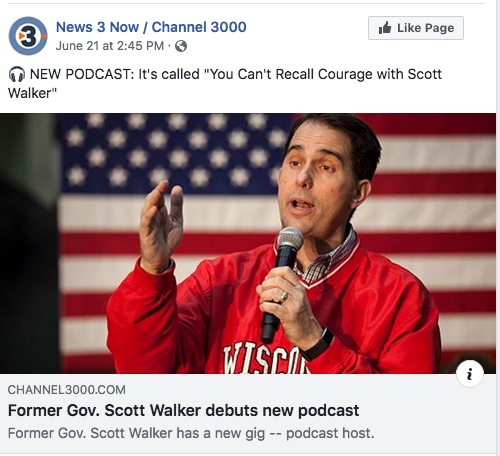
The title in the tweet showcases the problem: “You can’t recall courage with Scott Walker.” The title is a play on words, in that Walker became the first governor in U.S. history to survive a recall election. However, on a first pass, the word “recall” more likely sounds like people are trying to remember something. (“I clearly recall putting my wallet in my pocket, but now it’s missing.”) So, it sounds like we can’t remember anything about courage when it somehow relates to Scott Walker. (“I can’t recall any acts of courage on the part of Scott Walker.”) I’m sure that sits well with the former governor…
In any case, the point is that had the writers read these items aloud, we wouldn’t be debating the issue. Other similar problems happen when you get a bad headline break. In print, when you “break” a headline between columns, you create a natural pause at the end of the first line, similar to a comma. On one line, the head makes sense:
Smith, Jones dead even in polls
However, when split at the wrong spot, you get a zombie movie of sorts:
Smith, Jones dead even in polls
When this happens in print, it’s often due to layout issues and those issues can lead to some awkward headlines:
(Wow… the soccer team must be exhausted…)
Even in digital copy, this can happen (h/t Testy Copy Editors)
Here are a couple points to help you avoid these problems:
Read your stuff aloud: I often tell students to read their copy out loud, as that will help them find grammar errors, run-on sentences and structural issues. One other benefit is that if you emphasize different words in different ways while reading the copy aloud, you can see how something might not read quite right.
Watch your swaps for size: In many cases, the headline errors come when people are trying to swap out a longer word for a shorter one or (occasionally) vice versa. This is how you get things like “shot” for “chance” and similar errors.
Keep an eye on your breaks: When you have a break in a headline, regardless of platform, realize it’s going to shift the way in which the content is read. Therefore, you need to put the breaks in the right spots to avoid people hearing that two candidates are “dead… even in polls”
Beware of potentially hazardous word choices: We talked about this before when it comes to reading like a 12-year-old boy, but it’s not just the double-entendre sex-ed stuff that can get you into trouble. A headline on suburban sprawl could have a politician hoping to “retard growth.” That word, although technically accurate, has the potential for danger, as the “R-word movement” can clearly explain. All sorts of words can create danger for you, so always think, “How can this go wrong?” and you’ll save yourself some explaining and agony for sure.
Prior to this situation, we had “helicopter parents,” named for their ability to hover over every aspect of their children’s lives, who were quickly replaced by “drone parents,” who are like “helicopter parents on steroids.” A number of years back, we had “soccer moms,” stereotypical middle-America parents who used a calendar and a mini-van to help their kids engage in every possible extra-curricular activity that looked great on a college application. In resistance to all of this hovering, sweeping, plowing and mowing, the concept of “free-range parenting” became popular in the media, with publications telling tales of parents who kind of just left their kids alone for 10 seconds or more each day.
This phenomenon of naming something that doesn’t really need a name isn’t new, as any journalist who started working after 1972 can tell you. In that year, several men connected to President Richard Nixon were caught while attempting to plant listening devices in the offices of the Democratic National Committee headquarters. This led to arrests, congressional hearings, impeachment hearings and Nixon’s resignation as president. The scandal became known as “Watergate,” named as such because that was the building that housed the DNC’s offices.
It’s not clever or unique:I remembered the first three. After that, I just started randomly typing foods or sex terms into Google with the word “gate” attached and got all of these. I never missed once, so you get the idea that this concept of “-gate” naming stuff isn’t new or innovative. It’s lazy writing and a stupid idea.
The scandals aren’t that scandalous: Watergate was a scandal that went to the highest office in the land and forced a sitting president who had won re-election in a walk to resign, something that had never happened before. Tom Brady “maybe” making footballs softer isn’t in the same neighborhood as this. Hell, it’s not even on the same planet. I’m sure that your university’s decision to keep taxing feminine hygiene products is a problem and should be covered, but don’t call it “tampongate.” (Besides, not one, but two, “scandals” have already used this one.)
The -gate thing isn’t real: The reason we called the Nixonian scandal “Watergate” was because that was the name of the building. It wasn’t like he used a “gate” to try to stop “water” or something. Thus, a scandal about a bridge or a clown or whatever, shouldn’t reference a suffix that isn’t part of its original title. I’m trying to imagine if someone stole stuff out of the Watergate now and how it might be a “Watergategate” or “Watergate 2.0,” another stupid way of building a term.
When it comes to covering a topic, you want to tell people what happened that matters to them. Your job isn’t to become a lexiconnoisseur or some sort of trendsetter. All it does is make you look like you can’t do your job without being cute. In addition, it will annoy your readers as you try to make your “-gate parenting” thing happen. As Regina George famously explained, you need to stop this right now:
The nexus of his thesis is something students should keep in mind: You won’t know what you want to do until you end up running into it. That can make for some pretty high levels of anxiety for students and parents, as well as some really awkward family gatherings where random relatives feel it is their duty in life to say, “So you STILL don’t know what you’re doing yet?” instead of “Nice to see you. Pass the potatoes.”
In hopes of helping you defend your psyche from the chaotic panic and shutting down the naysayers who keep blaming your generation’s downfall on “FaceSpace and those iText things,” here are four things to keep in mind:
Everyone in college is lost and that’s just fine: At the beginning of each semester, I ask the students in each of my classes what they want to do with themselves once they get out of school. Some of them have a vague notion, half of an idea or a general sense, and that is about the BEST it gets. Only once in all my time teaching did I ever really have a kid tell me something straight-up honest and it was last semester:
Me:So what do you want to do with your IWM (Interactive Web Management) degree? Him:Make a ton of money. Me: How will that work? Him: I don’t know. I’m gonna figure that out when I graduate.
For the rest of the people in my class, it’s like this: “I want to graduate, get a job, not move into my parents’ basement and not have to answer stupid questions like this one from every relative who runs a business selling wiener dogs out of a mobile home and somehow thinks they’re better than me.” Spoiler alert: That’s the American dream of this generation.
Cunning is right, though, in that you won’t know what you want to do until you do it, which is why they force you to take a boatload of general education requirements in college: They figure you don’t know what you want, so they give you a taste of a bunch of stuff.
Instead of taking those classes with only the edict of “Please, God, not another 8 a.m. on Fridays,” look at classes that might interest you and see where they take you. That’s how you bump into things you might like to do for the rest of your life and find some direction. In the mean time, it’s not a problem to not know.
Being good at something doesn’t mean you should do it: The longest-running argument in my life is between my mom and me about what I should have done right out of college. She still believes that I would have made a great speechwriter for politicians, based on my various skill sets. I liked to write and had the ability to turn a phrase fairly easily. I did well in public speaking courses and extracurricular activities, such as debate and forensics. I worked well under pressure and could logically process information quickly. It seemed like a perfect fit for me.
Here’s the counterargument I had for mom: I hate politics.
I spent a lot of time with political figures during college, ranging from student government folks on up through the city and county leaders and found I disliked the majority of them and their attitudes. I never understood the wrangling and the gamesmanship they used to carve up their little portion of the world just a little bit finer. I also hated the arrogance and ego associated with the jobs. Why on Earth would I want to write things for people like this so they could snow under a whole bunch of voters in hopes of furthering their own petty agendas?
The point is, Mom and I were both right in some way. She was right that I had the talent and skill set to do this as a job, and I was right that I’d rather gargle with raw sewage than subject myself to that career path. Thus, the maxim outlined above.
You might have a talent, a skill or some general proclivities that push you into a realm of study or onto a career path, but keep in mind that just because you can do something, it doesn’t necessarily follow that you should. If you don’t like something, don’t put yourself in a position where you dedicate your life to it.
In this regard, Dad had the better take on this topic: Find something you like doing and you’ll never work a day in your life.
You are not a fraud, even though you will feel like one: During my doctoral program, we had a class in which every faculty member in the school could come in and discuss his or her research or offer us advice. Of all the advice I got at that point, a couple stuck with me, including this one from Dr. Stephanie Craft:
A few years into your career, you are going to look around and panic because you think that you are a fraud. You will worry that you aren’t good enough or smart enough or whatever and you figure that it’s only a matter of time before everyone else figures this out, too. You then start counting the days until the entire illusion you’ve built will shatter and you won’t know what to do.
Don’t worry. It’s not true. You are not a fraud. You will be able to push past this.
A few years ago, I read about this concept called “imposter syndrome” that essentially captures this whole notion perfectly. It happens to a lot of people and it’s not something you can necessarily dodge in advance of its arrival. When it hit me, it didn’t matter how much work I had done, how well I had done at that work or what everyone else thought about how awesome I was. All that mattered was that I figured I’d eventually get caught short and revealed as something between a carnival huckster and a guy selling snake oil out of the back of a covered wagon.
The one thing that made the difference was remembering what Dr. Craft told me and realizing her prescience on this fraud fear arriving also made it likely that she was right that I could beat it.
Your parents’ generation sucked at this, too: If your parents tell you that they knew everything when they were your age or that they had a job or that they knew their destiny, I’ve got two words for you: “Reality Bites.” This movie came out 25 years ago, or roughly around the time many of your parents were finishing up their college careers and looking around for whatever that next stage of life would provide. This movie really captured the post-collegiate zeitgeist better than almost anything else at the time, and it provides you with the perfect time capsule to look at what your parents dealt with.
If you strip away that last part, you realize that this generation didn’t know anything either, and I say that as PART OF IT. Sure, she fell in love at the end, which is pretty much what the film industry was selling at that point, but she didn’t have a job, was dead broke, had to use her father’s gas card to pay bills and there was no sense she was figuring it out. (And yes, that’s why reality really does bite.) Still, that generation eventually dug in, figured something out and managed to build a life that produced you.
Whatever they tell you about their origin story, view it through the prism of “Reality Bites” and you’ll probably be closer to reality.