Four things I learned about the mass-shootings debate after wearing a bulletproof vest for a week

TeachingVest

Nearly three years ago, I decided to live in a bulletproof vest for a week as part of a journalism project to find out about guns, fear, mass shootings and more. (Photo by T.R. Gleason)

Over the past two weeks, the country has suffered two mass shootings: A gunman killed 10 people at a King Soopers grocery store in Boulder, Colorado and another killed eight people at three spas in Atlanta, Georgia.

News coverage of these events have examined the motives, the shooters and the “next steps” elements of this in a way that has become all too common in the United States. For me to do so here would be redundant at best, so feel free to Google these incidents and read all about the various elements of these crimes.

A few years back, in the wake of several mass shootings, I decided to take on a project where I dug into things that went beyond what you read in the horse-race coverage after a mass shooting or the political grandstanding that comes with gun-related violence of this nature. Instead of going out to people we normally talk to in the wake of these events, I wanted to talk to people who had specific angles on the various facets of the issue and then just shut up and listen to them.

The project that had been rattling around in my head for three years. After one of my friends noted that her university had become a concealed-carry campus, she expressed concern about what this meant for her safety. After several colleagues weighed in on potential ways to deal with the situation, all to no avail, I made a simple suggestion:

“Wear Kevlar.”

In other words, if you couldn’t play offense, play defense. A bulletproof vest might get people talking about the issue in a different way. She didn’t go that route, but I thought it was worth taking a chance. What followed was a week of personal participation reporting, several months of reporting and eventually a six-part series I called “First-Person Target.”

Here is the link to the main site for that project and all six pieces if you are interested.

After these more recent shootings, I went back and reread what I wrote during that time and found a few minor epiphanies that I thought might be worth sharing. I wanted to note that these are only my opinions based on looking back at what I wrote back then. I wish I had better answers to the bigger questions, but here’s what little I do have:


FEAR IS A COMMON THREAD: We often talk about guns as an issue of Constitutional rights or personal freedom or safety. What we don’t talk about, but is embedded in all of these topics and more is the concept of fear.

On a basic level, we do talk about the fear of someone deciding to unleash an internal fury upon a group of unsuspecting people in a seemingly random act of violence. I doubt people who entered a spa or a grocery store earlier this month in Georgia or Colorado thought to themselves, “I’m putting myself in harm’s way by going to this place right now.”

However, once these killers opened fire, many more of us now think about how it could happen to us at any time, in any place. For most of us, the fear will eventually subside when the story is no longer leading the nightly news or filling our news feeds with updates. Then, when the next attack occurs, our fears will be stoked once again.

Beyond that, however, I found that fear is at the heart of every action or lack thereof regarding the gun issue. People who dislike armed citizens fear the havoc guns can create. People who arm themselves do so for fear of not being able to protect themselves. People who oppose legislation that would limit access to firearms fear losing rights they see as sacrosanct. People who could propose legislation to limit access to guns fear the backlash from gun owners and lobbying groups as a result of trying to move the needle.

When I tried to get this project off the ground, fear was right at the forefront. I asked the UWO police chief if he knew where I could borrow a bulletproof vest to wear. He offered me instead a dose of reality:

Vince,

I’m sure you could purchase a vest for yourself, however I do not know of any police outfitter that would loan out this type of equipment.  In fact, if you started inquiring about borrowing a vest it could cause some concern from these vendors on your motives. As you stated people have a heightened awareness because of these mass casualty events.  Sorry I couldn’t be of more help to you.

When I sought people associated with firearms to help me understand a topic I really lacked knowledge in, I found fear as well. When I asked the folks in my community for someone to talk to about sales and gun registration and so forth, they all pointed me to one person in Omro, who owned a gun shop. I reached out to him and got an initial response, but after that, all I got was silence.

In talking to other people who knew this guy, the answer was simple and common: “He’s afraid to talk about this.”

Of all the people I talked to during my project, only one really told me they acknowledged the fear that comes from all of this, and it was Tracy Everbach, the professorial colleague of mine from the University of North Texas whose initial concerns helped spawn the project:

“I don’t spend a lot of time wondering if someone in my classroom is carrying a gun anymore or thinking, ‘Are they going to pull it out and shoot you with that?’”

“It’s just a personal thing to me,” she added. “I’ve chosen not to be afraid of it. I figure I’m as likely to have that happen as a car accident or whatever. Anything can happen to anyone at any time.”


WE ARE NOT SIDES OF A COIN, BUT FACETS OF A GEM: Journalism always talks about getting “both sides” of a story, as a way of avoiding bias. If someone is pro-X, we need to find someone who is anti-X. When we do, we quote them both and we’re done.

While some stories, like those on sporting events, do follow that pattern, most stories are much more complex than that. Even more, the people behind those stories are far more complex than many of us care to know.

When I started this project, I didn’t want archetypes or the “usual suspects.” I didn’t want a press release from the head of the NRA that spoke in platitudes. I didn’t want a “thoughts and prayers” statement from a politician. I didn’t want to collect soundbites that I could repeat in my sleep and move on.

I wanted real people who could help me understand their lives and interests and positions without fear of judgment or reprisal. I wanted to look into the heart of the issue through their window and see what they saw, whether I agreed with what they were seeing or not.

What I found is that reality isn’t what we see playing out in the wake of shootings on the news or at protests or elsewhere. I didn’t find “gun people” and “anti-gun people,” but rather people that saw their lives intersect with firearms in a variety of ways and how those intersections shaped them in some fashion.

UWO police officer Chance Duenkel carries a gun every day as part of his job, and yet knows that the weapon and his protective gear might not keep him safe in certain situations. In referring to a fallen officer he knew, he explained:

“He had all the equipment, he had the experience dealing with these types of firearms and weapons calls and the cards, unfortunately, weren’t in his favor.”

Nate Nelson, who trains people how to use firearms safely and is an avid hunter, carries a gun as well. He knows better than most the importance of training, safety and respect for weapons of this kind as well as the ramifications of choosing to carry one:

“If you draw that gun you’re probably going to spend six figures in legal defense,” he said. “People need to take that portion seriously on top of the fact of you might end up taking somebody’s life and it might be the assailant that’s bothering you or it might be somebody else that’s innocent because of where those bullets go beyond that.”

Joseph Peterson, a professor at UWO, owns a gun and works with the FBI to help people better understand mass shootings. Peterson was wounded when a gunman entered his classroom at Northern Illinois University in 2008 and opened fire. The shooter killed six and wounded 17 more.

Peterson spent time  learning a great deal about guns and what he refers to as “gun culture,” and found both the fallacies associated with the law and the nuanced nature of people with whom he interacted:

“Gun laws don’t prevent anything,” he said. “Absolutely. Laws don’t prevent anything. It’s that most people agree with them and people agree not to break them. Safety comes from having more good people than bad people.”

<SNIP>

“I think I’ve been in this kind of journey that I’ve been trying to put myself through on this,” he added. “In learning more about gun culture, learning more about firearms and learning to appreciate them for what they are, demystified a bit, I’m learning that there is a lot more middle ground covered. It’s the extreme views that muddy these waters and that’s what’s keeping things from getting done.”


LISTENING VERSUS WAITING TO TALK: During one interview, a source (I can’t remember who said it) stopping abruptly to tell me that they found themselves talking way more than they ever have on the topic. The reason, the person explained, was that I hadn’t said almost anything during the interview.

A similar thing happened when I was talking to Nate Nelson. At one point, about a half hour in, he asked, “Are you getting what you wanted from this?”

My answer was honest: “I really didn’t have anything I wanted to get. I just wanted to listen.”

In many cases, we know what we “want to get” from a source. We have questions that need answers and quotes that need to be gathered. I have done it dozens of times, asking the “How do you feel about X?” question to get the “I’m proud, happy and thrilled” answer. I don’t say this with any great level of pride in my reporting acumen, but rather to explain that experienced reporters and experienced sources know how to do the dance.

In this case, I went the completely opposite way. I had questions, sure, but they were more of a “Tell me a story” variety than a “Give me an answer” form. I also came in with as much of a blank slate as I possibly could. My goal wasn’t to poke back at people, but rather just hear what they wanted to tell me. Could they have been blowing smoke up my rear end? Sure, but that goes back to the earlier point about whom I chose and whom I avoided.

In several interviews, I got the sense that the people with whom I spoke weren’t used to people who listened. They were used to people who were waiting to talk.

I understand that passions can be loud and strong around life-and-death issues and that not everyone had the luxury I had in trying to just sit back and let information envelop me. However, when we aren’t listening, we are simply waiting to tell the other people why they’re wrong, and that’s not going to get us anywhere anyway.

In listening, I got to hear important points that made a lot of sense:

  • If people are going to say that mental health concerns are more to blame than guns for mass shootings, they need to be willing to put forth the money, research and resources to deal with that. They also need to be willing to look beyond that issue if this issue becomes a definitive red herring in the issue of mass shootings.
  • We’re often looking at the wrong thing when it comes to guns and death. Although the mass shootings draw the most attention and an ever-increasing body count continues to work people into a media frenzy, guns do far more damage in far less public ways. Gun statistics demonstrate that more than half of the gun deaths in the United States are suicides. Homicides account for another third of those deaths, with the majority of the deaths coming at the hands of people who knew their attackers, as in the case of domestic violence. Less than one-fifth of one percent of the gun deaths in the U.S. come from mass shootings.
  • People who don’t know a lot about guns actually talk the most about guns. Joe Peterson mentioned in an interview that shortly after the NIU shooting, he found himself talking a lot about the topic of guns and mass shootings while knowing much about either. He then did the academic thing and really researched the topic like a scholar would: Open the aperture on the lens, see the full picture and come to some provable conclusions. Nate Nelson mentioned that people get freaked out by the AR-15 because of its look and misunderstandings about the reason the gun is preferred in some legitimate circles. He noted the light weight and limited recoil make it valuable for hunters like his son. I also dug around after our interview to find that he was right about its role in mass shootings: Most mass shootings were committed with weapons OTHER than an AR-15. (For example the shooter at Virginia Tech killed 32 people with a pair of handguns. The shooter at NIU employed a shotgun and a handgun as well.) However, if all you see are social media posts, memes and news clips, you might be left with the impression that banning the AR-15 would solve all of our shooting problems.

I figured out a lot more along the way as well and I find myself pushing back at a lot of things I might have otherwise accepted as gospel before this project. I also figured out that I can understand a lot of things people believe without completely agreeing with them, and vice versa.

WE SUSTAIN MENTAL SCARS THAT NEVER COMPLETELY FADE: Of all the things I heard in doing this project, the one that stuck with me the most came from Chase Cook, a reporter at the Annapolis Capital Gazette. In 2018, a man with a long-standing feud against the paper came to the newsroom armed with a shotgun. He killed six of Cook’s colleagues.

Cook was off that day, but upon hearing of the attack, he went to the office where he began to report on the events of the day. The work of Cook and the fellow survivors earned national honors and praise, including a spot as Time’s “People of the Year.”

As the incident faded from the collective consciousness, Cook continued to deal with the aftermath of his experiences.

“I have a hard time in movie theaters now,” he said. “I get anxious when the lights go out, which is a bummer because I love going to the movies. I think about it a lot when I’m in really crowded places… That fear factor has kind of permeated through everything. I’m at work, I’m in danger. I’m at school, I’m in danger. I’m at church, I’m in danger. I have to convince myself that I’m not because while mass shootings are a problem in the country and they’re up, they’re still a rare crime.”

I haven’t spoken to Cook for at least a year now, but I often think about him when a shooting occurs. I wonder if he reads the news coverage. I wonder if he’s been able to enjoy movies again. I wonder if he is OK.

In talking to Kelly Furnas, the former adviser of the Collegiate Times at Virginia Tech, I found he also had residual mental scars after dealing with a mass shooting. He mentioned to me simple things, like noticing how certain door handles were replaced because the campus shooter had chained the doors of a building to prevent escape. He mentioned trying to be more aware of certain things but not letting fear dominate his life.

As a newshound of sorts, however, he also found difficulty when it came to reading about each subsequent shooting that occurred in the U.S.:

“Quite frankly when I hear about a mass shooting I read the headline and I mention it to my wife and that’s about it,” he added. “That’s about all I can handle at this point. It’s obviously overwhelmingly sad and it’s frustrating and it makes you angry and upset but it’s also just like not where my energy can be. I think every single time that happens I think back to my students and what they went through and maybe that’s part of it.”

Joe Peterson, who was wounded in a mass shooting, talked about therapy and life changes and other major issues he dealt with. He also discussed minor things like seeking out exits in movie theaters and not being able to sit with his back to the door at a restaurant for a long time. In explaining his experiences, he told me that a lot of those personal difficulties were shared among people who had gone through situations like he had:

“With every one of these tragedies there are more and more survivors,” he said. “We are all members of a club we don’t want to be a member of and we don’t want any more members in it.”

If there was a single thing I think everyone I spoke with would agree on, it would be that.
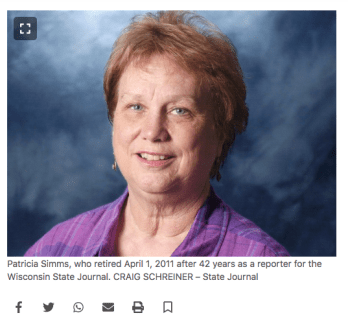
I love Pat Simms, and I’d like to ask all of you to love her, too

Trying to tell a story about Pat Simms is like trying to paint a portrait of Leonardo da Vinci: You are working in the master’s medium, the master is awe inspiring and you’ll never perform half as well as they would.

Here’s a screen capture of Craig Schreiner’s photo of Pat that ran when she retired a decade ago. I tried desperately to find a different image, but I hope my former colleagues at the State Journal won’t come after me for a copyright violation.

For 42 years, she broke barrier after barrier at the Wisconsin State Journal, as she put the fear of God in her sources and told her audience what they needed to know most. She was constantly ahead of the curve, becoming one of the first women in the newsroom and definitely the first one who got maternity leave. She was a coiled steel spring who would hold her own against the men who wondered why she was “allowed” in what had previously been an all-boys club. She could also bring the heat at sources who thought they could pat her on the head and send her on her way with a fluffy soundbite.

The legendary newsroom story about Pat is of her strapping on a gas mask to cover the Vietnam War protests at UW-Madison at the beginning her career at the paper. At the end of it, she was covering the Act 10 protests at the State Capitol. In between, she was a reader’s dream and a weaselly source’s nightmare.

This week, I got a message from a friend that almost stopped my heart:

“Pat Simms is in hospice with uterine cancer. We all thought she could beat it with chemo. It spread. I am sad beyond words.”

Her daughter reached out to her former colleagues at the paper with this message:

We would like you to inform fellow journalists about my mom’s condition at this time.
In January my mom was diagnosed with uterine cancer. We were optimistic that with chemotherapy it would be treatable. Unfortunately we have received some bad news.
New scans were done and the cancer has now spread to her lungs. We need to stop the chemo because her body can’t take it. And we can’t do radiation because you can’t radiate the whole lungs. So we are now focusing on quality of life. We are going to get a second opinion so we will see what they say. But for now we are preparing for living out her days at home with calm and as comfortable as possible.
They have given her about 6 months.

When I was at the State Journal in mid-1990s, the desk I shared with the day-shift GA reporter was right next to Pat’s. Our computers faced each other and consisted of old ugly hard drives and giant beige monitors that were so tall you couldn’t see the person across from you. Still, I could hear every conversation Pat had, as her phone was constantly ringing with tips, scoops and “guess-what-I-heard” insights.

At that time, she was writing her “Snoop” column, which served as a mix of Page Six style gossip and a floodlight of attention she shone on area hypocrisy. In my mind’s eye, I can still see the mug shot that ran with each column: She had her chin resting on her hand and her eyes sparkled with an “I-know-something-you-don’t-know” look.

The sheer volume of people who called her in a day would be enough to stop a speeding 18-wheeler in its tracks. People from all over the place called in to tip her about some shady deal, some hushed-up arrest or some bizarre tale. It was every day, all day that she took call after call and listened to these people, some of whom I’m absolutely certain were just bat-shit nuts.

Somehow, she was able to parse fact from crap, truth from political hatchetry and interesting content from inside baseball. How she was able to fact check all of those insane stories people shared with her was beyond me.

Whenever I thought I had gotten an exclusive tip on something and I was explaining it to an editor, the answer was almost always, “Oh, yeah. That ran in Snoop on (fill in the day).” It got to the point where I read Pat’s column first every day so I would stop looking like an idiot by pitching old news. On the extremely rare occasion where I did have something she hadn’t heard, her head would pop up like a Whack-A-Mole over the top of those computer monitors and she’d be asking questions of me, trying to figure out what I knew and how she hadn’t heard it first.

When I left the paper to head off to Mizzou, Pat congratulated me, but went out of her way to remind me that her alma mater, Northwestern, was the best J-school in the country. If it produced journalists like Pat, it was really hard to disagree.

The last time I saw Pat was a little more than two years ago. Out of the clear blue sky, I got an email from her that simply read: “I just decided to use your book as the textbook for my Fall Introduction to Journalism class. How about that?”

In her “retirement” she had taken on a job as a journalism professor at Edgewood College in Madison, where she had also started advising student media. She told me she’d been reading the blog and that’s why she picked my book. She asked if I was going to be at the state media convention and if we could talk about the book and her class.

When we met up, she grilled me like I was a source. It was all “How does this work?” and “So, why would I include this in the syllabus?” and “Wait, that doesn’t make sense. Explain it again.”

It was incredible to me because I wanted to say, “You’re Pat FRICKIN’ Simms. The kids in your class are going to pick up about 50 IQ points by just being near you. The hell do you need me for?”

Still, there she was, seven years into retirement, 50 years into her journalism career, trying something new. She was bound and determined to learn how best to ply her trade.  She was going to make absolutely certain that she did it right and that she left no stone unturned in making that happen.

Pat’s daughter asked people to share stories about Pat to buoy her spirit. The stories I have pale in comparison to those of people who knew her longer and better, but in the few years I spent with my computer terminal butted against hers at the State Journal, she made a profound impact on me. Here are two memories that still stick with me:

“THEY’RE YOUR STORIES. GO DO THEM.”

I worked nights and weekends at the paper. During the nights, we had a consistent crew of me from 6 p.m. and 2 a.m., a specific swing-shift reporter from 3 p.m. to 11 p.m. and the night city editor from godknowswhen to godknowswhen. Weekends were a different story, in that I was always there on Sundays from 10 to 6, but the reporter and the editor were always changing, based on who got stuck taking a reporting turn that day.

One Sunday, I got a call from someone who complained that there were recruiting pamphlets for the Ku Klux Klan in a free newspaper rack outside of a local grocery store. I was ready to rush out there when I got another call from someone telling me that a tagger or group of taggers had basically destroyed the side of a Walgreens on campus with spray paint.

I went to the grocery store, got the last two copies of the Klan brochures and interviewed the store manager. I then stopped outside of the Walgreens to take some notes when a kid in a trench coat stopped and asked me, “Do you like that stuff?”

I told him I didn’t have an opinion one way or the other, but I wanted to know more about it. He then opened up his coat and showed me a couple cans of spray paint stuffed into his inside pockets.

I interviewed the tagger kid, who gave me some great stuff and I got back to the newsroom just in time to catch a call from the editor who was coming in later that day. He asked me if anything was going on and I told him all about the two stories I had.

“OK, Simms is coming in about an hour from now,” he told me. “Give her the pick of those two stories and you do the other one.”

My heart sank, as I was wondering which one she was going to pick. They were both REALLY good stories and I knew they would be byline-worthy. No matter which one she got, Pat’s story was going to be amazing and way better than what I could have done.

Pat showed up about a half hour later in a rush, as usual. She was unloading her purse and coat at her desk when I told her about the two stories and how she was supposed to pick one of them.

“You do them both,” she said. “Ralph Hanson died and I need to do an obit.”

Hanson was the former police chief at UW-Madison, who ran the department during the 1960s and 1970s. He was famously involved in the Dow protest in 1967 and the Black Student Strike of 1969.

Pat had gotten a tip (as she always did) and was pulling sources from her files to write his obituary. Still, Pat could have written that piece, my two pieces and probably another story during her shift and done it without breaking a sweat.

“But the editor said-” I began.

“They’re YOUR stories,” she told me. “Go do them. I’ll tell (the editor) when he gets here what’s going on.”

The KKK story made the top of the front page and led every newscast the next day. The tagging story was on the local section’s front cover. Both had my bylines. It was the greatest day I’d ever had as a professional writer.

One thing that I still treasure about that day was how Pat treated me as an equal. She was quite literally doing professional journalism before I was born, and yet in her way of thinking, we were just two reporters in a newsroom, banging out stories and waiting for an editor to show up. The way she saw it, I caught the story, I did the work and I should keep going on it.

The other thing, however, was that she had a sense as to how much this really mattered to me. I was 21, had less than a year in at the paper and barely got any bylines. Pat’s byline file was crammed with so much great stuff, that I doubt she would even remember either of these two stories. For me, it was the kind of thing that would have me buying a dozen extra copies of the paper to send to my parents and grandparents.

To not only give me ownership of those stories, but to “tell the editor” that they were my stories (a concept for me that, at the time, was like trying to set God straight about a few things) showed me something important: It was possible to be the big dog while not making someone else feel like the runt of the litter.

Ever since that day, I always looked for the opportunity to do that for someone else, which is probably why I ended up in education. I wanted to aid in those moments that made someone desperate to pick up a phone and call home to say, “The best thing just happened!”


“WE’RE GOING OUT.”

I had broken off my engagement with a city council rep, something that was awkward personally and professionally. Given that I had to tell my employers we were in a relationship, I now had to tell them we were no longer an item. It was a messy situation and I wasn’t handling things really well.

Around that time, Pat was going through some personal turmoil as well. We were bantering over our life misfortunes when she got out of her chair and poked her head over the top of our computer monitors.

“Are you on the desk Saturday night?” she asked.

“No,” I said. “Why?”

“We’re going out.”

She said she had four tickets for a comedy club opening and she’d given two of them to a couple of her friends. She wanted me to go with her because “you need a laugh.”

We got to this club and a few things became clear.

First, everyone, and I mean EVERYONE, knew Pat. It was like going somewhere with the pope.

People were coming up to her from every direction to tell her something or ask her something. The club owner told her the club area wouldn’t open for a few more minutes, but she could wait in this little area to the side so she wouldn’t be bothered. Pat refused, staying right in the middle of the action and talking to anyone who came within shouting distance.

Second, she had some serious pull. We got escorted to this table that is up front and slightly left of center. A friend of mine later explained that this was the best table in a club, because they usually seated VIPs there. Comedians were told not to bother these people with their shtick. Thus, while some poor guy from Baraboo was being berated for living “in that city with the (expletive) clowns” and the bride in a bachelorette party got ripped on for using a “penis sipper cup,” we remained unscathed.

Also, when Pat’s “friends” arrived with the other two tickets, it turned out to be our congressman and his wife. Looking at that table, I felt like the answer to a game of “Which one of these is not like the other?”

At the end of the night, where I laughed until I hurt,  the congressman picked up the check for us. Pat and I walked out together, reliving some of the better bits from the comics as people were still trying to get a moment of her time. I got to feel like a big shot for a moment simply by being in Pat’s general vicinity.

Pat was probably the most perceptive reporter I’ve ever been near, but that night she made clear she also was an extremely perceptive human being with wide streak of humanity and empathy to match. She could have asked a hundred other people to take that ticket or just decided to give the pair away and stay home that night. Instead, she used it in a way that still resonates for me.

She saw I was broken and she took the opportunity to salve my soul.

—

Contrary to what you might believe based on the word count, I had trouble trying to write this. My memories and stories with Pat happened years or decades ago, but to refer to her in a past tense felt almost shameful to me.

Pat isn’t a “was.” She is an “is.” And no matter what happens going forward, she will continue to be one.

That’s what happens when you spend your life making things better for people through your work, your craft and your sheer force of will. The lives Pat continues to influence are like seeds planted in premium soil, growing strong because of her. I know that, because I like to think I’m one of them.

It’s never too late to tell people how much they matter, so that’s what I’ve tried to do here. I’ve flailed about a bit and probably overwritten in spots because Pat matters so much more than my skills can accurately explain.

As I said, it’s really hard working in the master’s craft.

But I hope Pat knows I love her dearly and will be thinking of her always.

Unforgettable Indiscretions: Student newspapers and requests for deleting old stories in the wake of the Boston Globe’s Fresh Start Initiative

In the 15 years or so I advised student newspapers, the most popular feature we produced was the police blotter.

At the Ball State Daily News, the listings appeared under the “Police Beat” title, while UWO’s Advance-Titan went with the more accusatory name of “BUSTED!” In both places, a reporter would go to the campus police station once a week and collect a litany of small crime items that weren’t worth a huge story, but likely held some level of interest to folks.

We tended to have a lot of underage drinking tickets, public intoxication arrests, drug busts and similar consumption concerns. Occasionally, we would end up with a fight, a verbal altercation or a case of vandalism. Anything more serious than that tended to be highlighted and relayed to us by the police department in the form of an alert or a press release.

(The one “BUSTED!” item that sticks in my mind all these years later happened the year before I started advising the paper. A male student and a female student were caught having sex behind the giant concrete UW-Oshkosh sign near the main thoroughfare of campus. When the police “stepped in,” the male begged the cop not to write a report or issue a citation, because then his sexual indiscretion would end up in “BUSTED!” and his girlfriend would find out about it…)

Although these features were popular among our general readers, we found them to be less popular among the people whose names ended up in them. In many cases, we received requests to not publish a particular person’s legal infraction or to remove the reports of them that we had previously printed. At one point, the requests became so popular that the Daily News put the phrase “It’s not our fault you ended up in Police Beat” on the back of the staff T-shirts.

The standing response was that we don’t edit our archives or try to change history. If it happened and we wrote it, it stays put.

Those papers I advised weren’t the only ones to hold that line, as many of student media outlets have policies like this one from the newspaper at Northwest Missouri State University, where my buddy Steve Chappell serves as the adviser:

The Northwest Missourian never knowingly publishes inaccuracies. If any error is found, The Northwest Missourian is obligated to correct the error as soon as possible, regardless of the source of the error. A consistent location, signature and style for corrections and clarifications is recommended.
The Northwest Missourian does not remove any editorial content from its website. However, if there is a factual inaccuracy in a story, the editors will run a correction or an update as needed. When a person calls in question of a fact published they should never be guaranteed a correction will run. A section editor must first confirm that the fact in question is an inaccuracy.

In a lot of ways, this can make sense. The hard-line approach prevents staffers from having to pick and choose among which things are worthy or unworthy of “scrubbing” from an archive. The requirement of factual accuracy being at issue makes it clear that someone being embarrassed or upset over accurate coverage isn’t going to cut it in terms of a correction or retraction.

What seems like a simple cut-and-dried approach to archived indiscretion became more complicated recently when the Boston Globe decided to give people a chance to get a pass on their past. The “Fresh Start Initiative” allows people to request a review of previously published content about them for updates, removal or other reconsideration:

Similar to “right to forget” programs that have cropped up in a number of newsrooms across the country, the undertaking is meant to address the lasting impact that stories about past embarrassments, mistakes,or minor crimes, forever online and searchable, can have on a person’s life.

“It was never our intent to have a short and relatively inconsequential Globe story affect the futures of the ordinary people who might be the subjects,” said Brian McGrory, editor of The Boston Globe. “Our sense, given the criminal justice system, is that this has had a disproportionate impact on people of color. The idea behind the program is to start addressing it.”

Truth be told, student newsrooms have been talking about these concerns for years and have had policies that support whatever position they took. To get a better grip on what student media outlets were doing regarding “take-down requests” and their thoughts on them based upon what the Globe had done, I posed the question on the College Media Advisers listserv.

In many cases, folks explained they had a pretty solid and long-running policy on how they viewed their content. The policy at The Temple News, for example, offers authority to any given editor-in-chief to remove or retain content, but it notes that published content, regardless of format, is seen as part of the “historical record.”

Others, like the Elon News Network at Elon University, provide a pathway to content removal and a process to petition the organization:

ENN has created a review board of organization leaders and faculty advisers to review content that has been petitioned to have content changed. The board will meet at least once a semester to review all requests.

The content removal petition form is available online, and should meet the following requirements:

  • The petition must be filed by the person directly involved, and not be made on behalf of an individual.

  • Three years must have passed from the content’s publication.

  • The form below must be filled out and submitted. Any relevant documents that the review board should be made aware of should be submitted in the form. The review board will not take into consideration any documents submitted after the board has met.

One adviser noted that her students were looking at revising the policy, given the ubiquity of the internet. The line of “Nothing ever truly disappears on the internet” is more true now than ever before. It used to be that a web page could be abandoned and it would fall so far off the beaten path, nobody would find it. Even more, I know at least one student paper where I worked lost a ton of archives when it switched providers.

Today? That stuff would be easy to find and accessible with about two clicks and a simple search term.

(Another interesting angle someone brought up was the way in which efforts to preserve the past are now opening up more windows to older embarrassing incidents. When libraries or media outlets decide to digitize past issues and make them searchable, suddenly that arrest for drinking and driving that your step-dad swears never happened is at your fingertips, complete with his bad 1970s feathered-hair mug shot.)

The question of how to do this is often more concerned with what are the ramifications for doing this at all. In a listserv discussion on this topic, the director of publications at Western Kentucky mentioned a concern I often had in regard to this situation:

The attorney who represents the College Heights Herald and the Talisman has pretty consistently given the advice that you open a Pandora’s Box by granting a takedown request. If you later turn a request down, then you could be subject to being found arbitrary if the matter went to court.

It will be interesting to see if litigation emerges from what The Boston Globe is doing. For the time being, I still favor the “you can’t rewrite history” mantra, with offering to update the story to reflect how it turned out – but with documentation.

As for most legal things, I turn to the Student Press Law Center, which has a giant list of things to consider and processes to follow in this regard. The explanation of how the law works and why it works that way makes a lot of sense. It also outlines the potential legal potholes you might hit along the road.  One other thing SPLC touches on in this write up is the way in which the law and ethics can diverge.

In other words, just because you “can” do something, it doesn’t follow that you “should” do something, and that involves both publishing and removing content. In the case of removing content, the law might say you are on firm ground leaving up the story about the freshman who was arrested after police found him asleep, naked in a tree. However, that kid is now a 30-year-old local minister who has done a world of good, but for some reason, Google’s algorithm keeps putting that at the top of any search of his name. Is it “right” to keep that at the forefront of any discussion of this guy?

To that end, was it “right” to publish it in the first place, even though the law said you could? When it was a day-long or week-long embarrassment that probably won’t make it beyond the campus confines, publishing the content might not seem like that big of a deal. However, if you knew something would follow this person their entire lives and nothing they did could ever scrub it off, would you think twice before publishing something about a drunk freshman peeing in a campus parking lot after a house party?

I don’t know exactly how to split that hair, but an adviser who has worked with me to make the reporting book much better explained his approach in fantastic fashion:

This is the reason I strongly encourage our editors not to pursue stories focusing on minor “crime” stories, things involving drugs and alcohol and general college-aged stupidity. College is a time in a person’s life when they should explore and experiment. And they should not have to live with the punishment of such misdeeds for the rest of their lives. Good gosh, if Google was a thing when I was in college …

I usually err on the side of the person over any notion of journalism ethics.

Human first. Journalist second.

3 teachable moments in the “Antifa dressed as Trump supporters” photo caption failure

On Jan. 8, conspiracy theorists reading the Tyler Morning Telegraph in Texas probably thought they had their deepest Deep-State suspicions confirmed about the melee at the U.S. Capitol that week.

According to a photo caption that accompanied an AP picture of rioters scaling walls outside the building, “Members of antifa dressed as supporters of President Donald Trump climb the west wall of the U.S. Capitol on Wednesday in Washington.”

Clearly, that wasn’t the case and it wasn’t what the paper would have printed if it had a “do over.” As the readers of the Telegraph deluged the paper with questions, concerns and outrage, the journalists there scrambled to figure out what had happened. The paper’s regional editor finally tried to stanch the bleeding with a declarative tweet:

“It was not done by editorial staff. That is not the correct cutline and we are addressing it.”

In other words, “Look, we have no damned idea what this is, either, but we’re not thrilled about it, so back off until we figure out how the hell this happened and if we need to fire someone.”

On Inauguration Day, the paper published an editorial that outlined what happened, how it happened and what happens next. Of all the revelations the paper put forth, here was the least shocking one to me:

How did this happen? To the best of our belief, it was a joke taken literally. We found that no staff member acted in a malicious manner to deliberately put misinformation in your paper. Instead, what we found was a misguided and misunderstood joke put on the page when it should not have been.

The moment this caption started making the rounds in journalism circles, I gladly would have bet my HOUSE on the fact that this would all trace back to one chucklehead thinking they were funny and nobody in the newsroom noticing until everyone else on Earth started to notice it.

This isn’t the first time this has happened, nor will it be the last. I have a manila file folder or three just THICK with screw ups like this, where someone punched down something in a hurry or with a taint of dark humor or both, and it found its way to the general public. The one that still makes the rounds in many journalism classes is the “Inexperience Faces Green Wave Soccer” debacle that we detailed on the blog a while back.

However, to help you learn how best to avoid being the next in the never-ending parade of cautionary journalism tales, consider these three pieces of advice:

IF YOU DON’T WANT IT TO SEE THE LIGHT OF DAY, DON’T TYPE IT: The rule in broadcast is that you treat every mic like it’s a hot (or live) mic, so you don’t accidentally start cussing on air. In most print/web media outlets the rule is to never type anything you wouldn’t want the world to see. It’s a basic rule that we tell ourselves and each other multiple times over the course of our newsroom lives and yet, for some reason, we STILL don’t listen.

Part of this is that journalists tend to think they’re funny, and to other journalists, they really tend to be. However, our audience rarely shared the “mortician’s humor” that we espouse. This is why writing a caption that includes a phrase like “Beth Jones, whose probably going to screw us over and die before this photo runs, celebrates her record-setting 103rd birthday Thursday during a party for her at the Shady Pines Assisted Living Center in Weyauwega.” isn’t going to be in our best interest, even if we’re just joking for newsroom eyes only.

Perhaps the greatest, and maybe entirely apocryphal, story of a joke gone wrong that either did or didn’t see print was one I’ve been looking for my whole life. The story I’ve heard was that an Ohio-based paper either nearly ran or short-printed a paper with a brief at the bottom of a local-section rail that had the headline: “Easter Services Cancelled.”

The body copy was one line: “They found the body.”

Another part of it is that we use humor as a coping mechanism. Between the low pay, long hours and general insanity we cover every day, it’s a miracle we’re not more damaged than we are. Somewhere between deciding if we should use active voice in describing a massive interstate pile up and answering the 194th phone call of the night where we have to explain that, no, it’s not a conspiracy that the “TV section” wasn’t in your paper this week, people crack.

They also crack when they’re trying to make a headline fit in an impossible hole or cram 20 inches of copy in a 5-inch hole. Thus, a quick note of “Cut the shit out of this dumbass councilman’s quote” sent back to the reporter or a filler headline of “Woman’s vagina outperforms clown car” on news feature about a family of 20 kids  seems like a good idea a the time until it shows up in black and white the next day.

The lesson here is a simple and yet seemingly impossible one: If you don’t want to get in trouble for doing something purposefully stupid, don’t do that purposefully stupid thing.

BEWARE OF TWO INCHES OF WATER: Wayne State University professor and copy desk legend Fred Vultee was fond of the saying, “You can drown just as easily in two inches of water as you can in the Pacific Ocean.” His point was that errors, libel and general stupidity could just as easily occur in the smallest piece of copy as it can in the largest one.

What I have found in collecting stupid mistakes over the years is that this mantra holds water. (Sorry… I had to…)

Rarely was it the sprawling investigative story that accused powerful people of unspeakable acts that led to the worst problems. It was usually the relatively innocuous brief, the simple caption or the run-of-the-mill meeting story that created massive uproar.

The “Green Wave” story is just one of the many where someone inserted a fake lead or a side-glance comment. I have photo captions that note “this lady might be dead so we might want to crop her out” as well as a photo of a basketball team that refers to an unknown player as “Some Fucker.”

This is why it’s important to avoid screwing around with small copy and to also read ALL copy with the same level of concern. The first part is easy to manage while the second part can feel almost impossible much of the time.

I know that when it came to a story we ran accusing a student of trying to make ricin, everyone in the newsroom went through that story like our lives depended on it. That photo caption about the Environmental Club’s recruitment drive? Not so much.

Still, knowing the most damage can occur in the smallest places with the least amount of obvious concern should motivate all of us to dig in a little harder on these things.

TRUST IS HARD TO BUILD, BUT EASY TO DESTROY: The only real currency we have as journalists is our credibility. We use it to buy trust from our readers. It takes years to build up that accumulation of credibility and it must be used judiciously because it’s precious and once it’s spent, we might not get any more.

I don’t know how trusted the Telegraph was before this incident, but it essentially blew through whatever stash it had and went into debt on this one. And, for what?

The paper’s editorial outlines a series of safety valves that it either put into place or reinforced in the wake of this disaster-bacle. It also provided a great amount of transparency in explaining EXACTLY what happened in awkwardly painstaking detail for its readers. This was an attempt to start rebuilding its credit at the bank of trust.

It also implored its readership to hang in there and not judge the whole product and its entire history on the basis of one really dumb thing. Unfortunately, that might not be very easy, given that we tend to remember people, places and things based on the best or worst thing they’ve done.

It’s why if you ask any football fan what they know about David Tyree, they’re going to say “Helmet Catch,” while the name Jackie Smith will have them saying, “Bless his heart, he’s got to be the sickest man in America.” That said, Jackie Smith is a Hall-of-Fame tight end, while Tyree played 83 total games in an undistinguished six-year career. The best or the worst thing usually sticks.

It’s unclear to what degree the paper will be able to recover, but the fact that it HAS TO do so and because of something THIS DUMB is what really makes this situation sad. If nothing else, it’s a good reminder that we need to treat the public’s trust in our work with true appreciation each time we ply our trade.

Happy Birthday, Mom: Four things my mother taught me that might help you, too

Back when we didn’t have to socially distance, Mom and I caught a Paul McCartney concert that was absolutely amazing.

(Editor’s Note: I do my best to follow the 70-20-10 rule for social media, in which only 10 percent is about some form of self-promotion. Today is one of those 10 percent days, so feel free to skip it if you feel I’ve already used up your willingness to tolerate me in promotion mode.

Also, if this or anything else I’ve ever done has helped you in any way, please feel free to wish my mom a happy birthday in the comments section. I’m sure it would be appreciated. -VFF)


Six months ago, I had to find a way to celebrate my dad’s birthday virtually, thanks in large part to the emerging pandemic and the fear associated with climbing case numbers in Wisconsin.

No way, I thought at the time, this is going to impact Mom’s birthday in November. I wasn’t optimistic enough to assume we’d have a cure by then, but I figured we’d have some sort of control over this thing, mitigating its spread or at least keeping the numbers low.

This is why I don’t get paid to prognosticate.

Numbers are skyrocketing, especially here in Wisconsin and ICU beds are packed to the gills. It also seems like the disease keeps getting closer and closer to us, with more people at Amy’s work testing positive and various family and friends either testing positive or locking down thanks to close contact.

The governor of our state is essentially telling people, “Stay the hell home as much as you can. And if you want to see your family for Thanksgiving, buy a Swanson’s Hungry Man turkey platter and hook up a Zoom call.”

The same 100 miles of I-41 separate me from my folks that did back in March, although it now seems so much longer and bleaker. I held on to Mom’s birthday card until this weekend, planning to sneak down there and throw it to her from a six-foot distance across a frozen backyard. Then, I got a text from Amy saying ANOTHER person she was in contact with tested positive.

I put the card in the mail the next day.

In what is a rather perverse irony, as much as I miss my mother and I know Mom wants to see me, the ability to persist through this giant crap taco known as 2020 was instilled deeply in me by my mother over a lifetime of love and lessons.

So, without further ado, here are four things my mother taught me in life that might be helpful to you, too, as you try to hang in there for as long as it takes:


You’re tougher than you think you are, so pick yourself up and get back to work: The kitchen table in every house I ever occupied served as an important place for the family. It was where we ate, sure, but it was where we had family discussions, where we paid the bills, where we did our homework, where we worked through important business and where we just talked out whatever needed to be talked out.

When I was in college, I would come home on a Friday and sit at the table  and talk to my mom about whatever was kicking my ass that day, week or month. Mom would have the ironing board propped up and she’d be plowing through a massive pile of wrinkled laundry as she listened to whatever was happening.

She didn’t always understand exactly why I was so upset about something or why I thought the way I did about the problem at hand. (Truth be told, I was probably being way more of a drama queen than whatever I was complaining about required me to be…) Still, she listened and asked questions and poked back when I went too far into the “woe is me” realm of self-pity.

In each discussion, I found that Mom somehow helped me realize that the problem I brought wasn’t insurmountable or that the impossible task could be done if I’d just work through it. She always told me she loved me, but she never blew sunshine up my keester. She gave me practical advice, helped me see things in a way I hadn’t and set me back on the path I needed to walk.

In short, she told me, “You’re not beaten. Get up. You are tougher than you think you are.”

And she was always right. And still is.


Use your gifts to help others as often as possible: Each year of her 45-year teaching career, it seemed, Mom would go back to her school and there would be at least one new teacher who looked as lost as a kid who got separated from their parents during Black Friday at Walmart. In the “teams” and “partners” that the schools used over the years to group the faculty, Mom constantly found herself paired with someone that had about six months of student teaching under their belt and a terrified look on their face.

It would have been so easy for her to have a “Crash Davis grouse session” each time she got paired with a newbie and had to start all over again, explaining everything from the location of the teachers lounge through to how to instill classroom discipline among a throng of hormonally challenged pre-teens. Instead, she found a way to get the best out of these people, giving them ample access to her materials, her lessons and, above all else, her experience.

Mom had a gift for being there for other people in the exact way they need it. It’s something that I always wanted to do, but it’s still something I’ve yet to master. In watching Mom operate, I realized this is part skill, part art and part gift.

What I have been able to do, however, is mimic her giving spirit in this area. When the pandemic hit, I had friends and colleagues in a panic over what to do or how to handle assignments, so I stopped everything I was doing to throw together the Corona Hotline page for journalism instructors. The fact that other people were struggling and I had a line on how to fix those struggles meant it was my responsibility to do something to help them. It’s also the reason I volunteer to critique newspapers, visit classrooms, speak at conventions and more.

If I could help someone, especially because I’d been lucky enough to have a gift that made it possible, well, I better damned well do it. That’s how I was raised.


Don’t let others dictate the terms of your life: If others were allowed to set the parameters of how my mother’s life were to play out, she would have been a wonderful housewife who would have raised a kid in a duplex and maybe seen a few of our 50 states while visiting random family members during the summers.

Even that might have been a bit much. The legendary family story had Mom and Dad explaining to my mother’s parents that they wanted to get married, only to be told, “You can’t right now. We need to buy new furniture.”

Instead, she spent 45 years teaching literal generations of kids in Cudahy, Wisconsin, having earned a college education  during the early years of her marriage to my father. She wanted a college degree, so she fought for it. She wanted to teach, so she made it happen.

She has visited Canada, Mexico, Germany, Greece, Italy, England, France, Singapore and probably a dozen other places I’m forgetting, traveling with family and friends to see some of the greatest things this world has ever produced. She always came home and shared her photos and stories with as many people as possible (see the point above) and reveling in the opportunities to learn and grow.

She also spent 53 years (and counting) married to my father, outlasting the furniture that once populated my grandparents’ living room.

It would have been so easy for this shy daughter of a police officer to acquiesce to the demands of other people, particularly growing up in a small town during a time in which norms dictated actions. However, she decided that she had one life and she was going to use it as she saw fit. She wasn’t about to let other people tell her “no” for no good reason.

Her courage served as a model for my life.

The first journalism teacher I ever had the displeasure of meeting told me that I would never be a journalist and I probably wouldn’t be much of anything unless I learned a trade so I could provide for a family.

My undergraduate academic adviser and it seemed like half the student media world told me it was a fool’s errand to try to bring the Daily Cardinal student newspaper back from the brink of insolvency.

My doctoral adviser told me I should look for a high-level research institution so I could do scholarship and avoid dealing with undergraduate writing classes.

In each case, and dozens more, people thought they knew better than I did about what I should or shouldn’t be doing. In each case, I would politely nod my head and then go out and do what I knew I should do. Like Mom, I wasn’t going to let the expectations of people who didn’t have to live my life determine how I would go about living it.

In the end, that sense of self-evaluation gave me the most wonderful life possible.


Love what you do, no matter what: For her entire teaching career, Mom taught grade school and middle school students in one school district. Some people would wonder why she hadn’t earned a master’s degree, “moved up” to the high school and taught there. At the very least, why not bounce around to several districts and jack up your earnings and value?

Others, including her own father, thought she should have climbed the ladder, becoming an assistant principal, then a principal and maybe even a superintendent.

I’m glad she didn’t do any of these things because she essentially taught me to love what I do, no matter what.

She easily could have gotten a master’s out of the 1,923 academic credits she seemed to amass over the decades of “continuation learning” that was required of her to keep her teaching certification current. She had more than enough skills, expertise and knowledge to teach any college class on history or English, let alone teaching introductory composition to freshmen in high school. She oversaw plays, musicals, events and more that would have befuddled half the administrators in her district, so the ability to run a school or a district was in no way beyond her capabilities.

However, that’s not what she loved doing. She loved to teach specific subjects to those students in that district. So she did it.

The pressure to move up and climb ladders is always all around all of us. A “better” job is always one that offers more money, higher levels of responsibility and bigger organizations, it seems. If there’s one thing Mom taught me that I try desperately to teach my students is that they shouldn’t chase other people’s dreams. If they want to be happy, they need to find what makes them happy and do that.

If I had the inclination, I’m sure I could be a chair or a dean or a provost or whatever. (Amy would likely love it, dragging me into Brooks Brothers and telling the guy behind the counter to “Fix this.”) I’ve had the chances to do those things, but I’ve begged out of those opportunities every time.

The same is true about moving to a “better” job or a “name” program. Every so often, a friend will tap me on the shoulder and say, “Hey, we’ve got an opening and you’d be great here…” I politely thank them, think about it and then stay right where I am, teaching kids the difference between “libel” and “liable.”

Being happy doing something you love is like a double rainbow: A beautiful thing that doesn’t come around all that often. Mom found it and stuck with it. In doing so, she showed me that I could (and should) seek the same kind of thing for myself.

That’s one gift I could never thank her for enough.

Happy birthday, Mom. I love you.

Four common threads associated with journalism malfeasance: A look at Ruth Shalit Barrett’s fraudulent story for The Atlantic

There’s a pretty good reason why people constantly scream that the media is full of “fake news” get traction on their arguments:

Two weeks after publishing a long, juicy and instantly viral story about the world of competitive niche sports, and the wealthy parents who push their children to play them, the Atlantic on late Friday appended a nearly 800-word editor’s note informing readers that it was “deceived” by the story’s author, Ruth Shalit Barrett.

By Sunday evening, the magazine had gone further, announcing that it had retracted the story altogether. “We cannot attest to the trustworthiness and credibility of the author,” an expanded editor’s note said, “and therefore we cannot attest to the veracity of the article.”

This wasn’t the author’s first scrape with journalistic malpractice. In the 1990s, she worked at The New Republic where she was fired for plagiarism and taking liberties with her copy. As she noted for this story, written shortly after her dismissal, she was there alongside fellow journalism pariah Stephen Glass, who fabricated multiple stories and faked large portions of others:

“Steve Glass was boring, a boring fabulist, the Milli Vanilli of journalism. There were all these sorts of pieces written about how he was this brilliant, misunderstood genius who was hemmed in by the literature of fact. I think that’s wrong, that the appeal of his pieces was that they were supposedly full of all this great reporting. If you go back and read these pieces knowing that it was all made up, they don’t seem fun anymore,” she says.

“When people started writing pieces about Steve Glass, it all sort of got thinned out….It was ‘Steve Glass, fabulist’ and ‘Ruth Shalit, plagiarist.’ The rest of who I was and what I had done got dumped. And that was a drag, because if you stand back, there are good pieces with solid reporting, and that are true, by the way. To equate that body of work to the work of another writer whose entire oeuvre turned out to be this tissue of lies, that seems to be a large leap,” she says.

Leaping forward to her current situation, The Atlantic went to cringe-inducingly painful lengths to lay out the sins of the author and the magazine’s role in letting it see the light of day. In an editor’s note that retracted the piece, The Atlantic noted the following problems with the story:

  • The main character was given the name of “Sloane,” Barrett said, to protect the anonymity of this stay-at-home mother with three daughters and a son. It turned out to be the source’s middle name, which made it easy for people to identify her. In addition, the woman didn’t actually have a son.
  • In the deeper dig, “Sloane” explained that Barrett suggested the invention of the fictional son, and then told her to lie about his existence when contacted by The Atlantic’s fact checkers. At first, Barrett denied knowing about this before fessing up later.
  • The wounds that “Sloane’s” daughter sustained during a fencing competition were false or extremely exaggerated. In one case, Barrett described a piercing throat wound that struck the jugular vein and nearly hit the carotid artery as “a Fourth of July massacre.” The wound didn’t even draw blood, as noted by witnesses who posted on social media. A second wound was described as a deep thigh gash, which it was not, the correction notes.
  • A family involved in lacrosse was identified as living in the wrong city in Connecticut.
  • A statement that some families had built Olympic-sized ice rinks in their backyards had to be corrected to merely state that private ice rinks were constructed. (Olympic rinks measure 200 feet by 100 feet, which approaches nearly a half acre of space.)

As these falsehoods and errors began to crop up, the folks at The Atlantic acted like trauma surgeons in a disaster: They kept tying off bleeders and trying to keep the patient alive. The editor’s note lists two dates in which the magazine added corrective information to the story, before making the decision to finally pull it. (A PDF of the article is still available on the magazine’s website.)

Simply put, they didn’t know how deep the rot really was, but they knew the author had purposefully lied to them:

Our fact-checking department thoroughly checked this piece, speaking with more than 40 sources and independently corroborating information. But we now know that the author misled our fact-checkers, lied to our editors, and is accused of inducing at least one source to lie to our fact-checking department. We believe that these actions fatally undermined the effectiveness of the fact-checking process. It is impossible for us to vouch for the accuracy of this article. This is what necessitates a full retraction. We apologize to our readers.

We have talked at length about a number of these situations, such as journalist Mike Ward’s use of fabricated “real people” across multiple stories,

Historically, there is always the “Jimmy” story that Janet Cooke wrote, in which she told the tale of an 8-year-old heroin addict who turned out to be a fabrication. There is Jayson Blair, who fabricated sources, lied about information he supposedly got from sources and plagiarized the work of other journalists. The New York Times ran a correction of around 7,000 words, in an attempt to fix all of the problems Blair caused and restore some of the paper’s credibility.

Heck, Barrett’s former colleague at The New Republic, Stephen Glass, fabricated content to the point he was portrayed by Darth Vader in a movie.

If you’re looking for a lesson here, the “no duh” one would be not to do this kind of stupid crap, as it is likely to lead to your demise as a journalist while cratering the credibility of every media outlet you ever touched.

If you’re looking for a more oblique lesson, it’s that journalists (and journalism educators, for that matter) are trained to be skeptical pit bulls. We dig into stuff and if we find out you lied, we will burn you so badly you will wish you had died as a child. The Barrett piece started to lose air once outside publications, like Erik Wemple’s blog, began picking at it.

Beyond those two things, consider a few basic observations I’ve come up with about the Barrett situation and some of the previous cheating scandals:

It’s rarely a one-time thing: In the movie version of “Shattered Glass,” New Republic editor Chuck Lane is faced with one piece of copy that he knows is false. The whole story of Ian Restil, a teenage computer hacker, is on the radar of Forbes Digital Tool and reporter Adam Pennenberg. Pennenberg has poked enough holes into this thing to make Lane suspicious and his interactions with Glass confirm it.

The scene that sticks out to me is when Lane finally suspends Glass and is walking past the wall of past issues of TNR. He pauses and you can almost hear the gerbil in his brain hopping onto the treadmill.

He pulls down each issue, flips to the Glass piece in it and starts to read. One by one, he hits something that just doesn’t jibe with reality. He suddenly figures out that this guy has been doing this forever. In the end, 27 of the 41 stories Glass wrote were either partially or entirely fabricated, the movie notes in its epilogue.

This tracks with what you see in the Blair story, where he had been making stuff up and stealing from people for years. His college newspaper, The Diamondback, had issues with him and a retrospective on his tenure at the paper noted people at the time were concerned with his content.

In Barrett’s case, the problems existed decades apart, but they fit this mold.

It’s usually for unimportant crap: My buddy Fred Vultee, a long-time copy editor and now professor at Wayne State University, used to say that you can drown just as easily in two inches of water as you can in the Atlantic Ocean. His point was that the big stories aren’t the only places where disasters occur, but we can screw up just as badly in some of the tiny bits of copy we write as a matter of course.

I find this analogy is pretty applicable here as well, because in most of the cases involving plagiarism or fabrication didn’t do great and mighty things in a journalism sense. In most cases, these fabrications involved some really stupid and tiny things, especially compared to the risk of damage associated with them.

Mike Ward’s actions fit this to a T. He used official sources and their real quotes for the meat and potatoes of his pieces. However, he made up “regular people” and their thoughts out of whole cloth to provide that “spice” in the story. As I mentioned at the time, I get that it’s not a lot of fun to go find those “salt-of-the-earth, real people” at the Waffle House and ask them what they think of a pandemic or something. However, it’s part of the job and if you can’t do it, the very least you should do is avoid faking it.

Glass did “color” pieces, something that’s pretty clear if you review his list of articles. He said he claimed to be a biting expert after Mike Tyson bit Evander Holyfield and he got a radio station to put him on a talk show where he took calls for almost an hour. He said he spent time hanging out with drunk and stoned young Republican turks at the CPAC convention, who sought a “real heifer” of a girl to sexually assault. (“Bad acne would be a plus,” his source was quoted as saying.) He claimed to spend time with bond traders who had to pee in specially made urinals to keep them trading instead of heading to the bathroom. On and on these tales went, each more fantastical than the previous one.

None of it was true, but even more, none of it was necessary. It wasn’t like he was Gary Webb, tracking allegations of a CIA-fueled crack epidemic. He wasn’t trying to get information on the Son of Sam by posing as a bereavement counselor and interviewing a victim’s family. If there had been a kid named Ian Restil who hacked a company named Jukt Micronics, would it have been crucial for everyone to know it? Not really.

A rare exception to this was Blair’s work on the D.C. Sniper case, where he wrote various false claims, including an allegation that authorities found a grape stem at the scene of one of the attacks with shooter Lee Boyd Malvo’s DNA on it.

Overall, however cost-benefit analysis these people took seemed to be all out of whack when it came to what they were doing and what would be added to the sum of human knowledge. What it seemed to do, based on what they’ve said over the years, is fed their egos in some prurient way, which they put above their responsibility to their readers.

Fellow journalists generally have a “Spidey sense” about these folks before the situation blows up:  There are moments in which people around the fraudulent journalists get a “feeling” that something isn’t right. In Blair’s case, there were warning signals all over hell and creation. A group of alumni from The Diamondback sent a letter to the J-school at Maryland after things blew up, outlining all the red flags they saw years earlier. Journalist Seth Mnookin’s book, “Hard News,” outlines the various editors at the New York Times who had huge concerns with Blair before he started “breaking” sniper stories.

The New Republic got complaints about Glass and his stories, noting errors or flat-out falsehoods. As he continued to deepen his fraud, he told a “60 Minutes” interviewer that he got fewer complaints because he was telling entirely fictional stories and that fake people don’t phone the boss.

In Barrett’s case, The Atlantic knew full well that she had a shady past, but the folks who hired her for this piece kind of squinted their way past this, noting her indiscretions were decades earlier and that people can change. Instead, they saw her kick up her malfeasance a notch from plagiarism to flat-out fraud.

Listening to that internal voice that says, “Something’s not right here…” isn’t easy for a number of reasons. First, it’s tough for a lot of journalists to imagine that one of our own would do something like this. It’s antithetical to who we are and what our profession espouses, so thinking this could happen is really hard to swallow.

Second, we are used to hearing crap like this from all sorts of people. Sources who said something might end up getting in trouble once the comment is published, so they call up and claim they never said it. When other reporters complain about the “star” reporter, it can come across like sour grapes. Thus, grousing that this guy or that gal is cutting corners or not fact checking or being a dink can be easily dismissed.

Finally, we can talk ourselves out of this “feeling” pretty easily for a number of reasons. In some cases, it’s because everyone is moving at warp speed covering the news, so we just figure it was a glitch or a “one-off” moment. In other cases, we realize that we’re about to accuse someone of something pretty egregious, so we better be damned sure. In most of these cases, these journalists exploited those weaknesses and continue to do their worst.

The dirt never washes off: Not every faker becomes a household name, but those who have done it and gotten caught tend to find their actions essentially ruin their lives. Outside of a couple interviews on a TV talk show and Mike Sager’s piece in CJR, Cooke has been actively out of communication for decades. Pieces often talk ABOUT her, but rarely, if ever, does anyone manage to talk with her. What could have been an incredible journalism career turned to dust.

Glass spent years going through law school, graduating in 2000 from Georgetown, but is unable to practice law, due to his problems as a journalist. He was able to get work with multiple law firms, but he is not an attorney.

Blair’s career was like a bottle rocket, streaking up through the sky quickly and exploding just as suddenly. In speaking with students at Maryland in 2016, he essentially admitted he harmed himself and the profession to the degree he knows he’d never be able to work in the field again.

Barrett got what all three of those folks, and many others, I would imagine, desperately want: A second chance. She took it and blew it. The “how” is easy to understand.

The “why?” Not so much.


Throwback Thursday: The five conversations journalism professors have in hell.

For me, this week has been like falling down a never-ending flight of stairs: It’s painful, random and you want it to stop. At a certain point, it’s like, “Either get me to the bottom or just knock me unconscious so I don’t have to deal with this…”

My students have been disappearing like crazy, thanks in large part to testing positive for COVID-19 or being around someone who has. Yesterday alone, I answered five emails for one of my 13-student classes, explaining how online-only instruction works because the sender was going to have to sit this one out until the test came back. My kid’s cheer team had three kids test positive, so we had to get her tested and isolate her. Her dance coach tested positive. At least three high schools around us have gone online only. Every time I turn around, something else has blown up or thrown up and I have no idea what’s coming next.

And when we thought it couldn’t get worse, yesterday, my kid’s rabbit died. So there I am, digging a hole under an aspen tree near the back of our property to give Clover a proper send off.

I’m sure I’m not the only one who could use a little humor, so I dug this post up for the sake of a laugh. I hope it helps:

—

The five conversations journalism professors have in hell.

Growing up as a Catholic kid, who spent way more time near nuns than is now recommended by the FDA, I found the concept of hell horrifying. Conceptually speaking, it was a place of fire, brimstone and evil where you went after you had sinned without repenting, angered God through evil acts or accidentally ate a Slim Jim on a Friday during Lent.

Later in life, I asked a priest who was a little more “new school” about the faith for his views on eternal damnation. He told me it was probably more of never-ending sorrow and sadness than the torture outlined by those who grew up before the Vatican II era. It was a a longing and pain for better things and regret over what we should have been. In other words, hell is more individualized and accounts for what we did and who we were.

If hell hits somewhere in that “sweet spot” between those points, I’m sure I know exactly what I’ll be getting myself into if I’m not a decent human being. Since I’ve invested most of my life in teaching and journalism, I know that hell will involve reliving certain conversations I’ve had with students over the past 20 years that continue to sap my will to go on.

So without further ado, I bring you the five conversations journalism professors have in hell and how you can help us avoid them while we’re still alive:


CONVERSATION 1: SO WE NEEDED THE BOOK?

Look, I get it. Textbooks are expensive. In fact, the entire premise of this blog is that textbooks cost too much, change too often and usually have the lifespan of a mayfly. That said, we assign them for a reason: They actually contain stuff you’ll need to know. This is particularly true for books like the AP style guide. Here was an actual conversation I had with a student half way through the semester:

Student: How much are these books?
Me: What do you mean?
Student: This AP book, how much does it cost?
Me: About $20-25. Why?
Student: It must not have been listed on the criteria for the class. I think I’ll go buy it though.

OK, let’s pretend that I hadn’t mentioned it about 10,002 times already and that I didn’t include it as a required book in the syllabus and that I didn’t mention this as a MUST HAVE for the class (as in, “If you are broke, don’t buy the textbook, but buy the AP book.) AND that it wasn’t stocked at the book store.

Every other student in that class had the book. What, they were clairvoyant and just figured I wanted them to have it?

Making things weirder, a student in the very next section of that class, sitting in that very same seat asked the EXACT SAME QUESTION about the AP book, swearing he had no idea that this thing would be important. I think I need to call in some sort of holistic medicine person to burn sage on that chair or something…

Still, this pales in comparison to the year I told the students in WEEK 12 that they should bring their AP style guides to class, only to have one student reach into his backpack and whip his out. “GOT IT!” he said, proudly displaying the book he was supposed to have read by that point in time.

It was still shrink wrapped.

HOW TO PREVENT THIS: Buy the books and read them. If you are REALLY broke (as in, stacking pennies for Ramen broke) and you CAN’T afford them, talk to the professor and see what is absolutely essential and what you might be able to dodge. However, do this somewhere before the midterm.

CONVERSATION 2: I LOOKED EVERYWHERE!

The constant yelling of old people (read: me) about “damned kids these days” come from the fact that we often wonder how hard students really tried before giving up all hope and saying, “Just give me the answer.”

Damned Kids

Case in point, here was a conversation I had about a midterm question in which students were asked to rewrite a lead on one of four stories. Each story included a specific time peg, so I told students to use the day specified in the story (e.g. The game happened Saturday, so use “Saturday” as your “when” element.) when they wrote their lead. About an hour into the test, here was the conversation:

Student: I know you said that there is a time element we need to use with each of these stories, but I honestly can’t find one in this story I’m using.
Me: OK, pull it up and let me see. (he does)
Student: I looked through this whole thing and there’s no time element.
Me: Really?
Him: Yes, I can’t find it anywhere.
Me: Read the first sentence out loud for me.
(Silence)
Him: Oh.

Yep. Right there in the lead was that elusive time element he sought. I suppose I was lucky the student didn’t have trouble finding his pants before showing up in class…

HOW TO PREVENT THIS: Don’t give up so easily on figuring things out. There is something to be said for figuring stuff out on your own. Print it out or magnify the text or whatever you need that will help you consume the content. Also, if you really CAN’T find the content, when you ask, do so in a way that doesn’t immediately insinuate your professor is an idiot who failed to include the content.

Trust me, this is a great fear of many instructors and there are days we can’t remember what we ate for lunch, so screwing up a test is always a possibility. We then panic when you are “so sure” that whatever it is you’re looking for isn’t actually there. Finding out that, no, it actually is present and, no, we don’t have early onset dementia, is both a relief and a moment of “What the hell is wrong with kids these days?”


CONVERSATION 3: I KNOW YOU SAID X, BUT…

Rules are put in place to assure fairness, standardize procedures and give everyone guidance on how to proceed with a test, an assignment or a project. If you want to curdle a professor’s soul, explain to him or her that, yes, you understand rules exist for all those reasons, but the rules really only apply to other people.

Student: I know you said we can’t interview relatives for this assignment, but I was wondering if I could interview my mom.
Me: OK, what does your mom have to do with (the story topic)?
Her: Well, she’s a parent of a college student…
Me: But that’s really not what the story is about and even if it was, there are like 14,000 students on this campus, many of whom have parents. Does she have some special insights that none of the others would have had?
Her: Um… I don’t understand what the problem is. Why can’t I just interview my mom?
Me: Again, she has nothing to do with the story and I need you to get out of your comfort zone and interview people that you don’t know. It’s a skill you’re going to need as a reporter.
Her: So that’s a no?
Me: Yes. That’s a no.

HOW TO PREVENT THIS: Start by assuming that the rules, however arcane, have a reason behind them. Envision that “Karate Kid” moment where Daniel realizes that he hasn’t just been an indentured servant, but rather has been learning karate:

Also, realize that we WILL give people special dispensation for certain things, but it has to be germane to what we’re doing and provide a rare glimpse into something no one else could provide. If you’re doing a story on what it’s like to be an NFL referee and your uncle is an NFL referee, we might think, “That would actually work.” However, if you’re doing a story on how bad parking is on campus and you want to interview your best friend because he owns a car, think twice before asking on that one.

Nothing sounds worse to a professor than a student essentially saying, “Look, I know you told me what to do here, but you have to understand that rules don’t really apply to me because I want to do it my way and obviously that’ll be better for me, so can you just rubber stamp my demands? Thanks!”

CONVERSATION 4: HEY, DID I MISS ANYTHING?

Professors have a ton of stuff to do and most of them feel like they’re not doing it well enough to make anyone happy. The ability to focus well enough to deliver a two-hour lecture on something you will need to know to succeed in the class is the Educational Dream of the Millennium.

When you blow it off, fail to take notes or get way too into a SnapChat battle with your roommates during lecture, it can be irritating to us. When you then ask us to “fill you in” on what you “missed,” We tend to have this reaction:

Actual email:

I was just wondering what exactly the group interview project is again and what needs to be turned into you by Friday! I don’t quite remember everything you said at the end of class yesterday so if you could remind me that would be great.

At least that guy showed up, unlike the student who blew off class, skipped an assignment she knew about and then sent this:

Sorry, I was not able to attend class today. What did I miss? When is the interview paper due?

Perhaps my favorite one was years ago when I had a student tell me she spent six hours in the ER with a kidney infection and that she was way too sick to attend my 3 p.m. class. I explained I understood and that these kinds of things happen.

Later that night, my wife and I were at the local journalism bar and guess who walked in? Yep. The student.

She saw me, got a freaked-out look on her face and practically dove into the party room next to the entrance.

The conversation that followed the next class period was epic:

Her: Hi, I was wondering if I missed anything in class…
Me: Well, it’s been said that the appearance of impropriety is worse than impropriety itself, which is what I thought about when I saw you walk into the Heidelberg the other night, four hours after skipping my class.
Her: Oh! I can explain that!
Me: I’d love to hear it.
Her: Well, it was my friend’s birthday and I was feeling much better at that point so I just stopped by for a drink.
Me: With a kidney infection?
Her: Oh, yeah! I have my doctor’s note for you. Let me get that!
Me: (feeling aneurysm building in my brain, fueled by her complete lack of self-awareness) Um… That’s OK… Let’s just start class.

HOW TO PREVENT THIS: Go to class. If you don’t go to class, get notes from somebody before asking us to rebuild a lecture for you. If you went to class and forgot to write something down, ask a classmate. If you are going to class, writing stuff down and still failing to remember major things, seek help immediately.

CONVERSATION 5:

Me: Hello? Anyone out there?
Voice: Welcome to hell. I am Lucifer, the fallen one, evil incarnate, the lord of the underworld. Do you know who you sinned against to land you here?
Me: Do you mean, “Do I know against WHOM I sinned to land here?”
Voice: Oh great. Another journalism professor. Y’all are down the hall, third door on the left.


Two years after five staffers were killed, The Capital Gazette is still “putting out a damn paper”

Two years ago today, the Capital Gazette in Annapolis, Maryland, arrived on the porches and stoops of subscribers and filled the racks and boxes of distributors throughout the area, just like any other day.

However, it wasn’t any other day. And the paper hadn’t published just any story.

CapGazetteA man who had a long-standing feud with the paper used a shotgun to blast his way into the newsroom, killing five staff members and injuring two others.
Those who lived to tell the tale decided to tell it as their fallen colleagues would have wanted them to. They used portable equipment, huddled up in a parking garage and reported on the deadliest attack on a U.S. newsroom in history.

Two years later, those connected to the Capital Gazette shooting continue to feel the ache of loss. The family and friends of those five people move forward through “painful milestones”as they recall those they lost and look to a continued future with out them.

As for those who remain at the paper, the work has taken on an additional level of importance. An editorial in Sunday’s paper explained how the staff members pressed forward, forever changed by the violence and yet they remain unrelentingly committed to their duty to the community:

We work hard to keep their legacy alive in the work we do every day. As we cover some of the most important news this community has ever faced, we find ourselves wondering how they might have influenced our coverage on the coronavirus pandemic? What stories would they want to see on the Black Lives Matter movement so passionately playing out on our streets? Where would their curiosity take them?

Each of them changed this organization and the lives they touched here. Their legacy at The Capital lives on in those who knew them as friends and colleagues.

About six months after the shooting, I was working on the “First-Person Target” series for the blog, when a friend helped me connect with one of the reporters from that newsroom, Chase Cook. Cook worked with fellow staff members to cover the shooting and inform the public about it. However, it was his tweet regarding the paper’s resilience that became part of journalism legend:

CookTweet

Cook, now an assistant editor at the paper, was gracious enough to do an interview with me for the series right around the time the Capital Gazette staff received “Person of the Year” honors from Time magazine. In revisiting the interview, I found myself struck by the strength Cook had in that time of crisis, but also the humanity he exuded in recalling both the traumatic and the mundane moments he experienced.

Both in that initial interview and in listening to it again, I came to the conclusion that Cook was exactly the kind of journalist and person I would want any one of my students to become.

Determined and human. Even-handed and reflective. Honest and hopeful.

What follows are the excerpts from Day 3 of the series, featuring Cook’s thoughts and recollections. Any errors are mine alone. Everything else is his:

—

When Jarrod Ramos began his attack on the Annapolis Capital Gazette on June 28, 2018, reporter Chase Cook wasn’t there. His request for an extra day of vacation might have saved his life.

“I wasn’t in the office that day…” he said. “Rob Hiaasen, who is now dead, gave me the day off because I worked 16 hours covering a primary election on the 26th. I was supposed to work Thursday and I sat at his desk on Wednesday and asked for an extra day off because I was exhausted.”

Ramos had a long-standing feud with the newspaper, which included an unsuccessful defamation of character suit and a series of ongoing social media attacks. He arrived at the newsroom on that Thursday in late June carrying a 12-gauge, pump-action shotgun, which he used to blow apart the office’s glass doors. He had planned the attack for some time, officials said, noting that he had barricaded a back exit to prevent people from escaping.

The shooting left five dead and two others injured. In addition to Hiaasen, staff members Wendi Winters, Gerald Fischman, John McNamara and Rebecca Smith died in the attack.

Cook was at home when he heard about the attack. He immediately changed into his work clothes and headed to the newsroom.

“I was kind of there to cover it and also make sure my friends and colleagues were OK,” he said. “It was kind of a balancing act.”

Cook and several of his colleagues gathered in a nearby parking ramp and set up their computers in the bed of a pickup truck, preparing to cover an incident that had ended the lives of several of their colleagues.

“I just remember meeting Pat (Furgurson) and Josh (McKerrow) at that truck…” he said. “I remember asking Rick (Hutzell) to put as many bylines on it as he could because I felt strongly that this was a group effort. It wasn’t just me.”

As he gathered information and helped construct the main news story on the shooting, Cook found himself having to go to a nearby mall for supplies.

“I remember going to buy a charging cable for my phone because it was going to die and I didn’t have a charging cable with me,” he said. “I must have looked insane to the person I bought it from because I was sweaty, I had been crying, I was tired and I was like frantic and I must have looked like I was on drugs or something.”

“It was weird, too, because being in the mall, everybody was kind of going through their day,” he added. “They were living a normal experience and my whole life felt paranoid. I thought this guy was following me in the mall I got really paranoid because I kept seeing him everywhere I went.”

In the wake of the shooting, the most famous words that emerged came from Cook’s Twitter account when he declared, “I can tell you this: We are putting out a damn paper tomorrow.” Cook said the paper was a group effort involving the staff of the paper, the folks at the home office of the Baltimore Sun, the press workers and countless others, and he thought it was important to let people know the Capital Gazette would still publish.

“For me personally it was kind of a 50/50 of my own personal resolve. I was really upset and I was there working and I wasn’t going to let that stop us from running a newspaper…,” Cook said. “The other part of it was this was news. Nobody knew if we would have a newspaper tomorrow. I was sitting there thinking, ‘Well, I don’t have anything to tell people except that this was a targeted attack. We’re the local paper. We should know more, this happened literally in our office.’ So, I confirmed it with Josh and them that we were still going to have the paper tomorrow.”

“I felt that nothing would have prevented any of us from putting out a newspaper the next day,” he added later. “Even if I had been dead inside the building, somebody would have done it.”

Accolades for the staff’s work have poured in from a wide array of sources. Time magazine named the staff of the paper among its “Person of the Year” winners in December, interviewing its members at a hotel near the Newseum. Cook said he begged out of that trip, because he is still having difficulty reflecting on his work on the shooting.

“I did not go to the Newseum with the staff because I still had some anxiety seeing the words that I had written, even if they were in a tweet, being on the wall of the most popular news museum in the country,” he said. “I wasn’t ready to do that.”

As much as the staff feels honored, Cook said he has trouble coming to grips with the attention and the praise.

“We internally reconcile with, ‘This is awesome we should be happy but why can’t Wendi, Rob, John, Rebecca and Gerald be here to enjoy it with us?’ And they can’t be,” he said.

“I struggle with feeling good or proud about what I did on the 28th and every day since then,” he added. “There’s no room in me to feel proud about that, it’s really just grief.”


******

Statistics state their case plainly and simply, but fear’s whisper grows louder with each outburst of gunfire and media report of massive death. As the frequency of these shootings grows, so does the number of people who feel the ripple effect.

“I’m so much more intimately familiar with the wave of destruction that happens after (another shooting),” Cook said. “It’s not just to the bodies of the people who are shot but how it proliferates throughout the community that I just feel depressed and sad.”

Cook continued working at the paper for days and weeks after the shooting, using work to help him cope with the tragedy. He said he didn’t really feel the full impact of the attack until he took a week or so of vacation and the adrenaline surge subsided.

He said he is still working to acclimate to daily life in some ways.

“I have a hard time in movie theaters now,” he said. “I get anxious when the lights go out, which is a bummer because I love going to the movies. I think about it a lot when I’m in really crowded places… That fear factor has kind of permeated through everything. I’m at work, I’m in danger. I’m at school, I’m in danger. I’m at church, I’m in danger. I have to convince myself that I’m not because while mass shootings are a problem in the country and they’re up, they’re still a rare crime.”

Cook said the most dangerous thing anyone does on a daily basis is drive a car, something he hasn’t stopped doing. He uses this logical approach to keep his mind quiet when it begins to spiral with fear.

“I try not to live that way but still people knock on the door or ring the bell or something unexpected happens, I get anxious there’s no way to not do that. It happens subconsciously,” he said. “I just try to say, hey, recognize how you’re feeling… Be honest with yourself and how you feel.”

“I think my general sense of safety is different now because I’m constantly having to have that conversation with myself of convincing myself that I’m not in an immediate threat,” he added. “That was not something I thought about before this happened.”

Cook said as he works toward feeling safer, he wouldn’t be inclined to turn to a gun for his own for protection, even though he has spent much of his life around them.

“I don’t know if I would feel safer with more people with guns in the room,” he said. “I’m from Oklahoma. I’ve shot guns. Shooting guns is not a thing you just show up and do. Shooting is a skill and it degrades so if you are going to have a gun, how often are you training with it? Are you confident that you can do something? Are you confident that you can kill somebody? There’s so much more to it than just having it.”

Over the course of his career, Cook has written stories about gun deaths, recalling one about a child finding a gun and accidentally shooting himself with it, which makes him leery of owning a firearm.

“For me personally, I have massive respect for guns,” he said. “That’s how my dad raised me. He’s in the Marines. He carries everywhere he goes… So, I’m intimately familiar with guns. I don’t personally own one. I don’t want to own one, only because I’m so aware of their destructive power that I’m afraid of making a mistake and I would rather just remove that possibility from my life by not having a gun.”

As he continues to move forward from his experiences on June 28, Cook said he sees an important conversation that needs to take place, with citizens demanding more of their leaders on this topic.

“It’s an incredibly complicated thing that I think at the basic level citizens should be demanding that their politicians and their newspapers do something about it,” Cook said. “Write about it. Talk to politicians. Demand they have a stance. Make the politician who thinks every teacher should be armed make that stance… explain to people why you think that would solve the problem and start that conversation.”

“It always turns out where people say, ‘Oh, you just want gun control,’” he added. “That’s not it. It doesn’t work that way. I’m not smart enough to come up with a solution on my own. I want to hear about it. I want to write about it. I want somebody to convince me that this will solve the problem, and use data, and we’re just not having that conversation.”

The Kindergarten Survival Guide

IMG_2219

I did this about 40 years ago. My mother still has it on display in the kitchen. Unfortunately, it’s probably still the best thing I’ve ever drawn, which is why I’m grateful that SAGE employs actual artists for my books.

Today is my birthday and it dawned on me that I’ve now spent more than half my life teaching college students. (Really, I have. The math checks out and everything).

One of the many benefits of spending this much time Peter Pan-ing my way through life is that I get to see a lot of my former students grow into adulthood, family life and parenthood. Seeing the updates of graduations, jobs, weddings and children is one of the best things this job offers as a continually renewing benefit.

Two of my former students, who have been immensely helpful to my book-writing and blog-pimping careers, got married a number of years ago, became parents and raised one heck of an amazing kid. As he completed his pre-school career, his mom asked if anyone on Facebook had any advice for him regarding kindergarten.

In an attempt to be helpful, and maybe amuse his parents, I sent the following “Kindergarten Survival Guide” to this young man and I figured I’d share it here as well. Enjoy:

1) Make sure the teacher knows your name for all the good reasons (good napper, drinks milk well, doesn’t fight) as opposed to all the bad reasons (makes noise, does not work and play well with others)

2) Always be nice to the kid who doesn’t seem to have any friends. If you pick on that kid or be mean to him/her, it will haunt you for the rest of your life.

3) Put time and effort into ANY major project that your teacher tells you is “going home for your parents to keep.”

My mother STILL displays the drawing I did for her that was turned into a plastic plate, and had I known that, I would have put more time into coloring it and I wouldn’t have drawn the tree so big.

(It STILL pisses me off that I forgot to color in that guy’s shoe…)

4) There’s nothing wrong with doing your own thing. Just because the bossy girl says, “We are ALL playing kitchen and I’M the chef” doesn’t make it so. Feel free to wander away and read or play with cars or something. You are under no obligation to feed into her delusions of grandeur.

5) Nobody likes a tattletale. Don’t run to the teacher for every minor grievance. Save your tattling for when it counts. Like when a kid accuses you of setting fire to the reading nook or when the milk money goes missing.

6) Kindergarten is not a competition over whose family is more dysfunctional. Feel free not to share everything that goes on at home.

7) You have the coolest mom and dad in the world. You know it, the teacher knows it and your parents know it.

8) Nobody really sleeps during nap time. Except the teacher. Let her snore. She’ll wake up eventually.

9) The kid who says he saw a leprechaun on St. Patrick’s Day is LYING TO YOU ALL. MAYBE he saw his dad drunk on green beer, but that doesn’t count. Don’t feel bad you didn’t see one. (OK, maybe that’s my own personal scar coming through, but still…)

10) Enjoy every minute of it. You are a great kid and don’t let anyone ever tell you any different.

“Well, unfortunately, we’re not landing on the moon, are we?” How “Apollo 13” thinking can get students and educators through this coronavirus disaster.

Fifty years ago, the crew of Apollo 13 headed toward the heavens aboard a technological marvel of engineering and chemistry, with the expectation it would explore the Fra Mauro crater. What appeared to be a routine mission took a potentially deadly turn on April 14, 1970, when command module pilot Jack Swigert stirred the oxygen tanks, as per NASA command, and an explosion rocked the ship.

The following three days were a series of unforeseen dangers and calculated risks, as the astronauts and mission control navigated a high-wire act unlike anything anyone had ever imagined. For a space program steeped in by-the-numbers calculations, it was a harrowing set of best guesses and duct-tape solutions. For the crew, frustrations grew as each solution seemed to create an opportunity to just fail in some other way.

By the time Swigert, Fred Haise and Jim Lovell splashed down in the South Pacific on April 17, 1970, the act of getting three men home alive from what was supposed to be a routine mission had likely become one of the most memorable feats of modern history.

I fell in love with this story during my college years, when a good friend lent me Lovell’s book “Lost Moon.” It became even more a part of my life (and I’m sure many other folks’ as well) when Ron Howard and Tom Hanks turned the event into a blockbuster film. If anything typified my love of the underdog and the sense that when stuff goes wrong, you figure it out, “Apollo 13” was it.

The value of the lessons from this space epic are particularly salient in today’s educational environment, where we start to see how the coronavirus pandemic has led to some uncharted waters for students and teachers alike. I thought a lot about this, after a friend posted this story about students complaining about their current educational situation. One line in particular got to me:

“Sitting in my own home, and not in a gorgeous classroom paid for by rich donors and students’ tuition — that’s not what I was promised,” Warren said.

To be fair, it’s not just the students who are apparently tone deaf in this time of crisis. A note was floating around a few Facebook groups that support professors during the pandemic, in which a professor railed against his students for not showing up on time for a synchronous lecture. Another note was about “proper attire” for students showing up to class, explaining that sweats and PJs were just not acceptable on a Zoom call.

(Side note: I try to find something as obnoxious as possible to wear in each call, in hopes it will dissuade my colleagues from having them. Next stop, 1970s Hawaiian shirt!)

Also, and maybe it’s just my observation, but a lot of folks seem to want to hold a hell of a lot of meetings via Zoom or Ultra or whatever, in which we all kind of look at each other and talk things we can’t actually do now because we have no idea what’s coming next. The extroverts who are scheduling these things seem to be bouncing around like my dog when she sees a squirrel through our living room window.

(Side note: My response is the same to both: “Stop it. You’re not getting out there and even if you do, you’re not going to get the damned thing…”)

In hopes of saving my own sanity, and possibly rebooting the reality of people who are in full, “This isn’t what _I_ signed up for!” mode, consider these Apollo 13 tidbits that might put things in perspective. In kind of a “cheat-mode effort,” I grabbed the quotes and bits from the movie, which was tweaked and enhanced for dramatic purposes, obviously:


“Well, unfortunately, we’re not landing on the moon, are we?”

It boggles my mind that we have to say this at this point, but NOBODY signed up for this. Some students were planning for a beautiful final semester before graduation. Others were planning for a spring break trip with their friends to an exotic location. Hell, I was planning on being in Arizona to see my grandfather and celebrate his 97th birthday.

Instead, we’re all stuck at home, probably getting enough screen time to give us radiation poisoning.

One student in the IHE story noted: “We understand you still have to pay the professors, but that shouldn’t come out of our pockets,” Oganesian said. “If I wanted to go to an online school, I could go to an online school. I paid to go to class and sit in a lecture.”

And if I wanted to do nothing but record podcasts in my basement, I’d probably be exactly the loser my students already think I am. Clearly, neither of us is getting what we want, but we’re making the best of a bad situation.

Occasionally, frustration can build, but it merits remembering that we’re not landing on the moon now, are we? So let’s do what we need to do to make this thing work the best it can and worry less about what we planned for when the semester started three months ago.


“Let’s work the problem, people.”
“What do we got on the spacecraft that’s good?”

In every decent disaster or alien movie, the good guys come in fully stocked with all the guns, food, toys or whatever, ready to take on the the bad guys. Inevitably, something goes terribly wrong and suddenly the good guys are in deep sheep dip.

That’s when you see the scene of the remaining members of the team tossing a bunch of random crap on the table, explaining how much ammo or food or whatever they have left, and it’s never enough. That’s kind of where we all are right now.

It’s always easiest to see what’s wrong and when what’s wrong seems completely overwhelming, it’s always easiest to give up hope. Instead of thinking that way, it is imperative for professors and students to think, “OK, what do we have left here that works?”

Would it be easier if you could stop by my office and get some one-on-one editing? Sure, but now you’re working at the grocery story 12 hours a day, I’m on 26 frickin’ Zoom meetings that should have been emails and the frustration over why we can’t get some together time is really burning holes in our souls.

OK, what can we do that works? Let’s edit online in an asynchronous environment. I’ll move the deadline back a day for the draft, if you promise to respond to the edits with questions before then. First one to hit an epic disaster emails the other.

It’s like the other part of this clip notes: “Let’s work the problem, people.”


“There’s a thousand things that have to happen in order. We are on number 8. You’re talking about number 692.”
“We’re not going to do this. We’re not going to go bouncing off the walls for 10 minutes if we’re just going to end up back here with the same problems. Trying to figure out how to stay alive.”


We used to have to do this “crashed on the moon” exercise almost every year when I was in school. Maybe it was because space travel was seemingly more awesome then, or we had fewer CGI dragons or Kardashians to watch on TV. I don’t know, but when I mention it to my students now, they have no idea what I’m talking about.

The principle is simple: You somehow crashed on the moon or landed in the wrong spot and you have 15 items that survived. You need to prioritize them and determine which ones you definitely need to stay alive until help shows up or you can get to the right spot.

The idea was to teach critical thinking and problem solving through prioritization. It was also useful to help identify the psychos in your class, as they were the people who picked the guns first and shot the other people in the lunar party to keep the resources for themselves.

Priorities become crucial at a time like this, which is why it would behoove all of us to keep that in mind. Professors online who have taking this approach have listed a series of questions we should be asking students right now, such as “Do you have a safe place to hole up?” “Do you have enough food?” “Are you physically and mentally healthy enough to continue?”

At this point, showing up for a chem lecture at exactly 1:30 p.m. or whatever should be somewhere in the neighborhood of number 692 in terms of priorities.

The frustration of professors is probably misplaced anger and anxiety as well. Getting booted out of my office so they could disinfect the whole building kind of threw me for a loop. I’m also trying to remember that students are now in a completely new environment, so it’s not just laziness or a bad hangover that might lead to a missed deadline. It can be hard working in a new environment, as I can attest to, given the make-shift office I have in the basement of my house.

Frustration can lead to anger and people boiling over at each other. Professors are often control freaks, um… sorry… “Type-A personalities.” When we suddenly lose control of our environment, we can get really into enforcing rules or cracking down on something. We can also feel hemmed in by all those other folks who seem to be on either the side of “The world is ending and we’re all going to die” or those who are like “Dude, watch me cough on this produce and freak everyone out!”

Guess what? Ten minutes after we send back that snarky email to a student or we start screaming about a deadline, we’re right back where we started.

With the same problems.

Possibly blogging in a basement.

It’s not what we wanted or what we planned on, but it is what we have. It’s like the other great line in here:

“This piece of shit is going to get you home. Because that’s all we have left, Jack.”


“With all due respect, sir, I believe this is gonna be our finest hour.”

According to Lovell, the Apollo 13 mission was dubbed “a successful failure,” in that the mission failed, but they managed to successfully dig themselves out of the disaster without having anyone die.

If you watch the final scene of the film in which Gene Kranz (the flight director played by Ed Harris) finally realizes that the ship is back on Earth and the crew is safe, you’ll notice he doesn’t celebrate. He slumps into a chair and presses his finger and thumb onto the bridge of his nose.

The guys were home. They were safe. The job was done.

We often imagine that success is an area in which we do something incredible. We provide the best class or get the best grades or create the best work anyone has ever seen. It’s even more amazing than whatever was the most amazing thing we ever saw.

The truth is that our finest hour is often the one in which the odds are long, the pain is real and success is about avoiding failure. Its when what “I” wanted or what “you” expected becomes what did “we” manage to do together when nothing good seems possible.

Happy Birthday, Dad: 4 valuable things I learned from my father that might help you, too

DadSuit

It might be hard to believe that a guy who dressed like this could have valuable advice, but trust me, he always does.

(Editor’s Note: I do my best to follow the 70-20-10 rule for social media, in which only 10 percent is about some form of self-promotion. Today is one of those 10 percent days, so feel free to skip it if you feel I’ve already used up your willingness to tolerate me in promotion mode.

Also, if this or anything else I’ve ever done has helped you in any way, please feel free to wish my dad a happy birthday in the comments section. I’m sure it would be appreciated. -VFF)

—

As my daughter was going stir-crazy the other day, whining loudly about missing her friends, her extracurricular activities and even in-school classes, I told her the one truism I hoped would keep her sane:

“You can’t focus on the things you can’t do because of social distancing. You have to focus on the things you DO get to do. Otherwise, you’ll go batty.”

For me, an introvert with a long-standing aversion to social situations, this has been an easy adage to espouse and obey.

Until today. Today is my dad’s birthday.

Like everyone else in this country, Dad is stuck at home with limited contact to the outside world, for fear of contracting a virus that is decimating people at an incredible rate. While this “wait this out at home” rule is rough on a lot of people, it has to be killing my dad, who earned the family nickname of “No-Line Frank” for his disdain of waiting in line for anything. (It probably isn’t any great shakes for my mom, either, as she’s isolated in the house with him like this for at least another month.)

I wish with all my heart I could jet down I-41 and give him a big hug (and a nice bottle of Drambuie) today. The fact I can’t saddens me to the point of distraction. That said, he would be the first one to tell me it’s fine, not to worry and that I should get back to work.

My parents were and still are instrumental in who I am and what I do in life. In honor of dad’s 76th birthday, here are four “Filak-isms” he taught me that helped make me who I am and likely will help me make it through this pandemic unscathed:

HUSTLE WHILE YOU WAIT: I can’t remember when he first said it to me, but I rely on it almost daily: “The best things in life come to he who hustles while he waits.”

Although Dad later told me he heard this in a Credit Union seminar or something, I still attribute it to him because he not only said it, but he lives it. I often joke that I’m a “human twitch” when it comes to keeping busy, constantly writing books, teaching classes, refinishing furniture and doing almost anything else anybody asks of me.

Compared to my dad, I’m a piker.

I can’t remember the last time I saw him watch a whole ballgame or TV show without getting up and looking for something to do. He might be cleaning out the junk drawer in the dining room or sorting some baseball cards or looking for something in the basement, but he’s constantly on the move. Seeing this always inspired me to find more stuff to do and to keep looking for new opportunities to make the most of my time.

If you’re always hustling, the good things will come your way.


DON’T BRING SHAME ON THE FAMILY: I know I’ve explained this before, but it bears repeating. Dad told me this when I went off to college and decades later, it still rings true. “When you go out there, have fun,” he said. ” But, don’t bring shame on the family. It’s my name, too.”

The sheer tonnage of stupid things I avoided doing in college, simply based on that bit of advice, could stop a speeding locomotive from moving another inch forward. Even now, when I considered doing something, I would imagine the headline “UWO Professor Arrested for (Fill in whatever stupid thing I thought about doing)” and immediately decided against doing that stupid thing.

Whether it was being a success or just avoiding failure, the goal was pretty simple: When Dad saw someone he knew at the grocery store, it would be great if the person didn’t start the conversation with, “Hey, yeah… Heard about your son… Geez… That’s not good…”


YOU ARE NOT AVERAGE: In fifth grade, I came home with five C’s on my report card, much to the dismay of my parents. Dad was less than pleased that I wasn’t living up to my potential, whatever that was, and he pretty much knew full well that I fell short because I wasn’t giving a crap.

We were in the middle of a “silent supper,” thanks to my transgressions, when I finally broke the silence with what I thought would be a pretty good argument for my folks to not be so upset: “I read the report card, and it says that a C is average, so-”

Dad cut me off in a firm tone, “You are NOT average.”

I got the point. I could do better. And I knew it.

From that moment, I didn’t get another C on a report card until I hit my freshman year of college. In that case, it was more of a scheduling mistake than a lack of effort, because I took an introductory zoology course that served as the “weed-out” class for the veterinary medicine program at the U.

It’s always easy to take it easy, but that’s not the right way to do things. I was lucky enough to get a set of tools and the ability to use them in a way that matters. I was also lucky as hell to have parents who wouldn’t let me slide because I was good enough to get by or because other people’s kids were doing something worse.

Once that got stuck in my head, I realized that it’s important to always push beyond average whenever possible.


FINISH THE WORK FIRST, DRINK BEER LATER: Dad always believed in the separation of work and relaxation. He once told me about my grandfather and how he liked to do part of a job and then relax a bit and then go back and do more of it. Dad fell into the mode that my great-grandfather espoused: Finish the work first, drink the beer later.

What I learned from this was not only the importance of a strong work ethic but also the idea that I could find joy in completion of work. Seeing things get checked off a list or looking at a well-done job brought me happiness that could far exceed the joy of a brief respite and the knowledge that I had to do more work.

Even more, the beer always tasted better when I knew I was done for the day.

Thanks for everything, Pop. I love you.

Dad