Hostile Takeover: The Indiana University Media School’s plan to converge student media and why the students hate it (Part II)

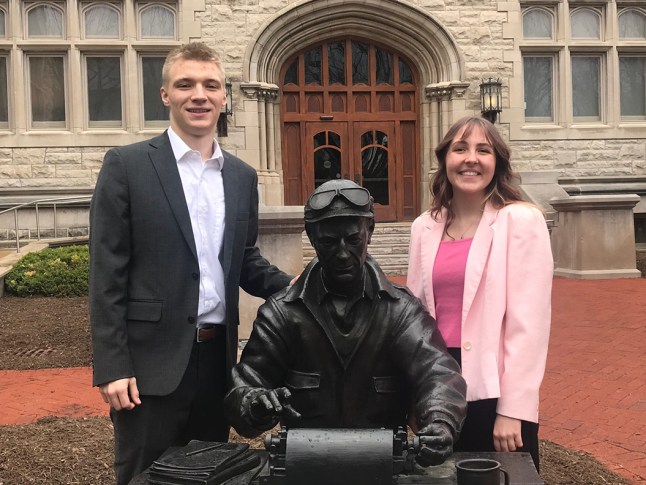
Jacob Spudich and Marissa Meador pose next to the famed Ernie Pyle statue outside Franklin Hall after speaking to the Student Media Board during the application process to become co-EICs. Photo courtesy of Marissa Meador.

(EDITOR’S NOTE: This is the second part of a multi-part series on the decision of the IU Media School to unilaterally converge its student media outlets, the Indiana Daily Student, WIUX and Indiana University Student Television. Part of the plan calls for the elimination of the final print edition of the IDS, something upsetting to the students.

If you want to help the students keep their print paper, they have listed this link as a way to do this: https://forms.gle/cisJyhvAxuQbC4co7.

If you want to tell Dean David Tolchinsky what you think about this situation, you can email him here: mschdean@iu.edu

If you missed Part I, you can find it here.)


THE ANNOUNCEMENT

Trevor Emery, the president of WIUX at Indiana University, knew something was going to change for his radio station in a fairly substantial way.

He just didn’t know what it would be or how fast it would hit.

“On Monday, we all get an email in the early afternoon, and it was three, four o’clock,” he said in an interview. “It said, ‘We’re all gonna meet Wednesday and talk about some big news for student media.’ And then Tuesday I’m my home… I get out of the shower and I look at my phone, and I have four missed calls from one of the IDS editors, and I call him back, and I’m like, ‘So what’s going on?’ He was like, ‘Have you seen what the media schools posted?’ I’m like, ‘No.’ Then they bugged me for a quote.”

The editors had received a leaked copy of a plan about massive changes coming to student media. The Media School stated it would merge the student media under one umbrella operation. It would also kill the final print edition of the IDS, shift the professional staff around to cover all the media branches and create additional media options, including a newsletter and an all-encompassing digital app.

“Then Wednesday, the next day, we all go into this meeting, and the dean starts off with, ‘Oh, the IDS got this report in a leak, and we just preempted them by posting it directly,’ The whole meeting felt like they were telling us, ‘We are here to inform you of this decision anyways, whether you like it or not,'” he said. “So then that says to me I was never going to be asked about anything in the first place.”

The mood at the IDS wasn’t any better, as the staff scrambled to make sense of what they had seen and tried to inform their readers about the issue. Co-editors-in-chief Marissa Meador and Jacob Spudich had planned to attend a meeting on Wednesday, where they thought they’d be asked for some input on a plan people had been working on since April.

“I think there was kind of like an assumption from Marissa and I that this meeting was going to be more of a constructive meeting where Marissa and I’s input would be valued somewhat, and I think that became clear that that was not the case that Tuesday,” Spudich said in an interview.

Meador said they found out the school had planned to meet with faculty Wednesday at 2 p.m. to clue them in, speak to her and Spudich at 3 p.m. and then make the formal announcement at 4 p.m.

“It’s hard to believe that anything we said was going to have an impact on their final decision if they had planned to release it right after our meeting,” she said.

With that in mind, and a copy of the plan in hand, the IDS crew went to work as reporters. They built both a story that provided the news of the plan and people’s reactions to it as well as a letter from the editors in which they expressed “no confidence in the Media School’s plan.”

“I feel we should have been considered in this decision,” Spudich said. “This is about more than just the money aspect. It’s about  staffing, the abundance of our newspaper stands around town, and the visibility that we have there. There’s just a lot of things that we don’t feel were taken into consideration. And really the only way they would have been is if a representative from our newsroom was there to voice those concerns early on in this process.”

Emery said the radio station also felt let down by the plan and the approach the administration took in announcing it.

“It did come out of nowhere, and it would have come out of nowhere on Tuesday, or would have come out of nowhere on Wednesday,” he said. “I don’t really have a difference on the day of the week that I’m getting screwed over. But it was very confusing.”


AT LEAST 99 PROBLEMS

When it comes to the financial aspects plan itself, the members of the IDS had several, specific concerns:

  • The cutting of the print edition didn’t make sense. The paper version of the IDS was revenue-positive, and it was a key way to reach the community, both for older people who still preferred that platform and as a signal on news stands that the paper was still publishing. Furthermore, the original committee’s recommendations did not include cutting print. The plan calls for the retention of special issues, but how those are done and which ones will happen remain a mystery, the students said.
  • Continual cutting had not solved any significant problems for the IDS to this point. As its name indicates, the IDS once published a daily print edition, but over the years, in response to dwindling revenue and loss of print readership, the staff had cut the paper and print run. The race to the bottom of printing still left them in debt.
  • This plan was created without transparency and then forced upon the staff. As Meador noted in an interview, the previous cuts or changes the IDS undertook to fix the finances were done by the IDS itself. This would be the first time print cuts or organizational changes were mandated by an external agency.
  • The resources aren’t there to make this work. Much like the convergence efforts of yesteryear, this one looked to get fewer people doing the work of more people. The comparatives the Media School was drawing to other converged student media operations involved far more professional staff and much higher buy-in from the institution, they noted.
  • It’s unclear who will be paying for what. The specifics about cuts are clear, but the revenue-generation portion and such are exceptionally vague. The radio and TV stations do not generate revenue, so the cost of the professional staff will have to come from somewhere else. Currently, the IDS pays their salary and benefits, but it’s unclear how that burden will be spread moving forward.

As far as WIUX was concerned, the problems were even bigger.

“The newspaper really is like the elephant in the room,” Emery said. “They’re consistently $300,000 over budget… The newspaper as a thing works, and they know that it is profitable. What isn’t profitable is paying like five or six adult-level salaries to people with health insurance and whatever else. And we don’t have any of that. We have a faculty adviser, and she does the work of like 10 people, and she gets paid a small stipend from the school just to help out.”

Emery said the three organizations rarely interact, primarily because they all have different interests, different needs and different purposes. The student newspaper produces local news content, while music and community events drive the radio station. (A representative from IU Student Television did not respond to requests to participate in this series.)

“I sit in these meetings with the media school, with the staff and the dean at times, and I point out that we are definitely much more student-life based,” he said. “We connect with the community. We were trying to get people out in public by doing events, things like that. We just finished up our whole week of events and a fundraiser to keep our station going. None of the two other clubs that we’re talking about do that.”

With both broadcast groups run as student clubs, Emery said they were not allowed to do certain things to earn money. In exchange, they both used to receive money through student life via student fees. However, around 2020, he said, the stations got cut off from that funding without much explanation.

“We were getting, at one point, like 70 cents a student, undergraduate student on the Bloomington campus,” Emery said. “So that ended up being like $30 or $40,000 a year. And we managed that to where we had a pretty big surplus. By the end of where that landed, like three or four years ago, we had like $150,000 to $200,000… Over the past four or five years, that’s dwindled down.”

With the Media School calling for a three-year phase in, Emery said he’s worried that time and funding might run out for the station.

“They also are like, you’re going to have three years to implement this, and it’s obviously not going to make money in that meantime while we figure out what systems to use and build a client base, etc., etc., and they won’t tell us how much money we’re going to be supported with during that time,” Emery said. “I’m assuming that they’ll cover the salaries of the newspaper, and they’re like staff, the pro staff. But for us, I don’t know what that means. That’s essentially the time when we run out of money in our account.”


NEXT TIME: The problems with convergence and the background of the guy trying to make it happen at IU.


Hostile Takeover: The Indiana University Media School’s plan to converge student media and why the students hate it (Part I)

The Indiana Daily Student’s first issue from 1867.

(EDITOR’S NOTE: When I started digging into the Indiana University Media School’s plan to merge the Indiana Daily Student, IUSTV and WIUX, I thought this was going to be a quick post on one week and then a Q and A with the staff, if I got lucky.

However, in looking into this more deeply, this officially started getting out of hand over a week or more. Thus, I wanted take a couple bites at the apple to try to understand what this is, how we got here and why one of the best student media operations in the country is in this situation. Buckle up. Stuff gets weird…. — VFF)


In early October, the Media School at Indiana University announced its plan to converge multiple student media outlets in an attempt to save money and develop synergistic editorial efforts. The Indiana Daily Student, WIUX radio and IU Student Television would be gathered under one umbrella, whether they liked it or not. In addition, the plan called for the elimination of the final print edition of the IDS, something that was clearly upsetting to the students.

The students published several pieces, including an editorial and an article, that outlined the general problems with this approach and the ham-handed way it was presented to them. For the IDS, this was like a mob hit: They never saw it coming and now they’re left picking up the pieces as they grapple with what could be a new reality for them.

“Obviously, we’ve been looking for ways to address our deficit for quite a while now,” Co-Editor-in-Chief Marissa Meador said in a recent interview. “We’ve been cutting print from five days a week to two days a week to one a week and that was part of that process. All of those previous print cuts were made by IDS professional staff in consultation with student leaders, not the Media School. So that’s a key difference here: This proposed cut of the weekly print edition is not supported by our professional staff, by student leaders, was not done in consultation with Jacob or I, and is being conducted by the media school and not the IDS. So that’s an important distinction.”

The paper faced both a deficit built up over time as well as one that was likely to continue into the future. How this happened is a big part of the story…

THE SITUATION

Not to overstate the obvious, but newspapers in the United States are dying at an unprecedented rate. More than a decade ago, it became clear that newspapers were essentially getting killed due to several market forces: Decline in advertising revenue, expansion of options for consuming content, decline in journalists creating content and a drop of interest people had in reading newspaper papers. A Medill Report from 2023 found that nearly one-third of all U.S. newspapers that existed in 2005 would be gone by the end of 2024. That would leave about 6,000 papers in the country, compared with nearly 24,000 in the early 20th century.

Campus newspapers found themselves facing a similar problematic future along those same timelines. The salad days of ads pouring in, as advertisers rushed to the only platform that could deliver them the campus market, ended and students were left to scrambling to deal with the change. A 2013 report from the Pew Research Center found that these publications were engaging in many of the behaviors as their professional counterparts for many of the same reasons.

The Indiana Daily Student is both the oldest and largest member of the student media on the IU-Bloomington campus. It is also one of the most award-winning college media outlets in the country. It has experienced many of the problems outlined above, despite weathering them better than many of their peer publications while receiving no financial support from the university itself. The paper had a $1 million reserve as far back as 2005 and had maintained a reasonably stable financial condition into the mid-2010s.

However, a confluence of events, including cuts to print, decreases in national advertising, university-mandated payments and COVID led the IDS to run a debt of nearly $1 million as of early 2024. In July 2024, Media School Dean David Tolchinsky emailed the IDS staff and said an arrangement with the provost’s office had led to the decision to wipe clear the million-dollar debt. However, underlying financial issues meant the IDS was likely to build that debt back up.

According to Meador, the paper appears to be on pace for another deficit-spending year to the tune of around $300,000

THE REPORT

Part of the decision to let the paper run a deficit in the first place back in 2021 was the agreement that the IDS and the administration would put a plan in place to both fix the deficit and prevent it from coming back. James Shanahan, dean of The Media School at the time, and Jim Rodenbush, who remains director of student media, issued a press release together, explaining the goal of this maneuver:

As we work together to secure the long-term future of the IDS, and with agreement from the Office of the Provost, the IDS will be permitted to operate at a deficit for three years beginning in the 2021-22 fiscal year. Any remaining deficit after that time will be covered by The Media School. There will be no immediate changes to the professional staff structure.

Discussions on the future of the publication have been in progress for some time. Media School administration and faculty have continued to work behind the scenes while responding to urgent modifications to teaching and staffing models necessitated by COVID-19.

As with most things put on a multi-year plan, things languished for a substantial portion of that time, with no real movement toward any reasonable solution. The IDS staff was concerned and said as much, while various options, including selling IDS swag, closing the campus yearbook, using newspaper racks for advertising on campus and other cash-raising options, were not allowed by the administration.

Tolchinsky commissioned an ad-hoc committee to figure out what was going on and what was the best path forward. In April 2024, the committee, which included representation of professional staff from the three student media outlets, issued its report. A few key takeaways were:

  • Student media at IU is not unique in its struggle to persist in the face of changing dynamics in the areas of newspaper, radio and TV operations.
  • The university red tape regarding marketing and sales rights has hamstrung student media in any attempt to generate revenue beyond the distributed content created by the student media outlets.
  • The university is out of step with the trend of current student media paradigms, as most colleges and universities provide student media with some form of financial support.
  • The administration needs to start thinking about student media the way it thinks about other learning opportunities that exist on campus and stop thinking about it as a profit-making enterprise.

The recommendations from that report were two-fold:

  1. Unify the operations under one umbrella as both a cost-cutting and editorially synergistic maneuver. This would eliminate redundancies while connecting students across the media platforms in a way that could improve content.
  2. Get the university to pony up some significant cash to keep these operations running. The report noted a $6 per semester student fee could allow the publication to continue as it stands while remaining in the black.

“Their overarching point there was that any plan moving forward should treat the IDS as an educational experiential learning opportunity, not as a business,” Meador said. “That was a big point. A major part of it was asking for some sort of direct University support, maybe in the form of a mandatory fee, which a lot of other college newsrooms have.

“What was not on our radar at all was that they were considering cutting the weekly print edition. We did not think that was that was on the table. It was no one talked about it in the report, and yet, that’s one of the few things in this October report that actually is being implemented right now. All the other things are, you know, future, future things. So, you know, we’re kind of, we knew this whole time that they were developing their plan, but we had no idea that it was going to involve print until the report got leaked to us and then it got announced on Tuesday.”

UP NEXT: The plan to converge and the fall out.


“Is this the hill you are willing to die on?” When to fight back against abject stupidity (A throwback post)

A number of events formed the confluence for this throwback post. First, the situation at Indiana University, where the Media School is forcing choices upon the staff of the Indiana Daily Student, WIUX and IU Student Television. The students there, particularly those in the IDS, are not thrilled about this and I’ve had a conversation with a few of them about that.

(I had planned to do a quick Q and A with the IDS folks and post that right after the initial post I put together on this. However, as I dug deeper, this whole thing got officially out of hand. I’m working on a series I hope will be ready next week. Don’t worry, IDS folks. I haven’t abandoned you. It’s just that there’s a lot more weird than meets the eye.)

Second, I spoke to the UWO volleyball team last night about their vision for the rest of the season. Coach said they were tired, beaten up and not sure of themselves in some cases. In discussing their approach and how best to meet some goals, I broke out the titular phrase listed in the headline.

Third, we’re still facing SLAPP suits and it’s hurting media outlets as they are forced to respond to nonsense. An appeals court ruled in favor of the Wausau Pilot & Review in a case where a politician claimed the publication libeled him by reporting he used an anti-gay slur. The politician lost the case on the grounds he was a public figure, something patently obvious to anyone who knows libel law. Still, this drained time and funding from the publication. Although a Go Fund Me drive and attention from the NY Times helped with the legal fees, the editor said the paper had to refrain from hiring due to the impact of the case.

Finally, I ended up spending time earlier this month with Allison and Tony at their place in Michigan. Somewhere in the calm, cool morning, surrounded by pines as big as skyscrapers, we were talking and realized we’d known each other for more than 30 years. That’s a lot of life and a lot of opportunities to pick a hill or two to die on. As we reminisced, it hit me that we must have picked the right hills, or at least avoided the wrong ones, to make it this far and still be the best of friends.

Enjoy.


SLAPPed around: How people with money who dislike your work can make your life miserable (legally)

About a year ago, we talked about the legal triangle that existed between coal magnate Bob Murray, comedian John Oliver and a 7-foot-tall squirrel named Mr. Nutterbutter.

The short version of this was that Oliver did a big piece on the coal-mining industry, in which he called out Murray’s company and made fun of the 79-year-old for a variety of things he did and said. Murray filed suit in West Virginia, claiming Oliver defamed him and seeking not only damages (to be specified by the court), but also a permanent injunction barring Oliver from ever broadcasting the piece again. It also sought to eliminate all copies of the “Last Week Tonight” story from public viewing.

A year ago, the state threw out the case against Oliver and HBO, stating that this was satire in some cases and free speech in all cases. (I still think the greatest legal argument came from the amicus brief filed by the West Virginia ACLU that noted, “Anyone Can Legally Say, ‘Eat Shit, Bob.’”) When the court tossed the case, Oliver let his fans know about it in a truly “Last Week Tonight” fashion:

Contrary to the title of that clip, however, Murray hadn’t given up the ship quite yet. He appealed the decision to the state’s supreme court before eventually dropping the case recently. Oliver then finally made good on his 2-year-old promise to tell us “the whole story” about what happened with the suit.

(Normally, I would upload the link to the piece here, but I think my publisher would kill me in this case if I did so. I have been told repeatedly that “students at small religious institutions” read this blog as part of their homework. Let’s just say that the dancing and singing number at the end is “a lot.” Feel free to find it on your own on YouTube.)

Oliver, however, didn’t spend all 25 minutes of the main story on a self-congratulatory Broadway-style number that pushed satire into a completely incredible stratosphere. His main point was about the way in which people with money can engage in ridiculous lawsuits to crush dissent, which is something of serious concern to journalists these days.

Strategic Lawsuits Against Public Participation, or SLAPPs, use the legal system as a sword as opposed to a shield. The goal of these, according to the Public Participation Project, is to crush free speech with lawsuits that have no merit:

SLAPPs are used to silence and harass critics by forcing them to spend money to defend these baseless suits. SLAPP filers don’t go to court to seek justice. Rather, SLAPPS are intended to intimidate those who disagree with them or their activities by draining the target’s financial resources.

In short, even if you win the point as the target of one of these SLAPP suits, you lose because you go broke. We covered this kind of situation when we talked about the small-town Iowa newspaper that went after a police officer who had been showing waaaaay too much interest in underage girls. The cop sued for libel and lost in a huge way. However, the paper ran up a six-figure debt defending itself and turned to a GoFundMe campaign to try to save itself.

In Oliver’s case, it cost about $200,000 to defend the coal piece and led to a tripling of his libel insurance premiums. And that was BEFORE he ran his giant Broadway number that went even further in talking crap about Bob Murray.

About 30 states have anti-SLAPP laws on the books now, which try to cut this kind of nonsense off at the pass. Although they vary from state to state, the gist of anti-SLAPP laws is that the person being sued can ask the court to view the story in question as being in the public interest (or at least free speech). It then is the plaintiff’s job to show that the suit has merit.

If those folks can’t meet that burden and it becomes clear it’s a SLAPP suit, the case gets tossed. In some cases, the law calls for the plaintiff to cover all legal bills derived from this stupid exercise.

However, not every state has these laws (Murray sued Oliver in West Virginia for precisely that reason) and not all laws are equally helpful to journalists. This makes life a little dicey for you if you want to take a shot at someone who has probably done something wrong but is likely to be extremely litigious.

Every time you ply your trade, you run the risk of being sued, regardless of if you did something wrong or if someone is just being a chucklehead. With that in mind, here are a few things to think about when it comes to SLAPPs:

IT’S NOT A SUIT UNTIL IT’S FILED: My good buddy Fred Vultee used to say this a lot on the copy desk when a story about someone threatening to sue would come across his desk. His point, and it’s a good one, was that anyone can threaten anything. Until paperwork is filed, all this huffing and puffing does is create a lot of wind.

As we pointed out in earlier posts, you shouldn’t panic and try to run away whenever someone threatens you with a suit. Instead, you should see what it is that is upsetting that person, if that concern has merit and if something needs to be done to resolve the concern before it gets too far down the road. If you’re wrong, an anti-SLAPP law isn’t going to help you.

As the Reporters Committee for Freedom of the Press points out, anti-SLAPP laws aren’t meant to solve every legal problem for journalists. They are just one more tool in your toolbox that can be helpful when a specific situation comes up.

If you’re right, and it become clear this person is just trying to mess with you, then you can start thinking about lawyers, laws and SLAPP stuff.

DOES SOMEONE HAVE YOUR BACK?: When we talked to Alex Crowe of The Great 98 a year or so ago, he found himself in the middle of what could be considered a SLAPP case. He reported on a messy police situation, which included a reference to a drug bust and a cop’s kid. The officer involved threatened to sue unless the station scrubbed its website of all stories involving this.

Although point one really applies here, sometimes, just the threat of a suit is enough to make people up the chain nervous about sticking their necks out for you. In Crowe’s case, the first inclination of the people around him was to back off. He did, however, know that if he could protect himself and the station without draining every resource from the organization, he would still be in decent shape. That’s where the RCFP came into play. The folks there provided him with legal advice, some pro-bono counsel and a chance to push back at the threats. That was enough to put the kabosh on the whole thing.

Organizations vary as do bosses. I’ve worked for people who would step in front of a bus for me. I’ve also worked for people who would not only push me in front of a bus, but would be more than glad to drive it over me a couple times if it kept their keesters out of the fire. This was the determining factor for a lot of what it was that I was doing in terms of fighting with angry sources, disgruntled subjects and other folks who were potentially litigious.

If you know where you stand with the people who might or might not stand with you on a situation, you at least have a sense of how scared you should be going forward. For all of his zany antics, something tells me that Oliver had more than a few conversations with his bosses at HBO about what might happen as a result of going after Murray before he aired the piece.

IS THE JUICE WORTH THE SQUEEZE?: In employing this “Filak-ism,” I’m likely to earn the ire of many old-school news journalists. In the idealized world of news, the goal is to tell the truth, consequences be damned. You HAVE to tell the truth and you MUST push back against powerful forces. In the movies, it always looks like this:

There’s that sense of “Damn the torpedoes! Full speed ahead!” that brings vigor to journalism and that is trumpeted as “this is why we do what we do.” I’ll never argue that in a perfect world, the bad guys get punished, the truth gets told and Gary Cooper always rides off into the sunset with Grace Kelly.

We don’t live in a perfect world and if you need any proof of that, go look at the approval ratings of journalists these days.

My friend Allison and I used to ask when we would deal with difficult situations or plan those Quixotic efforts, “Is this the hill you’re willing to die on?” In other words, if everything goes to hell in a speedboat and you don’t end up winning the day and Gary Cooper gets run over by a horse while Grace Kelly runs off with the blacksmith instead, are you OK with that? Was this worth it?

In the case of Crowe’s story, he felt it was worth it and he ran the risk of losing the fight, the ability to do good news and maybe even his job. In the case of the “Spotlight” story, the Boston Globe eventually got the pieces in front of the public and unveiled some of the darkest elements of the powerful force that was the Catholic church.

In the case of John Oliver, well, we got another awesome moment or 12 from Mr. Nutterbutter, so I guess that was good as well.

The point is, if you’re going to take on someone who will likely torture you with legal stuff and drain your piggy bank of every last cent, make sure you feel it’s a worthwhile endeavor. If you don’t, then let it go and be OK with the fact someone is getting away with lousy behavior because of your choices.

A look back at threats and violence against journalists we know in the wake of the Robert Telles verdict. (A Throwback Post)

Jeff German’s page remains on the Las Vegas Review-Journal’s website more than two years after he was killed. A jury convicted Robert Telles of stabbing German to death over stories Telles found critical of him.

A former Las Vegas official was convicted Wednesday of murdering a journalist who wrote accurate stories about the official’s bad acts while in office.

Robert Telles, an administrator at the Clark County Public Administrator’s office, lost his bid to retain his position in 2022, due in part to Jeff German’s stories of Telles’ inappropriate acts while in office. Telles stalked German at his home and stabbed the 69-year-old man to death, the jury concluded:

The prosecution has indicated it won’t pursue the death penalty. The jury, which said it found the murder to be “willful, deliberate and premeditated,” is set to hear further evidence before deciding on a sentence. Telles could get life in prison without parole, life with the possibility of parole after 20 years, or 50 years in prison with a chance at parole after 20 years. The use of a deadly weapon may also add to the sentence.

“He took the life of an individual who was simply doing his job,” prosecutor Christopher Hamner said at closing arguments.

District Attorney Steve Wolfson said the verdict sent a message that attacks against members of the media won’t be tolerated.

In reading this story, I recalled a post we did more than five years ago where the hivemind folks recalled some of their scariest moments on the job. Threats, violence and intimidation were part of what they tolerated to do nothing but tell their audiences relevant and valuable information. Here’s a look back at what these folks endured and what we still face as journalists today:


“I slept with a baseball bat under my bed:” Journalists share stories of being threatened and attacked.

Rage against “the media” is a common form of expression among people who have the same difficulty in differentiating between “fake news” and “factual stuff they don’t like” as they do “their ass” and “a hole in the ground.”

One of the things that many people forget is that “the media” is actually full of real people who go to work every day. Moms and dads. Sons and daughters. Friends, loved ones and more.

For these people, and those people who care about them, hatred of the media is not an abstract concept. The anger they face is palpable. The threats they receive cause fear. As we noted a while back, we all feel the pain when a journalist is attacked or a newsroom is the site of a shooting.

And all of this takes its toll.

Lori Bentley Law, a broadcast journalist at KNBC, wrote a piece that Poynter featured, titled, “Taking the Leap: Why I’m leaving TV news after 24 years.” Of all the things she mentioned, this one stuck with me:

I’m a happy, positive, optimistic person. I don’t want to be immersed in sadness every day. I don’t ever again want a cute little girl in pigtails to look up at me and say, “We hate you.” I don’t want to hear “Fake News” shouted at me anymore. Or to be flipped off while driving my news van. Or worse yet, to have the passenger in the vehicle pacing me hang their naked butt out the window and defecate. Yes. That happened.

(Law posted her original piece and made her decision even before CNN received a pipe bomb, one of at least a dozen explosive devices sent through the mail to people and organizations throughout the country. Then people like this emerged:)

Bomber
(Yet one more moment where I think, “What the hell is wrong with people?”)


I often tell my students stories of how I had been called a “vulture” and a “scumbag” and worse. I remember one person who told me, “Your mother didn’t raise you right!” Another one, for some reason, told me that he was “gonna get my cousin and we’ll be over to take care of this.” I forget why he was so upset, and I still have no idea why the guy was getting his cousin, but I doubt his relative was a conflict counselor.

The other screaming fits kind of blur into a mess of random anger. Occasionally, I was fearful when I went to shootings or other things and people would tell me to “get the (expletive) out” of their neighborhood. However, most of the time, I was covering late-night crime, so the presence of the police tended to make me feel a bit safer.

In this age of the media being dubbed “the enemy of the American people,” I wondered how bad things are now or what others had faced during their time in the field. I asked the hivemind for any recollections they had of incidents involving angry people, threats or worse.

These are their stories:

The local crank is a constant job hazard for journalists. Between the conspiracy theories related to the clues in the crossword  and the allegations of biased coverage of the local dog show, some people have a lot of issues to work through. One former student encountered a particularly virulent crank with some serious issues:

At a small-town newspaper in Ohio we had a guy who would get mad about articles we wrote, photocopy pages of our newspaper, write profanity on the copies then mail them to us…

My boss actually got a restraining order against the guy because he was stalking her. He liked to slowly drive past her house and glare at her and her family. Following some court hearings and visits by the police, the letters stopped coming, but he’d still curse at me when he saw me covering an event. When I knew he was around I sometimes would have a recorder ready to go so I could record him if he ever threatened me.

This went on for about seven-and-a-half years, beginning in 2010, until the guy died earlier this year.

That same guy also sent an email to our web editor once requesting a full body photo of a high school volleyball player, which was pretty creepy. He loved going to high school sporting events, especially high school girls games.

According to my boss, a teenage girl from another school also had a restraining order against the guy. He apparently printed photos of the girl, action shots from sports and senior portraits, and mailed them to her, requesting she autograph them and send them back to him.


Aside from the generally creepy people, journalists tend to take the most abuse from people who feel they’ve been unfair. A media instructor who covered local politics shared the kind of story people have seen an unfortunate amount lately:

I was threatened by a political candidate a few years ago while working at our local paper. I called him to get his reaction to losing the election, and one of his supporters answered the phone pretending to be the winning opponent. It was obnoxious. I told one of our editors what had happened, and he took to Twitter. The losing candidate called me the next day threatening me (I took it as a physical threat) and promising to exclude me from any news tips he might have — and he had a lot, he claimed.


In some cases, it’s not even the topic of a story who gets angry with the media. A general assignment and sports reporter once came face to face with the family members of a man convicted of a crime:

Closest call came when friends of a defendant charged with killing his friend in a drunk driving crash recognized me one night while I was out with friends watching a band … started with stares, then to whispers and pointing, then to getting in my face to confront me … luckily, had more friends than they did so the issue was quickly calmed down.


A good friend of mine who broke the news of a “Spotlight” -like molestation scandal in the Chicagoland area found herself targeted by the leaders of her own faith:

Torrents of abuse while covering the Catholic Church sex scandal, including being screamed at by a nun (who was basing her rage on being lied to by her bishop, who she probably couldn’t yell at, so) and the now-deceased Cardinal Archbishop of Chicago once shouted at me that a story was unfair in front of an entire congregation.

She also found herself threatened physically for criticizing another “holy man” in the paper:

Our newsroom in Elgin got shot at (we never knew if it was deliberate or just that we worked in a gang territory in dispute). I wrote something semi-critical of Saint Ronald Reagan after he died and a guy called my editor and threatened to kick HIS ass once he was done with mine.


Being blamed for the problems of others is common in the media. I remember once telling a woman on the phone who called to scream at me about a story, “Ma’am, it’s not my fault your son was involved in a shoot out at a Taco Bell Drive Thru.”

Usually, it’s just someone screaming on the phone about a DUI report or something, but for a former student of mine, the “blame game” was much worse:

I covered the lengthy trial of a dermatologist who was accused by about 16 women of abusing his position to sexually assault them. It was already going to be a high-profile case because he was a doctor, one of the most sacred positions of trust. Every time I’ve covered a courts story involving a physician there’s been hordes of satisfied patients who come out of the woodwork to blame the messenger (me, or the media in general) — I’m assuming because that’s easier than acknowledging you put complete trust in someone who is flawed.

Anyway, this trial went to a whole other level of crazy after the doctor alleged he was being unfairly targeted because he previously had a one-night-stand with the female district attorney (she adamantly denied it), and that she was trying to put him behind bars only because she was a spurned ex-lover. The trial, unsurprisingly with so many accusers, didn’t go his way. And on the last day his adult son walked out onto the freeway and stepped in front of a semi-truck to commit suicide…

In a newsletter to the hundreds of patients still supporting him, which he forwarded to other media outlets, he singled me out as causing his son to commit suicide. The case ended up lingering over more than a year as he appealed, and he repeated the accusation over and over again over that time.

It would have bothered me if it wasn’t so batshit crazy. But then again that was nearly 10 years ago and I’m still thinking about it, so maybe he did deliver a few blows to my reporter psyche.


A publisher of a Midwestern paper, who also teaches courses in journalism, said she received blame after covering a football coach and his abuse of players:

I was working as a sports editor at a small market newspaper in the early 2000s. I had to be escorted to and from the office by law enforcement for almost a month after a coach threatened my life following stories I wrote about him assaulting players in the locker room after a tough loss. I was outside the locker room and heard it happening and got it on tape and many of his players came forward and went on record. He was fired and of course, it was all my fault.

That journalist also received some sexist and violent threats more recently:

Last year, I had the mayor of the town I own the newspaper in call my husband and scream at him to “manage his bitch of a wife.” I published a story with his quotes about how the city was knowingly dumping raw sewage into a local creek. Later… our farm (was) vandalized.


People can clearly get angry when you report things they don’t want you to cover. A good friend said he once found himself almost being a punching bag for an angry young man whose house had caught fire:

One time in the early to mid-2000s, I was covering a house fire, and the teenage/young adult son of a man presumed to be inside got right in my face and threatened to beat the daylights out of me (pretty sure that’s not the phrasing he used) because I had no business being there. Turns out the dad was fine, and I’m sure the kid was upset because he thought his dad was dead, but I really felt like I was a millisecond away from taking a right cross to the head.


And that wasn’t even the scariest situation in which he found himself:

There was a period of time when I slept with a baseball bat under my bed, and I remember that was directly connected to some kind of threat I received while on the cop beat — but I really don’t remember exactly what it was. Kind of funny that this sort of thing happens regularly enough that I can’t even recall why I was sleeping with a defensive weapon nearby …


Of all the stories shared among the hivemind, this one was the most terrifying. A journalist recalled an incident that happened to him as a student editor at his college newspaper. A reporter began looking into what he thought was a fairly pedestrian story about a professor. The professor didn’t like the story idea and posted a screed on a website, which led to the whole story blowing up on a national level:

A fan of the professor’s work (unaffiliated with the university as far as I can tell) started sending death threats via Twitter and Facebook to me, some of which was wildly anti-Semitic.

I frankly didn’t know about them until after Public Safety contacted me to warn me about the posts. After months of online harassment and my multiple meetings by phone or in person with law enforcement, he showed up on campus one day looking for me.

He even found and entered the school newspaper office, but luckily I was in class across campus at the time. Public Safety at the school detained him, interrogated him and told him to never return.

I’ve never heard from him since.

Four potential story ideas for student journalists heading back to school

QUICK REMINDER: I’m trying to gather information for folks about what students use AI for and what would make them avoid using it to cheat in class. If you are interested in helping out by reaching out to your students, here’s the link to the survey again:

https://forms.gle/WH9nzpHNT2XbMX5KA

Now, on with the show…

With the start of the semester, it can be a bit tough to get back into the swing of things in terms of coming up with some good fodder for the student media outlets out there. Here are four things that came to mind as I was trying (and failing) to come up with something more profound to launch the blog this year:

COVID COMEBACK: According to the Centers for Disease Control, COVID is making a big comeback, with several new variants getting into the act. When we first faced this mess back in 2020, we were isolating like it was a zombie apocalypse and washing our mail before opening it. Today, it’s treated less like the start of the apocalypse and more as a potential annoyance.

That said, what are the policies your school is rolling out for this? Is COVID now covered under traditional illness policies your school has? Is it still a “get out of class for a week” card? What alerts have the schools enacted regarding shared on-campus housing, dealing with workers who have diminished immune systems and more? Your school’s approach might be nothing and it should be something, or it might be a whole lot more than it needs to be.

FAFSA FAILURES: The Free Application for Federal Student Aid, better known as FAFSA, hit more than a few snags this year thanks to an “improvement” to the online application system. What that meant was hotly debated in the spring and the summer, but now we should be able to see what the actual impact is.

A recent national survey found that the freshmen classes are smaller than expected, with fewer overall financial aid applications  and less diversity in their populations. The individual impact obviously varies from school to school, so it would be a good idea to pull the FAFSA data for your school for the past five years and see where things sit today. Anecdotes will also help if you can find people who took an unintended gap year due to these problems or people who otherwise monitor the enrollment situation at your school.

HOT HOT HOT: Regardless of where you live, late August and early September are ungodly hot, compared to other times of the year. It’s also the time in which students are expected to move back to campus, leading to potential health and housing issues.

A number of news outlets in Minnesota, Wisconsin and other normally not that hot states have done the “it’s hot as hell but they’re moving kids into the dorms” stories, so there’s always a good follow up on that kind of thing. It’d be interesting to see about any medical calls (Hey, dads aren’t going to let some BS heat index stop them from hauling a freezer up 15 flights of stairs…) during the move in as well as any follow up about lack of A/C in student housing. It’s also probably not a bad thing to check on off-campus housing with landlords not keeping the air on or otherwise making the places inhabitable.

HOUSING HELL: The cost of housing in the country has become a focal point of everything from news articles to the presidential campaigns. In many cases, the focus tends to be on single-dwelling homes and hedge-fund maneuvers to corner the market on rental units in big cities. That said, every campus has its own challenges when it comes to housing space and getting students put into it.

I remember a few old stories about the dorms (residence halls, excuse me…) being booked beyond capacity, forcing some students to live in shared spaces until at least a few kids dropped out of school or got kicked out for trying to grow weed on the roof of the com building. Then there is this story out of Madison, Wisconsin that says the housing available to students is well outside their price range. (Paywall. Sorry. But Kim is a great reporter and pretty much the sole reason I’m shelling out whatever I’m shelling out to keep a subscription to the State Journal these days.)

What’s the situation out by you? Do they need to build more residence halls or have Silicon Valley billionaires bought every scrap of land around Northeast West South-Central University to corner the housing market? Also, what kind of living situations are people dealing with these days due to these pricing situations? (I’m always amazed when a student tells me they’re sharing a four-bedroom, one bath home with seven other people. I have no idea how that works…)

Hope this helps! Have a great start to the semester!

Vince (a.k.a. The Doctor of Paper)

Filak Furlough Tour Update: Hanging out with Wichita State University and The Sunflower Staff

Repping my Sunflower T-shirt for the Sunflower staff at Wichita State University. A nice photo of the group, although I never photograph well. I think it’s that my eyes always look closed and my mouth always looks open. It’s like a demented baby bird or something. (Photo courtesy of Amy DeVault)


The Filak Furlough Tour’s final stop of the year is the one I was most excited to make. Amy DeVault at Wichita State University is a great friend and colleague. She advises the Sunflower, the student newspaper there and does an incredible job with some incredible students.

I also have a history with these folks, in that we were blogging about the little …. um… people in student government a few years back trying to slash the paper’s funding and kill the publication. In the end, things worked out well, but I’ve always had a soft spot in my heart for the underdog in the fight, which is why I will always do anything I can to help The Sunflower.

Wichita State University — WICHITA, KS

THE TOPIC: The folks there wanted a basic critique of the newspaper itself as well as the opportunity to do some Q and A stuff, so that’s what we did. I had a chance to see the publication a couple times over the years, including a recent review of it for the Kansas College Media contest.

BASICS OF A CRITIQUE: If you want to see a really great, well-rounded news publication that covers its niche well, grab a copy of The Sunflower. They have a great mix of big pieces and small news bits. They have a strong collection of writers, photographers, designers and graphics folks. I loved a lot of what they did, so I made it clear that pretty much any critique was of the “here are some polish points” variety as opposed to a “Dear LORD do you need a wrecking ball and a blowtorch to get this thing into shape” collection of grievances.

Here are some observations I hoped might be helpful to them, and might also be helpful to you all as well:

  • Size versus value: In some cases, stories can get out of hand a bit, particularly when it comes to pieces that feel investigative, but don’t really add up to a lot. For The Sunflower, one piece in particular had a lot of content to it, but it really didn’t add up to a lot. The story looked at allegations of racial animosity during a rec center basketball game. The reporter dug into every allegation and every explanation offered to counter them, but in the end, the story was basically that a couple dudes got out of control playing basketball and nobody could fully corroborate either side of the argument.
    The story could easily have been cut significantly to reflect that reality and the graphic used to create the front-page centerpiece didn’t really add a lot to the storytelling either. This is one of those cases where the size didn’t mirror the value of the piece. It can be tough to see a lot of hard work essentially amount to less than we would hope for as journalists, but it’s worth remembering that the readers need to see value if they’re going to invest a ton of time in a piece. Whacking the hell out of something can be painful, but your readers will thank you.


  • Keeping it local: Overall, there was a TON of great local coverage in the publication. My only minor grouse was a common one on the arts/entertainment page: movie and music reviews. If you can give people something they can’t get anywhere else, fine, do those reviews. If not, leave that stuff for the IMDB’s and Richard Roepers of the world and go cover some local bands or some local theater.
    If you’re asking yourself, “OK, so when WOULD I do a movie review?” my answer is an example from a student paper I critiqued years ago. The paper was from a small religious school out west and it reviewed the movies from the perspective of the faith base. The reviews noted how much violence or sex or whatever was in there and how people who practiced certain levels of the faith’s orthodoxy might be more or less offended by this content. I’m not getting that level of clarity on Rotten Tomatoes.


  • Use your voice: The opinion page was solid, and it’s often difficult to critique an opinion page, because it’s often at the mercy of whatever is going on around you. When the paper was under attack all those years ago, the opinion page thundered against the stupidity of the student government with the fire of a white-hot sun. That’s not always possible to do when you’re faced with some “meh” news days. Even more, it can make things worse if you’re trying to gin up some false-front rage for the sake of feeling like you’re wielding the power of the press.
    That said, I did note that they shouldn’t be afraid to go in the corner and fight for the puck when news merits their viewpoint on behalf of the student body. If something needs to be called out, it’s the publication’s duty to use its voice effectively to do so.

PICKING FILAK’S BRAIN: Here are a few of the things that came up in our time together. The questions aren’t direct quotes, but more of the general gist of what we were going after. Answers fit the same pattern:

QUESTION: What kind of balance do you think should be present in the publication between the kinds of things people like and the things people need? Is there a percentage split on something like this?

BEST ANSWER I COULD COME UP WITH: I’ve had a version of this question in a number of other stops on the tour and throughout my time working with student media. What I’ve tried to convey is that ALL information should be geared toward things that provide value to the readership, whether that value is in the form of entertainment, editorial insights, informational alerts or knowledge-building content.

What tends to happen is that we present content without a strong sense of WHY readers should care. In other words, people tend to blow off the “newsier” stories because as writers, we don’t make a strong enough “this matters because” statement for them.

My suggestion, therefore, is to worry less about trying to get people to eat their vegetables by force-feeding them dry news pieces and worry more about trying to make those pieces clearly personally relevant to the readers so they’ll be drawn to those stories.


QUESTION: What does it take to make a profile really work well as a profile and not feel so blah?

BEST ANSWER I HAD AT THE TIME: A lot of profiles fall flat because they lack observational elements that add flavor and meaning to them. The SCAM model can help you better find ways to capture the setting, character and action of your source through spending time with that person. You can then convey meaning by making sense of how those first three pieces work together to inform the readers about the overall “vibe” of this person.

You don’t have to describe every hair on the source’s head, all the way down to the worn heels on their cowboy boots to do a good job of describing a person. In fact, the opposite is almost always the case. You need to paint a word picture so that I can see this person in my mind’s eye while I’m reading the story. That can be their physical presence, if that’s crucial to the story. It can be their emotional presence, if that matters more.

Case in point, I was reading a profile today that one of my kids wrote about a young woman who is on a national-championship-winning gymnastics team here at UWO, while also having committed to the Army ROTC program. The programs seem ridiculously disparate: One requires individuality, and glitz, while the other required uniformity and plainness. Gymnasts tend to be tiny and Army folk tend to be giant. So, to more fully understand how that worked in one person, we needed to have a physical sense of this kid.

In another instance, the person was describing a religious leader who used his own struggles with faith and his practical nature here on Earth to help others find their way. In this case, whether he was giant or tiny was less important than the emotional interconnectivity he displayed in life.

Whatever route you go is fine, but you need to do a lot of observation of that person to truly capture the source’s essence and communicate that effectively to the audience. In doing so, you can focus less obsessively on getting every detail about the person’s life in there, like you’re crafting a resume.


QUESTION: The people around here in the upper reaches of power tend to like to route everything through the marketing department or just issue statements when we want interviews. How do we get around that kind of thing?

BEST ANSWER I COULD COME UP WITH: This is a trend with a lot of folks, and it happened here as well for a while. The general consensus is that if you don’t actually do an interview, you can’t say something stupid. This is supported by the idea that statements get about 23 people revising them before they go out to the public. Meanwhile, a mouth can yield a lot of problems when someone forgets to put their brain in gear before opening it.

The problem with statements, other than the general reek of bovine excrement that wafts from them, is that there is no chance to ask follow-up questions, refute basic assumptions in them or generally cut through the fog of obfuscation they offer. Thus, getting the interview is vital to making sense of some things reporters are covering.

I argued that you should always push back against the statement approach and track people down who decline to respond to your email requests. The university leaders have offices. Go there. Professors have teaching schedules. Track them down after class and walk with them. Set up camp outside their faculty office or generally be a persistent pain in the rear end. If they refuse to answer questions, turn THAT into part of the story:

“Professor John Smith refused to engage with a reporter who met him after class, instead saying he would ‘have someone issue a statement on the matter.’ When the reporter noted that a statement would be insufficient, Smith went from a slow walk to a brisk trot toward his office. He quickly entered and slammed the door behind him. Knocking to rouse him was unsuccessful.”

In short, as I said to the staff, “Tell the administrators, ‘You mean to tell me that someone of your educational level is afraid of an undergraduate student who works for a newspaper named after a pretty yellow flower? Come on!'”


FIN: And that’s where the Filak Furlough Tour came to an end. Thanks so much everybody for letting me be part of your lives and for making my furlough fun.


Filak Furlough Tour Update: Hanging out with McPherson College

As we finish off the 2023-24 tour, I’d like to say thanks again to Brett for this awesome logo.


The Filak Furlough Tour’s spring stops kind of ended up all over the place. That said, I managed to catch up with all the folks who still wanted me to make a stop by before the end of the term. Thus, as promised, we’re finishing out the year with a post for each stop.

(And yes, to answer the question I got the other day, you’re still getting your bats. I just need to hit a few rummage sales to do some scrounging, as apparently, my bat supply was depleted by you all being awesome people.)

Onward to greatness…

McPherson College — McPHERSON, KS

THE TOPIC: The request here was pretty simple: Talk about journalists as investigators and how journalists handle trauma. “Both super-light topics, I know,” professor Julia Kuttler said in her request email. I think both are great topics, so we’ll give them both kind of a shot here.

THE BASICS OF INVESTIGATION: I love students who are inherently nosy and the opportunity to shape that nosiness into something that can lead to improved journalism. I was meeting with a prospective student and her mother recently and I found myself telling them about the program and various other things. The mother mentioned several schools they were considering, and I often praised a lot of what they had going for them. Then, she mentioned one school with which I had significant experience and I noted that I probably wouldn’t recommend it.

Both the kid and the mom immediately asked, “Why?” with the enthusiasm of my dog seeing the UPS truck pulling into the driveway.

I tried to back away from that a bit, as I didn’t want to come across as crap-talking a program, even if I was being totally honest. The kid stayed  on me, with more, “Why” questions until I gave her a decent answer. (Or at least one that satisfied her curiosity.) I then looked at her and said, “You’re going to be a hell of a journalist, no matter where you go. You’ve got that nosy gene in you that will lead to some great investigative stuff.”

This was kind of the core of what I was trying to convey to the kids at McPherson about investigative work: If you can be engaged and interested, while being undeterred by people who clearly are looking to dodge your questions, you’ll be great at it.

To further explain it, I went back a bit to what I learned from investigative journalist (and former student) Jaimi Dowdell’s work on the FAA and the “Secrets In The Sky” pieces that earned her and co-author Kelly Carr the 2018 TRACE award for investigative reporting. You have to be nosy, you have to be interested and you have to be willing to keep pecking away at a topic until eventually “if we figure something out” becomes “when we figure something out.”


THE BASICS OF TRAUMA: I don’t think I’m alone in that I don’t like thinking about the concept of “trauma” in terms of what journalism has shown me. Or, in some cases, maybe done to me. The truth of the matter is, however, when you see enough of something that is outside of what normal people experience, it is going to mess with how you view the world.

That could be watching a ton of  local news coverage that paints your town as a violent, scary place, which leads you to overestimate your area’s lack of safety. It could be watching a ton of biased political coverage, which leads you to think the world is going to be a lawless hellscape if the “other side” wins the election. It could also be watching a ton of porn, which erroneously convinces you that every pizza delivery guy or plumber is likely to score with a lonely housewife on every house call.

It wasn’t until I started working at various universities, where I was asked to review other people’s classes, that I realized I was some sort of traumatized outlier when it came to my journalism experiences. Guest speakers and veteran journalists were talking about interviewing political figures or reviewing budgets or digging through data sets to find stories. They talked about how they incorporated their profile-style interviewing techniques into their daily journalistic stories to add depth and feel to pieces.

And I’m there thinking, “OK… so why do about 80% of my stories start off with something like, ‘So there was this drunk guy driving a car who ran over a kid on a bicycle and dragged him about half a block…’ instead of having something like those experiences?”

Also, why was I able to pretty reliably remember the name, age and cause of death of every dead kid I ever helped cover?

And why is it, I can still see the body of a 73-year-old woman, who had been set on fire, lying on a lawn, clutching a stranger’s hand as she fought for life and waited for an ambulance?

I’d like to say I just have a good memory and a penchant for war stories, but if I’m being honest, it’s probably because my job scrambled my mind a bit and left me with some ugly brain scars.

The best thing I could tell these kids about trauma is that we now recognize it. The Dart Center is a great resource for journalists who find themselves covering some messed up things. Editors are more attuned to this kind of thing today as opposed to even 25 years ago. The idea of “have a drink to take the edge off” isn’t viewed these days as preferable to talk therapy and other forms of self-care, something that wasn’t the case in previous generations.

In the end, you can’t really avoid it if you spend enough time in journalism. You will eventually run into something that messes with you. However, we have a lot more tools in the toolbox to deal with it once it happens and we’re better at preparing people for it before they see it.

NEXT STOP: Wichita State University.

Recalling Jim Lehrer’s rules of journalism as the Trump trial gets underway (A Throwback Post)

The breathless coverage of every post, sketch and fart of the Trump trial in New York has cable news in a lather these days. Without cameras being allowed in the courtroom, but still having all sorts of time to fill, television has seemingly turned everything about this thing into the Zapruder film. In his return to “The Daily Show,” Jon Stewart used his Monday opening to castigate these folks for their approach to “news” in this situation:


Stewart has long said he’s not a news journalist, so it might be easy to dismiss his critique as arrogance mixed with humor. That’s why we dug out today’s throwback post from four years ago, when Jim Lehrer died to make the same case for us.

Below is a brief tribute to Lehrer upon his death as well as a recap of his “rules” that really should guide our work in a time in which it seems like every shiny object can distract us and minutia can rule the news cycle.


Jim Lehrer’s rules matter now more than ever

Jim Lehrer, a journalist’s journalist to the core, died Thursday (Jan. 23, 2020) at the age of 85. He spent decades of his life covering politics, corporations, international affairs and more, and yet had the none of the pretense associated with the greatness he encountered or the epic stories he conveyed:

Jim was calm and careful in moments of crisis, as demonstrated by his coverage of the September 11 terrorist attacks.

“I’m Jim Lehrer. Terrorists used hijacked airliners to kill Americans on this, September 11, 2001,” Jim reported on national television. “Another day of infamy for the United States of America.”’

Lehrer essentially retired about a decade ago, and he did his work on public television, so it’s likely few folks under a certain age would remember much about him. Truth be told, he was really just a name and a standard to me for much of my life: A symbol of straightforward reporting and a talent to which one should aspire in the field.

However, among the many obituaries written on this titan of news, I came across Jim Lehrer’s Rules, guiding principles he used that can and should continue to influence generations of media students to come. (The world in general would probably be a nicer place, too, if non-media folks kept an eye on these things as well.)

These may seem quaint in the era of “Screaming Head” journalism, opinion-as-fact reporting, “sources say” coverage and a general sense that members of the general public have the IQ of a salad bar. However, with very limited quibbling, I could clearly defend each of these as something worth striving toward in our field.

An open letter to college students: Please learn to give a shit

Dear students,

I know that there are a solid number of you out there who actually abide by the request in this post most of the time. That said, that number appears to be dwindling significantly recently, so I need to make this plea.

I’ve always believed that as a professor, I owe it to you to try to explain things so that you can understand them. I also believe that if I don’t actually SAY something in explicit terms, it’s my fault when you screw up. If I do my best to lay it out, like I’m trying to teach a dog how to do calculus, and you still screw up, well, then, that’s on you.

I felt the need to put this post together after the first half of a semester that had me utterly vexed and befuddled at the current state of my courses. This isn’t a typical semester in which I have a couple kids who skip class constantly, a few others who fake their way around a few things and some dumb-ass behavior that makes me question the functionality of at least one student’s frontal lobes. There will always be one kid who shows up late so often I swear they’ll be late for their own funeral.

And it isn’t about the life events that get in the way for all of us. I still get the “I’m sick” emails or the notes about emergency surgeries and funerals. That happens all the time and, honestly, any professor who doesn’t understand this is someone I don’t want to know.

No, this appears to be a pandemic level of “I-Don’t-Give-A-Shit-itis” that has hit in a way I’ve never seen before on the college level. I had students miss deadlines for quizzes, writing assignments and even exams. Students were given days and even weeks to meet those goals, only to let the deadlines go by like a knee-buckling curve ball.

This isn’t just affecting my intro-level students, as several folks who are in their senior year have forgotten about midterms. The excuses are of the “I have no excuses, but let me fix this anyway” variety, with a steady stream of “I was unaware” emails, which appeared strange to me, given that I’d posted the information in the syllabus, flagged the deadline in the LMS and spoken repeatedly about it in class.

I keep thinking that these folks are suffering from whatever the hell Guy Pearce had in “Memento” and I’m strongly considering bring tattoo kits to class:

This also isn’t just affecting the students here at UWO, as I asked the hivemind of educators I trust if they’ve seen this as well. It turns out this is hitting states across the country, even those that haven’t recently legalized weed or consider a pub crawl to be a national holiday. A constant stream of attempting to spoon-feed students review questions, examples, instructions and extended deadlines has not proven to be a panacea for this situation.

Some educators speculate that this might be some sort of “long COVID” impact, with the idea that college students who spent their formative years merely trying to survive what we all assumed was the end of days weren’t properly prepared for self-reliance in their education. Others wondered if students felt their college efforts lacked value, given the high number of good-paying jobs that are currently available, sans a college degree. Still others pondered about the effects of artificial intelligence, as students looked for easier ways to get out of work. My sister-in-law, who teaches dance, had this insight:

“People are just lazy. We have a new generation of stupid on our hands.”

The cause and the cure are outside of my scope of knowledge, as I’m really not that kind of doctor. That said, please consider the following advice, as you move forward into the second half of the semester. Some of this may seem like it’s stuff you heard in second grade, but that’s probably because we need to dive that far back into the realm of education to properly reboot a few folks:

GIVE A SHIT: This is really the core of everything I’m going to say below, but again it bears repeating. If the way in which my 8 a.m. class tends to listen, I might have to say this six or seven more time before we’re done here.

I have told students over the years that the one thing I absolutely cannot teach them is how to care about a course. I can teach the basics of all sorts of rudimentary journalism skills and quite a few higher-level elements at that. I can teach students how to be tough, or brave, or nosy, or a dozen other “soft skills” that can aid them in their work.

The one thing I can’t make them do is “wanna.” If you don’t “wanna,” I can’t help you.

I get that not every course is your muse and that every class is not an Academy-Award-winning performance on the part of your instructor, but I know that a lot of us are really trying to make a difference. However, if you don’t care, it doesn’t matter.

And, if you don’t care, you should probably think about why you’re sitting in that classroom, spending a boatload of money that you’ll spend decades of your life paying back.

READ DIRECTIONS: When I was growing up, we were inundated with ads for a program called RIF: Reading Is Fundamental. The idea was that if you couldn’t read, you probably weren’t going anywhere in life:

This is really true in college, as you should be somewhere further along in your personal literacy than the crew of kids surrounding a relatively young Ed Asner here. Reading directions is a fantastic way of figuring out how much content you have to write, how many citations you need to include or even when something is due.

It might not be as much fun as if we did the directions in a TikTok, but when the Feds block this app for fear that the Chinese government is using it to figure out how stupid we all are, those literacy skills might come in handy.

PAY ATTENTION: College professors often have difficulty when we see you on laptops and tablets during class, because we’d love to pretend that you’re using these items to take copious notes and add deadlines to your calendars. However, when we call on you to verbally add your thoughts to the topic under discussion and your head pops up like a prairie dog getting electroshock therapy, you kind of give up the game.

Look, I get that we’re boring, despite how hard we work. I also know that not everything will apply to any one student in class. That said, you are PAYING for this. It’s like buying entry to the Golden Corral buffet and then quietly sipping a water in the corner. If that’s all you’re doing, why the hell did you come here?

Paying attention in class is a great way to actually learn stuff. This is particularly true if you are opposed to reading directions. I’m a big fan of both, but you need to do one or the other in order to survive in college. Neither of these things is asking too much or should come as a massive shock to you. We showed you the library, the classrooms and even professors’ offices during your campus tour: Books and lectures were not hidden from you.

Unless, of course, you were on your phone the whole time…

STOP PSEUDO-APOLOGIZING: I can’t tell you how many emails I’ve gotten that start with “I’m sorry” and then follow that up with a detailed outline of some easily avoidable screw up. I finally went and looked up what an apology actually entails and this is what I’ve found:

The Three A’s of Apologies
  • Acknowledgement. Acknowledge the situation and say you are sorry for what happened.
  • Acceptance. Hold yourself accountable and work to rectify the situation.
  • Amends. Talk about what you will do and start working on corrective measures.

What I’ve come to realize is that most of the apologies I get had none of those elements to them.

You’re not really sorry, in the idea that you are acknowledging the situation. Hell, some of you wouldn’t realize you’ve been hit by a bus until your phone told you as much or your Apple Watch stopped tracking your pulse. You just don’t like the negative outcome of what occurred and you want some way out of it.

You aren’t really accepting anything. Some of the emails I get say that the sender “will accept whatever punishment” I have in mind, but quickly following that up with “but I would really like it if (Fill in way of getting away with screwing up here).”

Also, I’m looking for amends. Maybe the sacrifice of a fatted calf would be a bit much, but some actual contrition and showing up on time for at least a week or two would help.

DON’T LIE: Journalists deal with weasels for most of our lives. This is why we have such great BS detectors and why we love nailing liars to the wall. In most cases, the lies students tell are so frickin’ unnecessary that they boggle the mind.

Case in point: I had a student tell me last week that she was going to miss class because she was sick. Totally fine, as they get two skips the whole term, and I don’t care what they’re for. I even go out of my way to say, “Look, if you want to tell me, ‘I got totally ‘faced last night and I reek of vomit and vodka sweat, so I’m skipping,’ I’m fine with that.”

However, when I got home, I found out from my kid that she met one of my students, who was applying for a job at the Olive Garden where Zoe works. It was my bed-ridden sickly waif who couldn’t make it to class, because it turned out her interview for the job was at that time.

The same thing applies to using AI to write your papers. We read enough college writing to know when something comes from a college student and when something comes from a computerized dictionary that spasms content. We also know that nobody writes to EXACTLY 500 words, so stop telling AI to write you a 500-word paper on a given topic.

I have worked ridiculously hard to be an empathetic ally to my students, so when I’m doing that and you lie to me, it makes me want to bring down a raging storm of hellfire upon you.

QUIT WASTING OUR TIME: After all of this, if you STILL can’t find it in your heart and soul to give a shit, that’s fine. Just stop wasting our time.

Believe it or not, some of your colleagues out there are desperate for help. They are applying for internships and jobs, but need help with resumes and cover letters. They are trying to bend their brains around this new form of writing that will be the foundation upon which a lot of their work after college will depend. They actually mean it when they stop by the office and start the conversation with, “Sorry to bother you, but…”

Every time you turn in some AI bullshit, you make us waste time determining how you cheated and filling out paperwork to have you penalized somehow. Every time you skip a class because “OMG earleeeee,” you make us waste time catching you up. Every time you blow a deadline and beg for forgiveness, you make us waste time taking a moral index of ourselves to see if we should bend a rule and help you out.

That’s time we could be spending on people who actually and honestly need our help and want to do the work. You’re not just annoying us, but you are actively depriving other people of an education they paid for and value.

If you can’t get to the point where you’re going to become one of those people, fine, just don’t make the rest of us suffer because of it.

I would tell you to just go work at Olive Garden, because I know they’re hiring, but something tells me their standards are probably higher than those we have here at the U.

Sincerely,

Vince (a.k.a. The Doctor of Paper)


Read your stories for holes and plug them before you publish (A Throwback Post)

This is the last minute of what Sports Illustrated called the greatest sports moment of the 20th century and I remember watching it live as a kid. Today, it turns 44 years old, making me feel even older than I already feel…


On Feb. 22, 1980, the U.S. Olympic Hockey team, comprised of college kids and amateurs, took on the greatest team of hockey players ever assembled, The Soviet Union’s Red Army Club in the semi-final game of the medal round.

The 4-3 U.S. victory became known as the Miracle on Ice and after the U.S. beat Finland two days later, the “Boys of Winter” became the second U.S. Hockey team ever to win a gold medal.

Why do I tell you this?

  1. I love telling that story, so I’ll tell it every chance I get.
  2. It showcases the point of this throwback post: Don’t leave a hole in a story.

If you’re like most people reading this, and you hit that final statement about only being the second U.S. Hockey team to win gold, you might wonder, “OK, but when did they win the first gold?” In short, I teased some information and didn’t follow through.

(For the record, it was the 1960 team, which performed its own “miracle on ice” by defeating half the Communist countries on Earth, it seemed, en route to the gold. The captain of that team was a 34-year-old named Jack Kirrane, a firefighter from Brookline, Massachusetts, who sold his truck to pay for his travel to the tryout site and then went unemployed for four months for the privilege of being an Olympian. I could talk about this stuff for days…)

The point is, you need to look through your stories and figure out if you have left people hanging or if you have filled in every key hole that could pop up in your piece.

Take a read:


Stories with holes: It’s not really journalism if you leave me with more questions than answers

10 Cities With the Big Bad Pothole Problems | Firestone Complete Auto Care

If your story looks like this, you’ve got problems.

Sunday morning had me facing my own level of mortality when my dad flashed the obituary section of the paper in front of me and asked, “Did you know this guy?”

Sure enough, I did.

Peter and I had gone to high school together and even been on the debate team at the same time. He was a year ahead of me and was wicked smart. He tutored me in geometry, a Herculean task to say the least, and he was the school’s valedictorian the year he graduated.

He went off to two Ivy League schools, earning a law degree and spending much of his career in patent law out on the West Coast. He died far too young, at age 47, which left me with the question I’m sure most people would have asked:

“How did he die?”

Despite my best googling and research skills, I couldn’t figure this out. I asked a couple people we held in common over the years, only to have them asking the same question I had. I even emailed his law firm and they didn’t have anything to tell me.

Which leads us to the point of this piece: Journalistic content shouldn’t have your readers asking crucial questions when they are done with the story. When I teach editing, I refer to stories that have this problem as having holes. The job of reporters and editors is to make sure the holes get filled or discussed before a story is published.

In the case of obituaries, we’ve discussed this before and explaining that they’re more for the living than the dead, so we need to make sure they serve as a complete telling of the person’s life. It should be clear that the story of the person’s life is the most important portion of the story, but it also remains the case that the only reason we’re telling it now is because the person has died.

(Side note: When I worked at a newspaper a long time ago, the local style guide dictated that an obituary written on anyone under the age of 70 included the cause of death whenever possible, as most people would be curious of what caused this person’s too-soon demise. I found an older edition of the style guide, which required the COD for those older than 60. Several of us surmised that our boss changed it when he got older, as he didn’t want to be in the “acceptable to be dead” demographic.)

(Second side note: I have told Amy that when I die, however I die, she needs to include the cause of death in my obituary. I don’t care if I died breaking my neck by falling off the couch trying to kiss my own butt as part of a TikTok challenge. If it mattered enough for me to die while doing it, tell people. I don’t need folks speculating…)

In the case of larger investigative stories, holes can unintentionally undermine the credibility of sources. When something is missing and readers have questions, they can become suspicious of the entire story.

Case in point: The Kansas City Star dropped a bombshell story of a former KU football player who stated that several of his former teammates harassed and threatened him and his family. The allegations included a teammate loosening the lug nuts of one of his car’s tires, teammates bursting into his apartment to threaten his family and the athletic department trying to buy his silence to the tune of $50,000.

The story mentions four players, but never names them.

I spent half the story wondering who these former KU football players were.

I spent the other half of the story why, if these allegations were credible, the paper didn’t name these dudes who attacked and threatened this kid.

Neither question got answered in the text, leading me to wonder more about the kid making the allegations and the author of the piece than anything else.

Filling in holes like this can allow the readers to make up their own minds about the credibility of sources, the seriousness of a situation and a dozen other things. However, when they are left hanging, they can’t exercise proper judgment.

I recall reading a story more than a dozen years ago about a small-town beef between a mayor and a city administrator over something the mayor had said. The administrator called it something like “the most offensive slur I have ever heard” while the mayor said it was something like “just a plain-folks saying that was being misinterpreted.”

I read the whole story, waiting to see what was said. The writer didn’t include it, didn’t clue me in on what it might be (a racial slur, a demeaning phrase describing people with disabilities, a sexist remark) and also didn’t tell me why that wasn’t included.

The fact I remember this, while I can’t remember what I had for lunch yesterday, clearly demonstrates that holes can stick with a reader for quite some time.

Here are a few things you can do to find and fill holes that will have your readers thanking you:

CONVERSE WITH THE READER AS YOU WRITE: Journalism has long had a tradition of filling in 5W’s and 1H or checking off news values and considering the job done. Those elements still have value, but we really should be spending more time focusing on the needs of the audience.

After all, when those tenets were crafted, journalists usually knew their audiences intimately and the number of sources of information were far more limited than they are now. Audience-centricity was baked into the process back then and people couldn’t just hop on the internet and find answers to their questions elsewhere.

A good way to make sure that you’re working for the audience is to imagine a conversation with the readers when you are writing. You tell them the most important thing you can and then follow the thread of how you imagine that conversation will go:

You: Hey, your mom called. There was a fire at your house around 2 a.m.

Reader: OH NO! Is everyone OK?

You: No one got hurt because the smoke detector woke them up and they got out right away.

Reader: How bad was the fire?

You: The house is a total loss. Firefighters say more than $200,000 in damage.

Reader: How did this happen?

You: The water heater in the basement got a short circuit and started some oily rags on fire…

When you’re done going through the process, see if what you’ve written does what it needs to or if there are holes. Also, you can review the ordering of your content to see if it follows the pattern of what you think they’ll want to know first. This helps you avoid starting the story with “The Berlin Fire Department, assisted by volunteer firefighters from the town of Aurora, responded to a report of a fire at 111 S. Main St. around 2 a.m. Sunday…”

IF YOU GIVE THE READERS DIRECTIONS, MAKE SURE THEY CAN FOLLOW THEM: A number of stories will tell people to do something or avoid something or respond to something. These stories become problematic when people aren’t told how to do these things.

Back when the illness we were all freaking out about was the Swine Flu (H1N1), a local daycare had an outbreak and had to shut down. The people at the daycare told parents to watch their kids carefully for symptoms of the illness. In fact, the story on the outbreak mentioned this important activity at least three times in six paragraphs.

The problem? The story never said what the symptoms were, so that wasn’t really helpful at all.

A similar story I remember reading was back when Zoe was about 4 and she really had an interest in Santa. The local paper reported that breakfast with Santa, which was in danger of being cancelled, had been green-lit, thanks to a generous donor. The whole story talked about how kids were going to have breakfast with Santa and that it was so great we didn’t lose breakfast with Santa and how important breakfast with Santa was.

The story never once mentioned when and where the event was taking place. Did the writer expect parents to wander the streets of Omro, looking for a fat guy in a red suit?

In the digital age, we can, obviously, look up things like H1N1 symptoms or local events on a city website, but that’s not the point. If we’re supposed to inform readers about important things, we need to go all the way. Saying, “Well, they can look it up” is akin to listing Chicken Kiev on the menu at a nice restaurant, and then serving patrons bunch of raw ingredients and a recipe card.

IF YOU CAN’T (OR WON’T) FILL THE HOLE, ACKNOWLEDGE IT: Not all holes in stories come from poor writing and reporting. In some cases, information isn’t available. In other cases, a publication decides to err on the side of caution while reporting. Even more, the publication might have a policy that prohibits the publication of certain content.

In those cases, you’re going to leave a hole. When you do, explain what’s going on so your readers can follow along:

“At the family’s request, the name of the MegaJackpot winner will not be released.”

“The cause of death has not been determined, the medical examiner stated.”

“In accordance with the Daily Tattler’s policies, stories do not name assault victims and instead provide a first-name-only pseudonym.”

Explaining WHY the paper wasn’t naming names could have been really helpful Kansas City Star story:

“Due to the lack of supporting legal documents/At the request of the paper’s legal team/Because we believed the kid enough to run the story, but not enough to risk a libel suit, The Kansas City Star is not naming the four players accused of harassing Caperton Humphrey…”

At that point, I could figure out if this was a case of “The lawyers won’t let us, even though we have the goods” or a case of “This story’s hanging by a thread anyway, so let’s not make it collapse.” Knowing which way the wind is blowing on this story would not only satisfy my own curiosity, but it would also make me feel more or less willing to share it on my social media.

In the end, make sure you’re giving the readers the most complete picture possible, even if that means explaining why that picture is incomplete.

Quality endures while quantity fades: Three helpful hints for finding ideas for rich, deep stories

I always liked this clip because it showed the importance of quality over quantity in some cases. That and it was essentially the moment Ford launched what I consider to be the greatest car ever made: The Mustang.

The nice people at the Texas Intercollegiate Press Association put this together to promote my Furlough Tour stop. All I could think when I saw this pitch was, “Dammit… I better be good at this…”

The Filak Furlough Tour hit Texas recently, as I got an opportunity through the Texas Intercollegiate Press Association to address students and advisers across the Lone Star State. The whole thing started with a basic request:

“One thing I see my students struggling with — and no doubt other campuses are the same — is staying on the surface. I’m seeing a dearth of deep dives, investigative and data-driven journalism, watchdog journalism, in-depth features. What we do have in abundance are truckloads of fluffy editorials.”

So, what’s the best way to get into all of this? Well for starters, here is Rule #1 to start you off in the right direction: You aren’t writing for yourself. You’re writing for an audience.

One of the main reasons people end up doing “fluffy editorials” is because they want to write things they care about. OK, that’s fine, but ask yourself this question: Does anyone else care about that thing?

I once had a student tell me that he planned to write an editorial for our student newspaper about how the U.S. should annex Puerto Rico. I remember asking him, “OK, but why should the readers of the Advance-Titan on the UWO campus care about this?” He stiffened up and said in a rather haughty voice, “EVERYONE should care about this!”

Um… OK… But a) do they? B) why should they? and c) what’s the point of it for a student newspaper on a regional campus in the middle of Wisconsin?

He didn’t get it, but my point was this: Writing about things you care about without thinking about your audience and what matters to the people out there is like deciding to become a chef at very nice restaurant because you like to eat. A chef is cooking for OTHER PEOPLE, so that’s where the joy and purpose lives. I wouldn’t want to go somewhere, order a steak and lobster dinner, only to have my server return with a plate of weird green stuff, explaining, “The chef feels strongly that people should be eating more organically braised kale, so enjoy!”

In terms of writing surface stuff, the reason why we end up doing it is because it’s easy and we’ve been trained to grind out pieces. There’s nothing wrong with learning how to bang out speech or meeting stories if you can find things that matter to your audience (see rule 1 above). However, as much as journalism is about quantity, it’s also about quality. You can’t just spend your whole life doing nothing but menial stories or you’ll want to throw yourself in front of a bus at some point in life.

Besides, quality endures while quantity fades.

Here’s what I mean. Every year, students come to campus and set up their apartments. They go to Walmart or Ikea and find a $50 tagboard piece of crap kitchen table and build it for the year. There’s nothing wrong with that kind of thing for students on a budget, especially if you’re sharing a house with people who view vodka as a food group and throw more parties in the place than a birthday clown on meth.

However, it’s never going to retain value or have lasting power. Throughout the year, I see broken ones of these tossed on the side of the road in front of apartment row on campus. A leg gave out, a side fell off, the top broke. At the end of the semester, none of those things is still around.

Contrast that with the table my great grandmother bought the year my grandmother was born. It lived in her house for decades and it was where all the meals of the family were eaten, the bills paid, the problems discussed. When holidays came, they tossed a couple leaves in there to make it big enough to accommodate everyone who could attend.

After she died, her son took the table with him and used it at his art studio. It withstood easels being banged on it, paint being dripped on it, brushes drying out on it and more.

When he died, my mom had to clean out his apartment. We saw the table there, just beat to hell and my mom said, “It’s a shame. That was where we used to have all of our best family gatherings and now it’s just done…” I told her, no way. I was taking it with me. I took it home, stripped off all the crap on the top, sanded out the imperfections and re-stained the whole thing. I then coated it all in a rockhard top coat. Today, 103 years after my great grandmother bought it, that table is beautiful and it’s in my dining room at my house.

The point is, you can’t just rely on throw-away crap if you plan to have any kind of value in this field. Sure, that table of my grandmother’s probably cost more than your $50 Ikea wonder, but it’s worth more, it carries on and it retains value. That’s where you want to be in this field at least some of the time.

So, how do you get there you might ask? Well, here are three things I think might help you find those stories and stick with them:


OPEN YOUR BRAIN: Freelance writer Jenna Glatz is fond of noting that coming up with a story idea is about learning to think that everything you experience could become a story. “Once your brain has opened up to this kind of idea generating, you’ll be amazed by how much more perceptive you’ll become in general,” Glatzer writes in Make a Real Living as a Freelance Writer. “Conversations you overhear will trigger ideas for new articles. An event you witness in a parking lot will trigger another. Moments before drifting off to sleep, you’ll think of your most compelling idea ever.”

I spend a lot of time driving to work each day along wide open roads and I do my best to open my brain. I try to notice what’s on the billboards along the highway or what vehicles are more prevalent around me. I listen to local radio to see what’s in the news and what’s on the ads. I also think about whatever the people in front of me at Kwik Trip are yammering about while buying their donuts and vape.

One of the first exercises I have my reporting and feature writing kids do is to leave their phones, their headphones and every other device in the classroom and then just go wander around for an hour with an open mind and open eyes/ears. When they come back to class, they have suddenly noticed all sorts of things they never knew were there before.


LEARN TO WONDER: Little kids are great for a variety of reasons, not the least of which is their sense of wonder.

A 4-year-old’s favorite question is “Why?” Kids want to know how stuff works, why it happens and the answers to all sorts of other important questions.

At some point, we stop incessantly asking “Why?” because we fear of looking stupid or because we stop caring about how things work. We stop engaging with the world around us and we no longer enjoy the wonderment we once experienced as little kids.

That’s a shame, because wondering more will lead to some incredible stories. Pair some of the 5Ws and 1H with the phrase “I wonder” and you’ll get some pretty interesting story ideas. Here are a few that rattled through my brain just this week:

  • I wonder why I can’t get a Diet Coke out of one of our vending machines. On our campus there is only one place I can actually buy a Diet Coke: A convenience store. Every place else, all I can get is a Diet Pepsi, which to me tastes like I’m licking a piece of chemically treated sheet metal. Why? Because our campus has a vending contract with the Pepsi Mafia, so I’m stuck. That said, I wondered why we got stuck with Pepsi. How does your university decide who gets the vending contract on your campus, how long is the contract and what kind of cash does the U get for exclusivity? Who has the say in where that money goes?
  • I wonder what the hardest scholarship to get on my campus is: What is the least-often claimed scholarship on your campus and what makes it a difficult one to achieve? (A scholarship for professional banjo players of Bohemian descent? A scholarship that requires perfect attendance since kindergarten?) Every year, we give out tons of scholarships, but there are those that go unclaimed every year because nobody applies or nobody is qualified for them. What is the longest untouched scholarship for your school and what other weird ones are out there?
  • I wonder if that law really exists. There are tons of urban legends out there about laws and rules at various schools and institutions. The one that makes the rounds from time to time is that certain housing set ups on campus are illegal if more than X number of women live together, as it technically qualifies as a brothel. It’s been debunked time and time again, but it still shows up.
  • I wonder what other people are wondering about: The Freedom of Information Act and state open records make certain documents to the public. If you are at a public university, you can get all sorts of information, including people’s salaries, departmental budgets and contracts the U signs with outside agencies.
    One thing that most people don’t think to request? A list of the open records requests that people have made over a given period of time. (I had a student do this once. When I asked him why he did it, he said, “I just want to know what other people want to know.” Good point.)


GIVE A DAMN: The best bit of advice anyone ever gave me about writing a bigger piece was that I needed to make sure I cared about what I was doing. Charles Davis, now the dean of journalism at the University of Georgia, was one of my professors for my doctorate at Mizzou when he told me this. He explained that completing a dissertation, a giant monstrosity of research that no one would ever read, was only possible if you made sure you cared about what you were doing and you wanted to find the answers to the problem you were tackling.

“It’s like a marriage,” he said. “It’ll be with you in good times and in bad, in sickness and in health, until death or degree do you part.”

I think about that a lot when I’m writing a longer blog post, a book or anything else that is more than a brief but courteous email to a student explaining that, no, I’m not changing your grade after I filed it with the university. It’s not my fault you missed so much class that we almost held a candle light vigil for you.

Case in point: I read this fantastic story in the Milwaukee Journal Sentinel recently by a reporter named Mary Spicuzza. In 1978 in Milwaukee, her cousin Augie was killed by a car bomb, something her family never spoke of for decades. Over the past year, she dug into the history of her family, her cousin’s various transgressions in life and how a powerful mob boss in Milwaukee likely ordered the bombing that took Augie’s life. In reading this piece, you can sense the amount of work that went into it and how much deep digging it took. Why did she do it? She NEEDED to find the answer and thought her audience would want to know as well, given how famous this incident was all those years ago. In short, she gave a damn.

When I think back on the stories I wrote that I liked the most, they were the ones where I gave a damn. I cared about breaking a story about how the KKK was distributing pamphlets on newspaper racks in grocery stores. I gave a damn about being right when it came to whether a local dog track was going to close down, costing hundreds of jobs and thousands of dollars to the local economy. I really felt it was important to do a six-part series for the blog on mass shootings, so much so, I wore a bulletproof vest everywhere I went for six days.

Even with the books I write, I think less about what I want to tell you, and more about what you really want and need to know and how best I can help you and your teachers get that stuff.

If you care, you’ll get into it and you’ll be like a dog with a Frisbee: You won’t let go until you’re satisfied.

And that can do a lot for you and your audience.