The annual county fairs are starting to take place out here, where you can smell farm life and eat anything anyone has ever thought of making with batter and a deep fryer. To honor our traditional days of being overfed and cheated out of a prize by a carnie, enjoy this classic Mystery Science Theater 3000 short, “A Day at the Fair.”
Also, here’s an AP style quiz based on those fun fair days.
You don’t have to create an account to play, but if you want to, it will rank you.
Post a screenshot of your score here and brag to your friends. Challenge a professor so you can have bragging rights.
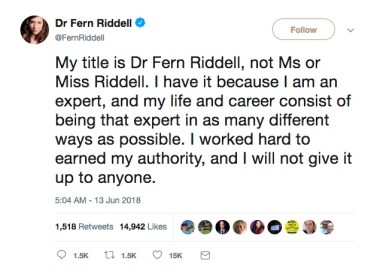
A friend of mine at the University of Oklahoma posted this picture of her Twitter feed shortly after she added the “Dr.” title to her name:
She pointed out that this was the first time something she put out there really went “viral” and that it wasn’t all love, luck and lollipops when it came to the responses she got:
Others joined, as noted in the article, while some folks griped or condemned or just flat-out trolled this idea. I’m sure for some people, who haven’t walked the academic walk, the whole “Doctor” notion can feel like this:
This issue has batted around for years in various social media groups, and I know the hivemind chatted about it a bit ago with folks noting that male professors often got the “Doctor” or “Professor” honorific while female professors got the “Miss,” “Ms.,” “Mrs.” or first-name treatment. I mentioned that I often eschewed the title of “Doctor” because a) I look like a homeless elf half the time, so putting a title on me is like putting prom dress on a pig and b) I never really felt like a “real” doctor.
Which leads us to the origins story of how I came up with “@DoctorOfPaper” and what it means…
When I graduated from Mizzou with my Ph.D., I did the “doctor” thing on graduation night and made dinner reservations under “Dr. Filak” for Amy and me at a fancy restaurant. Later that night, we ran into a student of mine who had just graduated and who was celebrating at a patio bar with her family.
She brought us over so she could introduce us to her mom and sister and everyone else there. During the chit-chat, I mentioned that I had just received my doctorate, which led to this:
Student’s Mom: “So what is your specialty then?” Me: “Oh, no… I did my Ph.D. I got my doctorate in journalism.” Student’s Mom: (Pauses before bursting out with laughter) “Wait… You mean… you’re a DOCTOR of PAPER?” (continues to laugh into her alcoholic slushy)
Amy loved that, so whenever she felt I needed to come down a peg or two, she’d remind me I was a “doctor of paper.” It was good-natured ribbing, but the point was clear: When someone’s dying in a restaurant and someone shouts, “Is there a doctor in the house?” I shouldn’t stand up and explain, “Yes! And please allow me to explain how the human surveillance need as part of uses and gratifications theory is why people all over the restaurant are staring at this choking guy.”
Thus, I usually let the whole “Doctor” thing slide with students. That said, one thing that a friend pointed out, which I hadn’t thought of at the time, was that I had the privilege to do that because, as a male professor, students showed me deference up front. For her, she had to fight to get that respect and she wasn’t giving it up for anyone. It’s an important point and a key difference.
Titles can be a weird thing in a lot of ways. A guy my dad worked with used to coach my basketball team from fifth to eighth grade and I always knew him as “Coach Groppi.” When I was about 30, my grandmother died and he came to the funeral. I hadn’t seen him in more than a decade but when he tapped me on the shoulder and said hi, the first words out of my mouth were, “Coach Groppi!” Habits can be hard to break, apparently…
So why is this on a journalism blog and why does it matter to you? Because there are some key things you can take with you as you report and write. Plus, it adds a good critical thinking notion to your thoughts as well as an ethical element. Consider a few points:
Style matters: When it comes to the simple idea of style, AP has gone out of its way to make things a little easier on you when you write in this area. Everyone gets “last-name-only” treatment on second reference and we eschew courtesy titles for folks up front, including “Mr.” “Mrs.” “Ms.” or even “Dr.” (The New York Times has its own thing with courtesy titles I’ve never understood, so I’m sidestepping that one.) As a writer in a publication that follows AP, abide by the rules in your copy and you’ll be OK there.
Inequity: Style wasn’t always so “up with people” about how it treated people who weren’t straight, white men. Women in publications used to be referred to as “Mrs. John Smith” as opposed to something like “Mary Smith” on first reference. I remember once seeing a story about a city council action in the 1960s, in which one guy was referred to as “the Negro councilman.” Nobody else had a racial identifier. We discussed the idea of how words create hierarchy and word choice is essential to equality here before. If one race, class, gender or whatever is getting X treatment, use X treatment across the board. The whole goal of style is consistency, but the underlying issue should also be fairness in how you deal with folks.
The “Mudcat Grant” theory:Jim Grant pitched in the majors for 14 years in the majors, becoming the first black pitcher to ever win 20 games in the American League. He became known as “Mudcat,” he once explained, because some coach at his first Spring Training or Rookie Camp thought he looked like he came from the south, so he nicknamed him as “Mudcat.” Grant said he almost got tossed out of camp because when someone called for “Mudcat Grant,” he just assumed it was someone else. Eventually, Grant had a discussion with the coach about this and explained that it wasn’t his name. “It is now,” the coach, who was white, told the scared rookie. At the end of the day, he dealt with it because he had to but the point is, people deserve the right to be called whatever they feel is most appropriate. We do it with names, as some people go by Vince or Vincent, but not Vinny or Vito. I had a friend who went by his middle name (Andrew) because his first name (Michael) was also his father’s name and he didn’t want to go by “Junior.” We do it with titles, such as university leaders. (I don’t recall a lot of Twitter rage when a university head is called “President Smith,” with people saying, “You’re not a REAL president! Where’s your army, you pencil-necked geek?”)
Just the smart thing to do: There’s one other thing I liked learning about with Jim Grant’s experiences. He had a simple philosophy: “I try to be nice to everybody.” That’s a pretty good idea for everybody, but specifically for journalists who are approaching people and asking for some of their time. I’m not a person who puts a lot of emphasis on etiquette (I can hear Amy laughing already with the use of “a lot” there…), but when people want something from me, they tend to get further with honey than with vinegar. When students send me emails that start with “Dr. Filak” and then they ask for something, I’m probably more inclined to read on and consider it. When I get the salutation of “Hey Filak” or even once “Brah” (not even a “Dear Brah” or “Dear Dr. Brah.” Just “Brah.”), I’m probably less inclined to read it. Why take a strike against you for no good reason right at the start of the at-bat? When you research the person to whom you wish to speak, look for the Ph.D. and address your email, text or call accordingly. As we noted in the interviewing section, let the source dictate the tone of formality and act accordingly. It’s just the smart thing to do.
The end of the school year is nearly here at UWO, and I’m hopeful that it’s close by for the rest of you as well. This feeling of “nearly summer” brings about two certainties:
Student emailing for any potential extra credit or possible grade boosts, offering explanations as to why they have not cut the muster to this point or pagan sacrifices in hopes of making it out alive.
The snow finally starts melting out here.
In honor of this annual ritual, here’s a “Summer is coming” AP style quiz to give you one last boost of style heading into your well-earned break.
You don’t have to create an account to play, but if you want to, it will rank you.
Post a screenshot of your score here and brag to your friends. Challenge a professor so you can have bragging rights.
I got a message from my editor at SAGE this morning, who had the unfortunate timing to visit Wisconsin at this point in time.
What is going ON with Wisconsin??? WHY IS THERE SNOW? ITS SO COLD HERE HOW DO YOU LIVE?
To be fair, it’s April 4 and this was what it looked like in my driveway when I got up to go to work:
In honor of “spring” in Wisconsin, here’s an AP-style quiz based on the weather out here in the Midwest. You don’t have to create an account to play, but if you want to, it will rank you.
Post a screenshot of your score here and brag to your friends. Challenge a professor so you can have bragging rights all year.
Every house I’ve ever lived in had a “junk drawer” in the kitchen where we kept everything that didn’t really have a place. Batteries, bottle openers, matches, a deck of cards and more were in the junk drawer. Today’s post is kind of a “junk drawer” of sorts, with a lot of little things worth noticing that don’t really have a place or merit a full post.
Consider the following leads, tweets and other bits of information:
For the audience with an interest in 19th century French linguistics:
Stephon Clark was in his grandmother’s backyard, trying to get into the house Sunday night when two Sacramento police officers loosed a fusillade of 20 bullets, killing him, Clark’s family told ABC News.
A fusillade, a term with roots in 19th-century French, is “a series of shots fired or missiles thrown all at the same time or in quick succession.” I have a Ph.D. in a communication-related field and I have spent the majority of my professional journalism life covering crime, but never once have I thought to use the word “fusillade.” This is one of those cases where you want to check the author’s desk for a “Expand Your Vocabulary” page-a-day calendars and destroy it.
The Department of Redundancies Department:
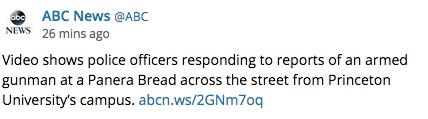
Here’s an example of how you don’t need a lot of space to screw something up:
Armed gunman? As opposed to what? An unarmed gunman? Unless you literally have a man with no arms packing an Uzi in his mouth, you need not distinguish between an armed gunman and an unarmed (or armless) gunman.
Grammar counts:
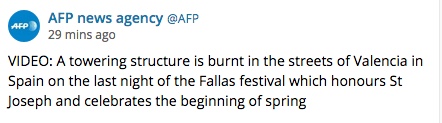
It took me two reads to realize what was wrong with this, but when I did, it came back to an old nun barking something about adjectives and verbs at me:
The author of this tweet uses the adjective “burnt” to describe the structure, which means the video would simply show the presence of a crispy statue. The author meant “burned” which is the action of someone setting fire to the item and letting the fire consume it.
Point/Counterpoint rides again:
I guess I would expect nothing less than disagreement with the premise that “straws are evil” from a person whose job it is to support the straw-manufacturing-and-distribution industry.
My worst nightmare in reverse:
I always fear that somewhere in one of my books, I’ll misspell “public” and add to the laundry list of “pubic libraries,” “pubic schools” and “pubic meetings” that have dotted the news landscape over the years. In reading the Omro Herald (*Omro, Wisconsin’s Finest News Source) this week, I ran across a formal outline of a new “anti-sexting” law the city had passed, and noticed this:
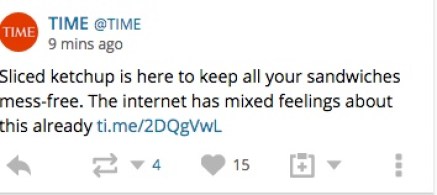
“The internet” has spoken:
Of all the dumb things we’ve been doing lately in media, saying “the internet” has something to say about whatever it is we’re talking about has to be one of the worst. The whole idea behind getting attributions is to allow us to show the readers who thinks what and why. When we just grab 83 tweets and call it a set of “mixed feelings,” we’d be just as informative if we asked my imaginary cat, Pop Pop, what he thinks about it. If you want reactions, go ask people who are informed for them. If you want to use tweets as a reaction, figure out WHO these people are and WHY your readers should put stock in their opinions. The internet isn’t a source, but the people you find using it might be.
It’s on the internet! It has to be true:
A student found this while doing a search for a research paper he was doing and saved it for me. It just reinforces my theory that “Wiki-Anything” isn’t a source.
Baseball is perhaps my favorite sport and leads to my favorite time of the year. The sounds of Bob Uecker calling Brewers games on the radio that Dad kept in the garage was the soundtrack of summer for me. Now, I listen to him or Tom Hamilton calling Cleveland games on my MLB app.
In celebration of the opening weeks of spring training, here is an AP-style quiz that focuses on those picky rules that surround America’s pastime. You don’t have to create an account to play, but if you want to, it will rank you.
Post a screenshot of your score here and brag to your friends. Challenge a professor so you can have bragging rights all year.
It’s cold, it’s gray and Spring Break is too far away. At least my wife loves me so I’ll have someone to out with on Valentine’s Day… Or is it Valentine’s day? Or maybe Valentines Day?
If you know, you’re 1/10th (or is it one-tenth?) of the way to a successful run at this edition of the AP Style quiz. You don’t have to create an account to play, but if you want to, it will rank you.
Post a screenshot of your score here and brag to your friends. Challenge a professor so you can have bragging rights all year.
With a lot of people getting back to the school grind, it’s time to knock the rust off of the ol’ AP style guide and sharpen your editing skills. If you think you have game, give this quiz a shot. Speed counts, but accuracy matters most.
Here’s a 10-question AP style quiz for you. You don’t have to create an account to play, but if you want to, it will rank you.
Post a screenshot of your score here and brag to your friends. Challenge a professor so you can have bragging rights all year.
“Dynamics of News Reporting and Writing” launched this week, which means a couple things:
I’ll usually be posting at least once a day, Monday through Thursday. (Friday, possibly. Weekends only if something really weird happens.) You can feel free to subscribe if your professor is making you keep track of this instead of randomly checking in on the blog from time to time.
I’ll be driving up Amazon’s web traffic exponentially by checking in constantly to see if anyone is buying this thing. (That’s not weird or anything, right? It is? OK, forget I said it.)
I’m going to screw some stuff up. It’s inevitable.
I was on a call with the publisher Wednesday and I asked if everything was going OK with the book and the blog. Her responses were essentially, “The reps have only had the book for a day. Calm down.” and “The posts are fine, just watch the cussing and the typos.”
I’ve been dialing back on the cussing, although I think we need a running list of things the president is allowed to say, the media is allowed to repeat and that I can’t say on the blog. Maybe we need bingo cards or something. Feel free to get on that.
As for the typos, I’m going to be honest: I read the heck out of the posts before they go out but eventually I go blind to what I write. As I noted earlier in the year, I know everyone needs an editor. In fact, when I made that post, I got an email from a former student who caught a typo in there. Yes, I suppose it proves my point, but good grief…
So here’s the deal in this wonderful world of symbiotic relationships: I’ll do my best to tell you stuff that helps you out and you should feel free to say, “Hey chucklehead, you spelled (whatever thing I screwed up) wrong.” Just hit me with an email or via twitter (@doctorofpaper) and I’ll patch up my stuff and give you a hat tip.
Hope you all have a great start to your semester and let me know if I can be of any help.
The issue of when certain words can and should be used in the media came back into play this week, after news broke about President Donald Trump and his position on immigration. According to multiple reports, he used the term “shithole” to describe several countries, thus upsetting people from those countries, shocking many politicians who were in the room and sending the media into another “should we or shouldn’t we” debate on language.
To say the past year or so has been a long, strange journey for language wranglers would clearly be an understatement. We had the “Billy Bush Bus Tape” incident, which had people wondering how to explain what Trump said could be “grabbed.” We had the questions about how exactly to refer to the allegations outlined in “the Russia dossier,” especially as they related to the act the hookers were said to have performed. We had the “Scaramucci meltdown” in which he offered a profanity-laced tirade to a reporter. And now we have countries that fail to measure up to the standards of Norway.
(Side Note 1: I actually asked if the term should be one word or a compound modifier. That was my key concern. You would not believe the level of grammar the hivemind went to in discussing this. Yes, your professors and your profession are both weird…)
(Side Note 2: I asked a former student who is now a bigwig with AP if she could give us some thoughts today on this in the wake of the “hole-like nature” attributed to these countries. It turned out, she was going on vacation for her birthday, so I let that go. We both, sadly, agreed this likely wouldn’t be the last time we’d be discussing some word that we’re not allowed to say in print, broadcast or anywhere short of a biker bar, so I could hit her up for some help next time.)
So how do you know if you should or shouldn’t be using the term, an explanation of the term or just some Q-Bert like exclamation? The hivemind dug into this earlier in the year with the Scaramucci thing, so feel free to click here and take a read to see what some of the “best practices” are for dealing with some of the “worst behavior” out there.