The Junk Drawer: Hump Day Edition

Is the weekend maybe hiding in here somewhere?

In the middle of the week during the middle of the semester, it’s a bit of a drag for students and professors. With that in mind, here are a few things that might amuse you all, spark some discussions or generally make it feel like the weekend isn’t so far away:

FLORIDA’S VERSION OF “WHO WORE IT BETTER?”

You know you’re a journalist when the first question you have after reading this headline isn’t, “What the hell was wrong with this woman?” but rather “How did the manatee get into a bikini?”

In the world of misplaced modifiers, I think this one is the gold standard.

Speaking of “What the hell is wrong with people…

STOP, THINK, THEN POST: Dan O’Donnell, a conservative talk show host out here in Wisconsin used the occasion of the Iran attacks to call for the death of Minnesota Gov. Tim Walz:

O’Donnell later apologized for his posts and took them down, but there are still copies of this floating all over the internet. It’s also not great optics, given Minnesota House of Representatives Speaker Emerita Melissa Hortman and her husband Mark Hortman were killed in July, in an attack deemed politically motivated.

This serves as one more reminder that stupidity is bad, but amplifying it on social media is worse.

GLAD WE GOT THAT NAILED DOWN: Stories based on opinions, particularly those that can’t be supported or refuted, don’t usually do much for me, but I have to admit this one grabbed me:

The former star of “Growing Pains” and long-time evangelist for Christianity has done a lot for publicizing his faith and reaching out to others to help them find Jesus. That said, I’m wondering where he got the inside scoop on the existence of hell.

I’m also going to argue that if he doesn’t believe in “eternal conscious torment,” he never had a nun for a teacher like I did. Sr. Mary Kenneth still haunts me in my dreams some times…

Speaking of living rent-free in someone’s head…

EVERY TIME A STUDENT REMEMBERS SOMETHING YOU TEACH THEM, AN ANGEL GETS ITS WINGS: I teach a lot of 8 a.m. required classes for sophomores, so I’m never exactly sure how much the students learn from me or how much they think about what I’ve taught them.

That’s why when a student not only remembers what I taught them, but also reaches out to say that they found an example of it in the wild, it just warms my grinchy little heart:

Hi professor, I saw this on Facebook and just thought it was so coincidental that we worked on a draft lead about a case just like this I thought I’d share with you. I think they wrote this terribly:

I’d have to agree with the kid, given that we don’t find out about a dead body until halfway through the piece. I’m also somewhat disturbed by the phrase “a working fire.” As opposed to what? An unemployed fire?

And finally…

SUITABLE FOR FRAMING: Some students wait until week 12 of a 14-week term to start trying to act right in class. At that point, they realize they’re totally screwed, as the math won’t allow them to pass, so they beg for extra credit.

I usually post this on my door right about the time I get that first request:

Feel free to borrow that.

Have a great day.

Vince (a.k.a. The Doctor of Paper)

UNC policy allows the U to record classes without telling professors or students, while students aren’t allowed to record at all

If you feel like this, you might be working at UNC…

THE LEAD: The University of North Carolina has implemented a policy that dictates who can and can’t record classroom content, which includes a terrifying Big Brother option for the university itself:

The University may record a class or access existing classroom recordings without the permission or knowledge of the instructor being recorded for the following purposes:

  • To gather evidence in connection with an investigation into alleged violations of University policy, when authorized in writing by the Provost and the Chief Human Resources Officer; and
  • For any other lawful purpose, when authorized in writing by the Provost and the Office of University Counsel, who will consult with the Chair of the Faculty.


BACKGROUND: The university had run into several issues related to recordings of professors over the years, only to figure out it really had no policy in place to deal with such things.

The tipping point appeared to be when UNC decided not to renew business professor Larry Chavis’s contract after reviewing recordings of his classes. Chavis noted he had no idea the university was recording him.

When called to account for this surreptitious move, the U fell back on the “well, we’re a one-party consent state” thing, which is true but a bit wobbly at best.


A FEW BASIC OBSERVATIONS: I found myself thinking about a couple aspects of the policy that either people haven’t considered very well or they just hope they won’t have to deal with in the future. Consider the following:

Rules for student recordings: I’m not sure exactly how this came into play, but the document makes it against UNC law for students to record in the classroom, except under specific circumstances:

Students may not record classes, including online classes, without express advance permission from the instructor teaching the class they wish to record. Students approved for recording as a University Compliance Office (UCO) accommodation to address a disability, pregnancy, or religious accommodation must notify instructors of their approved accommodation by sending an accommodation notification plan in advance of any recording. The approved accommodation plan must indicate the means by which the recording will be accomplished and any other details pertaining to the recording or its use.

Well, for starters, how are you going to monitor that, given students carry about 97 digital devices on them at any point in time? I guess if I’m in my computer lab at UWO with 20-some kids, maybe I might notice a kid’s phone set to record, but most likely not. In a UNC pit class, though? Not a chance in hell.

Add that to the lack of a specific “or else what” in this policy and I’m thinking this thing is going to be relatively toothless when it comes to enforcement. I’m not an expert on university policy or UNC’s policies in particular, but I don’t see a “If you do X, you will suffer Y” in this document. The document also doesn’t say, “See POLICY X for punishments” so I’m left to wonder if the kids will record anyway depending on how strict the policy and problematic the punishment.


Martyrs to the cause: Most of the kerfuffle I’ve seen in relation to classroom recordings getting out into the world is related to students trying to “expose” professorial bias. We’ve covered a few of these here, and there are dozens more cases elsewhere in which a student records a professor doing or saying something that upsets a large group of the perpetually offended. Once that match of outrage hits the kerosene of social media, the professor’s goose is cooked.

With that in mind (and the previous point in mind as well), I somehow doubt this kind of thing will stop. Even more, I imagine that a kid who “exposes” a professor via an illicit recording at UNC will now be hailed as a martyr to the cause if any punishment befalls that kid.

(“Let’s all remember the brave sacrifice of Jimmy, who recorded Professor Jones misgendering a piece of wicker in Underwater Basketweaving 385. That ‘stern talking to’ he got from the dean will haunt him always…”)

We have a world in which social media rules, “gotcha fame” is aspirational and people are way too full of themselves around the academic world. Recordings are going to happen.


To Chill or Not To Chill: I’ve studied the concept of the Willingness to Self-Censor for a number of years and found that many people have an innate sense of how willing they are to speak out or shut up when faced with controversy. Certain topics tend to spark this more in all people, but many topics spark it in specific people. In short, there are a lot of reasons why people will hold their tongues and it’s not always because they don’t have something to say.

Conversely, I’ve dealt with academics all my adult life and I found that many of them apparently have some sort of condition that makes them think everyone should hear what they have to say about everything, regardless of the circumstances.


Michael Palm, president of UNC’s chapter of the American Association of University Professors and associate professor in the UNC Department of Communication, said faculty members are aware they may be monitored by the University or even outside groups.

“My sense is that most faculty, at this point, just assume they’re being watched,” Palm said.

<SNIP>

“I think it is unquestionable that there has been a chilling effect on campus and that many more faculty now than at any other time that I’ve been a faculty member — and I’ve been at UNC for 18 years — are self-censoring out of fear for what might happen if the wrong people disapprove of the content in their classes,” Palm said.

If I’m being honest, there are days I have a “come at me, bro” vibe going on when it comes to my classroom. If you think I’ve said something stupid, childish, offensive or whatever… well… take a number, I guess. Then there are other days where, if I think about all the potential ways something like this could screw me, you couldn’t pull a needle out of my keester with a tow truck.

What I foresee here is that the students are going to lose a lot, thanks to this policy. The professors who really SHOULD be curbed a bit in regard to their histrionics and side-rambles will be the ones thinking, “Well, that’s for other people…” The folks who are more like academic prairie dogs, popping their little heads out of their holes juuuuuusssst enough to see if the coast is clear, will stay under ground for fear of getting whacked.

Cleveland Plain Dealer honcho Chris Quinn took time out of his busy schedule to crap all over journalism schools about their views on AI, despite not actually knowing their views on AI

I hope the computer-based journalism helpers Chris Quinn is putting his faith in work better than the Cleveland Plain Dealer website. I tried to buy a subscription to view his diatribe about journalism schools and AI, only to have a spinning wheel of death show up for about a day or so…

THE LEAD: Chris Quinn, the VP of content for the Cleveland Plain Dealer, took a victory lap over the weekend, bragging about how he removed the writing requirements associated with journalism via “AI specialists,” while also telling journalism schools they suck:

Because we want reporters gathering information, these jobs are 100 percent reporting. We have an AI rewrite specialist who turns their material into drafts. We fact-check everything. Editors review it. Reporters get the final say. Humans — not AI — control every step.

By removing writing from reporters’ workloads, we’ve effectively freed up an extra workday for them each week. They’re spending it on the street — doing in-person interviews, meeting sources for coffee. That’s where real stories emerge, and they’re returning with more ideas than we can handle.

<SNIP>

Journalism programs are decades behind. Many graduating students have unrealistic expectations. They imagine themselves as long-form magazine storytellers, chasing a romanticized version of journalism that largely never existed.

That’s what they’re taught.


DISSECTION TIME, PART I: Let’s look at both Quinn’s arguments as well as take some time to disprove them, starting with his view of students and journalism programs:

The Strawman Student: Quinn’s piece begins with an exemplar of how students suck these days, especially because we teach them poorly at every journalism school in the country:

A college student withdrew from consideration for a reporting role in our newsroom this week because of how we use artificial intelligence.

It reminded me again how college journalism programs are failing to prepare students for the workforce.

I don’t have a reason to doubt Quinn that this kid exists, but I also have no reason to trust him. I’d like to see the withdrawal letter/email/voicemail the kid sent and I’d probably also like to talk to the kid.

See, Chris, sometimes people tell you stuff that isn’t true, like “I really wish I could make it to your party” or “The break up isn’t about you, it’s about me” or “It happens to a lot of guys and it’s not a big deal.”

Maybe this kid didn’t want to work for someone who saw their role in the newsroom as feeding grist into a mill for a robot overlord. Maybe they actually enjoyed writing, so giving up the part of the job they like wasn’t worth it to them. Maybe, and I say this as a huge fan of the sports teams, they didn’t want to move to Cleveland.

Could be a lot of things, but blaming it solely on your AI policy helps you nicely set up your argument that journalism schools suck.


The Incorrect Overgeneralizations: The bigger problem here is the leap from this one kid not liking something to all journalism programs failing all of the kids out there all of the time. Even if we pretend that this one alleged kid was so allegedly horrified at the Plain Dealer’s amazing-as-hell AI set up that they had to pull out immediately, it doesn’t follow that all kids in all schools are taught to hate AI. This is called negative social stereotyping.

Even if that feels like a bit of hyperbole, let’s at least agree that not every kid who comes out of a program is the exact same in terms of quality, maturity and expectations.

Also, I think we can agree that not every journalism program is created equal, so while the kids at University A might be using smudge pots to ward off the evil spirits used to power AI, kids at University B might be getting some good data journalism help, transcription services and other goodies, courtesy of AI.

Then again, maybe we can’t agree, given this generalization:

Like many students we’ve spoken with in the past year, this one had been told repeatedly by professors that AI is bad. We heard the same thing at the National Association of Black Journalists convention in Cleveland in August. Student after student said it.

Chris, did you bother to dig a bit deeper on this, because there are a few nuances that merit consideration. First, who were these professors? Were they in journalism or were they in departments where they’ve gotten used to grading 500-word essays that AI can now crank out in 18 seconds, thus putting the fear of God into these people?

What kind of AI was under discussion? Traditional AI? Generative AI? Did the professors state that certain AI programs are less helpful than others, or that relying solely on whatever content AI puked up was dangerous from a fact-based standpoint?

Did the professors explain the “black box” and “hallucination” concerns about AI? Did the professors show them example after example after example of how AI completely screwed the pooch, thus trying to help them see that you can’t just turn it loose and hope for the best? 

I’m also curious, given your disdain for journalism programs, where did the amazing Hannah Drown and Molly Walsh garner their educational pedigree that mixed the poli sci, business and non-profit knowledge you desperately want kids to have?

Oh… Yeah…

Given their background, I’m wondering how Hannah and Molly feel about this proud declaration you made:

Fortunately for those of us who know exactly what skills we need in applicants, AI has altered the landscape so dramatically that we don’t need journalism school grads.

We don’t need any damned JOURNALISM GRADUATES… Except, of course, the two we hired to do this work that we’re so proud of…


The Erroneous View of J-Schools: I’d like to know how many journalism programs Quinn visited in the past five years. A five-year span would cover the time frame where artificial intelligence would have become relevant enough for schools to start embracing a relatively stable set of AI tools.

I’d put the over/under at about three schools, and I’d advise people to take the under.

There are likely colleges that are shunning AI, but clearly many more are embracing specific aspects of these tools.

CUNY has an entire AI Journalism lab for professionals to come back and learn the ropes. Northeastern University is diving into the research and practical ends of AI with its AI Literacy Lab. The Medill School at Northwestern University has its Knight Lab to work on AI and media. Arizona State University has put a ton of resources into its work on AI and news innovation. University of Northern Colorado built a production course that teaches students how to meld AI and journalism effectively.

Stanford, UCLA, Atlantic International University, Florida and Columbia are just a few of the other schools that have Journalism-based AI courses on the books, and those are just the ones I found on through a cursory search. That’s not even counting all the programs (ours here included) that have infused AI into the current courses we have, so we can demonstrate the value of the tools while we teach caution as well.

(NOTE: If your school or your class does some AI stuff, feel free to pipe up in the comments section. I bet we could really make a run at the record for most comments on the blog.)

I not only teach about artificial intelligence in my classrooms, but I also include chapters on it in my books and provide basic exercises to educators that showcase its strengths and weaknesses.

What we have here is a collection of facts, supported by links to additional information. I’d like to think that’s a bit stronger case than Chris Quinn’s “Old Man Yells at Cloud” approach to generalizing about what’s wrong with journalism schools today.


The “Road Less Traveled” Advice: Quinn’s ignorant view on J-school is problematically compounded by his educational suggestions for kids who want to enter his glorious newsroom:

If you’re a student considering journalism, I’d skip that degree. Study political science. Learn technology. Understand how government, businesses and nonprofits work. Take communications law and ethics as electives. Skip much of the rest.


Got it. Just like you did back in the day! Right, Chris? Oh… Wait…

I don’t know if he’s going to be on College of Media and Communication Dean David Boardman’s Christmas card list this year, but I’d love to see Boardman’s reaction to this column… 


Aside from the “do as I say, not as I did” thing, if I wanted to tank a kid’s future, I’d pretty much tell that kid to do exactly what Quinn is saying here.

Technology changes so rapidly that whatever the kid learned in freshman year would likely be obsolete by graduation. You can learn tools, but it’s important to know the broader ways in which they should be applied to further your skills and connect with your audience. For example, in my day, we didn’t major in Quark XPress. We majored in design, used the tool in conjunction with our broader understanding of the field and then adapted to technology changes.

In addition, there’s a reason the phrase “Why try? Go Poli Sci” is still heard in the halls of many academic institutions. It’s also much more likely to be in the “paper law” as opposed to the “trial law” end of the spectrum. I’m not saying a certificate, minor or even double major in this is field is bad, particularly if you want to take your media skills into the political realm. However, you’re not making it to a newsroom solely on a steady diet of Politics and Genocide or Western European Politics courses.

I’d also like to know where Quinn thinks students are getting their interviewing skills, their social media experience or their general reporting knowledge in this newly formed major he’s promoting here.

Being forced to meet people takes effort, particularly based on how today’s generation of students has grown up in a digital-first, post-pandemic, borderline-anthropophobic world. Research suggests that nearly 45 percent of Gen Z men have never asked someone out on a date in person, so if Quinn is assuming this fresh crop of potential folks can do this without some reporting courses (still a thing) or other forced socialization, I’ve got some unfortunate news for him.

Also, com law might not matter much any more, if what’s happening in the real world is any indication…


DISSECTION TIME, PART II:  With that out of the way, let’s pick apart Quinn’s views on artificial intelligence and the glorious way in which it has drastically improved his newsroom:

AI! It’s FANTASTIC! (Usually):  Quinn has gone all-in on AI, which is always dangerous when it comes to a new technology. Actually, it’s usually dangerous in any situation, given that most new ideas suffer a lot of growing pains before they eventually become valuable, but so much less so than what was expected.

Still, he’s a fan:

Artificial intelligence is not bad for newsrooms. It’s the future of them. It already allows us to be faster, more thorough and more comprehensible. It frees time for what matters most: gathering facts and developing stories to serve you.

Anyone entering this field should be immersing themselves in AI.

I’ll buy faster, but I’m not entirely sold on the other descriptors here, given what we’ve seen AI mess up already. Dare I say Quinn is “chasing a romanticized version” of this technological marvel.

AI has fouled up a ton of content in some pretty awkward ways, including calling a guy “useless” in his own obituary, misnaming the city in which an NFL team resides, cliche-festing local sports stories and screwing up an entire development plan in a local news story. That’s not counting the number of times people got tricked by AI sources or generally misled by AI-generated content.


Words, Words, Words…: Quinn seems to take an almost perverse level of pride in how much content his staff members can grab and how none of them has to do any actual writing any more:

By removing writing from reporters’ workloads, we’ve effectively freed up an extra workday for them each week. They’re spending it on the street — doing in-person interviews, meeting sources for coffee. That’s where real stories emerge, and they’re returning with more ideas than we can handle.

I get that it’s important to do deeper reporting, spend more time with sources and connect with the communities journalists cover. However, the question becomes, “How much of all that good will and strong effort is wasted if you just toss everything in an AI blender and then watch the content move along like you’re “Laverne and Shirley” at the Shotz Brewery?”

Plus, and maybe Quinn doesn’t give a damn, but I’ve found that when I invest a lot in the reporting, I tend to care about the story I want to tell. That usually leads to some stronger, more engaging pieces based on well-crafted writing.

Being a writer isn’t a negative, particularly if you want to write for the benefit of an audience that is interested in what you have to say. I think I’m qualified to say that, given everything I sit down to write has me thinking, “Who would want to read this and what would they want to know?”

I’m not sure if AI has gotten to that point yet, but I know good writers have.


Quantity over Quality: I forget what movie it was in, but there was a scene in which prisoners were told, “We’ve got good news and bad news. The bad news is that all we have for your dinner tonight is horse manure.” When someone asks, “So what’s the good news?” the official replied, “There’s plenty of it.”

Which brings us back to the Plain Dealer’s Bin of AI Content…

A quick look at the list of stories Hannah Drown put together recently provides some sense of the quantity. Each day she appears to be on the job, a handful or more stories with her byline show up. She’s got coverage of events at the Lorain County Junior Vocational School, a UAW strike in the area, a pop-up shop at the Lorain Community College, a school lockout in Elyria and more. The volume is there.

The quality, however, leaves something to be desired.

These are mostly stories that could have easily come from a press release rewrite, featuring a “Hey, come check out this new thing” approach. These lack depth and nuance, not to mention any level of critical thought. The stories have overly long sentences, generally lack flow and are as dry as a popcorn fart.

For all the bragging Quinn does about reporters getting a chance to sit with sources, meet for coffee and chat these people up, most of the content comes straight from documents, not people. A look through more than a dozen of these pieces revealed virtually no direct quotes or specific references to interviews with these salt-of-the-earth individuals.

For example, a story about a school teacher who donated bone marrow to a complete stranger half a world away would seem to be exactly the kind of piece that would engage readers through amazing storytelling. Instead, we get this lead:

LORAIN, Ohio — Valentine’s Day usually arrives with candy hearts and roses, but this year, one of the clearest acts of love connected to the holiday came without flowers at all.

We get no direct information from the teacher about the experience, nothing from the folks at the National Marrow Donor Program talking about the value of the program and nothing from people who have had their lives saved through some of these selfless acts.

The story has zero quotes in it and reads like a “how-to manual” for getting on the bone marrow registry and donating it to someone. Boring doesn’t begin to cover it.

I’m not entirely sure I can blame Drown for this, as it is her job to just shovel content into the front end of the pipeline. It’s also not stated to what degree AI did any work on this (or any other) piece in her clip file, which I’d consider a bit of an ethical concern.

What I can say is that if my name were on these things, I’d want the writing to be a lot better than it is. As we’ve noted before, AI essentially creates an average of EVERYTHING it takes in, regardless of quality, and this definitely feels like “C” writing.

What goes unsaid in Quinn’s magnum opus is that people now have an abundance of media outlets at their disposal that provide vast sums of content. Journalists have to grab people by the eyeballs and hang onto them in a way that distinguishes their work from the noise.

This is where quality writing and keen storytelling come into play and where the generic “held a meeting” leads that AI can churn out will fail.


(FINAL NOTE: I’m sure Quinn would be horrified at the amount of time I spent writing this piece, given his “crank ‘er out” philosophy. I’m fine with it, though, because I believe dedication to one’s craft matters a lot, even if the point is just to tell someone they’re full of crap.)

Journalism-related concepts that played out as well in the medical world while I was getting gallbladder surgery

My boss was nice enough to let people know I’d be out for a bit, but this is a little vague… Not like THAT’S gonna lead to speculation…

At the start of every semester, I try to come back with a “X number of things I’ve learned” or a “X years of teaching have taught me” kind of post. It was ruminating (I swear) when my second gallbladder attack in four days hit me badly enough to head to the ER at midnight the day before school started.

Although everything went well, I found myself living out little moments that had me shifting into “analogy mode” as I saw parallels between where I was (the hospital) and where I wanted to be (a journalism classroom). So, as I continue to mend and catch up with the 82,324 things that have landed on my desk while I was gone, I thought a simple slow-walk post of advice would be a good start to what has already been a shaky semester.

(Also, to be fair, I’m still on meds, somewhat hazy and worried I’d somehow come in hot on a topic like Bad Bunny or something that would end up getting me fired without me entirely knowing why.)

So, here are a couple of the maxims that ring true in journalism that kind of came home to me throughout my hospital stay and recovery:

ACCURACY ABOVE ALL ELSE: We’ve been having a lot of conversations like this around the house:

Me: Who called?

Zoe: She didn’t leave her name on the voicemail.

Me: Can I listen to it?

Zoe: She was just like “Hi, this is mumble mumble and I’m with…

Me: So she did leave a name, but you just didn’t understand it? Is it possible that maybe if I listened to it, I could figure it out?

Zoe: Well, I guess…

As much as I expect that out of my kid, I didn’t think I should expect it from a healthcare provider.

Case in point: Upon leaving the hospital, the discharge nurse is going through all the stuff I should or should do, eat or drink. She tells me to avoid fried food and fatty food like bacon. Due to the lack of the gallbladder, these things are likely to create severe gastric distress in the early stages of my recovery.

OK, got it. Most of my diet goes on the shelf.

The other night, Amy made this amazing chicken and potato thing that was part of our “healthy eating” resolution for the year. About 20 minutes after I ate it, I’m in stomach-cramp hell for about two hours. Turns out, she used olive oil on the stuff, which has the same basic effect as those other two things, even though the nurse didn’t mention it and we all usually seem to think olive oil baking is good and deep-fried drumsticks are bad.

I often think about the way in which we ask questions of people in journalism and how we get “almost” answers, or how sources provide information that’s direct but not entirely accurate. From now on, I plan to start interrogating sources like the entirety of my GI tract depends on it.


VOCABULARY MATTERS: We always talk about picking the right word, the proper descriptor or the exact phrase to help the audience understand things accurately. In news stories, it’s relatively important. In the medical field, it means a hell of a lot more.

In trying to explain what he found when he dug into my gut, the surgeon referred to the gallbladder as “angry,” “wicked” and “gnarly.” Those descriptors sound more like the tappers at a South Boston pub than a description of a human organ.

In addition, he explained that something had happened causing my gallbladder to grow a “rind” over the top of it and encase it tightly against my liver. What created said rind and what the rind was composed of, he would not venture a guess. Apparently, I just have a brie-like defense mechanism against gallstones or something.

I didn’t need the whole medical textbook explanation, but it did dawn on me that I felt like I was interviewing Nuke LaLoosh in “Bull Durham” for a bit here:

When it comes to telling people things, keep your audience in mind and use strong, clear vocabulary that helps the folks out there understand exactly what is going on and why they should care.


CONNECTIONS CUT BOTH WAYS: We talk a lot in reporting about the importance of having strong connections with good sources. Those kinds of relationships can give you an edge when it comes to a big scoop, a key interview or a sense of confidence on a topic.

They can also be a problem if sources try to ask you for things you can’t provide or they assume you won’t write about things they don’t like. I always tell students, “It’s great having the mayor feeding you tips, right up until the point his kid gets busted for a DUI and he wants you to keep it out of the paper.”

In terms of connections at the hospital, I was not only being treated at the same hospital where Amy had worked for several years, but I was actually on her old unit. This led to some significant comfort for me in terms of knowing (relatively speaking) who some of these folks are. It was also great because they had nothing but praise for Amy and wanted to know how she was doing at her new job and so forth. I also knew I had a rock-star surgeon because Amy had worked with this guy’s post-op patients over the years, so she knew him and his work.

The “cuts both ways” part really was more of my own making, in that I was groggy and gimpy most of the time, with that “gown” barely doing much of anything. As a massive social hermit, I don’t even like to be in the house when Amy has friends over, so you can imagine how I’d feel about needing their help to wander semi-bare-assed to the bathroom several times a day.

(The closest parallel I can offer is this one time when my parents and I went to a restaurant during the summer and it turned out one of my mother’s teaching colleagues was there waiting tables. She ended up as our server, which felt awkward as hell when I needed to flag her down for another Diet Coke or ask about desert. And at least I was fully clothed there…)

The nurses and staffers were totally professional, even when I managed to set off the bed alarm that Amy used to tell me would tick off the staff to no end. They were also patient with me as my body seemed to be re-calibrating all functions at the same time for no real reason. And it wasn’t like I would be flailing naked down the halls if Amy DIDN’T know these people. Still, it was a combination of comfort and clumsy.

And finally…

TRANSPARENCY IS THE BEST VIRTUE: My buddy, Pritch, used to tell me that in PR transparency is everything, even if what is happening is something you’d rather hide. Abiding by that rule, the first chance I got, I told everyone in my classes what had happened, what the doctors were saying and when we might be able to get back together.

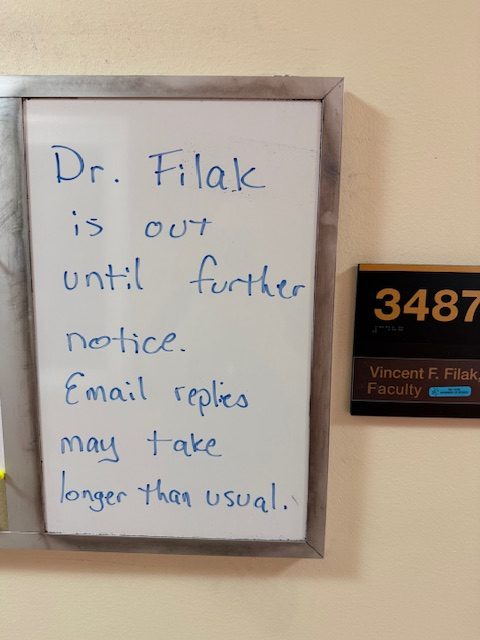
Some kids who knew me but weren’t in the classes I’m teaching got the message on the whiteboard outside my office and kind of freaked out. My boss explained he didn’t want to disclose my health issues without my permission, which is great. However, I know how the minds of journalists work and I could only imagine what it was these people thought had happened to me.

I’ve told Amy this many a’ time: When I die, put the cause of death in the obituary, no matter what. If I died when I broke my neck falling off the couch trying to complete the “bite your own toenails TikTok challenge,” tell people that. It may appear stupid and demeaning, but if I cared enough about it to die doing it, well… there you go. Besides, whatever I did, the speculation of what I might have done will be far worse, I guarantee.

I understand that some folks might be more demure or more guarded than that, which I get, but the less you tell people, the larger the space for the rumor mill to operate. It’s a good rule for PR folks putting out messages and it’s a good thing to remind sources of when they try to get weaselly.


Tell me how to help people with money I might not actually get: A look at the Anthropic AI lawsuit and its $1.5 billion settlement

As if this semester hasn’t been weird enough, I got this email from a colleague on Monday:

In case you hadn’t seen this, Anthropic is being sued for copyright infringement.  Two of your books were swept up by them, and you are entitled to file a claim for damages: https://www.anthropiccopyrightsettlement.com/ 


Abiding by the “if your mother says she loves you, go check it out rule,”  I did a search on the site and found that he was right.

I’m honored that someone considers my work worthy of theft…

It’s Doctor of Paper 2, AI Pirates 0, apparently:

In one of the largest copyright settlements involving generative artificial intelligence, Anthropic AI, a leading company in the generative AI space, has agreed to pay $1.5 billion to settle a copyright infringement lawsuit brought by a group of authors.

<SNIP>

The settlement, which U.S. Senior District Judge William Alsup in San Francisco will consider approving next week, is in a case that involved the first substantive decision on how fair use applies to generative AI systems. It also suggests an inflection point in the ongoing legal fights between the creative industries and the AI companies accused of illegally using artistic works to train the large language models that underpin their widely-used AI systems.


BACKGROUND: Anthropic trained its AI using a ton of content, including a boatload of books and other copyrighted material. In the case of things that were open to the public or properly purchased, this was apparently fine, based on the “fair use” doctrine associated with copyright.

The argument the lawyers for Anthropic made was that the training of AI on these books was a transformative effort, meaning that the books themselves were changed into something else entirely through this process. Transformative acts have often been protected as fair use for years and it’s why Google could digitize books as part of a search-engine service and Andy Warhol could present Campbell’s soup cans to the world.

(It’s also why Roy Orbison is likely spinning in his grave over 2 Live Crew’s version of “Oh, Pretty Woman” or why we get thumbnail images before clicking on a link to visit “Perfect 10” magazine, so maybe it hasn’t always been the greatest of things… )

That worked for a lot of the content they fed the AI beast, but unfortunately some of the stuff they fed it came from sites that pirated copies of texts:

(The judge) also found that Anthropic had illegally acquired millions of books through online libraries like Library Genesis and Pirate Library Mirror that many tech companies have used to supplement the huge amounts of digital text needed to train A.I. technologies. When Anthropic downloaded these libraries, the judge ruled, its executives knew they contained pirated books.

Anthropic could have purchased the books from many sellers, the judge said, but instead preferred to “steal” them to avoid what the company’s chief executive, Dario Amodei, called “legal/practice/business slog” in court documents. Companies and individuals who willfully infringe on copyright can face significantly higher damages — up to $150,000 per work — than those who are not aware they are breaking the law.


If this dude thought getting the books the legal way was a “slog,” he should try writing a book once…

In any case, I reached out to Sage and they are on this, noting I should be getting a letter or email from them to explain what to do and how to fill out a claim form. News stories noted that authors could get up to $3,000 per text, but I’m pretty darned certain there’s no way I’m getting that.

Sage is really the aggrieved party in this, given that the folks there put in the “slog” to get this book built, shipped, marketed and in the stores in time for the Christmas rush. There’s a mention of royalty percentages, so I might get like 5-10% or whatever of whatever the actual amount is. Then again, I might get nothing.

That said, let’s do the thing we all do when we buy that Mega-Millions ticket: Plan to spend money we might never get…

FUN WITH MONEY: As I noted on the “About” page, comedian John Oliver is my spirit guide in everything I do here. One of the things I love most about “Last Week Tonight” is when Oliver does something incredibly weird to sponsor something he finds particularly important.

It’s why he bought Russell Crowe’s leather jockstrap from the movie “Cinderella Man” and stationed it in one of the last remaining Blockbuster Video stores in the country. It’s why he wrote a book about Vice President Mike Pence’s pet rabbit (Marlon Bundo) and turned it into a fundraiser for the Trevor Project and AIDS United. He even managed to buy the website “John Oliver’s Junk” and use it for an auction that raised more than $1.5 million to support public broadcasting.

I’m sure I lack that kind of star power and I might end up getting $50 and a ham sandwich out of this, at best. Still, not for nothing, but Oliver’s weird fundraising efforts got a Koala Chlamydia Ward named after him, so let’s reach for the stars on this one…

Here’s the deal: Whatever I get, I’ll see if Sage would be willing to match it. Then, whatever we scrape together, we’re gonna do something with it that you think is fun, weird, good or all three and more.

Either post below or use the contact form on the website to tell me what you want me to do with my pirate’s booty, whatever of that I actually get.

A few thoughts came to mind already:

Honestly, it could be anything, or nothing if we get shut out. The point is, let’s plan to do something to commemorate this one time where the words “Vince Filak” and “lawsuit” is a cause for celebration, as we make a point to help someone or something important in a random and oblique way.

Thanks for reading as always.

Vince (a.k.a. The Doctor of Paper)

It’s time for some unpleasant honesty for journalism folks based on the Olivia Nuzzi/Ryan Lizza/RFK Jr. debacle

Believe it or not, this post is still up on Olivia Nuzzi’s X account… 

THE LEAD: As much as I wished this weren’t the case, we aren’t finished learning all the lurid details of the Olivia Nuzzi/Ryan Lizza/RFK Jr. debacle: 

Robert F. Kennedy Jr. wrote disgraced political reporter Olivia Nuzzi an outrageously raunchy “poem,” which was dramatically revealed by her ex-fiancé and reporter Ryan Lizza in the second part of his series exposing the secrets of his ethics-challenged ex.

“Yr open mouth awaiting my harvest,” Kennedy Jr., the current Secretary of Health and Human Services, wrote to Nuzzi in undated texts recounted by Lizza in a piece published on his Substack early Saturday.

The poem was included in Lizza’s second part of his series about the affair between his former fiancee and the current Health and Human Services secretary. The post titled “Part 2: She did it again” is available on Lizza’s Substack.

I’m not linking to it here for three specific reasons:

  1. The piece is behind a paywall and I can’t in good conscience promote this as journalism or something worth spending $10 on. I would rather set fire to a ten dollar bill than pay for whatever the hell is back there.
  2. The teaser paragraphs alone introduced enough “explicit content” that would have my editors at Sage literally having aneurysms.
  3. My mother reads this blog and I don’t know what would be worse if she clicked that link: Having her asking me what certain sexual terms Lizza uses mean or having her tell tell me she completely understood everything and didn’t need a translator.

    Either way, it’d feel like this:


THE BACKGROUND: Oh, hell, where to begin?

Nuzzi was booted from her job with New York magazine after her “inappropriate relationship” with RFK Jr. came to light. Nuzzi had written a glowing profile of the Kennedy offspring, while also finding herself infatuated with him to the point of having a long-distance-messaging-with-sexy-photos-but-we-pinky-swear-we-didn’t-bang relationship.

Lizza, Nuzzi’s fiance at the time, who has his own history of icky sex allegations, broke off the engagement and made some very public statements about Nuzzi and this situation.

Both mercifully dropped off the map until this month, when Nuzzi’s “American Canto” book hit the shelves, leading to a “little girl lost” style profile on her by the NY Times. In response to some of the stuff in the book, Lizza took to his Substack to publish a response titled, “Part 1: How I found out.”  In that post, he pulled a “Sixth Sense” twist at the end to reveal his whole “I can’t believe she’s cheating on me” build up wasn’t about RFK, but instead about former South Carolina Gov. Mark Sanford.

Meanwhile, Nuzzi is now working for Vanity Fair, and media folks are a-flutter discussing this situation.


DOCTOR OF PAPER HOT TAKE: It’s too easy to crap all over Nuzzi, Lizza and everyone else involved in this situation. Right now, this feels like staring at a multiple-vehicle car wreck on the interstate. Instead of taking the easy path, consider the following difficult advice:


BASIC ADVICE TO FELLOW EDUCATORS AND MEDIA PROS: We need to be honest with ourselves, the public and our students, even though it really sucks.

Whenever a situation like Nuzzi-gate (as we’re apparently calling it now) pops up, a common refrain that emerges is, “Female journalists don’t sleep with sources.” I know a number of professors, former journalists and current journalists who hate it when this kind of thing happens, because it reinforces thread-bare stereotypes about women and it debases the work quality female journalists have done.

Here’s the problem: Lousy examples exist in almost every field and they create misery for the rest of the folks in that field. I don’t like it any more than you do, but it’s the reality of our surroundings.

Trust me, every time some jagwad professor decides to treat his undergraduates like a sexual charcuterie board, I want to die inside a little. I hate that I find myself second-guessing every interaction I have with students for at least two weeks, wondering if they think I might be “one of those.”

That said, I can’t tell students, “Professors don’t sleep with students,” because despite the ever-present blank stares they give me in class, I know they aren’t completely unaware of reality. I’ve even overheard students I know talking among themselves about skeezy professors hitting on them or their friends.

I also can’t just say, “Well, I don’t do that…” because that’s just really creepy to make them think that I’m thinking that I have to tell them that and too damned specific to make anyone feel better about it. It’s usually why I just shake my head and say, “What the hell is wrong with people?”

In regard to journalism, I’ve met multiple former and current journalists who “engaged in inappropriate sexual relationships” with people they cover. In one case, a local reporter who also worked at a local university was accused of sleeping with someone she had profiled. A friend told me that his wife worked with her years earlier, so I asked what she recalled about the reporter. The response: “Tell Vince she was a whore who occasionally wrote stuff.”

Another friend who worked with this journalist in another newsroom told me the majority of the staff knew about multiple similar indiscretions, so they referred to her by a nickname that merged part of her last name with the word “rabbit.”

In another case, one guy confessed to me that as a student journalist he “accidentally” slept with a student athlete while he was a sports reporter and editor at the student newspaper. The following is my recollection of the conversation:

Him: “Um…” Blank stare. “This is not good, right?”

Me: “Well, I wouldn’t add it to my resume… I don’t get how you “accidentally” slept with her. Did you trip and fall on something?”

Him: “No, I mean I didn’t know she was on the team until just before we… you know…”

Me: “I’ve got so many questions, not the least of which would be, ‘How did her athletic affiliation come up at that exact moment?’ ‘How little did you know about her before you decided to sleep with her that this nugget of information didn’t come up?’ and ‘Did you maybe think about not doing this when you became aware of this situation?'”

It went downhill from there…

I don’t think I’m that special that I knew at least a handful of people who had violated this basic tenet of journalism, so I imagine more than a few other folks reading this have a “Hooo boy…. not good…” story of this nature.

We need to stop pretending that this kind of thing doesn’t happen and be more on point about what we want to say here:

  1. Most journalists do not sleep with sources period, let alone to gain special access for stories. A small number of journalists are bad actors, but to paint all journalists with a wide brush because of them is unfair to those who aren’t.
  2. None of us who don’t violate the rules are thrilled by the people who do, particularly when their actions reinforce negative stereotypes against people who have already had to work harder than they should to make it in the field.
  3. Those of us who take this job seriously are not going to pretend that those people don’t exist, but we are going to make damned sure you know we aren’t like them.

I’m sure there’s a better way to say this, but at least we’re being honest and letting people we aren’t thrilled by this, either.


BASIC ADVICE FOR STUDENT JOURNALISTS:  I can’t stress this enough, but for every situation like this, where it seems like the world turns out great by flouting the rules, there are dozens more that are just god-awful disasterbacles that never get a book deal.

Colby Hall of Media-ite made the case that Nuzzi, his DM buddy, really just learned how to play the game based on the way the system has shifted, so we can’t really hold it against her:

The glamorous photo shoots, the Lana Del Rey cosplay with the white Mustang convertible on PCH, the literary ambiguity about Kennedy’s identity in her book, the defiant framing that positions her as a victim bearing witness to power.

But here’s what I’ve come to understand: This isn’t tone-deaf. It’s the only move that makes economic sense in 2025.

Nuzzi has correctly read our current media ecosystem. There is no path back to institutional credibility for her—those institutions are dying anyway, and they were never going to reward rule-following in the first place. But there IS a path forward through celebrity, through controversy, through the monetization of scandal itself.

The Vanity Fair job. The book deal. The rehabilitation tour that’s a Klieg light away from what it really wants to be. She’s not trying to rebuild her reputation as a journalist—she’s building a different kind of brand entirely, one where being interesting matters more than being ethical, where attention is the only currency that still spends.

Please don’t buy into that line of thinking. She’s the “it” thing at the moment, but that fades pretty quickly and even if it doesn’t for her, it doesn’t follow it will work for you. If you don’t believe me, ask anyone who tried to become a millionaire starting an “Only Fans” account.

As much as it might seem like a great idea to be that rule-breaking, cool-as-hell rebel in the moment, these things don’t end well. As someone who has watched almost every VH1’s “Behind the Music” episode, I can pretty much guarantee short-term career thinking leads to some long-term misery. And unlike video games, you can’t just hit the reset button once things start going bad.

Follow the rules, behave better than the attention-seeking toddler at the grocery store and do the job to the best of your ability. You might not become famous, but that’s likely to be a good thing.


BASIC ADVICE TO PROFESSIONAL MEDIA OUTLETS: Watching Vanity Fair hire Nuzzi is like watching pro sports teams picking up troubled players who have talent, arguing that, in their system, the player will thrive. What they fail to realize is that even if the talent is in there somewhere, the human foibles are going to massively undercut it and you’re essentially just buying trouble.

With that in mind, I’m begging you. Stop buying trouble.

First, the juice is rarely ever worth the squeeze. Everyone is out there thinking they are buying the next Hunter S. Thompson. Instead, they’re buying the next Ruth S. Barrett. Hiring people like this has the same internal logic of cashing in your 401K and using it to buy lottery tickets to secure your retirement.

Second, you’ll make my job a lot easier as a professor because I won’t have explain to students that to get their dream job, they should work hard, play by the rules, and then pray they don’t lose out to someone who banged a source and now has 2.3 million followers on Instagram.

I’m having a hard enough time getting them avoid bias in their writing, abide by grammar rules and attribute the hell out of things, what with all the god-awful crap that’s passing journalism these days. I don’t want to have this conversation:

ME: You can’t write a profile story about your best friend. It’s not ethically sound.

STUDENT: So, why can (REPORTER X) sleep with a profile subject and land a job with a six-figure salary?

ME: Go read your AP style book.

Third, you need to understand the “Cockroach Theory of Terrible Behavior.” When you see one cockroach in a house, rest assured it’s not the only one around, like he’s on vacation or something. For every one you see, there are several more just waiting to show up.

I remember being at my college newspaper during an editor election, where one candidate was trying to justify some bad behavior, explaining, “Oh, that was an isolated incident.” Once we retired to debate his candidacy, the one guy piped up with, “I counted 10 or 11 ‘isolated incidents.’ How many does it take to make a trend?”

Vanity Fair is already playing defense on the hiring, as they were “take by surprise” at Lizza’s accusations about Nuzzi’s nuzzling with Sanford. The magazine is “looking at all the facts” in this situation as it decides how the hell it’s going to get out of this situation before another cockroach comes crawling out of the corner.

If you want to see the best of journalism, hire good quality people. Promote and showcase them as what’s worth doing in the field. Let us in the classroom highlight the good work done in the right circumstances.

None of this will stop another Nuzzi situation, but at least you can help us point to this as a cautionary tale and not a smooth career move.

As a scummy weasel whose mother didn’t raise me right, I’d like to offer my support to the loud, rude piggies and terrible reporters out there (A Throwback Post)

President Donald Trump spent part of the last several days living up to his reputation of being “combative” with the media. During an event featuring a Saudi Prince, he told a journalist from ABC how terrible she was, before musing about how the FCC should consider yanking the network’s license to broadcast.

A few days prior, he barked “Quiet! Quiet, Piggy!” at a BBC reporter while she was trying to ask him a question on Air Force One.

The journo-folks in my orbit have poked at this in a lot of ways. Some are arguing the media outlets didn’t do enough to defend these journalists. Some have pointed out that with both journalists being women, this was another case of sexism rearing its ugly head. Some have said it’s another case of “Trump being Trump” so why are we surprised.

Truth be told, if you’ve worked in this field for more than about 20 minutes, you’ve likely found yourself on the end of the ugly stick, with someone swinging it wildly at you.

Even before Trump, politicians were railing against reporters and their work. If you covered education, parents, teachers and school administrators were likely to be upset with something you covered and weren’t afraid of telling you about it. If you spent time in business, entertainment or sports, you probably had a few run-ins with people who didn’t like what you wrote.

In covering crime, I got more than a few irate calls over the years, including one person screaming at me about how we made her son look bad by reporting his role in a shooting. A sentence I’ve never said before came out of my mouth: “Ma’am, it’s not my fault your son was shooting at people in a Taco Bell drive thru.”

I guess part of the umbrage we’re feeling in regard to these current outbursts is because we’d like to expect more out dignity and decorum out of the president of the United States than we got out of an angry mother of some guy who just landed in jail for the umpteenth time, despite her insistence he’s “such a good boy.”

With that in mind, here’s a throwback to a post about the beatings we all seem to take in the media and why it is good reporters stick with it:


Scummy weasels and death peddlers: What some people think about journalism (and why we tolerate their ignorance.)

“Your mother didn’t raise you right.”

I forget the context of that comment, but I know a woman yelled it at me over the phone once when I had the temerity to ask her a question about something someone she knew had done that landed that guy in jail. The implication was that I had nothing better to do than make people miserable and that if my mother had raised me properly, I’d know how sleazy I was being at this very moment.

The reason I bring this up is the story that is making the rounds, thanks to Dana Loesch’s speech at the recent CPAC event. Loesch, a National Rifle Association spokesperson, told the room that the mainstream media just loved it when someone went on a massive shooting spree:

“Many in legacy media love mass shootings. You guys love it,” Dana Loesch said Thursday. “Now I’m not saying that you love the tragedy. But I am saying that you love the ratings. Crying white mothers are ratings gold to you and many in the legacy media in the back (of the room).”

As someone who spent a good amount of time in a newsroom and even more time teaching budding journalists, it’s a little hard to swallow that statement. (I’m not alone in that regard, as multiple journalists have called out Loesch for her statements at CPAC.) The point here, however, isn’t to poke at Loesch but rather to let you know that although the statement is a bit more hyperbolic than most of those made about the media, it’s not rare that people think about journalists this way.

Former college basketball coach Bobby Knight turned hating the media into an art form and a cottage industry. Here are 10 of Knight’s most “memorable” soundbites, about half of which involve him fighting with the press. (Number 8 is my favorite, in which he compares journalism to prostitution.)

Knight isn’t the only person to hate the media for being the media. The clip of CNN’s Jim Acosta battling Donald Trump:

And he wasn’t the first president to rip on the media in front of a large group of people:

However, perhaps the greatest diatribe regarding how journalists react to disasters came not from a politician, but rather from musician Don Henley. His 1982 release of “Dirty Laundry” was No. 1 on the charts that year and really picked apart the way in which TV journalists appeared to enjoy “disaster porn.”

Personally, I’ve been called words I’ve been asked to avoid using on the blog. I think “scum” was the most user-friendly word I could include here. I’ve been accused of having vendettas against people for reporting that the caller’s son got involved in a shooting some place. I’ve been told to get a real job. I’m sure if you asked any of your professors who worked in the field, any one of them could tell you similar stories in which people took out their gripes on a journalist or two.

Still, as Allison Sansone noted earlier, you are serving readers who need you to get them information, even if that information is unpleasant. Of all the things I’ve seen that were nauseating, destructive or worse, I’ve never felt particularly happy about them. Sure, the adrenaline is pumping and the anxiety goes through the roof, so I can see how people would think I was “up” a bit while on the scene of something. However, I was never happy to see a dead guy, a fire-scarred woman or a flaming house full of dead dogs (all things I had to witness.).

This field can be a rough one to enter, especially if you enjoy people liking you or your work being positively appreciated on a universal scale. (I remember somebody once remarking about this idea, “If you want to be loved, go plan kids’ birthday parties for a living.” Personally, I find that more terrifying than covering a lot of the stuff I covered.) However, if you read through the responses the reporters gave to Loesch’s statement, you’ll find that they felt the job was worth it and the experiences associated with some of these traumatic events led to a greater sense of self.

I can’t think of many careers that will get you all of that. Even if it means you have to apologize to your mother for what people think of her child-rearing skills.

An Open Letter to The IU Media School: Please spare us your bullshit and leave the Indiana Daily Student alone

The top of the IDS’s letter explaining how the university killed print.

(EDITOR’S NOTE: Sage has always asked me to avoid any “unnecessary cursing” on the blog, as it tends to offend the sensibilities of some delicate readers. I promised I’d only use “necessary cursing,” and today it’s called for. Sorry, guys.)

Dear Dean David Tolchinsky and the rest of the administration at the IU Media School,

You have made it clear over the past several years, and even more so over the past few days, that you have absolutely no idea how journalism, student media or the First Amendment work, or that you don’t care about these things.

Either way, nobody is buying your bullshit anymore.

The decision to demand students not print news in the Homecoming edition, then fire adviser Jim Rodenbush when he would not force this upon students and then kill all printing 24 hours later in response to the editors’ concerns has drawn negative attention from all corners of the country. The Student Press Law Center and Foundation for Individual Rights and Expression both condemned your actions. News outlets across the state and beyond are digging into this situation. Even the alumni aren’t happy.

Free press and editorial freedom can’t be a “when we feel like it” thing, or else you are supporting neither a free press nor any editorial freedom. I’m not even sure your chancellor gets this, based on his most recent statement:

“Indiana University Bloomington is firmly committed to the free expression and editorial independence of student media,” IU Bloomington Chancellor David Reingold said in a statement. “The university has not and will not interfere with their editorial judgment.”

“In support of the Media School and implementation of their Action Plan, the campus is completing the shift from print to digital effective this week,” he continued. “To be clear, the campus’ decision concerns the medium of distribution, not editorial content. All editorial decisions have and will continue to rest solely with the leadership of IDS and all IU student media. We uphold the right of student journalists to pursue stories freely and without interference.”

OK, but see, you all actually DID interfere with editorial judgment when the powers-that-be demanded that no news content be placed into the homecoming edition. Furthermore, you made it clear that you WERE trying to censor by having two editions: One on campus for the alumni that was filled with only unicorns and rainbows and Homecoming parades, and another one for the city that would be allowed to wrap a news section around it.

The IDS quotes Assistant Dean Ron McFall essentially saying that the school knew this was censorship and interference:

“How do we frame that, you know, in a way that’s not seen as censorship?” Ron McFall, assistant dean of strategy and administration at the Media School, asked in that meeting.

And Dave, you can’t throw this guy under the bus with a “poor choice of words” or “one bad apple” thing, given what people know about you and your approach to student media. People at IU know that you are “clueless” about the First Amendment and you “don’t know the first thing about journalism,” to quote a non-student source close to the IU situation.

A source also relayed a story about one of your first encounters with the IDS upon your appointment as dean. The paper had written an editorial that had ruffled some feathers and you were confused about your power over the situation.

“He wanted to know why he couldn’t just make them apologize,” the source said.

You have tried your damnedest to frame this issue as one of finance, and finance alone, because this is the best defense you have against your indefensible actions. Even if the IDS students and the rest of us who understand how media works were to grant you this premise, which we don’t, dozens of examples of censorship through financial means exist in student media. Trust me, I’ve researched this a bit.

If money were the motivating factor, there would be no reason for killing off ALL print editions, including those special ones you were so excited to force the kids to produce. In their letter from the editors, Mia Hilkowitz and Andrew Miller explained that you now refuse to let them publish the homecoming edition, which fit the bill of what say you wanted, namely a special issue that turns a sizeable profit.

In addition, the editors have pointed out that the three issues that the IDS produced to this point have turned a five-figure profit, that the IDS has advertising contracts for future publications and has contracts for advertising to be placed on public-facing news stands where the print edition is distributed.

Those things all sound like money to me, and any reasonable human being who understands how money works. And if you’re worried about money, maybe you shouldn’t piss off IU alumnus billionaire and donor Mark Cuban, who also is not happy about this situation.

The problem with all of this is that you can’t un-ring the bell. Bringing Rodenbush back or opening the door to printing won’t solve the underlying problem: A complete lack of trust between the IDS and this administration. The students aren’t stupid, so they know that anything you do right now will only be to shut people like me up for the moment. Once you feel we’ve moved on and the outrage has died down, you’ll pull another stunt like this and the cycle will start all over again.

The only solution is the simplest one: Quit. Leave. Go away.

And take your band of merry administrators with you, who apparently have no interest in actual journalism and actually have “neutered the reporting curriculum,” to quote a source. I’m sure you’ll all land on your feet at some nice, private college where they’ll overpay you to keep the kids in line as they write hard-hitting stories about a local dog named “Pooch” that barks at the campus squirrels.

In the mean time, maybe the chancellor can put his money where his mouth is and hire someone capable of restoring the IDS to its previous state as a venerable, formidable journalistic enterprise.

Sincerely,

Vince (a.k.a. The Doctor of Paper)

P.S. – No, I am not angling for your job, Dave. If this letter makes anything clear, I lack the bullshit-osity to be an administrator anywhere.


“Record everything, always, and apologize later, if need be.” (A throwback post)

Having a literal videographic memory would really, really come in handy sometimes… 


This post came to mind after an email exchange I had with an administrator last week. Not to get too into the weeds, but a crisis hit and I was being asked to do something in exchange for a benefit of my choosing.

During a meeting, I got the verbal “OK, that’s fine,” with a promise I’d get something in writing shortly after. After a month or so, I hadn’t gotten the documentation or the benefit, so I made some inquiries.

Although things aren’t entirely settled, what bugged me the most was a line that an administrator wrote to me in an email: “I found no record that we promised (SAID BENEFIT).” 

At that point, I was reminded of the phrase I often tell students: “Record everything, always, and apologize later, if need be. In God we trust. Everyone else gets recorded.”

I’m not sure yet if I’ll be wiring my office like Nixon’s White House, but while I ponder that, here’s today’s throwback post, which looks at the issue of recording people, with or without their knowledge.


‘Can you?’ vs. ‘Should you?’ A secret recording of a Wisconsin government phone call that inspired five random thoughts for journalism students

In trying to explain ethics to my intro writing students, I often fall back on the line that, “Ethics basically deal with things that aren’t illegal, but can get you in a lot of trouble, anyway.” Another way we separate law and ethics is the line between, “Can I do X?” vs. “Should I do X?”

This concept came into focus in a strange way last week, as Wisconsin continued to put the “fun” in “dysfunction” at the state government level:

MADISON – Republican legislative leaders lashed out Wednesday at Democratic Gov. Tony Evers after his staff secretly recorded a May 14 phone conversation over how to respond to the coronavirus pandemic the day after the state Supreme Court struck down the state’s stay-at-home order.

The recording and the reaction to it all but ensures a permanently broken relationship between Evers and Republicans who control the Legislature. The two sides have rarely gotten along since Evers was elected in 2018 and Wednesday’s episode was characterized by GOP leaders as unprecedented.

Republicans referred to the recording effort as “Nixonesque,” referring to former Republican President Richard Nixon’s desire to record everything involving him at the White House. I’m uncertain if this is irony, self-loathing behavior or something just randomly laughable, but I’m at a loss for words while watching a Republican use the name of a former two-term (almost) president as an insult. I guess I’m also pretty sure that the relationship between Evers and the Republicans was permanently shattered like Waterford Crystal thrown off the top of the Empire State Building waaaaaaay before this incident.

In any case, here are a few random thoughts for journalism students that don’t delve into the political grandstanding in this case that makes soccer “injuries” look honest by comparison:


THIS SHOULD HAVE BEEN PUBLIC ANYWAY: Bill Lueders, president of the Wisconsin Freedom of Information Council, made the best point about this situation. Why the hell was this a “private phone call” among three key governmental officials?

(Lueders) said recording a conversation without alerting the other parties isn’t illegal in this state, but is in bad form — and that the nature of the meeting should have pushed the three to talk publicly instead of privately.

“I wouldn’t do that as a journalist, to record someone without them knowing,” Lueders said. “On the other hand, I don’t know what would have been said in that meeting that needed to be kept private.”

Maybe if this is a public meeting, none of this becomes an issue in the first place. Sunlight is said to be the best disinfectant, and it would appear to be so in this case.


RECORD EVERYTHING, BUT BE HONEST: According to the numerous accounts I’ve read, Richard Nixon was paranoid as hell and believed people were always out to screw him over. If you have spent any time as a reporter in this day and age, I bet Tricky Dick starts making a little more sense in that regard.

I can’t tell you how many times I have written something I got from a source, quoted a source or provide information I got about a source, only to have the person who gave me that information tell me I was wrong. And I did most of my work before the era of people in power calling everything they don’t like “fake news.”

Thus, my advice to students? “Record everything.”

That said, recording is one of those key areas where law and ethics diverge. The majority of the states in the U.S. operate under one-party consent. This means that if you are on a phone call with another person, you may record it legally without letting that other person know. The others have some version of two-party consent, which means BOTH parties on the call must know and agree to the recording before it happens. (You can read more on your state’s rules and what happens if your recording across state lines etc. here.)

The law says, “Record them all. Let God sort them out.” Ethics, however, would dictate that secretly recording people kind of undermines trust, as Lueders pointed out. This is why I always tell the students to be up front about their recording. Tell the source, “I would like to record this interview. Is that a problem?” In most cases, sources will be fine with it.

Some folks will be reticent, so I tell the students to explain WHY they want to record the interview: “I want to make sure I don’t make a mistake,” or “I want to be sure the quotes are accurate,” or “I want to protect both of us.” However, the students want to explain it is fine, but at the end of the day, it’s about having a permanent record of what occurred so if the stuff hits the fan, and suddenly everyone is pulling a “Shaggy” on this situation, you have a complete record of what happened.


STILL, WATCH OUT FOR YOU FIRST: I totally get why the person recorded the conversation: The Evers administration and the Republicans out here who will rule the assembly in perpetuity, thanks to gerrymandering the likes of which we’ve never seen before, are constantly in a bombastic struggle to define “truth” for the public. I’ll read one story one day and think, “OK, they’re doing X” only to read the next day some recasting of the situation that makes me think it was a dream.

In the end, if you know someone’s going to try to screw you, get a permanent record of reality.

Honestly, I’ve recorded people without their knowledge. I don’t say this with a great deal of pride, but this is what happens when you run a crime beat in an area where people felt no compunction about calling you up to scream at you about coverage. After I almost got smoked once, I considered it an insurance policy.

The first time this happened, a person called the main desk at the newspaper, asking to talk to the person in charge of crime stuff. The staffer sent the person to me, and the caller spent at least five minutes screaming at me about a story we ran. It turns out her kid/brother/friend/whatever was “illegally arrested” (a phrase I still love to this day) and what we wrote needed to be retracted RIGHT NOW.

After mentioning places that I could put my head, which defied the laws of physics, and questioning the lineage of my parents, this woman was not happy with my decision not to acquiesce to her demands. She wanted to speak to my boss.

I gave her his number and he got a much different treatment: A lot of “sir” mentions and some polite questions and so forth. She mentioned how horrible I was and how I said horrible and unspeakable things to her. Of course, my boss brought me in to ask me about this. He bought my version of events, but I swore it would be the last “he said/she said” thing I dealt with at that paper.

I hooked up a tape recorder to the phone and kept it at the ready. When I got the next call transferred, questioning my approach to crime news, I recorded it. After my boss got the complaint about me, I offered to let him listen to the recording. Eventually, that became our routine:

Him: “I got a complaint that you were horrible to (SOMEONE) who was complaining about (WHATEVER I DID).”
Me: “Uh… No… Would you like to hear the recording of the call?”
Him: “Fair enough…”

Still, the most important moment of recording I can recall came when I was an adviser at Ball State University. The school was in the middle of a provost search when one of the three candidates pulled out. The remaining two candidates were relatively polarizing: The president clearly favored one and the faculty and staff favored the other.

Just to back up her notes, the reporter borrowed my recorder for the phone call with the president. She asked the obvious question if the president had planned to restart the search. I can still remember to this day hearing the reporter as, “Is that even an option in your mind?”

The answer was no. We have two qualified candidates and we’re moving forward.

That was the story we ran, and then all hell broke loose.

Faculty were outraged, figuring they were going to get screwed, so they started talking. The president, clearly not wanting this to be a mess, decided the best thing to do was throw the newspaper under the bus.

She issued a statement via email to faculty and staff that basically said, “Look, the kids at the newspaper try really hard, but they’re kids and they screw up stuff. I never said we wouldn’t restart this. In fact, that’s what I’m doing right now. So, relax and don’t worry about the mistakes of children.”

Her problem was, we had it recorded. She didn’t know.

To be fair, the student SHOULD have told her we were recording her, and that was a lesson we made clear in the post-game analysis with the reporter. Thus, we gave the president a chance to do the right thing. The editor-in-chief called her and told her that she made us look stupid and that we were asking for a retraction. We’d let it go if she fessed up. She immediately went back to her talking points about the reporter screwing up and how this happens with cub reporters and how she wasn’t mad, but she had to set the record straight.

At that point, he let the cat out of the bag. She paused, said some unprintable things and then asked, “Are you recording me now?”

I remember thinking, “No, but I wish we were…”

In the end, she held firm. We ran her email alongside a transcript of the phone call along with an editorial on the whole thing. She was displeased, but that was on her. If the primary complaint someone has about you recording them is that you’ll report exactly what they said and they don’t like what they said, I have very little sympathy for them.

This leads to the next point…


IT’S NOT OUR FAULT YOU’RE A DIPSTICK: The reason we know about this recording in the first place is because the Milwaukee Journal-Sentinel put in an open records request for everything associated with a coronavirus meeting between the two sides. Once they asked for everything, including recordings of the meeting, the recording came to light.

(Good side note: In open-records requests, ask for stuff that MIGHT exist, even if you don’t think it does. You might get lucky. In this request, the reporter apparently asked for any recordings of the meeting when requesting documents from Vos as well and got nothing because he didn’t record anything. The request sent to Evers yielded the tape. Short version: It never hurts to ask for stuff.)

Evers did the right thing in turning over the file, even though I’m sure he really didn’t want to. It had to be like that scene in “Silence of the Lambs” when the moth flies out of the basement and basically the killer knew he was screwed. The game was over at that point, and he basically had to brace for impact.

The recording was what I would have expected of divorced parents who were forced into a dinner with their kid at graduation: A lot of people talking past one another, some pointed jabs and the essential “How much longer must we endure this fool?” vibe. One thing that did pop up as a story was Assembly Speaker Robin Vos blaming immigrants for the coronavirus:

MADISON – Assembly Speaker Robin Vos blamed the culture of immigrant populations for a coronavirus outbreak in Racine County, according to a secret recording of his meeting last month with Gov. Tony Evers.

“I know the reason at least in my region is because of a large immigrant population where it’s just a difference in culture where people are living much closer and working much closer,” the Rochester Republican said of an outbreak in Racine County.

Of course, Vos didn’t like the story that pointed this out and tried to move the discussion back to how shameful Evers was for recording the call. He also tried to spin this to make it about how he had a deep concern for people of color who were disproportionately suffering the effects of the virus.

(Hang on… I’m dealing with the vertigo caused by that spin… OK… Phew…)

At the end of the day, neither group looks good and Vos has to deal with what would appear to every Latino group the MJS contacted as a dog-whistle, anti-immigrant blame-fest.

What’s important to remember, however, if you record something as a journalist and someone says something stupid, it’s not your fault.

This is one of the few cases where people aren’t blaming journalists, because the journalist didn’t make the recording. Vos comes the closest, in accusing the paper of not keeping its eye on the ball with the whole “Nixon-esque” recording. However, usually, in a story in which someone records something (telling the source or not) and it turns out the source says something horrible, the outrage is more over the recording or the choice to run the story than it is the horrible thing the person said.

It shouldn’t be, and you shouldn’t feel bad about it.

Your job is to report the facts, getting as close as you can to the purity of truth, in an attempt to inform your readers of something important. Rarely are those revelations something pretty and happy, so someone will be upset.

If a state rep or a city council member or a school board president says something offensive about race, gender, sexual-orientation, socio-economic status or some dude named Chad’s little brother, and you think your readers need to know about it, that’s called editorial discretion. Use it to guide you in your choices.

ALWAYS ASK, “IS THE JUICE WORTH THE SQUEEZE?”: In looking at ethical behavior, I sometimes find myself being a pragmatist more than I would like. Still, that’s because I know I have to live in the real world and not in an ivory tower, subsisting on creeds and mottoes. What I “can” do versus what I “should” do often comes down to a weighing of my options and examination of the ramifications.

(This situation is weird, in that the journalists didn’t make recording, so whatever they picked out of the open record was less on them than it was on the person making the comments and the staffer who recorded it.)

If I record a source, and the source knows the information is on the record, and the source knows I’m recording it, I pretty much have carte blanche to do as I see fit. That’s where editorial discretion comes in. What am I trying to do here?

If I run a story based on one part of an hour-long interview that makes a long-time and trusted source look bad, will I be cutting off my nose to spite my face? Probably. Some folks would say that ethics demand the unveiling of any ill that could showcase the true nature of public figures. Others would say that, short of watching that source kill a guy, you’re not ratting him out because sources like that are hard to find.

This is where I spend more time bean-counting than I might otherwise like. Is one flashy story worth not getting another story again from this source? Is my ability to tell people important things, thanks largely to this source, going to be undermined by me taking a shot across the bow at this guy? Am I protecting a person I shouldn’t be protecting, primarily because he makes me job easier?

This is why journalists who have ethics tend to drink like fish and chew Xanax like Tic-Tacs.

As a journalist, what you do is up to you (and to that extent, your publication/boss/editor/whomever runs the show), so you need to decide for yourself if the juice is worth the squeeze.

The Four-Word Interview Rides Again (A Throwback Post)

Today’s post was sparked by a Facebook memory that reminded me both how damned old I am and how lucky I am.

My dad took the above picture 16 years ago today, just after I purchased my first mid-life crisis vehicle: A 1968 Ford Mustang. Dad knew it was the right thing to do as we were taking a test drive. (I can’t repeat exactly what he said here, as the editors at Sage might have their heads implode, but trust me, it was accurate recognition of pure joy.)

The old part should be obvious, but I want to quantify the lucky part.

I’m lucky that I’ve got a wife who told me, “Go get it. We’ll figure out the rest later.” I’m lucky my dad, who always “had a guy,” could take it to a mechanic to get an honest review and then help me go get it. I’m lucky I have a mom who helped me understand that everyone needs some joy in their lives, or else life isn’t really worth a whole lot. I’m lucky I have a job where a car like this wasn’t going to negatively impact the family or what we need to do to survive.

Beyond that, I wanted to say I’m lucky to have the opportunity to converse with you all on a weekly basis. Yesterday’s post had a number of people I’ve never met reaching out to tell me, “Thank you! I’ve been complaining about (FILL IN THE TOPIC) for a while and maybe the kids will now listen!” I’m lucky that I’ve got the folks at Sage, especially Staci Wittek, who is constantly finding ways to tell people that what I write is good for their students.

Not everything is roses and sunbeams in life, but I will say that when I would get behind the wheel of that car, a lot of the anxiety or distress that comes from all the world’s problems just kind of melt away a little bit.

For that and everything else good around me, I am grateful.


The Four-Word Interview

262061_2304935341586_1282884_n
(The subject of a four-word interview.)

I stopped off to get gas this morning when a man in his 70s approached me.

“What year?” he asked, pointing to the Mustang.

“’68.” I told him.

He nodded. “Nice.” He then got in his truck and drove away.

In the simplest of terms, this was a perfect interview and the whole thing took four words.

In all the reporting and writing classes I have taught, the biggest problem students tell me they have is interviewing. They don’t know what to ask or how to ask it. They feel awkward talking to other people or they get the sense that they’re being pests. They would rather just email people and hope for answers instead of approaching people in public and talking to them. This is why interviewing features prominently in both the Dynamics of Media Writing and the Dynamics of News Reporting & Writing.

Interviewing is a skill and like any skill, you need to practice it to become better at it. That said, it is important to understand that every day, you conduct dozens of interviews, so you are probably better at it than you think you are. You ask your roommates how their day went, you ask the waitress what the special of the day is and you ask your professor, “Will this be on the test?” If you don’t think of these interactions as interviews, it’s because you are overthinking the concept of interviewing.

The purpose of an interview is to ask someone who knows something that you need to know for the information you seek. When you get that information, you do something with it. The guy at the gas station wanted to know one thing: What year Mustang was I driving? He figured the best source was me, the owner of the car. He asked a question that would elicit the answer he sought. He got his information and he moved on.

Interviewing as a journalist can seem much more complicated than that, mainly because you have to do a lot of preparation, you need to troll for quotes and you need to figure out how the answers fit in the broader context of your story. That’s all true, but if you start with the basic premise of “What do I need to know?” your interviews can feel more natural and less forced.

Terrible tragedies occur when shots fired by armed gunmen ring out (A throwback post)

A newspaper of note sent me an alert recently that told me that police were engaged in an  “active investigation” near on the campus of my alma mater.

When I noted on social media that I’d give anything to know if police were ever in the middle of a “passive investigation,” a mentor messaged me a few more stupid terms that needed to die in the fire of journalistic hell.

(My favorite remains “armed gunman.” If you ever see a guy with no arms holding up a bank with an uzi in his mouth, I’ll back off on this one. Until then, knock it off.)

When police were investigating the Charlie Kirk killing, he sent along one more term that was getting a lot of use:

If you have a “to do” list, please add the “shot rang out” cliche. God I hate that.

The wall-to-wall coverage of Kirk’s death seemed to find as many ways as possible to weave that phrase into the mix, along with one of the problematic phrases listed below (terrible tragedy). Thus, in hopes of getting the message across this time, I dug up the list of bad terms and phrases that really need to go away immediately if not sooner.


An Unprecedented List of Radical, Breaking News Items that Need to have their Ticket Punched to the Ash Heap of History

Every so often, we hit up the Hivemind here for words that are getting used way too frequently for no really good reason. Without further ado, here is the list that emerged from our most recent visit to cliche town:

Unprecedented: Between the pandemic, the Trump lawsuits and the trend of cooking chicken with Nyquil, we are the point where the bar for something receiving the “unprecedented” label is pretty high. At this point, it better be Jesus riding a unicorn while throwing tacos to his followers.

(And thanks to the AI artists program, we actually can check this one off our bucket list of “unprecedented” things.)

You’re welcome. Now, go find something else to use in place of this word…

UPDATE NOTE: Since AI is advancing at a ridiculous rate, I gave this prompt another shot and got the image below:

(I’ve gotta say, we got a much better Jesus and unicorn, as well as some minor improvements on the followers but apparently AI is still having problems with tacos. At best, those are pitas or loaves of unleavened bread…)


Miracle (sports): I’m sure it was a great game or an incredible comeback, but unless the seas parted between third and home or loaves and fishes multiplied in the end zone, we can stop with this.

Radical (political ads): Did the candidate threaten to castrate guys with tin snips in the parking lot of an Aldi’s as part of their plan to limit the needs for abortions? THAT’S radical. The rest is just stuff you don’t like.

Squash (legal term): It is not. You quash a subpoena. You squash a bug. Or you plant a squash.

Agenda (political ads): I’ve yet to run into a politician who has a fully formed set of motives and efforts that they’ve outlined and subsequently enacted, which is the literal definition of an agenda. In most cases, it feels like this:

Punched their ticket to: Nobody punches tickets anymore. I can’t even get a paper ticket so I can keep the stub as a souvenir. I think if the bands you’re seeing are old enough to qualify for Social Security, the fans should be allowed to request paper tickets. And those will still remain unpunched.

Phone ring off the hook: Phones no longer have hooks. They rarely ring. I get that “Phone buzzing off the desk” doesn’t have the same feel, but maybe just take the next train out of Clicheville… I bet they’ll punch your ticket on the way out.

Weaponize (politics): If you accuse people of “weaponizing” race or gender, they’d better be able to launch a missile out of something. Same thing with anything else we “weaponize.”

Officer-involved shooting: Tell me the cop shot someone or that someone shot the cop. Active, not passive.

Breaking news: It’s not breaking just because you finally figured out about it. Also, it’s not breaking news just because you want to tell me something now. “Breaking news: I just started writing this blog post… More at 11…”

Parlay: By definition, it is, “a cumulative series of bets in which winnings accruing from each transaction are used as a stake for a further bet.” You did not “parlay initial success” of anything into anything else. Unless you could lose that success, stop it.

Brandish: It requires a waving with a flourish, usually in anger. The robber with the gun in his pocket didn’t brandish anything. Unless he broke out into show tunes with a dance number…

Parents’ worst nightmare: Really? We sure on that? I just finished watching the Netflix series on Jeffrey Dahmer, and I lived in Milwaukee during that whole time period, so I’ve got a pretty high “nightmare” threshold. I’m sure whatever happened sucked, but if you spent any time in my nightmares, you’d probably not be talking about a kid not answering a cell phone on time in that regard…

Iconic: A friend notes this article on Ben Affleck and a nap as the moment “iconic” jumped the shark. (Another phrase we should stop using, probably, unless this happens again…)

Unique: It means one of a kind. Unless it’s a snowflake or the Hope Diamond, find a different descriptor.

Ash Heap of History: Unless we really are burning the books, stop using this to describe things we stopped using.

Worth noting: Translation- “I don’t have this from a source, but I want to tell you something.”

Terrible tragedy: As opposed to what? Those fantastic tragedies that make us all happy to be here?

Incident (cop speak): “Police responded to an incident in which…” We know it’s an incident. Everything is an incident. Me typing right now is an incident…