Learn to love data reporting the NY Times way

The New York Times has provided all journalists, journalism educators and journalism students with a golden opportunity to learn data journalism. The paper posted its entire data-journalism curriculum online for free, allowing anyone with an interest to go through the entire three-week course that its staffers use to become familiar with data.

Lindsey Rogers Cook, one of the people responsible for compiling this work, said the paper saw the importance of data literacy and knew it could help others who didn’t have the same resources as the times:

While we recognize most publications aren’t able to offer their reporters a three-week data training, we know that increasing data skills is hardly a Times-specific need. Even in smaller newsrooms, making time to teach someone data skills has benefits in the long run. But it can be difficult and time-consuming to build out proper materials, especially if developing training programs isn’t your sole job.

So, we’ve decided to share our materials in the hopes that students, professors or journalists at other publications might find them useful.

Over the last four rounds of data training, Digital Transition has amassed dozens of spreadsheets, worksheets, cheat sheets, slide decks, lesson plans and more, created by me, my fellow Digital Transition editor Elaine Chen and various speakers around The Times.


Aside from including those key elements, the paper included a great tip sheet that echoes my own love of paranoia: How Not To Be Wrong.

Even if you don’t want to go through the whole course, it’s worth seeing to what degree these items could weave into your reporting toolbox. Even more, it’s worth seeing what the Times does because far too often, journalists excuse themselves from doing hard-hitting data pieces by saying, “Look it’s not like we’re the New York Times or anything…”

Well, now you can be. Give it a shot.

The Underwear Thief Theory of Lead Writing: When you either know too much or not enough about a Catholic school principal who was arrested at a strip club

I often joke that having spent my professional life on a crime desk meant that most of my leads essentially wrote themselves. Fire leads were basic: Fire damages house. Crime leads were basic: Guy robs store, Gal steals car and so forth.

When we got weird crimes, however, there was a difficult moment in trying to determine how much information to put into the lead while also trying to avoid putting too much information in there. It was also a game of, “What, exactly, do we care most about?”

The exercise that typifies this for my students is the one lovingly dubbed “The Underwear Thief Lead.” A story I pulled out of the Oshkosh Northwestern years ago told the tale of a guy who was arrested on suspicion of breaking into women’s homes with a ladder and stealing their underwear. Here is the original lead:

An Oshkosh man ac­cused of stealing women’s undergarments and sending them threatening letters told police he considered himself a sexual predator and ad­mitted he was close to committing more serious crimes — – including rape and murder but that his    religious  beliefs pre­vented  him   from following through.

The lead is nearly 50 words. It has a misplaced modifier that makes it sound like he was sending threatening letters to people’s underpants (Dear Victoria Secret Size 8, I will find you and stretch out your waistband…). He considered himself a sexual predator? Well, I consider myself the starting center for the Cleveland Cavaliers, so let’s see how that goes… Also, what kind of religious beliefs can make you think it’s OK to break into homes, steal underwear, threaten women and so forth? (It also doesn’t help that the headline, “Thief thought of Rape, Murder,” essentially convicts him of multiple crimes before the courts get a shot at him.)

The story goes on for about a mile and a half before we ever get a “when” element, at which point in time we find out we’re hearing about this now because the guy was in court that day. If convicted, he’s facing more than 60 years in prison. There were all sorts of other “tidbits” in there, and if you’re interested, you can read the story here. 

The point of the exercise is about more than writing a lead better than what is listed above. The students need to be able to justify what they put in and what they left out. They can’t include everything, so they have to make choices. Here are some of the best discussions we’ve had over the years:

  • Age: Some students don’t see it as being important to note “A 43-year-old Oshkosh man” as it’s not a big deal. Others said it helped clarify this wasn’t a stupid frat prank, as at 43, this guy was like the creepy dude at the college bar who reeks of Polo and wants you to come to the parking lot and check out his Iroc-Z.
  • Penalty: Some want to list the EXACT number of years (62.5) while others say cutting it to a general area (more than 60) is fine. Also, should we include the fine ($125,000) or not? For some, it’s a lot of money so it matters. Others said if they had to choose between 62 years in the joint and paying $125K, they’d hock a kidney to pay the fine.
  • Lead type: Some people want to lead with the name (Christopher J. Sullivan) while others want to do an interesting action lead (delay the name). The question is how many people were likely to know him versus how many people were likely to read on after hearing about the underwear thing?
  • Level of creepy: The story goes into excruciating detail about decapitated Barbie dolls, threats to boil off people’s skin and more. How much of that can make the lead and what shouldn’t comes into play here.

This theory of trying to balance and choose came to mind today after a story about a Louisiana principal of a Catholic school resigned for a truly spectacular reason:
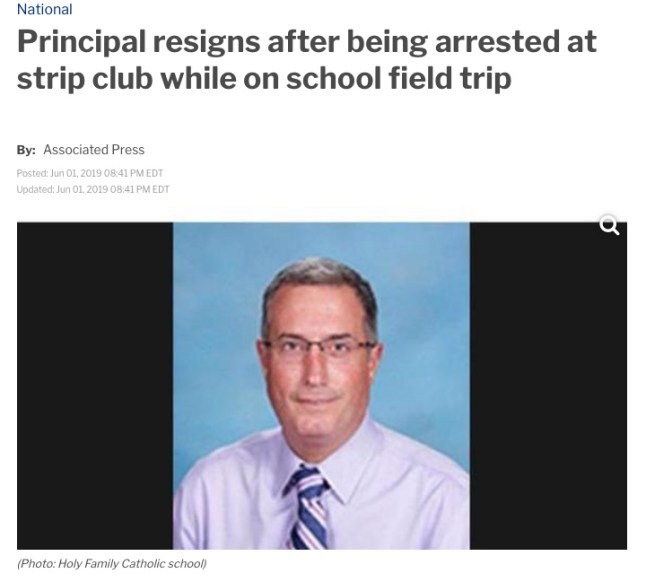
StripPrincipal

When it comes to the lead on this, you have an Associated Press approach that cuts to the chase:

A Louisiana Catholic school principal was arrested at a Washington, D.C. strip club after refusing to pay his bill.

It’s 19 words and right to the point. However, it’s really missing some of the nuances.

First, the guy hit the strip club while on a SCHOOL FIELD TRIP. I remember my mother freaking out when her school and my school ended up having a trip to the circus when I was in second or third grade and she saw our teacher smoking a cigarette and drinking a beer behind the big top. I can only imagine what parents at this school were thinking.

Second, the guy was drunk at 2:20 a.m., outside the club, refusing to move out of the roadway. And, again, remember this is a FIELD TRIP for a CATHOLIC SCHOOL.

Third, he had a history of problems, including the mismanagement of Hurricane Katrina donations to a previous school. Still, he was a reserve officer in a local police department.

Still, the AP might not have wanted to use all the information that was in The Advocate, the local paper for this educational leader. Here’s the lead from that paper, where the writer clearly decided to go a different way:

Michael Comeau, the principal at Holy Family Catholic school in Port Allen and an educator who previously received the prestigious $25,000 Milken award, has resigned after his arrest early Friday at a Washington D.C. strip club while on a school field trip to the nation’s capital.

This is a case of throwing the kitchen sink into the lead, as it’s 46 words. The author names the person up front, relying on his presumed local fame to drive the interest. (I asked a friend who reads this paper and he said this guy isn’t a known entity, so there’s that…)

The part about him being an award-winning educator makes the lead (and about a half-dozen paragraphs throughout the story for some reason). It also updates the story to explain he resigned after the arrest, pushing up the newer stuff that AP didn’t use.

Neither of these leads hits the nail on the head, as I’m guessing more people would care about the action than the person, making the second lead a bit weaker in the approach. I’m also sure more people want to know about the field trip and the resignation than the arrest. However, WHY he was arrested (whatever the strip club/booze equivalent of “dine and dash” is) would be worth knowing up front. (There’s something in another story about his use of a service dog at the strip club, which just screams for a follow up…)

If you’re looking for a fun and yet somewhat disturbing exercise, use all the information in these two stories to determine what would make for a good 25-35 word lead for a broad audience.

Revisiting “The Midterm From Hell”

In honor of my students who will be taking this exam today, I thought it would be a good idea to revisit this post with a few tweaks. Enjoy. — VFF

I often get to hear students complaining about classes and professors, as that comes with the territory of being an academic adviser, a  former newsroom adviser and having an office right next to the computer lab. When they don’t think I’m listening, I’ve heard students mutter about the amount of reading I assign in Feature Writing or the way that AP style is way too big of a deal in the Writing for the Media class.

However, two grievances have been repeated about two specific things I force students to do that are both points of annoyance and points of pride for them. When they gripe about these things, they do so loudly and with an odd tone like someone in a really bad 1980s movie yelling, “I was in ‘NAM, man! You don’t even know!” It’s a mix of irritation and self-congratulations.

The first we’ve discussed here before: The Feel-It Lab.

The second is what one student referred to as “The Midterm from Hell.”

Conceptually speaking, it’s reporting in its purest form: You get an assignment you know nothing about, you research it, you find sources and you turn the story in for publication immediately. Maybe working night desk where asking “Can I get this done tomorrow?” would have gotten me mocked and then fired and then mocked again has jaded me to the difficulty of this, but I doubt it.

Below is the outline for “The Midterm from Hell” as it is presented to the students. Feel free to use it as you see fit or adapt it as you need. Consider it a “share the hate” moment from me to you.

——-

Reporting Midterm Assignment

The 24-Hour Story

As promised, this isn’t going to be your standard “memorize some facts, regurgitate them and move on” type of midterm. Reporting is a skill that you hone over time and in many cases, you don’t have a lot of time to do the honing. You will be responsible for your own fate and the fate of your colleagues in this midterm exercise.

Part I: The Pitch

As per your syllabus, you will have to email me a midterm pitch no later than Sunday at noon. If you do not turn in your pitch, you will not be able to participate in the midterm itself on Tuesday.

(UPDATE NOTE: About one student every other year fails the midterm before it even launches because of this. I guess if I had this threat hanging over my head, I’d make it a priority to beat the deadline by several days.)

What you are attempting to pitch is a story that you believe you could accomplish within a 24-hour period. The pitch itself should include the following things:

  • Your name
  • Your contact information (phone number, email address etc.)
  • An introductory paragraph of about five or six sentences that outlines what the story is about, what makes it worth doing and why it matters to a specific readership.
  • A list of at least THREE human sources, including contact information and rationale behind these people being used as sources.

You should attempt to create a quality pitch, obviously. If your pitch is too weak or fails to meet the basic elements of the assignment, your pitch will be discarded and you will not be allowed to participate in the midterm.


Part II: The Story

Everyone who turns in a pitch will be expected to be in class ready to go on Tuesday. I will print off all of the acceptable pitches and give each pitch a random number. Each participant will select a number and thus receive the associated pitch. YOU CANNOT RECEIVE YOUR OWN PITCH. I will read the pitch to the class and give you a copy of the pitch. The person responsible for the pitch can then augment the pitch with additional information or suggestions. We then open the floor for other people to suggest other sources or other places for information. Once you feel comfortable with your pitch, we move on to the next person.

When all the pitches are handed out, you will then have approximately 24 hours to complete a solid news story on that topic. It must be at least 2 pages, typed, double-spaced. It must contain no fewer than three human sources. You do not need to use any or all of the sources suggested to you in the pitch. You can augment the list or stick to it. The pitch is merely meant to guide you.

Your story must be in at noon on Wednesday.  If you are late, you fail the assignment, so remember the old line we repeat in here: Journalism is never done. It’s just due. Your completed work will be graded along the same lines as your previous stories, with one-third of the grade being assigned to each of the three main areas: Reporting, Writing and Style.

This is going to typify the quote on the front of your syllabus: You have to improvise. You have to adapt. You have to overcome. Stuff can go wrong. People might not get back to you. Sources might be out of town.  Your job is to be a reporter and figure out how to get the best possible version of the story out of the assignment based on what you have available to you at the time. Perfection is unattainable, so don’t panic about that. Make sure you’re accurate, clear, concise and balanced. Work on smoothing out your writing without obsessing about how perfect it is.

You can do this. We’ve been preparing for it all term.

Questions? Ask ‘em.

GAME TIME! Spring Break AP Style Quiz

If you’re anything like my students, you are desperately awaiting the start of spring break. Or is it “Spring Break?” Or maybe Spring break…

See what you know about AP style with this quiz on our favorite time of the spring.

You don’t have to establish an account to play. It’s 10 questions and you will be judged on speed and accuracy.

Take a screen shot of your score and post it everywhere! Challenge a professor (who likely wants this break more than you do) and earn bragging rights for the year.

To start, click this link.

GAME TIME! AP-Style, Spring-based Quiz of Mirth and Hope

In Wisconsin, this time of year makes you really question your sanity and hate every Facebook friend from Florida who is posting beach photos. It was -18 windchill the other day and I don’t see it getting better any time soon. A friend of mine told me that the giant pile of snow at the airport in Milwaukee is expected to melt no sooner than July. And he was serious.

In hopes of bringing on a season in which “windchill” is not a word, here’s an AP quiz based on spring themes. Speed counts, but accuracy matters most.

You don’t have to create an account to play, but if you want to, it will rank you.

Post a screenshot of your score here and brag to your friends. Challenge a professor so you can have bragging rights all year.

Click here to begin the quiz.

GAME TIME! AP Style Quiz: Snow-Pocalypse Edition

(It’s like this, but colder and without the weird maze thing.)

In Wisconsin, we rarely get riled up over snow storms, but the one that hit overnight was something that had people freaking out for days. Our area is slated for about 18 inches and then a polar vortex is supposed to drop temps into the negative double digits.

So, with me being trapped in the house, I figured it would be a good excuse to punch down a snow-pocalypse edition of an AP quiz for those of you who are in areas where 50 degrees has the meteorologists telling you to dress in layers. I hope you enjoy pondering our misery, as you ponder these 10 questions.

You don’t have to create an account to play, but if you want to, it will rank you.

Post a screenshot of your score here and brag to your friends. Challenge a professor so you can have bragging rights all year.

Click this link to begin the quiz.

GAME TIME! AP Style Quiz, High School Edition

I spent Thursday in Stoughton, Wisconsin, as part of an “in-class field trip” for the student media folks at the school. A friend and I taught the students there how to do everything for student newspapers from editing and writing to design and graphic creation.

In honor of those fun high school days,  here’s an AP style quiz based on the inner-workings of high school.

You don’t have to create an account to play, but if you want to, it will rank you.

Post a screenshot of your score here and brag to your friends. Challenge a professor so you can have bragging rights all year.

Click here to take the quiz.

GAME TIME! See how well you know your First Amendment rights on this Constitution Day.

Today is Constitution Day, which commemorates the day in 1787 that the Founding Fathers last met to dot the I’s and cross the T’s on the Constitution. The holiday itself evolved into its current status after several iterations, such as “I am an American Day” and “Citizenship Day.”

In 2004, Sen. Robert Byrd of West Virginia urged his colleagues to support the inclusion of an amendment to an omnibus spending bill that would change the name of the day to the Constitution Day and Citizenship Day. The amendment required that the head of every federal agency provide employees with educational material pertaining to the Constitution on that day. It also stated that each educational institution that gets federal funding should provide programming regarding the Constitution on the holiday.

Given the importance of the First Amendment to the Constitution to media folks, it’s worth asking: How well do you know what freedoms and protections the First Amendment provides? The Student Press Law Center gives you a way to find out with this handy 10-minute quiz. The 30 questions here cover a wide array of topics and scenarios.

Sure, it would be great to get all of them right, but that’s not the only thing that matters here. The better you understand your rights and WHY they are protected, the more easily you can stand up for yourself as a media practitioner and a citizen.

Click here to give the quiz a try.

Can you spot the deceptive post? The NYT gives you a pop quiz on Facebook fakers.

Spotting fake stories, parody Twitter accounts and other similar landmines out there can be tough. In previous posts, we gave you a look at a fake news quiz and some examples of Twitter trolls that led to some awkward media moments. To help you with deceptive social media posts, consider this great interactive graphic from the New York Times that will help you test your BS detector.

The Times developed this piece that both gives you the posts to examine and then explains why you were right or wrong. In addition, the authors outline the history of the people behind the posts and what has happened to them.

Click here and give it a try.

Game Time! An AP-Style News Quiz

The Associated Press style book is the bible (not Bible) of media writers. It helps provide consistency, structure and clarity for writers in news, PR, advertising and more. (Broadcasters have their own style for on-air scripts, but they still need AP style for filing text-based web stories.)

Think you have a handle on AP? Give this quick quiz a shot.

You don’t have to create an account to play, but if you want to, it will rank you.

Post a screenshot of your score here and brag to your friends. Challenge a professor so you can have bragging rights all year.

Click here to take the quiz.

GAME TIME! AP quiz, county fair edition

The annual county fairs are starting to take place out here, where you can smell farm life and eat anything anyone has ever thought of making with batter and a deep fryer. To honor our traditional days of being overfed and cheated out of a prize by a carnie, enjoy this classic Mystery Science Theater 3000 short, “A Day at the Fair.”


Also, here’s an AP style quiz based on those fun fair days.

You don’t have to create an account to play, but if you want to, it will rank you.

Post a screenshot of your score here and brag to your friends. Challenge a professor so you can have bragging rights.

Click here to begin!