Whether you agree or disagree with Mahmoud Khalil, you need to watch his case

THE LEAD: Mahmoud Khalil, a graduate student at Columbia University and a legal U.S. resident, was picked up in an ICE raid Saturday and faces deportation. Khalil was a leading voice in the Palestine protests on the university’s campus last spring.

Khalil was detained Saturday night as he and his wife were returning to their Columbia University-owned apartment in upper Manhattan by officials from the U.S. Department of Homeland Security.

The agents told the couple that Khalil was being detained because his student visa had been revoked.

When his wife provided documents proving he was a green card holder, the agents said that was also being revoked and took him away in handcuffs, according to a lawsuit Khalil’s attorneys filed challenging his detention.

President Donald Trump discussed the matter in a social media post in which he supported the arrest and potential deportation, calling Khalil a “terrorist sympathizer” for his stand on the Palestine situation.

Secretary of State Marco Rubio concurred, saying Khalil’s protest actions were “aligned with Hamas” and thus it was acceptable to revoke his green card (and his marriage to a U.S. citizen, I guess) and deport him.

A court held up his deportation and his lawyers will be arguing Wednesday that he’s essentially being punished for exercising free speech.


DOCTOR OF PAPER FLASHBACK: We talked about the issues related to protests last year when a number of campuses were dealing with upheaval and cracking down on students who peaceably assembled. As we noted back then, you can’t just support free speech when it’s speech you like. The same is essentially true for all of the other aspects of the First Amendment.

In other words, if you’re cool with people standing up for Side A of an issue, you have to be cool with people standing up for Side B of that issue. As long as the protests and speech don’t run afoul of what the law has already stated as being out of bounds (fighting words, child porn etc.), the Bill of Rights protects those actions.


WHY YOU SHOULD CARE: You could easily make an argument that this is one guy, speaking out on a topic in a way that a lot of people don’t like, so it shouldn’t really matter.

You could make that argument and it would be both dead wrong and dangerous.

The actions here underlie a broader set of concerns for anyone who supports free expression. Earlier in March, the president noted he would crack down on colleges and universities that allowed for “illegal protests” to persist. It wasn’t clear what made something an “illegal protest” in the eyes of this administration, but I imagine that the translation would be “anything the president doesn’t like.”

Anyone who has an opinion about anything should probably be concerned about this approach, even if you disagree with everything Khalil stands for. Without legal protections for expression, it could be just a matter of time before whatever you think is worth talking about could land you in prison under some sort of trumped up charge.


DOCTOR OF PAPER HOT TAKE: Again, I don’t like a lot of speech or protests, and I’m pretty sure I wouldn’t agree with most of what Khalil has to say. That’s not the point of sticking up for his rights.

The law has long held that the government can’t suppress speech it doesn’t like, but it seems like we’re living in some sort of parallel universe right now where the government tends to do something beyond the pale and ask questions later. The Elon Musk line about how the administration will “make mistakes” but fix them up once they realize they made a mistake is a bad idea in general, but it’s even worse when it come to the inalienable rights associated with our country’s founding.

If the courts give the administration a pass and say, “Well, it’s just this one guy and, yeah, screw Palestine anyway,” it sets a dangerous precedent for when someone else upsets this administration. The cure for speech we don’t like is not to crush that speech. It’s more speech that presents a counterbalance to the original speech.

Even if the courts let this guy go, we still have the problem of how these actions have the potential to chill speech throughout the country. It’s like a bad parent smacking a kid in the head for voicing an opinion. That kid is probably not going to pipe up again, but the rest of the kids in that family are probably also going to keep their mouths shut.

That’s not how we’re supposed to roll as the United States.

Former UW La Crosse Chancellor and Porn Actor Joe Gow is Suing the UW System to Get His Professorial Gig Back

UW-La Crosse chancellor Joe Gow fired for producing porn

Former UW La Crosse Chancellor Joe Gow at a convocation of some sort, making sure not to go “Elon Musk” on everybody.

THE LEAD: Former UW La Crosse Chancellor and faculty member Joe Gow has filed a federal suit to undo his firing. Gow was fired from each of his positions after it came to light that he and his wife were doing porn and posting the videos online for public consumption.

The lawsuit argues the UW System’s decision to terminate Gow violated the First Amendment and flouted the UW System’s commitment to free expression.

“I think this is an important moment for free speech and I’d like to think this will result in a court saying you can’t fire someone for what they do on the internet on their own time,” Gow, 64, told the Milwaukee Journal Sentinel. “It sounds grandiose but maybe we can get people to rethink pornography.”

Milwaukee-based attorney Mark Leitner filed the lawsuit on Gow’s behalf on Monday, the first day of spring semester classes at UW-La Crosse.


BACKGROUND: As we previously outlined on the blog, Gow was removed as chancellor in late 2023 once the Board of Regents became aware of his hobby. However, as is the case with most faculty in administrative positions, Gow retained retreat rights that would have put him back in the classroom as a tenured faculty member of the communication department.

The regents apparently decided that the idea of Gow teaching students at a university he led for almost 17 years with few problems was going to be a bridge too far, so they stripped him of his tenure and fired him in 2024. At the time, Gow was in contact with the Foundation for Individual Rights and Expression (FIRE), which helped him find legal counsel for a potential suit.


BLOG FLASHBACK: In September, we did a Q and A with Zach Greenberg of FIRE, who was nice enough to walk through the issues associated with the case as well as why FIRE felt this was a First Amendment issue. You can give that a read here.


A  FEW UNPLEASANT REMINDERS ABOUT THE FIRST AMENDMENT:

  • The First Amendment is essentially content neutral. It’s not meant to protect expression people like. It’s meant to protect expression people DON’T like. As we explained when universities were trying to take sides on the Israel/Palestine situation, you can’t just defend free speech when you like the speech.
  • To overcome the protections afforded in that amendment, it requires some very specific things: Fighting words, true threats and child porn are among the most clear cut. Something making someone feel uncomfortable or what might happen at some distant point in the future doesn’t clear that bar.
  • The First Amendment is about governmental action, which includes public institutions. As part of the First Amendment to the Constitution, the government generally does not possess the right to curtail free speech or free press. If Gow were working at Marquette University when this happened, he’d be out on his ass, no questions asked.

DOCTOR OF PAPER HOT TAKE: Long story short, this is essentially a game of “chicken” and has been since Gow’s porn stuff first became public knowledge.

Gow almost HAD TO sue, as to let things sit as they were would essentially be saying, “The UW System was right and I shouldn’t have been doing the porn thing.” In the same way, the university system almost HAD TO fire him and then brace for impact, because it’s not like the folks at the State House and State Senate aren’t already looking for 10,002 reasons to cut higher-ed funding in Wisconsin. To let this go would have every fire-and-brimstone legislator screaming about how not a dime of state money should fund “the UW Porn System!”

I also think the idea of him doing porn just makes the regents and Gow’s colleagues feel awkward and icky, so they don’t want to have to deal with him any more. I get it, in that nobody with a half-dozen siblings likes looking at their parents and being forced to think, “Wow, Mom and Dad really got busy a lot…”

Let me be clear: I have no problem with two consenting adults doing whatever they want to do together, so long as it’s not breaking the law. I also wouldn’t want to think about my boss doing a Porn Hub channel, nor would I want to see it. However, just because I don’t like something, it doesn’t follow that it shouldn’t exist and the First Amendment serves to protect the rights of all people in that regard.

I understand that certain things can and should lead to people being fired, but I tend to think of most of those as legal matters. Felonies tend to reflect poorly on individuals and therefore the companies that employ them, so that makes sense. Misdemeanors? I guess it depends on what it is, but it is up for debate. If I fail to yield the right of way to a roaming cow out here, I could be fined, but I don’t think I should be fired. Public urination? Yeah, that doesn’t look so great, so maybe…

Gow’s hobby used to be illegal back in the late 1960s and early 1970s, when the possession, creation and dissemination of pornography was illegal. You know what also used to be illegal back then? My hobby: Pinball.

From the 1940s to the 1970s, laws prohibited the silver-ball games due to their influence of “juvenile delinquency” as well as fear that they were morally bankrupt and would lead to gambling and other vices. In fact, it wasn’t until 1974 that the Supreme Court ruled that pinball was fine and it took until 1976 for New York City to start acting right. That was after both the Stanley v. Georgia ruling and the Miller v. California rulings that made porn passable in the country.

Back then, both were criminal offenses. Today, it’s totally cool for me to tell my students, “Hey, I’m working on a pinball machine I just bought,” while it’s less acceptable for Gow to announce in a classroom, “Hey, I’m working on a new film for Only Fans!”

The one thing I’m constantly left wondering in situations like this one, and the Sam Kuffel case we discussed Monday, is this: Exactly how much of my life does my employer have a right to control and who draws those lines?

The Sam Kuffel Kerfuffle: CBS58 in Milwaukee “Parts Ways” with a Meteorologist Who Complained about the “Elon Musk Nazi/Not-A-Nazi Salute” on Social Media

Sam Kuffel, meteorologist for CBS 58 in MilwaukeeSam Kuffel via the station’s old Facebook post.

THE LEAD: CBS58 in the Milwaukee TV market “parted ways” with meteorologist Sam Kuffel after the weather caster posted her displeasure about Elon Musk’s “hand gestures” on her social media account.

The 31-year-old graduate of UWM had been doing TV weather reporting around the state of Wisconsin since about 2016. The posts she made after the inauguration were being lambasted on Milwaukee conservative talk radio.

In one post on her personal Instagram account, Kuffel posted a picture of Musk at the podium, saying, “Dude Nazi saluted twice. TWICE. During the inauguration.”

She added, “You (expletive) with this and this man, I don’t (expletive) with you. Full stop.”

Kuffel then posted a GIF from “It’s Always Sunny in Philadelphia” on Instagram along with the saying, “Screw that old (expletive). He’s a Nazi.”

By late Tuesday, she had made her Instagram account private.

Kuffel told the Milwaukee Journal-Sentinel on Friday that she was, in fact, fired for the posts. She noted that she was “just voicing my personal opinion” on her private Instagram account, adding she was still processing the situation and weighing her options.

BACKGROUND: In case you were on Mars or one of the other planets Musk is apparently planning to conquer and missed it, Musk spoke after President Donald Trump’s swearing in and made two sweeping arm gestures.

For the sake of bending over backwards to provide a benefit of the doubt, let’s just say that those gestures had the same movement, angle, finger-stretch and general stridency associated with the “Sieg Heil” salute used during the Nazi Regime.

Musk repeatedly makes gesture likened to 'Nazi salute' at Trump rally

Unless there is a guy out of frame getting ready to hi-five Musk for an “and one” play during the NBA playoffs, this doesn’t look all that great.

The Anti-Defamation League asked everyone to take a breath and relax after the “awkward gesture,” noting that we should all be giving each other some grace in this time of transition. The ADL later condemned Musk, grace period be damned,  after he took to Twitter/X and made some Nazi jokes about the situation.

Musk previously took heat for the antisemitism he allowed to foment on his Twitter/X platform, as well as his retweeting (or whatever we’re calling it now) of antisemitism. In 2023-24, as part of his “apology tour,” he ended up visiting Israel as well as taking a tour of the Auschwitz death camp.

In addition, he has endorsed the AfD, the far-right wing of German politics, and recently told an AfD rally audience that they need to “move past” the history they have related to the Nazi movement and get over “past guilt.”

A FEW BASIC (POSSIBLY UNPLEASANT) REMINDERS ABOUT FREE SPEECH: When a situation like Sam Kuffel’s hits the public eye, comments related to free speech, free press and other similar “rights” start flying all over the web and social media. To better deal with the situation, it’s important to keep a few basic rules of the game in mind:

The First Amendment is about the government: As part of the First Amendment to the Constitution, the government generally does not possess the right to curtail free speech or free press. What we’re talking about in the Kuffel case is a private enterprise making a decision about the activities of one of its employees. That’s different.

Law and ethics are completely different things: People have complained in various forums that the station should have stuck up for one of its own and kept Kuffel on the air. The question of if the news station SHOULD have fired her is one of ethics. The question of CAN the station fire her is one of the law. (See point one)

SOME ADDITIONAL UNPLEASANT REMINDERS: This situation mixes several key reminders I have to give my students each semester. These include:

  • Free speech (even when properly understood vis a vis the First Amendment) does not mean consequence-free speech. You can publish without fear of government intervention, but many other things can happen to you in court or the court of public opinion in terms of consequences for what you say.
  • Despite Kuffel’s contention that it was a “private” account, there is no such thing as private social media. Just ask this person. Or this person. Social media is available to EVERYONE and even if you have your settings locked on “double-super-secret-private pinky swear,” there is still a good chance it’s not going to remain “just among friends.”
  • In most cases, where you work has a social media policy in place that is meant to keep your posts as sanitized as a bleach bath and as sharp as a bag of cotton balls. Know what it says before you violate it and find yourself looking for work.
  • Think before you post.

DOCTOR OF PAPER HOT TAKE: Getting rid of Kuffel probably did a lot more harm than good in a number of obvious and oblique ways. I could do this for days, but let’s pick out a few key ones:

The optics are bad: Nothing says, “We are a proud member of the Fourth Estate,” like tossing the WEATHER PERSON under the bus after she made a stupid social media post. What? Were the higher-ups at the station worried that her disdain for Musk might lead to inaccurate forecasts over the next few months? (Spoiler Alert: She’s doing the weather in Wisconsin. It’s cold, colder and “holy crap, are your nostrils freezing together?” frigid.)

Seriously, you’re talking about a person best known for a weird weather beef with Erin Andrews. Her most recent piece for the station was about “pancake ice.” If you really worry about bias on the staff, start by getting Lance Allen to ask harder questions at the Packers press conferences.

If the theory is that if anyone at the station does something bad, then everyone at the station comes into question, OK. However, how is it that the station was totally cool hiring a journalist who got arrested at a Brewers game after a fistfight with another reporter? (Side note: Don’t include the phrase “is no stranger to Milwaukee, though” in his official station bio.)

Also, if you’re willing to dump the weather person, what happens when a news reporter wants to do a story that might lead to some upset people? If I worked there, I’d be asking for the “puppy and kitten beat” for the next few years.

You essentially killed a fly with a sledgehammer: Most of the experts that the news reports tried to find a balance in their comments. That said, they tended to agree that a) if there’s a policy that says “don’t call someone a Nazi on social media, even if they are a Nazi or we will fire you,” Kuffel likely had no cover and b) firing her seemed like overkill.

On point a, it’s likely not a policy like that. It’s probably some mushy “morals and standards” thing that the lawyers built into everyone’s contract to give them the right to fire anyone that the station felt did the company dirty. In those cases, it’s “fire her and let’s see if she’ll fight it.”

On point b, the station really did try to kill a fly with a sledgehammer. Kuffel was essentially saying what a lot of people were saying, although she used some “saltier” language to do it. It wasn’t on air, it wasn’t on the station’s social media and it probably wouldn’t have been a huge deal if we hadn’t suddenly become “Snitch Nation.” (More on that later.)

When local conservative radio host Jay Weber called Tim Walz’s neurodivergent son, Gus, “a blubbering bitch boy,” on his social media account, he got a two-week suspension. Greg Doyel of the Indy Star received a similar “time out” after a press conference exchange in which he awkwardly requested Caitlin Clark to flash him a “love sign” after each game. The Washington Post’s Dave Weigel only got a month suspension for a retweet  that noted “Every girl is bi. You just have to figure out if it’s polar or sexual.”

The last instance I can find of a media outlet firing a journalist in a way that drew public attention is when New York Magazine cut Olivia Nuzzi loose. In that case, she’d profiled RFK Jr. but also had been sexting him and sending him nudes, according to media reports.

Google “reporter suspended” and “reporter fired” and you’ll a good number of examples to decide which category Kuffel’s situation best mirrors.


You embolden Snitch Nation: This is the kind of thing that probably wouldn’t have gotten much traction, if not for the amplification of outrage that is local talk radio. Conservative media host Dan O’Donnell basically lit the “Bat Signal” in this case, criticizing Kuffel’s posts and working his audience into a lather over it. At that point, the station decided it had to do something to move out of the crosshairs of O’Donnell and crew, so they canned Kuffel.

This sets a precedent that any decent third-grade teacher will tell you is bad: Someone does something that’s maybe not all that great and a giant tattletale starts yelling “OOOHHHH! MS. SMITH! MS. SMITH! MS. SMITH! DID YOU SEE WHAT SAM DID?????,” thus getting everyone else to start yelling, “OOOOHHH!!! SAM’S IN TROUBLE!!!” Thus, rather than apply grown-up logic, you overreact and whip out the punishment stick to get the noise to stop.

What that does is a) make everyone afraid of the loud tattletale and b) make it seem like being a tattletale is how everyone should act. Not a great idea. I can’t wait to find out what happens if O’Donnell gets a whiff of this blog post…

(SIDE NOTE: You’d think a guy with high honors at a top-flight law school and a background in media himself would have better things to do than bullying a local meteorologist, but maybe that’s just my take…)

Letting loud idiots dictate your behavior doesn’t eliminate the problem. It literally leads to much bigger ones.

A MODEST PROPOSAL: As I was talking to Mom last night, she asked when the blog would be coming back and if I’d be covering this. After I assured her it was already half written, she asked what I thought would happen next on this. My answer is probably too logical and easy to make happen, but here it is:

If I had control of Weigel Broadcasting Co., CBS 58’s parent company, I’d quietly approach Kuffel and offer her another job at one of the other affiliates in the network, with the promise that Kuffel won’t sue for wrongful termination. This takes a potentially ugly legal battle off the table, gives Kuffel essentially a “suspension” instead of the death penalty and the company gets to keep a solid broadcast meteorologist.

I would also review the social media policies for the entire company and make sure a) they’re air tight, b) everyone gets a refresher course and c) the penalties for whatever will happen get spelled out clearly. This might also be a good time to let the news staff know where the network stands on backing its reporters if things get dicey or if anyone throws up a hissy fit. Or a Nazi salute.

An open letter to Madison Mayor Satya Rhodes-Conway: Media folks don’t like dealing with the death of kids any more than you do, so please don’t treat them like crap

Dear Mayor Satya Rhodes-Conway,

I saw the comments you made to a gaggle of reporters in the wake of the Abundant Life school shooting, in which you basically accused working journalists of being pain vampires, who live off the misery of others. You chastised these folks for asking legitimate questions, told them to have some “human decency” as if that never occurred to them and then shamed them with a “y’all” that could only come from someone who spent most of their life in the land of Yankees.

I don’t know what compelled you to castigate the media at large in that press conference. It might have been just the stress of the day or it might have been previous experiences with a few bad folks in the field. I can tell you for sure that, just like in politics, there are good and bad people in journalism. And, just like in politics, the lousy ones tend to make the biggest impressions and do the most damage for the whole lot of folks. If I had to wager, I’d say that most of the people in that media cluster would have gladly been covering ANYTHING ELSE that day than a school shooting.

I let this post sit for a day or two, in the hopes that you would issue some sort of apology for this, even if it were completely insincere, so that we could all go back to doing what we’re good at: Media folks covering the news, you not pretending to be a journalism expert. Unfortunately, the PR people who advise you are apparently no better than you are, so I thought I’d offer a few insights on what this situation is like for news people.

I spent three years as a reporter, another five as an editor and then about 15 as a newsroom adviser, and in every case, I’ve had to deal with stories involving dead kids. This is not a morbid flex, but rather a chance to help you understand where I’m coming from.

All those things you said at the press conference? Hell, I’ve been told worse and more loudly by far more traumatized people than you. I’ve been called a vulture, a scumbag, a waste of life and a few other things that could peel the paint off of a car. The hardest one was the lady who told me that “Your mother must not have raised you right, if you think what you’re doing is appropriate.”

Believe it or not, journalists are actually human. Sure, we’re really good at hiding it a lot, but we have the same emotional range as most other bipeds you’ve encountered. If you felt pain, agony, shock, angst or anything along those lines, it’s safe to say that the people who were asking questions of you that day did as well.

If you think that reporters in that gaggle are going to enjoy talking to sobbing parents and bothering traumatized kids before heading home for a nice casserole supper, you’re delusional. This kind of thing sticks with most people for a long time, and journalists are no exception.

When my students would ask me about my experiences writing about death and mayhem, I told them that I could remember the name, age and cause of death of every dead kid I ever covered. It’s been decades since I was reporting and editing, but it’s still true.

Casey Rowin, Shawn Magrane, Matthew Dunn,  Deanna Turner… those names and a dozen more stick with me every day. I think about Rachael Himmelberg, the infant who died after receiving what should have been life-saving open heart surgery. She would be in her late 20s now and I wonder what she would be doing. I think of Jordan Sosa, who died at 22 months old when he wandered out of his grandparents’ house and fell into the Black Earth Creek. He might have been a college student of mine, if he hadn’t drown that day.

My first year at Ball State, we had five college kids die of various causes: Michael McKinney was shot to death by a cop,  Karl Harford was robbed and executed after giving some guys a ride… accidents, suicides and more… I remember one of the more veteran editors of the paper, who had lived in Muncie his entire life telling me, “This is not normal for us around here…” like he was trying to convince both of us that what he was saying was true.

The editor also asked me, “How did you get so good at covering stuff like this?”

My answer was simple and I think most journalists would be on board with it: “You don’t get good at doing this. You become more experienced in doing the best you can. If you ever get to a point where you feel you’re good at covering dead kids, it means you are really broken and you need to walk away for a good, long while.”

Each dead kid we cover is like a wound we receive, the scar a permanent reminder of what it was to be there in the worst moment of someone else’s life. Each mistake we made in how we phrased a question or how we approached a source still stings. Each time we did the best we could and still faced the wrath of a pained family member or friend brings about a wince and grimace.

You mentioned that reporters should go away and give people a chance to grieve. Despite your apparent thoughts on the state of media today, reporters can be a crucial component of that grieving process. I go back to what Kelly Furnas, the adviser of student media at Virginia Tech, said to his students as they went out to cover what remains the deadliest shooting on a college campus:

“The students I talked to were terrified of the fact that they would need to call these families and I said, ‘You don’t assume that these families don’t want to talk,’” Furnas said, recalling that day at a college media conference a few months after the shooting. “That’s a very important thing to these families to tell the story of their son’s or daughter’s lives. That’s a very important thing. A lot of people not only want to do it, but expect to do it.”

I can tell you for sure that this holds water. When it came to the dead people I covered in one way or another, I got one of three reactions 99% of the time:

  1. “I just can’t… I’m sorry…” These people were already at the maximum level of stress and pain and they were just incapable of dealing with anything else at that point. I would apologize for intruding on their grief and then leave them alone.
  2. “You #%*%ing VULTURE!” Yep, we talked about that already. This reaction gave me a ton of anxiety and pain, but I understood. It was like putting your hand out toward a wounded animal: They just hurt so badly, they lashed out, regardless of your intent. Again, I’d apologize and back away.
  3. “The pressure-release valve” This is what Kelly was talking about. These people are so full of emotion and they have nowhere to go with it. Everyone around them is feeling the same pain, misery, stress and more… All they want to do is talk about how great their kid was, or how amazing their parent was or whatever stories make them feel less hurt. As a journalist, we’re that opportunity to not only help, but to share their thoughts with others.

So in the future, please feel free not to tell journalists how to do their jobs at a time like this. It’s a job nobody wants, no one revels in and few people can do and remain unscathed.

If someone asks a particularly crappy question like, “Are there plans to call it ‘Less-Abundant Life’ now that people have died there?” or “Don’t you find it ironic that there was a lot of thoughts and prayers happening in there but the kids still got shot?” go ahead and release your inner scold. That kind of person deserves your wrath.

However, the basic “5Ws and 1H” questions are normal, even if the situation is not and you lack the answers. Everyone is frayed to the nth degree, so you need to operate above the fray. If you can’t, don’t hold the press conference or send someone out there who is actually skilled at PR to do the work for you.

I hope this helps, because I somehow doubt this will be the last time you and the media will spend time together discussing a devastating death or two.

Sincerely,

Vince (a.k.a. The Doctor of Paper)


When Write Goes Wrong: How to avoid the trap of journalistic fabrication (A Throwback Post)

It’s rare to have a group of students be exceptionally engaged at 8 a.m., but when it came to our ethics lecture today, the room was humming. Tons of hands up, tons of questions, tons of despair.

They had read stories about a drug addict and a rape survivor, seeing how their lives were forever altered by the choices they had made and the choices made for them. They cringed as the description of the these people’s circumstances, they flashed anger about the way in which the people around them had acted and they felt both helpless and compelled to act at the same time.

“I wanted to drive (out there) and beat those people up,” one student said of the people who engaged in the sexual assault.

I let them get all of it out, before I asked them to describe their feelings about these stories in one word or a simple phrase. They came up with things like, “anger,” “disturbed,” “disgusted” and “sad.”

I then took a deep breath and told them the truth: None of these stories were real.

In case you haven’t guessed, they read “Jimmy’s World” by Janet Cooke, “Hack Heaven” by Stephen Glass and “A Rape on Campus” by Sabrina Erdley. Each story was fabricated in some part or entirely. Each one fooled people at some of the most influential publications in the country. Each one had readers enraptured in a way that only amazing writing and terrifying topics can.

After that brief reveal, I asked the students how they felt now, knowing this new information. The answers were somewhat similar (anger, disgusted) but also different (relieved, stupid). As we shifted the topic toward how NOT to put themselves in this situation, I told them that any time they feel like they want to cut a corner or bend the rules in this kind of way, they should think about how they felt when they found out these stories weren’t real. Then, realize that’s how they’ll be making their own audiences feel if they fake it and get caught.

Today’s throwback piece takes a look at another case of fabrication and some potential things that might help your students come to grips with this issue.


“Don’t Bring Shame On The Family.” 4 helpful thoughts related to the Mike Ward fabrication debacle

Every time I see a situation like the one involving former Houston Chronicle journalist Mike Ward, who was found to have fabricated sources for his stories, I always think, “What the hell is wrong with this guy (or gal)?” Thanks to my overly Catholic upbringing and the guilt that comes with it, my next immediate thought is, “Hey, there but by the grace of God, go any of us.”

However, at various points in life, family and friends have hit me with a few helpful thoughts that stuck with me that kept me out of a lot of trouble. In hopes that these things might help you in your journalism career (or life in general), here are four of those bits and bites that might be useful:


If you’re going to steal something, steal the whole store

My dad can always make sense of things in a way that usually kept me from doing a lot of stupid things. He once told me a simple adage that helped me understand cost/benefit analysis in a truly elementary way.

“If you’re going to steal something,” he said. “Don’t steal a candy bar. Steal the whole store. I mean when they come back in the morning to open up, there should be nothing left but wires sticking out of the ground.”

His point was that once you steal something (or do something else despicable), you were marked for life, so it better be worth it when you throw away everything for it. I have no idea what Mike Ward was best known for before this, but it’s pretty clear he won’t be known for much else other than this going forward.

It’s hard to find a lot of background on Mike Ward, but he’s not like some of the other “fabulists” like Jayson Blair or Stephen Glass who was a 20-something who got in over their heads. He spent more than 40 years in the field of journalism and nearly 30 years doing it in the state of Texas. He was working for one of the best newspapers in the state and a well-respected publication overall.

Was it worth throwing away his whole career and reputation to pep up the stories with random quotes that weren’t all that great to begin with? I doubt he thought about it like that, but I know I always let flights of paranoia take me to the worst possible scenario before I even think about “candy-bar-level theft” let alone taking out an entire store.


Stupid is bad, lazy is worse

I think this one came from my mother, but I’m not 100 percent sure. In any case, the underlying premise of not being lazy usually was Mom’s stock-and-trade when it came to things I was doing.

I know my general laziness was like a stone in a shoe for my mother. I can’t tell you how many times I’d be doing my homework and yell to Mom, who was in another room, “How do you spell (whatever I didn’t want to bother to look up)?” Her answer was always the same, “Look it up! You have a dictionary in there.” In short, don’t be lazy.

It could be unfair to deem Ward as lazy, but the way in which he seemed to make up random people would indicate at least some corner-cutting behavior.

It’s easy to find sources you use all the time for stories and to get used to those folks being ready to comment. The investigation into his various stories found that most of his “meat and potatoes” official sources were real people with legitimate quotes. Those folks could be interviewed with a quick phone call or a simple email.

The “real people” who hated guns or gun control, who planned to vote for a specific party, who didn’t like that the McRib wasn’t available all year and so forth require some “shoe-leather reporting.” Reporters have to go to local diners, knock on doors with “Don’t Tread On Me” flags flying outside, ask people they know for help finding people they don’t and generally chase around to get that one pancake-eating source who can give you the “salt-of-the-earth person” quote.

That part of the job is a major pain in the keester and it can be awkward as hell. Truth be told, I used to prefer asking people for comments after a shooting or a fire or something else horrible than walking up to a guy eating a funnel cake at the county fair to find out how much fun he was having at the event. Still, it’s part of the job, so I did it, despite the fact people treated me like I was from the KGB when I asked for their names.

Why Ward thought he could pull this off was a mystery, but it would seem to either be a dumb decision or general laziness. Neither of those approaches is good, so do your best to avoid both of them as a journalist.


They never did it just once

This one came from a former journalist and great friend of mine who covered the Chicagoland Catholic church molestation scandals of the early 2000s. I used to ask her how she knew for sure that the priests in her stories were serial pedophiles. The information she gathered came from the accusers, usually years or decades later, and was almost impossible to back up with documents or other “official source” content that I had gotten used to using in my own work.

Her answer was simple: She did a ton of digging, verified in every way she could and then she published the content and waited. In almost every case, if she published one or two accusations, she immediately heard from at least three or four other people who told her the same things had happened to them. It was like this scene at the end of “Spotlight.”

“They never did it just once,” Allison told me. “And they always did it the same way.”

She found that if a priest had trapped a child in the 1970s by promising baseball tickets and then luring the young man into his room, he did the same thing in the 1980s and 1990s. It was never a one-off and it was always the same.

Even though the magnitude is in no way the same, I think about this whenever a student mentions that they only cheated on an exam once or only lied about a source once or only did anything else sketchy once. It’s never just once. It’s just that they finally got caught.

When Blair was caught in New York, his student newspaper at the University of Maryland went back and found other fabrications and noted people were alerted to these problems at the time.Ward has a 40-year career in this field and he just got caught now in Houston. I would be willing to bet that this didn’t just happen once and it didn’t just occur to him now to do it. I have no idea how far back people want to go, but it wasn’t “just this once.”

If the thought ever occurs to you to cut the corner “just this once” and make up a source or hide a detail to spare a friend or fake your way through a story, don’t do it. It’s never just once.

It’s only hard the first time. After that, it becomes standard practice without a second thought.


Don’t bring shame on the family

I hear this in my head on a daily basis, courtesy of my father.

As I was preparing to go off to college, my mother was a veritable trove of advice, thoughts and wisdom that made “Oh, the Places You’ll Go!” seem underwhelming by comparison. She told me of all things I would see and the experiences I would have and everything else good that college away from home would bring.

Dad was more practical and blunt: “Go have fun, but don’t bring shame on the family. It’s my name, too.”

Tarnishing the family name was unacceptable to Dad, and to be fair, it kept me out of a lot of stupid situations. To this day, whenever I imagine doing something that might not be all that bright, I can see the headline in my mind: “UWO professor arrested on suspicion of (fill in the stupidity here).” I imagine the folks “back home” seeing my dad in the grocery store or running into him at the local farmer’s market and saying, “Hey… I read about your kid…” I STILL do this and I’m middle-aged, to put it kindly.

However, I also think about mistakes that tarnish that other “family” I referred to in the post about how journalists aren’t the enemy. In his 2016 piece on Janet Cooke, Mike Sager talks about how her fabrications led to the general mistrust of various groups of people. Some of his sources said that Cooke led others to distrust African-Americans in the newsroom. Others said it tarnished all journalism, leaving the public to regard all content with a wary eye.

I wonder what Cooke’s professors at the University of Toledo felt when they saw her quick rise and even quicker fall. I remember a few years back when a journalist in Alaska, Charlo Greene, quit her job during a live broadcast while outing herself as the owner of a marijuana-related enterprise.

A number of professors were chatting about this online when a professor I knew messaged me to say she had been a student of his. In discussing Greene’s collegiate experiences and the current situation, I could almost feel his grimace over the internet. If it were my student, I know I would have been rubbing my head and searching for aspirin while muttering, “Oh, good grief…”

Maybe it’s an old-fashioned notion that has people like me avoiding disaster by asking, “Good LORD! What would the NEIGHBORS think?” but I really believe it goes deeper than that. Each of us owes a debt of some kind to the people who helped us get here. The people who support us. Who take part in our lives. Those folks are family in the best possible sense and to create shame through poor judgment is to spread that shame upon them as well.

I might not always be thinking of myself when I do something good or bad, but you better believe I’m doing my best to not bring shame on those people.

Former UW La Crosse Chancellor Joe Gow loses his tenured professor position after UW Board of Regents decides porn is icky

I know this shouldn’t be my primary concern, but a) is it accurate to call him “chancellor” in the headline and b) is porn-making chancellor properly hyphenated as a compound modifier. If I had to guess, I’d say a = no, but b = yes.

ED NOTE: As was the case when we covered this in December, I apologize in advance for any double entendres. It is almost impossible to write this without hearing a 12-year-old boy in my head laughing, despite my best efforts to avoid such concerns.

Also, Monday, we’ll have a Q and A with one of the First Amendment attorneys at the Foundation for Individual Rights and Expression, the organization that has helped Joe Gow get legal representation.

THE LEAD: Joe Gow, the former University of Wisconsin La Crosse chancellor who was removed from his position after his bosses realized he was making porn videos in his spare time, was fired from his tenure position at the university as well on Friday.

The regents voted unanimously to terminate Gow. Deliberations were made in a closed session away from the public for about half an hour.

In December, university officials discovered Gow had produced and starred in pornographic content across the web in videos and self-authored books he published under a pseudonym. He was fired as chancellor and recommended to be stripped of his tenure.

Besides his future with UW, Gow has also lost $300,000 in accrued medical benefits. Before his June hearing, Gow said he was planning on using the benefits for more than a decade of coverage into his retirement.


THE BACKGROUND: We covered this situation here back when Gow lost his role as chancellor when the porn first came to light back in December.

Long story short, the regents removed him after they found out he was making porn. Gow stated he never used university materials, services or anything related to his job as he and his wife made the adult videos. That said, the role of chancellor was basically “You serve at the pleasure of the regents,” so he got yanked.

Still, like most administrators, he had what are called “retreat rights,” which meant he had the right to go back and teach in the department to which his expertise is tied. Thus, the regents had to figure out how to rid themselves of Gow and the baggage his hobby carried without breaking the law or violating his rights as an employed, tenured professor.


NEXT STEPS: Gow is out of a job but he is strongly considering legal action against the university. Gow noted he thinks this could go to the Supreme Court, as previous cases involving unpopular but totally legal speech have in the past few decades.


DOCTOR OF PAPER HOT TAKE:  The university and the UW system have been stacking sandbags on this one to try to find anything they can fire him for, other than what they are actually firing him for.

There have been accusations of refusing to cooperate with an investigation into his activities, perhaps violating the UW technology policies, engaging in “unethical and potentially illegal conduct” and engaging in activities that would harm his ability to be an effective teacher.

What they really want to say is “This makes us all uncomfortable. Joe did icky stuff, so he needs to go away.”

The problem with what they want to say is that it violates the First Amendment. I always go back to the simplest explanation I have for the First Amendment: It’s not meant to protect expression people like. It’s meant to protect expression people DON’T like.

I’ve also spent more than a little time thinking about the question, “How much of my soul does the university have the right to own?” I mean, sure, there’s the time in class and the time with the kids outside of class and the time in my office and the time publishing and the … Eh… You get the idea.

However, what happens when the university decides that whatever expression I want to engage in or someone else on faculty wants to engage it is considered too uncomfortable for words?

I’m quite certain my friends in the LGBTQ+ community who are of a certain age and worked at public universities found themselves a bit wary of what their private lives would mean for their public jobs. If we kept along that more conservative line of thinking, what would it take for a university to find that two people of the sexual orientation being together as a couple made for a firing offense today?

Conversely, I also know that opinions on certain things tend to change over time, so what seems OK at the moment, might lead to concerns in the future. For a while, there was this massive trend of everyone getting Chinese symbols tattooed on themselves as a form of expression and few people thought twice about it. (One of my students at the time, however, did say that his father, who was fluent in the language, would not write out such symbols for people as it was a cultural concern.)

Today, cultural appropriation is a concern and rightly so, could there be a risk to a professor at a public institution who has these permanent markings in a visible place if enough people make noise about it? I don’t know, but I like living in a world where the First Amendment says, “You can be upset, but you can’t punish someone for expression that is offensive.”

The phrases “objective journalism” and “sexting relationship with a source” rarely co-exist

Not to put too fine of a point on it, but when you Google a person’s name and EVERYTHING comes back related to one story, it’s rarely going to be a good day for that person.

THE LEAD: It’s stories like this that give me a brain aneurysm:

New York magazine on Thursday said its Washington correspondent, Olivia Nuzzi, is on leave after learning the star journalist had allegedly engaged in an inappropriate relationship with a reporting subject. That person is Robert F. Kennedy Jr., according to people familiar with the matter.

“Recently our Washington Correspondent Olivia Nuzzi acknowledged to the magazine’s editors that she had engaged in a personal relationship with a former subject relevant to the 2024 campaign while she was reporting on the campaign, a violation of the magazine’s standards around conflicts of interest and disclosures,” a spokesperson for New York magazine said in a statement in response to questions from Status.

A BASIC LOOK: Nuzzi met Kennedy in person once, according to published reports, as she worked on a profile that ran in November 2023. Kennedy is married to actress Cheryl Hines while Nuzzi was engaged to Politico chief Washington correspondent Ryan Lizza, but the two recently called off the engagement.

A variety of news outlets chipped in bits and bites of this story, but they all generally agree on the fact this wasn’t a physical affair. It included some tawdry banter, full-on sexting and/or Nuzzi sending nude photos to Kennedy. Word of the nudes and texts got back to the bosses at New York Magazine, and Nuzzi eventually confirmed the gist of the situation.

She is currently on leave from the magazine as a result of this situation.

POST-TRAUMATIC JOURNALISM FLASHBACK: I’m not naming names, as the last thing I want to do is dredge up the past or be accused of internet shaming. However, this isn’t the first case of a reporter and a source ending up in a compromising position of this nature. If you don’t believe me, just Google “Reporter source romantic affair” and you’ll find more than a few of these situations have made the news outside of the RFK Jr./Nuzzi situation.

The one that comes back to my mind happened in Milwaukee when a reporter for a local publication wrote a profile about a high-ranking law-enforcement official while simultaneously slipping into a relationship with the person.

This situation was a full-on affair of a physical nature that was eventually nudged into the public eye by other local journalists. I remember the editor of the reporter’s publication standing up for that person in public, only to back off later after finding out things were much more involved than the editor thought at the time.

As this whole thing went into full Dumpster-fire mode, I just kept thinking, “This is not going to look good on a resume…”

THINGS I DON”T GIVE A DAMN ABOUT: You can feel however you want to feel about certain elements of these kind of situations, or this one in particular. As a journalism professor and journalist, here are the things that I don’t give a damn about that are getting reported with breathless pearl-clutching in the press:

  • The age difference: She’s 31, he’s 70. Yes, he’s technically old enough to be her grandfather and no, I don’t want to think about that, either. However, from a journalistic ethics perspective, I couldn’t give a damn. (I seem to recall the Milwaukee situation being a case in which one of the people involved was about twice the age of the other person. Still don’t care.) Whether they were born within nanoseconds of each other, or if they have an age gap that makes the one between J. Howard Marshall and Anna Nicole Smith look tiny by comparison does not make this ethically better or worse. As long as they were both above the age of consent, it’s not an issue. As long as they were source and reporter, that’s the issue.
  • Relationship status: He is married and she was engaged. Personally, I wouldn’t be all that thrilled to find out that Amy was trotting around on me. Also, I know If were doing something like this, I’d come home to find her with a meat cleaver and a shovel, sitting calmly in her chair as she practiced her alibi. However personally sketchy or morally repugnant you might or might not find the concept of breaking the bonds of commitment, it’s neither here nor there for me when it comes to the ethics of this situation.
  • The “level” of the affair: Maybe I missed it somewhere in the SPJ Code of Ethics, or I just haven’t come across one at a yard sale yet, but I don’t think journalists have some sort of “conversion chart” for what is an “acceptable affair” with a source. (“If they only got to second base, and they’re not the subject of a profile….”) There’s a pretty clear line that anyone with a brain has in regard to the difference between being friendly with a source (“So, how are your kids doing in soccer this year?”) and crossing that line into an affair (“So, are your kids still at soccer? Can I come over?”) I know that everyone has their version of that line, but I’m guessing the phrase “sent nudes” would garner general agreement that a line got crossed.

SO WHAT DOES MATTER IN THIS CASE?: For me, it’s a pretty short list, but here we go…

Reporters shouldn’t engage in sexual (or sexually adjacent) conduct with sources: As we’ve reported here, it’s a well-debunked trope that all women in journalists trade sex with sources for information. That doesn’t mean that a) cases in which reporters of all genders having sexually inappropriate relationships with sources of all genders don’t exist and b) it’s wrong, no matter who started it, when it started, how it started, where it started, why it started or what level of sex stuff is involved.

This breaks the ethical code journalists ascribe to in a clear and basic way, as the SPJ code clearly states:

Avoid conflicts of interest, real or perceived. Disclose unavoidable conflicts.

Refuse gifts, favors, fees, free travel and special treatment, and avoid political and other outside activities that may compromise integrity or impartiality, or may damage credibility.

No, it doesn’t say, “Thou shalt not have a naughty-time tussle with a source,” but it’s still pretty clear.

Look, I get that journalism is a particularly weird field in which we get really close to a lot of people, and that we’re all damaged in a lot of ways that don’t really lend themselves to finding normal human relationships on the regular. I also know that it’s nearly impossible to spend any time in journalism without running a risk of a conflict of interest.

I had two: In the first case, I became engaged to a city council rep after a relatively brief period of dating. I wasn’t covering the city council, but I still disclosed it to the editor and got it out there. (Oddly enough, I told him on a Friday night and on Monday, I was sent to cover the city council for the first time in my career. When I protested, reminding him of the situation, he told me he had no one else available and, “Just don’t quote her.”) That relationship ended a short time after that situation, so it didn’t become an issue again.

The second was when Amy and I were married and in Missouri. I was the crime editor and she had gotten a job as a police dispatcher at the university police department. We both disclosed and it was fine, in that dispatchers rarely ended up speaking to the media, and I wasn’t about to lean on her for information about anything at MUPD.

That said, there were more than a few nights when she’d come home and want to unburden herself about a ridiculously terrible day, only to stop and say, “Wait, you’re not a journalist now. You’re my husband… Spousal privilege applies.” I didn’t break the faith, but, man… that was tough some days.

The point is: It’s not like this is some uncharted territory or arcane rule we’ve never heard of. That said, “knowing” and “knowing better” are apparently two different things, and “caution” should remain a watch word when we feel the line between source and friend (or more) start to blur.

What happens when police use AI to draft their incident reports?

(We’re not quite here yet, but it’s a little disconcerting how I keep finding parallels between RoboCop and reality. Also, that Kurtwood Smith was somehow less threatening here than in “That ’70s Show.”)

THE LEAD: Some police organizations are experimenting with AI, in which ChatBots are writing the first drafts of their situation reports based on what the officers’ body cameras capture.

“They become police officers because they want to do police work, and spending half their day doing data entry is just a tedious part of the job that they hate,” said Axon’s founder and CEO Rick Smith, describing the new AI product — called Draft One — as having the “most positive reaction” of any product the company has introduced.

“Now, there’s certainly concerns,” Smith added. In particular, he said district attorneys prosecuting a criminal case want to be sure that police officers — not solely an AI chatbot — are responsible for authoring their reports because they may have to testify in court about what they witnessed.

“They never want to get an officer on the stand who says, well, ‘The AI wrote that, I didn’t,’” Smith said.

The pilot programs have found that the reports that once took 30-45 minutes to draft can be done in a matter of seconds. To kind of hedge their bets on the issue of how much they should be leaning on the technology, some departments are using the AI on misdemeanors and petty crime.

Aside from the idea that the computer might be doing the officers’ “homework” for them, legal scholars and civil-rights activists are concerned about the impact this could have on society as a whole:

“I am concerned that automation and the ease of the technology would cause police officers to be sort of less careful with their writing,” said Ferguson, a law professor at American University working on what’s expected to be the first law review article on the emerging technology.

Ferguson said a police report is important in determining whether an officer’s suspicion “justifies someone’s loss of liberty.” It’s sometimes the only testimony a judge sees, especially for misdemeanor crimes.


DOCTOR OF PAPER HOT TAKE: Accuracy and legality lead the list of my concerns here. At one point in the article, the officer notes that the AI included a detail he didn’t remember hearing. That could be the AI capturing something real or it could be fabricating something that the officer then kind of adopted as true.

Experts and users have found AI can engage in “hallucinations” where it presents something untrue as fact. It’s kind of funny when AI tells us that the downfall of Western Civilization began when the coach refused to put Uncle Rico in at quarterback in the ’82 finals. It’s less funny when it tells a court of law that you threatened a cop who pulled you over for speeding.

The officers interviewed for the story mention that they’ve become more verbal in their interactions with the public, which allows the body camera to capture that information and thus improve the AI report.

In this kind of case, it feels more like transcription than creation, which seems safer, but who knows. What would be beneficial for reporters in cases like this would be to get the AI-based reports and the officer’s body-cam footage to do a side-by-side comparison.

Legally speaking, I would be curious to know what levels of access journalists could have to the AI version of a report as well as the final version of a report. Police reports and court documents are public records, but some internal memos and drafts of public items can occasionally be considered off limits. In addition, it’s technically not being created by a public figure, but it’s the ramblings of a computer program. Who can have access to what, when and where and how is interesting here.

It’s also interesting to see how well these things hold up in court compared to other reports, witness testimony and so forth. As with anything new, there’s going to be a learning curve and development issues, with the older technology probably still being better.

When we first started seeing automobiles, they could barely break into double digits in terms of their mph speed. Meanwhile, horses could literally and figuratively run circles around them. As time went on, cars clearly became the faster mode of transportation, but it took a while. It’ll be interesting to see how many lawyers start asking questions like, “So, Officer Smith, did you write the initial report of this or did you rely on artificial intelligence to do it for you?” and then showing off all the stupid things AI has written to undermine AI’s credibility.

The folks in the article who distrust the AI process have noted concerns about racial targeting and other such issues in terms of bias against people traditionally mistreated by legal wrangling. We have seen AI generate some of those kinds of biased reports here, and it is a valid concern. I would probably go a step beyond this, only to say that I’d be really concerned in general for anyone who is being accused of criminal activity while the police are working the kinks out on this system. The article notes that the crimes are generally “low level” but that doesn’t make me feel much better if I’m on the other end of an AI disaster.


The trolling of Gus Walz and the history of people picking on political kids

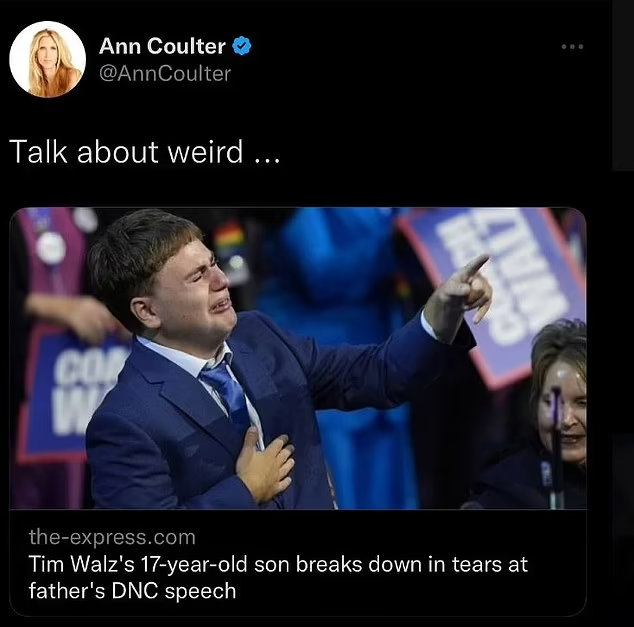
THE LEAD: Gus Walz, the teenage son of Democratic VP candidate Tim Walz, went viral during the DNC last week for his unabashed love of his father. Gus, who has a nonverbal learning disorder as well as anxiety and ADHD, yelled, “That’s my dad,” before he broke down crying during his father’s speech.

It was a sweet, touching moment of humanity that only took about six seconds for people to start ridiculing online:

Mike Crispi, a Trump supporter and podcaster from New Jersey, mocked Walz’s “stupid crying son” on X and added, “You raised your kid to be a puffy beta male. Congrats.”

Alec Lace, a Trump supporter who hosts a podcast about fatherhood, took his own swipe at the teenager: “Get that kid a tampon already,” he wrote, an apparent reference to a Minnesota state law that Walz signed as governor in that required schools to provide free menstrual supplies to students.


The professional media operatives also decided to get into the act:


Both Coulter and Weber issued apologies of a sort, with Coulter saying she took her post down once someone told her Tim was “austistc” and Weber noting  he “didn’t realize the kid was disabled.”

(SIDE NOTE: It’s unclear exactly how serious to take an apology from anyone who a) doesn’t take the time to spell the apology appropriately, b) takes a shot at a kid and only feels bad when the kid turned out to be “disabled,” or c) uses the term “disabled” rather than learn about the condition the kid he has is mocking.)

A QUICK HISTORY OF RECENT POLITICAL KIDS AND MEDIA: Kids whose parents decide to make a run for the highest office of the land don’t always get the best treatment in the media. I remember a teenage Chelsea Clinton taking a lot of guff in news reports for her “frizzy hair” and “awkwardness.”

The late-night TV crowd got into it as well, with various skits:

An SNL cold opening that featured “Wayne’s World” once took a shot at her that was so bad, NBC edited it out of all the reruns. (Strangely enough, they didn’t edit out the “schwing” the guys gave to the Gore daughters, who ranged in age from 13 to 19 around that time…)

The Bush twins were in their teens when George W. Bush was elected the first time, with Jenna’s “minor in possession” charge becoming fodder for the news reports and tabloids. (SNL mocked the twins as well, but this time had the dignity to wait until Bush was re-elected, putting them in their early 20s.)

Conservative radio host Glenn Beck took potshots at then 11-year-old Malia Obama, as part of a 2010 diatribe about the BP Oil Spill in the gulf,  a move he later apologized for making.

The Obama girls had the misfortune of being in the White House right around the time social media was becoming a thing, so their lives were not just the target of regularly stupid people using traditional media outlets, but also extra stupid ones Facebook and Twitter. In 2014, GOP staffer Elizabeth Lauten resigned after she raked the girls across the coals in a Facebook rant for needing to have “a little class.”

While Donald Trump was in the White House, teenage Barron Trump actually fared fairly well in regard to the media’s mockery machine. Most mainstream outlets considered him to be off limits, and SNL actually suspended Katie Rich for a tasteless Tweet about Barron in 2017.


DOCTOR OF PAPER HOT TAKE: I’m not sure what was worse: Picking on Gus Walz for showing human emotions toward his father or basically saying it would have been fine to mock a 17-year-old kid if he hadn’t had a neurodivergent condition. Both are deplorable, but one seems like it should put you at the gates of hell, while the other seems more like a VIP ticket to hell’s champagne room.

The underage children of political folks really have no agency, as they aren’t the ones who decided to run for office and put themselves in the public eye. When they are adults, they can choose to become more or less part of the public discussion.

Tiffany Trump was more in the background of her father’s political efforts while Don Jr., Eric and Ivanka Trump were part of the Trump political machine. Barron, now that he is 18, chose to be political delegate for Florida at the RNC, which does put him out there for public “discussion.” However, I still go back to the fact that he’s 18 and there should be at least a few guardrails people should consider in “discussing” him.

There aren’t too many hard-and-fast rules about who should or shouldn’t be put in the media spotlight and who shouldn’t but let’s consider a few points:

  • AGE: People we consider to be kids (under 18) should usually be off limits to mockery and punditry. Media professionals often take care to really avoid harming kids or generally putting them through the ringer even if they are tangentially related to a media story. The younger they are, the more protected they tend to be.  (We also tend to protect the very old in society for similar reasons. What makes you “very old” is in the eye of the beholder, but it is something we think about.) I tend to broaden the age range for “being a kid” a bit, with the idea that nobody is their best version of themselves between 18 and 22.


  • LEGAL ISSUES: Crimes open the door to more things being discussed in the media than do other forms of public participation. Thus, if Political Candidate A’s 17-year-old son skipped a class to play the latest version of Madden, leave the kid alone. If the kid crashed a car while driving drunk, started a public fight at a Starbucks or shot someone, that’s getting covered. The degree of the incident, coupled with the age of the participants operate on a sliding scale of debate among journalists as to what to say about whatever the kid has done.


  • COGNITIVE ABILITY AND CULTURAL SOPHISTICATION: Protecting people who are unable to protect themselves is at the core of everything from the SPJ code of ethics to the IRB research dictates. People with cognitive limitations of all varieties should be treated with extreme care when it comes to media coverage. I often extend this to the concept of cultural sophistication as well, given that there’s a huge difference between an 18-year-old kid (yeah, I said kid) who grew up in the spotlight and has been on TV more times than Lester Holt and the 18-year-old kid who grew up in a town of 400 people and never met anyone who wasn’t from that town. How each of those people is able to handle questions from a reporter clearly varies.


DISCUSSION STARTER: What do you think about the media coverage of Gus Walz and the other political “kids” in recent memory? What is or isn’t fair? What should or shouldn’t be out of bounds? What experiences have you had in your life makes you set those kinds of standards?


Help me help you figure out why students use AI to do their work and what it would take to get them to stop

help me help you | HELP ME, HELP YOU! | image tagged in help me help you | made w/ Imgflip meme maker

If you missed Wednesday’s post, we spent a good amount of time talking about what motivates (or deters) students in their use of generative artificial intelligence when it comes to coursework. You can take a look at the ideas behind the motivational theories and how they apply to this issue, but I know the big question is the simple one:

“What can I, as an instructor, do to make them want to do their own work instead of relying on AI to churn out a word salad of content they send in at the last minute?”

This might be the most Pollyanna answer you get all day, but here we go:

“Let’s ask them.”

And this is where I need your help.

I built a Google doc that has two simple questions on it:

  • What kinds of writing assignments do you (or would you) use programs like ChatGPT to do the work for you? What reasons do you have for using the program instead of doing the work independently? (e.g. “I ran out of time,” “I was bored by the work,” “The work was too hard.”) Please expand on your answer as much as you would like.
  • What would motivate you to NOT use generative AI programs like ChatGPT to do your written work for you? In other words, what makes you more willing or able to do the work independently? (e.g. “It would be cheating.” “I’m afraid of getting punished.” “I like what I’m asked to do.”) Please expand as much on your answer as you would like.

(UPDATE: Based on the request of a colleague, I added one more: In what ways have you used AI to facilitate your independent work? How do you wish teachers would allow AI as the tool it could be?)

It collects no private data, it doesn’t require them to log into Google to do it and I’ll have no idea where any of this came from. It’s simply two short answer questions meant to figure out WHY they do (or don’t do) something so we can look for potential solutions based on the research people have done on things like motivation and task completions.

If you want to help me help you, here’s the link:

https://forms.gle/WH9nzpHNT2XbMX5KA

If you have to (or want to) offer extra credit for this, I put a “code phrase” on the completion page you can ask them to give to you.

I’m going to let this run for a couple weeks and see what we get. If we get responses enough to make some soup out of this, I’ll put together something to share with you all a couple weeks after that.

In the meantime, hang in there and keep the faith. We got your back.

Vince (a.k.a. The Doctor of Paper)

What motivates students to use Generative AI and what would motivate them not to?

(The classic scene from “Back to School” that is both outdated and exactly the problem AI presents to us today.)

As most of us have already begun the semester, are headed toward the start of the semester or are in the process of panicking about the semester, we’re booting up the blog to tackle one of the bigger concerns we all seem to have these days.

THE CORE PROBLEM: As the semester began, I started seeing a lot of posts like this one from a friend and longtime college mass com professor:

I am up at nearly 2 a.m., going back and forth about whether to remove a writing component that I’ve used in almost every course I’ve taught over the last 10 years. It’s usually worth 25 to 30 percent of the course grade.
But it’s a massive waste of time to grade writing assignments that have been completed via generative AI.
The alternative? Reading quizzes, blue book responses, heavier emphasis on creative (group) projects, etc. Writing exercises are an opportunity for students to demonstrate the depth and originality of their thought.
The advent of Generative AI seems to be rendering useless a lot of the writing assignments professors have relied on for eons. As students began relying on AI to write their pieces, professors sought AI-detection tools to sniff out the fake stuff, leading to an escalating arms race between improved AI and improved AI detection.
Two years ago, The Atlantic published an essay titled “The College Essay is Dead,” noting that AI would likely challenge our approach to higher ed in ways we were incapable of understanding and dealing with. Journalism professors who once scoffed at this as being more of a “gen ed” problem are now finding AI-written content popping up in their own classes. It has also made several embarrassing forays into the profession itself, with some media chains using it to replace human writers altogether. With AI expanding rapidly to the point in which recorded lectures can be uploaded and integrated into the AI responses and AI helping you to sound less like AI, it can feel like we’re totally screwed.
MOTIVATION TO USE OR NOT USE: I’ve been studying psychological motivation for almost 25 years now and you can find a ton of reasons why people do or don’t do something. I still consider self-determination theory and its motivational spectrum as my bible for such things, including this situation.
Here are the four general motivational pivot points most of us have for doing (or not doing) something:
  • Extrinsic: We are compelled by an outside force to do or not do something. Think of a stick or a carrot as being the sole reason for completing a task: Your parents gave you $5 to cut the grass. Your parents threatened to ground you if you didn’t clean your room. This is the lowest form of motivation and it leads to the worst outcomes overall. This is where “cheating” or corner-cutting usually occurs. So, you pay your little brother $2 to cut the grass and claim the work as your own to get the $5. You take all the stuff that’s messing up your room and cram it in your closet, instead of taking out the garbage and putting the dirty stuff in the laundry etc.
    • NEWSFLASH: This is where we normally are for dealing with stuff like AI, in that we tell the kids in the class not to do it or else they’ll get a zero, fail the class, get expelled or experience whatever this is.
  • Introjected: We are compelled to do something based on motivation that is not entirely ours, but we do it because we feel we have to. Think of guilt or shame as the reason for doing something and you’ve got a handle on this one. You want to go hang out with your friends, but your parents convince you to visit your aunt instead because “she’s probably going to die soon and it would break her heart not to see you one last time.” You don’t feel strongly toward either presidential candidate, but your favorite teacher tells you about “how many people died for your right to vote,” so you cast a ballot.
    • NEWSFLASH: Guilt is a hell of a motivator and this really does work in a lot of cases, particularly for high-engagement people. However, people who are most likely to cut a corner or cheat are those most immune to this form of motivation. In other words, guilting people into avoiding AI for written assignments will work for students who are on the fence about cutting the corner, particularly if there is a strong affinity for you as a professor. However, the people most likely to cut the corner are going to do it, regardless of how much guilt you lay on them.
  • Internalized: We are compelled to do something because we see a benefit in it. Think about a nursing student taking the NCLEX test: They don’t like the test or all the work it requires, but they see value in becoming a nurse and therefore work really hard to pass it. This is one of the better forms of motivation, as the person is geared toward seeing a reason for doing what they’re doing, even if it’s not what they want to do. In short, they own the motivation and value the outcome.
    • NEWSFLASH: This is really the sweet spot for most educators, as it’s more successful than guilt and less Pollyanna than what we’ll discuss next. The underlying issue here is to tell people WHY they’re doing what they’re doing so they can internalize that motivation.
  • Intrinsic: We are compelled to do something because we really like it. This is why my dad sits at the kitchen table for hours doing word searches and why my wife can knit or needlepoint for days without wanting to stop. They really love it.
    • NEWSFLASH: If you can find a whole classroom full of kids that are intrinsically motivated, take a picture for the rest of us.

SO WHY AI? If what we’ve outlined above is true, and about 60 years of research from people way smarter than me says it is, the key to preventing students from AI-ing their homework and calling it good comes down to a few potential things:

  • The work is too hard, so they rely on outside assistance to get it done.
  • The work is too easy, so they figure they’re not missing something by letting AI do it.
    • (NOTE: The concept of flow by Csikszentmihalyi says people are most likely to enjoy an activity and persist in it when the difficulty is just slightly outside of their normal range of ability. In short, if we can feel just a little bit of stretch, we feel motivated to continue. If not, we are bored or frustrated.)
  • Other activities are preferential to the one we use AI to complete.
  • The work provides no inherent or perceived value. (a.k.a. “busy work.”)
  • Lack of repercussions.
    • (NOTE: Carrots and sticks count here, but so does the “So what?” element. In other words, if the kid doesn’t learn about the intricacies of The Council of Trent, what difference will that make in real life? However, if the nursing student doesn’t learn proper titration of drugs into an IV line, they might kill someone.)
  • Other, unknown things we aren’t thinking about but they are. (I’m always amazed at the things I DON’T know when it comes to my students and their reasoning behind doing or not doing something. This includes everything from having seven roommates and one bathroom to getting a ton of tattooing, despite telling everyone how broke they are. This is a true consequence of being old, I imagine…)

So the question obviously is, what is the best way to go about trying to figure out what to do about AI based on all of this.

In tomorrow’s post, I’ll give this a shot, but I’ll need your help.