Guest Blogging: Reflections on covering “The Pizza Bomber case” 15 years later

To help provide a broad array of perspectives on the blog, we strive to post content frequently from guest bloggers, each of whom has an expertise in an area of the field. This week, we are fortunate to have  Brian R. Sheridan, who is the chairman of the communication department at Mercyhurst University in Erie, Pennsylvania. He formerly worked as an award-winning anchor and reporter at WJET/WFXP-TV.

Brian1.jpeg

SheridanBrianToday, Sheridan recalls a famous story he covered during his time as a broadcast journalist: The Pizza Bomber case. What began as a bank robbery turned into a bizarre tale that garnered international interest and led to a recent NetFlix series. Sheridan walks through what he experienced 15 years ago and some of the bigger things he learned during his coverage of this case. Interested in being our next guest blogger? Contact us here.

Fifteen years ago, I watched a bomb kill a man right in front of me. It wasn’t a war or terrorist attack but a bomb that had been strapped around the neck of pizza deliveryman Brian Wells in Erie, Pennsylvania.  He had been stopped by police after he had robbed a bank. The story – the biggest of my career – became known the world over as “the Pizza Bomber case” and this year was serialized as the documentary “Evil Genius,” on Netflix. And I was the only journalist there to watch it happen live.


I had been working as anchor and reporter for Erie’s ABC/FOX affiliate, WJET-TV & WFXP-TV. My job was anchoring the 10 p.m. newscast. That day, I had just begun my shift at 3 p.m. when our assignment desk sent me down the street with a photog to cover a reported bank robbery. No big deal. They happen all of the time. You show up – shoot some video – grab a soundbite and return to the station. The FBI wouldn’t have much to say until hours after clearing the scene.

When we arrived, we could tell something was off. Peach Street, one of the city’s busiest, had been completely shut down to traffic. We snuck around the back and when I poked my head over a grassy ridge, I came in direct line of fire of two Pennsylvania State Troopers who held their weapons trained at a suspect seated on the pavement in front of his car.  I knew this was no ordinary bank robbery.

The assignment desk rolled the live truck and we set up across the road as police attempted to move people away from the scene. We were told the man had a bomb strapped to him. Yet, the man later identified as Brian Wells, remained calm and politely chatted with troopers.

We readied the live shot but a technical problem with an audio cable kept us from going live. While my cameraman worked on replacing it, I looked at the man and thought about what I could tell the audience. Then, without warning, the bomb went off with a loud bang followed by tinkling sounds of wire shrapnel falling near us. Wells flopped onto his back. My first words to my photog were, “Did you get that?” meaning were we recording? Bomb or not – we had a job to do. He had been recording as well as feeding the live signal back to the TV station. Audio problem fixed. Time to go live.

As I waited for my intro from the anchor, thoughts of the 1995 federal building bombing in Oklahoma City passed through my mind. I remembered watching TV reporters making assumptions on-air about what had happened that turned out to be wrong.

What I thought I needed to do was do what journalists are supposed to do – be calm, rational, tell the people what you know and don’t speculate.  I remember thinking that I shouldn’t make this more dramatic than it already was – a man was killed by a bomb because someone had placed it around his neck. I didn’t need to pump up the drama.  The tech problem also was a godsend. Without a delay button back at the station, we would have broadcast a man’s murder live to our after-school audience.

What we didn’t know at the time was all of complex and crazy twists the “Pizza Bomber” story would take over the coming months and years. As I look back, it is fascinating to think how news dissemination has changed over the ensuing decade and a half.  Social media wasn’t as ubiquitous in 2003. Subsequently, it took about three days for the rest of the world to hear the bizarre tale.  Today, that story would have been immediately trending on social media.  Cell phone video would have been everywhere. The whole world would have heard and seen the story in real time.

When media attention focused on the story, I became a guest via telephone on newscasts in the UK, Ireland and Australia. CNN and Fox News had me live from Erie. Film crews came from Europe and Asia to shoot documentaries. Japanese TV did a crazy reenactment for a news/game show hybrid.  National news outlets sent news crews to Erie. The story became a worldwide phenomenon despite a lack of arrests or a conclusion.  The television drama, CSI, even did a “collar bomber”-based episode. A movie called “30 Minutes or Less” tried unsuccessfully – and in many people’s opinion’s tastelessly – to spoof the story.

Federal charges would come in 2007, after I left the news business for a career higher education. When law enforcement released the whole story, I always felt that despite the interesting characters involved, and the complexity and ridiculousness of the plot, the end seemed unsatisfying. With such a dramatic start to the story, there wasn’t any death-bed confessions. No one arrested and convicted ever admitted to their role in the crime, despite the amount of evidence the government presented against them. Wells’ family vehemently argued that he had been an innocent dupe, despite what law enforcement said. Those suspected or charged with the crime didn’t even turn on each other even when faced with their own deaths from natural causes.

Is that really any way to write a crime story as big as “The Pizza Bomber?” If you were a novelist, you’d say, “Of course not!” I tell my students that as a real-life journalist doesn’t deliver big stories like this one, neatly bundled with a drawing room denouement, like an Agatha Christie mystery (with no offense to Dame Christie). Sometimes the stories or the crimes barely make sense, but it is our job to report all of it, using our best skills as an interviewer, researcher and writer.

Real-life also doesn’t operate on a time-table that’s convenient. When I left my news job, the “Pizza Bomber” became someone else’s story. Fifteen years later, I’m just proud to have been a part of it.

“I’ve got one of your reporters in our holding cell:” How to “deal with it” when journalists become the news for all the wrong reasons

In covering the news, journalists can occasionally find themselves becoming the news. This happens when reporters attempt to do their jobs, as was the case of Dan Heyman, who was arrested in West Virginia for persistently asking Health and Human Services Secretary Tom Price questions. (The charges of “willful disruption of governmental processes” were dropped four months later.) In another incident, a reporter was arrested at the New York Capitol for using a cell phone while in the building. According to media reports, a discussion between Ken Lovett and Capitol police regarding the phone “escalated quickly” leading to Lovett’s arrest. The situation ended shortly afterward when Gov. Andrew Cuomo had him released.

Then there was the case of Adair “A.J.” Bayatpour, who was arrested on a tentative charge of substantial battery while reporting on a Milwaukee Brewers/Chicago Cubs game Friday. According to the police report, Bayatpour was sitting at the game with his colleague Madeline Anderson and her fiancee, a local NBC reporter named Ben Jordan, when the even occurred. An article in the Milwaukee Journal-Sentinel stated that this all began when Anderson showed Bayatpour a photo of a bulldog. The situation escalated to the point where Bayatpour punched Jordan in the face three times, breaking his nose, chipping a tooth and causing orbital bone fractures.

Boy… That escalated quickly…

FTVLive.com, which first reported the incident, accused FOX-6 of having “buried” the incident in its newscast. The site also noted that neither reporter was reporting on the game at the time of the arrest, which probably didn’t make things any better for either TV station.

When media practitioners become “the news,” it makes things awkward for other journalists who have to cover the situation. Even more, when you have to report on someone in your own newsroom, it’s downright weird.

When I was working as a crime editor/night city editor at the Columbia Missourian, I got a call from my wife, who was a dispatcher for the University of Missouri’s police department. (In some other post, I’ll get into how awkward THAT kind of situation is.) Thus began one of the weirder phone calls of our marriage:

Me: “Hello?”
Her: “Hey, it’s me. I’ve got one of your reporters in our holding cell.”
Me: “What?”
Her: “We arrested one of your reporters. He’s in our holding cell, singing show tunes to the security camera.”
Me: “Wait… WHAT?”

It turns out the reporter was picked up with a couple roommates on suspicion of burglarizing a historic home on our campus, an action that included the theft of an $11,000 oil painting. The kid seemed oblivious to what was going on, as he apparently told the person taking his mug shot that he was “ready for my close up” and then started singing and dancing after the police put him in cell. Amy explained that he was driving the officers crazy.

I can’t remember exactly the order of the next several events that occurred, but I ended up informing my boss, assigning the story and running a piece on this guy. (I don’t remember if we used the mug shot and I can’t find a copy of this online.) As we were both a city paper and an educational endeavor, we were not allowed to dismiss him from the paper until he was tried and convicted or until he pled out. Thus, as my reporter is writing a follow-up story on this burglary, the accused was sitting about 10 feet away at another terminal, working on a feature story about something or other.

“Hey, can you come over and read this story about the stupid burglary thing?” I remember my reporter yelling to me, as I was walking across the newsroom.

“Shut up!” I hissed at him. “The guy’s right over there.”

Eventually there was a plea or something (I have open records requests in at about three university and state agencies, so I’ll fill in more if I ever hear back…), thus pushing the kid out of the newsroom and mercifully allowing the story to end.

Based on this experience and talking to others who have had similar “Oh, God, why do we have to report on this?” situations, here are a few basic bits of advice in case you have to deal with this:

Treat it like every other story, even though it’s not: The news is the news, regardless of how happy or displeased it makes you. Thus, you need to knuckle down and do your job. If you’re the editor, assign a reporter who is qualified and least likely to have a conflict of interest in reporting the story. If you are the reporter chosen for this fantastic assignment, do the same things you do for every story: Request documents, verify facts, seek sources and get interviews. If the person is willing to talk, treat that person like you would any other source. That means also not allowing the person to be near you when you’re putting the story together. Give it the same play you would for other stories involving “minor local celebrities” and give it the same amount of space/time/word count you would as well. Then, move on.

Transparency, transparency, transparency: You do not want to be late on this story, nor do you want to hide this somewhere. What news reporters tell PR professionals in that chastising tone comes back to roost here: The more you hide something, the more people will dig and the worse it will get. That doesn’t necessarily mean you’ll lead with a “GUESS WHAT OUR GUY/GAL DID!” lead, but you don’t want to try to gloss this over as well. Try using an “interesting-action lead” and focusing on the situation as opposed to a “name-recognition lead” and focusing on the person. Still, get it out there and get it over with.

Have a plan as to how you will respond to others: OK, you know how YOU want to handle this, but that doesn’t mean everyone else is going to follow suit. Depending on where you work and how many people really dig this stuff, you might get one call for a comment or five dozen. The trick is to take a page from the PR practitioners’ playbook and have a plan for handling this: Who will speak, what the statement will be, when they will make it and how they will handle any inquiries beyond that first-day story. Just because you want something to be over, it doesn’t mean that’s going to happen.

Oy vey: How to avoid being a shmendrik or a schmo when working with Jewish terms and topics

I often joke that one of the best Easters I ever had was the time I celebrated Passover.

It was one of my first years living alone in Missouri when my friend Adam asked if I’d be interested in coming over for Passover Seder, a traditional meal with family and friends often held on the first night of Passover.

I spent half the night asking two basic questions: “What does X thing we’re doing now mean?” and “Is there meat in this?” (The Seder took place on Good Friday, so I had that no-meat thing happening as a Catholic kid.) Adam, Lee and all the folks who had done this before were more than happy to help me figure things out. My only regret is that they let me eat too much matzoh, which felt like it was expanding in my stomach and making me want to die.

This week marks the end of Passover for this year, so in honor of the timing of this event, I thought I’d roll out some of the worst media errors tied to misunderstanding, misinterpreting or just just screwing up things associated with Judaism and a couple basic rules to prevent making these mistakes in the first place.


If it doesn’t make sense, ask again

A lot of people will have trouble capturing quotes from sources who use terms that are unfamiliar to them. This is why it’s always important to ask the person to either repeat the quote or clarify it. If you don’t know something for sure or it’s not making sense, don’t use the quote. That will help you avoid a correction like this one:

SittingShiva.jpeg

The term “sitting shiva” refers to a week-long period of mourning in the Jewish faith. Close relatives of a person who died stay at home and greet family and friends. According to Forward.com, the New York Times similarly screwed up a shiva-related item in its coverage of “JSwipe,” an app for Jewish singles that is akin to Tinder. (The paper also misused another Jewish term, yentas.) If the reporter didn’t know that was what the sheriff was referring to, that might be fine. However, I have no idea who thought people would “sit and shiver.”

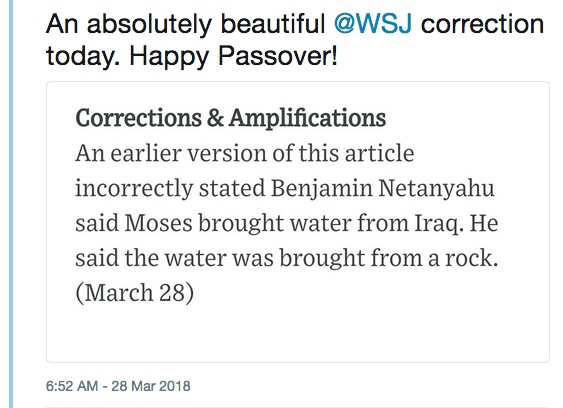
The Wall Street Journal made a similar gaffe in quoting someone, who was discussing a story from the Old Testament:

IraqARock

The story at issue came from the Book of Numbers, in which the Israelites had become angry with Moses for bringing them out of Egypt to a place with no food or water. God instructed Moses to strike a rock with his staff and when Moses did, water flowed from it. (I’m paraphrasing a bit here.) However, the Journal reporter referenced a country that didn’t get any version of that name until the third century (at the earliest) and wasn’t modernly defined until the 20th century. Even if it had been around, it’s unclear why the reporter thought Moses decided to undertake a 500-mile irrigation plan.

Basic rule: If you’re not sure, ask again. If it still makes no sense, don’t use it.


“Like a Christmas tree to celebrate Easter”

Just because something is associated with a group, it doesn’t necessarily follow that you can just slap it on anything you’re doing about that group and call it good. One of my friends pointed me to this photo that was used in a tweet by a political organization in Canada to wish people a “Happy Passover:”

ndp_passover_tweet_cropweb.jpg.size-custom-crop.1086x0.jpg

As news reports on the issue pointed out, the two people here are making challah, a braided egg-bread that is eaten on almost every Jewish holiday. The problem? Passover is one of those outside of the “almost every” holiday list, as leavened items are banned. It took several hours for this tweet and image to come down, as the one person who had access to the group’s social media account couldn’t be reached.

A fellow educator pointed out a similar problem when it comes to the use of menorah photos in ads or with news stories:

(This is like) using the wrong menorah for Chanukah on the promo. There are two kinds of menorahs: the Chanukah one has 9 candles and the weekly one has 7.

Basic rule: Not all symbols are created equal, so don’t try to “spruce up” your coverage of something based on a limited understanding of the topic. It’s akin to having someone who doesn’t understand Christianity say, “Happy Easter! I brought you a pine tree!”


Look it up

The initial title for this post involved the word “putz.” I looked it up and found out that, although the colloquial version of this word roughly translates to dummy, twerp or idiot, it literally means “penis.” I then moved on to shmuck (or schmuck in some cases), only to find that this word, too, literally means “penis.” In short, I learned two things:

  1. My knowledge of Jewish insults isn’t as great as I thought it was.
  2. It seems most of the insults I knew had something to do with male genitalia.

The point is that I looked these things up before assuming I knew what it meant so I didn’t embarrass myself when I misused the word. I also found that there are multiple spellings and some difficult pronunciations to some words. (The Jewish-English Lexicon was a real lifesaver.)

This revelation could be helpful for people who are in broadcast and might not be able to sound out the words they want to use:

Chutzpah refers to things like nerve, gall and shamelessness. I would argue it takes some serious chutzpah to try to fake your way through a pronunciation on live TV.

Or to just “guess” at a word because it sounds close, as Wisconsin Gov. Scott Walker did in a letter to a Jewish constituent. Walker signed off the letter with the line, “Thank you again and Molotov!

Walker was trying to come up with “mazel tov,” a term that means “congratulations” or “good fortune.”

On the other hand, Molotov is generally used as a shortened reference to a “Molotov cocktail,” which is a bottle-and-wick fire bomb:


Molotov-cocktail-design

Basic rule: The dictionary never hurt anyone, so don’t be afraid to use it.

In picking through these various levels of disaster-bacles, I hit up a bunch of people I know who have a better overall understanding of the faith, the traditions and more to see what they thought when they saw this. Adam, who ended up being the best man at my wedding years later, chipped in to the conversation with some good advice that I thought would bring this post full circle:

To me this just gets back to fact-checking 101. If you don’t understand a court hearing you went to, ask a veteran lawyer or judge or even a reporting colleague to explain what just happened. Don’t understand a Jewish ritual? Same deal. Ask a rabbi, or somebody at your local campus Hillel, or a Jewish colleague, etc.

When I covered Roman Catholic services or other news events, I double- and triple-checked every dang detail, even the ones I thought I was pretty sure about. And nobody with the diocese, or my Catholic colleagues, minded that I asked and asked and asked again. They were happy I was trying to be accurate.

In my view, there’s no more or less of an excuse for screwing up a Jewish fact as any other fact.


The journalism films you should watch if you want to be a journalist (Part II)

The other day, I went through the five films I thought would be good for journalism students to watch. Today, we go through what the Hivemind had to say about which journalism films you should watch and why. Here are ten more films to consider:

All the President’s Men (1976) – Let’s talk about the 200,000-pound elephant in the room. This one popped up on everyone else’s list, and for good reason. It’s the gold standard of journalism and film, it showcases how a newspaper brought down a president and it inspired generations of writers to do more reporting and less stenography when it came to covering famous people. The story behind this movie is important, valuable and incredible as a turning point in American and journalistic history.

It didn’t show up on my list for three reasons:

  1. At 2 hours and 18 minutes, it’s a hell of a slog and it literally typifies almost everything that Meyers talks about when it comes to movie cliches. Sure, ATPM did it first and it was real, so calling it cliche in retrospect is unfair but it goes back to the third point on my rationale list. I have personally found myself drifting off watching this thing and I know I shouldn’t. Every year or so, this movie becomes a point of debate among a bunch of us on a college media listserv, so I know both sides have their supporters here.
  2. The piece lacks historical perspective for a lot of students in today’s day and age. Watergate is just as relevant as Washington crossing the Delaware in their lives. People over 50 remember Watergate happening, so it’s relevant to them, but many students are barely old enough to remember the 9/11 attacks and they weren’t even born when Nixon died. Because the film was made in 1976, it doesn’t include the “backstory” elements that current retrospectives do. In 1976, everyone KNEW the outcome because Watergate happened four years before the movie came out, so it was more about the story behind the story. That approach leaves the current generation a bit lost.
  3. OK, this is a cheap shot, but it lost the Academy Award for “Best Picture” that year to “Rocky.”

Still, overall, if you want to really dig in and watch this, go for it. I’d recommend it the same way I recommend eating vegetables: It’s good for you, but it’s not as fun as some other things you could do. Like watching “Rocky.”

The Post (2017) – This takes a look back before the Watergate scandal and showcases another huge story the Washington Post covered: The Pentagon Papers. Truth be told, the main reason it didn’t make my list was that I haven’t seen this yet. Everyone in the Hivemind who saw it thought it was perfect in its approach and its historical value, while still setting the stage well enough for people in this generation who didn’t live through it. It might be a top-five for me once I eventually find time to see it a couple times.

The Insider (1999) – Another great story of a journalist and a big story. Russell Crowe is a whistleblower in the case against Big Tobacco and Al Pacino is journalist Lowell Bergman, who is determined to make sure the story gets told.  As one of my colleagues noted it “is a great primer on the reporter-source relationship.”

Good Night, and Good Luck (2005)This is another look back at an important clash in history between the government and journalism. David Strathairn stars as journalist Edward R. Murrow, who takes on Sen. Joseph McCarthy during the 1950s “Red Scare.” The work Murrow and producer Fred Friendly do to push back against a seemingly invincible opponent at a time of heightened nationwide fears was incredible. The use of news footage featuring McCarthy, as opposed to an actor playing him, adds realism and provides an even greater sense of what these journalists faced. What you are willing to do when you see nothing but risk all around you is a valuable question at the core of this film.

The Front Page (1931) – I hadn’t heard of this one, but it was suggested to me by a colleague who teaches a history of journalism as well as a “lit and film” journalism class. A comedy film, the piece looks at journalism in ways that are still relevant: Investigative reporter Hildy Johnson plans to leave his job at a tabloid to get a better-paying advertising gig when he comes across the scoop of a lifetime. A convicted killer escapes and Johnson pays off someone to get the story. Later, he comes across the killer on the lam and Johnson hides him in the newsroom until he can get the story from him. A 1974 remake starring Walter Matthau and Jack Lemmon is also out there if you’re interested.

Almost Famous (2000) – This is a great film, even though I never really thought of it as a journalism movie. That said, two others in the Hivemind posted it, so here we go. The semi-autobiographical tale of a young Cameron Crowe, “Almost Famous” sends a 15-year-old William Miller (Patrick Fugit) on tour in the 1970s with the band Stillwater so he can write a piece for Rolling Stone. It’s a fun movie, runs a little long and is more of a character study than anything else, in my mind. However, it does contain the world’s greatest lead for a band profile: “I’m flying high over Tupelo, Mississippi with America’s hottest band and we’re all about to die.”

I Am Jane Doe (2017) – A film that combines the “I haven’t seen it” and “I hadn’t thought of it as a journalism movie” issues discussed earlier. The story is about sex-trafficking and the website Backpage.com. The question it asks in the trailer is “How can it be legal to advertise children online for sex?” The answer sits at the core of something called Section 230 of the Communication Decency Act of 1996, which has broad implications for journalism. I trust the faculty colleague who recommended this one.

Network (1976) –  This is a great, great movie, but it just didn’t make the cut for my five. (In retrospect, it probably should have, but I don’t know what to cut, and don’t you dare suggest “The Paper.”) Veteran news anchor Howard Beale (Peter Finch) finds his ratings falling as younger journalists and “catchier” stories undercut his traditionalism. When he finds he is about to be fired, he says that he’ll kill himself on the air one week from now. This announcement leads to a ratings spike, the network’s decision to ride the story and perhaps one of the best-known moments in journalism-movie history:

Even all these years later, this piece is SO on the money in terms of where we are today with reality TV, media quality, corporatization of news and more that it essentially made a comeback when Aaron Sorkin did his version of it with “Studio 60” in 2006:

Or even when Sorkin did it again in “The Newsroom” in 2012:


As one person in the Hivemind called it it is “a favorite and works well with discussions about media dependency, conglomeration, reality TV…” It’s a real keeper. (Oddly enough, this lost out on the “Best Picture” Oscar to “Rocky” as well… “Why this fighter of such limited ability has gained such popularity is such a mystery…”)

His Girl Friday (1940) I have a love of Howard Hawks films, due in large part to his rapid-paced dialogue and his desire to just bang out the story. Of course, my favorite Hawks movie was “Rio Bravo,” which has nothing to do with journalism, but does include John Wayne. Watching everyone else working in “Hawks speed” while Wayne is still lumbering along at his own pace of dialogue is incredible. In any case, “His Girl Friday” showcases Cary Grant as a newspaper editor trying to get his ex-wife and top reporter, Rosalind Russell, from leaving the paper and getting remarried. The movie doesn’t age well, particularly in terms of sexism, but it is still a classic film worthy of a look if you can look past some of the historical failings it contains.

The Killing Fields (1984) – Another one I need to add to my NetFlix list. Sam Watterson plays a New York Times journalist who goes to Cambodia in search of a story during Pol Pot’s “ethnic cleansing” of the country.  One of the Hivemind called it “excellent for discussion of US reporters covering war, use of local sources/handlers and ethics.” 

So, what else did we miss? Feel free to drop us a comment below.


“Picked up some Hookers!” (or why knowing your audience matters)

Hooker-Headers-Heart-511x412

A guy I know who works on classic cars made a social media post a while back that told everyone who follows him that he “picked up some Hookers” over the weekend.

Not one person shamed him online or forwarded the information to the guy’s wife. A lot of people responded with comments like “happy for you” or “so excited,” mainly because his audience was other car nerds.

Hookers, in car parlance, are exhaust headers named for their inventor, Gary Hooker, who constructed his first set of these back in the early 1960s. Headers like these provide your engine with more power because they help move the exhaust gas out of the engine more quickly.

In a more general context, it could appear that this guy was bragging about purchasing the services of prostitutes. In a car context, he was just making the engine more powerful.

And that is why understanding your audience matters.

News writers often cover topics that fall into “beats” when they work for general-interest publications like local newspapers or news magazines. Bloggers often have specific niches as do magazine writers for publications on health or hobbies. Public relations professionals have internal publics, who share an intimate understanding of how an organization works, and external publics, who often lack the detailed knowledge of a company or group. In each case, the writer has to understand what the readers know and don’t know as to best fine-tune the material and clarify the vocabulary.

Too often, we forget that people don’t know everything we know as writers, and thus we lapse into jargon, lingo and “alphabet soup” that can alienate the audience. Here are a couple thoughts to help you refine your writing as you work to reach your readers:

    • Who is reading this? Don’t assume that you know your audience or that the audience is as informed as you are. Go check it out. Web analytics, market research and other similar data can help you figure out who is most frequently reading your work. This can help you determine if mostly local folks who know what “The Dean Dome” is or if the audience contains mostly out of state people who need the formal name (the Dean E. Smith Center) and some information about location and purpose.
    • At what level are they reading this? A student once wrote an incredibly good piece for one of my writing classes on the issues surrounding raw milk. As I read it, I felt like I learned a ton and I suggested she get it published, probably in a local agricultural publication. The student, who grew up on a farm and had frequently read the publication, smiled at me like a parent smiles at an innocent child. “Um… This is really way too overly simplified for farmers…,” she explained.
      For me, a non-farmer, she was writing at exactly the right level: Assume I’m somewhat educated but have spent no time on a farm. For farmers, this would have read like a “See Dick and Jane” book. Know how much your audience knows, how much background the readers will need and how slowly you need to walk into a topic to avoid losing anyone.
    • Avoid alphabet soup for the most part. If your writing looks more like an eye chart than it does a story, you probably have a few too many abbreviations or acronyms in there. Some of these letter-based terms make sense within niche markets. If a business journal notes that a CPA for a B2B marketer uses GAAP, this will likely make sense to readers who know that CPA means “certified public accountant,” B2B means “business to business” and GAAP means “generally accepted accounting practices. However, for most of us, it looks like we would either need to spin the wheel again or buy a vowel. AP suggests using generic terms like “the organization” instead of using an abbreviation or acronym that would be confusing to readers.


(Case in point from “Good Morning, Vietnam.”)

  • Help people out. In traditional media, it never hurts to include a brief definition or some context clues for audience members who might need a little help on an unfamiliar topic. If you’re working on the web, a link or two might make the difference between informed and lost readers. Always give people a chance to figure out what you’re telling them.

At the core of all storytelling is language and shared understanding. For health aficionados, adjusting your carbs might lead to weight loss, while car folks know adjusting your carb will help your engine run better. Somewhere in between, the rest of the world resides, so it’s on us as writers to make sure we make our message clear.