I Scream, You Scream, but When Stephen A. Smith Screams, He Makes $40M A Year: Understanding how our “hot-take culture” took hold of us

This is perhaps the most informative and honest look at what journalism has become and why it has become more and more difficult to have students do quality journalism when screaming stupid thoughts at other people is a much more lucrative option:


Joon Lee’s piece tapped into a few things that most of us already knew:

  • Our society has gotten less civil and but exponentially louder and less informed.
  • It’s cheaper and more lucrative to have two idiots screaming at each other on TV than it is to invest in quality journalism based on clarity an nuance.
  • If something works at a small level, people will inevitably increase the frequency and intensity of it until the speakers essentially go to 11.

Beyond that, however, here were some really fascinating things (and I use “fascinating” to cover over a multitude of emotional states I had watching this, ranging from “feeling informed” to “wanted to vomit through my ears.”):

  • The walk through the history of how ESPN built this culture of hot takes showcased the way in which the spike in the ratings from Skip Bayless screaming at people eventually moved us from debate to hot take.
  • The honesty Lee provides about his experiences in being a guest on one of these shows. After Stephen A. Smith made some pretty racist comments about Shohei Ohtani not speaking English, Lee got asked to step in and present some information about the impact of Ohtani and racism on the Asian American community. His points were great, but what people on social media most commented on was how he got Smith, who never apologizes for anything, to apologize. It was then he realized the content was secondary to the battle.
  • Lee was also honest about how he felt the pull of the hot-take gig, in that it brought him more into the public eye, helped spike up his social media presence, led to raises at work and other such things. In short, he understood why people would do this, even as he wasn’t really that fond of doing it.
  • Stephen A. Smith’s overall earnings was reported here to be about $40 million per year, which helped me understand why every sports kid I teach wants to be like him. I also realized I should have started screaming at people for no real reason much, much earlier in my life…
  • How sports set the table for this, but how it has now poisoned almost every area of our lives, including politics. I remember when Biden snapped at Trump at one of their Election 2020 debates and suddenly, “Will You Shut Up, Man?” T-shirts were for sale before the event ended. I’ve yet to see a nuanced policy discussion show up on a fridge magnet or bumper sticker, but still…

DISCUSSION STARTER: The video gives us a lot of depth and context as to the how and why of this situation, but it doesn’t really provide a lot of relief for those of us hoping we can somehow get out of this mess.

I guess the questions to get the discussion going could include, “Should we worry about this at all, given that people seem to like this stuff?” and “If we need to stop it, how can we get people addicted to better content than what amounts to a mix between a schoolyard punch-fest and cockfighting?”


The Sam Kuffel Kerfuffle: CBS58 in Milwaukee “Parts Ways” with a Meteorologist Who Complained about the “Elon Musk Nazi/Not-A-Nazi Salute” on Social Media

Sam Kuffel, meteorologist for CBS 58 in MilwaukeeSam Kuffel via the station’s old Facebook post.

THE LEAD: CBS58 in the Milwaukee TV market “parted ways” with meteorologist Sam Kuffel after the weather caster posted her displeasure about Elon Musk’s “hand gestures” on her social media account.

The 31-year-old graduate of UWM had been doing TV weather reporting around the state of Wisconsin since about 2016. The posts she made after the inauguration were being lambasted on Milwaukee conservative talk radio.

In one post on her personal Instagram account, Kuffel posted a picture of Musk at the podium, saying, “Dude Nazi saluted twice. TWICE. During the inauguration.”

She added, “You (expletive) with this and this man, I don’t (expletive) with you. Full stop.”

Kuffel then posted a GIF from “It’s Always Sunny in Philadelphia” on Instagram along with the saying, “Screw that old (expletive). He’s a Nazi.”

By late Tuesday, she had made her Instagram account private.

Kuffel told the Milwaukee Journal-Sentinel on Friday that she was, in fact, fired for the posts. She noted that she was “just voicing my personal opinion” on her private Instagram account, adding she was still processing the situation and weighing her options.

BACKGROUND: In case you were on Mars or one of the other planets Musk is apparently planning to conquer and missed it, Musk spoke after President Donald Trump’s swearing in and made two sweeping arm gestures.

For the sake of bending over backwards to provide a benefit of the doubt, let’s just say that those gestures had the same movement, angle, finger-stretch and general stridency associated with the “Sieg Heil” salute used during the Nazi Regime.

Musk repeatedly makes gesture likened to 'Nazi salute' at Trump rally

Unless there is a guy out of frame getting ready to hi-five Musk for an “and one” play during the NBA playoffs, this doesn’t look all that great.

The Anti-Defamation League asked everyone to take a breath and relax after the “awkward gesture,” noting that we should all be giving each other some grace in this time of transition. The ADL later condemned Musk, grace period be damned,  after he took to Twitter/X and made some Nazi jokes about the situation.

Musk previously took heat for the antisemitism he allowed to foment on his Twitter/X platform, as well as his retweeting (or whatever we’re calling it now) of antisemitism. In 2023-24, as part of his “apology tour,” he ended up visiting Israel as well as taking a tour of the Auschwitz death camp.

In addition, he has endorsed the AfD, the far-right wing of German politics, and recently told an AfD rally audience that they need to “move past” the history they have related to the Nazi movement and get over “past guilt.”

A FEW BASIC (POSSIBLY UNPLEASANT) REMINDERS ABOUT FREE SPEECH: When a situation like Sam Kuffel’s hits the public eye, comments related to free speech, free press and other similar “rights” start flying all over the web and social media. To better deal with the situation, it’s important to keep a few basic rules of the game in mind:

The First Amendment is about the government: As part of the First Amendment to the Constitution, the government generally does not possess the right to curtail free speech or free press. What we’re talking about in the Kuffel case is a private enterprise making a decision about the activities of one of its employees. That’s different.

Law and ethics are completely different things: People have complained in various forums that the station should have stuck up for one of its own and kept Kuffel on the air. The question of if the news station SHOULD have fired her is one of ethics. The question of CAN the station fire her is one of the law. (See point one)

SOME ADDITIONAL UNPLEASANT REMINDERS: This situation mixes several key reminders I have to give my students each semester. These include:

  • Free speech (even when properly understood vis a vis the First Amendment) does not mean consequence-free speech. You can publish without fear of government intervention, but many other things can happen to you in court or the court of public opinion in terms of consequences for what you say.
  • Despite Kuffel’s contention that it was a “private” account, there is no such thing as private social media. Just ask this person. Or this person. Social media is available to EVERYONE and even if you have your settings locked on “double-super-secret-private pinky swear,” there is still a good chance it’s not going to remain “just among friends.”
  • In most cases, where you work has a social media policy in place that is meant to keep your posts as sanitized as a bleach bath and as sharp as a bag of cotton balls. Know what it says before you violate it and find yourself looking for work.
  • Think before you post.

DOCTOR OF PAPER HOT TAKE: Getting rid of Kuffel probably did a lot more harm than good in a number of obvious and oblique ways. I could do this for days, but let’s pick out a few key ones:

The optics are bad: Nothing says, “We are a proud member of the Fourth Estate,” like tossing the WEATHER PERSON under the bus after she made a stupid social media post. What? Were the higher-ups at the station worried that her disdain for Musk might lead to inaccurate forecasts over the next few months? (Spoiler Alert: She’s doing the weather in Wisconsin. It’s cold, colder and “holy crap, are your nostrils freezing together?” frigid.)

Seriously, you’re talking about a person best known for a weird weather beef with Erin Andrews. Her most recent piece for the station was about “pancake ice.” If you really worry about bias on the staff, start by getting Lance Allen to ask harder questions at the Packers press conferences.

If the theory is that if anyone at the station does something bad, then everyone at the station comes into question, OK. However, how is it that the station was totally cool hiring a journalist who got arrested at a Brewers game after a fistfight with another reporter? (Side note: Don’t include the phrase “is no stranger to Milwaukee, though” in his official station bio.)

Also, if you’re willing to dump the weather person, what happens when a news reporter wants to do a story that might lead to some upset people? If I worked there, I’d be asking for the “puppy and kitten beat” for the next few years.

You essentially killed a fly with a sledgehammer: Most of the experts that the news reports tried to find a balance in their comments. That said, they tended to agree that a) if there’s a policy that says “don’t call someone a Nazi on social media, even if they are a Nazi or we will fire you,” Kuffel likely had no cover and b) firing her seemed like overkill.

On point a, it’s likely not a policy like that. It’s probably some mushy “morals and standards” thing that the lawyers built into everyone’s contract to give them the right to fire anyone that the station felt did the company dirty. In those cases, it’s “fire her and let’s see if she’ll fight it.”

On point b, the station really did try to kill a fly with a sledgehammer. Kuffel was essentially saying what a lot of people were saying, although she used some “saltier” language to do it. It wasn’t on air, it wasn’t on the station’s social media and it probably wouldn’t have been a huge deal if we hadn’t suddenly become “Snitch Nation.” (More on that later.)

When local conservative radio host Jay Weber called Tim Walz’s neurodivergent son, Gus, “a blubbering bitch boy,” on his social media account, he got a two-week suspension. Greg Doyel of the Indy Star received a similar “time out” after a press conference exchange in which he awkwardly requested Caitlin Clark to flash him a “love sign” after each game. The Washington Post’s Dave Weigel only got a month suspension for a retweet  that noted “Every girl is bi. You just have to figure out if it’s polar or sexual.”

The last instance I can find of a media outlet firing a journalist in a way that drew public attention is when New York Magazine cut Olivia Nuzzi loose. In that case, she’d profiled RFK Jr. but also had been sexting him and sending him nudes, according to media reports.

Google “reporter suspended” and “reporter fired” and you’ll a good number of examples to decide which category Kuffel’s situation best mirrors.


You embolden Snitch Nation: This is the kind of thing that probably wouldn’t have gotten much traction, if not for the amplification of outrage that is local talk radio. Conservative media host Dan O’Donnell basically lit the “Bat Signal” in this case, criticizing Kuffel’s posts and working his audience into a lather over it. At that point, the station decided it had to do something to move out of the crosshairs of O’Donnell and crew, so they canned Kuffel.

This sets a precedent that any decent third-grade teacher will tell you is bad: Someone does something that’s maybe not all that great and a giant tattletale starts yelling “OOOHHHH! MS. SMITH! MS. SMITH! MS. SMITH! DID YOU SEE WHAT SAM DID?????,” thus getting everyone else to start yelling, “OOOOHHH!!! SAM’S IN TROUBLE!!!” Thus, rather than apply grown-up logic, you overreact and whip out the punishment stick to get the noise to stop.

What that does is a) make everyone afraid of the loud tattletale and b) make it seem like being a tattletale is how everyone should act. Not a great idea. I can’t wait to find out what happens if O’Donnell gets a whiff of this blog post…

(SIDE NOTE: You’d think a guy with high honors at a top-flight law school and a background in media himself would have better things to do than bullying a local meteorologist, but maybe that’s just my take…)

Letting loud idiots dictate your behavior doesn’t eliminate the problem. It literally leads to much bigger ones.

A MODEST PROPOSAL: As I was talking to Mom last night, she asked when the blog would be coming back and if I’d be covering this. After I assured her it was already half written, she asked what I thought would happen next on this. My answer is probably too logical and easy to make happen, but here it is:

If I had control of Weigel Broadcasting Co., CBS 58’s parent company, I’d quietly approach Kuffel and offer her another job at one of the other affiliates in the network, with the promise that Kuffel won’t sue for wrongful termination. This takes a potentially ugly legal battle off the table, gives Kuffel essentially a “suspension” instead of the death penalty and the company gets to keep a solid broadcast meteorologist.

I would also review the social media policies for the entire company and make sure a) they’re air tight, b) everyone gets a refresher course and c) the penalties for whatever will happen get spelled out clearly. This might also be a good time to let the news staff know where the network stands on backing its reporters if things get dicey or if anyone throws up a hissy fit. Or a Nazi salute.

Recalling Jim Lehrer’s rules of journalism as the Trump trial gets underway (A Throwback Post)

The breathless coverage of every post, sketch and fart of the Trump trial in New York has cable news in a lather these days. Without cameras being allowed in the courtroom, but still having all sorts of time to fill, television has seemingly turned everything about this thing into the Zapruder film. In his return to “The Daily Show,” Jon Stewart used his Monday opening to castigate these folks for their approach to “news” in this situation:


Stewart has long said he’s not a news journalist, so it might be easy to dismiss his critique as arrogance mixed with humor. That’s why we dug out today’s throwback post from four years ago, when Jim Lehrer died to make the same case for us.

Below is a brief tribute to Lehrer upon his death as well as a recap of his “rules” that really should guide our work in a time in which it seems like every shiny object can distract us and minutia can rule the news cycle.


Jim Lehrer’s rules matter now more than ever

Jim Lehrer, a journalist’s journalist to the core, died Thursday (Jan. 23, 2020) at the age of 85. He spent decades of his life covering politics, corporations, international affairs and more, and yet had the none of the pretense associated with the greatness he encountered or the epic stories he conveyed:

Jim was calm and careful in moments of crisis, as demonstrated by his coverage of the September 11 terrorist attacks.

“I’m Jim Lehrer. Terrorists used hijacked airliners to kill Americans on this, September 11, 2001,” Jim reported on national television. “Another day of infamy for the United States of America.”’

Lehrer essentially retired about a decade ago, and he did his work on public television, so it’s likely few folks under a certain age would remember much about him. Truth be told, he was really just a name and a standard to me for much of my life: A symbol of straightforward reporting and a talent to which one should aspire in the field.

However, among the many obituaries written on this titan of news, I came across Jim Lehrer’s Rules, guiding principles he used that can and should continue to influence generations of media students to come. (The world in general would probably be a nicer place, too, if non-media folks kept an eye on these things as well.)

These may seem quaint in the era of “Screaming Head” journalism, opinion-as-fact reporting, “sources say” coverage and a general sense that members of the general public have the IQ of a salad bar. However, with very limited quibbling, I could clearly defend each of these as something worth striving toward in our field.

How “Who The F— Did I Marry?” Broke A Ton of Media-Related Rules And Still Built A Massive Audience

This is the first TikTok video of 52 on the playlist called, “Who TF Did I Marry?” More than 28.8 million people have already watched this piece.

When I teach content creation and distribution to students, there are some really simple maxims I use that help them do the job well:

  • Tell me the most important stuff first.
  • Nobody’s going to hang with you if you’re really damned long.
  • Use the right tool for the right job.
  • It’s not about you.

The epic TikTok series “Who The F— Did I Marry?” manages to break every one of those rules and more, but somehow has become a runaway success online. Let’s look at what it is, how it broke so many “rules”  we’ve come to associate with today’s media experiences and some reasons why it actually worked:

WHAT WE KNOW: The TikTok-er, ReesaTeesa, tells the story of how she met, dated, married and divorced a man she calls Legion during the pandemic times of 2020-2021. (ReesaTeesa relies on pseudonyms for many of her characters and she never reveals her own name during the story as well.)

She says Legion claimed to be a divorced man who played football at San Diego State University, made good money as an Arena League football player and became an executive at a condiment company. Over the course of the series, she said she found out that none of that was true, and even more, he had been divorced multiple times, he lied about his connections with family members, he had a criminal history and he didn’t have the money he said he did.

That’s about the best I can do in shrinking this down. If you want a bit more expansive view of the series, feel free to read this piece in Glamour that does a bit of a deeper dive.

WHAT WE DON’T KNOW: As is the case with a lot of content online, we have some “don’t know” elements that add to the oddity of this experience:

  • We don’t know who this TikToker is: In most cases, we know the person who is telling the story, so we can get some background on them. In this case, she doesn’t identify herself and early media reports agree not to include her real name. (That said, TMZ has named both ReesaTeesa and Legion in its reporting, which came after the series blew up.)
  • We don’t know how much is factually accurate: People often talk about things like content being “substantially true” or “emotionally true,” so I’m not doing the true/not true thing here. I have no doubt that this woman went through a lot. What I’m talking about are facts that we can verify the way we would with a reporting story. For example, you know my name and you could use records to prove when I got married, to whom and so forth. You could also check me out for any pending litigation, property ownership etc. We can’t do that here.  (For his part, Legion is threatening to sue over this series, claiming it had serious factual inaccuracies.)
  • We don’t know the answers to things like “Why now?” for this story: For her part, ReesaTeesa has promised to do a “live” to answer all sorts of questions.

BREAKING THE RULES: Let’s walk through the maxims I outlined above and explain how this series doesn’t abide by any of them:

Tell me the most important stuff first: ReesaTeesa either never heard of the inverted pyramid or really didn’t care about it. Either way, she does this mega-series in pure chronological order.

Clearly, we know the situation isn’t going to be great for her, given the title of the series. I mean, nobody says “Who the f— did I marry?” and comes up with the conclusion “The best person ever!” That said, we have no idea of what depths of hell she’s going to face in this thing. In some cases, she’ll even tease future disasters with a “Don’t worry. We’ll get to that later.”

She does some brief recapping at various points, and she also does a few “resets” or “clarification” episodes when viewers have raised questions or asked about specific holes in her stories.

That said, if you decide to get into this, get ready to wait a long, long time to find out what happened. This leads to…

Nobody’s going to hang with you if you’re really damned long: ReesaTeesa is giving us a massive allegory, 10 minutes at a time. Think of the last time you actually sat down and watched something on social media that lasted 10 minutes. Then realize she did 50 of these things, which means it’s about 500 minutes long.

If you do the math on this, that means you are sitting through more than EIGHT HOURS of content to get to the end of the story. There are NetFlix mini-series that aren’t this long, and those things have actors and budgets and scenery and such. This is literally nothing but ReesaTeesa sitting in her home or her car and talking to the camera for that amount of time.

This thing is ridiculously long, and yet even the later pieces have upwards of 5-6 million views. That’s not counting the views of her videos that fans have reposted or the YouTube versions where people mercifully pulled multiple posts into one larger video.

I know people watch a lot of TikTok, but this seemed like a lot for this platform, leading to the next key point…

Use the right tool for the right job: The idea of using the right tool for the right job goes all the way back to my days as a “convergent journalism apostle.” In short, if you can tell the story best with a video, do that. If a graphic does the job better than a text story, do the graphic. If photos work better than graphics in conveying meaning, use the pictures.

In today’s era, we can expand that idea by saying that certain platforms do better than others for certain things. Blogs like mine that rely on text are set up a certain way while people who tell stories via photo tend to use Instagram etc.

In terms of TikTok, the average video ranges between about 38 and 50 SECONDS. People tend to think of “big” TikToks as close to three minutes.

ReesaTeesa has picked the absolute wrong platform for her story, as she maxes out the limit (10 minutes) 50 times to tell the tale of Legion. Doing this on TikTok is akin to writing the novel “Shogun” on Twitter/X in a thread of 280-character posts. A YouTube channel would be a better pick and even that’s a stretch.

It’s not about you: Whether someone was building a blog or doing a photo series, I’ve repeatedly explained that the audience has to come first. In short, you can’t make it about yourself. It has to be about them.

ReesaTeesa stated that she wanted to tell her story, with the goal of it helping at least one other person out there who might be experiencing something similar. In each episode, she repeats the idea that she’s trying to tell her story, and that we are all kind of just riding along with her.

WHY IT WORKS ANYWAY: Even with what should be a long list of fatal flaws, the series is a massive hit. I can’t speak for everyone, but I can tell you what I’ve observed in listening to all 8+ hours of this (I had a couple long drives with time to kill…):

  • She’s a good storyteller: First and foremost, she tells the story well. Between emotional anguish and moments of levity, ReesaTeesa is just really good at weaving a yarn. If I had the option of editing this thing, I’m sure I could cut it down by one-third without batting an eyelash and not lose anything, but the excess content doesn’t come at the risk of losing the audience.
  • She stays on point: As long as this thing is, she doesn’t drift into other random tales or bring in unrelated content. It literally is a single story told in 50+ parts.
  • She connects with the audience: Her general vulnerability and unvarnished approach really makes her connect with people. I felt like I was part of a friend group, listening to a good friend bare her soul. She would often start parts of the series by answering questions people asked in the chat or clarifying things based on comments people had. In making this a two-way street of communication, she made it work.
  • She’s honest: I distinguish this from factual accuracy, in that I can’t PROVE certain things she said, but I can tell she honestly believes what she says when she’s offering opinions or reflections. That’s never more true than when she describes parts of the story that don’t make her look great. She talked about how she wanted a specific car (it had a “cognac interior” is all I can recall) and how that made her sound really bougie. She said she fell into this mess because she wanted it to be “her turn” to get married. She admits to her faults, which make us feel like she doing more than throwing a pity party online.
  • She gave a damn: When it came to telling the story, I could tell that she cared about telling it. Her approach, her content and everything else was so compelling because she felt so compelled to tell the story. Because SHE cared, WE cared.

Tired of political ads on TV? Three reasons they’re not going away

(“I just want to warn you that when I wrote this song, I was watching TV during the 2022 midterm campaigns so…”)

Avoiding political advertising this time of year is like trying to stay dry in a hurricane: Despite your best efforts, it isn’t going to happen. Candidates, political action committees, outside organizations, issue-oriented groups and anyone else who has a bone to pick will flood your mailboxes, newspapers, inbox, digital devices, fax machines, billboards and more with a torrent of advertising geared toward shifting the vote total just a smidge more in favor of their candidate.

If you think this year is worse than most, you’re probably right. This piece from NPR outlines the way in which both major parties are pounding the heck out of us with paid speech at a cost and speed unlike any previous midterm election. It has gotten so bad that I’m practically begging my TV to show me Tom Selleck hawking a reverse mortgage or out-of-control Xentrex ads.

Anything but another frickin’ ad about the radical, unhinged, wrong-for-us, out-of-touch, elitist, self-serving, corrupt candidate that will ruin my life, destroy our country and probably get me hooked on Xentrex…

Despite a seemingly universal disdain for deluge of political ads (especially negative ones), they’re not going away for three simple reasons:

In some cases, the law says the ads must run

We might not want to see U.S. senate candidates and individuals seeking office in the U.S. House of Representatives on our TV every 16 seconds, but federal law sure does. Section 312(a)(7)  of the Federal Communications Act states that a broadcast license can be revoked if a station does not provide legally qualified candidates for federal office with access to the airwaves. The stations are required to “permit the purchase of reasonable amounts of time for use of a broadcasting  station” to reach the public.

This only covers the federal offices, which means that this only applies to people running for the positions of president, vice president, U.S. senator and U.S. representative. It also doesn’t state what accounts for a “reasonable amount” of advertising time, thereby allowing candidates to stretch the bounds of reasonability like it’s a Stretch Armstrong doll on speed…

Beyond that, Section 315 of the communications act provides what are known as equal time rules or equal time doctrine. This simply means that if a station allows one legally qualified candidate for an office access to its facilities, it must provide an equal opportunity for the other candidates for that office. So, if I’m running for Waushara County Dog Catcher and I am allowed to buy a 30-second spot on the local ABC affiliate for $500, any other legally qualified candidate for that office must be able to get the same amount of time for the same price on that station.

Now, the station can decide it doesn’t want to get involved in this nonsense, and thus make the statement that it won’t allow me, or any other candidate for that office to run ads. That’s fine. Also, the station that allowed me to run that ad doesn’t have to go looking for all the other candidates and tell them they have this opportunity. However, if one of my many fine opponents comes to ABC and wants to run a 30-second ad for $500, that station is duty-bound to do it.

Here in Wisconsin, and I’m sure we’re not alone, the broadcast outlets have been stepping forward to make the case as to why they HAVE TO run these ads. They are also explaining why they can’t censor the political ads to eliminate all the nastiness that goes into them:

Can television stations not air an ad because it is violent or has harsh language in it?

Matt Rothschild: “The Federal Communications Act of 1934 was so worried that stations were going to be censoring political candidates that they said essentially, you can’t do anything about the content except run it.”

Technically, the stations could sit out everything except for the federal races, although they often pitch the advertising for those non-federal offices as being tied to the “general public interest standards” that govern their license. Still, that’s not the main reason why broadcast stations run these things…


Political ads make serious money for the stations:

As much as the public tends to hate election season, it’s practically a lottery win for broadcasters. The law dictates that stations must charge candidates equal amounts for equal time, so they can’t charge me $500 for my Dog Catcher campaign ad and then charge my opponent $20,000 for the same type of ad. The law also dictates that political candidates must be charged the lowest rate available for advertising.

That said, they more than make up for it in total volume. Experts expect total election ad spending to hit almost $10 billion this cycle, with advertising experts foresee serious financial windfalls for broadcasters this election cycle:

Kantar Media Intelligences Inc. expects TV stations to realize some $4.2 billion in political ad revenue, though cable, digital and connected TV will also benefit from increased political outlays, according to Steve Passwaiter, Kantar’s vice president and general manager for North America.

It’s actually tough to figure out how much money actually will go into this election until everything is said and done. If you have ever bid on something through eBay, you know why: The pace can be stable and normal for the majority of the auction time, but when the last few seconds come around, everyone who is desperate to win will jump in with insane final bids and jack the total expenditure through the roof. The estimated amount spent on ads of all kinds, or even just in broadcasting ads, for this campaign season might vary widely based on who is counting, what they’re counting and when they did their projections, but they all say the same thing: People are pouring money into this like they’re trying to drown democracy with buckets full of cash.

And TV folks are bemoaning the loss of accuracy and integrity among advertisers all the way to the bank.

Still, people wouldn’t be offloading cargo ships full of Benjamins if it weren’t for the final reason the ads aren’t going away…


Political advertising works in many distinct ways:

So many people say they hate political advertising that it’s a wonder it actually exists. Then again, to be fair, so many people say that pornography is abhorrent, terrible and should never be viewed, but PornHub is in the top 10 most visited websites, with an average of almost 3 billion views a month…

In short, what we say and what we experience are usually two different things.

Researchers have found that political advertising has the ability to shape turnout, with positive ads driving higher rates of it and negative ads suppressing it. Negative advertising tends to “stick” more with potential voters, other scholars have noted, with additional researchers finding that negative framing of issues tends to motivate people.

Some analyses across multiple election cycles have found mixed overall results in terms of how much ALL ads impact voting and to what degree positive or negative ads creates specific outcomes. However, a vast swath of research shows that the more politicians beat on us with their ads, the more likely we are to do SOMETHING in relation to that race, whether we like it or not.

The one saving grace? Election Day is just two weeks away…


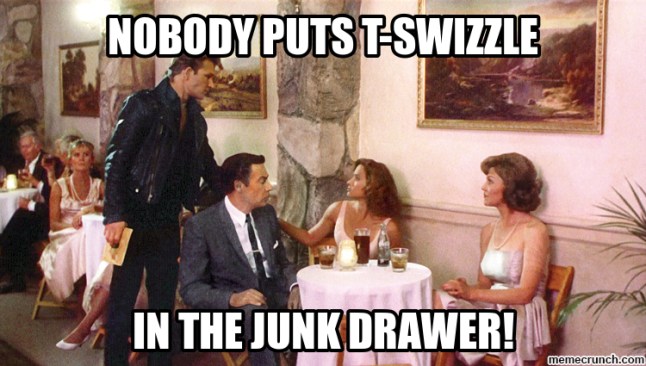
The Junk Drawer: Taylor Swift Can’t Save The Cops edition

Welcome to this edition of the junk drawer. As we have outlined in previous junk drawer posts, this is a random collection of stuff that is important but didn’t fit anywhere else, much like that drawer in the kitchen of most of our homes.

Here’s a look at some screw-ups, stories and updates:

MAYBE JUST BE BETTER AT YOUR JOB? At the risk of creating anarchy with the title of this post, let’s tackle how Taylor Swift ended up in the middle of a controversy surrounding police officers in Alameda County. It turns out that, in addition to not understanding copyright law, the First Amendment and general common sense, at least one officer in this fine hamlet doesn’t understand how YouTube’s service agreement works either:

Last month, Sergeant David Shelby, an Alameda County Sheriff’s Department officer, was caught playing Taylor Swift’s “Blank Space” from his phone as he was being filmed by activists, in a move he said was done “so that you can’t post on YouTube.” The incident was the latest in a bizarre trend in which police officers play copyrighted music while they are being filmed by the public, in hopes of triggering social media antipiracy filters, which would theoretically get the video deleted. 

Aside from not doing what he had hoped it would do (keeping people from filming him and/or allowing YouTube’s “bots” to save him), Shelby actually brought more attention to his actions from both inside and outside of the police department. He is apparently not the only one who has tried this:

In the last few months, cops across the country have been trying this cute little trick for keeping their interactions with the public off social media: Playing pop songs over interactions with the public when they’re being filmed. One Beverly Hills cop played Sublime’s “Santeria” when he realized he was being live-streamed in February and another with the Beatles’ “Yesterday,” and another in Illinois tried it with Blake Shelton’s “Nobody But You” in March.

They think that if the audio captured was smothered by a copyrighted song, posting it to sites like Instagram or YouTube would result in the poster getting smacked with a copyright takedown notice—and the platform would either remove the video, mute the audio, or ban the user altogether. In each of these cases, it didn’t work, and the videos remained online. People have a First Amendment right to film the police.

Shelby tried it, but it didn’t work: the video stayed up on the Anti Police-Terror Project channel, and now has almost 740,000 views.

It’s unclear what any of these officers were doing at the time that made them so worried that they were being filmed, but maybe THAT should have been the bigger concern. If you’re doing something so bad that evidence of it requires you to try to force illegal actions (copyright infringement) on other people to get away with it, that doesn’t say much for you.

On the other hand, I’m waiting for the first time some officer tries this with a Brittney Spears song, so this can start making the rounds again:

Speaking of outrage…

I AM FURIOUS AT… UM…: Journalism has two simple rules when it comes to telling a decent story:

  1. Tell me what happened.
  2. Tell me why I care.

Usually, people being upset with something leads to a pretty good answer to both of those stories. That said, it only really works if you let us in on what you know:

OK, Augusta McDonald might have been following the story, and the outrage, and the lawsuit, but maybe a couple people out there reading this thing (read: Me and Amy at least…) have no damned idea what happened, so how about filling us in? The photo of a basketball team (I think) with blurred faces and three smug looking weasels in red shirts isn’t helping here either.

I get that you don’t always want to give away the whole story in the promo like they do in “The Kentucky Fried Movie” but for Pete’s sake, give us a bit of a hint in either the head, the lead or the photo captions.

Speaking of things that are usually Kentucky-fried…

THE CHICKENS COME HOME TO ROOST FOR THE AP: Fred Vultee, a journalism professor at Wayne State University and eternal copy-editing god, was fond of telling folks that it’s just as easy to drown in 2 inches of water as is to drown in the Pacific Ocean. His point, in the editing realm, was that we should read every piece of copy carefully and fact check everything, regardless of how important we think it is.

I’ve often taken this a step further in explaining to students that it’s rarely the deep-dive, FOIA-driven, scandal-based investigative piece that ends up with problems or that costs journalists their jobs. It’s usually the small stuff that we either overlook, joke about or just make random assumptions on that tend to kill us.

A case in point is this article that shows how the Associated Press did the chicken industry wrong with its use of improper “chicken art” with a story on a corporate poultry merger:

When the AP distributed the story to all of its member news outlets, it also distributed a photo of an egg laying operation, rather than one of a broiler operation such as Sanderson Farms, or Wayne Farms, with which Sanderson Farms will merge.

And that layer operation photo was published on the websites of some of the nation’s major news outlets, such as USA Today, Financial Times, U.S. News and World Report, Boston Globe, and many others. Considering USA Today is part of the Gannett network, which owns over 100 daily newspapers and 1,000 weekly newspapers, its hard to tell how many readers saw this.

But the simple fact is that way too many people did. And my guess would be most of those people don’t understand that broilers and layers are totally different breeds of chicken and the operations are completely different.

Chickens are chickens, in their minds.

(Side Note: We have eight chickens at the ol’ homestead now and all I really know about them is how to build stuff like a coop, a “poultry palace” and a chicken run. Well, that and that it’s a major pain in the keester to try to catch them when Amy says, “Go make sure the chickens are in the coop for the night.”

If you ever want to visualize a humorous moment, imagine the author of your textbook cursing in the darkness while diving headlong after a pile of fleeing poultry, only to grab one by the leg and be beaten about the face with its wings.

You’re welcome…)

The thing that is important to understand here is not that the AP had some sort of fowl up (Sorry, I had to…) but rather that there are ALWAYS people out there who have niche interests reading your stuff and they are ALWAYS going to be upset when you screw up their beloved topic. For an earlier edition of the media writing book, I interviewed Meghan Plummer, who was working at the Experimental Aircraft Association as a publications editor. She told me stories about how she would get angry letters and emails when she’d mistake one kind of tail rudder from another in a piece or incorrectly note the year in which a plane was built or flown.

To some folks, planes are planes, but Plummer understood that these people have a passion for the topic and have come to expect that the material they read from an aviation publication will feed that passion. Keep those kinds of folks in mind when you’re writing about a topic, even if you couldn’t care less about it.

And finally, speaking of things you couldn’t care less about…

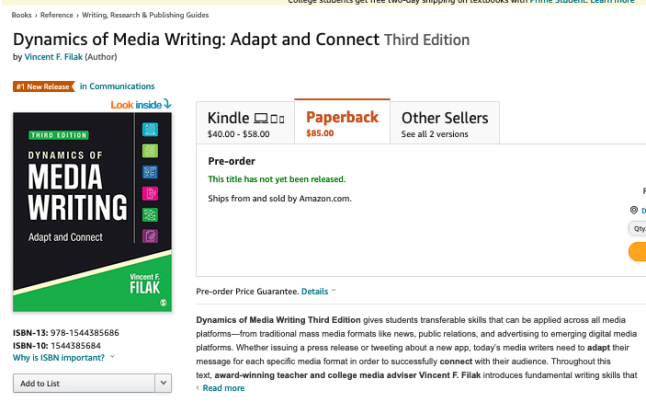
THIRD TIME IS THE CHARM: The Dynamics of Media Writing’s Third Edition has just pressed and is available for purchase at all fine textbook institutions (and I imagine free downloading already on at least three hacker sites). The update covers a lot of the crucial updates in the law, ethics, social media and web writing while doubling down on the basics that that still matter in all fields of writing.

It’s been more than a decade since I went looking for a media-writing text that treated each field of media equitably and honestly, if for no other reason than I was tired of having students in my class say, “I’m going into PR! Why do I need this stuff? The whole book is just news, news, news…” I can still remember the conversation I had with Matt Byrnie of SAGE at an AEJ conference that led to this book:

Matt: “That’s a great book! We don’t have it. You should totally write it.”
Me: “I don’t want to write a book. I want you to have someone write it so I can buy it from you.”
Matt: “You don’t understand. NOBODY has that book. That’s why I need you to do it.”

We scheduled a sit down for noon the next day where I would pitch him a concept. I remember doodling on a piece of paper from the Renaissance Hotel with ideas, rules and core concepts. When I showed it to him, he said, “We might have something here.”

I looked the book up at Amazon when putting this post together and saw this:

Number one new release in communications? Maybe we do have something here… And I’d like to thank all of you who read my stuff for making that happen.

Have a great week.

Vince

(a.k.a. The Doctor of Paper)

Racism Reaction Recap: Amazing stories, horrid headlines and the semantics of tear-inducing organic-chemical-agent deployment

To borrow a phrase from author and former major league pitcher Jim Bouton, there was a lot of week in this week, particularly in regard to journalism. Let’s dive right in and look at some of the best, worst and weirdest moments in the week that was:

AND I THOUGHT DEAN WORMER WAS BAD…

The student newspaper at Arizona State University published an incredibly detailed and damning story last week about the incoming dean of its journalism school. Using interviews with more than 20 former students at Loyola University New Orleans, The State Press outlined dozens of cases of racist behavior by Sonya Forte Duhe. The paper also got a copy of a formal bias complaint a student filed against Duhe, outlining similar allegations.

This story is an amazing read and is a much stronger overall piece than those published in other media outlets for a number of reasons that are worth examining:

1) The reporting is incredible. If you look at the stories in the Phoenix New Times, the Arizona Republic and other places that covered this story, they relied heavily on Whitney Woods as a source but didn’t go much beyond that. Woods’ Twitter thread did jump start this entire process, but when these publications relied primarily (or only) on her, it sounded a lot like a “she said/she said” story: One disgruntled student against one former professor. The State News story shows that this goes WAY beyond that.

2) The allegations are specific. I remember once reading a story about a small-town mayor who was under pressure to resign after he made a “racist statement” during a town board meeting. The city manager, who was leading the charge, called it a horrifying statement that demanded the mayor immediately leave office. The mayor responded by saying he had no idea what the problem was. His statement was just an old turn of phrase people had said for years and was in no way racist.

The problem for the readers? The journalist didn’t tell us WHAT that statement was, or even give us a clue about it, so that we could judge for ourselves.

In the State Press story, the journalists got specific and detailed on what happened. It wasn’t a case of “She just kind of seemed kind of racist toward me” or some mealy mouthed guesswork. It was damning. Here are some of the “greatest hits” from the story in terms of specificity:

  • In a classroom setting and privately, Woods said Duhé told her that her hair was messy and admitted after years of schooling, she didn’t know Woods was Black because Woods didn’t act like it.
  • Andrew Ketcham attended Loyola in 2015, but did not complete his degree at the school because of the loss of a grant. Ketcham, a gay student, said Duhé was very critical about the sound of his voice.

    “I’ll never forget her advice to me that my voice was too theatrical and that I should stick with print,” Ketcham said.

  • Bonner said Duhé’s comments included telling a student they should have their mole removed to be more presentable for television and that during events Black students should not have “natural hair.”
  • Hutchinson said that when she told Duhé her problems, she responded that Hutchinson had gained a lot of weight, and she thought it would help if she lost weight.
  • Outside of the School of Mass Communication building before a school break, 2017 graduate Caroline Gonzalez was with her dad and Duhé who was giving guidance on how she could improve for the upcoming year.

    Gonzalez said the conversation shifted to one about makeup and clothes and Duhé even suggested Gonzalez “do something” about her nose.

  • In addition to a conversation about a nose job, Gonzalez said Duhé suggested she straighten her “curly, thick hair” before class and undergo a boob job.
  • That student, who wishes to remain anonymous out of fear of retribution, said that during a meeting to discuss a project, Duhé said no one would want to hire them because they may have a heart attack at work due to their weight.

That level of specificity gives this piece the kind of traction that most others don’t have and it makes it an astonishing piece of quality journalism.

A quick postscript: Arizona State University announced Sunday that the college pulled its offer to Duhe and she will not take over as the dean of the school on July 1. This was less than a week after Woods’ tweet was posted and the subsequent story ran in the State Press. Never doubt the power of media outlets to shine a light on important topics and instigate change.


HEADLINE HELL

I’ve frequently written here about the word “allegedly” and why it makes me break into hives whenever I see it. As a legal scholar once told me, “allegedly” and its many variations will offer you no legal protection and is “why libel lawyers can afford a second yacht.”

As godawful as it normally is, the use of “allegedly” in the Duhe coverage had some specific problems that bear digging into. Consider the headline on the State Press piece:

AllegedHistory

The reason “alleged” isn’t a great idea here is because it hides the source of the complaints and operates from a position of weakness that belies the strength of the piece. When I first read that head, I thought, “Oh boy… here comes a ‘Simone story‘ on how this person might have sort of, kind of done something… maybe.” Instead, it was a rock-solid piece that was packed with reporting. A headline that makes that case in a noun-verb-object form would do a better job here:

More than 20 students say incoming Cronkite dean has history of racist, homophobic behavior

This has almost the same number of characters (78 vs. 79) and tells the story from a position of strength.

A more problematic version of an “allegedly” headline ran in the Phoenix New Times:

AllegedlyRacist

We talk a lot about misplaced modifiers here on the blog, and this is a case where the placement of the modifier changes the meaning of the head. What the article says is that there are allegations of racism, but that’s not what the head says. What the head says is that statements are “allegedly racist.” That means that the racism of the statements is up for debate. Here’s the difference:

Allegations of making racist statements: Smith said Jones used racial slurs to describe a black student, a charge Jones denies.

Allegedly racist statements: Smith said Jones told him to “call a spade, a spade,” which Smith said is racist. Jones said the statement is not about race and actually dates back to ancient Greece, directing someone to “tell it like it is.”

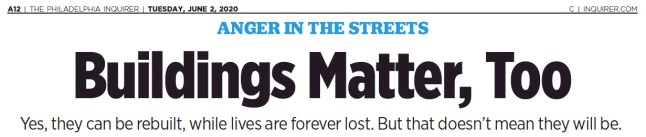
However, the winner in the “What The Hell?” Sweepstakes this week is the Philadelphia Inquirer for its “unique angle” on the damage demonstrators have caused while protesting the death of George Floyd:

BuildingsMatter

A couple things to ponder after you finish reading that headline and while you pick your jaw up off the floor:

  • Anyone who has been alive lately has probably already seen explanations as to why the response of “All Lives Matter” to the statement “Black Lives Matter” is insulting and infuriating. Taking that into account, I have no idea what someone thought the reaction was going to be to a headline that seemed to say, “Yes, black people have the right to live, but WHAT ABOUT MY WALGREEN’S?”
  • I get the idea that in the middle of a major story, every publication is looking for an approach to make its coverage unique. That said, I’m not sure an “architecture-centric” viewpoint (to borrow a term from the piece’s writer) is the way to go. Not since Rand Paul essentially blamed a tobacco tax for the death of Eric Garner have I seen a worse angle on a story.
  • Stan Wischnowski, the paper’s top editor, resigned late last week in the wake of this, but it isn’t the only reason for his departure. After a Zoom call to discuss issues of race, 50 journalists of color at the paper signed a letter, pressing the paper to do more and work harder to address these and other similar concerns.


I CALL “SOLID, MALE-BOVINE EXCREMENT” ON THIS

Journalists are always held to a higher standard when it comes to accuracy because we craft the first version of history. If we’re wrong, the error gets perpetuated and warped over time to the point in which the truth itself is in question.

That said, there are limits to the semantic contortions we should be forced to make.

Law enforcement officials drove protesters out of Lafayette Square in Washington, D.C. last week so President Donald Trump could walk to a church for a photo op. To disperse the crowd, the officials used a series of “less lethal” weapons that left protesters “coughing and limping, their eyes burning amid clouds of smoke.” However, the White House and federal officials disputed reports that these officers used rubber bullets or tear gas on the protester:

What the White House did acknowledge was that it used “‘pepper balls,’ a projectile munition that lofts irritant powder into the air, and “smoke canisters” to scatter the crowd Monday.” “How is that different?” you might ask. Well, according to the CDC, it really isn’t:

According to the Centers for Disease Control and Prevention, riot-control agents are “chemical compounds that temporarily make people unable to function by causing irritation to the eyes, mouth, throat, lungs, and skin.”

Several compounds fall under this category, according to the CDC. Among others, they include chloroacetophenone (CN), more commonly referred to as mace or pepper spray. Such compounds are all typically referred to as “tear gas” because their most prominent effect is to irritate mucus membranes, including the eyes, which secrete tears as a protective response.

This reminded me of a story I did about 25 years ago (Crap… I’m getting old…) when a giant block party got out of hand and police had to come in and clear the streets. Drunks  lit giant bonfires in the middle of the road and caused $60,000 damage to a fire truck when firefighters arrived to put it out. They set a car on fire and they fought the police with rocks, cans, bottles and more. Several people were injured and several people were arrested.

I got on the phone with the officer in charge that next morning and I wanted to know if they called out a 10-33: Riot in progress.

“Don’t you dare call this a riot!” he told me.

I outlined all of the above information, also noting that police donned riot gear for the first time since the Vietnam War protests on the campus decades earlier. If this wasn’t a riot, what the hell was it?

“It was a large, prolonged disturbance,” he said, before hanging up on me.

AND I’M STILL NOT CURT LENZ, BUT I’M GLAD HE’S OK

Finally, a shout-out to a friend in the field in this scary time for journalists.

Way back in college, I had half of a notion that I might want to be a broadcaster, so I took all the broadcast classes and even got the “broadcast sequence” in my journalism major. In my very first radio news broadcast, I was anchoring the news with Curt Lenz and we had prepared like crazy to do this perfectly. Eight minutes of stellar journalism, ready to hit the airwaves.

Curt was to lead off the news cast, introduce himself and then throw it to me so I could introduce myself and hit the first story. We go live to tape and Curt intones:

“Welcome to Campus Update. I’m Curt Lenz and I’m Vince Filak and here is the news…”

It was pretty much all downhill from there for both of us that day.

Curt stuck with broadcast and became an amazing broadcast reporter and photographer, while I decided I had a face for writing books.

Curt and his reporter, Amelia Jones, were covering the aftermath of protests in downtown Madison. A man who had previously yelled at them not to film him, crossed the street and attacked them while they tried to do their jobs. The man was arrested a short time later and booked into the jail on suspicion of battery, disorderly conduct, resisting arrest and a probation violation.

Journalists know that every time they go into the field, something unexpected can happen. However, you can only prepare for so much or worry about so many things without getting paralyzed by fear. It can be tough to go back out there after something like this, kind of like it’s tough to step back in the batter’s box after getting beaned in a previous at bat.

Although they were a bit shaken, Curt and Amelia were unhurt and back on the job later that day, recounting the story for the viewers.


Jim Lehrer’s rules matter now more than ever

Allegedly: The word journalists should avoid at all costs and three ways to do it

I remember once talking to a media law expert about the word “allegedly” and what kind of protection it offered reporters.

“None,” he told me. “The word ‘allegedly’ is why libel lawyers can afford a second yacht.”

He then explained that “allegedly” is nothing but a thinly veiled accusation that lacks a concreted source to support it. Instead of saying, “Smith then allegedly killed Jones with a hatchet,” a good reporter would say, “Smith then killed Jones with a hatchet, police said” or “the criminal complaint stated” or whatever source this came from. All that “allegedly” means is that someone, somewhere said this thing we are now accusing someone of doing.

Ever since that moment, the word “allegedly” has given me hives whenever I hear it in a media report or see it in a news story.

In the case of a TV report about a police officer recovering from a stabbing, “allegedly” felt not only weak, but downright stupid:


Let’s look at the anchor’s lead in here and compare it to the web version the station posted:

TV: “Today marks six days since Student Resource Officer Michael Wissink was allegedly stabbed by a student at Oshkosh West High School before shooting and injuring the teen.”

The passive voice in this isn’t great, especially since broadcast thrives on strong, active verbs. What makes it worse, however, is the use of allegedly, because at first glance, it sounds like we don’t believe he was stabbed. He was just “allegedly stabbed.”

Something tells me we can be pretty sure he was stabbed if he spent six days in a hospital, recovering from his injuries.

Weirder still, while the station is only alleging a stabbing, it’s definite on the shooting and injuring part, stating it with certainty.

The web version fixes this pretty easily.

Web: A school resource officer, who police say was stabbed by a student last week, was released from the hospital Monday.

Notice two important things here:

  1. We don’t have “allegedly” but instead we have an attribution to a source (one that operates under the shield of privilege, to boot).
  2. Although this sentence is in passive voice as well, it’s shorter and tighter than the broadcast opening, something that shouldn’t happen. Broadcast is supposed to be short and tight compared to all other forms of media writing.

The writers of these two sentences were trying to explain that the student is innocent until proven guilty of the attack, so it isn’t smart to say the kid stabbed the cop straight out. However, the use of “allegedly” does more harm than good in here.

About 55 seconds into the story, the reporter offers a less-defensible use of “allegedly” when it comes to explaining what happened to the officer:

TV: “Students and staff lined the streets to show support for the officer who was allegedly attacked on school grounds.”

If the first case made it seem like we possibly didn’t believe the officer was attacked, this case basically says it. Here, the use of “allegedly” is even dumber because it’s unclear who the heck the reporter is trying to protect with his “allegedly” shield.

I see only two, equally stupid reasons for “allegedly” here:

  • The reporter is afraid this guy made up the attack, and thus hopes “allegedly” will cover it.
  • The reporter is afraid the guy got his ass kicked at a bar or something and then staggered over to school and claimed the whole thing happened on school grounds to get worker’s comp.

And, once again, the web version is tighter and it dodges the problem altogether:

Web: The escort went from the hospital in Neenah to Oshkosh. The motorcade passed by Oshkosh West High School where faculty, staff, and students stood outside to cheer.

This delivers essentially the same information (actually in more of a broadcast style as well) and does so with no need for attribution. We can prove the escort went from Point A to Point B without needing a GPS tracker on the guy. Also, we can say without fear that people were outside cheering (We even have photos of that!) so we’re OK there.

“Allegedly” is one of those words that will imbue you with a false sense of confidence in your writing. It can make you feel like you have protected yourself when you haven’t and can give you a feeling of authority when you are completely lacking in it. Here are a couple simple tips to help you dodge the “allegedly” bug:

  • Attribute: If “allegedly” is just an accusation, let’s see who’s doing the accusing. If it’s someone we think should be doing so (police, courts, the pope etc.), then let’s say so. “Police said Smith hit Jones with a golf club.”  If the person alleging this has an axe to grind, we probably want to think twice about it, but it doesn’t mean we shouldn’t use the accusation: “John Smith, who divorced Mary Smith last month, said Mary Smith once tried to kill him with a golf club.” (It probably wouldn’t hurt to include a response, if possible: “Mary Smith stated in a court filing that the incident involving the golf club was ‘blown out of proportion’ during the divorce.”)


  • Write what you can prove: Instead of telling readers what you don’t know, try telling them what you do. Instead of “The officer was allegedly stabbed by a student,” try  “The officer suffered multiple stab wounds.” The second example from the web does a good job of showcasing how to avoid the “allegedly” issue by just explaining the people lined the streets and cheered. By this point in the story, we probably know about the stabbing, so repeating it here and introducing another “allegedly” doesn’t do much good.


  • If you aren’t sure, don’t use it: The duty to report is not the same as the duty to publish. So, if you get some information that you can’t verify or that feels a little shaky, it doesn’t follow that you HAVE to publish it, with an “allegedly” or otherwise. Try to get a source that will back up what you want to write or find a way to write something that is a bit sturdier than whatever you’re about to allege. If you can’t make that work, it’s better to be safe than sorry.


Kisses, Snowballs and Worse: The perils of going live as a broadcast journalist

(Hat Tip to the Teachapalooza crew, specifically Melissa Harrison of TCU, for the head’s up on this issue.)

When broadcast journalists go to the scene and report live, everything seems to be up for grabs, thanks in large part to the dumber elements of our society. Case in point: A reporter for WAVE-3 in Kentucky was doing a live shot about a bourbon festival when some chucklehead decided to get his 15-minutes of fame by kissing her:

Reporter Sara Rivest dodged several people trying to disrupt her live shot before a guy eventually dove in for a kiss. Rivest responded, “That’s not appropriate” and she was right: At best it’s creating a problem for a journalist in a work environment. At worst, it’s sexual assault. In either case, it’s pathologically stupid.

Rivest talked about the incident on WAVE-3, outlining the issues she faces as a reporter in the field, including the ways in which men seem to think she’s there for their touching pleasure. She also explained that she’s not the only woman who has faced this kind of thing (I didn’t notice this until she said it, but the first time this guy hops into the shot, he was apparently pretending to grab or smack her rear end.).

She said she used nervous laughter to try to power through the segment, even though she felt powerless in that situation. She also said, clearly, that this kind of intrusive behavior is not OK.

Broadcast journalists go live for a wide variety of reasons, including covering breaking news events or trying to put a fresh touch on an earlier story. In doing so, they run a risk of having the public decide to be antagonistic toward them.

When the Green Bay Packers were in Super Bowl XXXI, the State Journal sent me down to State Street, an area near the UW-Madison campus where a great deal of alcohol is consumed and celebrations occur, to get some “color” for a story. As I wandered among the drunks, completely incognito under my giant parka, I saw a Channel 3 news truck parked on the road, with the reporter about to go live.

A group of revelers had gathered and the reporter, Rick Blum, was telling them that when he went live, he would love it if they all started cheering. Blum was standing on top of the truck with his videographer so they could be out of the crowd and yet still have the crowd as a big part of what he was doing. It looked like the fans were going to cooperate, but quickly things turned ugly.

First, some idiots started throwing snowballs and ice chunks at the journalists. Next, someone got a chant of “RICK BLUM SUCKS!” going. As it looked like the group was about to start shaking the news van, Blum and his videographer got down and went inside the van. I can’t say for sure, but I’m guessing they never got the shot.

Other broadcasters have run into similar problems along the way, like this journalist in Mexico who was covering a protest. My Spanish is horrible, but this moment about a minute and a half in doesn’t need much translation:

I have no hope of translating any of this, but again, it’s clear what happens to this broadcaster in the Ukraine:

Perhaps the worst of all situations involving journalists being harmed while live on a scene was this situation from WDBJ in Virginia, where journalist Alison Parker and cameraman Adam Ward were shot and killed by a disgruntled former station employee.

After this situation, a local news crew interviewed me as part of a localization story and they asked me what I tell students in terms of how to avoid these kinds of outcomes. My answers didn’t fit their narrative, which was about how to do things safely, going in pairs to things and knowing when to leave.

I tried to explain that, yes, I tell students it’s important to be safe on any scene, and yes, they might have to improvise/adapt/overcome when it comes to stuff going sideways, and yes, you have to be aware of your surroundings at all times…

BUT, you are literally at the mercy of the public when you enter any public space. The guy in the Spanish-speaking clip was reporting on the scene of a protest, so there’s clearly going to be some adrenaline flowing from those people, but it’s not like he knew he was going to be punched.

Rivest and Parker were going life on two of the most vanilla stories possible: a local festival and something for the morning show about the chamber of commerce. One got kissed, the other got killed and neither should have expected either of those outcomes.

These people could not have prevented these outcomes if they wanted to do their jobs well, and that’s a scary thing to consider.

Writing 101: Don’t tell me that you’re going to tell me something. Just say it.

Zoe got pretty excited this weekend because her “favorite TV show” (whatever it is this particular week) was coming out with a second season. The first season, as shows like this one are wont to do, ended with a cliffhanger. The main character overheard her aunt and the school’s vice principal talking about the girl’s dead mother. She then walked out and said to the VP, “How did you know my mother?”

Cut to black, thanks for watching, see you next season (maybe).

This kind of teaser approach can work well in ongoing serial dramas, but it’s a lousy technique for media writing. Your readers want to know what’s going on right away and they don’t want to play a game of “Where’s Waldo?” to find key information. Additionally, this approach is a waste of time and space for busy journalists who want to get their job done and move on to the next important story.

We have talked about burying the lead before, so that’s not something worth rehashing. Instead, let’s look at the body of stories for print and broadcast and see how this problem can manifest itself and what we can do to fix it.

PRINT:

In most print stories, we like to operate in paraphrase-quote structure, with the paraphrase introducing the quote and the quote delivering on the promises established in the paraphrase. In the book, we refer to this as the “diamond ring” approach, with the paraphrase serving as the setting and the quote serving as the jewel.

The problem is when your setting doesn’t do its job and instead just tells your readers that you’re going to tell them something:

Mayor Bill Jackson talked about his thoughts on giving firefighters a raise.

“Nobody else in this city is getting a raise this year,” he said. “I know firefighters are incredible men and women, but with a budget this tight, it’s not fair to play favorites.”

The paraphrase talks about the content that is upcoming, but all it really does is tell me that you’re going to tell me something. When you run into a jam like this, you have several options:

Cut the first line of the quote and retool it to make it part of the paraphrase.

Mayor Bill Jackson said although he supports firefighters and their needs, no one in the city is getting a raise this year.

“I know firefighters are incredible men and women, but with a budget this tight, it’s not fair to play favorites,” he said.

Find additional valuable information to include in the paraphrase that can still allow the quote to stand on its own.

Mayor Bill Jackson said he has supported raises for firefighters in the past three budgets but he can’t do it this year because the budget won’t allow it.

“Nobody else in this city is getting a raise this year,” he said. “I know firefighters are incredible men and women, but with a budget this tight, it’s not fair to play favorites.”

The main goal is to tell your readers something of value in each and every sentence you provide. If you just tell them that you’re going to tell them something, you’re not doing that.

BROADCAST:

In television and web-based video packages, reporters have to find ways to introduce their soundbites, the broadcast equivalent of quotes, in a way that adds value to the story. These introductory statements are known as lead-ins.

One of more common failings of new broadcasters is to just tell people the soundbite is coming. Here’s some examples from the media-writing book:

Horrible lead-in: In responding to the budget crisis, University System President Nate Craft had this to say:

“The loss of more than 20 percent of our revenue over the next biennium is more than our campuses can withstand without cutting faculty and staff positions.”

Bad lead-in: University System President Nate Craft says a 20 percent loss in revenue would force campuses to cut faculty and staff positions.

“The loss of more than 20 percent of our revenue over the next biennium is more than our campuses can withstand without cutting faculty and staff positions.”

Better lead-in: University System President Nate Craft says the budget cuts the governor proposed would substantially weaken all of the campuses across the state.

“The loss of more than 20 percent of our revenue over the next biennium is more than our campuses can withstand without cutting faculty and staff positions.”

In each case you see improvement, although even these lead-in sentences would be a bit long for broadcast. If you feel they are overly long. You can always cut them in half:

Nate Craft is the university system president. He says the budget cuts would weaken campuses across the state.

“The loss of more than 20 percent of our revenue over the next biennium is more than our campuses can withstand without cutting faculty and staff positions.”