THROWBACK THURSDAY: “Forget the mistake. Remember the lesson.” A few thoughts on how to deal with corrections.

I had to give one of my best reporting students a failing grade on her midterm, and it killed me to do it.

It was a phenomenal job of reporting and writing, as she conquered “The Midterm from Hell” better than anyone has in a long time. She could have survived a few minor mistakes I found, but then she had a fact error, a misspelled proper noun. That did enough damage to sink her.

I went to talk to her about it and she had no complaints. “That’s on me,” she said. “I just copied and pasted the quote from the email and never thought to look up how to spell the names.”

“Next time, I’ll know better.”

I have to admit, that was a more enlightened view of things than I would have taken at age 19, but it is what I’ve been trying to teach students for the past several decades: The grades don’t matter, but what you learn based on what leads to those grades does.

In honor of that, here’s a throwback Thursday post on learning to forget the mistake but to remember the lesson you learned from it.

“Forget the mistake. Remember the lesson.” A few thoughts on how to deal with corrections.

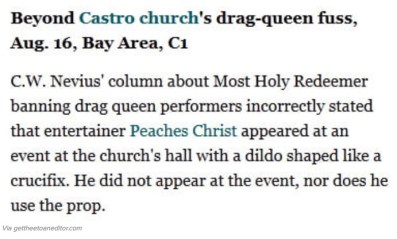
Of all the things you will write over the course of your career, nothing feels worse than writing a correction. Essentially, corrections tell the world, “Hey, remember that thing I told you yesterday that I was so proud I managed to find out and share with everyone? Yeah, I screwed up…” Corrections run the gamut from the amusing ones, like this correction on a drag queen’s presence at an event as well as her act:

PeachesChrist

…to the geeky ones like this look at a quote from “The Simpsons:”

Simpsons

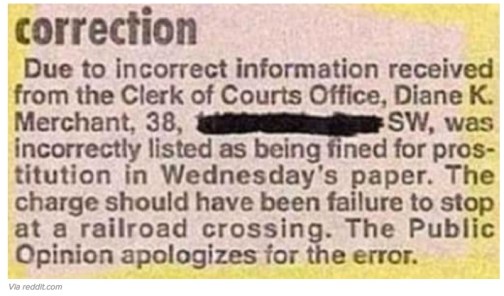
…to the downright embarrassing:

Hooker
(It might just be what the kids are calling it these days… “Hey, you gonna go home or should we um… y’know… fail to stop at a railroad crossing…”)

Perhaps there is nothing worse than having to correct a correction, which happened at one of the papers where I worked. We misspelled the name of the Carrerra soccer club, first by using only one “R” in one of the double-R pairings and then we screwed up the correction by using only one “R” in the other one. When we asked the managing editor if we should run another correction, he told us, “No, you’ve done quite enough damage already.”

Corrections can be painful but they’re worth doing. My worst one involved a guy we thought was dead but turned out not to be, even though he was still teetering on death’s door. The question became: “OK, so we said this guy died yesterday, but he didn’t. What happens if he dies now? How do we write that correction?” Eeesh. The guy lived past press time, so we were at least saved the pain of trying to work through that one, but it still stung.

One of my other problems with corrections (and I’ve been told I’m not alone on this), is the issue of “correction contagion” in my work. I had a handful of corrections at each stop I made as a journalist, but they tended to “bunch up” on me. Thus, after I made my first error and fixed it, I’d be so myopic about not making THAT mistake again, I would make four other stupid mistakes. Fortunately, I had great editors who saved me most of the time, but when they couldn’t hold back my wave of stupidity properly, I ended up with another correction or two in short order.

So, how do you deal with the corrections as a writer? To figure out how to write a solid correction, give the book a read. As for how to mentally deal with this blow to your ego and skill set, that’s a bit tougher.

I found a good piece of advice on one of those chatty billboards outside of an area business or church or something as I was driving around recently:

“Forget the mistake. Remember the lesson.”

In other words, don’t obsess about the stupid thing you did, but rather how you came to make that stupid mistake in the first place. Was it a case of thinking you knew something so you failed to check on it? Was it something where you forgot to check back on an evolving situation? Was it time where you didn’t have a lot of time to recheck a fact? Was it that you didn’t stop and think before completing your work? Whatever the underlying factors were for that error, consider those to be the lessons to take with you so you can avoid making that mistake again.

Then, let the mistake go or just let it serve as a reminder of the lesson.

A few observations from judging journalism contests this year

Best Whatever Trophy – Sarah Duyer

“I’d like to congratulate the winners while keeping their names out of my (EXPLETIVE) mouth…”


I spent a significant portion of March judging various media contests at a variety of journalistic levels. One of the things I have found about being a judge is that once you agree to judge a contest, you become part of some eternal list that gets shared and reused and shared and reused. Not since the loaves and fishes miracle has there been an exponential expansion like the one I have seen for my judging requests.

I honestly don’t mind it and I think it’s a great way to keep my finger on the pulse of what’s going on in the field. I have judged nationwide and statewide contests this year, giving me a look at some local issues and some broader concerns. I’ve also judged high school, college and professional publications, which helped me see various levels of growth and some interesting (and occasionally painful) commonalities among those levels. It also helps me see what people think is truly the best of their best work, as the submissions are meant to represent potential award-winners.

Without further ado, here’s a look at some of the good and maybe not so good aspects of what emerged from this year’s collection of entries:

PEOPLE KNOW THEIR AUDIENCES: One of the best things I’ve seen come out of this mix was how on-point people were about meeting the needs of their audiences, and recognizing the importance of meeting those needs. In one professional contest, I found that a reporter was taking extra time to slowly breakdown a complex set of figures to outline how and why this change to a school district policy mattered to the parents in that district. In a college contents, I noticed the level of attention paid to local stories that had serious impacts, like the terrible conditions in one of the residence halls. That particular piece had a ton of great reporting about how flooding forced students to deal with lousy conditions, how the maintenance folks weren’t responding well enough and how long all of this was going on.

Other stories also focused on key aspects of the school life, ranging from shifts in COVID protocols on campus, to changing traditional events to give people a complete college experience during the pandemic, to issues of faith at schools that had a religious connection. In each case, it was clear these folks understood that even in a global pandemic, local issues needed to be at the forefront of their locally based publications.


ATTRIBUTION AGONY: I know I’m a total crank on this one, but hear me out. Attributions matter for a wide array of reasons: They show support for content. They provide protection for the authors. They also just let me know who is saying something so I don’t feel like I’m hearing voices in my head.

Attributions tended to show up in a lot of these stories at random intervals, without any rhyme or reason. It was like the author flipped a coin: Heads we’ll attribute this paragraph, and tails we won’t. That was the only reason I could find for attributing things that were so fact driven, nothing bad could happen without an attribution (e.g. when someone became a teacher) and not attributing content that could get you sued into the ground (e.g. accusations of illegal spending).

If the coin determined the presence of an attribution, apparently a “Wheel of Fortune” device was used to determine the verb of attribution. “Said” got use in some cases, but I also saw things like “claimed,” “argued,” “laughed,” “noted” and “proclaimed.”

The one that bothered me the most, however, was “expressed,” as in:

“Jones expressed that he wanted to win the game.”

First, the grammar there makes no sense.

Second, exactly how did he “express” it without saying it? Was he doing it through emojis? Did he get REEEEEAAAALLLLY into mime during the pandemic and can’t stop now?


Do tell, how this “expressing” occurred.

Finally, and maybe this will put an end to this kind of thing, every time I hear about “expressed” I go back to the time we had to take our dog to the vet to have her anal glands expressed. (That’s a real thing.)

So the next time you plan to “express” in your writing, just watch this and wait for better verbiage to come along:


RIGHT TOOL, RIGHT JOB: I got a number of “Best in Show” categories that pitted full issues of each publication against those of other contenders. This gave me the chance to see everything the paper or website did on a particular section or a particular topic.

What I got to see was that people generally had a really strong sense of when to use specific forms of communication to get their messages across. I found that stories with math tended to make good use of graphics. Stories about people had nice descriptions and good head shots. Action stories tended to use a lot of good visuals while stories with more “in the weeds” stuff used timelines or background boxes to do the heavy lifting in some simple ways.

This was a big switch from previous years where it felt like some papers felt that EVERYTHING needed a graphic or a photo, regardless of its practical applicability. It also seemed like this year the visuals tended to have sizes that were commensurate with values. In other words, I wasn’t getting full-page mug shots or graphics that could serve as a thimble cozy. Stuff read well at size and did the job well.

HOLES, HOLES EVERYWHERE: I can’t remember the last time I saw as many stories that people considered award-worthy entrants that had only one human source in them. I would have been more willing to give these folks a pass if these stories were epic, data-driven, investigative pieces where sources were dodging the reporter like they had been trained by Patches O’Houlihan. However, the array of content here ranged from one-source meeting stories to one-source personality profiles.

These aren’t really stories, so much as they are soliloquies at that point.

Even when stories had more than one source, they still had some pretty obvious holes. In one contest, I was on a judging panel and we all agreed on the winner, even as we all agreed that a story involving something that would impact parents and children should at least TRY to include quotes from parents and children. In another case, a fellow judge asked me about a story that highlighted an achievement it took a teacher their whole career to reach. “Did the writer even CHECK to see that this happened?” the judge asked me. I thought it was a good question, given the claim would have taken dozens of years to accumulate, so a simple, “How did you keep track of X over all those years?” seemed to merit an ask.

QUOTED QUOTABLES: Quotes need to include information unique to a source or information said in a unique fashion. In other words, it’s gotta be powerful stuff or pithy verbiage if it’s going to work.

Both of these were present in the content I saw. This was particularly true from some of the high school publications I read. The quotes from students captured emotions so perfectly in so many cases, whether it was joy, anger or general annoyance. I also found that the publications that seemed to have a good handle on filling the niche their publication tended to cover seemed to have quotes that reflected that niche: Educational pubs tended to have quotes that were more explanatory. Religious pubs tended to have quotes that reflected faith-based ideology. College arts sections tended to have that “promising local band” feel to them.

For some reason, the quotes just really worked.


LONG AND WINDING PROSE: There appears to be a misguided correlation in the minds of a lot of folks between something being really long and something being really good. Granted, some stories need more room to breathe than others, based on a large number of factors, including the number of sources needed in the story, the overall complexity of the story and the amount of information necessary to tell the story. It’s also true that most stories can shed 10% without losing a bit of value.

However, I found in reading both profiles and in-depth stories that it seemed the authors felt the missing ingredient to making a story great was to make it longer. In most cases, I have found the opposite to be true.

One of the many benefits I get in writing books that I don’t get on the blog is having an editor who will tell me, “Stop writing so damned much.” I also tend to get put on word counts, so that the 10,000-word chapter doesn’t suddenly become 15,000 for no other reason than I was on a roll and “Bat Out Of Hell” was playing in my headphones at the time. The folks who edit me are nice enough to suggest trims, with the idea that I can argue to keep them, but for most of the cuts, they’re usually right.

We tend to put too much emphasis on length in terms of stories we enter for contests, with the idea that we invested a lot of time into this, so it’s probably really valuable. In most of the winners I picked, the inverse was true: They got my attention, told me something important and finished up relatively quickly. A good rule of thumb is, if you wouldn’t read it, don’t write it.

One final piece note…

If you find yourself torn between entering and not entering a contest, just enter it. I don’t know if I’m a typical or even good judge some years. When I end up on a panel of judges and we’re all feeling the same way about something, it actually makes me feel better because I get the sense that I might actually know what I’m talking about.

That said, a winner is in the eye of the beholder, so give yourself a shot.

You can’t win if you don’t enter.

On the back end of the Corona-pocalypse, here are four stories student journalists could dig into

We’re not out of the woods yet when it comes to the COVID-19 pandemic, but a number of indicators have us no longer walking into the woods of this situation, but walking toward the exit. Around here, we’re looking toward system campuses getting back to whatever “normal” is, at least as far as masks are concerned:

University of Wisconsin System officials said Wednesday they plan to end their campus face mask mandates by spring break.

UW System President Tommy Thompson announced widespread COVID-19 vaccinations and waning case numbers on system campuses and across the state justify the move.

“While we will continue to take prudent prevention measures when warranted, restrictions can be lifted as case counts drop,” he said.

Thompson said vaccines and tests will still be available on campus and students and employees can still opt to wear masks if they wish.

(I’m sorry. My mind drifted off into a fantasy land of joy when I saw the words “spring break…” What else is going on?)

With the idea that we’re “getting there” (wherever “there” is), here are a few potential story ideas for college media based on these kinds of updates:

CONTINUED ACCOMMODATIONS: One of my colleagues here asked a really good question about what happens when we go back to “normal.” What will the universities do in terms of accommodations for students who have immune system issues in regard being in classrooms now and for future illnesses?

A lot of what we dealt with over the past two years was learning what an illness can do to people, how it can spread and what can be done to avoid putting students in harm’s way. As much as the coronavirus outbreak was a fearful situation for society as a whole, I’m quite certain it was even more terrifying for people who were most ill-equipped to have their immune system protect them. As universities started to understand all of this, it’s worth asking the question of, “So, when we have a flu outbreak in 2024, are we going to find ways to help these folks the way we helped everyone else, or is it ‘You’re on your own, dude’ kind of situation?”

ONLINE ACCESS: One of the greatest things of our lives as kids here in Wisconsin was waking up and seeing the cars on our street buried in snow. We would immediately tune the radio to WTMJ and pensively listen for our school to be called in the list of “snow day closings.” Once that happened, our joy erupted as our parents cursed a bit, trying to figure out what to do with us because they still had to go to work.

Today’s students don’t have that same joy in every case, thanks in large part to online access. In the pre-pandemic era, we kind of had a split between the “hip, young, tech-savvy profs” who would just send a video or a podcast for a lecture that would have otherwise been cancelled due to weather and the “old-school, screw-this, technology-peaked-with-frozen-pizza profs” who just called it a day and let the kids have the day off. Now, after two years of going online, most of the folks teaching have online versions of in-person classes. To what degree are professors making those options available to students who can’t make it to class? To what degree are students still requesting this kind of access, rather than going to campus when it’s lousy outside (or they’re reaaaalllly too hung over to walk six blocks).

Also, how many classes are likely to remain in a mixed/hybrid/online only version on your  campus going forward? Are they expected to be more or less popular than the old-school lecture approach?

THE KIDS ARE(N’T) ALL RIGHT: The incoming freshman class for the 2023 school year will have spent more than half of their high school career in some form of online schooling, doing hybrid coursework or otherwise learning in a way that we haven’t seen before. A number of schools are trying to adjust to this through all sorts of things, like making SAT and ACT scores optional for applicants. Other schools are trying to find ways to help students adjust once they get to campus.

The question that’s worth asking is what is your school doing to try to get this group of anomalies ready and capable to survive in college, given how screwed up their high school life was? This would be worth digging into.

It would also be worth digging into how the freshmen currently on campus are doing, given that they’ve had three school years of total weirdness. What are grade trends professors are noticing? What are social anxiety trends campus health services are noticing? What are academic concerns advisers are noticing? This is especially important in terms of comparisons to other years. In other words, what’s happening to these kids that seems different or potentially problematic compared to previous generations of students?

FACULTY FALLOUT: Even before the pandemic hit, a number of universities were offering older faculty members who were close to retirement a “golden handshake” deal as an incentive to move on with their lives. Whether it was extra money, better insurance or something else, the goal was to prune the branches on the faculty tree where maybe those professors weren’t needed or to eliminate the big-salary profs and replace them with younger, cheaper options.

Then, we saw the rise of COVID-19 and the faculty tree was pretty much struck by lightning. Even if we don’t entirely ascribe to the theories of “The Great Resignation,” it stands to reason that more than a few people on your campus said, “Screw this. I’m not dying here…” Over two or three years, a number of people will naturally come to the conclusion that they should retire, so those folks probably moved on. Then there are people who started coming to grips with their own mortality and decided now was as good of a time as any to be done with the rat race. There might have even been a few deaths that didn’t get the same level of notice as normal on your campus because nothing was normal on your campus.

In looking forward either at the end of this year or the beginning of next year, take a look around at the data of how many faculty and staff have decided to call it a career. See if any particular areas have been hit hard by this (food service, the chem department, whatever) and what plans are in place to replace folks. Maybe this is the time your school decides it no longer needs an underwater basket weaving department now that both faculty members have left. Maybe the once-great physics department lost a lot of folks that made it great, and now your institution is trying to figure out if the B-team has what it takes to sustain the rep.

Anything is possible when it comes to this recovery, so keep an eye out for potential stories as you start getting back to “normal” again.

Before your student newspaper hops on the “Let’s Cover Ukraine” train, here are a few things to keep in mind

The story that will dominate the news cycle for the foreseeable future is Russia’s invasion of Ukraine, as every state, national and international news organization has ramped up its war coverage. I have always said student journalists are no different than any other journalists, and have taken severe umbrage at the idea that these collegiate folk were just “playing reporter,” to quote one particularly idiotic idiot I know.

That said, it doesn’t necessarily follow that college media outlets should follow suit and flood the zone with all Ukraine, all the time. Here’s why:

Audience-centricity: One of the most memorable arguments I’ve had with a student writer was one in which a columnist wanted to publish a detailed opinion about why the U.S. should annex Puerto Rico. When she first brought it up, I honestly thought I was being punked, until I realized she wasn’t old enough to remember “Little Giants:”

When I asked her why the students at UW-Oshkosh should care about this topic, she stiffened and chastised me by stating, “EVERYONE should care about this!”

OK, fine, there are a lot of things everyone SHOULD do, like eating vegetables, flossing and jogging a few miles per day. As I do none of those, I’m clearly part of a psychographic group that will require someone to give me something a lot more specific than “EVERYONE should do X.” And I don’t think I’m alone.

Case in point: A few years back our university’s foundation was in the middle of a sticky situation regarding university funds and how money was coming and going through its system. At one point, the foundation was looking to declare bankruptcy and nobody knew what that would mean for all the donations that were sitting in its coffers.

I walked into my 8 a.m. reporting class and said, “Wow! Have you all been following what’s going on with the foundation?”

Blank stares. Then one kid asked, “What is that and why would I be?”

So I asked, “How many of you in here have a scholarship?”

Every hand went up.

“Where do you think that money is kept?” I asked.

The looks changed from disinterest to horror as they suddenly figured out they had some skin in the game if this situation went from bad to worse. When I gave the students a break at the halfway point of class, they were all feverishly Googling everything they could think of having to do with the foundation.

Self-interest drives readership, and we as writers really need to take advantage of that. So, unless there is a direct way to tie a topic like the situation in Ukraine to your readers, it’s going to be a waste of time.

Niche publication and limited resources: When it comes to student publications, you are serving a niche audience: A specific campus, with an educated audience, that sits in a specific age range (mostly) and has certain heightened interests (Are classes going online with the next COVID surge? How did the basketball team do in the conference tournament? What was with all the cop cars outside of Smith Residence Hall last night?). That audience is also getting information fed to it through a fire hose right now, so to break through, you need to be really specific with how any particular story impacts your readers’ lives.

In addition, you’re covering that niche with resources that are nowhere near those available to the major international news outlets. Never once have I seen Wolf Blitzer speed up an interview with a member of the Joint Chiefs because he had to make a study session at the library for some BS group project.

In looking at these two issues, it’s clear that you’ll need to apply your resources judiciously and you’ll need to focus on things in your niche more than things outside of it.

If you have access to AP wire and you want to run a Ukraine story, that’s not a problem. However, your readers can get all the Ukraine coverage they want from hundreds of other places. They can only find out about the locks on the bathrooms in Hawthorne Dorm being broken from you.

Addition, not repetition: George Kennedy, the long-time managing editor of the Columbia Missourian, would frequently ask editors and reporters under his watch, “So, how does this add to the sum of human knowledge?” (In his more bitter moments, George would  declare that we not only failed to add to the sum of human knowledge, but we actually managed to subtract from it.)

His point was that everything we put in the paper should move the needle, advance the ball or chip into the kitty of information somehow. If we were writing the exact same thing that everyone else was writing, what was the point?

This is where that understanding of your audience and your niche can come into play. If you have stories that nobody else is telling about this invasion, tell them. If you’re basically telling people what you saw on Fox News or MSNBC or CNN or whatever, why bother? This is even more true for publications that tend to operate on a non-daily schedule. If you’re publishing once a week, a fast-moving war can render your content way, way, way out of date before it hits the stands. (The same thing applies for posting to a website, if you’re not actively updating it as things continue to change.)

So now that we’ve dumped all over what you planned to do for the next two weeks at the student paper, let’s look at some things that could meet all of those needs in some interesting ways:

Local events: As is always the case, if there’s a local event that deals with this situation, cover it. That could be a local candlelight vigil calling for peace or a protest over involvement/lack of involvement/whatever. (Some campuses have a ton more activism about almost everything than others do. When I lived in Madison, the joke about the city and campus area was, “Two’s company. Three’s a protest.”)

It’s always good to find out what the purpose of this is, who’s running it and what they hope will come out of this public display of concern.

Local folk, Ukraine tie: One of the simplest ways to show local impact on a national or international story is to find local people who are actually feeling the impact. See if your area has a large swath of Ukrainian immigrants who have family or friends still over there. This could provide some good human interest coverage with people who are well-known to the community around you.

Check with the faculty and students on your campus to see if any of them are connected in some meaningful way to that area, either through relatives or through travel experiences. Maybe your school even did a study abroad in that region at some point. Find people who can tell you what it’s like pouring over content from as many sources as possible regarding this mess and hoping to find out what is happening to people who matter to them.

Expert insight: Colleges and universities have a great number of people who have studied certain topics for a long time and know a lot about them. Between the folks in international relations, global studies, poli sci and probably a half dozen other departments I’m forgetting, you probably have some folks who have a really good set of insights on what is going on over there and WHY it is going on.

Find those experts and get them to help you craft some good explainer pieces about what is happening. The layout of who is involved, why this situation got to this point and what is likely to come out of all of this can help students care more about a topic that seems either overly reductive (Putin is a dink) or way too complicated (that whole region has a lot of history, to say the least). It might also be interesting to find out what they think about how the conflict is being portrayed in the media. (In some cases, folks might note the media is taking a “side” in a situation. I don’t think there’s another side to this one, but I don’t know, so I would definitely ask if I were interviewing someone on this.

It’s also a good idea to ask them about specific local impacts. (“So, what would you say to the average university student who doesn’t think what’s going on in Ukraine has any direct impact on them?”). When the war in the Gulf began in the early 1990s, I started to realize I lacked a truly fuel-efficient vehicle and it was killing my pocket book. I also had family and friends who were being deployed to that area, giving me a direct connection to what was going on over there.

This situation is at the front end of the conflict, so I’m sure there are a ton of things that Russia, Ukraine and a bunch of other countries in that area have/do/build/export that will have an impact on folks that we have yet to see. Those experts can look three or four moves ahead on the chessboard and give your readers a few insights about what’s going to happen and why it matters to them.

Military moments: If your institution has a strong ROTC presence, or a lot of folks in the reserves, this would be a good time to check in and see what they have heard. My initial instinct was that if we were staying out of this one, there wouldn’t be much to think about. That said, Zoe came home from school and told me two of her teachers who are somehow part of the military are being shipped out to Europe over spring break for support and training because of the invasion. (I trust the source, but the specificity was really lacking.)

If people at your institution are planning to go somewhere because of this situation, it would be good to sit down with them and get some information about what’s happening. This can also be helpful to make a connection for an overseas source, if some of those folks are deployed to the region. The ability to have that audience-centric perspective right in the thick of the situation can’t hurt.

It might also be good to talk to vets who have chewed similar dirt along the way. This isn’t the first conflict of this  nature and it (unfortunately) won’t be the last. Talking to people who have walked the walk about what is happening there for the average deployed military participant could provide some insights that other publications won’t have, as they’re so busy covering the minute-by-minute stuff.


Throwback Thursday: Obituary Writing: Telling truths, not tales, in a reverent recounting of a life

A student in my reporting class mentioned last week that he feared writing obituaries. “Those must have been the toughest stories you ever wrote,” he noted.

In some cases, they really were, as I was reaching people at the worst times of their lives and asking some of the most difficult questions I ever had to ask. In other cases, they were the best stories I ever got, because I was able to learn a lot about people who I wished I had gotten to know when they were alive.

At the end of the last semester, a student who was struggling with all sorts of things told me that her grandfather was dying so she’d be missing a class or two. During our semester break, she emailed me an update:

“My grandpa died on Tuesday morning, but one of his last wishes was for me to write his obituary! Thank you for showing me how to do it!”

With that in mind, here’s a throwback Thursday piece that goes through the best and the worst of obituary writing.


Obituary Writing: Telling truths, not tales, in a reverent recounting of a life

In a discussion among student media advisers, one person noted that obituaries are probably the second-hardest things journalists have to do frequently. (The hardest? Interviewing family members about dead kids.) When a person dies, media outlets often serve as both town criers and official record keepers. They tell us who this person was, what made him or her important and what kind of life this person led. This is a difficult proposition, especially given that people have many facets and the public face of an individual isn’t always how those who knew the person best see him or her. Couple these concerns with the shock and grief the person’s loved ones and friends have experienced in the wake of the death and this has all the makings of a rough journalistic experience.

The New York Times experienced this earlier in the week when it published an obituary on Thomas Monson, the president of the Mormon Church. The Times produced a news obituary that focused on multiple facets of Monson and his affect on the church. This included references to his work to expand the reach and the population of its missionary forces as well as his unwillingness to ordain women and acknowledge same-sex marriages. The obituary drew criticism from many inside the church, leading the obituary editor to defend the choices the paper made in how it covered Monson. (For a sense of comparison, here is the official obituary/notification of death that the church itself wrote for Monson.)

You will likely find yourself writing an obituary at some point in time if you go into a news-related field.  Some of my favorite stories have been obituaries, including one I did on a professor who was stricken by polio shortly after he was married in the 1950s. I interviewed his wife, who was so generous with her recollections that I was really upset when we had to cut the hell out of the piece to make it fit the space we had for it. Still, she loved it and sent me a card thanking me for my time.

Some of my most painful stories have also been obituaries. The one that comes to mind is one I wrote about a 4-year-old boy who died of complications from AIDS. His mother, his father and one of his siblings also had AIDS at a time in which the illness brought you an almost immediate death sentence and status as a societal pariah. I spoke to the mother on the phone multiple times that night, including once around my deadline when she called me sobbing. Word about the 4-year-old’s death had become public knowledge and thus she was told that her older son, who did not have AIDS, would not be allowed to return to his daycare school. Other things, including some really bad choices by my editor, made for a truly horrific overall situation in which the woman called me up after the piece I co-wrote ran and told me what a miserable human being I was. She told me the boy’s father was so distraught by what we published that he would not leave the house to mourn his own son and that she held me responsible for that. Like I said, these things can be painful.

No matter the situation, there are some things you need to keep in mind when you are writing obituaries:

  • Don’t dodge the tough stuff: Your job as a journalist is to provide an objective, fair and balanced recounting of a person’s life. The Times’ editor makes a good point in noting that the paper’s job is to recount the person’s life, not to pay tribute or to serve as a eulogist. This means that you have to tell the story, however pleasant or unpleasant that might be. One of my favorite moments of honesty came from hockey legend Gordie Howe who was recalling the tight-fisted, cheap-as-heck former owner of the Detroit Red Wings:

    “I was a pallbearer for Jack,” says Howe. “We were all in the limousine, on the way to the cemetery, and everyone was saying something nice, toasting him. Then finally one of the pallbearers said, `I played for him, and he was a miserable sonofabitch. Now he’s … a dead, miserable sonofabitch.’”

    It’s not your fault if the person got arrested for something or treated people poorly. If these things are in the public record and they are a large part of how someone was known, you can’t just dodge them because you feel weird. Check out the Times’ obituary on Richard Nixon and you’ll notice that Watergate makes the headline and the lead. As much as that was likely unpleasant for the people who were closest to Nixon, it was a central point of his life and needed to be discussed. In short, don’t smooth off the rough edges because you are worried about how other people might feel. Tell the truth and let the chips fall where they may.


  • Avoid euphemisms: This goes back to the first point about being a journalist. You don’t want to soften the language or use euphemisms. People don’t “pass on” or “expire.” NFL quarterbacks pass and magazine subscriptions expire. People die. Also, unless you can prove it, don’t tell your readers that the person is “among the angels” or “resting in the arms of Jesus.” (Both of these euphemisms ended up in obituaries I edited at one point or another. They obviously didn’t make it to publication.) Say what you know for sure: The person died.


  • Double down on accuracy efforts: People who are reading obituaries about loved ones and friends are already on edge, so the last thing you want to do is tick them off by screwing up an obituary. I don’t know if this was just a matter of newspaper lore or if it was a real thing, but I was told more than once at a paper where I worked that there were only two things that would get us to “stop the presses:” 1) we printed the wrong lottery numbers and 2) we screwed up an obituary.
    True or not, the point was clear to me: Don’t screw up an obituary.
    Go back through your piece before you put it out for public consumption and check proper nouns for spelling and accuracy. Do the math yourself when it comes to the age (date of birth subtracted from date of death) and review each fact you possess to make sure you are sure about each one. If you need to make an extra call or something to verify information, do it. It’s better to be slightly annoying than wrong.


  • Accuracy cuts both ways: As much as you need to be accurate for the sake of the family, you also need to be accurate for the sake of the public record. This means verifying key information in the obituary before publishing it. The person who died might told family and friends about winning a medal during World War II or graduating at the top of her class at Harvard Law School. These could be accurate pieces of information or they could be tall tales meant to impress people. Before you publish things that could be factually inaccurate, you need to be sure you feel confident in your sourcing.
    Common sense dictates that you shouldn’t be shaking the family down for evidence on certain things (“OK, you say she liked to knit. Now, how do we KNOW she REALLY liked knitting? Do you have some sort of support for that?”) but you should try to verify fact-based elements with as many people as possible or check the information against publicly available information. Don’t get snowed by legends and myths. Publish only what you know for sure.


  • Don’t take things personally: Calling family, friends and colleagues of someone who just died can be really awkward and difficult for you as a reporter. Interviews with these people can be hard on them as well as hard on you. I found that when I did obituaries, I got one of three responses from people that I contacted:
    1. The source told me, “I’m sorry, but I really just can’t talk about this right now.” At that point, I apologized for intruding upon the person’s grief and left that person alone.
    2. The source is a fount of information and wanted to tell me EVERYTHING about the dead person. I found that for some of them, it was cathartic to share and eulogize and commemorate. It was like I was a new person in their circle of grief and they wanted to make sure I knew exactly why the person who died was someone worth knowing.
    3. The source was like a wounded animal and I made the mistake of sticking my hand where it didn’t belong. I have been called a vulture, a scumbag and other words I’ve been asked to avoid posting on this blog. One person even told me, “Your mother didn’t raise you right” because I had the audacity to make this phone call. I apologized profusely and once I hung up, I needed a couple minutes to shake it off. I knew it wasn’t my fault but it wasn’t easy either.

Your goal in an obituary is always to be respectful and decent while still retaining your journalistic sensibilities. It’s a fine line to walk, but if you do an obituary well, you will tell an interesting story about someone who had an impact on the world in some way. I like to think a story about this person who died should be good enough to make people wish they’d known that person while he or she was alive.

THROWBACK THURSDAY: 5 important things that get lost in the mess that is the “Richard Jewell” movie

In my media writing class this week, we covered the basics of libel and defamation, which inevitably led me to break out the cautionary tale that was the coverage of Richard Jewell. I still haven’t seen the Clint Eastwood movie that brought the security guard back into the journalism lexicon, but I still show the “30 for 30” episode to my reporting class each year.

The Jewell saga is a good one to remind journalists that “everyone knows” isn’t good enough to turn a supposition into a fact.

Here’s a look back at the important things that get lost in the mess of the film and why the whole situation still deserves attention in our journalism courses


5 important things that get lost in the mess that is the “Richard Jewell” movie


After reading Tracy Everbach’s excellent review of, “Richard Jewell,” the Clint Eastwood film that looks at the 1996 Olympic Centennial Park Bombing, it became clear that the film missed the opportunity to provide a new generation with important lessons.

In the wake of the movie’s release, multiple groups have dialed in on the film’s key failures. The discussion of how Kathy Scruggs, and by implication female journalists, was portrayed has people upset with the trope that women trade sex for tips in journalism. The Atlanta Journal-Constitution has spoken out about the Scruggs issue, as well as how the movie fails to show that the journalism the paper did that helped turn the tide in Jewell’s favor.

I have long used the Richard Jewell story as an example of what can happen when “EVERYBODY KNOWS!” becomes, “Um… Whoops…” in journalism.

I show, and will continue to show, the ESPN 30 for 30 Short “Judging Jewell,”as it covers the case from all angles, including having representation from the AJC. It’s about 30 minutes and it’s worth the time. So is the “60 Minutes” piece on Jewell from 2002:


I have not seen the “Richard Jewell” movie yet, so I can’t say what it actually did or did not do. What I can say is that the film’s approach has enough people upset about the issues listed above (and a few others) that several key things got lost along the way:


It wasn’t one reporter or one publication that created this clustermess: The focus on Kathy Scruggs and the Atlanta Journal-Constitution makes the media coverage feel like a game of one-on-one between Scruggs and Jewell. It wasn’t even close to that.

The Olympics were in town and you had participants from 197 countries present. That put thousands of journalists in that area at the time of the bombing, thus leading to a giant pack of TV and print reporters chasing one big question: “Who did it?”

Pictures and video taken outside Jewell’s mother’s apartment had photographers, videographers, reporters and more swarming the area as Jewell went to work the day after the attack. As the FBI showed up to interview him, and later to search the apartment, the media was all over the place with all sorts of equipment. (In one interview, Jewell said there were at least five satellite trucks in the apartment’s parking lot.)

(Scruggs wasn’t even the only reporter from the AJC to be on the story. In a review of the news coverage that came out after the infamous, “FBI suspects `hero’ guard may have planted bomb,” story, I found nearly a dozen names of journalists attached to stories about the attack.)

People everywhere seemed to be piling on. Entertainers and tabloids called Jewell, “Una-Doofus” and “Una-Bubba,” a reference to the recently captured Unabomber, Ted Kaczynski. This was a global story.

To pin any one thing on any one journalist or one publication is more than a stretch. As Henry Schuster, a former producer at CNN, noted, “This thing just goes nuclear.”


Attributions matter, so use them: The courts that heard Jewell’s cases against the Atlanta Journal-Constitution reviewed statements made in several articles in which Jewell was identified as the key suspect in the bombing. In a 2011 Appeals Court Ruling in favor of the AJC’s reporting, the court noted:

On July 31, in an article entitled “`Hero’ denies planting bomb,” the AJC reported that, “[i]nvestigators now say… they believe [Jewell] placed the 911 call himself.” Likewise, in the same August 4 article referenced in Division (III)(A), the AJC stated that “[i]nvestigators have said they believe Jewell … phoned in a warning to 911.”

Again, we cannot agree with Jewell that the challenged statements are actionable. Although the July 31 article repeats the opinion of investigators who reportedly believed that Jewell may have placed the 911 call, it includes within its text the factual premise of that reported opinion.

In other words, the reporter properly attributed the information to an official source, who was acting in an official capacity, thus giving the paper protection against a claim of libel. (This concept is often referred to as “qualified privilege.”) Several other sections of the court’s ruling note similar attributions protecting several of the paper’s other stories.

This is one of the many reasons why I often write “SAYS WHO?” on statements my students make in their stories and why I’m a major pain in the keester about attributing information to a source. It can keep you out of a hell of a lot of trouble.


You are a reporter, not God: The one story I kept looking for was the original piece Scruggs and fellow reporter Kent E. Walker published in that July 30 “Extra” edition of the paper that declared, “FBI suspects `hero’ guard may have planted bomb.” I noticed it wasn’t mentioned in the appeals and it wasn’t in the archives I had access to. Jewell stated in multiple interviews that this was the piece that really started the entire whirlwind of controversy about him.

After paying for access to the AJC’s archives, I found it and I could better understand why he thought so. If attributions are like armor and shields against an attack, this story was butt-naked. Consider the first three sentences:

The security guard who first alerted police to the pipe bomb that exploded in Centennial Olympic Park is the focus of the federal investigation into the incident that resulted in two deaths and injured more than 100.

Richard Jewell, 33, a former law enforcement officer, fits the profile of the lone bomber. This profile generally includes a frustrated white man who is a former police officer, member of the military or police “wannabe” who seeks to become a hero.

This whole opening gives me hives, and I’m guessing I wasn’t the only one afraid of it. CNN actually read the paper’s piece live on air, making absolutely certain to be clear they were just telling people what the AJC reported.

Who made up this “profile?” How was it conceived? How many other people might “fit” that profile? Who says Jewell is “frustrated?” A “wannabe?” Not a single sentence here is attributed to anyone, least of all an official source acting in an official capacity. Also, by not having ANY attribution, the story reads as if the paper itself is saying the guy is not only the focus of the investigation but he fits the profile of a bomber.

Journalists only get away with those kinds of statements when they are of the “water is wet” variety, so when the AJC states this, it’s like, “Water is wet, the sky is blue and Richard Jewell, a man who ‘found’ a bomb, fits the pattern of the kind of guy who would plant one.”

In a case study of the AJC’s coverage, the author notes that the managing editor, John Walter, made the decision not to attribute the information:

Walter decided that Scruggs should use what the paper calls the “voice of God” approach when it came to attributing the information. The voice of God approach means that the paper would not attribute the story to unnamed sources. Rather it would take the responsibility on itself, implying that not only has the paper learned these things, but vouches for their accuracy.

As Walter explained later, he didn’t think attributing the story to unnamed sources “was fair.” The reason, he said, is that “once you start introducing sources, then you can have those sources do anything you want. They can speculate wildly. And so I felt safe, I felt better without that word in there.” In other words, if the paper took the responsibility itself, because it had multiple sources and was confident it was right, it was more authoritative than if it hung it on some anonymous source who might or might not be someone with real authority.


A couple things:

  1. I have always found the “Voice of God” approach to be stupid as hell, as it essentially says, “Look, just take my word for it. I’m a journalist and I know stuff.” It removes possible protections you might have and it really does put the media outlet at risk for anything that might go wrong.
  2. I reread Walter’s explanation a dozen times and found it to have the same internal logic as saying, “I smelled gas in a dark room and I didn’t feel safe not knowing where it was, so I felt it was important to light a match and see what I could find.” It reminded me of the way in which our student newspaper editors at Ball State would say stuff like, “Oh that photo/graphic/story is way to bloody/naked/unproven to run in the print paper. Just stick it online.”
  3. You’re not God. You’re a journalist. Act like it.

Again, this wasn’t just the AJC who decided to play God when it came to laying out information. NBC, which ended up settling out of court with Jewell, ran several pieces in which Tom Brokaw took on the “Voice of God,” including one particular exchange he had with Bob Costas, live on air:

“The speculation is that the FBI is close to making the case, in their language. They probably have enough to arrest him right now. Probably enough to prosecute him but you always want to have enough to convict him as well. There’s still some holes in this case.”

Brokaw explained to Mike Wallace in a 1996 “60 Minutes” interview his reason for making the statement he did on air. It sounded like a word salad that a drunk puked onto a passing bus:

Brokaw later in the interview said that he had multiple sources in high places in law enforcement telling him they were focusing on Jewell.

Fine. Then say THAT:

“I spoke with multiple law enforcement officials who said Jewell is the primary suspect in the bombing. They also told me they plan to arrest him if and when they get enough evidence together to convict him of the bombing.”

How hard is that to say?

In short, don’t let a sense of either self-importance or general knowledge get in the way of nailing down your facts. If you have a “water is wet” fact, tell it to me straight up. If it’s a “Vince Filak is a great professor” fact, you need an attribution on that thing because, God knows, a lot of folks are going ask, “Says WHO?”


A key court ruling about Jewell’s status made a huge difference: Lost in the argument about the accuracy of the reporting was the courts’ decision that Jewell was viewed as a limited-purpose public figure. The initial court ruling, as well as the 2001 appeals court decision, explained why this mattered:

The central issue presented by this appeal is whether Jewell, as the plaintiff in this defamation action, is a public or private figure, as those terms are used in defamation cases.   This is a critically important issue, because in order for a “public figure” to recover in a suit for defamation, there must be proof by clear and convincing evidence of actual malice on the part of the defendant.  Plaintiffs who are “private persons” must only prove that the defendant acted with ordinary negligence. Jewell contends the trial court erred in finding that he is a “public figure” for purposes of this defamation action.   We disagree.

Had Jewell won this point, all he would have needed to show to win the case was that the AJC should have done a better job than it did during its reporting on him. His standing as a limited-purpose public figure meant he had to prove actual malice, which means that the paper knew what it was doing was wrong and did it anyway because the folks there wanted to mess with him.

Private citizens get a lot more protection than public figures in a lot of ways. For example, journalists have frequently reported on allegations that President Donald Trump cheated on his wife with a porn star and then paid her $130,000 to keep it quiet. As a public figure (and maybe the MOST public figure in the United States), this kind of stuff is fair game for journalists.

If I, as a private citizen, were to cheat on my wife like that today, the first time the media would be justified reporting on it would be in my obituary that would run the day after Amy found out about it, or in a story about her being charged with murder.


Regardless of who was right or wrong, the Jewell case is an important cautionary tale: The movie has a lot of stakeholders trying to shore up their positions: The producers, the AJC, other media outlets, the FBI, Jewell’s family/attorneys and more. When that happens, we tend to find ourselves arguing about what kind of bark is on the tree in front of us instead of seeing the entire forest.

The FBI was under pressure to get this situation resolved, but folks who dealt with the Jewell investigation knew that some agents cut corners they shouldn’t have. In several interviews, Former US Attorney for the Northern District Kent Alexander noted that the FBI tried to trick Jewell into admitting things he didn’t do under the pretense of creating a “first-responder video.” Alexander and journalist Kevin Salwen outline a lot of this in their book, “The Suspect.”

The AJC didn’t settle its case while other outlets quickly folded and paid off Jewell. The paper was convinced it reported the news in a legitimate and legally protected fashion and the courts agreed. However, the folks at the paper stated, in retrospect, that there were issues in how everything came together in the reporting. Former Senior Managing Editor Bert Roughton explained in his “Judging Jewell” interview that he still isn’t entirely comfortable with the way attributions were or weren’t used, as well as some of the choices the paper made in terms of phrasing.

Last month, Roughton wrote a first-person essay about the movie, the book and his own experiences and it really does leave journalists and journalism students with something to take with them every time they ply their trade:

For the rest of my career, however, the lessons of the Jewell story remained with me. The most important one is that journalists must never forget that we are writing about flesh-and-blood people whose lives may be changed forever.

We owe them our best work.


How to cover a shooting or other chaotic event as a beginning journalist

After I ran Thursday’s post on the mass-shooting event in Michigan, a fellow journalism educator posted a note and a request:

I want to get your Dynamics of News Reporting and Writing to read your thoughts on covering shootings.
I teach near Philadelphia, the City if Brotherly Love, that surpassed an annual record of 500 people shot and killed—in 11 months. I am very sad a Temple University student returning from Thanksgiving weekend was shot twice in the chest in broad daylight by a 19-year-old who was trying to carjack him.
Whether shootings are individual or en masse, we must be sensitive to victims and families while seeking answers to curb the killings.
As I’ve said before, if someone asks for something, I will gladly blog about it, so here we go…
I teach crime reporting and breaking news as part of my junior-level reporting class, but I always include a caveat up front:

Reporting on things like shootings, hurricanes, car crashes and other sorts of mayhem doesn’t really lend itself to a lot of guidelines. I can tell you what I’ve done or what I’ve seen, but at the end of the day, how you react to something is entirely your own doing. While we can read press releases and talk about crime, you never know how you’ll react once you’re on the scene of something.

Until you’ve seen a man get pulled out of a thresher or stood 3 feet from a shooting victim’s dead body, you really don’t know how it will impact you in the short term or the long term.

That said, experience has been a pretty good teacher for me, as a crime reporter, a criminal justice editor and a student media adviser, so here is my best advice on how to work a shooting or other chaotic event for the first time.

We’ll look at what to do (or not do) during your reporting phase, your writing phase and your “afterward” phase.

REPORTING PHASE:

PRIMARY REPORTING ADVICE:

Here are two key pieces of advice when it comes to covering these types of events:

Stay Calm: Things can be blowing up all around you or you might never have seen that much blood before in your life. You may be fighting the urge to throw up. Whatever it is, you need to keep your head about you.

A panicking reporter is a useless reporter. You need to take a deep breath and focus on the task at hand.

Stay Safe: Police and fire rescue folks are trying to do their job. You are trying to do your job. Sometimes, those efforts conflict with each other. Regardless of how important you feel you are, you need to realize that their needs trump your needs at the scene of a shooting or other similar event. In many cases, they put up special tape to keep you out of harm’s way. In other cases, they tell you where to stand or where not to stand.

You need to understand that the shooter might still be out there, which can be dangerous or deadly for you or other people. Even if the shooter is dead or captured, police are likely still in a state of high tension, looking for other shooters or dangerous devices. You wandering around where you’re not supposed to be can create serious problems for them and you might be mistakenly viewed as a danger to them or others.  Adrenaline and watching too many “journalism movies” can make us feel emboldened to break the rules to get a major scoop.

Don’t.

Even when the authorities aren’t there to tell you what to do, you need to make sure you use common sense. Don’t stand up against a burning building to do your stand up. Don’t drive into a flood zone and then expect people to bail you out.

Whatever is going on around you, you need to make sure you’re safe and sound. A dead reporter isn’t much more useful than a panicking one.

OTHER REPORTING ADVICE

Use official sources when possible: When we talk about privilege in law, what we are talking about is the right to quote official sources, who are acting in their official capacity, without fear. This generally applies to judges rendering verdicts, congress-folks making proclamations from the floor and probably the pope. In some cases, it also applies to law-enforcement officials and fire folks who are working the scene of what’s going on. Relying on those folks can keep you out of trouble if facts turn out to be less than accurate.

(The law can get squishy here, so it’s always wise to check the rules.)

Even if the law itself isn’t providing you with a shield, interviewing these folks can be better than relying on witnesses or participants when it comes to the big-picture items. Regular folks get rattled when a shooting occurs or a car slams into a wall in front of them. They’re pumping adrenaline and freaking out, so their version of reality isn’t as solid as a crime scene investigator who has seen all this before. Even more, officials tend to have more of the entire picture in hand before they speak, which is beneficial to you as you try to make sense of this.

(Again, this doesn’t mean you won’t get screwed over by the officials at some level, especially if they’re hiding something. However, you can REALLY get screwed over if a regular citizen decides to accuse someone of murder on live air. Yes, that actually happened…)

Engage in empathy during interviews with those involved: Trying to interview someone who is the victim of a shooting, a bystander/would-be victim of a shooting or those who are essentially collateral damage (family, friends etc. of a victim) is a ridiculously difficult proposition.

It can feel ugly and vulture-esque to bother people who just went through a chaotic and traumatic event. In some cases, a reporter’s desire to get the story can get them to push sources for information and exacerbate the trauma. Some publications have lousy editors who lean on reporters to dig into the situation with grace and dignity of frisking a dead body for valuables.

I have had a number of interviews in which I’ve had to approach a family member or friend of someone who just died or was injured in a terrible way. In one case, it was the family of a 13-year-old boy who was accidentally shot by his best friend. In another case, it was the mother of a 17-year-old girl who died after slamming her car into a tree while drunken driving. The first family wanted nothing to do with me; the second talked to me at length. Neither was a pleasant experience.

Empathy and caution go a long way to making this less painful for everyone involved. I tell my students that we’re like waiters at a fancy cocktail party who walk around with hors d’oeuvres on a tray: We offer people something and if they don’t want it, we walk away quickly and politely.

The best example of how to think about this came from Kelly Furnas, a professor of journalism, who was advising student media at Virginia Tech during the 2007 campus shooting. More than 30 people died during an attack in which a student opened fire on campus. Furnas and his staff at the Collegiate Times had to not only cover the story, but eventually write obituaries for each of the fallen.

A quote he gave me years ago still sticks with me:

“The students I talked to were terrified of the fact that they would need to call these families and I said, ‘You don’t assume that these families don’t want to talk.’ That’s a very important thing to these families to tell the story of their son’s or daughter’s lives. That’s a very important thing. A lot of people not only want to do it, but expect to do it.”

He said the students were told to do their best and just give people a chance to speak. If they were outraged by the reporter’s questions, the reporter was to apologize and walk away.

In the end, however, very few people rejected the request for an interview, he said.

Don’t bail out on your duty to report because you are afraid of what people might say. Give them the chance to say no before you do it for them.


WRITING PHASE

Primary Writing Advice

The duty to report is not the same as the duty to publish: When you are working against the clock, trying to break news and pushing back against competitors and social media folks, it can feel like the weight of the world is on you to get SOMETHING out there.

In the olden days, as in before everyone could be online in 3 seconds after they saw something, we could hang on for a bit before having to produce content for public consumption. Broadcasters got the 5, 6 and 10 p.m. newscasts to inform folks. Print journalists could wait until press time to get the best version of reality, or update things between editions.

Today, you are live 24-7, so it can feel like you’re always under pressure to convert whatever you gathered into something for the public.

In the case of chaos, you need to balance that urge against your journalistic training to be accurate above all else. Fast and wrong isn’t doing anyone any good.

If you don’t have something you feel is accurate, supported and clear, don’t pump it out there and figure you’ll fix it later. You can always publish something later. Once you toss something out there, you can never really get it back.


Additional Writing Advice

Play it straight: You are likely living through an emotionally turbulent situation, one unlike anything you’ve faced to this point in your career. Your emotions can run the gamut of fear and anxiety to the sense that you’re about to write the Greatest Piece of Journalism Ever ™ so it’s time to shine.

There’s a reason we teach you the Driver’s Ed Rules of Journalism, namely so that when faced with something completely out of the ordinary, you can rely on your training to do things right. This is one of those times, so don’t overdo anything.

Tell the people what happened and why they care in the most direct way possible. It’s what good pros do:

A 15-year-old opened fire at his Michigan high school Tuesday, killing at least three people and wounding eight others, authorities said, in what appears to be the deadliest episode of on-campus violence in more than 18 months.

Don’t start slathering on adverbs. Don’t hype it with opinions. Don’t turn this into a narrative lead that shifts the focus toward “dig my writing” and away from what happened.

Tell people what happened in the most direct and clear way possible, based on what you can prove.

Speaking of which…


Stick to the facts: In the film “And the Band Played On,” researchers at the CDC are trying to pinpoint the cause of a strange malady that is killing primarily gay men. Their quest to identify the AIDS virus as well as its cause and spread had the virus  hunters relying on a simple mantra: “What do we think? What do we know? What can we prove?” Unless they could hit the “prove” stage, they refused to state something publicly with certainty.

This approach is a good one for anyone covering chaos, especially something that continues to unfold, like an active shooter situation.

If you can stick to the facts and the material provided to you from reliable sources, you can keep your readers informed and avoid spreading misinformation. If you don’t know how many people were shot, don’t guess. Don’t rely on terms like “arguably” to cover over your limited knowledge, saying things like “This is arguably the worst shooting in U.S. history.”

Say only what you can prove at the time, and that also means taking care with how you are stating something.

For example, police can say something like, “The shooter is no longer a threat.”

OK, does that mean he’s been captured? He was killed? He ran out of bullets? Also are we sure the shooter is a “he?” (Make sure in the reporting phase to check these things, as well as other details before publishing.)

Good work on the front end and sticking to what you know on the back end can lead to simple statements like: “Police Chief John Smith said the shooter, a 15-year-old male student at the school, is ‘no longer a threat.'”


Attribute everything you can: One of the key things you should note in the Washington Post lead was the attribution. Even though “authorities said” is vague, the rest of the story was able to fill in specifically who those authorities are and why we should trust them.

I always try to make the point that attributions are like anchor points when you’re climbing a rock formation: You might not need all of them, but it’s better to have them and not need them than need them and not have them. I also note that I’ve never met anyone who has been fired or sued for over-attributing, but more than a few people have ended up on the short end of the stick for under attributing.

When you are writing a story like this, it’s important to look at each statement you type and ask, “Says who?” If the answer is a specific person, include that in the attribution (County Coroner Jill Smith, Police Chief Doug Jones, Superintendent Raul Allegre etc.). If the information is more general, as in you got the same story from multiple people or documents, make that clear as well (Several police officers said the hallway was littered with spent shell casings from an AR-15; Court documents state Principal Helen Carter repeatedly filed reports with the district on this issue; An email chain between the boy’s parents and teachers show that while school officials were worried about his behavior, the parents said ‘Guns are part of his life, so back off.'”)

If you DON’T have a specific source or collective source, where did you get this stuff and how sure are you that it’s right? That’s where people usually screw up, because they assume they know more than they do and they fail to look it up or find a source worthy of attribution.

If you can’t find a source worthy of an attribution, wait until you can before you publish it.


Have someone else read it before it goes out: After you read and reread and reread something again, you can find yourself blind to your work. You also probably cut and pasted a half-dozen things in a half-dozen spots and then undid at least half of that. By the time you think you’re done, you lack any sense of what is actually in there and what you SWEAR you wrote instead.

A fresh set of eyes are a godsend in this kind of situation.

An editor or a colleague who hasn’t read this before will give you a good chance of catching things like if you swapped the name of a victim and the shooter or if you skipped a first reference to a source. It’s something worth doing because you want to make sure you’re right.

My personal stupid thing was that I always got the day wrong for every story I did. For reasons past my understanding, I always wrote that something happened Monday. Didn’t matter what day, week, month or year something happened, I always made it a Monday.

I caught a lot of those on second or third reads, but it was usually up to my editor or a colleague to ask, “Are you sure this happened on Monday?”

Again, you can’t beat a fresh set of eyes.


AFTERWARD PHASE

Never assume you’re done reporting: The thing about chaos is that it doesn’t operate on a schedule. It doesn’t show up as expected or finish up neatly at the end of an hour, like a TV crime drama. You have to make sure you’re frequently checking in to see what’s going on and if you’re still telling people the most accurate and up-to-date information.

Whatever was right as rain at 9 a.m. is completely wrong at 2 p.m.

The arrest that happened last night turned out to be a case of mistaken identity the next morning.

An early body count ends up being much larger or smaller than once was thought.

Assumptions become facts or become worthless as police continue to investigate.

I remember once following up on a story for a fellow reporter who had filed and gone home after her shift was done. The story was about a toddler clinging to life after falling into a creek. The whole story was about hope and prayer and this boy’s will to live. She was a great reporter and a great writer and this was one of those amazing stories she always told.

My job was “just to make sure” if something changed, so about 10:30 p.m., I called the hospital to get an update that might or might not make the paper.

The PR person was kind of half talking to me and half talking to someone nearby when I heard her say, “So… We can tell him then?”

The kid died five minutes earlier when they took him off life support.

I asked about four really bad questions, that ended up having this woman shouting at me something like, “Everything possible was done to save this child’s life!” (which sounds a lot better in print without the anger in her voice). As she’s talking/yelling, I wrote “KID DIED” on a legal pad and held it up for my editor who was across the room.

He saw it and came rushing over as I finished the interview.

“Oh shit,” he told me. “You have four minutes to rewrite the story.”

Long story short, it got done and we got it subbed in for the first edition of the paper. I didn’t get a byline, but I got a hell of an experience and a valuable lesson: Chaos doesn’t operate on your schedule. Make sure you’re constantly checking in.

Engage in self-care activities: One of the easiest things to forget when you’re in the middle of a chaotic event is that you are human and that things do affect you. The job allows you a kind of shield against feeling things or coming to grips with what you’re witnessing at the time.

Don’t kid yourself. You’re taking a beating, whether you know it or not, and you need to heal yourself a bit.

The truth is, you will see things that will gag a maggot, horrors that will haunt you for years and truly inexplicable acts that have you asking “Why?” more times than a 4-year-old after ingesting a pound of sugar. Those things DO leave a scar, whether you want them to or not. They’re there, whether  you realize it or not.

You will need to do some serious self-care activities to keep from sustaining serious damage.

This can be simple decompression things like clearing your mind or coming to grips with things you’ve seen or written. It can be talking through your feelings and emotions with colleagues or looking for things that can help you reset your mind and body.

These things can also include therapy or professional help. Acknowledging and coping with what your work has done to you does not make you weak or soft.

It makes you a human being who wants to take care of their own needs before they can take care of their audience’s.

 

Throwback Thursday: The horrifying revisions of my textbooks: Chapter by chapter, shooting by shooting

A school shooting in Oxford, Michigan this week left four dead and seven others wounded. A 15-year-old boy named Ethan Crumbley is charged with murder and terrorism, after he was accused of exiting a school bathroom with a handgun and firing it repeatedly at his classmates.  News reports state that Crumbley’s parents were at the school earlier that day, discussing the boy’s disturbing classroom behavior with school officials.

In looking for a throwback post today, I just searched “mass shooting” on the site and found an unfortunately large number of posts I’d written that included that term. There were pieces about how the Pitt News covered a shooting at a local synagogue. There were pieces regarding the Virginia Tech and Las Vegas shootings. There were “how to cover this” explainers for people involved in breaking news of this type.

The piece I picked out, however, was the piece I forgot that I had written. When you write a textbook, they tell you not to pick such specific types of examples that you won’t be able to update a second or third edition easily with a fresh version of it. In other words, if you’re pinning a whole section of a chapter on this one time this one thing happened that likely will never happen again, you’ll be in trouble.

What I found in looking back, unfortunately, is that I referenced a number of mass shootings in my texts and that I never seem to run out of fresh examples. If you don’t believe me, read on and also realize that four years after I originally posted this, I had forgotten about a lot of these incidents myself. And I know that I’ve updated both books without missing a beat when it comes to fresh shooting examples.

I find that heartbreaking.


The horrifying revisions of my textbooks: Chapter by chapter, shooting by shooting

The first draft of what would become the “Dynamics of News Reporting and Writing” featured a sample chapter written in 2008, discussing at length the Virginia Tech shooting. I was pitching a reporting book to another publisher when the rep for that company asked for two chapters that could help her sell the book to her acquisitions committee.

Kelly Furnas, then the adviser at the student newspaper at VT, had done a session at a student media conference about his newsroom’s efforts in the wake of the attack. I knew Kelly through friends and helped book him for that session. I also was able to talk to him after the session for this chapter, assuming that the magnitude of this event would never be equaled.

It turned out I was wrong about that, much to my continuing dismay.

The arguments of when is the right time to discuss broader issues are beginning to emerge in the wake of Monday’s attack in Las Vegas. So are the calls for all sorts of regulations, restrictions, restructuring and more. It is hard to see the carnage wrought upon the citizens of this country and remain dispassionate or above the fray when it comes to the continually evolving topic of attacks like this one.

As a reporter and then an editor and then an adviser, I always believed in the simplest of ideas when it came to covering something like this:

  • Show, don’t tell.
  • Provide facts and let them speak for themselves.
  • Don’t try to oversell it.
  • Just let the readers know what happened.

This blog isn’t a podium or a pulpit, nor will I use it to advance whatever agenda or whatever “side” some displeased readers would disparagingly note I must be on as a professor, a journalist or whatever other label was convenient.

That said, it struck me tonight as I thought about the morning post that the two books featured here, “Dynamics of Media Writing” and “Dynamics of News Reporting and Writing,” catalog the expansive nature of violent outbursts, here and abroad. Even more, they do so in a way that shows me something exceedingly painful: My continual endeavors to update these volumes in a meaningful way as they relate to these horrific events is an ongoing, losing effort.

After a few years of discussions, the book in which the Virginia Tech shooting story was included did not come to fruition. The proposal was scuttled when the publisher decided to “go another way,” corporate-speak for “we didn’t really think this was worth the time.”

About three years after that happened, I met a rep from SAGE while at a journalism convention. I was looking for a book to use in my writing across media class, while Matt was trying to convince me to write one instead. In writing the pitch, I built two chapters for him, one of which was on social media. I included a reference to the Aurora, Colorado shooting, in which a gunman shot up a theater during the midnight showing of the Batman film, “The Dark Knight Rises.” The point there was not to show the magnitude of the attack, but rather what can happen when people are inept at social media: The hashtag used (#aurora) to keep people abreast of the unfolding situation was co-opted by a fashion boutique to promote the Aurora dress.

After reviewing the pitch and the chapters, Matt came to the conclusion that I really had two books: one for general media writing and one for news reporting, so he signed me to both. This was 2014 and I had already written several chapters for each book. Almost by accident, I had layered in references to additional shootings.

In my initial discussion of the importance of geographic referents in the audience-centricity chapter, I tried to explain how a reference to a “Cudahy man” who had killed six people at a Sikh Temple in Wisconsin drove me to a fit of anxiety. My mother taught grade school and middle school in that town for 40-odd years at the time, so I feared some level of connection between Mom and a monster. (As it turned out, there was none as he had moved to the area more recently. In addition, the whole explanation was overly complicated, so I cut it during one of the draft chapters.)

In the reporting book, I referenced the Charlie Hebdo attack in my discussion of hashtags. In the media writing book, I included a reference to Sandy Hook in discussing magnitude. In a law chapter for one of them, I discussed the Boston Marathon Bombing and the “Bag Men” cover that essentially libeled two guys who just happened to be at event.

At one point, I added and cut references to the Northern Illinois shooting, in which a grad student killed five and injured 17. I knew the DeKalb area, as my grandfather had been a police chief there for years and I had interviewed for a job there about four years before the shooting. The adviser at that student paper was also a friend of mine at the time.

I remember thinking when I cut it that it was because it hadn’t been “big enough” for people to easily recall it. It galls me to think that five dead and 17 wounded could be prefaced by the modifier “only.” Unfortunately, it was accurate: Sunday’s attack in Las Vegas had fatalities ten times that one and injuries scores and scores beyond that attack.

Somehow, and I honestly don’t know how this happened, I was between edits or editions of both books when the Pulse nightclub shooting happened in 2016. I could find no reference to this in any draft chapters and it defies logic that the murder of 49 people somehow slipped past me or didn’t make the cut in one of these books.

However, in finalizing the Reporting book, I ended up coming back around to the story Kelly Furnas told me all those years ago. I was building a section on obituaries and realized I never actually published the story he told me about how his staff wrote literally dozens of obituaries for a single issue of the paper. He had long left VT, but I found him and got his permission to finally publish this incredible explanation as to how his extremely green reporters gritted their teeth and met this challenge.

That book is currently in press and is already out of date as a result of the attack in Las Vegas. However, the Media Writing book is in the completed draft phase of a second edition, so this information will likely supplant some previous horrifying event and make the cut. At the very least, I’m going to include the Jack Sins incident to outline the importance of fact checking, even when it feels almost slimy to do so.

In looking back, it’s not so much the number of these incidents or the magnitude of them that disturbs me in an inexplicable way. Rather, it’s that I have recounted these events not by impacted memory but rather a search through my hard drive, using key terms like “shooting,” “dead,” “killed” and “attacked.”

Each time I added one of these “recent events,” it was fresh, clear and horrifying. As I review them now, it is more like looking through a photo album that provided refreshed glimpses and renewed recollections of vague people and places.

Each incident wasn’t so much of a “I’ll never forget” moment as a “Oh, now I remember” one.

Freedom of the press isn’t everywhere

So, you wanna be a journalist?

American journalist Danny Fenster has been freed from prison in Myanmar, according to a Myanmar military official and former New Mexico governor Bill Richardson, who had been on a private humanitarian visit to the country.

Fenster’s release comes just days after the former managing editor of Frontier Myanmar — an independent news outlet that covered current affairs, business and politics — was sentenced to 11 years in prison by a military court in Myanmar.

The ability to cite the First Amendment or use the law to require government agencies to release documents can seem like standard fare around here. It’s great that we have these rights and that we have access to organizations that will help us stand up for them as well.

That’s not the case everywhere, as Fenster was one of about 120 journalists detained in Myanmar this year after a governmental coup.

According to CNN, 47 remain in prison.

“Our job is to speak truth to power, and that’s what I’m going to do:” Award-winning sports reporter Ryan Wood discusses his in-depth examination of the NFL concussion settlement’s impact on former players

Ryan Wood, a Green Bay Packers beat reporter for the USA TODAY NETWORK-Wisconsin, covers the day-in, day-out elements of NFL football in the league’s smallest outpost. 

He worked the sports beat at the DeKalb (Illinois) Daily Chronicle, where he covered Northern Illinois University athletics. He also covered the athletic programs at the University of South Carolina and Auburn University before taking on his current job covering the Packers. He has earned multiple awards for his reporting on the team as well as his coverage of the retirement and hall-of-fame moments of players.

Sports journalism requires heavy reliance on quick-hit social media posts and deadline-pounding stories from games, something Wood has perfected over his time in Green Bay. What he thought might be another quick-hit story turned into one of the longest ones of his life: an 18-month reporting journey into the NFL’s concussion settlement with former players and how the league was dodging many players’ claims. His reporting took him from former players and league offices to lawyers and concussion experts to fully understand what was happening with this settlement.

Wood was nice enough to submit to an email interview to give us an inside look at how the story started, what he dealt with throughout the process of building it and some tips on how student journalists can do some quality investigative journalism on their own.


You mentioned when you shared this on social media that you thought this might be a quick story, but it quickly evolved into something that took 18 months of your life. How did you find this story and how did it evolve to the piece that you published?

“The story found me more than I found it. Seems the best stories tend to do that. I was on the phone with an NFL agent at the end of April, just after the 2020 draft, when the Packers selected Jordan Love in the first round. A story like this was the furthest thing from my mind, but then I got an email forwarded from my editor. It was just a tip that Jim Capuzzi, the son of then-88-year-old former Packers player Camillo Capuzzi, was having difficulties with the NFL’s concussion settlement.
“My first reaction was that there must be something this family was missing. I certainly did not expect it to become a story, much less one that would engulf 5,500 words and 18 months of my attention. I would simply send an email and get an answer, I thought. I emailed Carl Francis, communications director for the NFL’s player association. This seemed like an issue the NFLPA would be interesting in helping solve.
“When I did not hear back, that was my first sign there was something more here.”
The thing that I noticed was the number of former players who spoke at length with you about their personal issues, their struggles after they retired and their battles with the NFL. How did you get these people to agree to work with you and what did you do to establish trust with them, especially after they had all of those rough experiences in life? 
“In reporting, the most important ingredient for cooperation is one word: motivation. A source must be motivated to help. What’s in it for them?
“These former players obviously had a great deal of motivation. They felt like the NFL and claims administrator BrownGreer was not paying money they were owed. The more I spoke with former players and their families, though, the more I came to realize the thing they wanted almost as much as the financial assistance is to be listened to.
“Many of these retired players feel like they’re living in the dark. They’ve gone from adulation, from playing inside stadiums packed with tens of thousands of fans, like modern gladiators, to the obscurity of retirement. Most of them are dealing with significant health issues, sometimes health issues they don’t even understand, and the realities of their situation are unknown to the public. I think they trusted me to tell their stories because I was genuine. The same thing with lead attorney Christopher Seeger giving me 20 minutes on the record.
“I approached this story from a genuine interest in understanding and being fair to every side, and I think that goes a long way when people feel like they’re not being listened to.”
The NFL is a key player in this and yet they didn’t seem all that interested in participating. What steps did you take in trying to get an official league response and how did the league treat your requests? Also, have you received any blow back from anyone attached to the NFL after the piece ran?  
“It took a lot of persistence to get a league response. I first emailed NFL spokesperson Brian McCarthy on a Tuesday, 13 days before my deadline, and gave him one week to respond. (I needed a few days to factor in for story revisions after the response.) I called the next day and left a voicemail. I didn’t get a response to the email or call, so I sent McCarthy another email on the ensuing Monday. That email consisted of key reporting details included in the story on how the NFL/claims administrator was treating claims. That email was followed by an immediate phone call, which McCarthy answered.
“We discussed the story while he read the email, and he said he’d do what he could do given legal restraints. McCarthy sent me a statement of several paragraphs the next day, meeting the deadline I had given him. I included the key proponents of that statement in the story.
“I have not received any blow back from the league. I think the reason is because the story fairly presents their side. The interest of fairness is why I sent the followup email. I wanted the NFL to have a chance to respond to the reporting in this story before it was published, not after. That email, I think, was the key to getting a response.”
We’ve had a lot of chatter about how sports reporters and political reporters and others at the highest levels have to “play the game” to get scoops or to avoid being ostracized.  Did you ever consider the ramifications of going after a piece like this or worry about how it might impact your day-to-day work with the Packers or the NFL?  Did you think, “This might get me into some trouble and it might not be worth it” for your career?
“That thought never crossed my mind during the entire 18 months. I’m not really wired that way, for one. Our job is to speak truth to power, and that’s what I’m going to do.
“But the biggest reason is because I know I have firm backing from my employer. I’m blessed to work at a newspaper committed to doing journalism at the highest level. So I never had to be concerned about backlash.
“A thought that did occur to me early on was that this story was entirely about the NFL, and not the Packers. This issue went above any team to the league level. So I also didn’t have to worry about any blow back from the Packers, who I work with on a daily basis. Not that it would have changed how I reported the story in any way.”
Were there any key moments in the reporting process where you started to see a bigger piece develop? Anything that made you start to realize how big this was and why the story mattered?
“After I did not get a response from the NFLPA, I spoke to lawyers. I got a referral to one lawyer, who gave me referrals to a handful of other lawyers, and the web started to grow.
“What makes this story special is that it falls on a rare cultural cross section of sports, legal and medicine. That’s a lot of factors to weave into one story. I knew the sports, but I needed to understand all the intricacies of from legal and medical perspectives. I knew nothing about the concussion settlement when I started reporting the story, so that was the first step.
“To become an expert, learn from the experts. It was basically like going to school. Those initial conversations were lengthy, at least an hour. I think my longest phone call was more than three hours. What the attorneys were telling me made it clear there was a big story here.
“As for why the story mattered, it was very simple. People needed help and weren’t getting it. Every now and then, we get the privilege and obligation as journalists to help people who can’t find it anywhere else. It’s what makes journalism a service. Those opportunities make this job quite rewarding.”
What advice do you have for student journalists and journalism students who might want to go after a bigger piece like this? Are there any things you found that were really helpful or things you would caution them against?
“Don’t eat the elephant in one bite. A project like this can feel impossible at the onset. You’ve got to start somewhere. A phone call. Another phone call. Just keep going.
“No story in my career has stressed the value of patience more than this one. Reporting a story 18 months can be very rewarding at the end, but it’s exhausting to reach that point. There were moments I had doubts whether the story would ever be published. I constantly questioned whether it would be worth the time investment. So I think it starts there, at the emotional level.
“In terms of reporting, it almost works the opposite. Cast the widest net possible, and narrow it from there. I wanted to speak to everybody: players, family members, lawyers, physicians. Every conversation ended with the same question: Who else do you know that would be good for me to speak with? That’s a critical question for reporters taking on a project like this. The people you’re speaking with sometimes know better than you who else to talk to.”
Anything else you want to say? Anything I missed?
“I’d be remiss if I didn’t emphasize the necessity of working with a great editor. The industry has devalued editors over the past decade, but this story more than any in my career emphasized the important role they serve to quality journalism.
“There’s no chance this story would have gotten off the ground without the work of my editors. I was fortunate to work with two superb editors over these 18 months. It started with my sports editor, Robert Zizzo. He helped me believe in the story, keep patience when the reporting took longer than I wanted, and was important to one of the most crucial elements, crafting a narrative through the reporting.
“It moved to the desk of Milwaukee Journal Sentinel investigative editor Sam Roe midway through. With Sam, I rewired the story. The analogy we used was keeping the structure of a house, but removing all the appliances, furniture and floors, and then refurbishing it. A major revision to the story was for it to be told through the perspective of players. Initial versions were too heavily reliant on reporting from lawyers. I think the final copy personalizes the story, helping make a dense topic digestible.”

Most of the sports reporters condemning Adam Schefter for violating the basic tenets of journalism are adorable hypocrites

ESPN’s Adam Schefter found himself in hot water last week after journalists kept digging through emails procured during the Jon Gruden debacle and found that Schefter was a little too close for comfort with a source:

In one of them from July 2011, ESPN NFL Insider Adam Schefter sent Allen the draft of an unpublished story that was published later the same day.

“Please let me know if you see anything that should be added, changed, tweaked,” Schefter wrote. “Thanks, Mr. Editor, for that and the trust. Plan to file this to espn about 6 am ….”

ESPN released the following statement in response to the correspondence: “Without sharing all the specifics of the reporter’s process for a story from 10 years ago during the NFL lockout, we believe that nothing is more important to Adam and ESPN than providing fans the most accurate, fair and complete story.”

Schefter released a statement Wednesday saying it was rare for him to send a story to a source in advance of publication and he did so because of the “complex nature of collective bargaining talks.” He added, “In no way did I, or would I, cede editorial control or hand over final say about a story to anyone, ever.”

The overwhelming consensus in Schefter situation is that sharing a complete story with a source is a violation of the most basic tenets of journalism, which should lead to some serious and tangible consequences for Schefter. Poynter’s Tom Jones makes it clear that what Schefter did is a rather a serious offense in the field of reporting itself:

Now, would it be all right to share just a sentence or brief passage to make sure specific language about a convoluted subject is accurate? Perhaps, but only in very rare, last-resort cases and only to confirm facts, not editorial tone. It’s also OK, in many cases, to verbally tell a source what you’re working on and allow them to share their thoughts, preferably on the record.

But a reporter should never share the entire story and should never invite the source to offer something be “added, changed or tweaked,” as Schefter put it.

Fellow sports journalists also took to their various platforms to slap Schefter around for this indiscretion that happened more than a decade ago.

Andrew Bucholz at Awful Announcing noted the lack of ethics this demonstrates, as Schefter would seem to be biased toward the owners in his work, trading inside favors for inside information. 

Jemele Hill, formerly of ESPN and currently of The Atlantic, stated that Schefter never should have done it, noting that in her 20 years in the field “I’ve never let a source proofread, preview or edit any story.” (In defending Schefter against this and similar claims, business/sports analyst Darren Rovell tweeted that “we’ve all done this in the name of accuracy,” a claim he walked back a bit later.)

Jane McManus, a legendary sports journalist, outlined the way Schefter operates outside of journalism tenets for Deadspin in a piece titled: “Don’t be mad at Adam Schefter, he’s not really a journalist anymore” in which she notes:

Schefter isn’t so much an insider as he is a liaison. He has broken massive news, but he doesn’t do investigative reporting on every piece of information he gets. He can’t afford to alienate league sources, and he needs all 32 NFL teams behind him if he wants to continue to break news across the league.

We also have Barry Petchesky of Defector giving the situation a strong once-over with his piece “Adam Schefter is Pathetic and ESPN is Gutless.” He notes that Schefter’s actions don’t just violate “some arcane, ivory-tower, j-school ethical holdover” but really create a serious problem for sports journalism:

The story in question was not the typical Schefter pap. It would be one thing if Schefter was asking someone to sign off on the sort of disposable, 300-word filler item he usually traffics in. Tom Brady, please let me know if you see anything that should be added, changed, tweaked in this story reporting that you still have “the will to win.” That wouldn’t be fine, exactly, but also who cares.

But this story was actual news. It was a story about CBA negotiations between the players and owners during the 2011 lockout. It was a labor battle, with both sides keen to get their spin on events in front of the public. It was a story with real implications for the livelihoods of the people involved. And Adam Schefter chose to let someone from the management side of the bargaining table have final say on how it was presented.

I could easily turn this into a content curation piece titled, “Hey, let’s take Adam Schefter out back and beat the crap out of him!” And I suppose I could just join the clucking chorus of people who find Schefter’s decision to be a terrible violation of journalistic ethics to grind out a simple post. (Truth be told, I DO think this editorial offer and the cozy relationship between Schefter and former WFT President Bruce Allen, clear in the language in this exchange, are seriously problematic for someone purporting to be an objective journalist.)

Instead, I’m laughing at the sheer chutzpah of some “sports journalists” who are treating Schefter like a he’s a whore in church while ignoring that a large wing of the building has been converted to a brothel. How else could you explain “journalist” Jay Glazer’s actions at the 2010 NFL Pro Bowl where he’s begging the coach to let him call a play during the game?

Let me get this straight: I’m not supposed to take a cup of coffee from a source, but this chucklehead gets to badger a source into letting him become part of the action at a professional sporting event? I somehow doubt I’d get away with yelling out during a city council meeting, “Mr. Mayor! Mr. Mayor! Let me propose an amendment! Let me propose an amendment! C’mon….”

It’s not that I’m against sports or sports journalism. I love reading this stuff for info on my favorite teams and updates on my favorite players. I like to know more than who won or who lost, sure, and much of this field and many of my former students and colleagues have gone on to do a lot of good work in this area.

However, many people operating in the field of sports journalism long ago abandoned the “Driver’s Ed Rules of Journalism” that so many of them are claiming to uphold in the wake of the Schefter revelation.

I’m not just talking about the way I can’t get a score in the first three paragraphs of a story because the writer has chosen to blather on about some random detail that they think gives them “insider cred.” Nor am I talking about every lousy rhetorical device and beat-a-dead-horse cliche that shows up in everything they write like rhetorical questions or “game of inches” mentions.

I’m not even talking about the way in which some of these self-professed austere authorities on journalistic writing can’t seem to find a period or a return key if their lives depend on it.

And yes, it still bugs me when reporters say that “Aaron Rodgers has thrown for over 300 yards, completing passes to eight different receivers.” No, he has thrown for MORE THAN 300 yards and of course the receivers are “different.” If we could have cloned Davante Adams, don’t you think we would have done that by now?

And don’t get me started on verbs of attribution…

I’ve given up on all of that ever changing, much in the way that I know nobody really goes the speed limit anymore and rolling stops are totally acceptable behavior unless a cop is nearby and really wants to put the screws to you.

I’m talking about how many of the supposedly vigilant journalists in this area of journalism violate significant journalistic norms on a frequent basis. Consider these areas of concern:

UNNAMED SOURCES: The rule in journalism is that we name our sources except in the most extreme cases. Those cases tend to be things like if the person’s life is in danger or the information is so explosive as to create serious consequences for the source. Think Deep Throat in Watergate, in which the information led Woodward and Bernstein to help bring down the presidency of Richard Nixon.

The Code of Ethics for the Society of Professional Journalists makes the clear in two key points:

Identify sources clearly. The public is entitled to as much information as possible to judge the reliability and motivations of sources.

Consider sources’ motives before promising anonymity. Reserve anonymity for sources who may face danger, retribution or other harm, and have information that cannot be obtained elsewhere. Explain why anonymity was granted.

Sports journalists hand out anonymity like Halloween candy. If you think I’m overstating this, consider this set of stories at the top of an ESPN feed:

You have three journalists, covering three sports, all for ESPN, relying on a “source” or “sources.” And I just randomly grabbed this while trying to make this point on a random weekday in October, so it’s not like I had to work really hard to find an example of this approach. In going through the stories, none of the stories name that “source” or “sources,” so we have no idea who said these things, how likely they are to be true or what those individuals’ agendas might be in sharing this information.

I asked a former student of mine who shall remain nameless (since we’re doing that now, apparently) who covers professional sports about the lack of named sources in this part of the field. He said, “If we made these people put their names on this stuff, they wouldn’t tell us anything.”

OK, I get that it can be tough to get a source to put their name on a statement calling Tom Brady a pretentious dingleberry or something, but that’s something we ALL face in EVERY part of journalism.

The question we often have to ask ourselves in journalism is if the juice is worth the squeeze: Can we get this from another source? Is this material worth giving someone the cloak of anonymity? What will this do to future interactions I have with this and other sources who don’t want to talk on the record?

I would wager a pretty hefty amount that a good percentage of the pearl-clutching contingent that is castigating Schefter right now have at least a few “sources said” pieces in their portfolio.


OBJECTIVITY AND FAIRNESS: Most ethical codes surrounding journalism require journalists to adhere to the premise of objectivity and apply the principles of fairness. What that means can vary, but here are some thoughts from a few codes that govern the field:

For every story of significance, there are always more than two sides. While they may not all fit into every account, responsible reporting is clear about what it omits, as well as what it includes.

Ethical journalism resists false dichotomies – either/or, always/never, black/white thinking – and considers a range of alternatives between the extremes.

Show compassion for those who may be affected by news coverage…

So, be decent, fair, balanced and such, all of which don’t seem to be reflected in The Defector’s piece titled “Kirk Cousins Sucks:

If the proliferation of highly effective COVID-19 vaccines has done one thing for us, aside from providing life-saving protection against a deadly virus, it’s to reveal exactly what sorts of dickweeds have always been surrounding us in our daily lives. For example, before the vaccines existed, I always thought of Vikings quarterback Kirk Cousins as a corny, harmlessly dim guy who I would never want to hang out with, but who for the most part seemed decent enough. He was just a dude. But now, I know the truth: Kirk Cousins fucking sucks!

And let’s go to Deadspin, which is where several of my students have told me that they hope to work someday:

Kyrie is Kyrie’s greatest foe. He has an affinity for becoming the catalyst of hoopla and endless Twitter conversations due to his willful and stupid decisions. We’ve become an audience to a man that’s failing and succeeding on a public stage and every hit and miss — on or off the court — is a fascinating watch. And because of that, one thing has become clear: Kyrie Irving has no idea what the hell he’s doing.

These are a few of the more tame ones from a couple publications that shamed Schefter that I can toss up without truly watching the folks at SAGE explode “Scanners style.” Let’s just say these places aren’t exactly taking an evenhanded approach to content.

UNATTRIBUTED OPINION AND SELF-IMPORTANT GARBAGE: Author Stephen King has been quoted as saying, “The road to hell is paved with adverbs.” I also seem to recall at least one editor telling me after I wrote that someone “luckily” escaped a fire, that “If they were lucky, the damned fire wouldn’t have happened at all.”

Maybe that’s a bit too restrictive for the world in which we currently live, but avoiding the inclusion of any opinion is definitely among the basic rules of journalism we supposedly all held near and dear as true bastions of the field. So let’s consider a few sports leads.

Here’s one about my beloved Badgers that ran over the weekend:

MADISON, Wis. — — The one big weakness of Wisconsin’s otherwise outstanding defense this season has been its inability to force turnovers.

(Side note: The Badgers gave up 41 and 38 points on consecutive weekends, so I’m not sure how outstanding that defense is, and no, holding Eastern Michigan to 7 points isn’t supportive evidence of that supposition.)

And here’s one about the Louisiana State game:

BATON ROUGE, La. — — LSU running back Tyrion Davis-Price and the Tiger’s offensive line apparently have figured something out.

That could improve LSU’s prospects for the balance of what has been a turbulent season.

And here’s one about Georgia, the No. 1 team in the country:

ATHENS, Ga. — — The final seconds were meaningless.

Except to the Georgia defense.

If I were grading these leads, I’d be scrawling “SAYS WHO?” all over the place.

There’s nothing wrong with not leading with the score, although I’d argue that’s what most people would actually want to read, as opposed to whatever self-important tortured prose the writer feels necessary to impose upon us to inflate their ego. However, if you’re going to dive into this field of random concept leads, let’s do it in a way that actually works.

Find people who say that Wisconsin’s defense is awesome, but sucks at getting turnovers, that LSU is having more turbulence this year than the final scene of “Passenger 57” and that Georgia’s D cared about the final seconds. Then actually quote those people and make that your lead.

Even worse than that is when the journalists decide that it’s super-important to mention themselves in their work. Again, I’ve given up on the “Told ESPN” or “exclusively revealed to WXYZ” or other self-aggrandizing crap that masquerades as “branding” and “marketing.”

However, here’s the lead of Mike Florio’s piece on the latest shoe to drop in the WFT email scandal:

Well, now we know why NFL general counsel Jeff Pash declined a request to be interviewed by PFT.

In one sentence, he references his publication (Pro Football Talk), pats himself on the back for requesting an interview, weaves in first person and essentially writes in the language of “smirk.” Not bad for a guy who took  Schefter to task for not following standard operating procedures when it comes to real journalism. (And that was the best “smirk back” I could manage.)

In any case…

The bigger question of “Is all of this terrible?” deserves to be addressed here. If the people who publish this stuff are serving an audience, providing information and not harming others who don’t deserve it, OK, fine.

Go ahead and call someone a “dickweed” or spend six paragraphs explaining how a coach picking his nose was a profound moment that led to a 58-0 blowout win. Write opinion pieces that go on for about 7,000 words and include the word “doucheknuckle” or whatever.

But admit that’s what you are and stop trying to pretend you wouldn’t do anything outside of the restrictive tenets of journalism because its beneath the dignity of the field you hold in such high esteem. Be honest with yourself and your audience by saying something like, “No, it wasn’t smart what he did, but we’ve all bent a rule here or there and probably shouldn’t have.”

Or to put it in language these folks might understand:

“Let ye who is without an amazingly, viciously, painfully awkward personal or professional screw up look off the free safety and then use your laser-rocket arm to cast that first stone and put it right on the numbers when your team needs it the most.  Otherwise, dig deep into your bag of tricks and diagram a better response in your playbook.”