Four things that can kill a personality profile and how to avoid them

All about me Memes

If this is your approach to profile writing, try something else with your life…


I got a note from a former student regarding her dissatisfaction with some big-wig publications and their approaches to personality profiles:

Question oh esteemed journalism professor: why are so many writers inserting themselves (“my impression” “I first encountered”) into features and profiles about other people? I absolutely hate it and it takes me out of the story I am reading but it’s been happening so much more. Today is the NYT but I’ll also see it in WaPo and occasionally the Sun Times. What is it?

After I washed off the sarcasm from that first line, I responded in a way that can’t be repeated here, thanks in large part to SAGE folks reminding me that “certain words aren’t for everyone.” Let’s just say I made the case that the writers tended to like themselves too much for their own good and in a way that would have the average Catholic priest requiring 14-year-old boys to say five “Hail Marys” before heading home with a promise not to do that again.

That said, I’ve found similar complaints over the years in regard to perfectly good profiles turning to trash, thanks in large part to writers making bad choices. With that in mind, here are a few things that can damage a profile and a couple ways to avoid those problems:


PROBLEM 1 – First-Person and Second-Person Writing: Even though profiles are less hemmed in by the strictures of the inverted pyramid and paraphrase-quote structure, it doesn’t follow that you can just cut loose with all the bad habits you picked up in a creative writing class.

One of the first casualties of the war on quality writing is the use of first and second person. Suddenly, “you” wouldn’t imagine how cool it is to be a firefighter or “you” would really love to eat at this vegan restaurant. The writer becomes ultra-omniscient and knows what every single reader is thinking, liking, doing or imagining. This can serve as a major turnoff for readers, who like most humans of a certain intellectual acumen, don’t like being told what to do or think or feel.

An even bigger war crime kicks in when the writer decides to shift into first-person writing. There are clearly degrees to this, as we discussed with the Woody Harrelson and Adam Sandler profiles earlier. That said, even an occasional lapse into first person can distract the reader, who is trying to “get into” the profile and feel engaged with what is happening at that point.

SOLUTION: Don’t be lazy. First and second person often show up when the writer wants to get something across to the reader but can’t figure out exactly how to describe it or failed to gather enough information to report it properly. Thus, they show up like a weird tour guide and force a transition on the readers through the use of “I was curious” or “I caught up with” or “I had to know…”

Think about it like this: Let’s say you’re watching the new Indiana Jones movie (yes, I’m obsessed, but watch the trailer. The odd-numbered movies in the franchise are the best.) and at the height of a car chase, the director pops on the screen: “Hey, folks! I bet you’re thinking, ‘I wonder how Indy’s gonna get out of this one!’ Well, get ready because I put this cool moment in where you get to see how he can use his whip in a way he hasn’t before in four other movies!”

Now, you’re taken entirely out of the scene and instead of experiencing something, you realize it’s just a movie and Harrison Ford’s stunt double is in no way at risk.

If you’re not being lazy, you’re instead being self-centered, which is probably worse. Here’s the unvarnished reality of your surroundings: Nobody gives a damn about you, reporter-person. They came to learn about Selena Gomez or The Weeknd or Bob Woodward or Elmo. You are inconsequential, other than for your ability to provide that information. Stop thinking you matter and just give the readers what they came for.


PROBLEM 2 – Source Conformity: We tend to equate quantity with value when it comes to a lot of things in this world, and sources are no different. To that end, a lot of beginning writers tend to slather on a heavy dose of sources that provide very little in terms of quality information.

For example, let’s say someone is profiling me for some reason. A weak profile would have the writer interview all 15 kids in my Writing for the Media class and ask, “So, what do you think of Dr. Filak?” They all might say things from how great I am to things that SAGE will not allow me to print here, but in the end, all these sources do is act as one-trick ponies. They give the writer one basic quote, based on spending four hours per week with me in one classroom environment.

What this does is allow me, the primary source, to blather on for pages and pages before the writer tacks on a couple, “Dude doesn’t suck as much as most professors” quotes from three or four people. It’s a profile, but not a good one.

SOLUTION: I often refer to the idea of building the donut around the hole. I forgot where this concept came into being, but we were talking about how you don’t know how big a hole really is until you define it by the things that surround it (dirt, wood, donut). To that end, you want to find sources that each add some special insight to the profile regarding this person.

Here’s how it looks:

This is the “me” that is completely undefined by anything:

Now, with each source, you kind of “wall off” part of me, as they explain different things about me. Some have more say while others have less:

This is now how I’m defined or explained by these sources. If the donut thing bothers you, you can always think about it like each of these people represent one facet of a gem, through which the rest of the stone is viewed. Each angle shows or hides different aspects of what’s inside.


PROBLEM 3 – Welcome to Clicheville: Profiles are long and involved pieces that ask a lot of investment from a reader. Like most things, people will decide whether they want to make that investment in the first couple paragraphs, so it’s in everyone’s best interest to make those paragraphs interesting. An opening of “Jane Smith is not your average college student…” does not inspire a great deal of investment.

Neither does the use of a wide array of well-worn phrases that attempt to put the person into a specific frame of reference. (“…a friend to all who meet her…” or “… she has a fun, engaging personality…” or “… clearly (fill in any word that follows this adverb)…”) If this person is worth profiling, you probably need to do more than tell me they’re not average or just like a dozen other people who all could meet the same basic cliche standards.

SOLUTION: Writing that has a formula doesn’t have to be formulaic in the worst sense of the word. Start the piece with an experience, such as this one about the go-to photo fixer in the fashion business:

For a charity auction a few years back, the photographer Patrick Demarchelier donated a private portrait session. The lot sold, for a hundred and fifty thousand
dollars, to the wife of a very rich man. It was her wish to pose on the couple’s yacht.

“I call her, I say, ‘I come to your yacht at sunset, I take your picture,’ ” Demarchelier
recalled not long ago.

He took a dinghy to the larger boat, where he was greeted by the woman, who, to his surprise, was not wearing any clothes.

“I want a picture that will excite my husband,” she said.

Capturing such an image, by Demarchelier’s reckoning, proved to be difficult.

“I cannot take good picture,” he said. “Short legs, so much done to her face it was
flat.”

Demarchelier finished the sitting and wondered what to do. Eventually, he
picked up the phone: “I call Pascal. ‘Make her legs long!’ “

The story picks up at that point with a solid nutgraf that tells me why this Pascal Dangin is the secret weapon for making photos look amazing without making them appear inauthentic.

A source talking about the main subject, a scene setting that establishes the subject’s bona fides or whatever else puts people in a place and time can work well here.

The same thing can be said for other parts of the piece. Let the sources do the heavy lifting for you instead of you trying to cliche your way to the finish. If the person is truly “a friend to all” let a source give you an example of how that manifested itself. If the person is really “a tough SOB,” let a source give you a “for instance’ on that topic. This helps provide more depth and value while also avoiding you trying to tell the story in a generic fashion.

PROBLEM 4 – Generic Language: Speaking of generic, when it comes to language, we can really rely a lot on things that don’t mean a lot.

Think about descriptors people use and how little value they have, like referring to someone as “tall.” What does that mean exactly? I’ll often put kids in my class through this simple exercise to illustrate the pointless nature of generic descriptors like that:

Me: Are you tall?

Kid: Not really.

Me: How tall are you?

Kid: about six feet tall.

Me: So if I stick you in a kindergarten class, you’re a giant, right?

Kid: Well… yeah…

Me: And if I stuck you on the Bucks basketball team?

Kid: Uh…

Me: Yeah. You’re Shorty the Towel Boy.

I’ll also ask kids in class what they think “a lot of money” is, or what an “expensive dinner” is. Not only do the numbers vary among the students, they’re variable to what a professor, a chancellor or Donald Trump would consider to be “a lot of money” or an “expensive dinner.”

The point is that everything is perspective and context, so saying someone is beautiful or ugly or tall or short or skinny or fat doesn’t really give someone a lot to go on. Instead, we need to be able to see the situation in our mind’s eye when we read the profile.

SOLUTION: Paint word pictures for your reader. The goal of good writing is to help your reader see a scene, a character or a specific object in a way that feels like the reader was standing next to you as you wrote down what you’re observing.

Some of the best descriptions came from comparisons. I remember reading someone describing a double to the gap in Yankee Stadium as being “a white pea, skittering across a lush green table cloth, under a black Bronx sky.” THAT is something I can see.

A student who profiled a Hollywood makeup artist described him as being “5-foot-2, both tall and wide, having bright orange Hawaiian shirts stretched over his ball-like torso.” She also noted that his voice “sounded like Michael Jackson after ingesting helium.”

Not sure if it works for everyone, but at least I knew he wasn’t a typical anything.

A Texas Rep. calls for Connie Lingus, Anita Dickenme and Holden MiDick (A throwback post on how to avoid getting pranked)

A friend of mine posted this moment from a Texas Legislative session where a bill targeting doctors who provided help to transgender youth was up for debate. As heartfelt as this woman’s pitch is to get this thing stopped, it pales in comparison to what happens next:

The fact it took this guy three tries to figure out what was happening is the reason for this throwback post. Between pranksters and terrible headline issues, we never know when our work will become a cautionary tale for future generations.

To help you avoid asking for Connie, Anita or Holden to step forward, here’s a throwback post to help you out:


3 ways to avoid letting Tucker Boner, Dick Hertz and Heywood Jablome turn your story into a prank

The world of news features is fraught with danger when you couple unsuspecting reporters with people who enjoy trolling them. A journalism colleague and friend alerted me to this potentially suspect source in a New York Times story about Zillow Surfing:

As my friend noted, “I couldn’t help but think the reporter got duped,” before referencing this classic “source” in a New York Post story:

If you need the joke spelled out, I’ll answer the question for you: “No, I would not like to blow you…”

The Post story is coming up on two decades old, but the folks there are apparently not giving up the ship when it comes to Heywood’s bona fides (sorry… couldn’t resist) as this story is STILL AVAILABLE.

Is it possible that these guys were both real people with just unfortunate names? Sure. I mean, one of the best pitching coaches in baseball history (at least in my mind) had probably the world’s worst name if he wanted people to take him seriously: Dick Pole.

Of all the greatest “add another layer” moments was the year in which Pole played for the Portland Beavers. Although you should know by now I’m not creative enough to make this stuff up, here’s proof:

We could spend hours going through a list of names people have used to punk reporters. The Seymour Buttz and Mike Rotch’s of the world are well known, thanks in large part to “The Simpsons” and Bart’s penchant for pranking the local bar.

There are plenty of cases where “regular” people have names that go beyond common spellings or those we have seen hundreds of times before. We once had a music guy who kept calling us to promote the promising bands he represented. His first name was Spackle. I have no idea how or why…

Even more, there are cases where people share famous names with people who have entered the public spotlight in an unfortunate fashion. (In my time at the State Journal, I worked with a “Susan Smith” right around the time another “Susan Smith” was in the news for all the wrong reasons. Our “Susan” actually wrote a column about these unfortunate pairings…) And, of course, it’s probably no great shakes for these regular folks, either, who have to deal with this on a daily basis:

However, as a journalist, you can’t cut people out of your stories or avoid them just because “that name sounds weird.” With that in mind, here are a few tips for keeping yourself out of trouble in these situations:

Trust but verify: In most cases, you’re getting people to tell you their names and spell them, so you’re in pretty good shape for making sure you got the name itself right.

If the name seems like it might be a “trolling moment,” you can’t automatically assume this person is messing with you. (“So that’s Dick P-O-L-E… wait a minute!”) It would be in poor form to demand ID from that person, but you can get around that concern in a few other ways.

Make use of the other publicly available databases, such as those for court records. Maybe “Yankton Weiner” was sued, filed suit, got a speeding ticket or got a divorce from the former Mrs. Weiner, which would help you figure this out.

Do a search through multiple other websites connected with the topic at hand to see if that person was cited as a source. A quick run through your own news site and a few others in the area would be helpful as well. If you keep coming up empty, telephone directory searches are also helpful.

Also, the internet has a burgeoning public records industry where various companies swear they can find out anything about anybody. If you search for a name, chances are, you’ll get at least something in the free version of the company’s site. Worst case, pay the $20 or whatever if you’re desperate to use the source but afraid of looking like an idiot.

Box the source in: One of the easiest ways to prevent a source from snowing  you is to pin that source down with specific questions about themselves. A person might quickly give you “I. P. Frehleigh” as a name, but would likely be less adept telling you what the I and P stand for. The more questions you ask, the more hemmed in that source will be.

If the source works in some professional field, ask for a business card with the idea that you might want to reach out to them later. If they balk, that’s a pretty good indication that something might not be above board. If they offer a phone number instead, use that number to reach out to them from another phone and see how they answer. Or use a reverse-directory app to get their name from that number.

Throw some basic chatter at the person to get some other information such as, “So how long have you lived around here?” or “Where did you say your office was?” If the answers are quick and easy, the person is likely on the level. If they feel forced, be wary. Either way, write the answers down so you can check them against other information. Also, don’t be afraid to go back and ask a basic question a second time to see if they have it the same way twice: “I’m sorry, but HOW did you spell ‘Frehleigh’ again?”

Ask that source to give you some contact information for their colleagues or other folks who might be just as helpful. This will help limit the number of lies that you can hear. At the end of the day, paranoia will be your best friend, so ask as many questions about the person as you need to

Cut it: There’s no rule that says you have to use a source just because you got the source to talk. Granted, some sources are crucial to a story, but if you review what Mr. Jablome and what Mr. Boner told the reporters here, you can see nothing vital or unique. This is a case of a reporter just deciding, “Well, I got the source, so I’m using him,” a concept in journalism known as notebook emptying.

At the end of the day, I’d rather be one source short than to add to the legend of “Elle Phunt,” “Dee Z. Knutz” or “Barry McCockiner.”


In honor of Student Press Freedom Day, here are a few tips on gaining access to public records (A Throwback Post)

In honor of Student Press Freedom Day, today’s throwback takes a look at how to get important public records released when folks in power are reticent to do so. The folks at the Student Press Law Center have a number of great things happening today, including open virtual sessions with Mary Beth Tinker (of Tinker v. Des Moines) and Cathy Kuhlmeier (of Hazelwood v. Kuhlmeier).

For more on these and other events, check out this link.

Now, on with the show…


A few tips on how to fight the good fight for open records

Open records and open meetings laws are among some of the most powerful tools available in trying to figure out what is really going on with many public institutions. Many big stories come out of open record requests and document digging. My favorites include the Journal-Sentinel’s “Cashing in on Kids” series, which looked at the way some people were gaming the state’s childcare system, and a series the Sun-Sentinel did years ago on deaths associated with plastic surgery.

Student journalists are often doing some great work in this regard as well. The Kentucky Kernel at the University of Kentucky has been locked in a protracted legal battle regarding the release of information pertaining to sexual assault allegations against a professor. Students at Duquesne clashed with student government officials about the publication of budget information lawfully obtained in the course of a public meeting.

(In the spirit of full disclosure, the paper I advise, the Advance-Titan, is currently engaged in a legal fight over the release of documents pertaining to a professor who was removed from his teaching duties in the middle of last semester. The rub here is that the university believes it SHOULD release the documents, but the professor has filed suit to prevent this from happening. A court ruled in the paper’s favor, but the professor has appealed.)

Open records requests are great tools because while people can deny things or decline to comment on issues, documents are pretty much the unvarnished reality in black and white (if you’ll pardon the pun). Here are a few recommendations for you if you are taking your first steps into this area or you are a pro at this and want some validation:

  • File frequently: Much like any other mechanism or muscle, open records efforts don’t work well if the system has atrophied. The more of these requests people see, the more likely they are to know how to address them properly. This doesn’t mean turn your record keepers’ office into a paper dump every day, but consider doing a couple requests a month to see what you can find and to get the offices you want to use used to how this works.


  • Follow up: States have various rules pertaining to how long they have to get back to you or to fulfill your requests. In some cases, they spell this out while in other cases it’s “as soon as reasonably possible,” which is akin to when your parents used to say “We’ll see” when you were 6 years old asked if you could get a pony or a rocket ship. As the deadline draws near, check back via phone or email with the record keeper to see where your request is.


  • Don’t back off: When people tell you “no,” that doesn’t mean you are done. In some cases, people will say no for no good reason. Again, the answer has to be rooted in law and completely explained. This can’t be like when you were in high school and you asked for something and your parents just said “NO!” and when you asked “Why?” they answered “Because I’M A PARENT! That’s WHY!” Maybe mom and dad could get away with that but public officials can’t. Make sure the law is clearly stated and that they aren’t trying to snow you. (One open records case we dug into found the university’s lawyer telling us that they didn’t have to produce the documents under some obscure Indiana state law. It turns out they basically were trying to assert that information they wanted to share with the entire campus, but not the newspaper, was an “internal memo” not meant for public consumption. The state arbiter eventually ruled in our favor, but it was because we pushed the issue and didn’t take the first “no” for an answer.)


  • Ask for help: Students often feel they get the shaft on this kind of stuff because the state, the university or whatever public institution has resources beyond their reach, including access to legal advice. If you can’t afford Ramen and Diet Coke at the same time, how the heck are you supposed to afford a lawyer? The answer is that the Student Press Law Center can offer you some assistance. They have experts on duty to give you free advice on how to proceed. They can also arrange to get you a lawyer in some cases to help you pursue your quest. (Again, disclosure, they’re helping our paper out in this case and I’ve chipped in to them on more than one occasion.) You can find the group’s website here. It’s full of all sorts of great information, including how to file a request, what states are doing what  in regard to the law and stories about students fighting the good fight for open access to stuff. It’s worth a read.

NewsNation Reporter arrested at an Ohio press conference for doing a live shot

EDITOR’S NOTE: In an attempt at “less is more,” we’re trying out the Axios approach to working through some of the more “event-based” posts. Tell us what you think in the comments. — VFF

The Lead: NewsNation reporter Evan Lambert was arrested at Ohio Gov. Mike DeWine’s press conference on Wednesday after law-enforcement officials said he should not have been doing a live shot while the governor was talking.

EAST PALESTINE, Ohio — While Gov. Mike DeWine and other local, state, and federal officials were announcing the lifting of the East Palestine train derailment evacuation order on Wednesday, a reporter at the briefing was taken into custody.

The reporter, identified as Evan Lambert of NewsNation, was apparently trying to do a live report as the news conference was taking place inside the gymnasium at the East Palestine Elementary School. Video captured by 3News shows law enforcement surrounding Lambert and ordering him to leave.

Short Recap:

See it: The Ohio State Highway Patrol released the body-cam footage of the arrest, which starts in the gym and continues for several minutes after Lambert is led away:


Fallout: NewsNation condemned the arrest immediately, with multiple other groups, including the Society for Professional Journalists and the East Liverpool/Wellsville NAACP Chapter, issuing statements that condemned the way Lambert was treated.

The police issued a statement as well. I won’t say it’s totally self-serving crap, but I will say if you watch any of the video versions of what actually happened and read this press release at the same time, you will find limited congruity:

Dynamics of Writing Flashback: We had a similar incident a number of years ago that we covered on the blog, with journalist Alex Crowe explaining how he was arrested covering a protest in Milwaukee. At least the Milwaukee Sheriff’s Department had the good sense to release him at the scene instead of marching him off to jail.

Key Takeaway: The First Amendment protects the freedom of the press, but not freedom from people who are in power and choose to take matters into their own hands. In this case, Crowe’s case and other similar cases, officials can get bent out of shape because they don’t like the way we’re doing our jobs, so they overreach and do stuff like this. In short, you shouldn’t end up in jail because of something like this, but you need to be prepared for it all the same, unfortunately.

CLASSROOM EXERCISE: Watch the bodycam footage as a class and discuss the incident, putting yourself into the shoes of the reporter (or the officials if you are so inclined). At what point would you have decided to back down, or would you have at all? What issues do you think played a role in this arrest, based on the footage and the statements issued by the various organizations cited above? Also, would you be willing to go to jail in a situation like this?

Police accuse Bryan Kohberger of killing four in Idaho, while news outlets allow random acquaintances to accuse him of being weird and mean

(EDITOR’S NOTE: We’re still on break for a few weeks, but for those of you who go back early and are looking for a timely topic in a reporting class, this seemed to have some potential.  We’ll return to the regular posting schedule in late January. — VFF)

In the race to fill in some important personal details about the man accused of killing four college students in Idaho, a few news outlets seem willing to let almost anyone step up to the microphone and call Bryan Kohberger an asshat:

Consider what ABC, a national media outlet, just did:

  • It relied on a first-name-only source, who was apparently interviewed over the phone, to provide “new details” about this guy.
  • It relied on “Thomas,” a former childhood friend, to provide key insights on a guy who is now 28 years old.
  • It then gave us the major insight that Kohberger was “mean” as a kid and apparently put “Thomas” into a headlock at some point.

The New York Times, which at least gave Thomas a last name, did similar digging into his life and strung together a series of random anecdotes that, when placed in the context of a guy accused of quadruple homicide, sound downright damning:

Jack Baylis, who became friends with Mr. Kohberger in eighth grade, said Mr. Kohberger had long been fascinated with why people acted the way they did and had seemed to enjoy his job as a security guard for the Pleasant Valley School District, where he worked for several years until 2021.

The last time Mr. Baylis saw Mr. Kohberger was in 2021, when they shot airsoft guns together in the Poconos. At the time, Mr. Baylis said, Mr. Kohberger drove a white Hyundai Elantra, the same model of car that the police in Moscow said had been spotted near the Idaho victims’ home on the night of the attacks.

Hmmm… the “he liked being a security guard and did gun stuff” accusation… where have we seen this kind of reporting before… Oh yeah! Now I remember!

Also, Hyundai sold more than 650,000 Elantras of the 2011-13 model that Kohberger drove, and a goodly number of them were probably white…

The Times then set about painting a picture of him through facts that essentially say, “Here’s some random crap we found. Feel free to make it feel as chilling as you want…”

At Washington State, Mr. Kohberger was continuing with his studies, his classmates said. B.K. Norton, who was in the same graduate program as Mr. Kohberger, said his quiet, intense demeanor had made some classmates uncomfortable.

That’s right… he was quiet… You have to watch out for the quiet ones… Especially the quiet ones that get loud and argue…

The fellow student, who spoke on the condition of anonymity because he feared that speaking publicly could jeopardize his safety, described Mr. Kohberger as the black sheep of the class, often taking contrarian viewpoints and sometimes getting into arguments with his peers, particularly women.

The classmate recalled one instance in which Mr. Kohberger began explaining a somewhat elementary criminology concept to a fellow doctoral student, who then accused him of “mansplaining.” A heated back-and-forth ensued and the doctoral student eventually stormed out of the classroom, he said.

Look, I love the people I went through the doctoral program with at Mizzou and still stay in touch with many of them more than 20 years later. That said, there were more than a few occasions in which we were spending all day, everyday with each other and it got to a point where I’m sure at least one or more of us felt like throwing a chair at one or more of the rest of us.

I probably even “mansplained” something, long before we had a term for that and just referred it as “being a dink.”

That said, students also had some key insights regarding Kohberger:

Mr. Kohberger was also a teaching assistant in a criminal law class during the fall semester, said Hayden Stinchfield, 20, one of the students in that class. He said that Mr. Kohberger often cast his eyes down while addressing the students, giving the impression that he was uncomfortable.

TA fails to make eye contact. How did investigators miss this? Also, why didn’t they study his pattern of grading for clues that he was likely to murder four people?

Students said Mr. Kohberger had a strong grasp of the subject matter but was a harsh grader, giving extensive critiques of assignments and then defending the lower marks when students complained as a group. Later in the fall, roughly around the time of the killings, Mr. Stinchfield said Mr. Kohberger seemed to start giving better grades, and the assignments that once had his feedback scrawled across every paragraph began coming back clean.

Apparently when you have just killed four people, it makes you less judgmental of your students, so A’s for everyone! It also apparently makes you “chattier” according to a fellow doctoral student that the New York Post managed to locate:

“Bryan seemed like he was on the knife’s edge between exhaustion and worn out and at the time it was extremely difficult to tell which was which,” he told the outlet.

But Kohberger’s behavior changed markedly after he allegedly killed Kaylee Goncalves, 21, Madison Mogen, 21, Xana Kernodle, 20, and her boyfriend Ethan Chapin, 20, on Nov. 13 in their off-campus home in Moscow, Idaho, Roberts said.

“He did seem to get a little chattier going into the later parts of the term,” the fellow criminal justice doctoral student told NewsNation.

“On the knife’s edge…” Even for the Post that was a bit much.

Still, this pales in comparison to the breathless game of “Six Degrees of Serial Killer Weirdness” that News Nation played in this report:

So, let me see if I follow this: You interviewed serial killer Dennis Rader’s daughter about her thoughts on Kohberger because Kohberger took undergrad classes from a professor who wrote extensively about her dad? Her insights include that she has no idea if Kohberger actually contacted her father, was influenced by her father, admired her father or  otherwise thought twice about her father.

We could spend days here going through the incredibly insightful coverage from myriad news outlets that have managed to track down Kohberger’s dentist from first grade who always knew he was a bad seed because he failed to floss twice a day. Instead, consider this a reminder of the “the duty to report isn’t the same as the duty to publish” mantra journalists should rely upon when deciding how best to tell a story.

The giant pile of “friends,” “colleagues” and other people who showed up in news reports with tidbits about how Kohberger wasn’t the greatest guy they ever met can seem damning when presented in the context of his arrest on suspicion of killing four people. However, if you go back and watch “Judging Jewell,” you can see a similar pattern of storytelling and anecdote stacking. This is not to say Kohberger is innocent, but it’s not the job of journalists to say he’s guilty, either.

Here’s a good classroom exercise: Go through your own past and pick out several facts that if applied to a story about you being accused of a significant crime would look damning even if they aren’t. For example, here’s mine:

I’m sure I could go on, but I’m already worried about running into myself in a dark alley somewhere…

Washington Post Senior Editor Marc Fisher took time out of his busy schedule to crap all over student journalists at the University of Virginia for being humane in the wake of a mass shooting

Marc Fisher of the Washington Post has more than 30 years in at the paper, a fistful of Pulitzer Prizes and a resume that would leave most journalists, and journalism students in awe.

Which is why it’s a damned shame that he decided to punch down at the staff of the Cavalier Daily at the University of Virginia for what he considered to be a terrible approach to their coverage of a mass shooting on their campus:

If you haven’t been following the news, UVa student Christopher Darnell Jones, Jr. is accused of killing three Virginia football players and wounding several other students while returning from a class field trip Sunday. Jones was on the run for about half of a day and the school was on lock down during that time. Following his arrest, the campus went into a state of mourning, with multiple tributes made to the victims and sports activities being cancelled.

The school’s paper, the Cavalier Daily, had dutifully and professionally covered the initial incident and the subsequent fall out with stories like these:

Apparently, that wasn’t good enough for Fisher, as he lambasted the students for not going door to door, rooting out grieving fellow students and demanding answers as to how they’re feeling about all of this. When the twitterverse asked him to look at what he was ACTUALLY doing (punching down, pontificating, acting like an arrogant jerk), Fisher doubled down with a loud sniff:

In a situation like this, there are MANY ways to gather and assess information. In the case of the ongoing investigation, the students are doing just that: finding out what is going on and telling people on campus about it. In less than three days, they’ve punched out at least a half-dozen good stories on this issue, including a breaking-news piece. That’s on top of all of the other things that the Marc Fishers of the world no longer have to do, like attend class, work a service-industry job to pay the rent, study for tests and keep up with their other school responsibilities.

And, of course, they spent time calming down their own parents, who are likely freaked out of their minds that their kids are on a campus in which a fellow student seemingly randomly stood up on a bus and killed three people and shot at several others.

It’s also worth noting that this is not whiny snowflake of a paper. It’s one of the best in the country, in which its student journalists have repeatedly put themselves in harm’s way to get the story. For example, here’s a look back at the series we did on how the Cav Daily covered the “Unite the Right” rally back in 2017, gathering information among marching white supremacists,  while dodging public brawls and gagging on tear gas.

Y’know, journalism.

It’s really hard not to curse like a sailor with his hand caught in a blender right now, primarily because these students deserve praise for behaving like professionals, covering an untenable situation with dignity and providing their readers with both important information as well as a respectful amount of space to process their own grief.

To that end, here are three key points I’ll end with:

COVERING DEATH TAKES PRACTICE: I have told every student I’ve taught that it’s impossible for me to adequately teach them how to cover crime and breaking news because we can’t emulate it. I can take them to a city council meeting to practice meeting stories or a ball game to practice sports stories, but there is no parallel for crime journalism. Until you have to ask someone about a dead friend lying on the ground in front of them or approach the parent of a dead kid in the hospital for a quote, you have no idea how you’re going to do at it.

I started covering things like that when I was the age of these Cav Daily kids and it really messed me up a lot. I can still remember the name, age and cause of death of every dead kid I ever covered. I can remember how some people would want to talk to me for hours about their loved ones and how others would say such foul things about me and how “your mother didn’t raise you right,” that I wanted to shrivel up and die myself.

I got better at it and one piece of advice stuck with me, years later, from Kelly Furnas, the adviser of the Virginia Tech newspaper back when that campus experienced the deadliest mass shooting of its kind: When you have to cover something like this, you offer people the opportunity to speak. If they choose not to, that’s fine, but you offer. That’s what the kids did here, even if it wasn’t exactly the way that Marc Fisher thinks he would have done it.

JOHNNY SAIN WAS RIGHT ABOUT GUYS LIKE THIS: The Johnny Sain Axiom on Old Timers’ Day applies perfectly here: “There sure is a lot of bullshit going on around here. The older these guys get, the better they used to be.”

I have no doubt that Marc Fisher is a fantastic reporter, editor, writer and more. That said, when you get to a certain point in life, you can really forget what it’s like before you became all of those really great things.

According to his bio, Fisher graduated with an AB in history from Princeton in 1980. That would put him there roughly in the latter half of the 1970s, which means we don’t have a true sense of what he was actually writing or reporting on back then. (I lack the time and resources to head to New Jersey, pull down some old dusty bound volumes of the Daily Princetonian and dig around for his clips.)

What I can say is that I know a ton of award-winning journalists who I had as students or worked with at college media outlets who were nowhere near as good back when they were in school as the kids at the Cav Daily have been in their coverage of this situation. I can also say that I’d rather look back at photos of me in god-awful polyester suits as a kid than go back and read what I wrote for the student newspaper in college.

We all sucked at some level as student journalists, which is totally understandable. We were learning the craft by making the mistakes that made us better. We were trying things because we saw other people doing them in their writing and we found out the hard way that it wasn’t easy to emulate the great ones. We made choices we’d cringe at in our later years, asking ourselves, “What the hell were you THINKING?”

If Marc Fisher is honest and actually took a look back, I bet he’d find out he wasn’t as great as he remembers himself being.

DON’T BE A DICK: I have yet to come up with a better way of expressing this, so I apologize to those with more sensitive disposition. However, it’s the best way I can get at the core of what’s bugging me the most about this.

Marc, believe it or not, you are an aspirational figure for a lot of these kids. I bet they’ve read your stuff, seen your books, caught your act on some round-table show or in some other way come in contact with what you do. What you say MATTERS to these people because you have done a lot with your career and it is a hell of a career at that. A snotty tweet, picking on a staff of students for what you perceive to be a journalistic faux pas (which it actually isn’t) does absolutely no good.

When you hold a position of value, people remember their encounters with you, even long after you have forgotten about them. I still have students to this day tell me things I’ve told them that meant a lot to them, even when I have absolutely no recollection of having said those things.

I also know what it’s like to be on the other end of this, and how a kind and supportive word from a person  you deeply admire can make all the difference. In 2000, I was working the night desk at the Columbia Missourian when we got a tip that Gov. Mel Carnahan’s plane had crashed during his campaign tour for a U.S. Senate seat. I had about two years of experience as an editor at that point and I was scared to death that I was going to screw everything up.

I scrambled to get staffers in, connect the dots and build the story. In the middle of all of this, my boss, George Kennedy, called in to find out what was going on. George wrote the book I learned from and the book I taught from. He had decades of experience and he was like a god to me. The first words out of his mouth that night were, “So… you’ve got kind of an interesting night, don’t you?”

He asked me to fill him in, which I did, before I asked him if he was coming in. I figured he would want to take the wheel on a story like this and make sure it was exactly perfect, especially since we were tearing the front page to shreds on deadline and we still weren’t sure if the governor was alive or dead. I’ll never forget what he said next:

“Why? I’ve got you.”

Then he hung up.

To this day, nothing meant more to me than that did in terms of building my confidence and making feel like I could do this job. Kennedy could have said, “Well, if you promise not to suck like you normally do, I suppose I could stay home,” or “Sure. I doubt you could do this without me.” Instead, he made me feel like a professional and an equal. I STILL would step in front of a bus if George Kennedy asked me to because of this.

THAT’S the kind of impact people like you have, Marc, over people who are still finding their way. What you might see as a tweet in passing has a lot more of an impact than you might ever know.


UPDATE: A friend forwarded me this while I was driving home with the line “Looks like his bosses pressured him to delete his tweet.”

For such a gifted wordsmith, Marc Fisher really sucks at saying, “I’m sorry for being a chucklehead.”

5 simple axioms Bob Woodward and Carl Bernstein relied on throughout Watergate that any student journalist can use, too

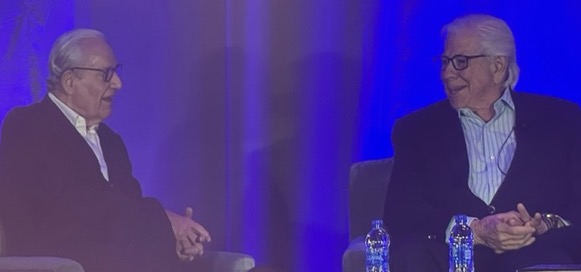
Journalism legends Bob Woodward and Carl Bernstein have a moment of levity Friday at the Media Fest 22 keynote event in Washington, D.C.

At this year’s Media Fest, media legends Bob Woodward and Carl Bernstein provided a new generation of journalists with a glimpse of how they broke one of the biggest stories in news history and brought down the Nixon White House. The Friday keynote address helped commemorate the 50th anniversary of the Watergate break in and the subsequent reporting the Washington Post duo undertook to unravel the “Dirty Tricks” campaign the president and “all his men” engaged in prior to his reelection.

The most fascinating thing about these two men was not the lengths to which they went to find the truth or the volume of stories they wrote on this topic between the break-in and Nixon’s resignation two years later. Instead, it was the way in which they plied their trade in a fashion that any student journalist in that audience could mimic in at any student media outlet in the country.

To that point, here are five basic reporting axioms they followed that can make you successful as a beginning journalist:


GRAB THE OPPORTUNITIES WHEN THEY COME: The legendary story of Watergate began with a simple break-in at the Democratic National Headquarters. Five men were arrested on June 17, 1972 and going to be charged with burglary and wiretapping the next day, a Sunday.

The editors at the Post knew someone needed to cover that story and they chose Bob Woodward, but not for the reason you would think.

“(People in the newsroom asked) ‘Who would be dumb enough to come in today?’ and the editors thought of me,” Woodward said.

At the time, Woodward was 28 years old and had about two years of journalistic experience under his belt. Instead of complaining that he had to come in on a Sunday or that it was the kind of garbage story that would be lucky to yield a byline, Woodward went to court where he noticed something amazing: The men accused of the crime were all dressed in suits.

“I’ve never seen a well-dressed burglar,” Woodward said Friday.

His curiosity got the better of him and he began down a two-year road that would turn him into a household name. It all started with taking the opportunity he received from people who thought lesser of him.

When it comes to opportunities, don’t let them pass you by.


SHOW UP: Woodward and Bernstein repeated this mantra Friday throughout their keynote, which actually felt more like two old friends shooting the bull over a couple beers. As they recalled key moments throughout the evolution of their reporting, they kept noting how they got the stories by going places and meeting people.

Bernstein said the biggest break in the early days was finding a bookkeeper for the slush fund used to pay the Watergate conspirators and finance the dirty tricks. He went to her house and knocked on her door, only to be met by the woman’s sister, who wanted to get rid of him as fast as possible. Still, he persisted:

“I sort of kept my foot in the screen door,” he said. “(The bookkeeper) said ‘Don’t let him in,’ but she eventually let me in. The bookkeeper was intimidated but wanted to talk.”

From there, Bernstein hung with the bookkeeper and kept asking questions until he managed to get a big piece of the puzzle. Had he called her instead of showing up, it would have been much easier to get rid of him, but since he was literally face to face with her, the bookkeeper acquiesced.

That lesson stayed with the pair over time. Woodward said he realized he had “gotten lazy” during his later years as he was tracking down sources for one of his more recent books. After repeated attempts to reach a military official who had successfully evaded his requests, Woodward came to a simple realization:

“We’re not showing up enough,” he said.

Thus, he went to the general’s door at 8:17 p.m. on a Tuesday (“the perfect time” to get a source to talk, he noted) and knocked. The general answered the door and asked Woodward the first question of what would be an in-depth interview:

“Are you still doing this shit?”

Yes, he was, and apparently, it still works.

As much as it seems easier to shoot a text or an email to a source, it often isn’t as effective when you really need to get the bigger story. I know that I have leaned a little too much on the phone or email while I’m blogging, as opposed to going to someone’s place of business or knocking on an office door. However, I also realized that if I REALLY wanted to get something done, I had to physically go somewhere and be in someone’s presence. That still yields the best results, whether I’m trying to find out if someone got fired or if a person actually will be fulfilling my request to approve an HR document.

As uncomfortable as it might feel to go and “bother” someone, it feels much more uncomfortable for that person, which means they’ll usually give you what you want just to get rid of you.


WHEN IT COMES TO SOURCES, GO LOW: During their collaboration, the pair developed a solid working relationship, drawing from each other’s journalistic strengths and experiences. Woodward said the most important thing he learned from Bernstein was what kinds of people made for the best sources:

“Find people at the lower level,” Woodward said. “That’s what Carl taught me. We can’t go to the White House and ask people about this so we have to knock on doors and that’s the Bernstein method.”

In the early days, the sources who let the cat out of the bag were the desk workers, low-level employees and other people who weren’t in the positions of power. They were the people who knew what was going on because they were the ones who had to do the banal work of typing up documents, filing forms and moving information from one important person’s desk to the next.

It warmed my heart to hear this, because I’ve always found that my best contacts were the people who weren’t really high on the food chain. I knew the night-time deputy coroners, the secretary at the police department who kept trying to set me up with her grand-daughter, the janitor at the city-county building and other folks like that. At first, I figured it was because I wasn’t much of a reporter, so those “more important people” didn’t need to bother with me. I later realized what Woodward and Bernstein knew all along: These are the people who know everything and are more willing to tell you about it.

That’s the reason I tell my reporting students, “Never diss a desk jockey. They’re the folks who run the world.”


BE HONEST AND FAIR IN YOUR WORK: When the moderator introduced these two titans of journalism, she listed two resumes that would be the envy of anyone in the room: Multiple books, Pulitzer Prizes, important jobs at major publications and more. However, when they started working the Watergate story 50 years earlier, they were a couple unknown “kids” in the newsroom.

Each story they wrote contained unnamed sources, claiming the president and the people around him had done things no one in that office had ever been accused of doing before. The editors in the newsroom had faith in them, but many of their colleagues weren’t as sure.

“Who are these two kids?” Bernstein said, recalling the popular newsroom sentiment at the time. “This stuff can’t be true. Nixon is too smart. There was skepticism about us in this newsroom.”

As the White House continued to deny the allegations and assail the Post with criticism, the men kept at the story because they knew they were right.

“There comes a moment if you’ve done your reporting right, you understand the dimensions of the story you are working on,” Bernstein said.

However, they realized the most important thing about telling the story was that they had to make sure they weren’t trying to make reality fit what they thought was going to happen. At one point, even amid the nay-sayers around them, they figured out that this whole thing was leading on the path to Nixon likely being impeached. In explaining this to the crowd on Friday, they said it was crucial that they keep their reporting above board and not jump past where they facts had led them.

“People can’t think you have an agenda,” Bernstein said.

In today’s media, that statement might seem as quaint as if he said you needed to make sure your typewriter ribbon was fresh before starting a story, but it really shouldn’t. Journalistic fairness isn’t about finding fake balance, like publishing a story about how the moon isn’t made of green cheese but only after you find a “lunar cheeser” source to provide “the other side” of the argument. It’s about going into a situation well prepared and yet open minded.

The goal both of these guys had for their reporting wasn’t, “Let’s go get Nixon and stick it to The Man!” It was to draw the truth out of the people who knew it and present that information to their audience.  When they stuck to that, they were able to tell the stories more effectively.

When you decide to cover anything at all, try to start with that idea of being open minded about your topic and your source. That should be guided by your research that prepared you for the piece. If you think the whole goal of the parking department on your campus is to fleece college students out of their hard-earned money, OK, fine. However, when you go in to interview those folks, actually keep an open mind and listen to what they have to say. They might change your mind, or they might not, but if you go in there with an agenda, nothing good is going to happen.


STAY HUMBLE: These two guys basically ended a presidency, took home every conceivable accolade in journalism and became journalistic nomenclature for exceptional reporting. Every journalist in that room, and all the overflow rooms, would give any body part they had to be 1/10th of what these guys have become. However, both in their demeanor and their presentation, Woodward and Bernstein never seemed to smack of ego or self-importance.

Woodward said the most important thing he learned throughout the Watergate saga was being humble and remaining the person he was before all of this happened. He said that Katharine Graham, the publisher of the Washington Post, helped him keep himself grounded after the Watergate scandal had ended:

“I got a note from Katharine Graham… It said, ‘Don’t start thinking too highly of yourself. Beware the demon pomposity. That demon wanders the halls of too many institutions,'” he said.

If Bob Woodward and Carl Bernstein can keep their egos in check, it’s safe to say any of the rest of us should be able to manage it as well.


John Oliver takes on crime reporting

Since it’s not always easy to broach a topic like “What if the police are lying to you as a journalist?” and because trying to keep students’ attention at around the six-week mark of class can be quite difficult, here’s a potential conversation starter for your reporting class. Comedian John Oliver took on the way in which crime reporting works on Sunday’s episode of “Last Week Tonight.” It has a lot of interesting jumping-off points as well as some important looks at how reporting shapes our worldview in terms of safety, race and the law, among other topics.

Before you consider showing this in class, a couple brief caveats:

  1. He swears an appreciable amount, something that might be problematic if you work somewhere that requires penance if you use the word “damn” in the classroom.
  2. He will often take a bit a little too far. He’s done far worse before, but there is at least one reference to Miss Piggy’s sex life, so don’t say I didn’t warn you.
  3. The piece picks at broadcast news A LOT, which seems a bit unfair, given that a lot of media outlets follow the same basic pattern of taking police press releases and running with them.
  4. He has a point of view. If you’ve never watched “Last Week Tonight” before, it’s worth mentioning, in that he fact checks the heck out of stuff but like most things with a point of view, he points to things that support his POV. Some people call that cherry-picking, but there appear to be a lot of cherries around this story.

From my own experience in working with the police and covering crime, let me add these thoughts:

  1. The reliance on press releases as a sole source is a bad practice across the board. Oliver points out that a lot of the problems in how narratives are cast comes from press releases from public-information officers. Journalists should essentially know that all press releases come with a point of view, not just those that come from the police. Relying on a press release from Dyson will probably lead to the story, “Study finds U.S. needs more, better vacuum cleaners.”
  2. A lot of the problems here are germane to all of journalism these days, in which the importance of filling the grist mill leads to grab-and-go journalism. A lot of our problems come from not being able to be at the scene or develop trustful relationships with sources or waiting to tell a story until it’s fully fleshed out. This is as true in political coverage, education coverage and other forms of coverage as it is in crime coverage.
  3. In some cases “police said” carries with it a special layer of protection, based on certain interpretations of qualified privilege, in which journalists can rely on official sources acting in an official capacity without fear. That’s why it’s there. Also, he mentions some places are using “police claim” as a substitute for being deferential to police.  Please don’t follow this path. “Said” is supposed to be neutral. The problem is that we lack other people on the other side of the issue to do some “saying” for us. Also, if you stick allegedly in there as another potential fix, please know that every time you use allegedly, God kills a kitten.
  4. He always ends giant segments like this with the “not all (fill in the group) are bad people who act this way” after spending 28 minutes telling you how crappy that group can be. I’ve had my share of crappy PIOs in various departments, but I’ve also worked with some really good police, deputies and other law-enforcement officials over the years. I follow the simple idea of extending them the level of trust I would like them to extend to me. When one of us violates that trust, now it’s game on.

With all of that in mind, here’s John…


THROWBACK THURSDAY: It’s all fun and games until Dominion Voting Systems sues you for a couple billion dollars

Today’s throwback post came to mind when I saw this bit of news regarding Infowars mogul Alex Jones and how he was back in court again this week:

Jones baselessly told his audience in the aftermath of the Sandy Hook Elementary School shooting that the incident was staged. He has since acknowledged the shooting occurred, but only after the lawsuits were filed. He said in a 2019 sworn deposition that a “form of psychosis” caused him to make his false comments.

In the Connecticut case, where Jones is being sued by eight more Sandy Hook families, Judge Barbara Bellis issued a default judgment against the Infowars founder in November 2021 after he failed to comply with court orders.

Because the judge already ruled that Jones is liable, the jury is determining the amount in damages to award the plaintiffs. While the families have not specified a dollar figure, an attorney for the families asked jurors last week to “send a message” to the public with its decision.

I have yet to run into a student yet who told me they want to be Alex Jones when they grow up, but a number of them have told me how they don’t understand why people who are on talk radio (like Jones) or write on the web (like Jones) are allowed to say whatever they want without consequences. After all, the students note, professors like me are crawling all over them about adverbs because they MIGHT lead to a sense of opinion. Why do we in journalism classes get so nutsy about accuracy?

Well, here’s a good look at what can happen when you play fast and loose with reality and reality decides to fight back:


It’s all fun and games until Dominion Voting Systems sues you for a couple billion dollars

During the 2020 presidential election, multiple people made claims that the voting systems had been rigged to favor Democrat candidate Joe Biden. Several of then-President Donald Trump’s allies and associates took to various media platforms to repeat these allegations, arguing that the voting systems had been compromised and that any outcome which did not place Trump back in the White House was a result of fraud.

Dominion Voting Systems, which produces many of the electronic voting machines used in the election, apparently isn’t too thrilled about this, as the folks there have filed several lawsuits regarding these claims. It’s gotten so bad that some media outlets are keeping track of who is being sued, for how much and for what reason, like ESPN tracking the movement of NFL free agents.

The most recent suit is one that is most likely of interest to the folks reading the blog, as Dominion filed a $1.6 billion suit Friday against Fox News, alleging the company knew it was allowing lies about the election to proliferate:

In the lawsuit, Dominion argued that Fox and several of its on-air personalities elevated baseless claims about the voting company rigging the 2020 election and allowed falsehoods by their guests to go unchecked, including a wild claim that the company’s machines were manufactured in “Venezuela to rig elections for the dictator Hugo Chávez” and that Dominion’s algorithm manipulated votes so that then-President Trump would lose.

“Fox engaged in this knowing and reckless propagation of these enormous falsehoods in order to profit off these lies,” reads the lawsuit. “Fox wanted to continue to protect its broadcast ratings, catering to an audience deeply loyal to President Trump.”

The lawsuit argues that there are actual damages to the company’s brand, but also to the workers who are just trying to make a living. The suit notes that Fox’s conduct not only will cost the company more than $600 million in the next eight years, but also that front-line workers have been threatened.

Fox has noted that it will defend itself, having already filed several motions to dismiss and that the company “is proud of our 2020 election coverage, which stands in the highest tradition of American journalism.”

Here are a few things to take away from this and several other lawsuits filed in regard to the voting systems:

A FREE PRESS IS NOT A CONSEQUENCE-FREE PRESS: A lot of folks misinterpret the First Amendment to mean you are protected against all sorts of things when you publish content. The truth is that all the amendment guarantees is that the government shall not prevent you from publishing material. That’s basically it.

It doesn’t mean that other people can’t stop you, like the owner of a website where you post content, the publisher of a newspaper or a producer at a broadcast station. It also doesn’t mean you can get away with whatever you want without paying the price.

When you say something that is false and harmful, you can be in a lot of trouble, which is why professors push so hard on students to make ABSOLUTELY SURE on every fact in a story. It’s also why editors pick and pick and pick at stories with reporters, as to avoid any potential landmines.

If I get up on Fox News and tell the world that I have information supporting the notion that the chancellor of my university is running a cocaine ring out of the student union in exchange for getting away with a murder he committed in 1987, I’m going to be in a HECK of a lot of trouble because it’s not true and it’s going to harm him.

It also leads to the second point…

UNLIKELY, UNREAL AND COMPLETELY UNBELIEVABLE ARE ALL DIFFERENT THINGS: One of the dumber defenses in a Dominion suit is that of former Trump lawyer Sidney Powell. The company is suing her for $1.3 billion, arguing she knowingly spread a baseless claim that Dominion and another voting system company were working with the late Hugo Chavez of Venezuela to rig the election.

Powell has argued in motions to dismiss that her claims were so outlandish that nobody in their right mind would believe them:

It was just conjecture. No reasonable person would conclude those allegations were true statements of fact. Besides, in heated political arguments, people tend to exaggerate. You should dismiss the lawsuit or at least move it to my home state.

That’s essentially the defense offered by Sidney Powell’s lawyers to the $1.3 billion defamation lawsuit brought by Denver-based voting Dominion Voting Systems, Inc. Dominion provides voting equipment to more than 1,300 jurisdictions in 28 states including Colorado.

We’ve talked about this kind of claim earlier this year when porn mogul Larry Flynt died. The “no reasonable person” defense was at the core of his Supreme Court appeal, when the Rev. Jerry Falwell sued Flynt for publishing a spoof advertisement involving him. Flynt won the appeal with a unanimous decision, but before Powell pops open the champagne, I’d consider these issues:

  • Flynt was publishing a porn mag, known for all sorts of really outlandish stuff, including a photo of a woman being stuffed into a meat grinder. Powell was on nightly news outlets and other media platforms purporting to deliver truthful information gathered from inside sources.
  • Flynt’s ad claimed that the highly religious Falwell lost his virginity by having sex with his mother and a goat in an outhouse, which is almost the textbook definition of outlandish. Powell was claiming election fraud, something other countries had experienced and something that people within the government were also stating as fact.
  • Flynt was a strip-club owner who published pictures of naked people in magazines that had been banned in multiple cities. Powell had been a counselor to the president of the United States.

When it comes to the idea of hyperbole and satire, or otherwise outlandish things, you have a pretty high bar to clear if you want to be on safe side of that argument. Had Flynt claimed that Falwell stole money from his congregation, he would have likely been on much shakier ground, given that other high-profile preachers had been accused or convicted of such things. The same thing could be said had he claimed Falwell had slept with prostitutes or committed adultery, given the climate of the time. However, nobody reading the Campari spoof thought, “Wow! Reverend Jerry is a really kinky guy! Guess you learn something new every day…”

Powell’s defense in this case is that nobody could have believed a legal expert who worked with the president in regard to voting irregularities when she said the company responsible for voting reliability failed in its task. I’m really interested to see how that plays out, but more out of morbid curiosity to see if the judge can keep a straight face throughout the trial, not because it’ll set a new precedent.

THE MUDDLING OF OPINION AND FACT IS ALWAYS A CONCERN: When I teach basic media writing to students, one of the hardest things for them to figure out is what is an opinion and what is a fact. It often comes down to me scrawling “SAYS WHO?” on their paper 183 times before they understand what they can say and what they shouldn’t say. Occasionally, we would have the discussion of “You are wearing a black shirt. That is a fact. You are wearing a NICE black shirt. That is my opinion.”

Cable news organizations have long muddied the waters of what is opinion and what is fact, almost to the point where people either don’t know the difference or don’t care as long as it matches up with what they believe. I often wonder if a lot of high-profile people end up buying their own BS to the point that they themselves think, “If I believe it, it must be true.”

Journalism pushes harder on people to verify information, clarify where the information originated and remain rigorous in reporting only what we can prove. At least, that’s the goal we have in mind when it comes to separating opinion from fact.

To help us clarify the distinctions a bit better, the U.S. Court of Appeals offered a four-step examination as part of its ruling in Ollman v. Evans (1984) to help people see if a statement falls into the realm of fact or opinion:

Can the statement be proved true or false? Courts have held that factual statements can be proved true or false. A statement like “The New York Yankees have won 27 World Series championships” can be proved true or false by examining their records in the annals of baseball. The truth or falsity of a statement like “The New York Yankees are the best baseball team ever” cannot be determined, because it lacks several key elements for us to examine. In a defamation case, the plaintiff must prove that the material is false, and this can be the case only if the material of a factual, as opposed to an opinion-based, nature.

What is the common or ordinary meaning of the words? People often use euphemistic language in their daily discourse. If you referred to a sloppy person as a pig, that person might be upset, but they can’t win a libel suit by demonstrating that they are not “an omnivorous domesticated hoofed mammal with sparse bristly hair and a flat snout for rooting in the soil, kept for its meat.” The common meaning that the person has poor personal hygiene or fails to keep their home neat and clean is clearly the way in which most people would interpret that remark.

What is the journalistic context of the remark? Who is saying something and the way in which they are saying it matter greatly in determining if something is a fact or not. For example, if you’re telling a joke involving two men walking into a bar, people are clearly expecting something different than if you are testifying in front of Congress. Content published on the news pages of a legacy media outlet is contextually different from a series of blog posts on a goofball-based website that would make the staff at the National Enquirer roll their eyes. The statements made on air during a newscast are contextually different from those made on a “morning zoo” radio show.

What is the social context of the remark? Where we tend to see opinions and where we tend to see facts often help define which are which. For example, a lecture on the biology related to procreation is expected to be based in facts, while two groups of protesters confronting each other outside an abortion clinic will be a more heated and opinionated exchange.


The basics of crime reporting and writing (Part I)

I got an “ask” from a journalism instructor to hit on a particular topic:

I was reaching out to see what guidance you could give me on teaching my students on how to cover crime stories.

As is the rule here, ask and ye shall receive. If anyone else has anything else you want me to cover, all you have to do is head to the Contact page and shoot me an email.

We’re going to do this in a two-parter because a) reporting crime and writing crime each involves a separate set of skills and b) I spent my entire journalism career covering crime, so I kind of geek out on it. I want to keep the posts tight (ish) so 10,000 or so words on crime is likely to crush your soul (or at least ruin breakfast and possibly lunch for you).

Truth be told, I always felt bad for my students because of my background. If they had a beat reporter in education, they’d learn about school board meetings, budgets and how to write features about first-grade kids making hand-print turkeys. If they had a business reporter, they’d learn about stocks, do profiles on industrialists and learn how to analyze budgets.

Instead, they get analogies that start with, “So there was this time that this drug dealer got shot to death on his porch…”

In any case, crime is important, even if we don’t always cover ourselves in glory while reporting on it. Let’s dig into the reporting elements of crime coverage and see where we go:


Covering crimes and disasters is an acquired taste, and doing it doesn’t come with a whole lot of guidelines. I’ve tried for years to “simulate” things for my students with police reports, mock press conferences, press releases and more, but it doesn’t really work. Until you’re on the scene of a shooting or you watch someone get pulled out of a farm thresher, you have no idea how you’re going to react.

Here are the two basic bits of advice that will help you the most in reporting on these things:

Stay Calm: Things can be blowing up all around you or you might never have seen that much blood before in your life. You may be fighting the urge to throw up. Whatever it is, you need to keep your head about you.

Focus on the task at hand by thinking about it like you’re picking up groceries off a list or like it’s any other event you’ve covered in your life. Don’t let the chaos throw you off. A panicking reporter is a useless reporter. You need to take a deep breath and get the job done to the best of your ability.

Stay Safe: Police, fire and rescue folks are trying to do their job. You are trying to do your job. Sometimes, those needs conflict with each other. Regardless of how important you feel you are, you need to realize that their needs trump your needs at the scene of a crime or disaster. In many cases, they put up special tape to keep you out of harm’s way. In other cases, they tell you where to stand or where not to stand.

Even when the authorities aren’t there to tell you what to do, you need to make sure you use common sense. Don’t stand in the middle of a hailstorm to do your stand up. Don’t drive into a flood zone and then expect people to bail you out. Whatever it is, you need to make sure you’re safe and sound. A dead reporter isn’t much more useful than a panicking one.

AT THE SCENE OF THE CRIME

At the scene of a disaster or a crime, what you get is always going to be a function of the incident itself and how much time you have to get it. If you are working for a traditional media platform, you may be pressed by a deadline for air or a print deadline.

If you’re using social media or a “web-first” model, you need to work through what you think, what you know and what you can prove before you start firing tweets into the atmosphere. In a lot of other stories, you can be a little off when it comes to your facts without being in a lot of trouble. Crime coverage isn’t one of those things. Say only what you know to be true and nothing more.

A great example of how this was done well came during the Waukesha Christmas Parade in 2021, when an SUV tore through the event, leaving six dead and another 60 injured. Milwaukee Journal-Sentinel business intern Kaylee Staral happened to be at the event, but jumped into reporter mode when the chaos began. Her tweets are a perfect example of what to do when all you know is what you can see:

She was able to tell people what she saw and heard, didn’t add in speculation and then passed her audience off to other people who were covering this more deeply. That might seem simple, but simple isn’t always easy when you’re dealing with a chaotic situation.

At the most basic level, here are the things you need to get at the scene of a crime or disaster:

Most important:

  1. Any death or severity of injury
  2. The identities of the people involved in the crime or disaster
  3. What happened? (Preferably this will come from the police. If not rely on corroborated witness statements. Don’t let the witnesses go rogue on you, though. More on this tomorrow.)
  4. Damage estimates (Again, from people in the know, if this is a fire, crash, flood or other similar incident.)

Secondary information:

  1. Witness accounts
  2. Biographic information on those involved (age, hometown etc.)
  3. Description of the scene based on your observations

WHERE YOU GET THIS STUFF:

Both in dealing with on-scene and after-the-scene reporting, you want to make sure that you are covering all your bases by reaching out to all potential sources. This is the duty to report, meaning you want to gather as much as you can from as many angles as you can. However, just because you GET certain bits of information, it doesn’t follow you HAVE TO publish that information. We’ll cover that tomorrow when we talk about editorial discretion.

In any case, here are some good sources for information in crime and disaster stories:

Officials (police/fire): Always start with any officials acting in an official capacity. Although journalism has become far more broad-based and opportunistic thanks to social media and citizen journalism, the law has not. Officials sources can often operate under absolute privilege, which transfers to you as “qualified privilege.” If you’ve taken law, you know that this means you can quote officials acting in that capacity without fear. (This doesn’t always apply to police or fire officials, depending on the laws of your state/city. Check this out to make sure on it.)

Even if they aren’t operating under privilege, these people have seen it all before and are more well equipped to tell you what happened in a clear and coherent manner. Witnesses are always happy to talk, but they are probably jacked up on adrenaline and are more likely to make mistakes or offer hyperbolic statements. What they say may make for more awesome quotes, but their words aren’t gospel and can hang you out to dry.

It’s also worth keeping in mind that these people can be wrong or they can obfuscate the truth in some cases. Just because it came from an official source, don’t treat it like it came via a burning bush from God. Gather info, verify it and THEN publish it. (More on that tomorrow.)

Assisting agencies (Red Cross/volunteers): Any time there’s a major disaster (fire, flood, famine) there are other agencies that assist the police, fire and National Guard. These people are great at adding information such as how wide spread the disaster was, how many people have been displaced or what the next steps will be for the victims. The degree to which they are “privileged” has been the cause of various discussions, so be careful and know the law where you work. Still, in most cases, they’re a good secondary source of information.

Witnesses: These people are a wild card because they were on the scene before the police or fire folks arrived, so they saw everything. They are also probably freaked out a bit or really excited that you want to talk to them. To that end, be exceptionally careful with them and make sure you aren’t allowing them to assign blame or cast aspersions. There’s a world of difference between a witness saying, “The car just sped around the corner and hit the house” and “It was clear that idiot was drunk or just didn’t care about anyone when he sped into the house.” The second quote is peppier, but it’s also potentially libelous.

Victims: This is something that can be a bit dicey and will vary a lot based on the type of disaster, the people involved and the amount of time between the disaster and the interview. In some cases, you don’t want anything to do with the victims because there are bigger issues involved. Don’t get in the way of the police who are trying to ascertain what happened or emergency personnel who are trying to administer medical care. Talking to victims, whether direct victims of crime or tangential ones (such as family members) isn’t easy.

I’ve had to approach the families of kids who have been killed, people who have been stabbed and folks who just lost everything the owned in a fire. It’s never fun and in many cases, you’re going to take the brunt of their anger. The key is to make sure you approach with caution and respect, present yourself to them in a professional manner and abide by their wishes if they tell you to leave. Don’t take it personally if they go off on you. They’re hurt and they probably just don’t know how to react, so they react like any other wounded creature: They lash out.


If there’s nothing else I can leave you with here, it’s that you need to remember you are human. In a lot of cases, we are emboldened by our job or powered by our adrenaline and we get way too dumb for our own good. If you find yourself getting pushy toward a victim or asking the stupid “How do you feel about that?” question, you’ve started to lose your humanity and that’s not a good thing. You need to make sure you are being decent to people while you do your job.

Of all the good things you might do, people who get you at your worst will only remember that about you.


TOMORROW: Writing crime and disasters while avoiding creating a second crime (libel) or disaster (corrections).

Helpful tips for student media outlets that want to cover the Supreme Court Roe v. Wade situation

A draft of a Supreme Court majority opinion regarding the case of Dobbs v. Jackson Women’s Health Organization leaked late Monday night on the Politico website. The 98-page document, written by Justice Samuel Alito, would reverse the nearly 50-year-old precedent of Roe v. Wade and eliminate the constitutionally protected right to abortions in the United States, if it remains unchanged when the court formally renders its opinion.

I have a hard time imagining that many student media outlets wouldn’t have a vested interest in covering this situation as it unfolds. With that in mind, this post does not aim to direct the opinion of those students, nor to take a stand on the issue itself. The point of this post is to provide student journalists with some help in navigating some truly risky waters when choosing what, when and how to present information to their readers on this topic.

First, let’s start off with a few key things you need to be aware of before you even start thinking about publishing something here:

  1. You will not change most readers’ minds about anything on this topic. Most of what people think and believe about this issue will have been codified in their minds, hearts and souls long before you showed up. A good friend, who was perhaps prescient, posted this explanation from The Oatmeal of why it’s hard to change minds or get people to listen on certain issues the other day and it bears a look. Trying to move the needle on this issue among readers is going to be as successful as bailing out a sinking boat with a pasta strainer.
  2. There aren’t two sides to this. There are many facets. Certain topics tend to bring out the extremes when it comes to public opinion. Yes, there are probably people out there who believe that life begins when a man unhooks a woman’s bra. Conversely, there are probably people out there who believe there should be free abortion punch cards available at Starbucks. Those people do not represent the majority of people who have an interest in this issue. If you want to dig into this issue, you need to look beyond the loudest voices screaming threadbare talking points. It’ll take work.
  3. This is not law yet. This is a leaked first draft of a document that the public wasn’t supposed to see, at least not based on tradition and protocol. The information, including how many justices voted to make this a majority opinion, who they are, how tied to this they are, how much they support the language and more, is not codified through official channels or publicly declared by the court itself. A lot can happen in multiple aspects of this case, including what the final opinion looks like, if Congress will make moves to solidify abortion rights and other things nobody has thought about yet. When covering this issue, it’s crucial to keep that in mind when making declarative statements, asking questions of sources and writing content (particularly headlines where space limits can lead to fact errors).
  4. You are running out of semester. TV shows can be great when they use the “cliffhanger” approach at the end of a season. News doesn’t benefit from that kind of situation, so be aware of how much time you have left to cover this topic, how many issues you have yet to publish and how those things should factor into your approach here. A half-baked “get-er-done” story that runs in your last issue can likely lead to more harm than good when you lack the ability to correct any errors, follow up on any developments or otherwise continue telling the story. You might have one shot at this, so make sure it does what it needs to do.

With those things in mind, here are some tips and hints on how to approach this topic:

KNOW YOUR AUDIENCE: If it sounds like I harp on this every time I write something, it’s only because that’s exactly what I’m doing. This isn’t the time or the issue where you should assume everyone is “exactly like me” or guess about how much of your readership feels a certain way about the topic. Even within the newsroom itself, people probably hold differing views on if this is the best thing or the worst thing ever to happen in this country. It’s also likely that many of those views will come as a surprise to folks once they are vocalized.

One key thing to do is to really assess who reads your paper and what matters most to them. In a case like this, it’s a little too late to do a readers survey, but you can look for some breadcrumbs that might be out there for the finding. Some private, religious schools might clearly lean more pro-life, but look around for pockets of dissent. Some liberal, public schools might lean more pro-choice, but look around for pockets of dissent.

Look for groups on campus that have voiced their opinions on topics before and see how large, engaged, involved and representative they are of the larger whole. Look for previous coverage in your publication of this issue to see who is out there and what they had to say. Talk to people in the newsroom and the classroom about this with the idea of finding out not just what they think, but also what their roommates, friends, teammates and peers think.

Get a handle on what kind of room you will be playing to when you publish your work.

RESEARCH LIKE HELL: You are looking at the possible reversal of a court decision that likely is older than some of your professors. In the nearly five decades since the court handed down its ruling in this case, a lot of stuff has happened. Your going to want to be the smartest person in the room on this topic before you start interviewing people and writing stories.

Learn as much as you can about the original case, the ruling and what changed because of it. Look at the other challenges to it over the years, including the Planned Parenthood v. Casey case of 1992, to see what has transpired over the past 50 years or so. Look into the history of abortions within the United States to figure out what happened during times when the procedure was legal and illegal. You’ll likely need to spend some serious time digging into this, but the last thing you want to do interview someone without having a full view of the facts. This is one topic in which the stakes are too high to risk getting snowed by a source with a bias.

Here are some tips and hints for potential stories:

LOCAL IMPACT: The court ruling, if it becomes final in its current form, would essentially kick the decision of whether abortions should be legal back to the states. States have had widely varying laws regarding this procedure, as you can see from the series of maps from the Washington Post. Figuring out what will happen to your readers will matter a great deal in how you approach this topic. Some states have laws that go into effect the minute the Court reverses Roe. Others have laws that remain on the books from decades ago that simply stop getting overridden by the Feds. Others are looking for laws that will remove or improve access to abortions once all of this gets sorted out.

Everyone else will be talking at the federal/macro level on this. You should explain it at the local/micro level. This could entail everything from what your student health center is allowed to provide to if any private businesses in the area provide this service and will no longer be allowed to do so.

Your job is not to tell people the sky is falling or the world is finally going to be right. Your job is to factually outline what it is that has happened, will happen and could happen if this draft becomes final.

UNPACKING “UNPRECEDENTED” AGAIN: If COVID taught me anything, it was to hate the word “unprecedented.” However, this situation has rolled out more cases in which that word will likely apply. Start looking at them:

  • Talk to local legal scholars about the leak. Folks are initially saying this “has never happened in modern history.” That’s a dodge within a couch of an argument, given “modern history” could be anywhere from post-Civil War era to since last Tuesday. Find out from people who study this stuff how rare this actually is, what the value/problem with such a leak can be and the likely impact the leak will have on the final draft.
  • Talk to local experts in history and law regarding an overturn of this nature. How often does the court fail to apply precedent in a situation like this? What issues have seen this kind of shift before? What results usually occur in a situation when the Court zigs like this, both in terms of the decision at hand as well as other cases that could follow?
  • Talk to local political experts to see what kinds of steps the executive and/or legislative branches might take in response to this judicial decision. There is already a rumbling about getting rid of the filibuster and trying to crank through something in the House and Senate that would counterbalance the court decision. Pro-choice advocates have noted President Joe Biden’s relative silence on the issue, as well as his history voting on the topic. Will he look to define his presidency with a move on this topic? I don’t know, but I’d surely ask someone smarter than me about it.

HISTORY TRIP: Generations of people have existed in a world in which this topic was hotly debated, but also clearly codified into law. Generations of people also lived through a time before Roe v. Wade, so it would be valuable to find out what things were like back then.

Most of what I have heard falls into oft-repeated phrases like “back-alley procedures,” “under-cover-of-night travel,” “unscrupulous and dangerous” and more. What that actually means in terms of true history is beyond me in many cases, so finding people who can better provide context, truth and history will be helpful. (The 19th did a piece on this topic not too long ago that followed women’s memories through their experiences in the pre-Roe era, if you are interested.) Professors at your school who study history, women’s studies and other scholastic areas that traverse this topic could be helpful, as could sources who were involved in either side of the struggle back then.

It would also be interesting to look at both current and historical data regarding the number of overall procedures that occurred in your coverage area, if that is available. The thing most people forget in talking about overturning Roe v. Wade is that it won’t eliminate abortions. It will just make them illegal and harder to come by. The numbers might tell a story both “back when” and “right now.”

PERSONAL STORIES: This is one of those that really has a strong risk/reward element to it. It is highly probable that you have students at your school who, in some way, connect strongly to this topic. How they connect, what they are willing to share and to what degree the reporter can work with these sources will determine the overall value of something like this. If you are unsure as to how to proceed with this, I strongly recommend you talk to your adviser, smart professors who have experience in the field and other journalism folk who can help guide you.

FINAL NOTE: The one last important thing to keep in mind on something like this is that the duty to report is not the same as the duty to publish. You might do an inordinate amount of work, only to find a weak or wobbly story that might not do the job you had hoped it would. There is no rule in journalism that dictates you publish it and take your chances. In many cases, caution is the better part of valor. This is probably one of those cases if you feel the story isn’t where it needs to be.

That said, don’t let fear of public reaction dissuade you from running a quality story. This is one of those topics where you will inevitably upset someone, so disabuse yourself of the notion that a well-reported, well-researched, factually based story will garner universal applause. If it’s good, run it.