Another lesson in how the First Amendment does and doesn’t work: The story of Oberlin College and a bakery accused of racism

(or a few other things, as Oberlin College discovered…)

As we have noted here numerous times, the First Amendment provides U.S. citizens with the right to free speech, not consequence-free speech. A recent appeals court decision in Ohio made that clear when it upheld a multi-million-dollar verdict against Oberlin College:

A private college in northern Ohio has lost its appeal after a lengthy court battle with the owners of a local bakery who accused the administration of perpetuating false allegations of racism against their business.

Now the college could be on the hook for $31 million.

A three-judge panel in Ohio’s 9th District Court of Appeals rejected Oberlin College’s arguments in a 50-page opinion published on Thursday, March 31. In doing so, the appeals court upheld a lower court decision that awarded Gibson’s Bakery $25 million in damages and $6 million in legal fees, the Associated Press reported.

This decision dates back to a 2016 incident in which a bakery employee accused three Black students from Oberlin of attempting to shoplift and use a fake ID. The students later pleaded guilty to various charges related to the incident, but before that, members of the college community protested what they felt to be racist and unfair treatment of the students.

During the protest, the school’s dean of students handed out a flyer that stated, in part: “This is a RACIST establishment with a LONG ACCOUNT of RACIAL PROFILING and DISCRIMINATION.” In addition, the student government at Oberlin passed a resolution stating:

A Black student was chased and assaulted at Gibson’s after being accused of stealing. Several other students, attempting to prevent the assaulted student from receiving further injury, were arrested and held by the Oberlin Police Department. In the midst of all this, Gibson’s employees were never detained and were given preferential treatment by police officers.
Gibson’s has a history of racial profiling and discriminatory treatment of students and residents alike.

Oberlin argued that the protest and statements made at it were part of a free-speech exercise and thus protected by the First Amendment. The courts ruled that the students could protest all they wanted, but that’s not the point of the suit. This is where it might be helpful to break down what the First Amendment does and doesn’t do:

It does:

  • Prevent government interference that limits speech. In other words, had the protest been shut down by the cops or the city council, or prohibited from occurring in the first place, the First Amendment rights of the students would have been violated.
  • Allow people to express opinions without fear of governmental retaliation. Simply put, if I want to tell people I dislike the president, or that the food at a restaurant doesn’t thrill me, I have that right.

It does NOT:

  • Protect all forms of speech, including false, defamatory content. The courts have to decide, as they did in this case, to what degree something is stated as a fact or an opinion. “This weather sucks,” is a statement opinion. “The weather forecaster on Channel 3 is a pedophile,” is meant as a statement of fact, and carries with it potentially defamatory content, if untrue.
  • Protect people from consequences from their free-speech activities. If you engage in free speech, you can say whatever you want, but you are held to account for that speech. This is where defamation suits come into play. It’s also why I’m a raving psychotic about fact-checking and attributions in stories.

Oberlin argued the protest, flyer and resolution were opinions, thus protected by the First Amendment. What the court in this case found was that the flyer and the student government resolution were presented in a way that a reasonable person could construe them as being factual. That includes the allegations that an employee assaulted a kid, that the situation was racially motivated and that the bakery had a history of racial profiling/racism. If the school wants to win the case, it has to demonstrate fact-based proof that this stuff has happened.

Although the court didn’t cite the Ollman Test in this case, it still serves as a benchmark for how to determine if something is fact or opinion. Two of the four standards are pretty important here:

Can the statement be proven true or false?

In order for a libel suit to be successful, the plaintiff must demonstrate the material in question is false. If the material is pure opinion, it cannot be proven true or false and thus cannot be libelous. In this case, claims of assault, racism and a history of racial profiling all could be proven or disproved at some level. Oberlin didn’t make any real effort to try to make the case the content was true, the courts found.

What is the common meaning of the words?

Assault, racism and racial profiling all have definitions that could be determined and applied. We do have degrees of assault, but what do people think of when they hear someone was “assaulted?” Probably physical violence that leaves injuries. What about “racism?” That is clearly more wide-ranging and based on a variety of factors, but in holding to the “reasonable person” standard, the court has to make a call. Is failing to say “hello” to an unknown person of another race a reasonable standard? Probably not. Is burning a cross at the home of a person of color going to fit the bill? Heck yeah and then some. Thus, somewhere in the middle of that range is where reasonability is going to come to play and that’s where the court gets to say if the accusations fit the meaning.

In short, the school put itself in jeopardy by failing to fact-check a situation and not considering the ramifications of failing to do so.  The school says it might appeal, but I’d probably put my money on this case being upheld.

That’s just my opinion, based on the facts.


MISSING: Verbs and articles. If found, please return to area journalists…

At just the right time in the semester, a classic plea for improved writing showed up in one of my feeds. Journalism and educational expert Deborah Potter does a great job of explaining what is happening to broadcast copy and why we desperately need verbs in it.

Anyone watching television news these days could be forgiven for thinking they’ve accidentally tuned into a strange new game show called “Hide the Verb.” No matter how hard you try, it seems, you just can’t find one.

Remember verbs? They’re the action words that come between subjects and objects, telling what happened and when. Try locating one in this NBC Nightly News script: “Less resilient, local business. Dwight’s concession stand, in the family three generations. Sales this summer off 75 percent.” Not a verb in sight.

What is going on in TV newsrooms? It seems unlikely we’re victims of some vast anti-verb conspiracy that has recruited news writers from coast to coast. Instead, this new news-speak could actually be the result of a misguided attempt to improve broadcast writing by making it more active and immediate. The goal is laudable. The results are laughable.

It’s a great read that points to a real problem we’re seeing in writing. I’ve noticed a similar problem with my text-based students and their aversion to including articles in their sentences. To wit:

“Sturgeon man was injured during a fire at his home Friday.”

“Mayor says the bill will not be approved, despite city council’s efforts.”

I tended to blame a lot of this on texting, given that as more and more of my students spent more and more of their lives typing with their thumbs, I saw this sudden drop off of “A” and “The” and “An” in the sentences they wrote. However, in reading through Potter’s piece, it might just be more “headline-ese” creeping into common writing in an attempt to make things feel snappier.

In any case, I reached out to the educational hivemind I trust for a reality check on this to see if I was the only person noticing this. Clearly, I was not:

You are not alone. The dropping of articles is one of the banes of my existence. I consistently have to get after students in all of my classes, including the copy editing classes, where they ought to know better. I would add the 280-character limit of tweets as a culprit as well as texting.

Yes!! I am seeing it and correct it daily.
yup, I call it “Tweet Speak.”
Omg, I thought it was only me. I’ve come to the conclusion it is because they only read headlines, not leads. When did they stop teaching articles (a/an/the) are necessary to make a complete sentence?
Same here! I had a student tell me recently that proper grammar was a thing of the past, that the younger generation just doesn’t care about rules of writing.

Back when Twitter moved from 140 characters to 280, I argued against it, using my “Fat Pants Theory” of writing. After that ran, I heard back from folks who said, “Look, this will improve writing because we won’t have to shorten sentences or write in headline-speak to get the point across. Well, clearly that’s not the case here, as we find that no matter how much space Twitter gives some folks, they’re going to cut the corners on things that make content readable.

So here are a few hints and tips for ways to reach your students (and I mean the kind of reach that doesn’t involve an Oscar slap) as you explain why complete sentences matter:

AUDIENCE-CENTRICITY IS YOUR GOAL: That last comment in that hivemind list made my brain twitch for a couple reasons, not the least of which is this: You’re not writing for yourself.  You’re writing for your audience, many of whom might not be old enough to remember writing in cursive on coal slates, but are at least old enough to still operate in complete sentences. Those people will be expecting you to write in a functional fashion so that you can communicate to them effectively.

Also, grammar is not a fad. You can’t BS your way out of bad writing with comments like, “Ugh… Commas are so 1993….” When you make the decision that you’re going to change the rules of language because you don’t think they matter, what you’re saying is that you know better than everyone else out there and they should come around to your way of thinking. Not exactly audience-centric.

LET’S SAY IT ALOUD: One of the tricks I’ve used to get students to break the “verb-noun” habit they developed at some point in attribution writing is to have them say verb-noun sentences aloud. So, I’ll ask them, “What did you do today?” They answer with basic statements about eating breakfast, going for a run, coming to class and so forth. Then I say those things out loud to them in verb-noun format and have them repeat them:

  • Ate I my breakfast.
  • Six miles ran I.
  • Came to class I did.

Then we do the, “Does that sound like anything you would say? If not, stop doing ‘said Smith.’ If it is, you now must dress like Yoda for class, as you pretty much sound just like him…”

Have the students read these sentences aloud without the articles or verbs in them and see how they sound. When they start sound like “caveman speak,” to quote one of the other hivemind folks, they’ll start to realize how dumb this sounds. Like most things having to do with grammar, I could spend six hours explaining it in some long, complex way and they won’t get it. If I just have the students read something aloud, when their tongue feels like its falling down a flight of stairs, they realize there’s a problem.

KNOW THE RULES BEFORE YOU BREAK THEM: Some of the best writers I have ever read break a ton of grammar and style rules. The reason that they are great is that they know EXACTLY when to break EXACTLY which rule for EXACTLY what purpose. They know the rules like the back of their hand and thus can adhere to them effortlessly, until there’s a reason to zig when the rules zag.

Ignorance of a rule is not an excuse to break it, or at least that’s what the cop that pulled my wife over told us… In any case, knowing the rules is all about understanding why we do what we do and what it does for us as writers. You earn that right, as we’ve explained here before, by being awesome at the basics to the point where you know how and when to excuse yourself from their confines.

I have told my students not only what rules I expect them to follow rigorously, but also WHY those rules matter. I also explain that once they are no longer on “Filak Island,” they can do whatever the hell they want. Until then, the rules apply. In short, show me you know how to amaze me with the rules and then we’ll talk. Otherwise, knock it off.

DEMONSTRATE DISTINCTIONS: As noted earlier, the “WHY” aspect of teaching is usually the one that sticks the best. Telling students, “It’s a rule, so follow it,” has the same feel as when their parents answer a question with, “Because I’m your mother, that’s why!”

So, look at a couple examples where distinctions matter like this:

Sheriff’s deputy resigned amid allegations of extortion.

So we’re missing the article on this one. Why does it matter? Well if it’s “A” sheriff’s deputy, this might be a bad situation, but it wouldn’t necessarily undermine the department’s ability to function. If it’s “THE” sheriff’s deputy, you have cut the county’s law enforcement in half. Also, if you had half of the department extorting people, this could be terrifying for everyone in the county, as they had almost nowhere to turn for help.

For a verb example, let’s borrow a fragment from Potter’s piece:

Sales this summer off 75 percent.

Think about how a verb can change the context of this:

Sales this summer “ARE” off 75 percent or Sales this summer “WERE” off 75 percent. In the first version, there’s hope that sales could rebound, while the second example says we’re done and we have no hope.

  • “Sales this summer REMAIN off 75 percent.” (Things were bad and continue to be so.)
  • “Sales this summer FELL off by 75 percent.” (Things suddenly took a turn for the worse.)
  • “Sales this summer EXPECTED TO FALL off by 75 percent. (Prediction for bad stuff.)

And on and on we can go. The point is, our job is to inform people to the best of our ability. Skipping words to sound cooler (or younger, apparently) might seem like a good idea, but if it costs us the ability to connect with the readers, we’ve failed.

THROWBACK THURSDAY: “Forget the mistake. Remember the lesson.” A few thoughts on how to deal with corrections.

I had to give one of my best reporting students a failing grade on her midterm, and it killed me to do it.

It was a phenomenal job of reporting and writing, as she conquered “The Midterm from Hell” better than anyone has in a long time. She could have survived a few minor mistakes I found, but then she had a fact error, a misspelled proper noun. That did enough damage to sink her.

I went to talk to her about it and she had no complaints. “That’s on me,” she said. “I just copied and pasted the quote from the email and never thought to look up how to spell the names.”

“Next time, I’ll know better.”

I have to admit, that was a more enlightened view of things than I would have taken at age 19, but it is what I’ve been trying to teach students for the past several decades: The grades don’t matter, but what you learn based on what leads to those grades does.

In honor of that, here’s a throwback Thursday post on learning to forget the mistake but to remember the lesson you learned from it.

“Forget the mistake. Remember the lesson.” A few thoughts on how to deal with corrections.

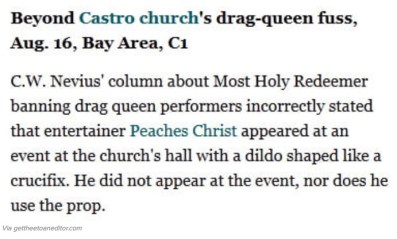
Of all the things you will write over the course of your career, nothing feels worse than writing a correction. Essentially, corrections tell the world, “Hey, remember that thing I told you yesterday that I was so proud I managed to find out and share with everyone? Yeah, I screwed up…” Corrections run the gamut from the amusing ones, like this correction on a drag queen’s presence at an event as well as her act:

PeachesChrist

…to the geeky ones like this look at a quote from “The Simpsons:”

Simpsons

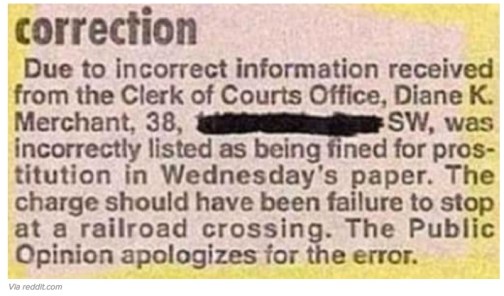
…to the downright embarrassing:

Hooker
(It might just be what the kids are calling it these days… “Hey, you gonna go home or should we um… y’know… fail to stop at a railroad crossing…”)

Perhaps there is nothing worse than having to correct a correction, which happened at one of the papers where I worked. We misspelled the name of the Carrerra soccer club, first by using only one “R” in one of the double-R pairings and then we screwed up the correction by using only one “R” in the other one. When we asked the managing editor if we should run another correction, he told us, “No, you’ve done quite enough damage already.”

Corrections can be painful but they’re worth doing. My worst one involved a guy we thought was dead but turned out not to be, even though he was still teetering on death’s door. The question became: “OK, so we said this guy died yesterday, but he didn’t. What happens if he dies now? How do we write that correction?” Eeesh. The guy lived past press time, so we were at least saved the pain of trying to work through that one, but it still stung.

One of my other problems with corrections (and I’ve been told I’m not alone on this), is the issue of “correction contagion” in my work. I had a handful of corrections at each stop I made as a journalist, but they tended to “bunch up” on me. Thus, after I made my first error and fixed it, I’d be so myopic about not making THAT mistake again, I would make four other stupid mistakes. Fortunately, I had great editors who saved me most of the time, but when they couldn’t hold back my wave of stupidity properly, I ended up with another correction or two in short order.

So, how do you deal with the corrections as a writer? To figure out how to write a solid correction, give the book a read. As for how to mentally deal with this blow to your ego and skill set, that’s a bit tougher.

I found a good piece of advice on one of those chatty billboards outside of an area business or church or something as I was driving around recently:

“Forget the mistake. Remember the lesson.”

In other words, don’t obsess about the stupid thing you did, but rather how you came to make that stupid mistake in the first place. Was it a case of thinking you knew something so you failed to check on it? Was it something where you forgot to check back on an evolving situation? Was it time where you didn’t have a lot of time to recheck a fact? Was it that you didn’t stop and think before completing your work? Whatever the underlying factors were for that error, consider those to be the lessons to take with you so you can avoid making that mistake again.

Then, let the mistake go or just let it serve as a reminder of the lesson.

A quick follow-up post on the UW-Oshkosh student media situation

The Advance-Titan staffers at UW-Oshkosh met with some folks in the administration Thursday to discuss the issue of reaching sources and the role of UMC. From all accounts, a lot of things got done and some more things need to get done.

The group agreed that some sort of plan, policy, procedure or other form of mutual understanding of how the A-T, UMC and the folks at UWO work together needs to be hashed out. I didn’t attend the meeting, but in pulling from some notes, conversations and emails, it looks like the students and the A-T board members were respectfully heard.

Chancellor Andrew Leavitt made it clear that he favors the free expression of ideas and that no one is punished for talking to the press, which was both good to hear and completely unsurprising to me. As I’ve said before, I really do like this guy and I really do think he has students and student media’s best interests in mind. I’m sure it’s not an easy job to balance all the audiences he deals with on a daily basis, but as far as I’ve been concerned, he’s always made me feel like he listens to student needs and he is honest about his positions on everything.

After I posted the email addresses of Leavitt, Peggy Breister and Cory Sparks earlier in the week, asking folks to express themselves, I know a lot of you all did just that. I also know that Leavitt personally responded to all of the emails he got, as multiple people told me they received a note back from him, thanking them for his interest in all this and reaffirming his commitment to student journalism at UWO.

The academics who shared those notes with me told me how impressed they were that he was willing to do this, with at least one of them saying, “My university president wouldn’t do that!”

Even more, I shot a quick email to the UMC to offer Breister or Leavitt an opportunity to give me their take on the meeting and I got this back:

Dear Vince,
Peggy Breister and Alex Hummel shared your request for comment.
I understand the staff of the Advance-Titan may be producing an account of our good meeting and valuable conversation yesterday. I would like to respect the space and opportunity the student journalists have to develop and publish their story. I won’t be commenting at this time.
Thank you,
Andy
I would like to respect that space as well. Rome wasn’t built in a day and nothing was going to get fully fixed in a meeting involving a dozen people at a table. It’s my understanding the students have schedule a follow-up meeting with the administration to codify some of the issues brought to bear this week and develop a plan (or whatever we’re calling it) that can bring peace with honor.
My hope going forward, and I don’t think I’m being a Pollyanna here, is that these folks build a really good set of guidelines and standards that will establish collaborative opportunities and clear boundaries in regard to who does what and in what way. I really want that to be something that when some other institution invariably hits the same kind of snag we’ve seen here, we can share the UWO policy and say, “Here. This is a thing UWO built that really works well. Feel free to adapt it to your needs.”
Thanks so much for all you all do for student journalists. I’ll post again on this once there’s something new to say.

Here is proof that UW-Oshkosh’s marketing department restricted the access student journalists had to interview subjects, and some ways you can help end this gatekeeping mess

I tried my best to give my university, the University of Wisconsin Oshkosh, and its head of University Marketing and Communications, Peggy Breister, every possible benefit of the doubt when it came to FIRE’s allegations that UMC was suppressing student journalism. The exact charges in FIRE’s article included the requirement that student journalists MUST contact UMC for ALL interviews with university personnel.

Breister said no such policy existed.

Breister lied to me. And here’s the proof.

She told students at the Advance-Titan, the university’s independent student newspaper, they MUST  request interviews through UMC:

She short-stopped interview requests student journalists made to UWO personnel without talking to her first and demanded that all requests for interviews be routed through UMC.

In this instance, she also required that the questions be submitted in advance, something else she said never happened:


She leaned on the staff to make changes to published copy.  In addition, as recently as this fall, she reiterated that the A-T MUST go through UMC for any interviews, stating it is a “required procedure” for reporters who wanted to interview UWO personnel:

These are just the emails I was provided through former A-T staffers who had graduated. I imagine there are more with similar messaging that I could find with a full open-records request.

In light of these revelations, today’s post is going to look at what has happened, what needs to happen next and how you can help fix this situation:

THE PAST

I reached out to a couple former staffers at the Advance-Titan for their recollections of working through UMC over the past two or three years, which is when I’m told this non-policy policy started to take shape.

Jack Tierney was the editor in chief for the A-T in the 2018-19 school year and said he had generally positive interactions with UMC during the earlier part of his tenure, noting “I always thought that working with Peggy was easy.” During the later part of his time at the A-T, he said UMC officials established a policy in which interview requests needed to go through them.

“That became a problem toward the end of my time with the paper,” Tierney said in an email interview. “Instead of having streamlined communication between officials and the paper, the messaging would be filtered through UMC. This would add time, hours or sometimes days between requesting for comment and getting an interview done, which is a problem when working on deadlines.”

By the fall semester of 2019, several A-T staff members noted they sensed a change in how UMC was interacting with the paper.

“There definitely was a shift in UMC’s approach to dealing with the A-T in Fall 2019, and it escalated early in Fall 2020,” former managing editor Joe Schulz said in an email. “My first year on staff, I don’t remember talking about how UMC would feel about a story or feeling that UMC had much of an impact on our work. By Fall 2019 and Spring 2020, it became clear that UMC really didn’t want us printing anything negative about the university.”

Carter Uslabar, the editor-in-chief from Jan. 2020 to May 2021, said UMC had clearly established criteria that required A-T staffers to use UMC as a portal to university sources.

“There definitely was a policy that we were supposed to go through UMC to get interviews,” he said in an email. “Peggy repeatedly demanded that we go through UMC to set them up. In one email from Peggy on Sept. 15, 2020, she said she told Joe Schulz that ‘A-T staff must work through UMC regarding any requests for interviews with staff.’ She also said we should contact her if we ‘don’t understand this,’ which I thought was kind of comically rude, like a Newspeak way of calling someone an idiot.”

Schulz said he remembered “swearing like a sailor in the newsroom” when the staff received Breister’s email that mandated all interview requests for UWO personnel go through UMC.

“It’s understandable to have a marketing person sit in on an interview with the chancellor, but making all interviews with staff go through UMC is ridiculous,” he said. “Direct communication with sources is key to building good relationships with sources and establishing a sense of mutual trust. Being able to directly communicate with staff enabled me to build relationships with professors that I otherwise wouldn’t have built. Having a rapport with sources is crucial to reporting.”

The ability to build rapport was also important to Uslabar, who said he thought going through UMC made the whole process of reaching sources feel “very impersonal.”

“The general feeling was that it was bogus, and that if we had to do that, it would make it exceedingly and unnecessarily difficult for us to do anything meaningful,” he said. “I think people mostly ignored it at first. I was particularly frustrated because this really hurt our ability to build rapport with sources in the university. A lot of these relationships were built by students dropping by during office hours or sending cold emails to staff, and now that was going to be mediated.”

Former managing editor Amber Brockman said the transition to this new policy also included frequent chastising from Breister.

“Before all this,  we could just reach out straight to our sources and email them,” Brockman said in a phone interview. “We had no problem and we’d get an email back. Easy as pie. Then this thing started happening where Peggy started emailing us back instead and saying we had to work through her. In one case, the professor I emailed must have emailed (Breister), and Peggy scolded me for not going through her.”

Other former staffers, who asked not to be named, also noted emails getting intercepted or sources getting cold feet in talking to the paper after UMC rebuked them for talking to the A-T. One former reporter said she was working on a story in 2020 about custodial staff and what precautions existed for them as they sanitized the campus during the pandemic when UMC stepped in.

“I had four interviews with custodial staff already set up when they all turned around and told me they weren’t allowed to give interviews,” the former staffer wrote in an email. “Breister then emailed me saying reaching out to those staff was against policy and I was only allowed to talk to their supervisor. I had to vet my questions with Breister to get a response and I only ended up getting a brief statement from the supervisor saying UWO was doing its best to keep its custodial staff safe. This completely impeded my ability to be a quality journalist and essentially shut down the story. It was stuff like this that continually kept A-T staff out of key COVID-19 responses the university was taking.”

Uslabar also said not only was the policy that all interviews must go through UMC problematic for getting the news covered, but the department’s overreaching approach to what the A-T covered made him leery.

“It was disappointing that we were being told to go through UMC for interviews,” he said. “It made things slower for students and staff, and made it more difficult to work on a deadline. Additionally, it was concerning because the paper has always had trouble receiving adequate funding, and I was worried that if we ran coverage critical of the university or its administrators, our paper would receive even less funding in the future.”

Although all of the sources interviewed here said that neither Breister nor UMC issued any direct threats to funding, Schulz said the paper felt the department was looming large in staff discussions in an uncomfortable way.

“We received several somewhat demeaning emails regarding our coverage, and UMC became a regular topic of discussion at our meetings,” he said. “It was always a fear that UMC would cross a line that would make it impossible to do our jobs. It didn’t reach that point during my time at the A-T, but we did have those fears.”

Tierney said UMC’s actions did lead to at least one story being censored. After Breister reached out to him to complain of what she called a series of inaccuracies, he and journalism Chairwoman Sara Hansen scoured a story, looking to see how what Tierney wrote was different from what Breister was telling them.

(In a separate discussion, Hansen confirmed working with Tierney as he explained. She also said she found the paper had quoted Breister accurately, but Breister continued to argue that the paper had incorrectly stated the facts.)

“After working together for nearly an hour to get the story to a place where Dr. Hansen and I felt was accurate, the A-T re-published the story,” Tierney said. “UMC reached out to the A-T after re-publishing and said they found more errors than what was originally published. The story was about a funding change to the college of letters and science with opposition to the change from the faculty union. After continued messaging from Breister about the noted inaccuracies of the story, we decided to pull the story entirely. I followed the story for the remainder of the year without publishing anything about it.”


THE PRESENT

The student journalists at the Advance-Titan continue to operate under a system in which all interviews of UWO personnel must go through UMC. Uslabar said he felt UMC was more concerned with the university’s image than treating student journalists with dignity and respect.

“The way UMC interacted with student journalists was shameful,” he said. “The pedantic, all-bold email I received from Peggy was the most unprofessional communication I have ever seen, and it was clear that the university and UMC were more concerned with controlling its appearance than providing real learning opportunities for students.”

Tierney said he understands that the goal of UMC is to present a positive image of the university, but the press still has rights.

“I think this situation shows a university using its leverage to maintain its image,” he said. “I have respect for the university and the people who lead the university, but I think it is clear the university is hyper-concerned about the message that gets put out into the public and does not like to have any negative communications surrounding its image. I think this issue reflects larger on the university than it does on Peggy or UMC.”

The fact the policy has gotten to this point has upset former staffers, who didn’t like the intrusive nature of the process and the way in which this has all kind of flown under the radar to this point.

“I think student reporters at the A-T should be able to talk directly to their sources without being filtered through UMC,” Brockman said. “I can see where UMC is needed for busy people like the chancellor and other people who need more schedule-conflict help, but they shouldn’t be the middleman with all the communication.”

In the wake of the FIRE article, Chancellor Andrew Leavitt and Editor-In-Chief Cory Sparks connected to discuss the situation. Leavitt, Sparks, Breister, adviser Barb Benish and several other folks plan to meet on Thursday on this topic.

“I’m glad this is getting some attention and hopefully something will be able to happen,” Brockman said.

As an alumnus, Schulz said he plans to keep an eye on the situation, hopeful that this issue gets resolved in a way that protects the autonomy of the paper.

“I sincerely hope the policy is changed to give student journalists and UWO employees the freedom to speak to each other without marketing interference,” he said. “I can’t imagine having all interviews go through UMC. In covering any community, whether a campus community, a big city or a small town, more often than not most news stories will be a positive reflection of that community. However, local reporters — at any level — should not fear that negative stories will hamper their ability to do their jobs moving forward.”


HOW YOU CAN HELP

The whole group meets on Thursday, where I’m sure some of these issues will likely be discussed. This situation isn’t as bleak as it might seem and there is something you can do to help:

This is Chancellor Andrew Leavitt. He’s the head of UWO and a really all-around decent guy.

He prizes student press freedom and he was exceptionally helpful to me when I was advising the paper. At that time, a group of little… um… student government people tried to get me fired. It would have been much simpler for him if he just did it, but he told me, “That’s not how we do business here.”

He told me on multiple occasions he appreciates the importance of the paper to the campus and I believe that he honestly believes that.

His email is: leavitt@uwosh.edu

Please feel free to email him and explain to him why the approach UMC is taking here is problematic to you. Also, feel free to explain what you think the “best practices” should be for the relationship between UMC and student and/or all media.


This is Peggy Breister. She is the head of UMC at UWO and the person who wrote the emails I screen-shotted above.

Her email is: breistep@uwosh.edu

Please feel free to email her your thoughts about her approach to UMC, student media and other similar topics. Also, if you are displeased by her actions regarding the Advance-Titan, please feel free to respectfully explain how you think things should be handled in the future.


This is Cory Sparks. He is the current editor of the Advance-Titan and, in the interest of full disclosure, one of my students.

I’ve done my best to keep him out of the danger zone on any stupid thing I write on the blog and not ask him to comment on any of this, lest there be questions about entangling alliances.

That said, he and the A-T crew have been dealing with a lot of garbage these days because of this situation, so please feel free to email the kids at: atitan@uwosh.edu

Please let them know you’re supportive of their rights and that you are behind them. I can speak from experience in this one case: When you’re in student media, you are isolated in a lot of ways, since there is usually only one paper or one TV station or one radio station on a campus. You can feel alone or that no one cares about what you’re dealing with.

Please disabuse them of that notion with a note of support.

The Second Kind of Dumb: Investigating allegations that my university, UW-Oshkosh, is “muzzling” student journalists

“There’s two kinds of dumb. The guy who gets naked and runs out into the snow and barks at the moon, and the guy who does the same thing in my living room. The first one don’t matter. The second one you’re kinda forced to deal with.”

– Hoosiers


For as long as I’ve been here at UW-Oshkosh, I’ve told basically anyone who would listen that we’ve got a great place for young journalists to learn the trade. That’s why it really upset me when a former student sent me this article from FIRE about how the campus was “muzzling the campus watchdog” with a rather heavy-handed policy:

 Journalists at universities are essential to keeping the public informed on campus activities, whether through reporting on mundane affairs or acts of impropriety.

Administrators at the University of Wisconsin Oshkosh have impeded this function, imposing an onerous process on reporters, including student reporters, who want to interview university employees.

Journalists at The Advance-Titan, an independent student newspaper at UWO, maintain they must go through particular steps in order to secure an interview with university employees. While university officials have refused to outline the details of this process in writing, these hurdles have been in place for at least two years and impose a constant barrier to the work of the paper’s journalists, whose reporting focuses on UWO and its personnel.

FIRE stands for the Foundation for Individual Rights in Education and its mission is “to protect fundamental rights on campus concentrates on four areas: freedom of speech and expression; religious liberty and freedom of association; freedom of conscience; and due process and legal equality on campus.”

I’ve worked with them on a couple occasions in various areas of student press and found the organization to be really interested in making sure people’s rights don’t get stepped on just because they work or learn on college campuses. The folks there aren’t above being a tad hyperbolic, but I haven’t known them to be flat-out wrong on something. I’d heard rumblings similar to those FIRE described from former and current students about “having to go through UMC to get an interview” with pretty much anyone on campus.

I’ve raised a stink about stupid policies, administrative overreach, borderline threats to student journalists and all sorts of other things on this blog, regardless of where they were happening, so to have something like this basically show up in my living room really ticked me off.

Still, journalism is the field in which if your mother says she loves you, you go check it out. So, I read the article, dug into some research, talked to a couple students and then reached out to the head of the University Marketing and Communications department, Peggy Breister.

Breister has worked in UMC for about five years at UWO, currently serving as the department’s executive director. She also has news chops, having spent 25 years of reporting and editing experience in our state and having earned a bachelor’s degree in journalism from the University of Minnesota. I asked for an interview, but added that I knew she was busy, so I included a number of questions about the FIRE story, the university policies and the situation at hand in case she wanted to type up some stuff.

She responded via email and here’s a chunk of her response:

We ask media to contact us when they would like to do a story about the University. We are here to help reporters connect with the individuals who can best respond to their questions. We have not changed our practices. Since the A-T is the media, we feel we should work with them in the same way that we work with other media.

We don’t require the A-T to provide us with written questions, but that is often the way we receive their initial requests, often due to deadline, or it is what is requested of us by the individual they are seeking to connect with. Reporters are welcome to request interviews, send questions via email, etc. We do not pre-approve questions or responses. We do try to clarify vague requests to help us identify the topic and appropriate source.

We try to make connections so requests can be responded to quickly. I think we have been very responsive. The A-T also does many stories that we are not involved with.

Several things concerned me with this response:

THE NON-ANSWER: I know I don’t always ask the best questions, but I think I was pretty clear with this one:

What is the explicit policy regarding student journalists and access to university employees? Is it true that all their requests must go through your office?

I spent at least five minutes playing a game of “Where’s Waldo?” with Breister’s response, trying to find a simple yes/no answer to that second part and some clarity for the first one. In regard to the first part, Breister responded by pointing me to this part of the university website, which isn’t so much of a  policy as it is set of vague tips on how faculty can talk to media folks about stuff.

In regard to the second part of the question, I got about four half-answers to completely different questions: We prefer if media folks contact us. The A-T gets the same treatment from us as we give to other media outlets.  We never ask for questions from them in advance. We’re working really hard here.

All of those things might be true and yet none of them really addresses the important issue, which requires a simple yes or no answer. Or, as I explained it to a equally peeved colleague: “It would be like if you asked if I thought you were a good classroom teacher and I responded with, “Well, there’s no doubt you’re here at a University, and nobody ever questioned your research skills and I know you think teaching is really important.”

Eeesh.

THE NON-DENIAL: The FIRE article really lays it on thick when it comes to allegations of First Amendment denial, information hoarding and generally weaselly behavior. As someone who prizes objectivity and fairness in journalism, it was a bit disturbing to me to see no mention of trying to get UWO to comment or trying to check this out with the university. I appreciate the heat FIRE likes to bring, but let’s play fair. So, I gave Breister a shot:

What is the rationale behind limiting access in the fashion the FIRE article describes? Or if you feel the article is inaccurate, please feel free to explain the inaccuracies here…

Nowhere in her email did she address the FIRE article, either to agree with it or to refute it. The closest she came was this:

I’m sure you have seen this piece, but I include it in case you have not: https://advancetitan.com/opinion/2022/02/23/student-journalism-must-not-be-censored

I guess if a national organization dragged me to the middle of the internet and started smacking me around, I would like to think I’d stand up for myself. Or, if they were right, I’d issue some sort of explanation as to how sorry I was about it or that I’d do better or whatever it is we make people say these days so they don’t get  put in Twitter Jail.

Maybe that’s just me, but not hearing a full-throated defense of my own institution made me a bit queasy.

THE RAMIFICATIONS: In reading through that email, I saw the lack of a clear policy, and that created problems for me on two fronts.

First, as a student-press advocate and journalism educator, I was concerned how this was going to impact my students. I don’t advise the paper anymore, but I send plenty of kids into the field for class assignments that get published there or elsewhere. I train them to go to sources for interviews and get answers from people who have them. Any restrictions that prevent these journalists from getting to those sources is worrisome.

Second, as an employee of the university, I know I’m governed by a lot of policies and rules. I also know that I’ve been interviewed for more than a few stories over the years, both through UMC hookups and from folks independently reaching out to me. If there’s a rule as to how I’m supposed to deal with something, I’d like to know what it is before I accidentally violate it.

Also, I’d like to know what the penalty is for breaking that rule. Contrary to popular belief, me having tenure doesn’t mean I can show up dressed like and acting like Rahad Jackson. Even more, there are plenty of people out there without tenure who would be operating under this policy, so that’s a concern.

So, I pushed back with two pointed questions that sought yes/no answers about the university’s policy regarding interview-seeking behaviors and the veracity of the claims of FIRE. I also provided this simple explanation for my concerns:

I guess what concerns me most is that student journalists (even those in my classes who aren’t operating student media outlets) are being told they HAVE TO go through UMC for anything on campus.
If that’s not true, let’s disabuse them of that notion and make it clear that UMC’s job is to help facilitate interviews when journalists need that help. I’ve worked with UMC many times at multiple universities over the years where some TV station wanted a professor who knows X and the UMC played matchmaker. That’s totally acceptable and makes sense.
If, however, it is a situation where the students ARE being told that public employees at a public institution are being actively withheld from them unless they go through UMC, lest some form of punishment (whatever it is… lack of access… a stern talking to…) befall them, that’s different.
If you can more clearly answer those concerns, it’ll make things a lot easier and simpler for me when I’m teaching the students and working with student journalists in various capacities.
Breister was clear in her response:
Hopefully this information will help you in your contacts with students:
UMC has guidelines related to media relations that we ask people to follow.
There is no policy, nor is there a penalty for not working through us.
OK, fair enough. I have worked in journalism, student media, education and parenting long enough to know that a lot of wires can get crossed over time and what I say isn’t exactly always what someone else hears. Let’s give each other the benefit of the doubt, right? Bygones be bygones and all that…
So, I forwarded this to the one student who had been helpful to me as I tried to iron out what was “suggestion” and what was “required,” hoping this would close the book on the situation. If nothing else, it’s a good note to have on file for any future staffers.
Then, someone forwarded me this email between Breister and a former editor of the paper that just pissed me off:
Well, shit, sheriff, I guess this changes things a tad…


TOMORROW: What has happened, what needs to happen and what should be done about this situation.

Why almost everyone in today’s social media era should be happy Sarah Palin lost her libel case

Former Alaska Governor and former Vice Presidential candidate Sarah Palin lost her libel lawsuit against the New York Times last week, as she failed to prove the news outlet was purposefully inaccurate and/or out to get her:

… after two weeks of testimony and nearly three days of deliberation, a jury decided Tuesday that the Times did not libel her in a faulty 2017 editorial — echoing a decision by the judge, who a day earlier said that he would dismiss her case regardless of its decision.

The jury’s decision conformed with that of U.S. District Court Judge Jed S. Rakoff, who said on Monday — while the jury was still deliberating and unaware of his comments — that the former Alaska governor had not demonstrated that the Times acted with “actual malice,” the high legal standard that public figures must demonstrate to claim libel.

The editorial in question inaccurately tied Palin’s political action committee to a mass shooting in 2011, an error the Times corrected within eight hours of publication. Palin brought suit against the paper anyway, even though she would have to prove the paper acted with reckless disregard for the truth, a barrier neither the judge nor the jury believed the paper breached.

In picking through the coverage of the outcome, what struck me was the voluminous nature of comments and posts from readers who were outraged that the Times “got away with” an attack on Palin. Consider a few comments from just one article that I could repost without violating the “unnecessary cursing” edict I operate under:

“What is the purpose of a Free Press if they can abuse their libel and slander protections to the benefit of their preferred politicians?”

“She will take to the SCOTUS if she loses here. We know Roberts will vote with the wrong side again, but Palin should win 5-4 – and hopefully start the flow of lawsuits against the legacy MSM.”

“I’m amazed that there hasn’t been more outrage that Clinton-appointed judge, who already had one of his Stalinist rulings against Palin thrown out last year by the appeals court, was allowed to pull another Stalin last night. This is not the US anymore.”

“So they can print totally false information that smears the name of a politician who is running for public office, admit they lied and still get off scot-free. Just saying “Oops” the next day seems to be the magic word. Never mind that it has already planted the seed. Never mind that this gives them free rein to smear anyone they want with impunity as long as they say “Oops” the next day. How comforting.”

In these and other responses across the digital universe, a common theme of “hang ’em high” seems to have emerged among a particularly angry sect of folks. The argument is that the best answer to published mistakes is to smack the media publishers as hard as possible so they get the message.

Well, keyboard warriors, here’s the problem with that: You are publishers. You are the media.

And if this case, or any of its progeny, gets any closer to opening up those libel laws, as one politician famously requested, it isn’t the New York Times that will be in the most trouble.

It’ll be you.

In teaching students the basics of writing, I’m a beast about accuracy, punishing fact errors with the stiffest of penalties all throughout the semester. I’m a pain in the rear end about making sure opinions are properly attributed and that the students are sure to be sure about any information they include in a piece. They grumble and grump about my overreactions to these seemingly minor concerns, wondering why being a journalism professor seemingly equates to being a reactionary jerk.

When we get to the end of the term, I outline the concepts of libel, defamation, slander and so forth. They see how these things have led to lawsuits, the loss of careers and other painful things, and they admit, this is all terrible. Still, they seem to be oddly detached from these stories, especially since they’re not working for a major newspaper or TV station.

I then ask, “How many of you are on social media?”

Everyone of them raises a hand.

“Great,” I explain. “You are all publishers. Anything you have written that meets the standards we outlined here could get you sued for defamation.”

It hits them kind of like this:


The responses I have heard over the years are priceless:

“But I wrote that just for my friends. It was supposed to be just a private thing…”

You put it on the WORLD WIDE WEB. What part of “world wide” don’t you get?

“I’m not a professional journalist, so that shouldn’t count!”

We don’t license journalists in this country. Everyone enjoys the same rights and everyone gets the same kick in the pants when they libel somebody.

“It was just on Twitter!”

You can libel someone on a gum wrapper if you put your mind to it, so your digital dissemination that has the potential to go viral isn’t immune to libel laws.

“I didn’t really think about it before I posted it.”

That’s a great answer. “Your Honor, I’m just a sloppy dimwit. Sorry about that.”

When the excuses are exhausted and the reality sets in, the students start to get why I am the way I am about facts and accuracy and keeping stupid stuff out of the public eye. They also start taking those apps on their phones a little more seriously.

Which brings us back to why basically everyone is so much better off that Palin lost this case.

The Times, the Washington Post, CNN, ABC and every other major media outlet out there have operated in a world for quite some time in which libel was a real threat. These outlets have trained professionals who know what can and can’t get them in trouble. The publications also have lawyers and experts who can vet content prior to publication, just in case someone is a little too close to producing defamatory content. In short, these folks know the game and they play it carefully.

In comparison, here are just a handful of cases that have made it to court involving “regular citizens” who published content online:

Now let’s imagine a world in which Palin won, in which the bar to prove libel was much lower. Who is likely going to end up in deeper trouble? The major media outlets with trained reporters and experienced legal teams or randomly enraged citizens with no legal training, no verbal filter and who are the reason silica packets have to bear the phrase “DO NOT EAT” on them?

So, as great as it would seem to some folks if the Times “got what was coming to them,” I’d argue we all probably better off that it remains just a little bit harder to libel someone.

Throwback Thursday: Obituary Writing: Telling truths, not tales, in a reverent recounting of a life

A student in my reporting class mentioned last week that he feared writing obituaries. “Those must have been the toughest stories you ever wrote,” he noted.

In some cases, they really were, as I was reaching people at the worst times of their lives and asking some of the most difficult questions I ever had to ask. In other cases, they were the best stories I ever got, because I was able to learn a lot about people who I wished I had gotten to know when they were alive.

At the end of the last semester, a student who was struggling with all sorts of things told me that her grandfather was dying so she’d be missing a class or two. During our semester break, she emailed me an update:

“My grandpa died on Tuesday morning, but one of his last wishes was for me to write his obituary! Thank you for showing me how to do it!”

With that in mind, here’s a throwback Thursday piece that goes through the best and the worst of obituary writing.


Obituary Writing: Telling truths, not tales, in a reverent recounting of a life

In a discussion among student media advisers, one person noted that obituaries are probably the second-hardest things journalists have to do frequently. (The hardest? Interviewing family members about dead kids.) When a person dies, media outlets often serve as both town criers and official record keepers. They tell us who this person was, what made him or her important and what kind of life this person led. This is a difficult proposition, especially given that people have many facets and the public face of an individual isn’t always how those who knew the person best see him or her. Couple these concerns with the shock and grief the person’s loved ones and friends have experienced in the wake of the death and this has all the makings of a rough journalistic experience.

The New York Times experienced this earlier in the week when it published an obituary on Thomas Monson, the president of the Mormon Church. The Times produced a news obituary that focused on multiple facets of Monson and his affect on the church. This included references to his work to expand the reach and the population of its missionary forces as well as his unwillingness to ordain women and acknowledge same-sex marriages. The obituary drew criticism from many inside the church, leading the obituary editor to defend the choices the paper made in how it covered Monson. (For a sense of comparison, here is the official obituary/notification of death that the church itself wrote for Monson.)

You will likely find yourself writing an obituary at some point in time if you go into a news-related field.  Some of my favorite stories have been obituaries, including one I did on a professor who was stricken by polio shortly after he was married in the 1950s. I interviewed his wife, who was so generous with her recollections that I was really upset when we had to cut the hell out of the piece to make it fit the space we had for it. Still, she loved it and sent me a card thanking me for my time.

Some of my most painful stories have also been obituaries. The one that comes to mind is one I wrote about a 4-year-old boy who died of complications from AIDS. His mother, his father and one of his siblings also had AIDS at a time in which the illness brought you an almost immediate death sentence and status as a societal pariah. I spoke to the mother on the phone multiple times that night, including once around my deadline when she called me sobbing. Word about the 4-year-old’s death had become public knowledge and thus she was told that her older son, who did not have AIDS, would not be allowed to return to his daycare school. Other things, including some really bad choices by my editor, made for a truly horrific overall situation in which the woman called me up after the piece I co-wrote ran and told me what a miserable human being I was. She told me the boy’s father was so distraught by what we published that he would not leave the house to mourn his own son and that she held me responsible for that. Like I said, these things can be painful.

No matter the situation, there are some things you need to keep in mind when you are writing obituaries:

  • Don’t dodge the tough stuff: Your job as a journalist is to provide an objective, fair and balanced recounting of a person’s life. The Times’ editor makes a good point in noting that the paper’s job is to recount the person’s life, not to pay tribute or to serve as a eulogist. This means that you have to tell the story, however pleasant or unpleasant that might be. One of my favorite moments of honesty came from hockey legend Gordie Howe who was recalling the tight-fisted, cheap-as-heck former owner of the Detroit Red Wings:

    “I was a pallbearer for Jack,” says Howe. “We were all in the limousine, on the way to the cemetery, and everyone was saying something nice, toasting him. Then finally one of the pallbearers said, `I played for him, and he was a miserable sonofabitch. Now he’s … a dead, miserable sonofabitch.’”

    It’s not your fault if the person got arrested for something or treated people poorly. If these things are in the public record and they are a large part of how someone was known, you can’t just dodge them because you feel weird. Check out the Times’ obituary on Richard Nixon and you’ll notice that Watergate makes the headline and the lead. As much as that was likely unpleasant for the people who were closest to Nixon, it was a central point of his life and needed to be discussed. In short, don’t smooth off the rough edges because you are worried about how other people might feel. Tell the truth and let the chips fall where they may.


  • Avoid euphemisms: This goes back to the first point about being a journalist. You don’t want to soften the language or use euphemisms. People don’t “pass on” or “expire.” NFL quarterbacks pass and magazine subscriptions expire. People die. Also, unless you can prove it, don’t tell your readers that the person is “among the angels” or “resting in the arms of Jesus.” (Both of these euphemisms ended up in obituaries I edited at one point or another. They obviously didn’t make it to publication.) Say what you know for sure: The person died.


  • Double down on accuracy efforts: People who are reading obituaries about loved ones and friends are already on edge, so the last thing you want to do is tick them off by screwing up an obituary. I don’t know if this was just a matter of newspaper lore or if it was a real thing, but I was told more than once at a paper where I worked that there were only two things that would get us to “stop the presses:” 1) we printed the wrong lottery numbers and 2) we screwed up an obituary.
    True or not, the point was clear to me: Don’t screw up an obituary.
    Go back through your piece before you put it out for public consumption and check proper nouns for spelling and accuracy. Do the math yourself when it comes to the age (date of birth subtracted from date of death) and review each fact you possess to make sure you are sure about each one. If you need to make an extra call or something to verify information, do it. It’s better to be slightly annoying than wrong.


  • Accuracy cuts both ways: As much as you need to be accurate for the sake of the family, you also need to be accurate for the sake of the public record. This means verifying key information in the obituary before publishing it. The person who died might told family and friends about winning a medal during World War II or graduating at the top of her class at Harvard Law School. These could be accurate pieces of information or they could be tall tales meant to impress people. Before you publish things that could be factually inaccurate, you need to be sure you feel confident in your sourcing.
    Common sense dictates that you shouldn’t be shaking the family down for evidence on certain things (“OK, you say she liked to knit. Now, how do we KNOW she REALLY liked knitting? Do you have some sort of support for that?”) but you should try to verify fact-based elements with as many people as possible or check the information against publicly available information. Don’t get snowed by legends and myths. Publish only what you know for sure.


  • Don’t take things personally: Calling family, friends and colleagues of someone who just died can be really awkward and difficult for you as a reporter. Interviews with these people can be hard on them as well as hard on you. I found that when I did obituaries, I got one of three responses from people that I contacted:
    1. The source told me, “I’m sorry, but I really just can’t talk about this right now.” At that point, I apologized for intruding upon the person’s grief and left that person alone.
    2. The source is a fount of information and wanted to tell me EVERYTHING about the dead person. I found that for some of them, it was cathartic to share and eulogize and commemorate. It was like I was a new person in their circle of grief and they wanted to make sure I knew exactly why the person who died was someone worth knowing.
    3. The source was like a wounded animal and I made the mistake of sticking my hand where it didn’t belong. I have been called a vulture, a scumbag and other words I’ve been asked to avoid posting on this blog. One person even told me, “Your mother didn’t raise you right” because I had the audacity to make this phone call. I apologized profusely and once I hung up, I needed a couple minutes to shake it off. I knew it wasn’t my fault but it wasn’t easy either.

Your goal in an obituary is always to be respectful and decent while still retaining your journalistic sensibilities. It’s a fine line to walk, but if you do an obituary well, you will tell an interesting story about someone who had an impact on the world in some way. I like to think a story about this person who died should be good enough to make people wish they’d known that person while he or she was alive.

Throwback Thursday: Ruth Shalit Barrett might not know facts or ethics, but she knows chutzpah

After being called out for fabricating multiple parts of a story in The Atlantic, Ruth Shalit Barrett did the only logical thing she could think of: She sued the publication for defamation:

The Atlantic, in a nearly 1,000-word editor’s note, said that its fact-checking department had gone through the piece and spoken with more than 40 sources, but that Ms. Barrett had misled the fact checkers and lied to the editors.

“It is impossible for us to vouch for the accuracy of this article,” the note said.

In the lawsuit, Ms. Barrett also accused The Atlantic of misrepresenting her background and destroying her journalistic career through what it publicly said about her.

Ms. Barrett was a rising star in political journalism in the 1990s, when she was in her 20s and wrote under her maiden name Ruth Shalit. She was accused of plagiarism in 1994 and 1995 over several passages and sentences in some of her work that resembled the work of other journalists. She left her job at The New Republic in 1999, and has had few articles published in the last 20 years.

The Atlantic said in the editor’s note that it had originally used the byline “Ruth S. Barrett” at Ms. Barrett’s request “but in the interest of transparency, we should have included the name that she used as her byline in the 1990s.” The note said that Ms. Barrett had been assigned the story because “more than two decades separated her from her journalistic malpractice at The New Republic” but that editors regretted the decision.

No words. My words have failed me.


For Throwback Thursday, here’s a look at the original piece we did on the blog when the story about her story broke back in 2020:

Four common threads associated with journalism malfeasance: A look at Ruth Shalit Barrett’s fraudulent story for The Atlantic

There’s a pretty good reason why people constantly scream that the media is full of “fake news” get traction on their arguments:

Two weeks after publishing a long, juicy and instantly viral story about the world of competitive niche sports, and the wealthy parents who push their children to play them, the Atlantic on late Friday appended a nearly 800-word editor’s note informing readers that it was “deceived” by the story’s author, Ruth Shalit Barrett.

By Sunday evening, the magazine had gone further, announcing that it had retracted the story altogether. “We cannot attest to the trustworthiness and credibility of the author,” an expanded editor’s note said, “and therefore we cannot attest to the veracity of the article.”

This wasn’t the author’s first scrape with journalistic malpractice. In the 1990s, she worked at The New Republic where she was fired for plagiarism and taking liberties with her copy. As she noted for this story, written shortly after her dismissal, she was there alongside fellow journalism pariah Stephen Glass, who fabricated multiple stories and faked large portions of others:

“Steve Glass was boring, a boring fabulist, the Milli Vanilli of journalism. There were all these sorts of pieces written about how he was this brilliant, misunderstood genius who was hemmed in by the literature of fact. I think that’s wrong, that the appeal of his pieces was that they were supposedly full of all this great reporting. If you go back and read these pieces knowing that it was all made up, they don’t seem fun anymore,” she says.

“When people started writing pieces about Steve Glass, it all sort of got thinned out….It was ‘Steve Glass, fabulist’ and ‘Ruth Shalit, plagiarist.’ The rest of who I was and what I had done got dumped. And that was a drag, because if you stand back, there are good pieces with solid reporting, and that are true, by the way. To equate that body of work to the work of another writer whose entire oeuvre turned out to be this tissue of lies, that seems to be a large leap,” she says.

Leaping forward to her current situation, The Atlantic went to cringe-inducingly painful lengths to lay out the sins of the author and the magazine’s role in letting it see the light of day. In an editor’s note that retracted the piece, The Atlantic noted the following problems with the story:

  • The main character was given the name of “Sloane,” Barrett said, to protect the anonymity of this stay-at-home mother with three daughters and a son. It turned out to be the source’s middle name, which made it easy for people to identify her. In addition, the woman didn’t actually have a son.
  • In the deeper dig, “Sloane” explained that Barrett suggested the invention of the fictional son, and then told her to lie about his existence when contacted by The Atlantic’s fact checkers. At first, Barrett denied knowing about this before fessing up later.
  • The wounds that “Sloane’s” daughter sustained during a fencing competition were false or extremely exaggerated. In one case, Barrett described a piercing throat wound that struck the jugular vein and nearly hit the carotid artery as “a Fourth of July massacre.” The wound didn’t even draw blood, as noted by witnesses who posted on social media. A second wound was described as a deep thigh gash, which it was not, the correction notes.
  • A family involved in lacrosse was identified as living in the wrong city in Connecticut.
  • A statement that some families had built Olympic-sized ice rinks in their backyards had to be corrected to merely state that private ice rinks were constructed. (Olympic rinks measure 200 feet by 100 feet, which approaches nearly a half acre of space.)

As these falsehoods and errors began to crop up, the folks at The Atlantic acted like trauma surgeons in a disaster: They kept tying off bleeders and trying to keep the patient alive. The editor’s note lists two dates in which the magazine added corrective information to the story, before making the decision to finally pull it. (A PDF of the article is still available on the magazine’s website.)

Simply put, they didn’t know how deep the rot really was, but they knew the author had purposefully lied to them:

Our fact-checking department thoroughly checked this piece, speaking with more than 40 sources and independently corroborating information. But we now know that the author misled our fact-checkers, lied to our editors, and is accused of inducing at least one source to lie to our fact-checking department. We believe that these actions fatally undermined the effectiveness of the fact-checking process. It is impossible for us to vouch for the accuracy of this article. This is what necessitates a full retraction. We apologize to our readers.

We have talked at length about a number of these situations, such as journalist Mike Ward’s use of fabricated “real people” across multiple stories,

Historically, there is always the “Jimmy” story that Janet Cooke wrote, in which she told the tale of an 8-year-old heroin addict who turned out to be a fabrication. There is Jayson Blair, who fabricated sources, lied about information he supposedly got from sources and plagiarized the work of other journalists. The New York Times ran a correction of around 7,000 words, in an attempt to fix all of the problems Blair caused and restore some of the paper’s credibility.

Heck, Barrett’s former colleague at The New Republic, Stephen Glass, fabricated content to the point he was portrayed by Darth Vader in a movie.

If you’re looking for a lesson here, the “no duh” one would be not to do this kind of stupid crap, as it is likely to lead to your demise as a journalist while cratering the credibility of every media outlet you ever touched.

If you’re looking for a more oblique lesson, it’s that journalists (and journalism educators, for that matter) are trained to be skeptical pit bulls. We dig into stuff and if we find out you lied, we will burn you so badly you will wish you had died as a child. The Barrett piece started to lose air once outside publications, like Erik Wemple’s blog, began picking at it.

Beyond those two things, consider a few basic observations I’ve come up with about the Barrett situation and some of the previous cheating scandals:

It’s rarely a one-time thing: In the movie version of “Shattered Glass,” New Republic editor Chuck Lane is faced with one piece of copy that he knows is false. The whole story of Ian Restil, a teenage computer hacker, is on the radar of Forbes Digital Tool and reporter Adam Pennenberg. Pennenberg has poked enough holes into this thing to make Lane suspicious and his interactions with Glass confirm it.

The scene that sticks out to me is when Lane finally suspends Glass and is walking past the wall of past issues of TNR. He pauses and you can almost hear the gerbil in his brain hopping onto the treadmill.

He pulls down each issue, flips to the Glass piece in it and starts to read. One by one, he hits something that just doesn’t jibe with reality. He suddenly figures out that this guy has been doing this forever. In the end, 27 of the 41 stories Glass wrote were either partially or entirely fabricated, the movie notes in its epilogue.

This tracks with what you see in the Blair story, where he had been making stuff up and stealing from people for years. His college newspaper, The Diamondback, had issues with him and a retrospective on his tenure at the paper noted people at the time were concerned with his content.

In Barrett’s case, the problems existed decades apart, but they fit this mold.

It’s usually for unimportant crap: My buddy Fred Vultee, a long-time copy editor and now professor at Wayne State University, used to say that you can drown just as easily in two inches of water as you can in the Atlantic Ocean. His point was that the big stories aren’t the only places where disasters occur, but we can screw up just as badly in some of the tiny bits of copy we write as a matter of course.

I find this analogy is pretty applicable here as well, because in most of the cases involving plagiarism or fabrication didn’t do great and mighty things in a journalism sense. In most cases, these fabrications involved some really stupid and tiny things, especially compared to the risk of damage associated with them.

Mike Ward’s actions fit this to a T. He used official sources and their real quotes for the meat and potatoes of his pieces. However, he made up “regular people” and their thoughts out of whole cloth to provide that “spice” in the story. As I mentioned at the time, I get that it’s not a lot of fun to go find those “salt-of-the-earth, real people” at the Waffle House and ask them what they think of a pandemic or something. However, it’s part of the job and if you can’t do it, the very least you should do is avoid faking it.

Glass did “color” pieces, something that’s pretty clear if you review his list of articles. He said he claimed to be a biting expert after Mike Tyson bit Evander Holyfield and he got a radio station to put him on a talk show where he took calls for almost an hour. He said he spent time hanging out with drunk and stoned young Republican turks at the CPAC convention, who sought a “real heifer” of a girl to sexually assault. (“Bad acne would be a plus,” his source was quoted as saying.) He claimed to spend time with bond traders who had to pee in specially made urinals to keep them trading instead of heading to the bathroom. On and on these tales went, each more fantastical than the previous one.

None of it was true, but even more, none of it was necessary. It wasn’t like he was Gary Webb, tracking allegations of a CIA-fueled crack epidemic. He wasn’t trying to get information on the Son of Sam by posing as a bereavement counselor and interviewing a victim’s family. If there had been a kid named Ian Restil who hacked a company named Jukt Micronics, would it have been crucial for everyone to know it? Not really.

A rare exception to this was Blair’s work on the D.C. Sniper case, where he wrote various false claims, including an allegation that authorities found a grape stem at the scene of one of the attacks with shooter Lee Boyd Malvo’s DNA on it.

Overall, however cost-benefit analysis these people took seemed to be all out of whack when it came to what they were doing and what would be added to the sum of human knowledge. What it seemed to do, based on what they’ve said over the years, is fed their egos in some prurient way, which they put above their responsibility to their readers.

Fellow journalists generally have a “Spidey sense” about these folks before the situation blows up:  There are moments in which people around the fraudulent journalists get a “feeling” that something isn’t right. In Blair’s case, there were warning signals all over hell and creation. A group of alumni from The Diamondback sent a letter to the J-school at Maryland after things blew up, outlining all the red flags they saw years earlier. Journalist Seth Mnookin’s book, “Hard News,” outlines the various editors at the New York Times who had huge concerns with Blair before he started “breaking” sniper stories.

The New Republic got complaints about Glass and his stories, noting errors or flat-out falsehoods. As he continued to deepen his fraud, he told a “60 Minutes” interviewer that he got fewer complaints because he was telling entirely fictional stories and that fake people don’t phone the boss.

In Barrett’s case, The Atlantic knew full well that she had a shady past, but the folks who hired her for this piece kind of squinted their way past this, noting her indiscretions were decades earlier and that people can change. Instead, they saw her kick up her malfeasance a notch from plagiarism to flat-out fraud.

Listening to that internal voice that says, “Something’s not right here…” isn’t easy for a number of reasons. First, it’s tough for a lot of journalists to imagine that one of our own would do something like this. It’s antithetical to who we are and what our profession espouses, so thinking this could happen is really hard to swallow.

Second, we are used to hearing crap like this from all sorts of people. Sources who said something might end up getting in trouble once the comment is published, so they call up and claim they never said it. When other reporters complain about the “star” reporter, it can come across like sour grapes. Thus, grousing that this guy or that gal is cutting corners or not fact checking or being a dink can be easily dismissed.

Finally, we can talk ourselves out of this “feeling” pretty easily for a number of reasons. In some cases, it’s because everyone is moving at warp speed covering the news, so we just figure it was a glitch or a “one-off” moment. In other cases, we realize that we’re about to accuse someone of something pretty egregious, so we better be damned sure. In most of these cases, these journalists exploited those weaknesses and continue to do their worst.

The dirt never washes off: Not every faker becomes a household name, but those who have done it and gotten caught tend to find their actions essentially ruin their lives. Outside of a couple interviews on a TV talk show and Mike Sager’s piece in CJR, Cooke has been actively out of communication for decades. Pieces often talk ABOUT her, but rarely, if ever, does anyone manage to talk with her. What could have been an incredible journalism career turned to dust.

Glass spent years going through law school, graduating in 2000 from Georgetown, but is unable to practice law, due to his problems as a journalist. He was able to get work with multiple law firms, but he is not an attorney.

Blair’s career was like a bottle rocket, streaking up through the sky quickly and exploding just as suddenly. In speaking with students at Maryland in 2016, he essentially admitted he harmed himself and the profession to the degree he knows he’d never be able to work in the field again.

Barrett got what all three of those folks, and many others, I would imagine, desperately want: A second chance. She took it and blew it. The “how” is easy to understand.

The “why?” Not so much.


THROWBACK THURSDAY: 5 important things that get lost in the mess that is the “Richard Jewell” movie

In my media writing class this week, we covered the basics of libel and defamation, which inevitably led me to break out the cautionary tale that was the coverage of Richard Jewell. I still haven’t seen the Clint Eastwood movie that brought the security guard back into the journalism lexicon, but I still show the “30 for 30” episode to my reporting class each year.

The Jewell saga is a good one to remind journalists that “everyone knows” isn’t good enough to turn a supposition into a fact.

Here’s a look back at the important things that get lost in the mess of the film and why the whole situation still deserves attention in our journalism courses


5 important things that get lost in the mess that is the “Richard Jewell” movie


After reading Tracy Everbach’s excellent review of, “Richard Jewell,” the Clint Eastwood film that looks at the 1996 Olympic Centennial Park Bombing, it became clear that the film missed the opportunity to provide a new generation with important lessons.

In the wake of the movie’s release, multiple groups have dialed in on the film’s key failures. The discussion of how Kathy Scruggs, and by implication female journalists, was portrayed has people upset with the trope that women trade sex for tips in journalism. The Atlanta Journal-Constitution has spoken out about the Scruggs issue, as well as how the movie fails to show that the journalism the paper did that helped turn the tide in Jewell’s favor.

I have long used the Richard Jewell story as an example of what can happen when “EVERYBODY KNOWS!” becomes, “Um… Whoops…” in journalism.

I show, and will continue to show, the ESPN 30 for 30 Short “Judging Jewell,”as it covers the case from all angles, including having representation from the AJC. It’s about 30 minutes and it’s worth the time. So is the “60 Minutes” piece on Jewell from 2002:


I have not seen the “Richard Jewell” movie yet, so I can’t say what it actually did or did not do. What I can say is that the film’s approach has enough people upset about the issues listed above (and a few others) that several key things got lost along the way:


It wasn’t one reporter or one publication that created this clustermess: The focus on Kathy Scruggs and the Atlanta Journal-Constitution makes the media coverage feel like a game of one-on-one between Scruggs and Jewell. It wasn’t even close to that.

The Olympics were in town and you had participants from 197 countries present. That put thousands of journalists in that area at the time of the bombing, thus leading to a giant pack of TV and print reporters chasing one big question: “Who did it?”

Pictures and video taken outside Jewell’s mother’s apartment had photographers, videographers, reporters and more swarming the area as Jewell went to work the day after the attack. As the FBI showed up to interview him, and later to search the apartment, the media was all over the place with all sorts of equipment. (In one interview, Jewell said there were at least five satellite trucks in the apartment’s parking lot.)

(Scruggs wasn’t even the only reporter from the AJC to be on the story. In a review of the news coverage that came out after the infamous, “FBI suspects `hero’ guard may have planted bomb,” story, I found nearly a dozen names of journalists attached to stories about the attack.)

People everywhere seemed to be piling on. Entertainers and tabloids called Jewell, “Una-Doofus” and “Una-Bubba,” a reference to the recently captured Unabomber, Ted Kaczynski. This was a global story.

To pin any one thing on any one journalist or one publication is more than a stretch. As Henry Schuster, a former producer at CNN, noted, “This thing just goes nuclear.”


Attributions matter, so use them: The courts that heard Jewell’s cases against the Atlanta Journal-Constitution reviewed statements made in several articles in which Jewell was identified as the key suspect in the bombing. In a 2011 Appeals Court Ruling in favor of the AJC’s reporting, the court noted:

On July 31, in an article entitled “`Hero’ denies planting bomb,” the AJC reported that, “[i]nvestigators now say… they believe [Jewell] placed the 911 call himself.” Likewise, in the same August 4 article referenced in Division (III)(A), the AJC stated that “[i]nvestigators have said they believe Jewell … phoned in a warning to 911.”

Again, we cannot agree with Jewell that the challenged statements are actionable. Although the July 31 article repeats the opinion of investigators who reportedly believed that Jewell may have placed the 911 call, it includes within its text the factual premise of that reported opinion.

In other words, the reporter properly attributed the information to an official source, who was acting in an official capacity, thus giving the paper protection against a claim of libel. (This concept is often referred to as “qualified privilege.”) Several other sections of the court’s ruling note similar attributions protecting several of the paper’s other stories.

This is one of the many reasons why I often write “SAYS WHO?” on statements my students make in their stories and why I’m a major pain in the keester about attributing information to a source. It can keep you out of a hell of a lot of trouble.


You are a reporter, not God: The one story I kept looking for was the original piece Scruggs and fellow reporter Kent E. Walker published in that July 30 “Extra” edition of the paper that declared, “FBI suspects `hero’ guard may have planted bomb.” I noticed it wasn’t mentioned in the appeals and it wasn’t in the archives I had access to. Jewell stated in multiple interviews that this was the piece that really started the entire whirlwind of controversy about him.

After paying for access to the AJC’s archives, I found it and I could better understand why he thought so. If attributions are like armor and shields against an attack, this story was butt-naked. Consider the first three sentences:

The security guard who first alerted police to the pipe bomb that exploded in Centennial Olympic Park is the focus of the federal investigation into the incident that resulted in two deaths and injured more than 100.

Richard Jewell, 33, a former law enforcement officer, fits the profile of the lone bomber. This profile generally includes a frustrated white man who is a former police officer, member of the military or police “wannabe” who seeks to become a hero.

This whole opening gives me hives, and I’m guessing I wasn’t the only one afraid of it. CNN actually read the paper’s piece live on air, making absolutely certain to be clear they were just telling people what the AJC reported.

Who made up this “profile?” How was it conceived? How many other people might “fit” that profile? Who says Jewell is “frustrated?” A “wannabe?” Not a single sentence here is attributed to anyone, least of all an official source acting in an official capacity. Also, by not having ANY attribution, the story reads as if the paper itself is saying the guy is not only the focus of the investigation but he fits the profile of a bomber.

Journalists only get away with those kinds of statements when they are of the “water is wet” variety, so when the AJC states this, it’s like, “Water is wet, the sky is blue and Richard Jewell, a man who ‘found’ a bomb, fits the pattern of the kind of guy who would plant one.”

In a case study of the AJC’s coverage, the author notes that the managing editor, John Walter, made the decision not to attribute the information:

Walter decided that Scruggs should use what the paper calls the “voice of God” approach when it came to attributing the information. The voice of God approach means that the paper would not attribute the story to unnamed sources. Rather it would take the responsibility on itself, implying that not only has the paper learned these things, but vouches for their accuracy.

As Walter explained later, he didn’t think attributing the story to unnamed sources “was fair.” The reason, he said, is that “once you start introducing sources, then you can have those sources do anything you want. They can speculate wildly. And so I felt safe, I felt better without that word in there.” In other words, if the paper took the responsibility itself, because it had multiple sources and was confident it was right, it was more authoritative than if it hung it on some anonymous source who might or might not be someone with real authority.


A couple things:

  1. I have always found the “Voice of God” approach to be stupid as hell, as it essentially says, “Look, just take my word for it. I’m a journalist and I know stuff.” It removes possible protections you might have and it really does put the media outlet at risk for anything that might go wrong.
  2. I reread Walter’s explanation a dozen times and found it to have the same internal logic as saying, “I smelled gas in a dark room and I didn’t feel safe not knowing where it was, so I felt it was important to light a match and see what I could find.” It reminded me of the way in which our student newspaper editors at Ball State would say stuff like, “Oh that photo/graphic/story is way to bloody/naked/unproven to run in the print paper. Just stick it online.”
  3. You’re not God. You’re a journalist. Act like it.

Again, this wasn’t just the AJC who decided to play God when it came to laying out information. NBC, which ended up settling out of court with Jewell, ran several pieces in which Tom Brokaw took on the “Voice of God,” including one particular exchange he had with Bob Costas, live on air:

“The speculation is that the FBI is close to making the case, in their language. They probably have enough to arrest him right now. Probably enough to prosecute him but you always want to have enough to convict him as well. There’s still some holes in this case.”

Brokaw explained to Mike Wallace in a 1996 “60 Minutes” interview his reason for making the statement he did on air. It sounded like a word salad that a drunk puked onto a passing bus:

Brokaw later in the interview said that he had multiple sources in high places in law enforcement telling him they were focusing on Jewell.

Fine. Then say THAT:

“I spoke with multiple law enforcement officials who said Jewell is the primary suspect in the bombing. They also told me they plan to arrest him if and when they get enough evidence together to convict him of the bombing.”

How hard is that to say?

In short, don’t let a sense of either self-importance or general knowledge get in the way of nailing down your facts. If you have a “water is wet” fact, tell it to me straight up. If it’s a “Vince Filak is a great professor” fact, you need an attribution on that thing because, God knows, a lot of folks are going ask, “Says WHO?”


A key court ruling about Jewell’s status made a huge difference: Lost in the argument about the accuracy of the reporting was the courts’ decision that Jewell was viewed as a limited-purpose public figure. The initial court ruling, as well as the 2001 appeals court decision, explained why this mattered:

The central issue presented by this appeal is whether Jewell, as the plaintiff in this defamation action, is a public or private figure, as those terms are used in defamation cases.   This is a critically important issue, because in order for a “public figure” to recover in a suit for defamation, there must be proof by clear and convincing evidence of actual malice on the part of the defendant.  Plaintiffs who are “private persons” must only prove that the defendant acted with ordinary negligence. Jewell contends the trial court erred in finding that he is a “public figure” for purposes of this defamation action.   We disagree.

Had Jewell won this point, all he would have needed to show to win the case was that the AJC should have done a better job than it did during its reporting on him. His standing as a limited-purpose public figure meant he had to prove actual malice, which means that the paper knew what it was doing was wrong and did it anyway because the folks there wanted to mess with him.

Private citizens get a lot more protection than public figures in a lot of ways. For example, journalists have frequently reported on allegations that President Donald Trump cheated on his wife with a porn star and then paid her $130,000 to keep it quiet. As a public figure (and maybe the MOST public figure in the United States), this kind of stuff is fair game for journalists.

If I, as a private citizen, were to cheat on my wife like that today, the first time the media would be justified reporting on it would be in my obituary that would run the day after Amy found out about it, or in a story about her being charged with murder.


Regardless of who was right or wrong, the Jewell case is an important cautionary tale: The movie has a lot of stakeholders trying to shore up their positions: The producers, the AJC, other media outlets, the FBI, Jewell’s family/attorneys and more. When that happens, we tend to find ourselves arguing about what kind of bark is on the tree in front of us instead of seeing the entire forest.

The FBI was under pressure to get this situation resolved, but folks who dealt with the Jewell investigation knew that some agents cut corners they shouldn’t have. In several interviews, Former US Attorney for the Northern District Kent Alexander noted that the FBI tried to trick Jewell into admitting things he didn’t do under the pretense of creating a “first-responder video.” Alexander and journalist Kevin Salwen outline a lot of this in their book, “The Suspect.”

The AJC didn’t settle its case while other outlets quickly folded and paid off Jewell. The paper was convinced it reported the news in a legitimate and legally protected fashion and the courts agreed. However, the folks at the paper stated, in retrospect, that there were issues in how everything came together in the reporting. Former Senior Managing Editor Bert Roughton explained in his “Judging Jewell” interview that he still isn’t entirely comfortable with the way attributions were or weren’t used, as well as some of the choices the paper made in terms of phrasing.

Last month, Roughton wrote a first-person essay about the movie, the book and his own experiences and it really does leave journalists and journalism students with something to take with them every time they ply their trade:

For the rest of my career, however, the lessons of the Jewell story remained with me. The most important one is that journalists must never forget that we are writing about flesh-and-blood people whose lives may be changed forever.

We owe them our best work.


How to cover a shooting or other chaotic event as a beginning journalist

After I ran Thursday’s post on the mass-shooting event in Michigan, a fellow journalism educator posted a note and a request:

I want to get your Dynamics of News Reporting and Writing to read your thoughts on covering shootings.
I teach near Philadelphia, the City if Brotherly Love, that surpassed an annual record of 500 people shot and killed—in 11 months. I am very sad a Temple University student returning from Thanksgiving weekend was shot twice in the chest in broad daylight by a 19-year-old who was trying to carjack him.
Whether shootings are individual or en masse, we must be sensitive to victims and families while seeking answers to curb the killings.
As I’ve said before, if someone asks for something, I will gladly blog about it, so here we go…
I teach crime reporting and breaking news as part of my junior-level reporting class, but I always include a caveat up front:

Reporting on things like shootings, hurricanes, car crashes and other sorts of mayhem doesn’t really lend itself to a lot of guidelines. I can tell you what I’ve done or what I’ve seen, but at the end of the day, how you react to something is entirely your own doing. While we can read press releases and talk about crime, you never know how you’ll react once you’re on the scene of something.

Until you’ve seen a man get pulled out of a thresher or stood 3 feet from a shooting victim’s dead body, you really don’t know how it will impact you in the short term or the long term.

That said, experience has been a pretty good teacher for me, as a crime reporter, a criminal justice editor and a student media adviser, so here is my best advice on how to work a shooting or other chaotic event for the first time.

We’ll look at what to do (or not do) during your reporting phase, your writing phase and your “afterward” phase.

REPORTING PHASE:

PRIMARY REPORTING ADVICE:

Here are two key pieces of advice when it comes to covering these types of events:

Stay Calm: Things can be blowing up all around you or you might never have seen that much blood before in your life. You may be fighting the urge to throw up. Whatever it is, you need to keep your head about you.

A panicking reporter is a useless reporter. You need to take a deep breath and focus on the task at hand.

Stay Safe: Police and fire rescue folks are trying to do their job. You are trying to do your job. Sometimes, those efforts conflict with each other. Regardless of how important you feel you are, you need to realize that their needs trump your needs at the scene of a shooting or other similar event. In many cases, they put up special tape to keep you out of harm’s way. In other cases, they tell you where to stand or where not to stand.

You need to understand that the shooter might still be out there, which can be dangerous or deadly for you or other people. Even if the shooter is dead or captured, police are likely still in a state of high tension, looking for other shooters or dangerous devices. You wandering around where you’re not supposed to be can create serious problems for them and you might be mistakenly viewed as a danger to them or others.  Adrenaline and watching too many “journalism movies” can make us feel emboldened to break the rules to get a major scoop.

Don’t.

Even when the authorities aren’t there to tell you what to do, you need to make sure you use common sense. Don’t stand up against a burning building to do your stand up. Don’t drive into a flood zone and then expect people to bail you out.

Whatever is going on around you, you need to make sure you’re safe and sound. A dead reporter isn’t much more useful than a panicking one.

OTHER REPORTING ADVICE

Use official sources when possible: When we talk about privilege in law, what we are talking about is the right to quote official sources, who are acting in their official capacity, without fear. This generally applies to judges rendering verdicts, congress-folks making proclamations from the floor and probably the pope. In some cases, it also applies to law-enforcement officials and fire folks who are working the scene of what’s going on. Relying on those folks can keep you out of trouble if facts turn out to be less than accurate.

(The law can get squishy here, so it’s always wise to check the rules.)

Even if the law itself isn’t providing you with a shield, interviewing these folks can be better than relying on witnesses or participants when it comes to the big-picture items. Regular folks get rattled when a shooting occurs or a car slams into a wall in front of them. They’re pumping adrenaline and freaking out, so their version of reality isn’t as solid as a crime scene investigator who has seen all this before. Even more, officials tend to have more of the entire picture in hand before they speak, which is beneficial to you as you try to make sense of this.

(Again, this doesn’t mean you won’t get screwed over by the officials at some level, especially if they’re hiding something. However, you can REALLY get screwed over if a regular citizen decides to accuse someone of murder on live air. Yes, that actually happened…)

Engage in empathy during interviews with those involved: Trying to interview someone who is the victim of a shooting, a bystander/would-be victim of a shooting or those who are essentially collateral damage (family, friends etc. of a victim) is a ridiculously difficult proposition.

It can feel ugly and vulture-esque to bother people who just went through a chaotic and traumatic event. In some cases, a reporter’s desire to get the story can get them to push sources for information and exacerbate the trauma. Some publications have lousy editors who lean on reporters to dig into the situation with grace and dignity of frisking a dead body for valuables.

I have had a number of interviews in which I’ve had to approach a family member or friend of someone who just died or was injured in a terrible way. In one case, it was the family of a 13-year-old boy who was accidentally shot by his best friend. In another case, it was the mother of a 17-year-old girl who died after slamming her car into a tree while drunken driving. The first family wanted nothing to do with me; the second talked to me at length. Neither was a pleasant experience.

Empathy and caution go a long way to making this less painful for everyone involved. I tell my students that we’re like waiters at a fancy cocktail party who walk around with hors d’oeuvres on a tray: We offer people something and if they don’t want it, we walk away quickly and politely.

The best example of how to think about this came from Kelly Furnas, a professor of journalism, who was advising student media at Virginia Tech during the 2007 campus shooting. More than 30 people died during an attack in which a student opened fire on campus. Furnas and his staff at the Collegiate Times had to not only cover the story, but eventually write obituaries for each of the fallen.

A quote he gave me years ago still sticks with me:

“The students I talked to were terrified of the fact that they would need to call these families and I said, ‘You don’t assume that these families don’t want to talk.’ That’s a very important thing to these families to tell the story of their son’s or daughter’s lives. That’s a very important thing. A lot of people not only want to do it, but expect to do it.”

He said the students were told to do their best and just give people a chance to speak. If they were outraged by the reporter’s questions, the reporter was to apologize and walk away.

In the end, however, very few people rejected the request for an interview, he said.

Don’t bail out on your duty to report because you are afraid of what people might say. Give them the chance to say no before you do it for them.


WRITING PHASE

Primary Writing Advice

The duty to report is not the same as the duty to publish: When you are working against the clock, trying to break news and pushing back against competitors and social media folks, it can feel like the weight of the world is on you to get SOMETHING out there.

In the olden days, as in before everyone could be online in 3 seconds after they saw something, we could hang on for a bit before having to produce content for public consumption. Broadcasters got the 5, 6 and 10 p.m. newscasts to inform folks. Print journalists could wait until press time to get the best version of reality, or update things between editions.

Today, you are live 24-7, so it can feel like you’re always under pressure to convert whatever you gathered into something for the public.

In the case of chaos, you need to balance that urge against your journalistic training to be accurate above all else. Fast and wrong isn’t doing anyone any good.

If you don’t have something you feel is accurate, supported and clear, don’t pump it out there and figure you’ll fix it later. You can always publish something later. Once you toss something out there, you can never really get it back.


Additional Writing Advice

Play it straight: You are likely living through an emotionally turbulent situation, one unlike anything you’ve faced to this point in your career. Your emotions can run the gamut of fear and anxiety to the sense that you’re about to write the Greatest Piece of Journalism Ever ™ so it’s time to shine.

There’s a reason we teach you the Driver’s Ed Rules of Journalism, namely so that when faced with something completely out of the ordinary, you can rely on your training to do things right. This is one of those times, so don’t overdo anything.

Tell the people what happened and why they care in the most direct way possible. It’s what good pros do:

A 15-year-old opened fire at his Michigan high school Tuesday, killing at least three people and wounding eight others, authorities said, in what appears to be the deadliest episode of on-campus violence in more than 18 months.

Don’t start slathering on adverbs. Don’t hype it with opinions. Don’t turn this into a narrative lead that shifts the focus toward “dig my writing” and away from what happened.

Tell people what happened in the most direct and clear way possible, based on what you can prove.

Speaking of which…


Stick to the facts: In the film “And the Band Played On,” researchers at the CDC are trying to pinpoint the cause of a strange malady that is killing primarily gay men. Their quest to identify the AIDS virus as well as its cause and spread had the virus  hunters relying on a simple mantra: “What do we think? What do we know? What can we prove?” Unless they could hit the “prove” stage, they refused to state something publicly with certainty.

This approach is a good one for anyone covering chaos, especially something that continues to unfold, like an active shooter situation.

If you can stick to the facts and the material provided to you from reliable sources, you can keep your readers informed and avoid spreading misinformation. If you don’t know how many people were shot, don’t guess. Don’t rely on terms like “arguably” to cover over your limited knowledge, saying things like “This is arguably the worst shooting in U.S. history.”

Say only what you can prove at the time, and that also means taking care with how you are stating something.

For example, police can say something like, “The shooter is no longer a threat.”

OK, does that mean he’s been captured? He was killed? He ran out of bullets? Also are we sure the shooter is a “he?” (Make sure in the reporting phase to check these things, as well as other details before publishing.)

Good work on the front end and sticking to what you know on the back end can lead to simple statements like: “Police Chief John Smith said the shooter, a 15-year-old male student at the school, is ‘no longer a threat.'”


Attribute everything you can: One of the key things you should note in the Washington Post lead was the attribution. Even though “authorities said” is vague, the rest of the story was able to fill in specifically who those authorities are and why we should trust them.

I always try to make the point that attributions are like anchor points when you’re climbing a rock formation: You might not need all of them, but it’s better to have them and not need them than need them and not have them. I also note that I’ve never met anyone who has been fired or sued for over-attributing, but more than a few people have ended up on the short end of the stick for under attributing.

When you are writing a story like this, it’s important to look at each statement you type and ask, “Says who?” If the answer is a specific person, include that in the attribution (County Coroner Jill Smith, Police Chief Doug Jones, Superintendent Raul Allegre etc.). If the information is more general, as in you got the same story from multiple people or documents, make that clear as well (Several police officers said the hallway was littered with spent shell casings from an AR-15; Court documents state Principal Helen Carter repeatedly filed reports with the district on this issue; An email chain between the boy’s parents and teachers show that while school officials were worried about his behavior, the parents said ‘Guns are part of his life, so back off.'”)

If you DON’T have a specific source or collective source, where did you get this stuff and how sure are you that it’s right? That’s where people usually screw up, because they assume they know more than they do and they fail to look it up or find a source worthy of attribution.

If you can’t find a source worthy of an attribution, wait until you can before you publish it.


Have someone else read it before it goes out: After you read and reread and reread something again, you can find yourself blind to your work. You also probably cut and pasted a half-dozen things in a half-dozen spots and then undid at least half of that. By the time you think you’re done, you lack any sense of what is actually in there and what you SWEAR you wrote instead.

A fresh set of eyes are a godsend in this kind of situation.

An editor or a colleague who hasn’t read this before will give you a good chance of catching things like if you swapped the name of a victim and the shooter or if you skipped a first reference to a source. It’s something worth doing because you want to make sure you’re right.

My personal stupid thing was that I always got the day wrong for every story I did. For reasons past my understanding, I always wrote that something happened Monday. Didn’t matter what day, week, month or year something happened, I always made it a Monday.

I caught a lot of those on second or third reads, but it was usually up to my editor or a colleague to ask, “Are you sure this happened on Monday?”

Again, you can’t beat a fresh set of eyes.


AFTERWARD PHASE

Never assume you’re done reporting: The thing about chaos is that it doesn’t operate on a schedule. It doesn’t show up as expected or finish up neatly at the end of an hour, like a TV crime drama. You have to make sure you’re frequently checking in to see what’s going on and if you’re still telling people the most accurate and up-to-date information.

Whatever was right as rain at 9 a.m. is completely wrong at 2 p.m.

The arrest that happened last night turned out to be a case of mistaken identity the next morning.

An early body count ends up being much larger or smaller than once was thought.

Assumptions become facts or become worthless as police continue to investigate.

I remember once following up on a story for a fellow reporter who had filed and gone home after her shift was done. The story was about a toddler clinging to life after falling into a creek. The whole story was about hope and prayer and this boy’s will to live. She was a great reporter and a great writer and this was one of those amazing stories she always told.

My job was “just to make sure” if something changed, so about 10:30 p.m., I called the hospital to get an update that might or might not make the paper.

The PR person was kind of half talking to me and half talking to someone nearby when I heard her say, “So… We can tell him then?”

The kid died five minutes earlier when they took him off life support.

I asked about four really bad questions, that ended up having this woman shouting at me something like, “Everything possible was done to save this child’s life!” (which sounds a lot better in print without the anger in her voice). As she’s talking/yelling, I wrote “KID DIED” on a legal pad and held it up for my editor who was across the room.

He saw it and came rushing over as I finished the interview.

“Oh shit,” he told me. “You have four minutes to rewrite the story.”

Long story short, it got done and we got it subbed in for the first edition of the paper. I didn’t get a byline, but I got a hell of an experience and a valuable lesson: Chaos doesn’t operate on your schedule. Make sure you’re constantly checking in.

Engage in self-care activities: One of the easiest things to forget when you’re in the middle of a chaotic event is that you are human and that things do affect you. The job allows you a kind of shield against feeling things or coming to grips with what you’re witnessing at the time.

Don’t kid yourself. You’re taking a beating, whether you know it or not, and you need to heal yourself a bit.

The truth is, you will see things that will gag a maggot, horrors that will haunt you for years and truly inexplicable acts that have you asking “Why?” more times than a 4-year-old after ingesting a pound of sugar. Those things DO leave a scar, whether you want them to or not. They’re there, whether  you realize it or not.

You will need to do some serious self-care activities to keep from sustaining serious damage.

This can be simple decompression things like clearing your mind or coming to grips with things you’ve seen or written. It can be talking through your feelings and emotions with colleagues or looking for things that can help you reset your mind and body.

These things can also include therapy or professional help. Acknowledging and coping with what your work has done to you does not make you weak or soft.

It makes you a human being who wants to take care of their own needs before they can take care of their audience’s.