
In trying to capture what’s wrong with using AI to write, I realized that AI will complete a task based on the average collection of information available, without considering the specific pieces of information a user needs.
As with most things, I figured it out dealing with something related to pinball.
Here is an advertisement for a used pinball machine that popped up in my Facebook Marketplace feed:
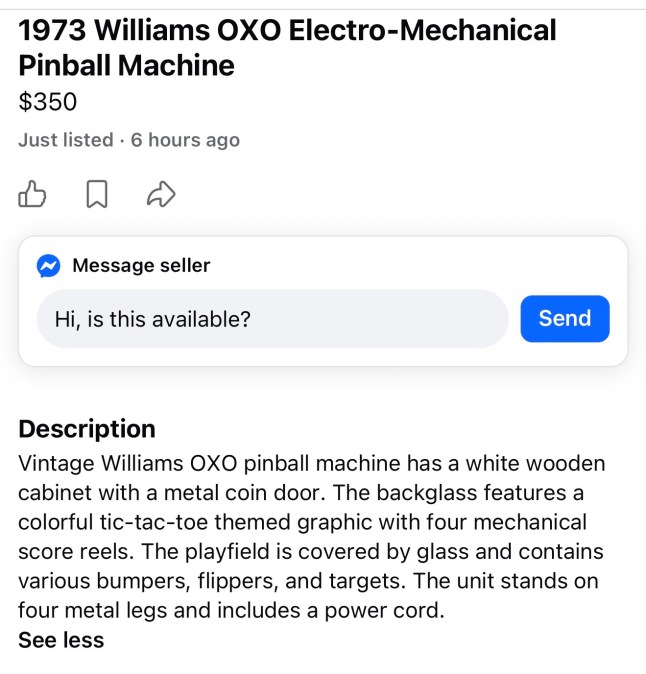
This was clearly written by AI, as it covers the basic element of the overall game and describes what is in a picture of the machine. It provides basic details about a pinball machine (playfield covered by glass, has bumpers/flippers/targets, stands on four metal legs, has a power cord) with a few basic descriptors of the specific machine (Williams manufacturer, white wooden cabinet, tic-tac-toe theme).
This is the core of what AI does for writing: It gathers all the info it can on the broad concept you care about and provides it to you in a simple, clear, surface-level fashion.
In the case of something like this, however, most buyers wouldn’t care about what the average Williams OXO pinball machine looks like or is composed of. They care about specific things related to this particular machine, many of which aren’t covered here:
DOES IT WORK? I think I actually bought two working pinball machines in my life (maybe three), with all the rest of them existing in some state of disrepair. The goal for me was obvious: buy cheap, fix the broken stuff and enjoy, with the possibility to sell it later at a profit. There are various states of functionality a pinball machine of that era can have:
-
- Dead: You plug it in, turn it on, nothing happens.
- Powers up: You plug it in, turn it on, the lights go on, but nothing else.
- Start-up sequence problems: It’ll power up and try to reset for a new game, but something goes wrong (reels won’t reset, reels won’t stop resetting, targets won’t reset, targets won’t stop resetting etc.)
- Playable: It works with some minor hiccups (bonus won’t score properly, some switches won’t score, game ends a ball too soon etc.)
- Fully shopped: Someone has gone through every switch, wire, coil and connection. It’s been fully cleaned, adjusted and is in as good of condition as humanly possible for a machine of its age.
I’m guessing at the $350 price tag, it’s not fully shopped, but how messed up is it will be a concern for a buyer, particularly one who isn’t fully versed in pinball repair.
BACK GLASS CONDITION: In terms of the cost of a machine, the priciest thing on one of these isn’t even related to the game play. It’s the visual art that surrounds the scoring reels and lights up at various times of the game, called the back glass.
During the time in which these machines were made, old incandescent bulbs were used to light them and those suckers got hot. Also, to make the artwork translucent for the lights, the manufacturers didn’t use paint, but rather a series of silk-screened ink layers. Pairing these two things, along with the aging process, means the artwork tends to “flake” off as the ink detaches from the glass.
It’s ridiculously expensive to replace the back glass, something I’ve discovered in trying to repair the machines. If it’s broken, missing or “totally roached,” a new or restored glass can cost more than half of what you could resell a fully restored machine of this vintage. In this case, we’re pretty closed to “roached:”
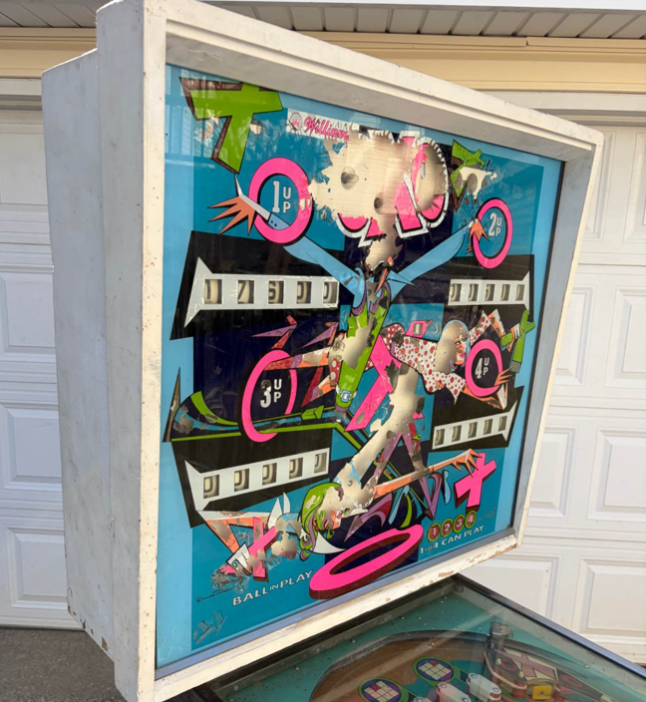
This not only impacts the visual aesthetic of the game, but also your playing experience. The light bulbs in the back glass are powerful enough to shine through the ink, so when there’s no ink, it’s just a bright light in your face. Lots of fun when you’re trying to keep the silver ball in play.
STORAGE CONDITION: Here’s where photos really don’t do you justice in buying one of these things. The way in which this was stored could lead to all sorts of damage that you can never really get rid of, especially smells. This is particularly true if you stored it somewhere damp, as mildew tends to make itself present in the uncoated wood pieces inside.
Even worse, the wiring is wrapped with vintage cloth insulation, something that mice love to eat and nest in. Your game-room treasure might actually be a giant petting zoo for mice. Also, if you haven’t had to clean the smell of mouse urine out of vintage wood, I can’t begin to describe what you’d be in for, but let’s just say it’s not good.
IS IT ALL THERE?: This question gets at a few things that matter to buyers. First, if it isn’t working at all, you want to make sure someone didn’t start cannibalizing it for parts, which means more money and more headaches. Second, certain things tend to go missing on these machines, like the locking backdoor on the head of the machine, where the back glass resides, the coin box, the coin mechanisms and even the keys. To what degree this is complete will dictate how much people want to spend or if they want it at all.
The point to all of this isn’t to give you all a free pinball machine purchasing tutorial (you are welcome, though, if you wanted that), but rather to demonstrate the gaps that are present between what AI can reasonably create and what important aspects of the story it is telling will be missing.
Think about it like this: If your mom asked you, “So, how was your day?” and you had AI put something together, it would likely be able to pull info from your calendar to see what events were planned, pull info from the GPS from your phone to add in where you went, include information from your alarms to figure out when you woke up and maybe even pull from your media (texts, social media posts etc.) to explain the ins and outs of the day.
However, how you actually FELT that PARTICULAR day would be more difficult to capture. It might explain that you were 10 minutes late to class, but it wouldn’t be able to explain if that was because you were enjoying 10 more minutes of snuggle time with your significant other or if you were spending 10 minutes in your car sobbing over the breakup you just endured. It could explain that you ordered an Egg McMuffin, hashbrowns and coffee, but not if it tasted good, bad or made you spend five hours in the restroom.
If you broaden this out to letting it take the text of a speech and creating a news story about it, you will likely get a reasonably decent synopsis of what the speaker wrote down and planned to deliver. However, the text on the page isn’t the only thing that matters in a speech. How the audience responded, if the place was full, if people protested and more exist.
For example, I remember a Christian conservative leader who came to Madison to deliver a speech on the issue of “family values,” which included his thoughts on “the gay community” (we didn’t have the whole abbreviation back then). He’d delivered it to a number of other campuses and had relatively little issue: The private, Christian colleges were polite and supportive while the public ones were a little less so, but still functionally decent.
Madison is a place where “two’s company, three’s a protest” and even then, it had a strong, active and vocal gay community. Police were outside dealing with protests, while people were carrying signs and chanting. The supporters of the guy were clashing with the protesters and still having difficulty getting in.
Police had made it clear that anyone who disrupted the speech vocally would be removed. In response, one group handed out pencils with little rainbow flags taped to them, with the instruction to people not to get loud, but rather wave the flag if they disagreed with the guy. At one point, the audience looked like a flutter of rainbow butterflies and the guy just stopped what he was saying and moved on.
This is why it’s important to use AI only to a point and only when it can do what you need it to do in a given situation. In other words, a story based on the speech might tell you what happened at A place where he gave that speech, but not THIS place when he gave the speech.
This means that when you employ AI, consider it a starting point from which you will do some work on the writing instead of letting it do all the work for you. It’s like the latter day version of Wikipedia, in which you can use it to figure out the gist of things, but you don’t want to just copy and paste whatever is there into a file and call it good, lest you end up with a significant problem.
