
About 15 years ago, I was riding in a taxi at 4:30 in the morning with a driver who was yammering a million miles per minute in a dialect best described as “Swamp People on Uppers.”
He was telling me about the heat index and how I was lucky to be leaving Columbia, Missouri before sun up. He was telling me about his home somewhere in Louisiana, which he left because of some reason he couldn’t adequately explain in our short drive.
He was talking about a story he heard on the radio about a woman in Philadelphia being hit in the face by a five-pound fish, a situation he said likely occurred when an eagle dropped its lake-drawn quarry into a nearby tree.
Suddenly he stopped, and in clear, crisp English said, “Hey, you wanna buy a watch?”
Then, he was off to the races again, explaining that a drunk flagged him down around 3 a.m. and asked for a ride home and how he wasn’t going to give the guy a ride, but the guy promised him a big tip and then they got to his house and you know what? “That sumbitch didn’t have no money on him.”
So… The guy hands over a watch to hold until he could go into his house and get money, but then he disappeared into the house and wouldn’t answer the door no matter how loudly the driver knocked…
Each time the driver pitched me the watch, the value went up: It started as a $100, based on what the guy saw online. Then it was a, swear to God, $150 watch. By the time we got to our highway off ramp, it was a $250 timepiece, but the hell did he need a watch for? He didn’t ever wear a watch and besides, he had his wife to tell him how damned late he was… All he needed was to sell it so he could cover his fare and not get in trouble with the bosses…
And on and on and on it went.
When we got to the airport, I had stifled the laughter as long as I could, but I still had to ask, “OK, so how much was the fare?”
“It was 25 goddaddanged dollars!” he told me. “And I mean this watch… You know how much this thing is worth?”
At that point, I forked over my fare, a tip and an additional $25 for the watch. It wasn’t so much that I was buying the watch, but instead, I bought the story. And the story attached to that object was worth so much more than the object itself.
When it comes to writing, you can find a lot of value in understanding stories and how objects can lead to those things. Objects themselves are pretty much static and plain, but the things they evoke in us can make for some fascinating stories. Good reporters can ask questions about those items to tap into something beneath the surface of a source. Good writers can then use those revelations to better paint word pictures for the audience.
For example, when I’m doing a profile, I look to see if there’s something very clearly important to a person in their office, their home, their car or more. Sometimes, it’s simple like hand-drawn crayon-colored pictures taped to a wall, showcasing that they’re a “mommy” or “daddy” first and a powerful CEO second.
(I once mentioned in a lecture that occasionally I’ll spot a piece of jewelry on someone that seems to feel particularly important. Almost instinctively, a young lady in the room reached up and touched a pendant hanging on her necklace. It turned out, that was the last gift her grandmother had given her, and it serves as a sentimental reminder of a relative.)
I have found that you can learn a lot about people based on certain objects and asking about those items. I figured this out when I first started doing furniture restoration and friends would put me in touch with people torn between selling and refinishing a piece.
I’d ask a simple question, “Tell me about your (chair/table/hutch/whatever).”
If they started to tell me that it was maple or walnut, or that it was such-and-such brand from such-and-such era, I’d likely offer to buy the piece. I’d then refinish it and either keep it or sell it.
If they started with, “Oh, this was my grandma’s chair,” or “This was mom and dad’s kitchen table, and we always had our holiday dinners on it,” I’d convince them to get it restored, do it for whatever they could afford and return it to them in the best shape possible.
In one case, I’d donated a “gift certificate” for refinishing to a fundraiser for a local boy who was experiencing some significant health challenges. I promised that the winner of the silent auction could have any piece done that they wanted (as long as it wasn’t a piano or something I couldn’t move).
The family that won it asked to have their oak kitchen table redone, and it had really seen better days. The finish was all worn off, it had glass rings permeating the wood and the thing had an ungodly wobble to it. As I was loading it into the car, the mom of the family said her daughter had a request. The daughter was in her early 20s and she seemed embarrassed that her mom was making a fuss, but I asked what she wanted.
“Do you see these cigarette burns?” she asked, pointing to several spots on the well-worn table top. “Can you save them? Her grandfather used to smoke at the table and she said she’d be sad if they were all gone.”
So, that’s exactly what I did, leaving those little “character” remarks behind because the sentimental reminder was worth more than perfection to these people.
As a reporter, look to the objects that are interesting or distinctive in some meaningful way and see what a source can tell you about it. In some cases, a vase is just a vase or a ring is just a ring, but it never hurts to ask. In many cases, you will open the door to something well beyond what you could have imagined.
ONE FINAL NOTE: Sometimes objects can help explain something about the subject of a piece or typify an aspect of a personality that otherwise would be inexplicable.
For me, the best example is this ashtray:
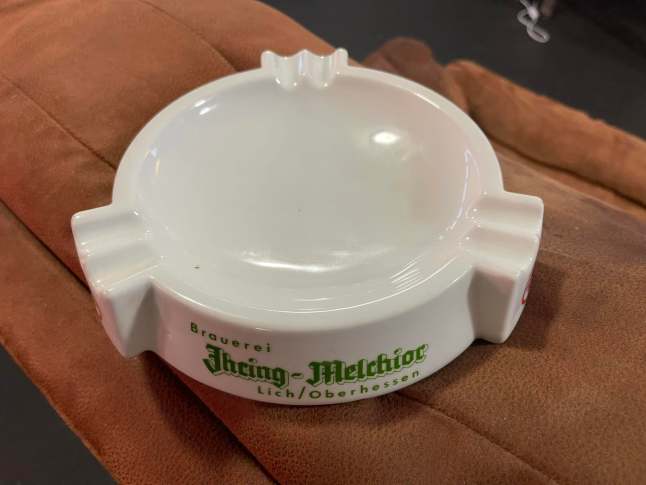
I picked this up at an estate sale a few years back, and it’s nothing special. I think I paid five bucks for it and it’s advertising a relatively obscure beer company overseas.
However, the process of getting it and keeping it reveals a lot about me. (At least that’s what Amy said, and she didn’t really say it in a good way…)
I was wandering around the sale when I spotted this on the ground and nobody else was near it or me. When I picked it up, a woman who runs an antique store and was hoarding things in a pile 30 feet away screams, “THAT’S MINE! I WAS GETTING THAT!”
I looked at the guy who was running the place and he kind of just shrugged, so as I went to buy it, she was making all sorts of passive aggressive comments about how I “stole” from her and how I should know how “unethical” I was being. As I was leaving, she asked the guy about furniture restoration and buying restored pieces, and he mentioned I had done some and was good, so she asked for my number.
Peace with honor, I thought, so when she texted me asking about furniture I’d done, I sent pictures and offered to sell her some things. To which she responded, “I might consider that if you give me back my ashtray.”
So, before I deleted her number and blocked her, I calmly texted back that if I were ever to be so broke that I starved to death and was forced to be buried in a debtor’s field, I would be buried with that frickin’ ashtray before I ever gave it to her for any reason.
