
THE LEAD: Google continues to find itself at the core of unflattering legal cases, including this one regarding its status as a monopoly:
One month after a judge declared Google’s search engine an illegal monopoly, the tech giant faces another antitrust lawsuit that threatens to break up the company, this time over its advertising technology.
The Justice Department and a coalition of states contend that Google built and maintains a monopoly over the technology that matches online publishers to advertisers. Dominance over the software on both the buy side and the sell side of the transaction enables Google to keep as much as 36 cents on the dollar when it brokers sales between publishers and advertisers, the government contends in court papers.
Previous lawsuits have found the internet giant of monopolizing the search-engine space by paying tech companies to make it the default search option on their products. In this case, the argument is that its efforts to maintain that monopoly have unfairly cost advertising customers more money than they would have to pay in a competitive environment.
CHUTZPAH MOMENT OF THE YEAR: Google is trying to swat the suit aside by claiming the revenue it receives for its ad programs is actually shrinking:
In recent years, Google Networks, the division of the Mountain View, California-based tech giant that includes such services as AdSense and Google Ad Manager that are at the heart of the case, actually have seen declining revenue, from $31.7 billion in 2021 to $31.3 billion in 2023, according to the company’s annual reports.
(Emphasis mine)
Well, hell’s bells… Somebody get me a crying towel.
THE BASICS: Monopolies are great things if you have one and lousy things if you’re the rest of the world. It’s been a while since we really had a lot of cases like this in court.
One of the more famous examples was the Rockefeller’s Standard Oil monopoly, where that company controlled about 95 percent of the oil business in the U.S. When a potential competitor would pop up, Rockefeller would drop the prices so low that it was impossible for the competitor to survive. After taking those losses, but killing off the competition, Standard Oil would put the prices back where it wanted and go on with life. It took about 30 years, but the company finally was broken up in 1911.
Despite my students’ estimation of my age, I wasn’t there for that monopoly, but I was around when the government decided to break up the Bell system in 1984. AT&T essentially controlled almost every aspect of the telephone system, including local, long-distance, telegraph service and equipment manufacturing. The breakup allowed for more competition, cheaper phone rates and even the advances that allowed for the internet to really become the thing we’ve all come to know and love.
WHY YOU SHOULD CARE: In going back to the AT&T situation, I remember when we had to buy or lease the actual phones in our home from authorized dealers. When a hotel closed down, my uncle knew a guy who knew a guy who managed to smuggle a ton of phones out of there and was selling them black-market style for much less than you could buy one from AT&T. It sounds absolutely ridiculous now, but that’s how it worked back then: AT&T owned the ball, the playing field and the entirety of the game, so you were stuck with what AT&T wants.
In the case of Google’s situation, the ad rates they set are based on almost nothing other than what they feel they should be set at, a figure that clearly favors them more than you or me. The only way to truly know if something is or isn’t priced properly is to compare it to other similar items in the field.
For example, when I go to a baseball card show and I want to buy the most recent bobblehead that the Brewers gave away for a game promotion, I can go to a dozen tables where people have them and compare the price. If everyone is sitting at about $25, I can decide which one I’ll buy or see if one is cheaper and make a deal for $20.

Yes this is real. It weighs like 3 pounds and I desperately want it…
However, if I want to buy a one-of-one rookie card of Caleb Williams, I’m stuck paying whatever that seller wants to charge. There’s only one in existence and trying to figure out if it should be more or less than a one-of-one Brock Purdy or a one-of-one Justin Fields is just guess work. Even if I can argue that it should be more than Fields or less than Purdy, it doesn’t matter if the dealer won’t budge on the price.
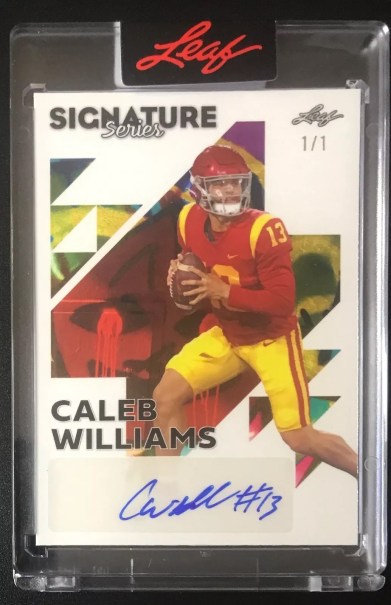
In three years, he’ll be the finest back-up QB that Pittsburgh has on its roster, just like the last couple guys the Bears drafted as their QB savior…
The same thing applies to monopolies. If one rental company in your college town owns all the rental property, you’re essentially stuck paying whatever that company wants to charge for rent, regardless of how much the roof leaks or if you’re time-sharing the bathroom with a family of disgruntled raccoons.
You can make the argument that if Google is doing a great job of giving people what they want, nothing else really should matter and the government should leave them alone. That said, because Google is essentially killing off every possible competitor before those competing forces can show any value, we don’t KNOW if Google is the best. If competition is allowed to develop and Google still rules the roost, then we will know it earned our patronage through quality service.
However, as is the case with all monopolies, the one thing we know right now is that Google is the biggest and only option.
DISCUSSION STARTER: Do you feel that monopolies matter to you? Do you have any concerns about Google’s status and its ability to control a large portion of the digital search and ad world? Or do you just care that it works when you need it?
