The Art of the Deal: A few suggestions for end-of-term grade debates

More than a few friends are posting online over the past week or so about the end of the semester and the “great grade debates” students tend to engage in with professors. One of them noted that a student demanded a passing grade because, “I’m graduating in a week.”

Um… Doesn’t it usually work the OTHER way around?

As I’ve written on more than a few syllabi over the years, “Instead of telling me at the end of the semester, when you have no hope of passing, that ‘I need this class to (graduate/move on/continue my program/whatever), wake up every morning before class, look in the mirror and say it to the person you see there. Then, behave accordingly.”

Still, if the kid who couldn’t be bothered to prove they were sentient in your class has now become a mix of Clarence Darrow, Jack McCoy and Daniel Kaffee while arguing for a better grade, here is a throwback post that looks at a few options.

Potential solutions for grade debates between students and professors

As the end of the semester draws near, grades tend to become a topic of consternation among students and professors. Students tend to worry about the outcome of their course work as it relates to their ability to graduate, move on or keep that ever-important GPA on the up-slope.

Professors, on the other hand, find themselves buried in grading, often wondering why we didn’t just show movies and mark attendance for 15 weeks. As we slog through the work we brought upon ourselves, students are questioning, begging and cajoling, all in desperate hopes of nudging grades just a little (or in some cases, a lot) higher.

I can’t solve every problem (or most of them) on the blog , but here are a few random ideas I have for making life a bit easier on all of us in regard to the grade debate.

Take them as seriously as they seem…

The “Peace with Honor” grade: I’m sure most students have failed to put in an appropriate amount of time on an assignment at some point in time. I’ve noticed this usually happens on essays or longer-form writing pieces, where the student figures if they pour enough BS into a Word document, the professor will decide to give them at least a few points.

The problem is that professors are often stuck when it comes to grading these papers, even with a quality rubric. We don’t know if you were having difficulty with the assignment, so we need to point out the errors in detail to help you for the next one, or if you just didn’t give a crap, so we’re wasting time telling you things you knew, but just didn’t do.

Thus, I propose a “Peace with Honor” grade approach.

When a student knows they are behind the 8-ball on an assignment, instead of BSing us to high heaven and having us wade through your BS, a student can write something simple like, “I know I should have dealt with this assignment better, but I’m not wasting your time trying to fake it.”

The professor, in gratitude, will fail the student with a specific amount of points (I’m a fan of 40-50%), with the idea that not having to comment on every stupid thing the student could have written will save time and defer carpal tunnel surgery.


The “I’m Better Than This” cease fire: In journalism, we care what you can do, not what your grades are once you graduate. To that end, many professors will encourage students to participate in student media to sharpen their skills and gain experience.

In more than a few cases, this is like encouraging someone to “just try” some cocaine so they can get a bunch of stuff done quickly. The students quickly become addicted to the newsroom and their GPA heads downhill like a stock market graph of the Great Depression.

Professors often start getting weaker work from those students because they’re running the paper or the radio station or the TV station. Suddenly, classes have become something of an fifth or eighth priority in their lives.

For some professors, this can become irritating because we KNOW you can do better at this work. For some students, this can also become irritating because they KNOW they are better than what the grades they get keep reflecting.

A potential solution is this cease-fire approach: I’ve told more than a few students, “Look, I get it. I once skipped six weeks of classes because I was dedicated to the student newspaper. I know why you’re disappearing like a kid running after a red balloon in a Stephen King novel. I also understand I’m not a top priority, so let’s try to make peace with this.

“I will promise not to ride you mercilessly about how crappy your work is in here, if you promise not to piss and moan about your lousy grades. We’ll get you through this alive, and once you end up running a professional newsroom, just make sure you keep your alma mater in mind for potential internship candidates. And don’t make GPA a requirement for successful applications when you’re running the show.”


The “One-Point, Death-Grade, Elevator-Pitch Shimmy” Approach: At the end of a semester in which we grade hundreds of papers across multiple sections and various courses, the computer will eventually spit out a number that correlates to your grade. In more than a few cases, that number will be riding juuuuuuuusssst on the line of a potentially life-altering edge.

For example, if 75 is the demarcation line between a C and a C-, and you need a C or better to continue in your program, you might find yourself sitting at 74.89. The difference between having to start all over with a course or be able to take what you’ve likely scheduled for next semester hangs in the balance of a professor’s attitude regarding rounding, grade-grubbing and the degree to which they want to tolerate you again.

Here’s the best I got for what I would consider “death grades,” the line between pass/fail, advance/retake or B-/C+ (It’s hard to sleep at night knowing you were THAT close to a B of any kind and came up short.): If you’re within a point or two of that death grade, we professors promise to tell you before we file. You have 24 hours to make up a 30-second elevator pitch that would convince us to buy your argument for a better grade.

If you use the words “deserve,” “worked hard,” “need this to graduate,” or any other whiny bull-pucky, you’re done. Gimme at least one or two concrete reasons that I told you were relatively important to this class that you learned or did that make you worthy of me shimmying  up your grade a tad.

My discretion in the end, but I gave you a chance.

And finally…


The “But I Tried Really Hard In This Class” Resolution: When your grade is somewhere in the vicinity of the Mendoza Line and you missed so many classes that I almost called in an Amber Alert on you , it’s kind of ballsy to make the claim of effort.

That said, numerous students do this every year, so here’s the best solution:

Good luck with finals and we’ll see you next time!

Tell me what media-writing and journalism exercises your kids need and I’ll build them for you

So, so pretty… And no, I was not inspired by “Wicked” when I approved this. Unless you would adopt it because of that, in which case, I’ll have you know I always sing “Defying Gravity” before I come to work.

With the fourth edition of “Dynamics of Media Writing” set to debut in August, and with the third edition of “Dynamics of News Reporting and Writing” having just published, it seemed like a good time to add some extra value to the books.

The biggest need people tend to express in reviewing textbooks is the need for more exercises. A friend hit me with an email about that just the other week:

Really hoping to find a text that offers enough exercises so we don’t have to require an exercise book.

I get it and that’s one of the reasons why we shifted from the exercise books that accompanied the texts to the blog approach. Kids pay a lot of money for school, so if we can give them everything they need for less, hey, I’m a big fan.

That said, asking for more exercises is a lot like when Amy says, “What are you thinking about for dinner?” I usually have no idea, as she often asks this right after we eat a huge breakfast, and I’m more of a “eat whatever is near me when I’m hungry” type of guy.

So, to better guide the focus of my summer work that will include both learning how to weld sheet metal and creating some more exercises for you all, I need some help. I also figure it’s a good time to ask this now, as most of you have just finished a semester, so the “Holy hell, do these kids need more practice doing XYZ” angst is likely fresh in your minds.

Either post at the end of this post or shoot me a message through the “Contact” page and answer the following questions:

1) What topics are most in need of exercises for your kids? Look at the chapters in either or both books and see what things I’ve written about that your students struggle with the most. That could be broader topics like grammar or interviewing, or it could be more specific things like how to write an obituary or a press release.

2) What format of exercise is most likely going to help you meet those needs? I tend to categorize these things into a few basic areas:

  • Memory Exercises: Think multiple choice, true false, pick the right word, matching game etc. This is when you want them to know what FOCII stands for or which ethical paradigm is reflected in the phrase “justice is blind.”
  • Explainer Exercises: Think short answer or mini-essays where they have to tell you what they were thinking about and why. That could be something like, “Explain the difference between AI and generative AI” or “List five things that are wrong with this lead.”
  • Just Do It Exercises: Think about things where the rubber meets the road and the kid actually has to create something that demonstrates competency at the task. It could be building a press release out of a collection of facts, rewriting a meeting story to better fit the inverted-pyramid format or using press releases to write leads.

Hit me up with this and I’ll add your needs to the pile. Once I get the pile built, I’ll share with the class.


Sieve! Sieve! Sieve! AG Pam Bondi green-lights the harassment of journalists as a result of Trump administration leaks

(Rare footage of Wisconsin Badger Hockey fans either taunting an opposing goalie for failing to make a save or mocking Pam Bondi for not running a tighter ship when it comes to stopping sources from leaking information to the media… )

THE LEAD: Attorney General Pam Bondi decided the best way to stop the sieve-like nature of the Trump administration’s leaking problem was to go after the journalists who received the information instead of the people leaking it.

To do that, she issued a memo late last month that made it easier for the government to subpoena reporters, their notes and other documents.

[T]he Bondi memo appears to have rescinded a specific provision protecting journalists from Justice Department subpoenas, court orders and search warrants based on the “receipt, possession, or publication” of classified information.

This change would make it easier for Justice Department attorneys to pursue journalists to identify confidential sources in reporting that involves leaks — like the Pentagon Papers or Watergate. And that could chill news reporting in the public interest.

THE MEMO: Bondi’s four-page explanation for her rollback of the protections put in place more than a decade ago under Merrick Garland offers both shot across the bow at journalists who receive and use leaked material as well as a general disdain for journalists generally:

Without question, it is a bedrock principle that a free and independent press is vital to the functioning of our democracy. The Department of Justice will defend that principle, despite the lack of independence of certain members of the legacy news media.

My takeaway is bloggers, as non-legacy news media, are safe to be completely dependent upon whomever they want for cash and prizes while taking leaked documents. So… Send your cryptocurrency bribes and emails about TrumpCoin to the email address linked on the blog’s About Us page…

Also, this feels more like an angry wedding party host giving a toast more than a serious memo at this point: “I’d like to say congratulations to Jill, the bride, my sister and my best friend. I will always be there for you, even though you slept with my prom date while I was throwing up in the bathroom at after prom. Still, love you, Jill! Jack, welcome to our family, and you might want to get a blood test…

And then there’s this…

This Justice Department will not tolerate unauthorized disclosures that undermine President Trump’s policies, victimize government agencies, and cause harm to the American people. “Where a Government employee improperly discloses sensitive information for the purposes of personal enrichment and undermining our foreign policy, national security, and Government effectiveness—all ultimately designed to sow chaos and distrust in Government—this conduct could properly be characterized as treasonous.”8 

A lot of suppositions there, not the least of which is that stuff “could” be treasonous or that all disclosures they want to attack are also definitely meant to undermine policies, victimize agencies and hurt people. By the way, the quote is from one of Trump’s executive orders, as are several other footnoted passages. Just one more reason to read the footnotes before assuming the content is valid.

The memo demonstrated why she probably should have hired one of those journalists she is now targeting to do some proofreading and copy editing:

The Attorney General must also approve efforts to question or arrest members of thew news media.

(Emphasis mine)


SO HOW FREAKED OUT SHOULD YOU BE? I wanted to run this past a couple of my “legal eagle” friends to basically get two questions answered before I posted about this:

  1. What is essentially going on here?
  2. How freaked out should journalism folks be about this and why?

Starting with the answer to number one, the legal folks explained that we do not have a nationwide press-shield law, nor an unfettered reporter’s privilege to legally keep the government at bay indefinitely. The case of Branzburg v. Hayes (1972) established that reporters can be compelled to break confidentiality agreements with sources if the government feels it is important that they do so.

As one of the legal folks noted, this isn’t just Trump being Trump about stuff he doesn’t like. Other administrations have also poked the media in a similar fashion when the situation benefited them:

“Many admins have used their federal investigative powers to harass journalists — Nixon famously, but definitely GW Bush and even Obama and certainly the Trump 1 admin. Merrick Garland as AG issued a memo saying his justice department wouldn’t do that, but that’s just guidance, it’s not binding. Congress had a chance to pass the PRESS Act in December provide more protection by law, but Trump told the GOP to kill it, and they did.”

As for number two, the answer basically comes down to, “Be as freaked out as you normally would be about dealing with leaks, because you never really had a lot of protection to begin with.” As one of those legal eagles put it:

“Congress has never passed a shield law, or Free Flow of Information Act, so our legal protection has always been in that weird middle space left by Powell’s concurring opinion in Branzburg.

“We still have a little bit of protection if there’s evidence the government is acting in bad faith or retaliation or harassment against journalists instead of having a bona fide need to get information they can’t get otherwise.

“I think this is more about undoing anything the Biden admin did than anything practically different. We all knew Trump and his admin would go after journalists — he’s been clear about that since before he was elected the first time.”

Essentially, the law itself hasn’t really changed, nor has anyone really stood up for journalists on the federal level (states have passed shield laws here and there, but that doesn’t apply when the fed comes calling). That said, it’s the enforcement that’s likely to be more of a concern.

“Trump and anyone serving in his administration see journalists who report things they don’t like as the enemy. They will target them for retaliation and force their newsrooms (if they work for one) to invest resources to fight in court. Bondi just gave the green light for that. Nixon would be proud.”

(SNIP)

“If anything, I think it’s aimed at trying to scare journalists from publishing leaks — or to scare leakers that journalists may not be able to protect them.”

“I’m not sure that’s gonna work, but it’s definitely the message Trump wants to send.”

DISCUSSION STARTER: What are your thoughts on the Bondi memo as well as the history of the government not solidifying a national media-protection act of some kind? Would that make you more or less worried about what to do if you received important information via a leak?


The stuff you wished someone had told you about looking for life after college (A Throwback Post)

YARN | Christ, 7 years of college down the drain | Animal House (1978) |  Video clips by quotes | 8468e662 | 紗

And this guy didn’t even have student loan debt…

Students have been stopping by the office lately with one of two declarations:

  1. “I got a job! The world is full of rainbows and kittens and sunshine!”
  2. “I can’t find a job. Is there any chance you could back your truck over me a few times in the faculty parking lot so I don’t have to go live in my mom’s basement for the rest of my life?”

The highest of the highs and the lowest of the lows are both likely to find things are significantly different than they expect them to be after the cap and gown goes to Goodwill and they begin the next stage of their lives.

Today’s throwback post is a look at something I deemed “Life 101” a few years back. A group of really smart folks I’ve had the honor of knowing (and in some cases teaching) were willing to chip in words of advice for the soon-to-be graduates. Seemed like a good time to bring this back.

As the post notes, this was part one of two, so I’ve linked the original part two at the bottom if you are so inclined.

Enjoy!


Life 101 (Part I): Everything you wished you’d known before you graduated but nobody told you

life depressing funny college - 8102692096

(It’s not really that bad. You just need a few hacks here and there to soften the situation.)

A student showed up in my office a few weeks back with a big smile on her face and the peptic energy that only comes from wanting to tell someone else the best news in the world.

“Dr. Filak! I got a job!” she said, a mix of glee, elation and relief pouring out of her as she explained what she did and how this worked and where she was going to be employed.

I listened and congratulated her multiple times before I asked the inevitable question: “You don’t have to tell me if you don’t want to, but what was the offer?”

She proudly told me how much she was making, which was a decent amount. She wouldn’t have to steal Splenda packets from local diners or live on Ramen for every meal, that’s for sure.

When I asked how the negotiation for that amount went, she said, “Oh. They just gave me the salary they were going to pay me. I asked my parents if that was good money and they said it was, so I took it.”

She noticed the look on my face. “Oh no!” she said. “Did I do bad?”

“No,” I said. “But you could have done better…”

I then explained the whole process of salary negotiations to her and she realized something nobody at this institution had ever taught her: Salaries ARE negotiable. So are so many other things.

If universities are good at training students to develop skills that will help them get their first career jobs and put them on the path to a fully adult life, they absolutely suck at helping students make the transition from college to that life. I know this from my own experience, as well as that of colleagues and former students, so I thought a good wrap up for the semester would be one final lesson for the group: Life 101.

I asked the hivemind of folks I trust through various social media outlets and connections to tell me one thing they wished they’d known before they left school that they found out the hard way once they got into the “real world.”

Today’s post is the first of two that look at issues beyond graduation, focusing mainly on getting a job and the reality of that first job.

Tomorrow’s post will look at the life issues you face once you get out and become “a grown up” that you probably won’t see coming.

I hope this helps:

THE JOB SEARCH

There are few things more anxiety-provoking and terrifying than looking for a first career job out of college. You have put in the time and energy to pass the classes. You got the grades they said were going to propel you forward. You got involved in every activity someone said would “look great on a resume” and you worked at student media, internships and part-time gigs to fatten up your experience.

You put yourself out there and… crickets…

As a college student, I feared my parents’ basement. I constantly heard of students who did “all the right things” but ended up living back with their parents in a basement because they couldn’t get a job. I mentioned that to several students and several currently employed former students and the vibe was the same:

“I was scared to death that I’d done all this work and I’d be living back home in the basement. I never had a problem with my family, but I damned sure didn’t want to be back there as ‘that kid.’”

“I knew I could go home. I just didn’t want to. I wanted to be a grownup.”

I have said this before and the people who have experienced it have told me I am dead on with this analogy. Those who haven’t tell me I’m crazy. Then, they experience this and they convert to my way of thinking:

Your first job search is a lot like a bad dating experience: You are ready to go, so you put yourself out there. People are ignoring you and it feels awkward. You don’t know what’s wrong with you, so you get really worried.

Then, someone shows an interest and you have that kind of, “Cool. We should hang out. Let’s exchange info” moment and you get really excited. You start imagining how nice it’ll be and your mind takes you on flights of fancy regarding this relationship.

Then, you don’t hear from them for a while and you start wondering what you did wrong and why they aren’t calling. You start questioning everything you’ve done to this point. You wonder if you should reach out, but you don’t want to look needy.

Eventually, you’ll start to get angry with the, “OK, screw you. I don’t need you thing.” You give up, only to hear from that person shortly after that, with the person giving you a true and great reason why it took so long to reach out and that they really want to see you in a day or two, so let’s set this up…

And then you’re like, “OHMERGERD! I LOVE YOU SO MUCH RIGHT NOW!” but you play it cool and the cycle begins again…

As I’ve told more than a few sobbing students over the years, “It’s not you. You are good. The right people just haven’t figured that out yet. It’ll happen. Trust me.”

(In completing the analogy, that’s what my mother used to try to tell me each time I got dumped in high school… She wasn’t wrong, but the situation still sucked.)


THE JOB OFFER:

The first career job offer is something most people never forget, and I certainly remember getting my job offer from Mizzou.

Well, I remember most of it.

At one point when I was being offered the job and told about what this involved, I think I passed out on the phone. Blood was pounding in my ears, my chest felt like it was going to explode with joy like a frickin’ Care Bear and I couldn’t believe how lucky I was.

giphy-downsized.gif?cid=549b592d5ab2ba3b6270323273a5dcae

When the first offer came, I took it. No questions asked. I was so happy to be getting that job.

About two years later, my boss called me into his office and told me, “I need to let you know something. I totally screwed you.”

He explained that when he hired me, he gave me the lowest lowball offer he could, figuring I’d negotiate my way up to something more reasonable. When I didn’t, he was over a barrel. He couldn’t just give me more money, but he also knew I didn’t know any better.

(To be fair, he then told me he was getting me connected with the grad program so I could go after a Ph.D. It was a fair trade in the long run.)

He was a good guy and it never occurred to me that he had lowballed me. He then gave me the best advice I share on a regular basis, “Never take the first offer. Always negotiate for your worth.”

Of all the things people mentioned in their responses to me, salary negotiations were the most important:

“Journalism is not a ‘calling.’ It’s a business. Negotiate your pay. Don’t work for less than you’re worth. Think 5-10 years down the road.”


“Don’t count on the editor who hires you to have your economic interests at heart. You should be prepared to negotiate for the pay you need to live, and expect them to expect you to negotiate because it may be a LONG TIME before you have as much leverage to get yourself more money than when you have the initial job offer.”


“Know your worth and don’t settle just to get hired and have a job. A LOT of companies are hiring, so test the waters and see where you feel valued.”


“Agreed with everybody who said negotiate your starting salary. Do some research of similar roles in the area and don’t just take the first offer that comes because you’re scared/excited just to get one, which is what I did.”

In addition to negotiating salaries, people noted that they wished they’d negotiated for extra vacation time, an earlier start for health insurance, improved hours/requirements and other bennies that they thought were just written in stone.

Another person noted this “look forward” in life as crucial:

Take whatever 401k match is offered, even if you can’t contribute anything else right away.


WELCOME TO THE FIRST DAY OF THE REST OF YOUR LIFE (OR NOT)

When I went to my college orientation session about 30 years ago, the people there told us that we would likely change jobs about six or seven times in our lifetime. At that point, they meant that we would likely climb the corporate ladder, maybe switching companies within our field, but essentially staying put.

According to recent data, Millennials will change CAREERS almost six times in their lives. People now tend to stay with an employer for an average of three or four years, even with opportunities for advancement. This shifts the entire paradigm of how to look at your first job. Here are some thoughts from the hivemind:

“Paying your dues” is an outdated concept. Don’t let your parents, employers or friends convince you otherwise.


The quality of the job and the people you work with are far more important than the location.


Having a different approach to teaching and research is a GOOD thing!… Students need to know there’s many paths towards your goals in life. Do what works for you.


You don’t have to stay in the first job you get after college forever. It’s okay to change your mind or realize it’s not something you enjoy.


(I wish someone taught me how to deal with) not starting exactly in the position you want and how to be content with the growth process. Your degree does not always land you your dream job immediately.

This last point leads us to the unfortunate truth associated with taking that first job…


YOUR JOB MIGHT SUCK

As much as the dream job might be just a dream, it doesn’t mean suffering and pain should be your daily life at work. Everything from toxic workplace environments and weird bosses to feeling lost and becoming undervalued can make that first job you were so excited about feel like an abusive relationship.

I’ve worked for bosses that I would step in front of a bus for, because they were so helpful, supportive and just entirely amazing. I have also worked for bosses I wouldn’t feel bad about nudging into path of oncoming freeway traffic.

The folks who chimed in on this had similar experiences:

Your boss makes all the difference for how well you do in your first few jobs. Take your first job based on how well you vibe with the boss.


I once told my son that if he ever has a job where the manager/supervisor/head honcho etc, comes over and parks his butt on your desk, smiles and says, “we’re all like family here”…….Leave.


Also that just because things aren’t perfect, it isn’t necessarily your fault:


Your first job isn’t your only job. Sometimes it legitimately sucks and that’s OK. It’s not an indictment on you or your work.


Always work toward aligning what you want to do with what your job/career actually is, while still getting your current job’s work done of course. But always keep working toward doing what you want to do, even if your first job out of school isn’t your dream job (it won’t be).

The one caveat I’ll offer here is the one based on my own sense of paranoia: There’s nothing wrong with leaving a job because it’s not what you want or need. That said, have your next move already to go upon your decision to quit.

I equate it to the old “Tarzan” movies when he’s swinging from vine to vine across the jungle. Don’t let go of one vine until you have the other in hand.

TOMORROW: Life, or something like it, after college.

The Draft Slide of Shedeur Sanders: An Exercise in Framing Theory

DOCTOR OF PAPER DISCLOSURE: I have to put this here or I’ll never hear the end of this from people who know me. Here is the baggage I bring with me to this post:

  • I am a decades-long Browns fan. I have seen more terrible football than I can accurately describe.
  • The Browns quarterbacking situation has always been a disaster and I’ve literally hated everything they’ve ever done with it since they cut Bernie Kosar in 1993. In some cases, I’ve been right as rain (Deshaun Watson, Johnny Manziel, Brandon Weeden, Brady Quinn… How long do we have for this?) while in other cases I was dead wrong (Baker Mayfield; I hated that pick but came to love the guy. Then I hated it when they let him go.)
  • I’m keeping my opinions to myself about Shedeur Sanders and Cleveland picking him for now, as to not ruin the point of the post, but if we had to say anything was “framing” my opinion, it would be the “I wish my Browns didn’t ruin everything they touch and make every bad decision about every player” frame.


Every time someone gets a “Welcome to the Browns” greeting, an angel gets sucked into the engine of a passing American Airlines jet…

THE LEAD: Shedeur Sanders, starting quarterback for Colorado and son of NFL Hall of Famer Deion Sanders, was selected in the fifth round of the NFL Draft this weekend by the Cleveland Browns. Sanders had been projected in numerous mock drafts to be a first-round selection by a QB-hungry team, but fell to pick 144, where the Browns actually traded up to get him.

The slide of Sanders was a major spectacle in the draft, but the reason we’re talking about him here is more about WHY people THINK he ended up as a Day 3 instead of a Day 1 pick.

FACTS ABOUT SHEDEUR SANDERS: For all the discussion about Sanders, here is a list of actual facts about him:

(I have to say “actual facts” here, even though it’s redundant, as so many of the commentators this weekend were screaming opinions and calling them “facts.” The louder you say something doesn’t make it any more true…)

  • He is the son of Deion Sanders, an NFL Hall of Famer and Shedeur’s primary coach throughout college.
  • He weighs in at 6-foot-2, 215 pounds
  • He was a senior at Colorado, where he played for two seasons, an FBS school (a.k.a. Division I). Before this, he played for two seasons at Jackson State University, a FCS school (formerly known as Division II)
  • At Colorado, he amassed a 13-12 record, going 4-7 in 2023 and 9-4 in 2024. In 2024, the Buffaloes went to the Alamo Bowl, where they lost 36-14 to BYU.
  • He received the following accolades in 2024: Second-team Associated Press All-American. Big 12 Offensive Player of the Year. First-team All-Big 12. Finalist for the Davey O’Brien Award (nation’s top QB).
  • In 2024 he also set a school record with 64 career passing TDs and led the FBS by completing a school-record 74 percent of his 477 passes. He ranked second in the FBS with 353 completions and school-record 37 passing TDs (10 INTs) and was fourth with school-record 4,134 passing yards.

This is as close as we can get to a set of facts that will set the stage for how this went from a simple draft story to an epic exercise in framing theory;

FRAMING THEORY 101: Framing is a concept first championed by Erving Goffman in the 1970s that looks at not just what a story is but how it is presented and what influence that has on how the audience comes to understand it:

In essence, framing theory suggests that how something is presented to the audience (called “the frame”) influences the choices people make about how to process that information. Frames are abstractions that work to organize or structure message meaning. The most common use of frames is in terms of the frame the news or media place on the information they convey. They are thought to influence the perception of the news by the audience

Here’s a simple example: The owner of some land in the city of Springfield wants to build a complex of condominiums on that land and is petitioning the city council for the permission to do so.

We could frame this story in a number of ways:

  • Government bureaucracy frame: How long does it take to get stuff done around here and why should someone have to get approval to do something with land they own?
  • Growth frame: The city is clearly in good shape in terms of its financial and population if we need more places for people to live.
  • Social inequity frame: Instead of building pricey condos that X percentage of the population can’t afford, why isn’t the city trying to push builders to create low-income housing that would better meet the needs of so many more people?
  • Environmental frame: This is yet one more project that turns green space into concrete, which will have significant ecological impacts on this area.

There are a ton of others, but this gives you a basic idea of an array of topics.

FRAMING SHEDEUR SANDERS: In looking at the Shedeur Sanders situation, the frames varied widely. The terms I use for each frame below is just a general “vibe” and not an official title for the frames, so worry less about that and look more at the explanation:

  • RACISM FRAME: One of the prominent areas of discussion was the issue of race and how Sanders was unwilling to “code switch.” That term, used in this case by former NFL player Emmanuel Acho in his analysis, meant he was basically a proud, young, Black man who spoke his mind and was unwilling to change who he was to appease the predominantly white ownership/management of the NFL. Thus, the NFL was trying to not only smack Sanders, but also “teach others a lesson” about how the league expects its Black players to “behave.”
  • DADDY ISSUES FRAME: Deion Sanders has long been a vocal individual in public. (That’s probably the most neutral way I can say that.) His “Prime Time” persona was an invention of his that amplified his presence well before social media even became a thing. When it came to his son, Deion was just as vocal about everything from hinting that certain teams shouldn’t draft his son to calling out the Browns before they drafted Shedeur. This frame suggests that teams didn’t want to deal with Deion and his vocal nature.
  • ARROGANCE FRAME: This is one of the flip sides of the “racism” coin that can go around and around and around until we’re dizzy. In this frame, teams passed on him because he was a “me, me, me” guy with a self-aggrandizing temperament that really didn’t sit well in a team sport. What some people saw as remaining true to one’s self, other people saw as cocky and overhyped.
  • NUMBERS FRAME: For every number that showcases significant value in Sanders, someone else can offer numbers that showcase significant weakness. His completion percentage was mindboggling, but he was barely a .500 QB. He led Colorado to a bowl game two years after the team only won one game, but they got crushed by BYU. This one goes either way.

You can go into a TON of other frames as well, and even flip most of these frames on their heads. That’s the goal of today’s exercise.

EXERCISE TIME: Do a search of the Shedeur Sanders post-draft coverage and see what frames you see as showing up most prominently and most frequently. What do you think this says about the overall view of the media and how accurate do you personally feel those predominant frames are.

ALSO:

Pick any story, column, social media tirade, blog post, vlog post, whatever your professor will allow and analyze it for a specific frame in how the draft slide of Shedeur Sanders is being presented. How much do you agree or disagree with this frame and can you counter the argument in a meaningful way, relying on facts and sources to support your point?  (You could even pick out something you know you’re going to disagree with and then work hard on that end.)


’60 Minutes’ leader quits, citing lack of editorial freedom and limited backing from his bosses


THE LEAD: Bill Owens, one of only three people to run “60 Minutes” over its lengthy stay on CBS, resigned this week, telling his staff that he felt the show’s editorial independence was compromised.

“Over the past months, it has also become clear that I would not be allowed to run the show as I have always run it. To make independent decisions based on what was right for 60 Minutes, right for the audience,” Owens wrote. “So, having defended this show- and what we stand for – from every angle, over time with everything I could, I am stepping aside so the show can move forward.”

Much of the concerns related to what “60 Minutes” is or isn’t doing is, spoiler alert, related to President Trump’s attacks on the show, network and parent company. He has filed a $20 billion lawsuit against anything that breathed within the vicinity of the program, stating it was fraudulent in its actions as they related to an answer on the Middle East that Kamala Harris gave.

Trump sued CBS, which is owned by Paramount, a few days before the November election, alleging that the “60 Minutes” interview with Harris was deceptively edited and therefore violated a Texas consumer protection law. He then expanded the lawsuit earlier this year, alleging an additional claim under the federal Lanham Act and seeking at least $20 billion in damages. In March, Paramount and CBS filed two motions to throw out the lawsuit, calling it an “affront to the First Amendment.” And on April 7, their lawyers filed another motion asking the plaintiffs to produce the documents requested in discovery.

“Despite their insistence that discovery move forward, Plaintiffs have shown very little desire to produce their own documents, relying on unfounded objections and delay tactics,” the Paramount and CBS legal team said.

Paramount is in negotiations to sell the company, which requires FCC approval and that means it’s a really awkward time to be in a pit-sticking match with the administration. Therefore, trying to settle the suit and trying to keep its watchdog on a leash is in the financial best interests of Paramount.


SECOND VERSE, SAME AS THE FIRST: This isn’t the first time that independent media outlets have gotten the muzzle treatment out of fear of Trump.

The Washington Post, owned by billionaire Jeff Bezos, had several tussles between speaking truth to power and trying not to piss off power. Artist Ann Telnaes quit the paper after Bezos spiked one of her political cartoons about how the corporate interests in the country worshiped Trump.

Ann Telnaes says the rough version of the cartoon she drew for The Washington Post , shown above, was rejected by the paper's editorial page editor.

Bezos also took heat during the election season when he spiked the paper’s editorial endorsement of Harris for president. The L.A. Times had a similar situation, in which its editor resigned when the paper’s owner killed a Harris editorial prior to the election.

Yep, this is the hard-hitting journalism I’m getting these days from Bezos media….

DOCTOR OF PAPER HOT TAKE: We can call this situation a number of things (disgusting, nauseating, terrible, autocratic), but we shouldn’t call it surprising. Money isn’t everything, but it always beats the hell out of whatever comes in second, so when doing the right thing and speaking truth to power get between a money-person and a payday, it’s pretty obvious what’s going to occur.

We also shouldn’t lay this all at the feet of Donald Trump, as if he were the sole factor in the squelching of public debate and awareness. Sure, he can wave a bigger stick at bigger institutions, but let’s not pretend that this kind of thing hasn’t happened long before he came down that escalator.

A former student of mine worked at a newspaper along the East Coast where he was doing business journalism. The woman who owned the paper had no interest in journalism, as she had inherited it from her publisher husband. When my student wanted to do investigations into local businesses doing shady stuff, she shut him down because she didn’t want him “bothering my friends.”

Another former student worked at a radio station where he found out about a police chief behaving badly. After the station published its stories on the web, the police chief and his lawyer threatened all manner of things. The message was simple: Pull the story down or we’re suing you out of existence.

Had it not been for some legal help from the Reporters Committee for Freedom of the Press, he likely would have folded under the pressure of the threats. The story stayed up and won an award, while the chief moved on and the threat of the suit went away.

And, not to put too fine of a point on it, student newspapers always find themselves dealing with some level of “external pressure” as it relates to covering things administrators, athletics or student “leader” don’t want mentioned. Just because it’s happening to “grown-up journalism” doesn’t mean it hasn’t happened before elsewhere.

As we outlined in various posts before, the First Amendment doesn’t protect against all the stuff people tend to think it protects against. It also doesn’t help people hoping to turn a profit grow a spine.

DISCUSSION STARTER: Is there a difference in your mind between the government stepping in and prohibiting speech and an organization self-censoring for fear of negative external outcomes?

Also, is resigning from the show the best thing Bill Owens can do, or is it not? It’s easy to make the argument in both ways, but focus on the WHY you think what you think about this and what it says about his ability to leave a job like this in this way.


I lost, but it doesn’t suck, and that’s thanks to you all


It can be ridiculously hard not to be a hypocrite some days.

I spent the previous weekend at the Missouri College Media Conference, where among other things, I presented the evening’s keynote address. Because the speech was just before the awards were presented, I decided to keep it short and focus on the topic at hand.

I told the students there something I’ve told every student in every newsroom I ever advised that I honestly believe to be true when it comes to awards:

“Awards are great things, and you should be proud to win one. However, they aren’t the end-all and be-all of life. When you win something, you should be honored, but don’t let it get to your head. When you don’t win something, you should NOT let it make you feel inferior, as you have more than plenty to offer now and in the future.”

The minute I said it, I realized I had essentially jinxed myself. My new textbook, “Exploring Mass Communication,” had been nominated for the Textbook & Academic Authors Association’s “Most Promising Textbook” back in late October and the winners were set to be announced any day now.

Sure enough, the results came out shortly after I got home and I didn’t make the cut.

After I checked the list a couple times to be sure, I emailed my friends at Sage and told them I was sorry I let them down. They spent time and money putting together an extensive application for this thing, not to mention about five years of their lives helping me build this opus, so I felt they deserved this award more than I did.

The answers came back pretty quickly and identically: We don’t know what the hell was wrong with the judges, but we think we have a winner here. The response to the book has been overwhelmingly positive and adoptions are beyond our most optimistic expectations. We’ll take that over a plaque.

That made me feel better, as did thinking about the award itself. I didn’t know the TAA existed six months ago, so being really upset about not winning something from them seems pretty stupid. It also helped that this was one of those “best newbie” awards that often feels like a kiss of death. In scrolling back through my mind, I thought of all the “Rookie of the Year” award winners (Joe Charboneau comes to mind) and “Best New Artist” Grammy winners (A Taste of Honey comes to mind) who became part of that one-hit wonder crowd.

Awards ARE great and winning IS great, but I was right that they don’t mean what people think they mean. Hell, the Starland Vocal Band won two Grammy awards more than a decade before the Rolling Stones even got nominated for one. If you asked me whose career I’d want, you better believe I’d want to be with Mick and the Boys as opposed to Taffy Nivert.

The thing that really made me OK with all of this was my boss, who put a different spin on things when he told me, “You need external validation more than any human being I’ve ever met.” In other words, it wasn’t the award that mattered. It was someone telling me I did something right.

Which is where you all come in and why I’m writing this post today.

Steve is one of the best friends I could ever ask for. He’s put up with me for far longer than the AMA’s recommended lifetime allowance…

The one goal I have in everything I do is to try to make life a little better for the person who is interacting with me. I want a student to learn something. I want an advisee to get through the program more smoothly. I want people who attend my sessions at conferences to feel like they didn’t waste their time. If you’re reading this blog, I never want you to say, “Well that’s 20 minutes of my life I’m never getting back.”

The same is true for my books. I don’t write them to supercharge my ego or to win an award. I write them for other people. I hope that they can help instructors reach kids and help kids learn something that matters in a way that doesn’t feel arduous. The best external validation I get is knowing that people trust me to help them help their students. That validation is much better than any award I could ever receive, and it shows up when I least expect it.

Case in point, a few student media advisers were on a listserv, discussing which media-writing text would be good for their classes. “Dynamics of Media Writing” came up three times. That was amazing to me. I also got a few messages after MCMC from people asking if they could get a desk copy of my “Dynamics of News Reporting and Writing” text, as they wanted to adopt it in the fall because they heard good things.

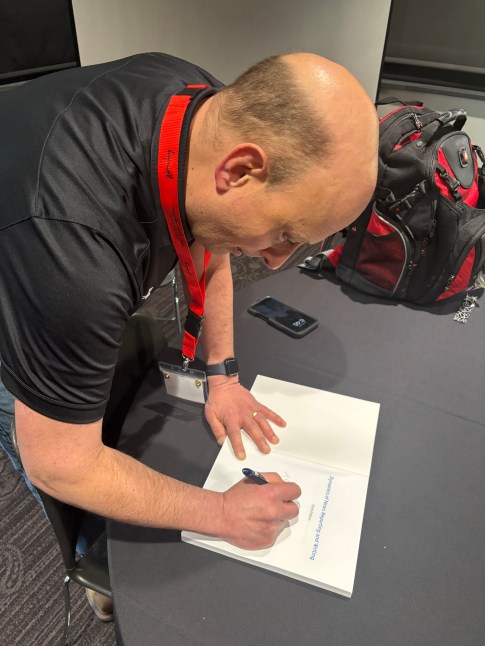
Even the kids, who I have been told a jillion times hate textbooks and never use them, have been amazingly kind to me over the years. For example, I brought a bunch of swag to the MCMC, including “Filak Furlough Tour” T-shirts and a “trophy bat” for the organization to give away.  At the end of the MCMC, the students on the board got copies of my reporting book as a thank you, when one of the kids came up to me and asked if I would sign the book.

“You don’t want me to sign that,” I explained. “If you keep it shrink-wrapped, the bookstore will pay you a chunk of change for it.”

She gave me a “why the hell would I do that?” look and then peeled off the wrapping. I ended up signing all three of the books that day.

Actual proof that someone wanted my autograph on something other than a check or a grade-change form.

When I got back and told the story to my reporting class, one young lady told me, “I read your book. I still think it’s the best textbook because I could understand things from it. It felt really… human.”

In the age of AI, I’ll take the hell out of that.

Perhaps this is the longest way I can think of to say thank you for everything you do for me in the “external validation” department. My goal with each edition of the book and each blog post is to make sure I earn it.

If there’s anything you need, please let me know.

Vince (a.k.a. The Doctor of Paper)


6 thoughts for new journalism graduates on the job hunt that have nothing to do with actually getting a job (A Throwback Post)

It’s not quite graduation time yet, but given the palpable anxiety I am sensing from my students, the job hunt for soon-to-be graduates is clearly underway. A young woman with a great set of experience showed up in my office this week with that “frustrated nnnnnggghhhh” vibe about her, as she had put multiple resumes into the field and gotten few responses.

“Should I call them or something?” she asked. “They’re not getting back to me and I’m worried.”

“When did you apply?” I asked.

“Last week…”

So that was a “No” on my end, as well as a reminder that as to how she needed to look at this whole situation. As I began to say it, she cut me off.

“I know, I know,” she said. “You were right. This is like bad dating. I need to be patient.”

Along with that pearl of weird-dom, here are a few other thoughts for your graduates looking for some help on life beyond the ivory towers and dive bars that formed their college experience.


6 thoughts for new journalism graduates on the job hunt that have nothing to do with actually getting a job

Graduation swept through town this weekend, and along with it came the speeches, the pomp, the circumstance and academic regalia (When I wear mine, I look like Henry the VIII got a Mr. T starter kit for Christmas).

img_5057.jpg

I no longer have the beard, but the medals are still pretty sweet…

Along with all this comes the anxiety of, “OK, now what?” Some students have jobs and they’re worried about how well they’ll do at them. Others have no jobs and wonder if they’ll ever get one. Parents worry that their children will be happy. Some probably also wonder if they’ll have to give up the home gym or a spot in the basement for a returning grad who hasn’t “found it” yet (whatever “it” is). What comes next?

For journalism grads, the anxiety can be even more palpable, as everyone seems to be telling you that your field is dead and you should have gone into business. Other fields can spend months or even years cultivating students for a job that’s waiting for them upon graduation. Journalism? I’ve been told once during a first interview, “We’d like to offer you the job today (Saturday). Could you start Monday?”

I asked the hivemind of pros and profs what advice they had for you all and it was really a mixed bag this time. Usually, everyone chimes in and it’s all in the same vein. This time, things were all over the place. One professor friend of mine noted:

My adult daughter just moved back home, soooo I got nuthin’.

I have often relied on the famous William Golden quote about Hollywood as well: “Nobody knows anything.” Whoever tells you, “This is how to get your perfect job” is either lying to you or trying to recruit you into a cult. Unlike all of those multiple-choice tests you’ve taken over the years, this question doesn’t have a right answer. That said, here are a few to think about as you try to game up for the next stage of life:

  • You have to be idealistic, but you have to be practical: U.S. Olympic hockey coach Herb Brooks once said this in explaining his team’s chance to do well in the 1980 Olympics. His point was you should shoot for the best possible outcome, but you shouldn’t do so without a reality check. In the case of the job search, take a shot. You want to work at a top five newspaper, in a top 10 TV market, a Fortune 500 company or whatever right away? Toss an application out there. What’s the WORST that can happen? They say no and you don’t get the job, which is right where you are right now.
    That said, a 22-year-old journalism graduate with five clips from an internship at the Tamany Tattler and a year’s experience at the student newspaper isn’t likely to land at one of those spots right away, so feel free to look elsewhere. Apply to starter jobs, smaller firms and other places that have openings and you think would be worth a shot. You have to eat. You have to pay rent. And, as they mentioned in “Bull Durham,” it beats selling Lady Kenmore’s at Sears.


  • Don’t become a desperate psycho-hose-beast: As Tom Petty noted, the waiting is the hardest part. For you, this is the most important thing ever, especially if you’re searching at this time of the year. Even if it’s not cold, snowy and gray where you are, a winter job search can be danged depressing. You know that you don’t want to go home for the holiday where every well-meaning relative will ask, “So, what are you doing now that you’re graduated? Do you have a job?” (Side note 1: When you say “No” and they look at you like you just came down with an incurable disease, remember that look so that you never give it to anyone else ever. Side note 2: Realize that these people will always ask you questions like this that will sap your will to live, even after you get a job. “Do you have a job?” will become “Are you dating anyone special?” will become “So when are you getting married?” will become “Don’t you two want kids?” will become “Are you sure you only want (1, 2, 3…) kids?” Your only hope is to outlive this person so you don’t have to hear, “Are you sure you want to be buried here?”)
    This can drive you crazy and it can manifest itself in a number of ways, none of which are good. The worst thing you can do is take it out on potential employers as you decide to call, email or text repeatedly to find out exactly WHERE they are in the hiring process. Most people can smell desperation a mile away and it naturally repels them. Think about the guy at the bar who is insistently trying to buy a gal a drink, a shot, an appetizer, a game of darts or a 1979 Chrysler Cordoba. Does that interaction ever end well for that guy? If you ever need a reminder of how bad this can get, catch the classic “Mike from ‘Swingers’” scene (NSFW- some cussing) or the “Wayne’s World” look at Stacy’s unrequited love.
    In short, don’t push it. Breathe.


  • Look more deeply into your toolbox: The premise of both of these books is that we’re putting tools in your toolbox that you can use in a variety of ways. If you can find the perfect job that  makes you happy right away, that’s great. If not, don’t be afraid to apply those tools elsewhere. A recent grad sent me this note, which touched on something I never considered:

    After I graduated while I was looking for work I hooked up with a temp agency. It’s a great way to try different stuff without major commitment, you gain experience (and interview skills), you get to network, and you get a weekly paycheck. And some positions are temp-hire.

    A journalism professor noted something similar:

    Think creatively about ways you can use your journalism skills for other professions, such as PR, teaching, trade publications, advertising, web producer and social media manager jobs. Many more people cross back and forth into journalism and other careers these days than they did back when we were journalists.’

    Look around you and see what kinds of places need your skills and don’t fret if they don’t have your exact degree specified in the requirements. You will bounce a lot in this day and age (sometimes by choice, sometimes by necessity, sometimes against your will), so look for things that you think might pay the bills and give you a leg up the next time your perfect job comes around.


  • Remember the Johnny Sain Axiom on Old-Timers Day: Sain, a longtime pitcher and pitching coach, used to disdain Old-Timers Day. It wasn’t the concept he opposed, but rather that banter among the older players. Sain used to note that “The older these guys get, the better they used to be.”
    The same thing can be true for you when dealing with people who are more than happy to tell you that when they were “your age” they got a job right out of school or they had a perfect job waiting for them or whatever. In their mind, they had it all figured out perfectly and made a seamless transition between their education and a career, so why can’t you?
    The truth is, it wasn’t that easy for most of them. Some people just got a fortuitous bounce, a lucky break or a family connection. Others don’t work in your field, so comparing your search to theirs is like comparing apples and Hondas. It’s not that they’re better or stronger or faster or whatever. It’s just the way it happened for them. Each search and each job is unique (and I mean that in the truest sense of the word), so don’t let what other people tell you about how great life is get you down.
    Even more, don’t presuppose that people you see as your role models nailed the perfect job on the first take. I met with a couple students last week who kept referring to a recent grad as “having it all worked out.” She was their role model who, according to them, interned at Company X, graduated into a full-time job at Company X and then got promoted at Company X in less than a year. She was their Golden Goddess.
    What they didn’t know was all the anxiety she had about getting ANY internship, how she had been rejected twice by Company X for an internship and how she ended up sobbing in my office multiple times after that. They also didn’t know about the office fights and other less-pleasant aspects of Company X. In short, the grass isn’t always greener.


  • Don’t keep up with the Joneses: The easiest way to make you hate yourself and your job search is to compare yourself to other people in a constant game of one-upmanship. If Billy gets a job in a top 75 market, you shouldn’t try to get one at a top 50 market. If Jane gets a job as a writer at a 50,000 circulation newspaper, don’t just go looking for a job at a 100,000-circ paper to prove a point.
    I watched this happen constantly among peer groups of students at several of my previous stops, in which it wasn’t enough to get A job, but rather it was crucial to get a job that was better than someone else’s job. Here’s the problem: Just because a job is at a bigger place or somewhere with more cachet, it doesn’t follow it’s a good fit for you. This was how one of my former students ended up in Kentucky doing night-cops, despite not wanting anything to do with Kentucky or a night-cops beat, simply so he could look more impressive. It didn’t work out and he was miserable, before eventually going back to a job that was more “him.”
    I know it’s hard to push back against that competitive thinking. (Trust me, it happens everywhere, even in my gig. Former professors will tell their former doctoral students, “Oh, I see you’re at (less prestigious university)… Did you know that James is now at (mega-university) and he’s a dean?”) However, if you find something you like doing, you’ll never really work a day in your life.


  • Never forget this moment: You will eventually get a job and  you will do well. You will get older and get more responsibility. You might change jobs or careers or whatever. However, what should never change is your memory of this moment right now, when you’re scared out of your mind about getting any job at all, making rent, dodging Aunt Ethyl and her questions at the family holiday party, trying to avoid calling the Beaver County Tidbit 1,002 times to find out if they are still interested in you and everything else you feel.
    If you can remember the feeling you have at this moment, you will never lose your empathy for the future generations who are going through it. It might help you in little ways like not asking the “Aunt Ethyl” questions of your younger family members or hustling a bit more to get through that stack of resumes you need to read. It might help you in big ways as well, like thinking a little better about the next generation instead of a little worse of it. (People  more than occasionally ask me if being around younger people all the time doesn’t make me kind of envious of their youth. My answer is always, “Hell, NO!!!!!” I survived my 20s the first time and made it this far. There’s not enough of anything in the world to make me want to go back to that point in time).
    When it comes to getting employed, things almost always work out. I know that sounds ridiculous, but my batting average on things like is pretty good and in the end, you’ll have some great stories to tell.
    And thanks to your journalism education, you’ll tell them well.

How AI “expert sources” have duped journalists and four tips on how to avoid being the next victim


Meet Elizabeth Hubbell, a 25-year-old skin-care expert who is willing to be a great source for your next story on anything makeup or skin-care related. She’s actually completely fabricated. Her picture came from an AI generation site and her name is a combination of my car (Betsy) and a baseball player whose card I had laying around (Carl Hubbell). Careful. It’s dangerous out there…

When it comes to doing interviews, I always tell students they need to do them in person.  In response, they often look at me like I’m asking them to use a teletype machine or some semaphore flags. It’s easier, faster and more convenient for both parties if they can do a text, a chat or an email interview, the students say.

I argue that the face-to-face interview allows for a deeper connection for profile and feature pieces. This approach also can prevent sources in news stories from weaseling out of answers they could otherwise work through via several drafts of an email. Plus, if I spend some time in the source’s environment, I can probably find a personal effect that could give us something to talk about, like a family photo, a kid’s drawing or a sports item. At the very least, it’ll help with scene setting.

Apparently, there’s another good reason for my approach these days: Your easy-to-access, extremely helpful, expert source might be AI:

Since the launch of ChatGPT in 2022, anyone can generate comment, on any subject, in an instant.

It is a technology that appears to have fuelled a rise in expert commentators who have appeared widely in national newspapers but who are either not real, not what they seem to be or at the very least have CVs which do not justify their wide exposure in major newsbrands.

The rise in dubious commentators has been fuelled by companies that charge the PR industry in order to share quotes via email with journalists who have submitted requests for comment.

Journalist Rob Waugh found that in a number of cases, digital outlets were mass-generating content from these supposed experts, giving everyone from news journalists to PR practitioners the exact the quote or information they needed on a wide array of topics. However, when challenged to engage more deeply regarding who they are or what they have done in life, the “sources” suddenly had difficulty:

She has been quoted in Fortune talking about “loud budgeting” and by Business.com talking about the best countries in which to obtain a business education (both sites are based in the US).

A profile on Academized describes her as a “biochemist and science educator”. The same byline picture also crops up on a publisher called Leaddev, for someone called Sara Sparrow. Rebecca Leigh has written for DrBicuspid.com about how to write a business plan for your dental practice where she is described as a writer for Management Essay and Lija Help (two online writing services).

When challenged via email to do something that would be difficult to do with AI image-generating software (send an image of herself with her hand in front of her face) or prove that she was an environment expert, Rebecca stopped communicating.

One AI source, “Barbara Santini,” was particularly prolific in the volume and array of topics she could cover for journalists. Waugh found this roster of publications that had included Santini quotes:

She has been quoted in The Guardian talking about the benefits of walking (paid content), in Newsweek talking about white lies, Marie Claire talking about the meaning of money, the Daily Mirror talking about the benefits of sleeping with your dog, in The Sun talking about sexual positions, Pop Sugar talking about astrology, and Mail Online talking about how often to change your pillow.

Santini was recently quoted in a BBC article examining the lifelike responses of AI to Rorschach tests used by some psychologists saying: “If an AI’s response resembles a human’s, it’s not because it sees the same thing but it’s because its training data mirrors our collective visual culture.”

Despite her ability to be all knowing and wise, Santini apparently couldn’t receive phone calls, a relatively easy giveaway that the “person” on the other end is AI. Waugh also found other examples of journalists who were getting taken for a ride by an AI source, including one case where the non-human pitched a sob story about breast cancer survival:

“Seeing my scarred chest in the mirror was a constant reminder of what I had lost,” Kimberly Shaw, 30, told me in an emotional email.

She had contacted me through Help a Reporter Out, a service used by journalists to find sources. I cover skincare and had been using the site to find people for a story about concealing acne scars with tattoos.

<SNIP>

Shaw’s experience may not have been relevant to my acne story, but it tapped into the same feelings of empowerment and control I wanted to explore. Thinking she could inspire a powerful new piece, I emailed her back.

But after days of back-and-forth conversations, something in Shaw’s emails began to feel a little off. After idly wondering to my boyfriend whether she could be a fake, he suggested that I run the emails through a text checker for artificial intelligence.

The result was unequivocal: Shaw’s emails had been machine-generated. I’d been interviewing an AI the entire time.

As a result of Waugh’s story, a number of these information clearinghouses have tried to cull their ranks of AI “experts” while the deceived publications have retooled or removed the stories with fake people in them. Although the founder of one of these “expert mills” blamed much of the situation on “lazy journalists,” he kind of gave up the game a bit when it came to explaining why these platforms don’t prevent the frauds from gaining access in the first place:

Darryl Willcox, who founded ResponseSource in 1997 and sold it in 2018, says that the simplicity and speed of platforms like ResponseSource is key to their appeal and that attempts to add authentication risk slowing down the system.

Willcox said: “The other factor which complicates things a little bit is that these platforms are quite an open system. Once a journalist makes a request they can be forwarded around organisations, and sometimes between them, and often PR agencies are acting for multiple parties, and they will be forwarded onto their many clients.”

In other words, “If we slowed down to make sure things were accurate, we wouldn’t be as appealing as we want to be.” Eeesh.

So what can you to to avoid quoting a fake person? The overarching theme is basically, “Don’t be a lazy journalist,” but here are a few more specific tips:

TRUST, BUT VERIFY: The old Russian proverb really comes into play here and for good reason. I often say that paranoia is my best friend and has kept me out of a ton of problems. To that larger point, not only did I click on every link I could find in Waugh’s story, I also Googled the hell out of Waugh himself. Why? I imagined that it would be the most epic “Punk’d” moment on Earth if the media world was flocking to this story about AI screwing with journalists, only to find out that Rob Waugh was also an AI fake. I found LinkedIn, X, Bluesky, media staff pages and at least a dozen photos. I wouldn’t bet the house on the fact he’s real, but I’d probably bet the lawn tractor.

This can be harder in situations like the one involving the cancer scammer, as regular people tend not to have as big of a social media presence or digital footprint. That said, even regular people under the age of retirement should have left a few breadcrumbs out there for you to find.

KICK THE TIRES: If you can’t find the person clearly through a digital search, feel free to play a little game of 20 Questions to see if you can get some things ironed out. Experts who have kicked the tires on a few bots can offer you specific ways to ask questions that will tend to ferret out fakers. The author in the cancer-scam story revealed that asking for specific photos based on prior conversations can be helpful as well.

I learned about this kind of thing in trying to defeat scams when it came to buying sports memorabilia. When unknown sellers offered either exactly what I wanted when I couldn’t find it anywhere else or provided me with a ridiculously low price for something I knew should cost more, the pros who had been around the block a few times suggested I ask the seller to “coin the image.”

What this meant was that I wanted the person to take a picture of the item with a coin (usually asking for either heads or tails, or maybe even a specific coin) so I could tell they had the item and weren’t messing with me. Turned out, that advice helped me dodge a bullet or two. As weird as it might seem, asking someone to take a picture with their left hand raised or holding a quarter with “heads” showing might help you avoid a problem.

MEET IN PERSON: Again, this is the most obvious one to suggest. If you meet a person, in person, it’s a pretty safe bet that you can consider them real. The rest of the stuff (Are they the expert they claim to be? Did they really do what they say they did? Do they actually have cancer?) remains a risk without substantial additional reporting, but at least you’ll know they exist.

If that can’t happen for legitimate reasons (the person lives too far away etc.), look for other ways to get some human connection with the source. That could be a Zoom/Teams/Whatever video chat or an actual phone call at an actual phone number. In the cases where the frauds proliferated, it was pretty clear that the only connection between the source and the journalist was through a keyboard. That’s especially dangerous when you don’t have a prior relationship with a source.

WHEN IN DOUBT, DO WITHOUT: At the end of the day, there is no journalistic rule that says you have to use a source, a quote or a “fact” just because you have it. If you don’t feel comfortable with how a source is providing you with information or you aren’t 100% sure this person is a person, it’s better to leave that source out of your story than it is to run the risk of getting bamboozled.

If you say, “Well, the whole story will fall apart without this one source and I can’t get anyone else to provide me with this information,” maybe that’s more revealing than anything else we’ve said here.


A Lot at Steak: How U.S. Education Secretary Linda McMahon’s AI Blunder Led to Marketing Gold

THE LEAD: Secretary of Education Linda McMahon managed to confuse AI (artificial intelligence) with A.1. (steak sauce) while delivering her comments at the ASU+GSV Summit last week.

The gaffe became fodder for all sorts of internet humor, but company responsible for making the condiment saw an awesome opportunity and took full advantage of the mistake:

A.1. Sauce capitalized on McMahon’s blunder by posting an Instagram post on their verified account saying, “You heard her. Every school should have access to A.1.”

“Agree, best to start them early,” the picture attached to the post reads.

Other Instagram users loved the response from the Kraft Heinz-owned brand. One user even commented, “I will be buying a bottle or two because of this post.”


KRAFT-ING MARKETING GOLD AGAIN: Kraft Heinz, which markets A.1., has a decent track record of grabbing a cultural moment and running with it. The company took advantage of the “Barbenheimer” explosion by introducing a pink “Barbie-cue” sauce and has also linked a ranch dressing to Taylor Swift. In each case, the company drew attention to its brand, garnered some nice free media publicity and avoided the kinds of gaffes often associated with trying to ride a trend.

Despite the random uncertainty in the market these days, the stock closed up on Friday and has shown a gain from $27.60 on April 9 to $29.33 on Friday. Although that time frame corresponds with the comments McMahon made about A.1., it’s a bit simplistic to say the gains were solely connected to that mistake.

In its rating of best food stocks to buy according to billionaires, Insider Monkey rated Kraft Heinz at the top of the list for a number of reasons, including global supply chain and reliance on AI (not A.1.) for keeping factories humming. Still, people are saying they’re buying a bottle or two of the steak sauce as a result of the gaffe:

So far, A.1.’s loyal fans seem to be in support of its “new sauce.”

“My husband wants a bottle for his desk,” one commenter wrote under the brand’s post. “He teaches middle school, at least until they replace him with A.1.”


BLOG FLASHBACK: Kraft Heinz isn’t alone in taking advantage of dumb situation with some marketing genius. As we noted back in 2018, Country Time Lemonade drew a lot of attention after it created its “Legal Ade” defense fund for kids who had been fined for not having a business permit to run their lemonade stands.

Like the A.1. effort, this worked because it was on the right side of the argument, made fun of the utterly ridiculous and didn’t run a significant risk of hurting its brand with this maneuver.

Other organizations tend not to be as lucky when they jumped in on trending hashtags or didn’t think about potential blow back before entering the larger discussion.

DISCUSSION TIME: What do you think Kraft Heinz should do next? Ride the wave? Leave it alone? Try something else? Also, what other marketing maneuvers have you seen that tried to connect with a trend? Did they succeed or fail in your eyes? Why?

The Junk Drawer: Only Good News Edition


I’m sure I put my happiness in here somewhere…


Despite all evidence to the contrary, this blog will not be renamed “Dr. Vinnie’s Trip Through Depressing News and Abject Sadness.” Over the past couple weeks, we’ve focused a lot on things that range from “not all that great” to “Can we get that asteroid Bruce Willis supposedly destroyed to take another shot at us?”

In a somewhat Quixotic attempt to make for a brighter day, despite the fact it might still snow here today and it’s likely that next week, the Easter Bunny will be frozen to the ground, we’re going to do a round up of a few things that give us some happiness. At least that’s the goal…

Let’s start with the best news for journalism…


AP’S BACK IN THE (WHITE) HOUSE: The Trump administration banned the Associated Press from the White House Press Pool in February for not agreeing to use the preferred term of “Gulf of America” when referring to the body of water everyone else calls the “Gulf of Mexico.”

AP sued to regain access and a judge found in favor of the wire service on Tuesday:

In a sharply worded opinion, Judge Trevor N. McFadden of the Federal District Court for the District of Columbia wrote that the Trump administration must “immediately rescind their viewpoint-based denial” of The Associated Press from presidential events.

“The government repeatedly characterizes The A.P.’s request as a demand for ‘extra special access.’ But that is not what The A.P. is asking for, and it is not what the court orders,” he wrote. “All The A.P. wants, and all it gets, is a level playing field.”

Trump actually appointed McFadden to his current position, so there’s no room for the argument that he’s some sort of Commie-Pinko, Barak-Hussain-Obama, Panickan judge. (I’m sure someone will argue that anyway, but still…) The judge did actually stay the order for five days to give the Trump crew a chance to appeal, but the opinion is very pro-AP.

Speaking of awesome journalism wins…


A LOOK AT THE UT-DALLAS STUDENT-MEDIA DEBACLE EMERGES: Of all the stories we’ve discussed about student media getting shafted, the one I dodged was the story of UT-Dallas. The reason was that a good guy and former staffer at the school’s paper, Ben Nguyen, was working on a deep dive about the topic. He and I first crossed paths at a student media conference in Minnesota, when he and one of his colleagues ended up breaking a story about a professor at UTD saying disgusting things on social media.

In this case, the story looked like a short piece on how the school wasn’t acting right. Ben had sources and background on all of that. However, the more he dug, the weirder it got. We talked a couple times about where this could go or what he had found.

He just emailed me a little bit ago with the published product and a note:

Throughout everything, I’ve appreciated our conversations while I’ve put this draft together. It’s definitely ended up twice as long and about 5 months later than I initially expected, but I hope it’s at least a more comprehensive record of what was a truly absurd chain of events.

Click here to read all of Ben’s hard work.

Speaking of journalistic hard work…


TAKE SOME POYNTERS FROM A GREAT SOURCE: Barbara Allen, the former director of college programming for the Poynter Institute, has taken on a new adventure with the launch of her new project that covers college journalism from all angles.  The website can be found here, where she outlines the kinds of stories she covers, the resources she provides and the content she curates for educators, students and media folks.

You can also subscribe to the newsletter she puts out weekly, which keeps you up to date on the crucial events impacting student media as well as highlighting some amazing pieces that students are doing in their own communities. I was proud to be one of the early adopters on this one and I have found a ton of great stuff on this site.

And finally, speaking of being proud of something…


THAT’S “HEY, YOU DISTINGUISHED IDIOT” TO YOU, PAL: I try to keep the personal promotional stuff to a minimum here, as this blog isn’t about me, but rather it should be about stuff you care about.

That said, I have to mention this because it speaks volumes about what makes for a good job and a good boss.

I was submitted for a promotion earlier this year, and when a rather specious decision came back from the committee, my boss and my boss’s boss had my back. They could have easily said, “Well, the committee makes the decisions,” or “Well, you’ll get ’em next time.” Instead, they said, “This is stupid and wrong and we’re going to fix it somehow.”

And they did. So, along with not having to file an extra post-tenure review report, I got the benefit of being named a “distinguished professor” at UW-Oshkosh.

The title is nice, although I still go back to all the students who wrote fire briefs in which they noted how firefighters “distinguished the fire.” I also think back to the “Doctor of Paper” origin story. Trust me, I’m not getting cuff links made with “Distinguished” on one and “Professor” on the other.

However, I will continue to tell my students that while more money or a cooler title can be appealing during your job search, finding the kind of boss you’d walk in front of a bus for is really worth a lot as well.

I hope this was positive enough for everyone. 🙂

Vince (a.k.a. The Doctor of Paper)

PS- I’ll be headed to Missouri to speak at the Missouri College Media Convention this weekend, so the blog is on break until next week. Can’t wait to blog all about it.