The “king of the mountain” lead and brief writing exercise

Lead writing is one of the more difficult tasks for beginning journalists to master. I would guess that it’s because it involves two things we’ve not really trained students to do in recent years: Think critically and make choices.

In most of their education, they are told to look for right answers, understand X because it’s going to be on the test and read content that is cast in chronological format. Now, we’re telling them there are no right answers, just better and worse ones. We’re saying, “There is no test. Just write the content well.” We tell them, “Put things together in descending order of importance, not the order in which things happened.”

With that in mind, I built an exercise that forces them to look for things that matter most, make smart choices and then justify those choices. The idea is to reinforce that something being important at one point might cease to be as important later. It’s to give them content that has them weighing its overall value in relation to other pieces of content.

I called this the “King of the Mountain” exercise, based on a game we played during the winter back when I was in grade school. The school would plow the parking lot of all the snow, creating a giant mountain of icy, slippery goodness. One kid would climb to the top of the pile and declare himself (usually it was guys, as the girls were smart enough to avoid this stupid ritual) “King of the Mountain.”

Who wouldn’t want to scramble up this thing to get knocked butt over tea kettle down the other side? These are the kinds of games you play in a state that has winter eight months out of the year.

Immediately, a half dozen or more other kids would start scrambling up the sides of the snow pile, trying to knock that kid off the top and claim the “throne.” Wrestling moves were common, punches were often thrown and more than a few drops of blood were shed, as each challenger tried to hold the top as long as possible.

The remainder of the day was spent arguing over who held the peak the longest or why they were the best.

This exercise essentially follows that pattern: There are four sets of factual statements that you can release to the students regarding a car accident near campus. You release the first set of facts to the students and have them write either a lead or a four-paragraph brief. They can then discuss what they selected for the top of the piece and why it was the best or most important thing for that lead or for the top couple paragraphs of the brief.

After that, you release the second set off facts and tell them, to rework anything they want in their lead/brief based on this new information. They can use both sets of facts in their rewrite.

And thus the process continues through upwards of four sets of facts, each getting more detailed and more enlightening.

If this works the way it should, the students should see how certain things become more important than other things and how looking for value in content can improve their approach to writing and reporting. Additionally, it can provide them with the understanding of why we keep bothering people for more information after we have gotten our initial set of basic facts.

I’ve linked it here, so feel free to grab it and use it as you see fit. I also dumped a link on the Corona Hotline page. I left a few spots open for you to fill in days or campus names etc. I also encourage you to change names, times, addresses and more to fit the “vibe” or “feel” of your audience. It’s in Word, so go for it.

Hope this helps!


Throwback Thursday: Teaching the Driver’s Ed Rules of Journalism

With the start of another semester, it’s a good time to remember the adage of, “Just because I’ve said it 1,000 times, it doesn’t mean the student has heard it at all.” With each new crop of students, it can be tempting to skip past the basics we pound constantly into our classes or look for ways to “jazz up” what are the seemingly tired tenets of writing.

Instead, it’s worth remembering the value of those tried-and-true “rules” that help keep the students safe and stable initially and to which they can return when they face dangerous conditions, even after they have moved beyond the basics.

Here’s a look back at our need for some “driver’s ed journalism” in the classroom:

Teaching the Driver’s Ed Rules of Journalism

The guy who taught me driver’s ed at the “Easy Method” school was a balding man with a ginger mustache and sideburns to match. He told us to call him “Derkowski.” Not Mr. Derkowski or Professor Derkowski. Just Derkowski.

I remember a lot from that class, as he basically beat certain things into us like the company would murder his children if we didn’t have these rules down pat.

Hands on the wheel? 10 o’clock and 2 o’clock.

Pedals? Release the brake to go, release the gas to slow.

Feet? One foot only. We were required to tuck our left foot so far back into the seat that we could feel the seat lever with the heel of our shoe.

Seat belt? You touch that before you touch anything else in the car or you fail the test. (Or as one of my dad’s friends told me just before the exam, “Get in the car. Put on your seat belt. Then, have your mom hand you the keys through the window.”)

There are a dozen other things that still stick with me, ranging from the left-right-left view of the mirrors to the probably-now-unspeakable way to look behind you when backing up. (“Put your arm across the back of the seat and grab the head rest like you’re putting a move on your girl at the drive-in,” he told me once, I swear…)

After 30 years behind the wheel, I still can’t shake some of this stuff, and most of it is still really helpful. Do I use it all the time? No. (I’m sure the man would be having a stroke if he saw me eating a hash brown, drinking a Diet Coke and flipping through the radio all at the same time while flying down Highway 21 at 10 over…) However, it was important to have that stuff drilled into my brain so that I knew, when things got iffy, how best to drive safely.

When I had to drive 30 miles up I-94 in a white out, in a 1991 Pontiac Firebird that had no business being a winter car, you better believe I abided by the gospel of Derkowski.

I had my hands in the right spots, I was looking left-right-left before a lane change and I treated those pedals like I was stepping on puppies (Another one of his euphemisms, I believe; “You wouldn’t stomp on a puppy!” he’d yell at someone who did a jack-rabbit start or a bootlegger brake.)

It took two hours, more than four times what Mapquest would have predicted, as I slowly passed among the littering of cars and semis that had slid into ditches and side rails. Still, I got there alive.

The reason I bring all of this up is because with the advent of another semester (we still don’t start for two weeks, but I figure you all are up and running), many folks reading this blog will be teaching the intro to writing and/or reporting courses. That means in a lot of cases, students will be coming in to learn how to write the same way I came into that driver’s ed class so many years ago: All we know is what we have observed from other people.

My folks were good drivers, but even they were like lapsed Catholics when it came to the finicky points of the rules: Five miles over the limit was fine, seat belts were pretty optional and one hand on the wheel did the trick. Outside of them, the world looked like a mix of “Death Race” and “The Dukes of Hazzard.” Gunning engines at stop lights, squealing tires, the “Detroit Lean” and more were what I saw.

Students coming into writing classes have been writing for years, so they figure they’ll be fine at it. They also figure writing is writing, so what’s the big deal if I throw 345 adjectives into this hyperbolic word salad of a sentence and call it good? Nobody ever said it was a problem before…

The students need some basic “rules” pounded into the curriculum, repeated over and over like a mantra, to emphasize the things that we find to be most important to keeping them out of trouble in the years to follow. Mine are simple things: Noun-verb-object, check every fact like you’re disarming a bomb, attributions are your friend, one sentence of paraphrase per paragraph… It’s as close to a tattoo on their soul as they’re ever going to get.

It’s around this time I often get into random disagreements with fellow instructors about this stuff. Some are polite, while others react like I accused them of pulling a “Falwell Campari” moment. In most cases, the argument centers on the idea that there aren’t really rules for writing or that “Big Name Publication X” writes in 128-word sentences or that paragraphs often go beyond one sentence, so why am I teaching students these “rules” this way?

It’s taken me a long time to figure out how best to explain it, but here’s it is: I’m teaching driver’s ed for journalism.

In other words, you will eventually be on your own out there and you won’t have your instructor yelling at you about where your hands are or if you looked at the right mirror at the right time. You probably won’t die if you drive without your foot all the way back against the seat, nor will not maintaining a “car-length-per-10-mph” spacing gap lead to a 42-car pile up on the interstate.

In that same vein, you won’t automatically lose a reader if your lead is 36 words, or confuse the hell out of them if you don’t have perfect pronoun-antecedent agreement. Libel suits aren’t waiting around every corner if you don’t attribute every paragraph and if you accidentally (or occasionally deliberately) tweak a quote, you won’t end up in the unemployment line.

However, if the basics get “The Big Lebowski” treatment up front, there’s no chance of those students being able to operate effectively when the chips are down. (There’s a reason the military teaches people to march before it teaches people how to drive a tank.) Until those basics are mastered, the students will never know when it’s acceptable to break a rule or why it makes sense to do so.

Of all the things I remember about Derkowski (other than that godawful straw cowboy-looking hat thing he wore) was that even though he enforced the rules with an iron fist, he could always tell us WHY the rule mattered and WHY we needed to abide by it. Say what you want to about the items listed in my “this is a rule” diatribe above, but I can explain WHY those things are important in a clear and coherent way. Even if the students didn’t like them, they at least understood them.

Sure, over the years, the rules change (Apparently 10 o’clock and 2 o’clock is now a death sentence…) with AP apparently deciding to keep all of us on our toes almost to the point of distraction. We adapt to them as instructors and the ones that are most germane to the discipline, we write into our own version of gospel.

We also know that we’re not going to be there to press the point when a former student at a big-name publication uses “allegedly” in a lead. (That doesn’t mean we still don’t. Just ask any of my former students and they can tell you about conversations we’ve had about quote leads and lazy second-person writing.)

I tell the students once they get off of “Filak Island,” they can do it however they want or however their boss wants. (I also tell them to ask their bosses WHY they want to use allegedly or randomly capitalize certain words. In most cases, the answer is silence mixed with “duh face,” I’m told.) However, my job is to teach them the rules of the road, and I think that’s how a lot of us view things in those early classes.

I will admit, however, that it’s fun when I hear back from a long-graduated student who tells me how they can still hear my voice in the back of their head when they’re writing something. (It’s even more fun when they tell me how shorter leads or noun-verb attributions are now the rule at work.)

If we do it right, enough of the important things will stick, they’ll revert to the basics when in danger and they’ll be just fine, even without us there to pump the brakes.

Throwback Thursday: Said: A perfect word and a journalist’s best friend

A friend of mine on a student media listserv asked this end-of-semester, why-don’t-kids-listen, why-is-God-angry-with-me question about her students and their ability to attribute information properly:
WTF is wrong with “said?” Why can’t students use it?
I’ve begged. I’ve put it on copy-editing lists. I’ve highlighted it on rubrics. I’ve talked to them individually. Nothing works.
Today I’ve seen at least 10 words in place of said and none of those situations required anything other than said.
We don’t know what the fire chief “believes” about the cause of the fire.
The university certainly doesn’t “feel” anything.
My biggest peeve: shared.

In situations like this, it always helps to know you’re not alone, and she wasn’t. More than 20 other emails popped into place after this one, all noting the various trials and tribulations of “said.”

For the last “Throwback Thursday” of 2020, here’s a look back at the last time I looked at “said.”

Said: A perfect word and a journalist’s best friend

Said.

Four letters, one word, simple perfection.

As far as verbs of attribution go, not much else can compete with “said,” even though it seems every student I have taught has a burning desire to find something else to use. As much as I don’t like blaming educators at other levels for anything (Hell, I’m not going to teach ninth graders without combat pay and a morphine drip…), I remember seeing a poster like this in a classroom while judging a forensics contest and almost immediately broke out in hives:

SaidIsDead

The rationale behind this approach is that “said is boring, so let’s do something different.” I might also point out that riding inside a car that is driving down the proper side of the street is boring, but that doesn’t mean you should try roof surfing on your roommate’s Kia Sorento while driving 80 mph the wrong way on the interstate just because it’s different.

If you want to write fiction, feel free to give any of verbs things a shot; Nobody’s going to argue with you about an orc “warning” a wizard about something. However, in journalism,  you actually have to prove things happened, which is why “said” works wonders.

“Said” has four things going for it:

  1. It is provable: You can demonstrate that someone opened up his or her mouth and let those words fall out of his or her head. You don’t know if that person believes them or feels a certain way about them. You can prove the person said them, especially if you record that person.
  2. It is neutral: If one person “yelled” something and the other person “said” something, one person might appear angry or irrational while the other person appears calm and rational. It shifts the balance of power ever so slightly to that calmer source and thus creates an unintended bias. We have enough trouble in the field these days with people accusing us of being biased without avoiding it in the simplest of ways.
  3. It answers the “says who?” question: Attributions are crucial to helping your readers understand who is making what points within your story. It allows readers to figure out how much weight to give to something within your piece. Simply telling someone who “said” it helps the readers make some decisions in their own minds.
  4. You’re damned right it’s boring: Name the last time that you heard anyone actively discussing verbs of attribution within a story outside of a journalism class or some weird grammar-nerd drum circle. Exactly. “Said” just does the job and goes on with its work. Verbs of attribution are like offensive linemen in football: If they’re doing their job, you don’t notice them at all. When they do something wrong, that’s when they gain attention. “Said” is boring and it is supposed to be. Don’t draw attention to your attributions. Their job isn’t to dazzle the readers.
    (The one I’ll never forget was one someone wrote for a yearbook story about a student with a mobility issue: “Bascom Hill is a challenge for anyone,” laughed Geoff Kettling, his dark eyes a’sparklin’. It was quickly switched to “Geoff Kettling said.“)

Let’s look at the three verbs most students tend to use instead of “said” and outline what makes them dicey:

Thinks: This is a pretty common one, in that most people being interviewed are asked to express their opinions on a topic upon which they have given some modicum of thought.

“Principal John Smith thinks the banning of mobile phones in school will lead to improved grades for his students.”

First, unless you have some sort of mutant power, on par with Dr. Charles Xavier, you don’t know what this guy thinks. Mind readers are excused from this lesson, but for the rest of us, we have no idea what he actually thinks.

He might be doing this because he’s tired of bumping into kids in the hallway who don’t look up from their phones during passing period. He might be thinking, “All that charging going on in classrooms is killing our electricity budget. How can I get this to stop?” He might be worried about students taking videos of teachers smoking weed in the faculty lounge or beating the snot out of kids. We don’t know what he’s thinking. We do, however, know what he said:

“Principal John Smith said the banning of mobile phones in school will lead to improved grades for his students.”

Second, and more inconsequentially, you have a weird verb-tense shift when you go from past tense to present with “thinks.” You can’t fix this the way you would fix a “says/said” verb shift by going with “thought,” as that implies he previously held an opinion but has since changed it:

“Principal John Smith thought the banning of mobile phones in school would lead to improved grades for his students, but the latest data reveals a sharp drop in GPA across all grades.”


Believes: This one suffers from much the same issues as “thinks,” in that you can’t demonstrate a clearly held belief in pretty much anything. Just ask all those 1980s televangelists who “believe” in the sanctity of marriage and then they were caught fooling around with the church secretary or some sex worker named “Bubbles” or something.

I use this example in my class each term, where I tell them, “I believe you are the BEST writing for the media class I have ever taught.” They don’t know if I believe that, or if I just professed the same belief to my other writing class. They don’t know if I go into my office and break out the “emergency scotch” and weep for the future of literacy after teaching their class. What they do know is that I said that statement.

You can either use it as a direct quote:

“I believe you are the BEST writing for the media class I have ever taught,” Filak said.

Or, if you really have a passionate love of my believable nature, go with this:

Filak said he believes this is the best writing for the media class he has ever taught.


According to: This is the one I waffle on more than occasionally, with the caveat that it not become a constant within the piece. It also needs to be applied fairly to sources.

This attribution works well for documents, although the term “stated” works just as well:

According to a police report, officers arrived to find the butler trying to capture an increasingly agitated lemur that had already bitten one woman in the face.

Pretty simple and easy, and nobody (other than the one woman) gets hurt. Here’s where it becomes problematic:

According to Bill Smith, Sen. John Jones has run a campaign of falsehoods and negative attacks.

Jones said Smith is upset he’s behind in the polls and is desperate to make up ground.

When one source gets an “according to” and the other gets a “said,” you have a situation in which it sounds like you believe one person and think the other person is just yammering. It comes across as if to say, “According to this twerp, X is true. However, the other person clearly and calmly says something that is actually accurate.”

How do you avoid all of these problems? Stick with said. It’s like Novocaine: Keep applying it and it works every time.

That said, if you want to have fun with verbs of attribution, enjoy the ridiculous ones we gathered below for your reading pleasure. (Whatever happens, don’t blame me if you use one of these on your reporting final…)

“I just can’t shake this head cold,” he sniffed.

“I’m going to have to draw you a picture to get you to understand this,” he illustrated.

“Of course I’m chewing tobacco!” he spat.

“All I know is, I love doing a ton of cocaine,” he snorted.

“This is the saddest movie ever,” he cried.

“Bethany said I was being distant, but it’s her fault we broke up,” he ex-claimed. “And that One Direction CD is totally mine as well.”

“I love this vintage, but I can’t remember what vineyard it comes from,” he whined.

“I used to have a poodle named Princess, but my ex-girlfriend stole her,” he bitched.

“Get me the phone so I can get a hold of Mom,” he called.

“Whose dog is making all that noise?” he barked.

“My empty stomach speaks for itself,” he growled.

“Don’t forget my Post-Its!” he noted.

“I know, I know, I know,” he echoed.


Need writing exercises for your media-writing class and sick of talking about COVID? Welcome to the Corona Hotline

“Corona Hotline… Yes, professor, we still have a land line…”

Each year in my writing for the media classes, I have students write a couple stories based on things that interest them. The problem I always faced was how to do this, because this course was an “everyone” course, not a reporting course and this was the first time a lot of these students were having to converse with other human beings for the purpose of garnering content that had to be spot-on, word-for-word accurate. Thus, having them each go out and do a handful of interviews was likely to end poorly for all of us involved…

What I did was have them pitch topics and I’d put them up on the white board. Once we had exhausted their interests, we would have a kind of an Athenian-democracy-meets-The-Hunger-Games kind of session in which we’d cut down the list to about eight topics. Of those eight, each student could vote for three, which would get us to the topics that we’d write on.

The students self-selected into groups based on interests. As I had 15 kids per class, the minimum per group was four and the max was six. They then had to discuss how they viewed the topic and who might make for a good interview subject. Each of them only had to interview ONE person, but they needed to make sure they all weren’t interviewing the SAME person (lotta calls from the police chief asking what the hell I was doing, after I forgot to mention that caveat one year after a particularly rough Pub Crawl Season…)

So, let’s say the topic was Pub Crawl, our twice-per-year event involving way too much day drinking that drives cops nuts and makes the kids do crazy stuff (one year, a young woman dove off her second-floor porch toward a kiddie pool in a back yard. She missed, but survived.)

Here’s how this would go:

Bobby: “OK, I know the police chief so I’ll interview him about what they’re doing different this year and what they want students to do.”

Susie: “Cool… I know a bouncer at The Drunken Clam who has to work on pub crawl and he’s worked the last five, so I’ll talk to him.”

Janie: “I know a girl coming down here for her first pub crawl from way out near Crivitz, so I’ll ask her about how she found it and why she’s coming.”

Nate: “Nice! I know two people who go every year, so I’ll get both of them!”

Clare: “My landlord has buildings all along Main Street and they always get trashed during Pub Crawl. I’ll talk to her about that.”

Troy: “I know a bartender at St. Elmo’s so I’ll interview her about her experiences at Pub Crawl.”

Each of these students then goes off and interviews their person and they send me the transcript of those interviews, along with any other information they found that they want to share. This could include links to previous stories on Pub Crawl, background on the sources and other such things.

I then put all of that material together into one big file for that group and call it something like “Pub Crawl RAW” so they all know it’s the raw material. Then, when they come to lab, they have to write a draft of a story based on whatever is in there that they want to use. They only need to do a two-page, typed, double-spaced piece on that topic. They can pick any angle they want. They only need to include TWO sources, but they can include as many as they see to be helpful in telling the story.

It’s like the old “pot luck suppers” we used to have at church or family gatherings: Everyone brings something and you can eat whatever you want.

That means that Bobby might decide not to use his interview from the police chief, but instead take the info from the bouncer and the bartender and do a “What it’s like to work on Pub Crawl” story. Clare might use her landlord and the police chief interview to talk about the negative aspects of Pub Crawl. Others might do the “why we love Pub Crawl” stories from the perspectives of the student interview.

After they file their stories, we go through the typical drafting processes with edits and suggestions and so forth.

This year, it was a bit tougher because a) half of my students were missing and b) it was hard to get interviews with people because students couldn’t go anywhere. What we came up with was kind of a compromise:

They went through the pitch process and got it down to three topics per class. I then agreed to either pull old interviews from previous classes and “freshen” them with updated information about life these days, or I agreed to make up content out of whole cloth after interviewing them a bit on the topic and digging around for other information. I then made up the names of the people, so there was no confusion, and they went about writing the stories.

I freely admit, I wish I could give them more experience in interviewing. However, in talking to them, I got the sense that they were afraid of going places (we’re a hot, hot, hot spot for the virus) and if they did this, the interviews would likely be weak as hell, which would impact the writing.

Still, this seems to be working, so I thought I’d share the stuff with anyone who needs it. The four topics (Spring Break, General Education Courses, TikTok and Movies/Theaters) are at the top of the Corona Hotline for Journalism Instructors Page, so feel free to grab whatever you want and use it however you want. I did some work to eliminate names and local references, but you might want to give this a look before you ship it out to the kids and they ask, “What the hell is a Kwik Trip?”

Hope this helps. Feedback is always welcome.

Vince

(a.k.a. The Doctor of Paper)

The Junk Drawer: The End of “What Summer Vacation?” Edition

As we noted in several earlier posts, the Junk Drawer is usually full of stuff that didn’t fit anywhere else but you still need. Since we start school after Labor Day, this will be the last post on the weekly summer schedule, with daily(ish) posts beginning shortly after that. Given the summer that was, it seems appropriate that we’re looking at a mess of really weird stuff that is random at best.

Consider some of these moments:

YEAH, THAT’S SMOOTH…: Like many other universities, UWO is in a fiscal pickle these days, thanks to the COVID-19 outbreak and other fun variables. To bring the budget back from the brink, the U decided to cut faculty salaries, although that’s not how they decided to put it in the email we got last week:

Smoothing

First, way to bury the lead. “Furlough… mumble, mumble… Smoothing… mumble, mumble… Reduced by… WHAT THE HELL!?!?!” Second, if you’re going into PR, realize that euphemisms don’t make things better. When rolling out a plan to force people to take days off that they don’t want to take (or will likely end up doing work on anyway), referring to jobbing them equally across the rest of the semester is anything but “smooth.”

Just be honest: “You’re taking a kick in the groin of about X percent each month to the end of the year.”

See? Much smoother.


PIVOT THIS: During my battle with smoothness, I found that one of the hivemind folks started the list of words and phrases that we really need to kill with fire. If you find yourself using these in any of your media writing efforts, consider taking an inflection point in these uncertain times and pivot away from them:

  • Inflection point
  • Grow (as in enrollment)
  • Uncertain times
  • Unprecedented
  • Pivot
  • For the foreseeable future
  • Remain flexible
  • De-Densify
  • Continue to be nimble
  • New normal
  • Synergy
  • Do the needful
  • Out of an abundance of caution
  • Circle back

Feel free to add your own candidates in the comment section.

SINE OF THE THYMES: I’m occasionally baffled by signage I see here and there, like this one from a local flea market:

IMG_4569

As God as my witness, I’m not entirely sure what’s going on here. That said, a few things stuck out:

  • The author (and I use that term loosely) either started with the “A-C-C” version of accepted and went, “Nah, that can’t be right” or did the “E-X-C” version only to realize the other one was right, tried to change it, realized they couldn’t and then thought, “Hell, nobody will know the difference around here.”
  • The apostrophe in “Offer’s” looks to be done with a different marker, meaning this person thought, “Wait, I gotta fix that or someone will think I’m stupid.”
  • I think we should add “reasonal” to the list of words above.


STIP JOYNTE: Our new home had some godawful wallpaper in the dining room, so we needed to get rid of it. In purchasing some items to help me do so, I came across this spelling gem:

IMG_4578

If I can find that “wallpaper stipper,” I’ll definitely be using this sponge…


WHEN LIFE GIVES YOU CLUSTERS….: As pretty much anyone with a brain or the ability to observe human behavior expected, once college students came back to campus for the start of the fall semester, COVID-19 spikes followed almost immediately. At UNC, the school saw multiple coronavirus clusters (maybe another word to add to that list above) appearing, as students didn’t engage in perfect social distancing, mask wearing and personal sanitizing. The student newspaper, the Daily Tar Heel, captured the mood on campus with a perfect headline and editorial:

ClusterfuckHeadline

I couldn’t have said it better myself, mainly because my publisher wouldn’t let me…


YOU BE ILLINOIS-ING: Some abbreviations lead to problems in headlines and decks, like this one for coronavirus-based travel restrictions between Wisconsin and Illinois:

IMG_4555

I think keeping Ill. residents home might be a good idea, but not as good as watching out for a Mass. murderer.


JUST A BIT OUTSIDE: This sign caught my attention because of the color and such, but the font choice put that first line in jeopardy of being  a terrible typo, much like the “Thompson’s Pen is A Sword” headline.

IMG_4566

If you’re going with this campaign, use a simple headline break or rewrite this. The last thing you need is people asking what an “Anals Superhero” does.


BILINGUAL BIAS: We often talk about reaching your audience where they are. For example, a number of really great student news outlets with heavy Spanish-speaking readership include Spanish versions of their work within the paper. When I saw this sign, I was torn in how to feel about Fazoli’s use of Spanish:

IMG_4549

You can make the argument that bilingual outreach is always a good thing, but why is it that the times and days in which the place is open for business is only written in English, while the alert to potential armed robbers is written in both English and Spanish? In short, if you speak Spanish, we don’t expect you to eat at our establishment, but we’d like to wave you off since you’re probably planning to rob the joint.

Eeesh.

And finally….


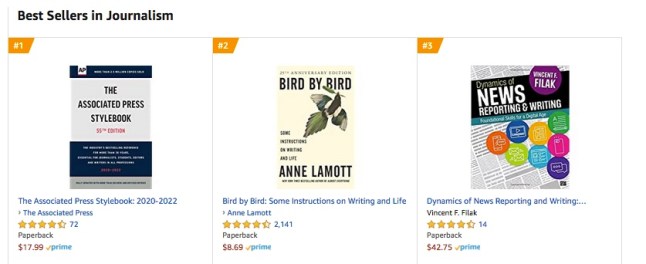
THANK YOU: I was looking for a wall-mounted aluminum-can crusher on Amazon last week, as to keep the number of empty Diet Coke cans from consuming my office, when I did the ego thing and typed in my own name in the search box. When it pulled up the reporting book, I was stunned at what I saw:

Top3

I know that there are 1,001 caveats here, in that this rating happened in only one hour of time, that it happened during textbook buying season, that it’s not representative of larger samples and more. (I know it also feels really self-important to “Google yourself” like this…)

That said, if you had told the 18-year-old version of me as I headed off to college so many years ago that at one point in life, that I would write a book that other people would read, I’d have been doubtful. If you told me the book would be in the top three best sellers in any category for the largest bookstore on the planet at any point in time, it would have been beyond my ability to comprehend. In many ways, it still is.

I don’t think I can adequately explain how big of a thrill it is for me to know that folks out there are using my books and reading the stuff on this blog as part of what they do in teaching this important craft. It’s one of the few times I’m truly at a loss for words, so I’ll just say, “Thank you. And please tell me what else I can do to help.”

See you in September.

Vince (a.k.a. The Doctor of Paper)

Guest Blogging: This headline is too short

koretzkyAs often as possible, we  strive to post content from a guest blogger with an expertise in an area of the field. Today, we are fortunate to have veteran journalist and student media adviser Michael Koretzky, who is explaining his experiences dealing with headline hell. He is the editor of Debt.com, regional coordinator for the Society of Professional Journalists and a volunteer adviser for the student newspaper at Florida Atlantic University. Interested in being our next guest blogger? Contact us here.

As a professional editor and volunteer adviser, I’ve never said this before: Brevity is not a virtue.

Then I was asked to review nearly 50 college headlines.

February and March is judging season for college journalism awards, and I’m currently saddled with “Best Headlines” for two state contests. You’d think this category would be easier to handle than, say, investigative reporting or best overall publication. But you’d be wrong.

The problem with judging headlines is the same as writing them: There’s not a lot of room to get the job done right. That’s why college journalists hate writing headlines. Here’s something I’ve never heard in 22 years as a college newspaper adviser: “Hey, back off! I’M writing that headline! Not you!”

But college journalists make headline writing harder than it has to be. For starters, they seem allergic to decks, scared of space, and obsessed with puns. Here’s an entry I just torpedoed…

Hurdling towards nationals

It’s atop an uplifting story about a first-year track team sending two athletes to a national competition – and one is a freshman. Except you know none of that from the four-word headline, which had no deck. Even worse, only one student runs the hurdles, and it’s one of seven races in which she’ll compete at nationals.

Then there’s this entry…

New ‘Path’ emerges into Butler

…and that’s all you know before the lede begins, “For the 2018-2019 school year, changes were made regarding courses and how students are set to succeed in receiving associate degrees. All Butler freshmen are required to enroll in and pass a first year seminar course in order to graduate.” You later find out this course is called Pathways. So why is “Path” in quotes? Who knows.

Something better (although still not great) would include a deck to give readers a clue…

Pathway to progress

Seeking a two-year degree? New course helps you stick to your timetable

For some reason, more than half of the entries in these two state contests are six words or less, with no decks…

  • Harvest was a party

  • Too Early For Christmas?

  • Inkling for Inkings

…and if you have no idea what’s going on with any of these, then neither did the readers. But here’s the really depressing part: The newspaper staff probably doesn’t have a clue, either.

Whenever I visit student newsrooms, I play a little game. I put up on a screen some old stories and ask staffers what the story was about. They can only see the headlines, so they usually squint at the vague words and answer, “I think it’s about…”

When I point out the irony of a newspaper publishing content its staff doesn’t understand, that’s when it usually sinks in: “Damn, no wonder we don’t have better readership.’

Then I recommend the editors hug their newest, greenest staffers.

These individuals are usually considered a burden, since they don’t yet possess the experience necessary to write, shoot, or design well. But they can certainly read. I urge editors to ask these newbies to bluntly review all headlines and even leads. If they can’t grasp what’s happening with their fresh set of eyes, it’s a fair bet readers won’t, either.

OK, enough chatter. I need to get back to judging. Here’s the headline on my screen right now…

‘Walking dynamite’ lights up community

…and I don’t know what the hell is going on. But I know this entry won’t win.

Shakespeare famously said, “Brevity is the soul of wit.” But the bard never judged a college headline contest.

An attribution-verb word search for beginning journalism students

Professors are always looking for exercises to help their students learn important lessons. After my introductory media writing class had a few “issues” with properly attributing quotes, I decided to put together this handy little word search. Feel free to steal it and use it:

SAID

Let’s just say that Wednesday was a trying day…

Hope the rest of your week goes well.

Vince (a.k.a. The Doctor of Paper)

Teaching the Driver’s Ed Rules of Journalism

The guy who taught me driver’s ed at the “Easy Method” school was a balding man with a ginger mustache and sideburns to match. He told us to call him “Derkowski.” Not Mr. Derkowski or Professor Derkowski. Just Derkowski.

I remember a lot from that class, as he basically beat certain things into us like the company would murder his children if we didn’t have these rules down pat.

Hands on the wheel? 10 o’clock and 2 o’clock.

Pedals? Release the brake to go, release the gas to slow.

Feet? One foot only. We were required to tuck our left foot so far back into the seat that we could feel the seat lever with the heel of our shoe.

Seat belt? You touch that before you touch anything else in the car or you fail the test. (Or as one of my dad’s friends told me just before the exam, “Get in the car. Put on your seat belt. Then, have your mom hand you the keys through the window.”)

There are a dozen other things that still stick with me, ranging from the left-right-left view of the mirrors to the probably-now-unspeakable way to look behind you when backing up. (“Put your arm across the back of the seat and grab the head rest like you’re putting a move on your girl at the drive-in,” he told me once, I swear…)

After 30 years behind the wheel, I still can’t shake some of this stuff, and most of it is still really helpful. Do I use it all the time? No. (I’m sure the man would be having a stroke if he saw me eating a hash brown, drinking a Diet Coke and flipping through the radio all at the same time while flying down Highway 21 at 10 over…) However, it was important to have that stuff drilled into my brain so that I knew, when things got iffy, how best to drive safely.

When I had to drive 30 miles up I-94 in a white out, in a 1991 Pontiac Firebird that had no business being a winter car, you better believe I abided by the gospel of Derkowski.

I had my hands in the right spots, I was looking left-right-left before a lane change and I treated those pedals like I was stepping on puppies (Another one of his euphemisms, I believe; “You wouldn’t stomp on a puppy!” he’d yell at someone who did a jack-rabbit start or a bootlegger brake.)

It took two hours, more than four times what Mapquest would have predicted, as I slowly passed among the littering of cars and semis that had slid into ditches and side rails. Still, I got there alive.

The reason I bring all of this up is because with the advent of another semester (we still don’t start for two weeks, but I figure you all are up and running), many folks reading this blog will be teaching the intro to writing and/or reporting courses. That means in a lot of cases, students will be coming in to learn how to write the same way I came into that driver’s ed class so many years ago: All we know is what we have observed from other people.

My folks were good drivers, but even they were like lapsed Catholics when it came to the finicky points of the rules: Five miles over the limit was fine, seat belts were pretty optional and one hand on the wheel did the trick. Outside of them, the world looked like a mix of “Death Race” and “The Dukes of Hazzard.” Gunning engines at stop lights, squealing tires, the “Detroit Lean” and more were what I saw.

Students coming into writing classes have been writing for years, so they figure they’ll be fine at it. They also figure writing is writing, so what’s the big deal if I throw 345 adjectives into this hyperbolic word salad of a sentence and call it good? Nobody ever said it was a problem before…

The students need some basic “rules” pounded into the curriculum, repeated over and over like a mantra, to emphasize the things that we find to be most important to keeping them out of trouble in the years to follow. Mine are simple things: Noun-verb-object, check every fact like you’re disarming a bomb, attributions are your friend, one sentence of paraphrase per paragraph… It’s as close to a tattoo on their soul as they’re ever going to get.

It’s around this time I often get into random disagreements with fellow instructors about this stuff. Some are polite, while others react like I accused them of pulling a “Falwell Campari” moment. In most cases, the argument centers on the idea that there aren’t really rules for writing or that “Big Name Publication X” writes in 128-word sentences or that paragraphs often go beyond one sentence, so why am I teaching students these “rules” this way?

It’s taken me a long time to figure out how best to explain it, but here’s it is: I’m teaching driver’s ed for journalism.

In other words, you will eventually be on your own out there and you won’t have your instructor yelling at you about where your hands are or if you looked at the right mirror at the right time. You probably won’t die if you drive without your foot all the way back against the seat, nor will not maintaining a “car-length-per-10-mph” spacing gap lead to a 42-car pile up on the interstate.

In that same vein, you won’t automatically lose a reader if your lead is 36 words, or confuse the hell out of them if you don’t have perfect pronoun-antecedent agreement. Libel suits aren’t waiting around every corner if you don’t attribute every paragraph and if you accidentally (or occasionally deliberately) tweak a quote, you won’t end up in the unemployment line.

However, if the basics get “The Big Lebowski” treatment up front, there’s no chance of those students being able to operate effectively when the chips are down. (There’s a reason the military teaches people to march before it teaches people how to drive a tank.) Until those basics are mastered, the students will never know when it’s acceptable to break a rule or why it makes sense to do so.

Of all the things I remember about Derkowski (other than that godawful straw cowboy-looking hat thing he wore) was that even though he enforced the rules with an iron fist, he could always tell us WHY the rule mattered and WHY we needed to abide by it. Say what you want to about the items listed in my “this is a rule” diatribe above, but I can explain WHY those things are important in a clear and coherent way. Even if the students didn’t like them, they at least understood them.

Sure, over the years, the rules change (Apparently 10 o’clock and 2 o’clock is now a death sentence…) with AP apparently deciding to keep all of us on our toes almost to the point of distraction. We adapt to them as instructors and the ones that are most germane to the discipline, we write into our own version of gospel.

We also know that we’re not going to be there to press the point when a former student at a big-name publication uses “allegedly” in a lead. (That doesn’t mean we still don’t. Just ask any of my former students and they can tell you about conversations we’ve had about quote leads and lazy second-person writing.)

I tell the students once they get off of “Filak Island,” they can do it however they want or however their boss wants. (I also tell them to ask their bosses WHY they want to use allegedly or randomly capitalize certain words. In most cases, the answer is silence mixed with “duh face,” I’m told.) However, my job is to teach them the rules of the road, and I think that’s how a lot of us view things in those early classes.

I will admit, however, that it’s fun when I hear back from a long-graduated student who tells me how they can still hear my voice in the back of their head when they’re writing something. (It’s even more fun when they tell me how shorter leads or noun-verb attributions are now the rule at work.)

If we do it right, enough of the important things will stick, they’ll revert to the basics when in danger and they’ll be just fine, even without us there to pump the brakes.

THROWBACK THURSDAY: Exercise time! Pick a song and write a lead (or “Santa sought in hit-and-run homicide.”)

This is still one of the more popular posts on the blog, if you don’t count the “First-Person Target” series and those that covered high school journalists getting shafted. The ability to come up with a fun lead-writing exercise can be difficult, but this one seems to work so we’re reposting it here as we head toward the end of the semester. Enjoy!

—-

In many cases, songs are essentially stories, just told in a different way. If you want a lead-writing exercise that emphasizes critical thought and a bit of fun, have your students write a basic lead to capture the 5W’s and 1H of a popular song. If you want to make it a bit more challenging, add the rule that they can’t use the title of the song in the lead.

Consider this holiday favorite for a simple news lead:

SUMMARY LEAD:
Citing a recent break-up, a Memphis man said Thursday he will be depressed this Christmas, even as he wishes his former girlfriend well.

If you want to have a little more fun or dig a little deeper, this song has been on constantly around here:

Interesting-Action lead:
A North Pole man is accused of homicide after one of his reindeer trampled an area grandmother to death Sunday night.

Name-Recognition lead:
Santa is wanted in a hit-and-run accident that left one woman dead Sunday night as she left a family gathering.

Day-Two lead:
Members of an area family are in mourning Monday after their “grandma” was killed in a hit-and-run accident overnight.


Looking for a “concert review” lead? Try this one:

Review lead:
An area percussionist upstaged several other acts in an impromptu gathering Monday in Nazareth that marked the birth of Christ.


OK, enough with Christmas…

Summary/Event lead:
Many celebrities celebrate “the festival of lights” rather than Christmas during this holiday season, a Brooklyn man said Thursday.


If you want to get away from the holidays all together, you can always pick a song from the recent inductees at the Rock ‘n’ Roll Hall of Fame:

Interesting-Action lead (two sentence edition):
In spite of financial struggles and personal problems, a New Jersey couple said Thursday love has kept them together.
Tommy, an unemployed dock worker, and Gina, an area waitress, said they will continue to fight for a better life because “you live for the fight when that’s all that you got.”


No, I don’t know “any bands from this millennium,” and half the songs my students suggested had a little too much cussing in them to make the folks at SAGE comfortable, so here’s something more recent, less caustic and still really poppy.

Broadcast lead:
Don’t wait to have fun in life.
That’s the message a London-based boy band had for its listeners Thursday morning.

Pick some songs and have some fun!

Hell Lead: Why 66-word sentences don’t help your readers and 3 ways to avoid writing them

As mentioned pretty much everywhere in both books and this blog, the concept for writing a simple lead should be simple:

  • It should be 25-35 words long.
  • It should contain as many of the 5Ws and 1H as possible without overwhelming your readers.
  • It should focus on a single concept to provide focus and clarity to the readers.
  • It should tell your readers what happened and why they care.

Reading the original lead on this story gave me a feeling similar to trying to drink from a fire hose:

More than 1,000 students, teachers and community members marched on the Madison School District’s administrative building Friday in support of a black security guard fired for repeating the N-word when a student called him the racial slur, prompting district officials to vow better education on the history and impact on the N-word and a review of the policies that led to the staffer’s termination this week.

That’s 66 words, or almost DOUBLE the maximum of what you really want to see here. Even more, it’s not just that this is too long, but it’s also WAAAAAY too heavy. (As a brief refresher, length is how we measure leads in a word-by-word approach while weight is about how much content is in there and how all words aren’t created equal in adding to the heft of a sentence.)

When we unpack all of this info, what we learn in the lead includes:

  • About 1,000 people protested at the admin building.
  • They supported a security guard who was fired.
  • The guard, a black man, repeated a racial slur after the student used it against him.
  • The district didn’t say if it would rehire the guy.
  • The district reacted by promising to educate somebody or other on how the slur is problematic and where it came from and why it has the impact it has.
  • The district will review the policies that led to the guard being fired.

Of course, we only learn that if we can wade through all of the stuff in this lead and take the time to figure it out. That kind of “Where’s Waldo?” approach to reading this thing is antithetical to what we’re supposed to be doing with a lead and with journalism in general.

A competing publication did pretty much the same job as this lead with about half of the words:

Wisconsin’s capital city school district is facing national pressure to reinstate a black high school security guard who was fired this week for saying the N-word while telling an unruly student not to use the racial slur.

(SIDE NOTE: The district reversed itself and undid the firing, and Marlon Anderson gets to go back to work.)

The point isn’t to do a “Goofus and Gallant” comparative between the leads, as even the better of them could get some fine tuning. The larger point about this lead is that it wasn’t just one misstep of trying to overcrowd the lead to avoid missing anything. Here are a couple other sentences from the original writer that left me stunned:

This guy is 42…

The swell of support for Marlon Anderson — who worked at West High School before being terminated Wednesday — culminated in a meeting between representatives of the school’s Black Student Union and district officials to discuss the situation that led to Anderson being fired.


This one is 53 words…

Emerging after a nearly two hour meeting inside the district’s Doyle Administration Building, Anderson’s 17-year-old son Noah, who is the president of the Black Student Union, addressed a crowd on what he said was a constructive conversation but just the start on making sure African-Americans are involved in school policies that impact them.

And this one is 63 words, which is exceeds the “coked-up Jay McInnery ‘Bright Lights, Big City’ character” level of run-on…

Speaking to reporters after the sit-down, interim Superintendent Jane Belmore and School Board President Gloria Reyes said the district will take a more concerted effort in teaching students about the usage of the N-word and the harm it causes, will review policies that led to Anderson being fired, and will expedite the appeal process to his firing after Anderson filed a grievance Thursday.

The point of writing leads in the 25-35 word range and body sentences in the 20-24 word range is to prevent exactly the kinds of things that happen here:

  • The readers who want to learn something will get lost and give up.
  • The sentence construction gets so complicated that you run the risk of creating modifier problems and other grammatical issues.
  • The pace and flow of the story get all out of whack because you end up with giant sentences followed by a few stubby ones. Thus, it feels like you’re flying down the highway at 110 mph when suddenly you hit a traffic jam.

Here are some tips on how to fix these problems:

  • Know the point of your piece: Yes, stories can get overly complicated, but as investigative sports journalist Eric Adelson once told me, “If you can’t tell me what your story is in about 25 words or less, you really don’t understand what you’re writing about.” I remember at the time thinking it was a harsh assessment, especially given that he did mostly deep-dig pieces. However, when I asked him to do it for me on the steroid scandal story he was in the middle of digging into, he told me,”Players and owners both knew steroids were used in baseball, but nobody said anything because everyone was making too much money because of them.” In less than 25 words, he nailed it. If you know what you’re doing, things become easier and simpler.
  • Make one point at a time: Readers do have shorter attention spans these days, so it feels like if you don’t throw everything at them at once, you’re going to lose them. However, the “Fistful of Jell-O” rule applies here: The tighter you squeeze, the less you have. In pumping content at your readers like you’re unleashing a fire hose filled with information, you repel them instead of engaging them.
    Start each sentence with the promise to your readers that you are going to make one, simple, clear point for them. Then, deliver on that promise. If you do this, and you have a clear understanding of what your readers need, you will keep them engaged and tell them something that matters.
  • Start from the core out: The sentences in the original story we analyzed feel heavy because the writer probably built them from the front to the back. This is how you end up with major dependent clauses that try to do too much or how you end up tacking on “just one more thing” that will make the sentences you write feel unwieldy. It also comes from not really figuring out what the key point you want to make is (see Point 1).
    To minimize the risk of this, start with the core: Noun-Verb-Object. Tell me who did what to whom and focus on that. This will create a much stronger version of the sentence and also shift your attention to making the noun concrete and the verb vigorous. Consider some of these NVO constructions, depending on the story you want to tell:

    • District fires custodian
    • Protestors rebuke district
    • Citizens protest firing

When it comes to how best to tell a story, it often comes down to how simply can you write the content. Start with the simple elements that matter most and expand up on them with each layer of detail. If the sentence gets too long or too complex, you can cut back on the sentence, removing the outer layers and tightening it back toward the core. In most cases, the writing is in the editing.

A Poynter Plea for Shorter Sentences and the Rosendale Theory of Speeding

A student in my reporting class turned in a story with a 64-word lead, leading me grumble about you damned kids and your hippity hoppity music again.

Ever since I taught my first writing class, I emphasized leads of 25-35 words. If you go past 35, it better be for a good reason. If you go past 40, you’d better be curing cancer with that thing.

Fortunately for me, I’m not the only one muttering about sentence length. Take a look at this piece from Poynter’s Roy Peter Clark, a master of journalism who is about a dozen times smarter than I am on this stuff:

Within a text, white space is created by paragraphs. Short paragraphs create more white space. Long ones, especially in narrow columns, cast a gray shadow on the page. Without reading a word, readers see tombstones with the epitaph: “Heavy lifting.”

This dense packing of words presents itself not only in the body of stories, but even in the leads. An old nickname for this problem is “the suitcase lead.” The writer takes all the key elements, stuffs it into a single paragraph, sometimes a single sentence, and slams it shut. If it doesn’t fit, the writer sits on it till it closes.

In the age of the text message, this trend seems odd.

The trend Clark outlines does seem odd, if you imagine that students are purposely writing gigantic sentences from the get-go. However, if you realize that this is more about language creep and failure to set meaningful limits, this makes sense.

Think about this like you would driving: How often to do you actively attenuate to the EXACT speed you are traveling for any extended period of time? If you’re like most of us, you’re cruising along at whatever speed everyone else is until you all spot the state highway patrol vehicle, at which point everyone starts driving 20 miles under the speed limit.

Only when you know you’re going to get crushed by a horrific ticket do you slow down, which is why a place like Rosendale, Wisconsin is so terrifying to most people.

The Village of Rosendale has about 1,000 people in it and it sits along Highway 23 just outside of the Fox Valley. Most towns of this size aren’t known for much. Rosendale is a legend for its speed-limit enforcement. If you find yourself going “just a few miles over,” you might get nailed. If you think I’m kidding, here’s a look at the T-shirts they sell in the village’s gas station:

RosendaleTshirt

The point is, they’re cracking down like hell and you knowing that puts a little sweat on your brow and removes a little lead from your foot as you drive through that little hamlet.

Think about the last time you were REALLY held to a word limit on a per sentence basis. Most professors force you to stretch for extra pages or longer essays, thus giving you a reason to infuse your writing with superfluous stuff. Even when you have word limits like on scholarship essays or eBay feedback, you’re not limited in each sentence. You can write a sentence that would put one of Bret Easton Ellis’ coked up protagonists to shame, so long as the total word count works.

When it comes to your writing, think about having that Rosendale cop sitting on your bumper, checking out your sentence length. That officer is just waiting to pounce, and all you have to do is ignore the simple rule of keeping things short and tight.

In writing longer sentences, we’re writing for ourselves, either feeling too lazy to go back and edit stuff or too proud of our winding prose to chop it back. However, the readers want to know two simple things:

  1. What happened?
  2. Why do I care?

In each sentence, you can tell the readers those ideas in a simple and easy way if you stick to the noun-verb-object structure and focus on what THEY need to know as opposed to what YOU want to tell them.

In essence, writing that way is just the ticket.