Journalism-related concepts that played out as well in the medical world while I was getting gallbladder surgery

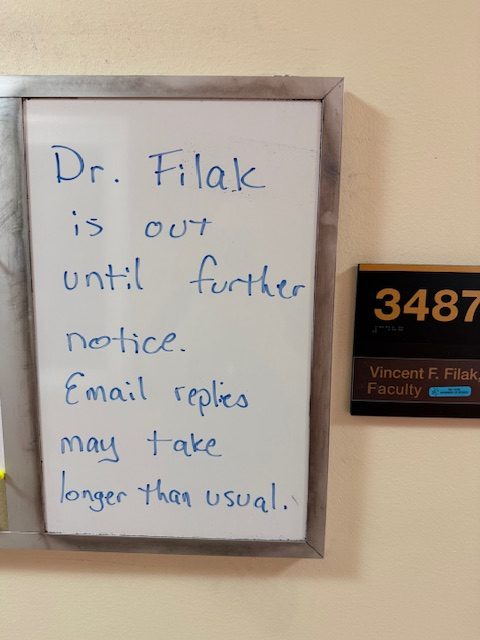
My boss was nice enough to let people know I’d be out for a bit, but this is a little vague… Not like THAT’S gonna lead to speculation…

At the start of every semester, I try to come back with a “X number of things I’ve learned” or a “X years of teaching have taught me” kind of post. It was ruminating (I swear) when my second gallbladder attack in four days hit me badly enough to head to the ER at midnight the day before school started.

Although everything went well, I found myself living out little moments that had me shifting into “analogy mode” as I saw parallels between where I was (the hospital) and where I wanted to be (a journalism classroom). So, as I continue to mend and catch up with the 82,324 things that have landed on my desk while I was gone, I thought a simple slow-walk post of advice would be a good start to what has already been a shaky semester.

(Also, to be fair, I’m still on meds, somewhat hazy and worried I’d somehow come in hot on a topic like Bad Bunny or something that would end up getting me fired without me entirely knowing why.)

So, here are a couple of the maxims that ring true in journalism that kind of came home to me throughout my hospital stay and recovery:

ACCURACY ABOVE ALL ELSE: We’ve been having a lot of conversations like this around the house:

Me: Who called?

Zoe: She didn’t leave her name on the voicemail.

Me: Can I listen to it?

Zoe: She was just like “Hi, this is mumble mumble and I’m with…

Me: So she did leave a name, but you just didn’t understand it? Is it possible that maybe if I listened to it, I could figure it out?

Zoe: Well, I guess…

As much as I expect that out of my kid, I didn’t think I should expect it from a healthcare provider.

Case in point: Upon leaving the hospital, the discharge nurse is going through all the stuff I should or should do, eat or drink. She tells me to avoid fried food and fatty food like bacon. Due to the lack of the gallbladder, these things are likely to create severe gastric distress in the early stages of my recovery.

OK, got it. Most of my diet goes on the shelf.

The other night, Amy made this amazing chicken and potato thing that was part of our “healthy eating” resolution for the year. About 20 minutes after I ate it, I’m in stomach-cramp hell for about two hours. Turns out, she used olive oil on the stuff, which has the same basic effect as those other two things, even though the nurse didn’t mention it and we all usually seem to think olive oil baking is good and deep-fried drumsticks are bad.

I often think about the way in which we ask questions of people in journalism and how we get “almost” answers, or how sources provide information that’s direct but not entirely accurate. From now on, I plan to start interrogating sources like the entirety of my GI tract depends on it.


VOCABULARY MATTERS: We always talk about picking the right word, the proper descriptor or the exact phrase to help the audience understand things accurately. In news stories, it’s relatively important. In the medical field, it means a hell of a lot more.

In trying to explain what he found when he dug into my gut, the surgeon referred to the gallbladder as “angry,” “wicked” and “gnarly.” Those descriptors sound more like the tappers at a South Boston pub than a description of a human organ.

In addition, he explained that something had happened causing my gallbladder to grow a “rind” over the top of it and encase it tightly against my liver. What created said rind and what the rind was composed of, he would not venture a guess. Apparently, I just have a brie-like defense mechanism against gallstones or something.

I didn’t need the whole medical textbook explanation, but it did dawn on me that I felt like I was interviewing Nuke LaLoosh in “Bull Durham” for a bit here:

When it comes to telling people things, keep your audience in mind and use strong, clear vocabulary that helps the folks out there understand exactly what is going on and why they should care.


CONNECTIONS CUT BOTH WAYS: We talk a lot in reporting about the importance of having strong connections with good sources. Those kinds of relationships can give you an edge when it comes to a big scoop, a key interview or a sense of confidence on a topic.

They can also be a problem if sources try to ask you for things you can’t provide or they assume you won’t write about things they don’t like. I always tell students, “It’s great having the mayor feeding you tips, right up until the point his kid gets busted for a DUI and he wants you to keep it out of the paper.”

In terms of connections at the hospital, I was not only being treated at the same hospital where Amy had worked for several years, but I was actually on her old unit. This led to some significant comfort for me in terms of knowing (relatively speaking) who some of these folks are. It was also great because they had nothing but praise for Amy and wanted to know how she was doing at her new job and so forth. I also knew I had a rock-star surgeon because Amy had worked with this guy’s post-op patients over the years, so she knew him and his work.

The “cuts both ways” part really was more of my own making, in that I was groggy and gimpy most of the time, with that “gown” barely doing much of anything. As a massive social hermit, I don’t even like to be in the house when Amy has friends over, so you can imagine how I’d feel about needing their help to wander semi-bare-assed to the bathroom several times a day.

(The closest parallel I can offer is this one time when my parents and I went to a restaurant during the summer and it turned out one of my mother’s teaching colleagues was there waiting tables. She ended up as our server, which felt awkward as hell when I needed to flag her down for another Diet Coke or ask about desert. And at least I was fully clothed there…)

The nurses and staffers were totally professional, even when I managed to set off the bed alarm that Amy used to tell me would tick off the staff to no end. They were also patient with me as my body seemed to be re-calibrating all functions at the same time for no real reason. And it wasn’t like I would be flailing naked down the halls if Amy DIDN’T know these people. Still, it was a combination of comfort and clumsy.

And finally…

TRANSPARENCY IS THE BEST VIRTUE: My buddy, Pritch, used to tell me that in PR transparency is everything, even if what is happening is something you’d rather hide. Abiding by that rule, the first chance I got, I told everyone in my classes what had happened, what the doctors were saying and when we might be able to get back together.

Some kids who knew me but weren’t in the classes I’m teaching got the message on the whiteboard outside my office and kind of freaked out. My boss explained he didn’t want to disclose my health issues without my permission, which is great. However, I know how the minds of journalists work and I could only imagine what it was these people thought had happened to me.

I’ve told Amy this many a’ time: When I die, put the cause of death in the obituary, no matter what. If I died when I broke my neck falling off the couch trying to complete the “bite your own toenails TikTok challenge,” tell people that. It may appear stupid and demeaning, but if I cared enough about it to die doing it, well… there you go. Besides, whatever I did, the speculation of what I might have done will be far worse, I guarantee.

I understand that some folks might be more demure or more guarded than that, which I get, but the less you tell people, the larger the space for the rumor mill to operate. It’s a good rule for PR folks putting out messages and it’s a good thing to remind sources of when they try to get weaselly.


A Sarcastic List of Serious Writing Rules We Need as Media Writers

(It’s important that you get key information in a timely fashion, for obvious reasons, so enjoy the list.)


One of the best things I get to do as a former media adviser and college professor is judge media contests. Between the pros, the college ranks and the high school pubs, I find myself deluged in content on a regular basis. It’s a ton of fun to see what’s going on all over the place, what makes for news in various corners of the country and how certain things are relatively universal across all levels of media writing.

I have to say, and I really believe this, the hardest part of the job is picking and then ranking the winners. It doesn’t matter if it’s just one winner or a top ten, it always seems like there just aren’t enough awards to go around. A lot of good folks are doing some good work all the time.

That said, I also run into a relatively large swath of copy that has me shaking my head a bit. Regardless of experience level, the size of the publication or the purpose of the piece, writers can be uncannily consistent in some really godawful ways.

With that in mind, I’ve built a running list of rules based on the bad, the awkward and the generally problematic writing I’ve been seeing lately. My hope is that it helps break a few bad habits, so folks can make next year’s judging even harder:

If you only have one source, it’s not a story. It’s a soliloquy.

Adding a dozen adverbs to an event story doesn’t transform it into a feature piece.

If you have to tell me, “When asked about XYZ…” in a story, you need to have another place in the story where you tell me, “In a spontaneous outburst of information somehow relevant to this story…”

The key to making a story better isn’t just making it longer.

If a kid from the 1980s could follow your concluding line with, “And that’s one to grow on!” pick a new closing.

Apparently, nobody is a typical professor, a typical administrator, a typical minister, a typical politician or a typical sophomore, so skip telling the reader that in your profiles and just explain who this person is.

Instead of thinking about what you want to write, think about what you would want to know if someone else were writing the story. Then, structure your story accordingly.

Unless you can prove you checked in with every human being on Earth, avoid generalizations like “nobody,” “no one,” “everybody” and “everyone.”

Put extra effort into your opening, whether it is a news lead or a feature opening. If you don’t grab the readers in the first 10 seconds, it won’t matter how awesome the rest of your story is, because they won’t see it.

An expansive vocabulary isn’t meant for you to show off. It’s meant for you to use the exact right words to better inform your readers in a way they can understand.

What you write won’t be perfect on the first pass. If you think so, save a copy for later and try to disprove your assumption with subsequent efforts.

Don’t try to tell me and sell me in your writing. Show me through facts, sources and descriptions and let me come to my own conclusions. You’re a journalist, not a MLM owner.

If you have to explain four things to me before I can understand a fifth thing, that fifth thing better be able to cure cancer.

If you wouldn’t read it, don’t write it.

Terrible tragedies occur when shots fired by armed gunmen ring out (A throwback post)

A newspaper of note sent me an alert recently that told me that police were engaged in an  “active investigation” near on the campus of my alma mater.

When I noted on social media that I’d give anything to know if police were ever in the middle of a “passive investigation,” a mentor messaged me a few more stupid terms that needed to die in the fire of journalistic hell.

(My favorite remains “armed gunman.” If you ever see a guy with no arms holding up a bank with an uzi in his mouth, I’ll back off on this one. Until then, knock it off.)

When police were investigating the Charlie Kirk killing, he sent along one more term that was getting a lot of use:

If you have a “to do” list, please add the “shot rang out” cliche. God I hate that.

The wall-to-wall coverage of Kirk’s death seemed to find as many ways as possible to weave that phrase into the mix, along with one of the problematic phrases listed below (terrible tragedy). Thus, in hopes of getting the message across this time, I dug up the list of bad terms and phrases that really need to go away immediately if not sooner.


An Unprecedented List of Radical, Breaking News Items that Need to have their Ticket Punched to the Ash Heap of History

Every so often, we hit up the Hivemind here for words that are getting used way too frequently for no really good reason. Without further ado, here is the list that emerged from our most recent visit to cliche town:

Unprecedented: Between the pandemic, the Trump lawsuits and the trend of cooking chicken with Nyquil, we are the point where the bar for something receiving the “unprecedented” label is pretty high. At this point, it better be Jesus riding a unicorn while throwing tacos to his followers.

(And thanks to the AI artists program, we actually can check this one off our bucket list of “unprecedented” things.)

You’re welcome. Now, go find something else to use in place of this word…

UPDATE NOTE: Since AI is advancing at a ridiculous rate, I gave this prompt another shot and got the image below:

(I’ve gotta say, we got a much better Jesus and unicorn, as well as some minor improvements on the followers but apparently AI is still having problems with tacos. At best, those are pitas or loaves of unleavened bread…)


Miracle (sports): I’m sure it was a great game or an incredible comeback, but unless the seas parted between third and home or loaves and fishes multiplied in the end zone, we can stop with this.

Radical (political ads): Did the candidate threaten to castrate guys with tin snips in the parking lot of an Aldi’s as part of their plan to limit the needs for abortions? THAT’S radical. The rest is just stuff you don’t like.

Squash (legal term): It is not. You quash a subpoena. You squash a bug. Or you plant a squash.

Agenda (political ads): I’ve yet to run into a politician who has a fully formed set of motives and efforts that they’ve outlined and subsequently enacted, which is the literal definition of an agenda. In most cases, it feels like this:

Punched their ticket to: Nobody punches tickets anymore. I can’t even get a paper ticket so I can keep the stub as a souvenir. I think if the bands you’re seeing are old enough to qualify for Social Security, the fans should be allowed to request paper tickets. And those will still remain unpunched.

Phone ring off the hook: Phones no longer have hooks. They rarely ring. I get that “Phone buzzing off the desk” doesn’t have the same feel, but maybe just take the next train out of Clicheville… I bet they’ll punch your ticket on the way out.

Weaponize (politics): If you accuse people of “weaponizing” race or gender, they’d better be able to launch a missile out of something. Same thing with anything else we “weaponize.”

Officer-involved shooting: Tell me the cop shot someone or that someone shot the cop. Active, not passive.

Breaking news: It’s not breaking just because you finally figured out about it. Also, it’s not breaking news just because you want to tell me something now. “Breaking news: I just started writing this blog post… More at 11…”

Parlay: By definition, it is, “a cumulative series of bets in which winnings accruing from each transaction are used as a stake for a further bet.” You did not “parlay initial success” of anything into anything else. Unless you could lose that success, stop it.

Brandish: It requires a waving with a flourish, usually in anger. The robber with the gun in his pocket didn’t brandish anything. Unless he broke out into show tunes with a dance number…

Parents’ worst nightmare: Really? We sure on that? I just finished watching the Netflix series on Jeffrey Dahmer, and I lived in Milwaukee during that whole time period, so I’ve got a pretty high “nightmare” threshold. I’m sure whatever happened sucked, but if you spent any time in my nightmares, you’d probably not be talking about a kid not answering a cell phone on time in that regard…

Iconic: A friend notes this article on Ben Affleck and a nap as the moment “iconic” jumped the shark. (Another phrase we should stop using, probably, unless this happens again…)

Unique: It means one of a kind. Unless it’s a snowflake or the Hope Diamond, find a different descriptor.

Ash Heap of History: Unless we really are burning the books, stop using this to describe things we stopped using.

Worth noting: Translation- “I don’t have this from a source, but I want to tell you something.”

Terrible tragedy: As opposed to what? Those fantastic tragedies that make us all happy to be here?

Incident (cop speak): “Police responded to an incident in which…” We know it’s an incident. Everything is an incident. Me typing right now is an incident…

Eight Years a Blogger: Come for the knowledge, stay for the snark

It’s hard to believe this thing is still going after eight years, kind of in the same way its hard to believe that the almond-colored refrigerator with the faux-leather texture and Bakelite handle that your parents bought in 1983 refuses to die. I always figured Sage would have decided I was more trouble than I was worth by this point, or I would have run out of bits of wisdom, weirdly effective exercises and opportunities to mock god-awful mistakes in the media.

Oddly enough, that’s hasn’t happened. And speaking of exercises, if you still want to get in on Dr. Vinnie’s Bin of Exercises and AI Joy, feel free to hit the link here.

This semester is guaranteed to be a little off as far as the blog is concerned, in that I found out last week I will need to teach a fifth class this term. It’s the second of the five that I’ve never taught before in my nearly 30 years of college teaching and the third of the five that’s not in my area of expertise.

Why, you might ask… Well..


The relative insanity that this blog provides me might be my only salvation, so let’s get started with a few thoughts to brighten your day (and allow me to blow off developing a giant roster of PowerPoints and podcasts I will likely use only once in my lifetime):


STUIPD IS AS STUIPD DOES, TOO: In digging through a ton of examples I wanted to use for the upcoming classes I am prepping, I was stunned at the level of general incompetence when it came to making sure things were edited before they went out. I’m not talking about internet memes or mom-and-pop operations posting on an AOL-Dial-Up-Friendly website. I’m talking about actual organizations with money and staff support.

The number of missing words, misspellings and generally bad writing made it tough to find quality examples for the kids. I mean, I can’t exactly say, “Here’s a great press release, if you ignore the three misspelled words in the lead and the sentence structure that makes Tarzan look like Shakespeare.” Of all the blunders out there, I had to highlight this one:

If you are in the state, promoting the state and having a fair for the state, the least you can do is spell the name of the state properly in the headline…

Also, for the sake of irony, I found this job posting for an entry-level PR position with these two key bullet-points back to back. And I SWEAR I didn’t PhotoShop this:

I looked at it three times and thought, “Is this like one of those tests where they try to trick you? Like that one speed test where you are supposed to read the whole set of directions first, so that you figure out you only need to do the first thing on the list?

Or do they just really need proofreaders that badly?

Speaking of someone who needs a proofreader:

If you really need something that big to house that item, I feel sorry for your significant other…


DID THAT REALLY JUST HAPPEN? I’ve frequently noted that paranoia is my best friend, so much so, that I often find myself doing double-takes on things I swear I saw that turn out to not be as bad as I thought. It usually comes up when I see a sign for “angus” burgers or “first-hand jobs” or something where my mind drifts to the terrible error, even if there isn’t one.

That said, this Milwaukee Journal-Sentinel headline on my phone really should have freaked out a couple people somewhere at the newspaper:

For starters, that’s not Cavalier Johnson unless I have officially gone blind from computer monitor radiation. Here’s his official city photo:

I have no idea who the dude at the podium is, but Arnold Schwarzenegger and Danny DeVito made a more convincing set of Twins than the two people in the photos above.

Second, and this is really what caught me, that has got to be the worst headline break any human or computer could have made with this story. When I saw that “Johnson speaks with black talk,” I think my brain broke, before remembering Robert Townsend’s spoof of how white people do stupid stuff in Hollywood.

I understand that everything can’t be perfect in every publication, but I also know there are certain topics that need a little more attention and care, due to their sensitivity and the long history of insensitivity associated with them. This is one of those where someone fell asleep at the wheel.

Conversely, sometimes we can really go a bit far in clarifying things for our readers:

Thanks for the clarification, CNN. Otherwise, I might have been confused…

And finally…

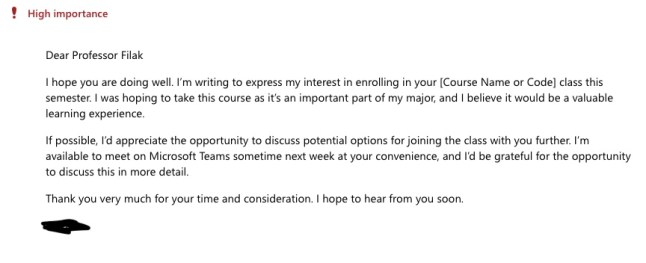
I, (FILL IN NAME HERE), AM HAPPY TO HELP (FILL IN NAME HERE): As is the case every semester, I got a series of “could you please squeeze me into your full Writing for the Media class?” emails over the past couple weeks. The excuses are usually the same (I missed my registration day, I accidentally dropped it, I died while donating my heart to my cousin, but thanks to revolutionary bionics, I’m back now…) as are the ramifications they use to nudge me in their favor (I need this to graduate, I can’t move on with out the class, I’m planning to join a biker gang but they won’t take me without a bachelor’s…)

This one came oh so close to moving me…

Look, AI can be helpful in some cases, but your really gotta meet it halfway…

And off we go on another semester-long adventure. Let’s stay safe out there…

Vince (a.k.a. The Doctor of Paper)

The Art of the Deal: A few suggestions for end-of-term grade debates

More than a few friends are posting online over the past week or so about the end of the semester and the “great grade debates” students tend to engage in with professors. One of them noted that a student demanded a passing grade because, “I’m graduating in a week.”

Um… Doesn’t it usually work the OTHER way around?

As I’ve written on more than a few syllabi over the years, “Instead of telling me at the end of the semester, when you have no hope of passing, that ‘I need this class to (graduate/move on/continue my program/whatever), wake up every morning before class, look in the mirror and say it to the person you see there. Then, behave accordingly.”

Still, if the kid who couldn’t be bothered to prove they were sentient in your class has now become a mix of Clarence Darrow, Jack McCoy and Daniel Kaffee while arguing for a better grade, here is a throwback post that looks at a few options.

Potential solutions for grade debates between students and professors

As the end of the semester draws near, grades tend to become a topic of consternation among students and professors. Students tend to worry about the outcome of their course work as it relates to their ability to graduate, move on or keep that ever-important GPA on the up-slope.

Professors, on the other hand, find themselves buried in grading, often wondering why we didn’t just show movies and mark attendance for 15 weeks. As we slog through the work we brought upon ourselves, students are questioning, begging and cajoling, all in desperate hopes of nudging grades just a little (or in some cases, a lot) higher.

I can’t solve every problem (or most of them) on the blog , but here are a few random ideas I have for making life a bit easier on all of us in regard to the grade debate.

Take them as seriously as they seem…

The “Peace with Honor” grade: I’m sure most students have failed to put in an appropriate amount of time on an assignment at some point in time. I’ve noticed this usually happens on essays or longer-form writing pieces, where the student figures if they pour enough BS into a Word document, the professor will decide to give them at least a few points.

The problem is that professors are often stuck when it comes to grading these papers, even with a quality rubric. We don’t know if you were having difficulty with the assignment, so we need to point out the errors in detail to help you for the next one, or if you just didn’t give a crap, so we’re wasting time telling you things you knew, but just didn’t do.

Thus, I propose a “Peace with Honor” grade approach.

When a student knows they are behind the 8-ball on an assignment, instead of BSing us to high heaven and having us wade through your BS, a student can write something simple like, “I know I should have dealt with this assignment better, but I’m not wasting your time trying to fake it.”

The professor, in gratitude, will fail the student with a specific amount of points (I’m a fan of 40-50%), with the idea that not having to comment on every stupid thing the student could have written will save time and defer carpal tunnel surgery.


The “I’m Better Than This” cease fire: In journalism, we care what you can do, not what your grades are once you graduate. To that end, many professors will encourage students to participate in student media to sharpen their skills and gain experience.

In more than a few cases, this is like encouraging someone to “just try” some cocaine so they can get a bunch of stuff done quickly. The students quickly become addicted to the newsroom and their GPA heads downhill like a stock market graph of the Great Depression.

Professors often start getting weaker work from those students because they’re running the paper or the radio station or the TV station. Suddenly, classes have become something of an fifth or eighth priority in their lives.

For some professors, this can become irritating because we KNOW you can do better at this work. For some students, this can also become irritating because they KNOW they are better than what the grades they get keep reflecting.

A potential solution is this cease-fire approach: I’ve told more than a few students, “Look, I get it. I once skipped six weeks of classes because I was dedicated to the student newspaper. I know why you’re disappearing like a kid running after a red balloon in a Stephen King novel. I also understand I’m not a top priority, so let’s try to make peace with this.

“I will promise not to ride you mercilessly about how crappy your work is in here, if you promise not to piss and moan about your lousy grades. We’ll get you through this alive, and once you end up running a professional newsroom, just make sure you keep your alma mater in mind for potential internship candidates. And don’t make GPA a requirement for successful applications when you’re running the show.”


The “One-Point, Death-Grade, Elevator-Pitch Shimmy” Approach: At the end of a semester in which we grade hundreds of papers across multiple sections and various courses, the computer will eventually spit out a number that correlates to your grade. In more than a few cases, that number will be riding juuuuuuuusssst on the line of a potentially life-altering edge.

For example, if 75 is the demarcation line between a C and a C-, and you need a C or better to continue in your program, you might find yourself sitting at 74.89. The difference between having to start all over with a course or be able to take what you’ve likely scheduled for next semester hangs in the balance of a professor’s attitude regarding rounding, grade-grubbing and the degree to which they want to tolerate you again.

Here’s the best I got for what I would consider “death grades,” the line between pass/fail, advance/retake or B-/C+ (It’s hard to sleep at night knowing you were THAT close to a B of any kind and came up short.): If you’re within a point or two of that death grade, we professors promise to tell you before we file. You have 24 hours to make up a 30-second elevator pitch that would convince us to buy your argument for a better grade.

If you use the words “deserve,” “worked hard,” “need this to graduate,” or any other whiny bull-pucky, you’re done. Gimme at least one or two concrete reasons that I told you were relatively important to this class that you learned or did that make you worthy of me shimmying  up your grade a tad.

My discretion in the end, but I gave you a chance.

And finally…


The “But I Tried Really Hard In This Class” Resolution: When your grade is somewhere in the vicinity of the Mendoza Line and you missed so many classes that I almost called in an Amber Alert on you , it’s kind of ballsy to make the claim of effort.

That said, numerous students do this every year, so here’s the best solution:

Good luck with finals and we’ll see you next time!

The stuff you wished someone had told you about looking for life after college (A Throwback Post)

YARN | Christ, 7 years of college down the drain | Animal House (1978) |  Video clips by quotes | 8468e662 | 紗

And this guy didn’t even have student loan debt…

Students have been stopping by the office lately with one of two declarations:

  1. “I got a job! The world is full of rainbows and kittens and sunshine!”
  2. “I can’t find a job. Is there any chance you could back your truck over me a few times in the faculty parking lot so I don’t have to go live in my mom’s basement for the rest of my life?”

The highest of the highs and the lowest of the lows are both likely to find things are significantly different than they expect them to be after the cap and gown goes to Goodwill and they begin the next stage of their lives.

Today’s throwback post is a look at something I deemed “Life 101” a few years back. A group of really smart folks I’ve had the honor of knowing (and in some cases teaching) were willing to chip in words of advice for the soon-to-be graduates. Seemed like a good time to bring this back.

As the post notes, this was part one of two, so I’ve linked the original part two at the bottom if you are so inclined.

Enjoy!


Life 101 (Part I): Everything you wished you’d known before you graduated but nobody told you

life depressing funny college - 8102692096

(It’s not really that bad. You just need a few hacks here and there to soften the situation.)

A student showed up in my office a few weeks back with a big smile on her face and the peptic energy that only comes from wanting to tell someone else the best news in the world.

“Dr. Filak! I got a job!” she said, a mix of glee, elation and relief pouring out of her as she explained what she did and how this worked and where she was going to be employed.

I listened and congratulated her multiple times before I asked the inevitable question: “You don’t have to tell me if you don’t want to, but what was the offer?”

She proudly told me how much she was making, which was a decent amount. She wouldn’t have to steal Splenda packets from local diners or live on Ramen for every meal, that’s for sure.

When I asked how the negotiation for that amount went, she said, “Oh. They just gave me the salary they were going to pay me. I asked my parents if that was good money and they said it was, so I took it.”

She noticed the look on my face. “Oh no!” she said. “Did I do bad?”

“No,” I said. “But you could have done better…”

I then explained the whole process of salary negotiations to her and she realized something nobody at this institution had ever taught her: Salaries ARE negotiable. So are so many other things.

If universities are good at training students to develop skills that will help them get their first career jobs and put them on the path to a fully adult life, they absolutely suck at helping students make the transition from college to that life. I know this from my own experience, as well as that of colleagues and former students, so I thought a good wrap up for the semester would be one final lesson for the group: Life 101.

I asked the hivemind of folks I trust through various social media outlets and connections to tell me one thing they wished they’d known before they left school that they found out the hard way once they got into the “real world.”

Today’s post is the first of two that look at issues beyond graduation, focusing mainly on getting a job and the reality of that first job.

Tomorrow’s post will look at the life issues you face once you get out and become “a grown up” that you probably won’t see coming.

I hope this helps:

THE JOB SEARCH

There are few things more anxiety-provoking and terrifying than looking for a first career job out of college. You have put in the time and energy to pass the classes. You got the grades they said were going to propel you forward. You got involved in every activity someone said would “look great on a resume” and you worked at student media, internships and part-time gigs to fatten up your experience.

You put yourself out there and… crickets…

As a college student, I feared my parents’ basement. I constantly heard of students who did “all the right things” but ended up living back with their parents in a basement because they couldn’t get a job. I mentioned that to several students and several currently employed former students and the vibe was the same:

“I was scared to death that I’d done all this work and I’d be living back home in the basement. I never had a problem with my family, but I damned sure didn’t want to be back there as ‘that kid.’”

“I knew I could go home. I just didn’t want to. I wanted to be a grownup.”

I have said this before and the people who have experienced it have told me I am dead on with this analogy. Those who haven’t tell me I’m crazy. Then, they experience this and they convert to my way of thinking:

Your first job search is a lot like a bad dating experience: You are ready to go, so you put yourself out there. People are ignoring you and it feels awkward. You don’t know what’s wrong with you, so you get really worried.

Then, someone shows an interest and you have that kind of, “Cool. We should hang out. Let’s exchange info” moment and you get really excited. You start imagining how nice it’ll be and your mind takes you on flights of fancy regarding this relationship.

Then, you don’t hear from them for a while and you start wondering what you did wrong and why they aren’t calling. You start questioning everything you’ve done to this point. You wonder if you should reach out, but you don’t want to look needy.

Eventually, you’ll start to get angry with the, “OK, screw you. I don’t need you thing.” You give up, only to hear from that person shortly after that, with the person giving you a true and great reason why it took so long to reach out and that they really want to see you in a day or two, so let’s set this up…

And then you’re like, “OHMERGERD! I LOVE YOU SO MUCH RIGHT NOW!” but you play it cool and the cycle begins again…

As I’ve told more than a few sobbing students over the years, “It’s not you. You are good. The right people just haven’t figured that out yet. It’ll happen. Trust me.”

(In completing the analogy, that’s what my mother used to try to tell me each time I got dumped in high school… She wasn’t wrong, but the situation still sucked.)


THE JOB OFFER:

The first career job offer is something most people never forget, and I certainly remember getting my job offer from Mizzou.

Well, I remember most of it.

At one point when I was being offered the job and told about what this involved, I think I passed out on the phone. Blood was pounding in my ears, my chest felt like it was going to explode with joy like a frickin’ Care Bear and I couldn’t believe how lucky I was.

giphy-downsized.gif?cid=549b592d5ab2ba3b6270323273a5dcae

When the first offer came, I took it. No questions asked. I was so happy to be getting that job.

About two years later, my boss called me into his office and told me, “I need to let you know something. I totally screwed you.”

He explained that when he hired me, he gave me the lowest lowball offer he could, figuring I’d negotiate my way up to something more reasonable. When I didn’t, he was over a barrel. He couldn’t just give me more money, but he also knew I didn’t know any better.

(To be fair, he then told me he was getting me connected with the grad program so I could go after a Ph.D. It was a fair trade in the long run.)

He was a good guy and it never occurred to me that he had lowballed me. He then gave me the best advice I share on a regular basis, “Never take the first offer. Always negotiate for your worth.”

Of all the things people mentioned in their responses to me, salary negotiations were the most important:

“Journalism is not a ‘calling.’ It’s a business. Negotiate your pay. Don’t work for less than you’re worth. Think 5-10 years down the road.”


“Don’t count on the editor who hires you to have your economic interests at heart. You should be prepared to negotiate for the pay you need to live, and expect them to expect you to negotiate because it may be a LONG TIME before you have as much leverage to get yourself more money than when you have the initial job offer.”


“Know your worth and don’t settle just to get hired and have a job. A LOT of companies are hiring, so test the waters and see where you feel valued.”


“Agreed with everybody who said negotiate your starting salary. Do some research of similar roles in the area and don’t just take the first offer that comes because you’re scared/excited just to get one, which is what I did.”

In addition to negotiating salaries, people noted that they wished they’d negotiated for extra vacation time, an earlier start for health insurance, improved hours/requirements and other bennies that they thought were just written in stone.

Another person noted this “look forward” in life as crucial:

Take whatever 401k match is offered, even if you can’t contribute anything else right away.


WELCOME TO THE FIRST DAY OF THE REST OF YOUR LIFE (OR NOT)

When I went to my college orientation session about 30 years ago, the people there told us that we would likely change jobs about six or seven times in our lifetime. At that point, they meant that we would likely climb the corporate ladder, maybe switching companies within our field, but essentially staying put.

According to recent data, Millennials will change CAREERS almost six times in their lives. People now tend to stay with an employer for an average of three or four years, even with opportunities for advancement. This shifts the entire paradigm of how to look at your first job. Here are some thoughts from the hivemind:

“Paying your dues” is an outdated concept. Don’t let your parents, employers or friends convince you otherwise.


The quality of the job and the people you work with are far more important than the location.


Having a different approach to teaching and research is a GOOD thing!… Students need to know there’s many paths towards your goals in life. Do what works for you.


You don’t have to stay in the first job you get after college forever. It’s okay to change your mind or realize it’s not something you enjoy.


(I wish someone taught me how to deal with) not starting exactly in the position you want and how to be content with the growth process. Your degree does not always land you your dream job immediately.

This last point leads us to the unfortunate truth associated with taking that first job…


YOUR JOB MIGHT SUCK

As much as the dream job might be just a dream, it doesn’t mean suffering and pain should be your daily life at work. Everything from toxic workplace environments and weird bosses to feeling lost and becoming undervalued can make that first job you were so excited about feel like an abusive relationship.

I’ve worked for bosses that I would step in front of a bus for, because they were so helpful, supportive and just entirely amazing. I have also worked for bosses I wouldn’t feel bad about nudging into path of oncoming freeway traffic.

The folks who chimed in on this had similar experiences:

Your boss makes all the difference for how well you do in your first few jobs. Take your first job based on how well you vibe with the boss.


I once told my son that if he ever has a job where the manager/supervisor/head honcho etc, comes over and parks his butt on your desk, smiles and says, “we’re all like family here”…….Leave.


Also that just because things aren’t perfect, it isn’t necessarily your fault:


Your first job isn’t your only job. Sometimes it legitimately sucks and that’s OK. It’s not an indictment on you or your work.


Always work toward aligning what you want to do with what your job/career actually is, while still getting your current job’s work done of course. But always keep working toward doing what you want to do, even if your first job out of school isn’t your dream job (it won’t be).

The one caveat I’ll offer here is the one based on my own sense of paranoia: There’s nothing wrong with leaving a job because it’s not what you want or need. That said, have your next move already to go upon your decision to quit.

I equate it to the old “Tarzan” movies when he’s swinging from vine to vine across the jungle. Don’t let go of one vine until you have the other in hand.

TOMORROW: Life, or something like it, after college.

6 thoughts for new journalism graduates on the job hunt that have nothing to do with actually getting a job (A Throwback Post)

It’s not quite graduation time yet, but given the palpable anxiety I am sensing from my students, the job hunt for soon-to-be graduates is clearly underway. A young woman with a great set of experience showed up in my office this week with that “frustrated nnnnnggghhhh” vibe about her, as she had put multiple resumes into the field and gotten few responses.

“Should I call them or something?” she asked. “They’re not getting back to me and I’m worried.”

“When did you apply?” I asked.

“Last week…”

So that was a “No” on my end, as well as a reminder that as to how she needed to look at this whole situation. As I began to say it, she cut me off.

“I know, I know,” she said. “You were right. This is like bad dating. I need to be patient.”

Along with that pearl of weird-dom, here are a few other thoughts for your graduates looking for some help on life beyond the ivory towers and dive bars that formed their college experience.


6 thoughts for new journalism graduates on the job hunt that have nothing to do with actually getting a job

Graduation swept through town this weekend, and along with it came the speeches, the pomp, the circumstance and academic regalia (When I wear mine, I look like Henry the VIII got a Mr. T starter kit for Christmas).

img_5057.jpg

I no longer have the beard, but the medals are still pretty sweet…

Along with all this comes the anxiety of, “OK, now what?” Some students have jobs and they’re worried about how well they’ll do at them. Others have no jobs and wonder if they’ll ever get one. Parents worry that their children will be happy. Some probably also wonder if they’ll have to give up the home gym or a spot in the basement for a returning grad who hasn’t “found it” yet (whatever “it” is). What comes next?

For journalism grads, the anxiety can be even more palpable, as everyone seems to be telling you that your field is dead and you should have gone into business. Other fields can spend months or even years cultivating students for a job that’s waiting for them upon graduation. Journalism? I’ve been told once during a first interview, “We’d like to offer you the job today (Saturday). Could you start Monday?”

I asked the hivemind of pros and profs what advice they had for you all and it was really a mixed bag this time. Usually, everyone chimes in and it’s all in the same vein. This time, things were all over the place. One professor friend of mine noted:

My adult daughter just moved back home, soooo I got nuthin’.

I have often relied on the famous William Golden quote about Hollywood as well: “Nobody knows anything.” Whoever tells you, “This is how to get your perfect job” is either lying to you or trying to recruit you into a cult. Unlike all of those multiple-choice tests you’ve taken over the years, this question doesn’t have a right answer. That said, here are a few to think about as you try to game up for the next stage of life:

  • You have to be idealistic, but you have to be practical: U.S. Olympic hockey coach Herb Brooks once said this in explaining his team’s chance to do well in the 1980 Olympics. His point was you should shoot for the best possible outcome, but you shouldn’t do so without a reality check. In the case of the job search, take a shot. You want to work at a top five newspaper, in a top 10 TV market, a Fortune 500 company or whatever right away? Toss an application out there. What’s the WORST that can happen? They say no and you don’t get the job, which is right where you are right now.
    That said, a 22-year-old journalism graduate with five clips from an internship at the Tamany Tattler and a year’s experience at the student newspaper isn’t likely to land at one of those spots right away, so feel free to look elsewhere. Apply to starter jobs, smaller firms and other places that have openings and you think would be worth a shot. You have to eat. You have to pay rent. And, as they mentioned in “Bull Durham,” it beats selling Lady Kenmore’s at Sears.


  • Don’t become a desperate psycho-hose-beast: As Tom Petty noted, the waiting is the hardest part. For you, this is the most important thing ever, especially if you’re searching at this time of the year. Even if it’s not cold, snowy and gray where you are, a winter job search can be danged depressing. You know that you don’t want to go home for the holiday where every well-meaning relative will ask, “So, what are you doing now that you’re graduated? Do you have a job?” (Side note 1: When you say “No” and they look at you like you just came down with an incurable disease, remember that look so that you never give it to anyone else ever. Side note 2: Realize that these people will always ask you questions like this that will sap your will to live, even after you get a job. “Do you have a job?” will become “Are you dating anyone special?” will become “So when are you getting married?” will become “Don’t you two want kids?” will become “Are you sure you only want (1, 2, 3…) kids?” Your only hope is to outlive this person so you don’t have to hear, “Are you sure you want to be buried here?”)
    This can drive you crazy and it can manifest itself in a number of ways, none of which are good. The worst thing you can do is take it out on potential employers as you decide to call, email or text repeatedly to find out exactly WHERE they are in the hiring process. Most people can smell desperation a mile away and it naturally repels them. Think about the guy at the bar who is insistently trying to buy a gal a drink, a shot, an appetizer, a game of darts or a 1979 Chrysler Cordoba. Does that interaction ever end well for that guy? If you ever need a reminder of how bad this can get, catch the classic “Mike from ‘Swingers’” scene (NSFW- some cussing) or the “Wayne’s World” look at Stacy’s unrequited love.
    In short, don’t push it. Breathe.


  • Look more deeply into your toolbox: The premise of both of these books is that we’re putting tools in your toolbox that you can use in a variety of ways. If you can find the perfect job that  makes you happy right away, that’s great. If not, don’t be afraid to apply those tools elsewhere. A recent grad sent me this note, which touched on something I never considered:

    After I graduated while I was looking for work I hooked up with a temp agency. It’s a great way to try different stuff without major commitment, you gain experience (and interview skills), you get to network, and you get a weekly paycheck. And some positions are temp-hire.

    A journalism professor noted something similar:

    Think creatively about ways you can use your journalism skills for other professions, such as PR, teaching, trade publications, advertising, web producer and social media manager jobs. Many more people cross back and forth into journalism and other careers these days than they did back when we were journalists.’

    Look around you and see what kinds of places need your skills and don’t fret if they don’t have your exact degree specified in the requirements. You will bounce a lot in this day and age (sometimes by choice, sometimes by necessity, sometimes against your will), so look for things that you think might pay the bills and give you a leg up the next time your perfect job comes around.


  • Remember the Johnny Sain Axiom on Old-Timers Day: Sain, a longtime pitcher and pitching coach, used to disdain Old-Timers Day. It wasn’t the concept he opposed, but rather that banter among the older players. Sain used to note that “The older these guys get, the better they used to be.”
    The same thing can be true for you when dealing with people who are more than happy to tell you that when they were “your age” they got a job right out of school or they had a perfect job waiting for them or whatever. In their mind, they had it all figured out perfectly and made a seamless transition between their education and a career, so why can’t you?
    The truth is, it wasn’t that easy for most of them. Some people just got a fortuitous bounce, a lucky break or a family connection. Others don’t work in your field, so comparing your search to theirs is like comparing apples and Hondas. It’s not that they’re better or stronger or faster or whatever. It’s just the way it happened for them. Each search and each job is unique (and I mean that in the truest sense of the word), so don’t let what other people tell you about how great life is get you down.
    Even more, don’t presuppose that people you see as your role models nailed the perfect job on the first take. I met with a couple students last week who kept referring to a recent grad as “having it all worked out.” She was their role model who, according to them, interned at Company X, graduated into a full-time job at Company X and then got promoted at Company X in less than a year. She was their Golden Goddess.
    What they didn’t know was all the anxiety she had about getting ANY internship, how she had been rejected twice by Company X for an internship and how she ended up sobbing in my office multiple times after that. They also didn’t know about the office fights and other less-pleasant aspects of Company X. In short, the grass isn’t always greener.


  • Don’t keep up with the Joneses: The easiest way to make you hate yourself and your job search is to compare yourself to other people in a constant game of one-upmanship. If Billy gets a job in a top 75 market, you shouldn’t try to get one at a top 50 market. If Jane gets a job as a writer at a 50,000 circulation newspaper, don’t just go looking for a job at a 100,000-circ paper to prove a point.
    I watched this happen constantly among peer groups of students at several of my previous stops, in which it wasn’t enough to get A job, but rather it was crucial to get a job that was better than someone else’s job. Here’s the problem: Just because a job is at a bigger place or somewhere with more cachet, it doesn’t follow it’s a good fit for you. This was how one of my former students ended up in Kentucky doing night-cops, despite not wanting anything to do with Kentucky or a night-cops beat, simply so he could look more impressive. It didn’t work out and he was miserable, before eventually going back to a job that was more “him.”
    I know it’s hard to push back against that competitive thinking. (Trust me, it happens everywhere, even in my gig. Former professors will tell their former doctoral students, “Oh, I see you’re at (less prestigious university)… Did you know that James is now at (mega-university) and he’s a dean?”) However, if you find something you like doing, you’ll never really work a day in your life.


  • Never forget this moment: You will eventually get a job and  you will do well. You will get older and get more responsibility. You might change jobs or careers or whatever. However, what should never change is your memory of this moment right now, when you’re scared out of your mind about getting any job at all, making rent, dodging Aunt Ethyl and her questions at the family holiday party, trying to avoid calling the Beaver County Tidbit 1,002 times to find out if they are still interested in you and everything else you feel.
    If you can remember the feeling you have at this moment, you will never lose your empathy for the future generations who are going through it. It might help you in little ways like not asking the “Aunt Ethyl” questions of your younger family members or hustling a bit more to get through that stack of resumes you need to read. It might help you in big ways as well, like thinking a little better about the next generation instead of a little worse of it. (People  more than occasionally ask me if being around younger people all the time doesn’t make me kind of envious of their youth. My answer is always, “Hell, NO!!!!!” I survived my 20s the first time and made it this far. There’s not enough of anything in the world to make me want to go back to that point in time).
    When it comes to getting employed, things almost always work out. I know that sounds ridiculous, but my batting average on things like is pretty good and in the end, you’ll have some great stories to tell.
    And thanks to your journalism education, you’ll tell them well.

A Lot at Steak: How U.S. Education Secretary Linda McMahon’s AI Blunder Led to Marketing Gold

THE LEAD: Secretary of Education Linda McMahon managed to confuse AI (artificial intelligence) with A.1. (steak sauce) while delivering her comments at the ASU+GSV Summit last week.

The gaffe became fodder for all sorts of internet humor, but company responsible for making the condiment saw an awesome opportunity and took full advantage of the mistake:

A.1. Sauce capitalized on McMahon’s blunder by posting an Instagram post on their verified account saying, “You heard her. Every school should have access to A.1.”

“Agree, best to start them early,” the picture attached to the post reads.

Other Instagram users loved the response from the Kraft Heinz-owned brand. One user even commented, “I will be buying a bottle or two because of this post.”


KRAFT-ING MARKETING GOLD AGAIN: Kraft Heinz, which markets A.1., has a decent track record of grabbing a cultural moment and running with it. The company took advantage of the “Barbenheimer” explosion by introducing a pink “Barbie-cue” sauce and has also linked a ranch dressing to Taylor Swift. In each case, the company drew attention to its brand, garnered some nice free media publicity and avoided the kinds of gaffes often associated with trying to ride a trend.

Despite the random uncertainty in the market these days, the stock closed up on Friday and has shown a gain from $27.60 on April 9 to $29.33 on Friday. Although that time frame corresponds with the comments McMahon made about A.1., it’s a bit simplistic to say the gains were solely connected to that mistake.

In its rating of best food stocks to buy according to billionaires, Insider Monkey rated Kraft Heinz at the top of the list for a number of reasons, including global supply chain and reliance on AI (not A.1.) for keeping factories humming. Still, people are saying they’re buying a bottle or two of the steak sauce as a result of the gaffe:

So far, A.1.’s loyal fans seem to be in support of its “new sauce.”

“My husband wants a bottle for his desk,” one commenter wrote under the brand’s post. “He teaches middle school, at least until they replace him with A.1.”


BLOG FLASHBACK: Kraft Heinz isn’t alone in taking advantage of dumb situation with some marketing genius. As we noted back in 2018, Country Time Lemonade drew a lot of attention after it created its “Legal Ade” defense fund for kids who had been fined for not having a business permit to run their lemonade stands.

Like the A.1. effort, this worked because it was on the right side of the argument, made fun of the utterly ridiculous and didn’t run a significant risk of hurting its brand with this maneuver.

Other organizations tend not to be as lucky when they jumped in on trending hashtags or didn’t think about potential blow back before entering the larger discussion.

DISCUSSION TIME: What do you think Kraft Heinz should do next? Ride the wave? Leave it alone? Try something else? Also, what other marketing maneuvers have you seen that tried to connect with a trend? Did they succeed or fail in your eyes? Why?

The Junk Drawer: Only Good News Edition


I’m sure I put my happiness in here somewhere…


Despite all evidence to the contrary, this blog will not be renamed “Dr. Vinnie’s Trip Through Depressing News and Abject Sadness.” Over the past couple weeks, we’ve focused a lot on things that range from “not all that great” to “Can we get that asteroid Bruce Willis supposedly destroyed to take another shot at us?”

In a somewhat Quixotic attempt to make for a brighter day, despite the fact it might still snow here today and it’s likely that next week, the Easter Bunny will be frozen to the ground, we’re going to do a round up of a few things that give us some happiness. At least that’s the goal…

Let’s start with the best news for journalism…


AP’S BACK IN THE (WHITE) HOUSE: The Trump administration banned the Associated Press from the White House Press Pool in February for not agreeing to use the preferred term of “Gulf of America” when referring to the body of water everyone else calls the “Gulf of Mexico.”

AP sued to regain access and a judge found in favor of the wire service on Tuesday:

In a sharply worded opinion, Judge Trevor N. McFadden of the Federal District Court for the District of Columbia wrote that the Trump administration must “immediately rescind their viewpoint-based denial” of The Associated Press from presidential events.

“The government repeatedly characterizes The A.P.’s request as a demand for ‘extra special access.’ But that is not what The A.P. is asking for, and it is not what the court orders,” he wrote. “All The A.P. wants, and all it gets, is a level playing field.”

Trump actually appointed McFadden to his current position, so there’s no room for the argument that he’s some sort of Commie-Pinko, Barak-Hussain-Obama, Panickan judge. (I’m sure someone will argue that anyway, but still…) The judge did actually stay the order for five days to give the Trump crew a chance to appeal, but the opinion is very pro-AP.

Speaking of awesome journalism wins…


A LOOK AT THE UT-DALLAS STUDENT-MEDIA DEBACLE EMERGES: Of all the stories we’ve discussed about student media getting shafted, the one I dodged was the story of UT-Dallas. The reason was that a good guy and former staffer at the school’s paper, Ben Nguyen, was working on a deep dive about the topic. He and I first crossed paths at a student media conference in Minnesota, when he and one of his colleagues ended up breaking a story about a professor at UTD saying disgusting things on social media.

In this case, the story looked like a short piece on how the school wasn’t acting right. Ben had sources and background on all of that. However, the more he dug, the weirder it got. We talked a couple times about where this could go or what he had found.

He just emailed me a little bit ago with the published product and a note:

Throughout everything, I’ve appreciated our conversations while I’ve put this draft together. It’s definitely ended up twice as long and about 5 months later than I initially expected, but I hope it’s at least a more comprehensive record of what was a truly absurd chain of events.

Click here to read all of Ben’s hard work.

Speaking of journalistic hard work…


TAKE SOME POYNTERS FROM A GREAT SOURCE: Barbara Allen, the former director of college programming for the Poynter Institute, has taken on a new adventure with the launch of her new project that covers college journalism from all angles.  The website can be found here, where she outlines the kinds of stories she covers, the resources she provides and the content she curates for educators, students and media folks.

You can also subscribe to the newsletter she puts out weekly, which keeps you up to date on the crucial events impacting student media as well as highlighting some amazing pieces that students are doing in their own communities. I was proud to be one of the early adopters on this one and I have found a ton of great stuff on this site.

And finally, speaking of being proud of something…


THAT’S “HEY, YOU DISTINGUISHED IDIOT” TO YOU, PAL: I try to keep the personal promotional stuff to a minimum here, as this blog isn’t about me, but rather it should be about stuff you care about.

That said, I have to mention this because it speaks volumes about what makes for a good job and a good boss.

I was submitted for a promotion earlier this year, and when a rather specious decision came back from the committee, my boss and my boss’s boss had my back. They could have easily said, “Well, the committee makes the decisions,” or “Well, you’ll get ’em next time.” Instead, they said, “This is stupid and wrong and we’re going to fix it somehow.”

And they did. So, along with not having to file an extra post-tenure review report, I got the benefit of being named a “distinguished professor” at UW-Oshkosh.

The title is nice, although I still go back to all the students who wrote fire briefs in which they noted how firefighters “distinguished the fire.” I also think back to the “Doctor of Paper” origin story. Trust me, I’m not getting cuff links made with “Distinguished” on one and “Professor” on the other.

However, I will continue to tell my students that while more money or a cooler title can be appealing during your job search, finding the kind of boss you’d walk in front of a bus for is really worth a lot as well.

I hope this was positive enough for everyone. 🙂

Vince (a.k.a. The Doctor of Paper)

PS- I’ll be headed to Missouri to speak at the Missouri College Media Convention this weekend, so the blog is on break until next week. Can’t wait to blog all about it.


When the marketing pitch is juuussst a bit outside (A throwback post)

In spite of what the optics suggest, my goal in life is not to write a book for every possible subject I might ever teach. In fact, I’m often on the look out for a good book for certain courses, including blogging, principles of advertising and feature writing (the one I have been using is discontinued).

So, when a company pitches an email at me about a book I’ve requested (usually through an online form or as a “standing order” in case they find something), I’m all ears. That said, here’s an email I got this morning that isn’t going to cut the muster:

Here are a couple reasons why this pitch isn’t going to work:

  1. I’m not teaching a convergent media class any time soon, nor have I taught a class in a while that might fit this bill for this book.
  2. I didn’t actually request this book, or access to it.
  3. Most importantly, if I wanted to peruse the book for any reason, I wouldn’t need a special code for this, as it’s my book.

Look! It’s got my name on the cover and everything!

I understand that publishers are in need of reaching out to sell stuff, and I’m glad that my other publisher (Focal) is doing something to try to connect people with this book. However, it does make me question their overall approach when they a) couldn’t bother to eliminate the author from the sales database and b) approach the selling like those scam texts that are “just providing you with information that you requested on this exciting opportunity!”

So, for the last Throwback Thursday before Spring Break, here’s a look back at another time where the pitch a publisher threw was juuuuuuusssssst a bit outside….


So… No, then? (or why it’s important to research your readers before you pitch to them)

I understand this blog tends to skew more toward news than some folks might appreciate, given that my entire pitch for the “Dynamics of Media Writing” is that ALL disciplines of media (news, PR, Ad, marketing etc.) can get something of value out of it. The skew is due to trying to cover both the media-writing text and the news reporting and writing text in one spot. It also also comes from the idea that a lot of things people perceive as “news” things are actually valuable for all media, including skills like interviewing, research, inverted-pyramid writing and so forth. Finally, it seems that news folks tend to make more public mistakes than do some of the other disciplines, so I get more content there. (If you want me to hit on more topics in the PR/Ad/Marketing stuff, feel free to pitch me some thoughts. I’d love to do it.)

That said, occasionally there is a specific foul up in a specific part of the field that bears some analysis. Consider that when you look at this email I got the other day. I redacted the identifiers as best I could:

Dear Professor Filak,

​Greetings from (COMPANY NAME)! ​I hope this finds you well. In the coming months, (AUTHOR NAMES) will begin to revise the twelfth edition of their introductory journalism text, (REPORTING BOOK NAME). ​This text strives to give students the knowledge and skills they need to master the nuts and bolts of news stories, as well as guidance for landing a job in an evolving journalism industry.
Right now we are seeking instructors to review the twelfth edition of (REPORTING BOOK NAME) ​a​nd provide feedback. This input is invaluable to us, ​as it ​giv​es​ us a greater sense of how to best address both instructor and student needs. ​If you are currently teaching the introductory news reporting and writing course or will be teaching the course soon, would you be interested in offering your feedback?
If you would like to review, please respond to this email and let me know if you will need a copy of the printed text. You should plan to submit your comments via TextReviews by 2/6/18. In return for your help, we would like to offer you (MONEY).
At your earliest convenience, kindly respond to this e-mail to let me know if you are available and interested in participating. ​Again, please let me know if you will need a copy of (REPORTING BOOK NAME)
I’m always happy to help people and I’m not averse to making a buck by pretending to know what I’m talking about, but this felt both awkward and ridiculous. One of the things both “Dynamics” books push a lot is the idea of making sure you know what you’re talking about before you ask a question. The books also push the idea of researching your audience members so you know how best to approach them. Either the person writing this email didn’t do that or just didn’t care.
Here’s how I know that: It’s called “Google.”
Had this person done even a basic search on me she would have learned several things:
  • I am teaching the courses they associate with this book. I teach nothing but these courses, as you can find on the UWO journalism department website. The line of “If you are currently teaching the introductory news reporting and writing course or will be teaching the course soon…” tells me I’m on a list somewhere and this is a form email at best.
  • I wrote several books, including one that is likely to be some form of competition for this book. (I’m not saying it will be as good or better or anything, but my title includes words like “news,” “reporting” and “writing,” so it’s a pretty safe bet we’re vying for the same students.) This was literally one of the top five items on the first page of my Google search. She also sent her message the same day I got this alert from Amazon:NumberOne
    (I have no idea how Amazon quantifies “#1 New Release in Journalism” but I’ll take it.)

    The point is, it wasn’t a secret, so it appeared that she didn’t look me up and was like the guy at the bar telling me, “Hey, see that babe over there? I’m totally going to score with her!” and I’m like, “Uh, dude, that’s my wife…”
    On the other hand, maybe she did look me up, found the book and asked anyway, which is like the even-worse guy at the bar who’s saying, “Hey man, your wife is pretty hot. Any chance you can give me some tips on how to score with her?”

Thinking about all of that for a moment, I did the polite thing and emailed back, explaining how I felt this would be a conflict of interest (it is), and that any advice I gave her would be likely be somewhat problematic as the author of a competing book (it is).  I also noted that I know the book she is pitching well (I do) and I know the authors well (I do), so this would also be a bit awkward for me (it really is). Here was her email back to me, which again made me think she wasn’t actually reading this:

Hi Professor Filak,

Thanks so much for letting me know. We will certainly keep you in mind for future projects!

So, again, the point of the blog isn’t to beat people up for doing things poorly but rather to offer advice on how to do things better. Here are a few basic tips:

  • Research first, then write: You don’t have to do an Ancestry.com profile on every person to whom you market or with whom you engage in outreach, but it’s not hard to Google someone. Most people put more social-media stalking effort into learning about the “new kid” at school than this person put into finding out about me. In marketing, you often have access to proprietary data as well, so you can find out if this person had any previous engagement with your organization. In my case, I used that book for more than a decade and still keep up with it, so that might have been something she could have found.
  • Personalize when possible: If you are sending out 100,000 requests for something like a survey and you are expecting a 10 percent response, you will not have the ability to personalize all of the information on everyone’s card or email. That makes sense. However, when you are microtargeting a group of people with a specific set of skills or interests and that group isn’t going to overwhelm a data center, work on personalizing your content. That line about “If you are currently teaching the introductory news reporting and writing course or will be teaching the course soon…” could have easily been tweaked to say something like, “I see you have taught writing and reporting courses at UW-Oshkosh…” and it wouldn’t have taken much. Making these minor tweaks shows that you have done your research. Engaging in some personalized communication shows your readers you care enough to see them as individuals as opposed to a wad of names on a spreadsheet.
  • Try not to screw up, but if you do, don’t ignore it: The one thing that stuck with me when I got that response email from her was that I didn’t think she figured out what she was actually asking me or why it was weird. I had that feeling that if I had written her back and said, “I’m sorry I can’t do this because I’ve just been placed in an intergalactic prison for the rest of my life for murdering a flock of Tribbles with a phaser I set to ‘kill’ instead of ‘stun,’” I would have gotten the exact same email back. The whole exchange really reminded me of this scene:
 The thing that is important to realize is that you are going into a field that has two important and scary things going for it:
  1. It’s small enough that you’re really about two degrees of separation from everyone else, so people know other people.
  2. People in the field love to talk.

If you end up screwing up because you didn’t do the first two things suggested above, don’t compound the problem.

I have no idea if I’ll ever get approached by this publisher to review anything, but I know I will always carry with me the memory of this interaction. Had it been a great interaction, that would have been good for the publisher. Unfortunately, that wasn’t the case.

A Brief Follow-Up on Fact-Checking A Flaming-Fart Claim

Apparently, I wasn’t the only one who saw the claim that Gorman Thomas once lit a fart and took off one of Alfredo Griffin’s eyebrows in the process:

Clearly, I hit a nerve…

This was the most traffic I got on a single post in one day since the opening of the blog. By 6 a.m. Thursday, I had more visitors than I have on most normal days. A former student hit me up on Facebook to let me know his friends had found it while Googling this topic and that my post was pretty high on the list. So, I took a look on Google and found this:

I’m now famous for all people who Google “Gorman Thomas” and “fart.” Mom would be so proud…

My post was at the very top of a Google search, something I never thought could happen on anything not sponsored. Apparently, I should have pivoted the blog away from journalism years ago and focused primarily on fact-checking retro-claims of the farts produced by athletes…

I guess if there are a couple key points to make about all this, they are:

  • I’m thrilled that so many people took the time to try to fact check the claim about Gorman Thomas, as it gives me hope that maybe we aren’t all digital lemmings. I’d be even more thrilled if folks were digging into things with a little more societal gravitas, but we all have to start somewhere, so let’s be happy for a moment on this one.
  • Oddity still remains a key interest element. Every time I rework the books for subsequent editions, I try to make sure that they’re aging well. When I pitched the FOCII mnemonic for knowing what tends to draw people to information (Fame, Oddity, Conflict, Immediacy and Impact), I could point to specific examples I was seeing to support each element. In each subsequent edition, things in the world kept getting weirder and weirder, so it wasn’t always clear if we had become kind of numb to Oddity. Apparently, we haven’t. Or we all just like the idea of lighting farts.
  • If someone out there knows Gorman Thomas and is reading this, tell the man I’ve got his back.

And tell him I’ve still got the ball he signed for me.

Until next week,

Vince (a.k.a The Doctor of Paper)