Hostile Takeover: The Indiana University Media School’s plan to converge student media and why the students hate it (Part III)

This clip is both an accurate assessment of the IU situation with the exact level of specificity the university seems to be offering as to how this will all work.

(EDITOR’S NOTE: This is the third part of a multi-part series on the decision of the IU Media School to unilaterally converge its student media outlets, the Indiana Daily Student, WIUX and Indiana University Student Television. Part of the plan calls for the elimination of the final print edition of the IDS, something upsetting to the students.

If you want to help the students keep their print paper, they have listed this link as a way to do this: https://forms.gle/cisJyhvAxuQbC4co7.

If you want to tell Dean David Tolchinsky what you think about this situation, you can email him here: mschdean@iu.edu

In case you missed them, here are Part I and Part II.)


THE CULTURAL CONCERNS

In looking into the convergence model decades ago, it became readily apparent to me that this wasn’t a situation where technology or news values would be the sticking point. It would be the culture of the newsrooms and the social identity those newsrooms created.

The general gist of all of this comes down to the idea that you can’t just pour a bunch of people together into a media operation and assume this is going to work. In fact, the opposite is true, as we reaffirmed more than a decade after that first look. A few things have to happen if this kind of convergence is to work:

  • It has to be a self-directed, organic movement. The few operations on the student level that have worked out tend to be those in which the staffs themselves decide this is a good idea and want to participate. Outside influence and demand tends to dramatically undermine convergent operations.
  • There must be a heavy investment in new resources. One of the easiest ways to get kids to play together is to give everybody new, cool toys. That works for my 3-year-old nieces and it works for most corporate organizations. If you come to the party feeling like you have “your toys” and that people want to take them from you, things are going to get ugly. Even more, in a situation in which resources are limited, groups tend to hoard things for themselves, even when a more equitable distribution might benefit the greater whole. Although university officials insist there will be investment in additional professional help, most of this is aimed at adding master’s students with professional backgrounds to the mix. As both a former grad student and someone working through a project that involves the use of grad-student labor, I can assure you it isn’t the same thing as dedicated, trained professional staff.
  • The groups must have the appropriate shared goals and vision. One of the primary reasons early convergence operations hit some significant rough patches was that the newsrooms tended to have mutually exclusive goals. In the world of journalism, being first (a.k.a. getting the scoop on the competition) is a primary goal.
    At the time, television had the advantage of going live first, so when newspaper people found out something of value, they tended to keep it quiet so they could publish it in print the next day. Instead of seeing the goal of getting information out to the audience in a timely fashion, regardless of platform, it became, “I want to be first.” This was a microcosm of what tended to go wrong due to a lack of shared goals and vision.
  • People must value and appreciate the importance each group brings to the collective.  The best way I have found to describe how this works is like this: I, as a writer, don’t have to do what you, a videojournalist, does to make this operation work. I do have to understand what you do, appreciate what it brings to the table and find ways to augment what you do in a meaningful way.

This last one might be one of the biggest sticking points for this IU effort, based on how the students explained their own operations and those of their potential convergence-mates.

WIUX President Trevor Emery said that the media operations tend to remain siloed and that they don’t have any sense of what each of them could do for the other.

“Us and the newspaper, don’t talk about it. Us and the TV station don’t really talk about it,” Emery said. “These guys are kind of on their own game, creatively, for sure, like we are. I’m gonna be completely honest. We’re primarily music station and that is our main focus. And the newspaper mainly does news. Their arts column is kind of piddly, and the TV station is, I don’t know, they do like everything. I’m not super familiar with them… sometimes (The IDS will) interview an artist that we booked or something, but other than like news and sports, there’s not a whole lot of crossover that’s possible because we mainly do music and entertainment.”

IDS co-Editor-in-Chief Marissa Meador said she had brief contact with members of the radio station and the TV station after the announcement broke. Although she hasn’t had a lot of interaction with the broadcasters, she said what she does know doesn’t fit the model established at the IDS.

“From what I’ve heard, I feel like WIUX, the radio station, is kind of fundamentally different,” she said. “They put on a music festival, and a lot of their people are just interested in music. They aren’t journalism majors at all, and so the idea that they’re now supposed to be generating a profit or generating revenue and selling advertisements? From what I’ve heard from the few representatives I’ve spoken to, they aren’t super excited about that idea.”

In terms of convergence efforts, Emery said the specifics have been horribly lacking.

“They really want us to combine all the podcasts,” he said. “They want us to be on an app together. It’s very, very confusing, and they’re kind of like, “You guys are going to be steering the ship for this thing you don’t want to do, but we’re also not going to fully support anything you’re doing, either. It’s very confusing.”

The student leader of IU Student Television did not respond to interview requests for this piece, so it’s unclear how engaged or enthusiastic the staff there feels about this situation. As part of an hour-long talk show on IPM’s Noon Edition, IUSTV news director Ashton Hackman spoke in favor of the plan, in large part because of the resources the TV station would be getting.

Hackman said the station has often operated in an inequitable position, only in recent years getting studio space in the Media School and having no professional staff to help them. Although Hackman praised the plan, he rarely mentioned the editorial convergence opportunities the school has been pitching and mostly focused on the benefits the TV station would obtain in this model.

Meador said earlier that she could understand why some aspects of this plan look great for IUSTV.

“I think that they’re, at least publicly, their organization is taking a positive position,” she said. “They seem to be publicly very supportive and celebrating this decision, which, to an extent, I think makes a lot of sense. They started with no professional staff members, and now we’re going to share the professional staff members’ work and time among all three organizations… I do see how this would be a step in the right direction for them.”

Speaking of people who see this as a step in the right direction…


THE UNIVERSITY SPEAKS (SORT OF)

IU Media School Dean David Tolchinsky seemed extremely happy and excited to announce this master plan to converge the student media outlets when he put out this press release.

“Successful media organizations are not afraid to reinvent themselves, and we have big dreams for student media at IU,” said Media School Dean David Tolchinsky. “We are proud of our tradition of excellence in student media. Through innovation, we will amplify the storytelling our students already do so well by reaching audiences where they consume content and generating revenue to support the organizations, enabling them to become the best learning labs they can be.”

In spite of student disagreement, Tolchinsky doubled down in a letter to the editor of the IDS, as he gave the “rah-rah” speech to end all such speeches:

We acknowledge the loss the IDS community feels for its weekly print edition. “Journalist” is not just a job; it’s an identity. 

We hear you: Why can’t IU just give student media more money? Actually, that would be a lot easier than what we’re doing. But subsidizing a business model on campus that does not reflect the ecosystem off campus won’t adequately prepare students for the career landscape they’re entering.

Remember those vanishing newsrooms? Someone has to do something about those. And our goal is to turn out creative and bold graduates equipped to solve that problem — and many more. 

You can do this. WE can do this. The Media School will always support student media.

The letter says, “‘Friday Night Lights’ with Coach Taylor telling us, ‘Clear eyes, full hearts, can’t lose.'” The photo says, “Joe Pantoliano’s character, Cypher, in ‘The Matrix.'” Y’know, the guy who sold out the whole crew.

Given all that, I figured he’s be more than happy to answer a few questions, so I offered him a phone interview, but included a half-dozen questions in case he or his associate deans were too busy to chat.

The response was underwhelming:

Thank you for your interest. I’m going to primarily refer you to the web storyFAQs, and plan on our website, and will add that our ad hoc committee that presented the recommendations this plan draws from included representatives from the IDS, WIUX, and IUSTV. Many operational details, such as the questions you raise in #6, remain to be decided under the purview of Director of Student Media Jim Rodenbush.
I did reach out to Jim Rodenbush, whom I’ve known for a number of years through various student media organizations. He’s a good guy, a strong free-press advocate and really invested in the IDS newsroom. That said, I didn’t get much from him either. He politely declined to talk about this, noting that they were “working through the process” and that the details “would come into focus over time.”
It felt like this in some ways:

I don’t blame him for not talking, because a) if he really loved the thing and told me, the newsroom kids would probably consider him a heretic or b) if he really hated the thing and told me, he’d be going directly against his boss without the protections of tenure or a guaranteed job.
What I didn’t account for was c), which emerged when Rodenbush asked a question of his fellow media advisers on a group’s listserv, explaining that his dean had asked him to draft a confidentialy agreement for the two of them:

Quick background: The recent announcement by the Media School was leaked in advance to the IDS, and my Dean is largely trying to avoid this sort of thing from happening again. I wasn’t the person who leaked the announcement, but here were are regardless. All that said… Are any of you aware of similar agreements existing at any other university between a Dean and Student Media director? Are any of your part of such an agreement? If so, could I see the language? Overall, is there anything I should be concerned about?
So let’s see if I have this right: The dean is so excited about this whole convergence thing that he’s basically declined to comment to a blogger about it and then the guy he has charged with commenting on behalf of the entire process is now being asked to sign a confidentiality agreement?
I wonder what background and relevant experience gave him the idea this was smart…
THE IMDB DEAN
According to the bio on the Media School website, Tolchinsky is pretty impressive: Degrees from Yale and USC, former position at Northwestern University and a content-creation background.
He also has a wicked IMDB.com page, as the entirety of his career prior to landing the dean gig at IU has been linked to cinema. That might be great for some things, but not when it comes to understanding how student newspapers, radio stations and television stations work.
This was one of the main concerns critics raised back in the 2010s when the school decided to shift from a journalism school to a media school. The prevailing theory at the time was that journalism would get the shaft, especially if other folks who had no predicate knowledge or interest in how it works took over. If the design and presentation on Tolchinsky’s website are any indication, these people might have been more prescient than we could imagine.
I don’t think Tolchinsky needed to be long-time journalist, a war correspondent or even a local newspaper publisher to understand that this entire approach was bass-ackwards. Any degree in a news-related field would have told him that you can’t hide stuff from journalists, and that journalism folks tend not to like being pushed around by “the man.” In addition, all research related to newsroom culture found that a) it exists and b) it persists beyond any one individual or group. In short, things don’t just change in a newsroom because you want them to.
A degree in public relations would have helped him see that you can’t just Jedi-mind-trick everyone into thinking the way you do by issuing a few blanket statements and then hiding under the bed when people come to ask real questions. You also can’t tell someone they need to be “confidential” and then have them speak on your behalf. (That’s especially true if you want them to be believable.)
In this field, you can’t just call for a script doctor or some CGI to bail you out when things aren’t to your liking.
NEXT TIME: OK, so now what?

Hostile Takeover: The Indiana University Media School’s plan to converge student media and why the students hate it (Part II)

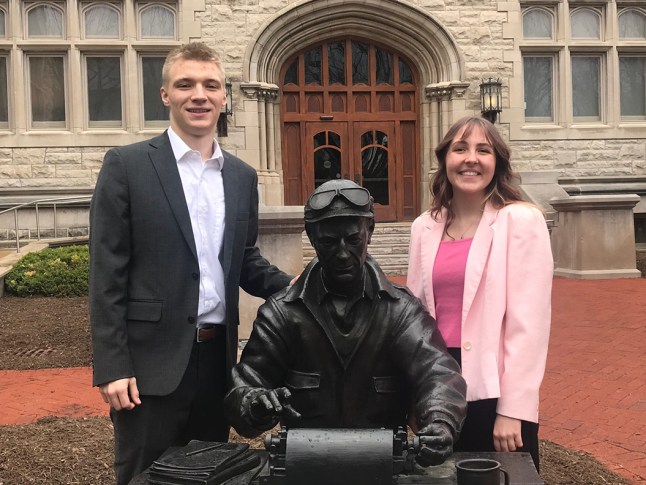
Jacob Spudich and Marissa Meador pose next to the famed Ernie Pyle statue outside Franklin Hall after speaking to the Student Media Board during the application process to become co-EICs. Photo courtesy of Marissa Meador.

(EDITOR’S NOTE: This is the second part of a multi-part series on the decision of the IU Media School to unilaterally converge its student media outlets, the Indiana Daily Student, WIUX and Indiana University Student Television. Part of the plan calls for the elimination of the final print edition of the IDS, something upsetting to the students.

If you want to help the students keep their print paper, they have listed this link as a way to do this: https://forms.gle/cisJyhvAxuQbC4co7.

If you want to tell Dean David Tolchinsky what you think about this situation, you can email him here: mschdean@iu.edu

If you missed Part I, you can find it here.)


THE ANNOUNCEMENT

Trevor Emery, the president of WIUX at Indiana University, knew something was going to change for his radio station in a fairly substantial way.

He just didn’t know what it would be or how fast it would hit.

“On Monday, we all get an email in the early afternoon, and it was three, four o’clock,” he said in an interview. “It said, ‘We’re all gonna meet Wednesday and talk about some big news for student media.’ And then Tuesday I’m my home… I get out of the shower and I look at my phone, and I have four missed calls from one of the IDS editors, and I call him back, and I’m like, ‘So what’s going on?’ He was like, ‘Have you seen what the media schools posted?’ I’m like, ‘No.’ Then they bugged me for a quote.”

The editors had received a leaked copy of a plan about massive changes coming to student media. The Media School stated it would merge the student media under one umbrella operation. It would also kill the final print edition of the IDS, shift the professional staff around to cover all the media branches and create additional media options, including a newsletter and an all-encompassing digital app.

“Then Wednesday, the next day, we all go into this meeting, and the dean starts off with, ‘Oh, the IDS got this report in a leak, and we just preempted them by posting it directly,’ The whole meeting felt like they were telling us, ‘We are here to inform you of this decision anyways, whether you like it or not,'” he said. “So then that says to me I was never going to be asked about anything in the first place.”

The mood at the IDS wasn’t any better, as the staff scrambled to make sense of what they had seen and tried to inform their readers about the issue. Co-editors-in-chief Marissa Meador and Jacob Spudich had planned to attend a meeting on Wednesday, where they thought they’d be asked for some input on a plan people had been working on since April.

“I think there was kind of like an assumption from Marissa and I that this meeting was going to be more of a constructive meeting where Marissa and I’s input would be valued somewhat, and I think that became clear that that was not the case that Tuesday,” Spudich said in an interview.

Meador said they found out the school had planned to meet with faculty Wednesday at 2 p.m. to clue them in, speak to her and Spudich at 3 p.m. and then make the formal announcement at 4 p.m.

“It’s hard to believe that anything we said was going to have an impact on their final decision if they had planned to release it right after our meeting,” she said.

With that in mind, and a copy of the plan in hand, the IDS crew went to work as reporters. They built both a story that provided the news of the plan and people’s reactions to it as well as a letter from the editors in which they expressed “no confidence in the Media School’s plan.”

“I feel we should have been considered in this decision,” Spudich said. “This is about more than just the money aspect. It’s about  staffing, the abundance of our newspaper stands around town, and the visibility that we have there. There’s just a lot of things that we don’t feel were taken into consideration. And really the only way they would have been is if a representative from our newsroom was there to voice those concerns early on in this process.”

Emery said the radio station also felt let down by the plan and the approach the administration took in announcing it.

“It did come out of nowhere, and it would have come out of nowhere on Tuesday, or would have come out of nowhere on Wednesday,” he said. “I don’t really have a difference on the day of the week that I’m getting screwed over. But it was very confusing.”


AT LEAST 99 PROBLEMS

When it comes to the financial aspects plan itself, the members of the IDS had several, specific concerns:

  • The cutting of the print edition didn’t make sense. The paper version of the IDS was revenue-positive, and it was a key way to reach the community, both for older people who still preferred that platform and as a signal on news stands that the paper was still publishing. Furthermore, the original committee’s recommendations did not include cutting print. The plan calls for the retention of special issues, but how those are done and which ones will happen remain a mystery, the students said.
  • Continual cutting had not solved any significant problems for the IDS to this point. As its name indicates, the IDS once published a daily print edition, but over the years, in response to dwindling revenue and loss of print readership, the staff had cut the paper and print run. The race to the bottom of printing still left them in debt.
  • This plan was created without transparency and then forced upon the staff. As Meador noted in an interview, the previous cuts or changes the IDS undertook to fix the finances were done by the IDS itself. This would be the first time print cuts or organizational changes were mandated by an external agency.
  • The resources aren’t there to make this work. Much like the convergence efforts of yesteryear, this one looked to get fewer people doing the work of more people. The comparatives the Media School was drawing to other converged student media operations involved far more professional staff and much higher buy-in from the institution, they noted.
  • It’s unclear who will be paying for what. The specifics about cuts are clear, but the revenue-generation portion and such are exceptionally vague. The radio and TV stations do not generate revenue, so the cost of the professional staff will have to come from somewhere else. Currently, the IDS pays their salary and benefits, but it’s unclear how that burden will be spread moving forward.

As far as WIUX was concerned, the problems were even bigger.

“The newspaper really is like the elephant in the room,” Emery said. “They’re consistently $300,000 over budget… The newspaper as a thing works, and they know that it is profitable. What isn’t profitable is paying like five or six adult-level salaries to people with health insurance and whatever else. And we don’t have any of that. We have a faculty adviser, and she does the work of like 10 people, and she gets paid a small stipend from the school just to help out.”

Emery said the three organizations rarely interact, primarily because they all have different interests, different needs and different purposes. The student newspaper produces local news content, while music and community events drive the radio station. (A representative from IU Student Television did not respond to requests to participate in this series.)

“I sit in these meetings with the media school, with the staff and the dean at times, and I point out that we are definitely much more student-life based,” he said. “We connect with the community. We were trying to get people out in public by doing events, things like that. We just finished up our whole week of events and a fundraiser to keep our station going. None of the two other clubs that we’re talking about do that.”

With both broadcast groups run as student clubs, Emery said they were not allowed to do certain things to earn money. In exchange, they both used to receive money through student life via student fees. However, around 2020, he said, the stations got cut off from that funding without much explanation.

“We were getting, at one point, like 70 cents a student, undergraduate student on the Bloomington campus,” Emery said. “So that ended up being like $30 or $40,000 a year. And we managed that to where we had a pretty big surplus. By the end of where that landed, like three or four years ago, we had like $150,000 to $200,000… Over the past four or five years, that’s dwindled down.”

With the Media School calling for a three-year phase in, Emery said he’s worried that time and funding might run out for the station.

“They also are like, you’re going to have three years to implement this, and it’s obviously not going to make money in that meantime while we figure out what systems to use and build a client base, etc., etc., and they won’t tell us how much money we’re going to be supported with during that time,” Emery said. “I’m assuming that they’ll cover the salaries of the newspaper, and they’re like staff, the pro staff. But for us, I don’t know what that means. That’s essentially the time when we run out of money in our account.”


NEXT TIME: The problems with convergence and the background of the guy trying to make it happen at IU.


Hostile Takeover: The Indiana University Media School’s plan to converge student media and why the students hate it (Part I)

The Indiana Daily Student’s first issue from 1867.

(EDITOR’S NOTE: When I started digging into the Indiana University Media School’s plan to merge the Indiana Daily Student, IUSTV and WIUX, I thought this was going to be a quick post on one week and then a Q and A with the staff, if I got lucky.

However, in looking into this more deeply, this officially started getting out of hand over a week or more. Thus, I wanted take a couple bites at the apple to try to understand what this is, how we got here and why one of the best student media operations in the country is in this situation. Buckle up. Stuff gets weird…. — VFF)


In early October, the Media School at Indiana University announced its plan to converge multiple student media outlets in an attempt to save money and develop synergistic editorial efforts. The Indiana Daily Student, WIUX radio and IU Student Television would be gathered under one umbrella, whether they liked it or not. In addition, the plan called for the elimination of the final print edition of the IDS, something that was clearly upsetting to the students.

The students published several pieces, including an editorial and an article, that outlined the general problems with this approach and the ham-handed way it was presented to them. For the IDS, this was like a mob hit: They never saw it coming and now they’re left picking up the pieces as they grapple with what could be a new reality for them.

“Obviously, we’ve been looking for ways to address our deficit for quite a while now,” Co-Editor-in-Chief Marissa Meador said in a recent interview. “We’ve been cutting print from five days a week to two days a week to one a week and that was part of that process. All of those previous print cuts were made by IDS professional staff in consultation with student leaders, not the Media School. So that’s a key difference here: This proposed cut of the weekly print edition is not supported by our professional staff, by student leaders, was not done in consultation with Jacob or I, and is being conducted by the media school and not the IDS. So that’s an important distinction.”

The paper faced both a deficit built up over time as well as one that was likely to continue into the future. How this happened is a big part of the story…

THE SITUATION

Not to overstate the obvious, but newspapers in the United States are dying at an unprecedented rate. More than a decade ago, it became clear that newspapers were essentially getting killed due to several market forces: Decline in advertising revenue, expansion of options for consuming content, decline in journalists creating content and a drop of interest people had in reading newspaper papers. A Medill Report from 2023 found that nearly one-third of all U.S. newspapers that existed in 2005 would be gone by the end of 2024. That would leave about 6,000 papers in the country, compared with nearly 24,000 in the early 20th century.

Campus newspapers found themselves facing a similar problematic future along those same timelines. The salad days of ads pouring in, as advertisers rushed to the only platform that could deliver them the campus market, ended and students were left to scrambling to deal with the change. A 2013 report from the Pew Research Center found that these publications were engaging in many of the behaviors as their professional counterparts for many of the same reasons.

The Indiana Daily Student is both the oldest and largest member of the student media on the IU-Bloomington campus. It is also one of the most award-winning college media outlets in the country. It has experienced many of the problems outlined above, despite weathering them better than many of their peer publications while receiving no financial support from the university itself. The paper had a $1 million reserve as far back as 2005 and had maintained a reasonably stable financial condition into the mid-2010s.

However, a confluence of events, including cuts to print, decreases in national advertising, university-mandated payments and COVID led the IDS to run a debt of nearly $1 million as of early 2024. In July 2024, Media School Dean David Tolchinsky emailed the IDS staff and said an arrangement with the provost’s office had led to the decision to wipe clear the million-dollar debt. However, underlying financial issues meant the IDS was likely to build that debt back up.

According to Meador, the paper appears to be on pace for another deficit-spending year to the tune of around $300,000

THE REPORT

Part of the decision to let the paper run a deficit in the first place back in 2021 was the agreement that the IDS and the administration would put a plan in place to both fix the deficit and prevent it from coming back. James Shanahan, dean of The Media School at the time, and Jim Rodenbush, who remains director of student media, issued a press release together, explaining the goal of this maneuver:

As we work together to secure the long-term future of the IDS, and with agreement from the Office of the Provost, the IDS will be permitted to operate at a deficit for three years beginning in the 2021-22 fiscal year. Any remaining deficit after that time will be covered by The Media School. There will be no immediate changes to the professional staff structure.

Discussions on the future of the publication have been in progress for some time. Media School administration and faculty have continued to work behind the scenes while responding to urgent modifications to teaching and staffing models necessitated by COVID-19.

As with most things put on a multi-year plan, things languished for a substantial portion of that time, with no real movement toward any reasonable solution. The IDS staff was concerned and said as much, while various options, including selling IDS swag, closing the campus yearbook, using newspaper racks for advertising on campus and other cash-raising options, were not allowed by the administration.

Tolchinsky commissioned an ad-hoc committee to figure out what was going on and what was the best path forward. In April 2024, the committee, which included representation of professional staff from the three student media outlets, issued its report. A few key takeaways were:

  • Student media at IU is not unique in its struggle to persist in the face of changing dynamics in the areas of newspaper, radio and TV operations.
  • The university red tape regarding marketing and sales rights has hamstrung student media in any attempt to generate revenue beyond the distributed content created by the student media outlets.
  • The university is out of step with the trend of current student media paradigms, as most colleges and universities provide student media with some form of financial support.
  • The administration needs to start thinking about student media the way it thinks about other learning opportunities that exist on campus and stop thinking about it as a profit-making enterprise.

The recommendations from that report were two-fold:

  1. Unify the operations under one umbrella as both a cost-cutting and editorially synergistic maneuver. This would eliminate redundancies while connecting students across the media platforms in a way that could improve content.
  2. Get the university to pony up some significant cash to keep these operations running. The report noted a $6 per semester student fee could allow the publication to continue as it stands while remaining in the black.

“Their overarching point there was that any plan moving forward should treat the IDS as an educational experiential learning opportunity, not as a business,” Meador said. “That was a big point. A major part of it was asking for some sort of direct University support, maybe in the form of a mandatory fee, which a lot of other college newsrooms have.

“What was not on our radar at all was that they were considering cutting the weekly print edition. We did not think that was that was on the table. It was no one talked about it in the report, and yet, that’s one of the few things in this October report that actually is being implemented right now. All the other things are, you know, future, future things. So, you know, we’re kind of, we knew this whole time that they were developing their plan, but we had no idea that it was going to involve print until the report got leaked to us and then it got announced on Tuesday.”

UP NEXT: The plan to converge and the fall out.


Indiana University administrators unilaterally killed the still-profitable print edition of the Indiana Daily Student in order to try a “convergence” model that we proved to be a failure back in 2002

“Here is your news robot, Mrs. Burgess! It’ll beam content into your brain until you forget that the Indiana Daily Student used to have a newspaper you liked!” (screenshot from the IU home page; sarcasm naturally grown in Wisconsin)

THE LEAD: In yet another ham-handed, “we grownups know best,” maneuver, administrators at Indiana University decided to kill the weekly print edition of one of the country’s best college newspapers, without discussing it with anyone involved at the Indiana Daily Student:

The IU Media School plans to eliminate the Indiana Daily Student’s weekly print edition beginning this spring as a key part of its plan for student media, claiming the move will save money and help make a converged IDS, WIUX and IU Student Television operation revenue neutral within three years.

The school announced the plan publicly Tuesday afternoon before consulting with student media leaders or the IU journalism faculty, even though the school had scheduled meetings with both groups Wednesday. Most of the IDS’ student staff members, including the designers that work to design a print product each week, were unaware of the change when it was announced.

THE FALLOUT: Well, for starters, not telling someone that you’re about to do something painful to them, without their consent or input, only to have them find out on their own is not really going to build confidence in the approach.

(It reminds me of when Zoe had to get her 18-month boosters and no one mentioned it until the nurse came in and plunged three needles into her leg before Zoe got a glance. The fourth needle hit and she began to sob uncontrollably as she looked at me with the, “Why hast thou forsake me?” look and I wanted to die.)

The IDS staffers, who were supposed to have a meeting on Wednesday to talk about this with administrators, found out when a draft of the plan leaked early (because of course it did) and a press release leaked (because, y’know, these kids are good journalists who find stuff).

Let’s just say their letter from the editor reflected that sense of betrayal, but also the clarity of a newsroom that understands big, sweeping changes may sound great, but they impact granular-level aspects of daily life:

We believe this plan was made with good intentions, but we do not believe it was made with proper consultation of the people who know the most about the IDS. That is clear throughout the report, where many ideas that sound good in theory have left our professional and student staffers wondering how they will work.

Since 2017, the IDS has undergone multiple reductions to its print edition, as well as its professional staff members — decisions that were made to combat the growing financial burdens that plague newspapers nationally. Years later, these cuts have not solved the deficit. The Media School’s latest decision — the first time a print cut has been mandated by administrators — will only perpetuate the problem.

We believe slashing print will have unintended negative consequences for our revenue. The plan poses a host of logistical problems associated with a reduced paper delivery schedule, such as the challenge of retaining delivery drivers.

(NOTE: I’ve got emails out to the editors and advisers at the IDS and we’ll do more on this Monday if those things bear fruit. If not, I’m sure I’ll still have enough outrage for a post or 12 in the next week or so.)

WELCOME TO 2000: One of the primary things the university has cited here is that by converging the media operations, not only will things run more smoothly from a content-delivery standpoint, but the university can save money.

If this sounds vaguely familiar, it’s because we’ve tried this before. Convergence was a concept that popped up in the late 1990s, but really became prevalent in the early 2000s. Laws had previously created walls between various media operations, so only a few operations like the Tampa Tribune, WFLA and TBO could exist in this converged environment. Once those laws went away, bean counters… er… corporate media titans found ways to couple up and thruple up as many of their organizations as possible.

The goal was multifold:

  • Eliminate redundant financial operations and general day-to-day expenses. (Why have three websites when you can have one? OR Why have three front-desks staffed with workers when you could have one?)
  • Expand advertising packaging to improve sales across multiple platforms (This is why you still get a landline with your cable and internet package, even if the last time you used a landline was never)
  • Create synergistic content creation among reporters, editors and media professionals from previously competitive backgrounds (Hold on to that one. We’ll get to it later.)
  • Dominate a particular area against the sad one-platform operations (Presupposing, of course, that bigger is always better. Is it? Asking for a friend…)

DOCTOR OF PAPER FLASHBACK: I first heard of convergence when my doctoral adviser came in from a weekend conference at the University of Kansas in a huff.

“Some jackass out there said that KU had already started working on some aspects of this convergence thing and that it planned to roll out some ideas in the next year or so,” she said. “I stood up and told them we had a guy who was already ahead of all that from a research standpoint and was probably doing his dissertation on that topic.”

Yep. I was dead.

WHY IT SUCKED: In researching the topic and how it was being portrayed in the world of media, any reasonable person would have thought this has a real chance to change how journalism works. What I found out, using the concepts I’d learned in my outside doctoral area of social psych, along with what I’d found out by working in student media, was that this thing had massive flaws that no one wanted to admit:

The forced nature of change: If you want to make sure people absolutely hate something, force it upon them without consulting them or without giving them a voice. The problem that most of these convergence-happy idealists faced was that they didn’t realize this isn’t like moving cans of soup from three shelves onto one. This was going to be about forcing people to do things they didn’t want to do for reasons that made little to no sense to them.

Social identity theory: One of the most obvious flaws I saw a mile away was that for eons, studies of newsrooms demonstrated that they retained the same dynamics as any other group in which social identity was strong. The basic idea is that you tend to relate to your group whether it’s an ethnicity (Proud to be Polish), a fan base (Go Guardians) or any other collection of like-minded individuals (Elect Smith). Newsrooms develop their own little community identities and you can’t just pour people from them together in one pot and figure, “Hey they’re all journalists” any more than you can pour baseball fans together and say “Hey, all their teams are in the playoffs right now.”

The folks at BYU figured this out the hard way almost a decade before anyone else did. In 1995, they tried this whole “converge to save money and supercharge the news” thing without involving the people actually getting stuck together. It turned out that at the end of the five-year experiment, nothing was better than when things started, including finances, content or staff attitudes. In fact, the students could only agree on three things:

  • They liked “their people.”
  • They hated “the other people.”
  • They hated convergence.

This was the starting point for my dissertation and when I surveyed professionals about convergence and the idea of converging their operation with other operations in the area, social identity reared its ugly head. Follow-up studies I did in the years to follow showed this was still the case, even as we all stopped using the word “convergence.”

The price of cost savings: The old joke of “How can you drop 15 pounds of ugly fat in a minute? Cut off your head.” seems appropriate here. No matter how much people claim convergence saves money or improves a product, it has never been shown to do both simultaneously. In fact, you usually go the other way with it, as costs rise from things you failed to account for and quality falls because you cut a bunch of positions/people.

You might have one fewer administrative assistant and say, “Look at the salary we saved!” but you never account for the wasted time of the 12 people left over who are trying to figure out how to make things work as well as that person did. You might remove the cost of one day’s worth of print, but you might also lose out on hundreds of extra eyeballs on ads that inspired local businesses to invest their promotions budget with you. This is the dirty secret of convergence that doesn’t make the front page of E & P when the whole process goes to hell on a rocket ship and the people who decided to force it upon the organization are now off somewhere else making money on the latest batch of snake oil.

DOCTOR OF PAPER HOT TAKE: Never in a million years did I ever see this happening at IU or with the IDS. This publication is one of the best in the country and I should know, as I was constantly trying to beat it for my five years at Ball State.

Every national award, we were both up for it and we usually both got it. I remember it being harder to win first place in the Indiana Collegiate Press Association newspaper division than it was to win a Gold Crown from Columbia University or a Pacemaker from ACP. Indiana was just stuffed full with amazing places from IU, ISU, Purdue, Notre Dame and Ball State to name the ones I remember in our division.

In the past decade or so since I left, they haven’t slowed down, either. I still see IDS stories showing up in national contests I judge and state ones as well. The work they do is phenomenal from the designing of print to the deep-dive investigative journalism the kids there produce. If this media school had any smarts about it, it would pour buckets of cash into this thing and thank God it was lucky enough to do so. If these people at the IU Media School had any idea how hard it was to build a consistently excellent winner like the IDS, they’d understand that.

If the kids want to keep one day of week for print and the rest of this is humming along well, leave them alone. You can’t BUY enthusiasm and motivation, especially in the jaded world of journalism. They’ve already made cuts and taken on sacrifices, so they are willing to work with this institution to keep things from getting out of hand.

In the mean time, the students are asking for people to help. Here’s the link they posted in that regard, if you are so inclined.


Why the hell I’m at UW-Oshkosh, Why the scholastic journalism division of AEJMC is wonderful and the most important question you should ask yourself more frequently: The 2024 AEJMC SJD Honor Lecture

Amy and I had a blast in Philly, where I received recognition for the Scholastic Journalism Division’s Honor Lecture. Photo courtesy of Bradley Wilson

Every year, I volunteer to present sessions at the Kettle Moraine Press Association’s Summer Camp, a week-long event on the UW-Whitewater campus that gives high school students a chance to learn from pros and professors in advance of their school year.

After I’d finished up with my sessions,  one of the college kids who had helped with the workshop approached me with a few questions. He was the editor of the Royal Purple, the student newspaper on campus, so we talked a bit about open records and crime reporting. Then, he paused.

“Do you mind if I ask you a personal question?” he began.

“Sure. Go ahead.”

“You taught at Ball State, right?”

“Yeah…”

“Well… I don’t know how to say this, but… What the hell are you doing at UW-Oshkosh?”

My first instinct was to say, “Dude, you’re at Whitewater. This is like Spud Webb calling Muggsy Bogues short.” I stopped short on that and started to laugh as I explained how life led me to where I am today.

A moment of levity before things really got out of hand. Photo courtesy of Bradley Wilson.

That experience with the high school kids and the subsequent diss on my place of employment kind of kick-started my approach to the AEJMC Scholastic Journalism Division Honor Lecture I gave about a month later. Since I got word that I’d received this major honor, I was wracking my brain trying to figure out what to say and how to say it.

I also found myself trying to avoid being a massive hypocrite, as I spent about 99.3 percent of my time lecturing students that they need to think about the audience, they need to avoid making everything about themselves and they need to actually make a point that matters.

Based on what I heard back from the people who attended the lecture, I figured out how to dance the line between what I think matters, why I think the division itself is amazingly cool and what I thought might be helpful to them.

The folks at the SJD recently posted the text of the Honors Lecture. See if I pass the muster.

Former UW La Crosse Chancellor Joe Gow loses his tenured professor position after UW Board of Regents decides porn is icky

I know this shouldn’t be my primary concern, but a) is it accurate to call him “chancellor” in the headline and b) is porn-making chancellor properly hyphenated as a compound modifier. If I had to guess, I’d say a = no, but b = yes.

ED NOTE: As was the case when we covered this in December, I apologize in advance for any double entendres. It is almost impossible to write this without hearing a 12-year-old boy in my head laughing, despite my best efforts to avoid such concerns.

Also, Monday, we’ll have a Q and A with one of the First Amendment attorneys at the Foundation for Individual Rights and Expression, the organization that has helped Joe Gow get legal representation.

THE LEAD: Joe Gow, the former University of Wisconsin La Crosse chancellor who was removed from his position after his bosses realized he was making porn videos in his spare time, was fired from his tenure position at the university as well on Friday.

The regents voted unanimously to terminate Gow. Deliberations were made in a closed session away from the public for about half an hour.

In December, university officials discovered Gow had produced and starred in pornographic content across the web in videos and self-authored books he published under a pseudonym. He was fired as chancellor and recommended to be stripped of his tenure.

Besides his future with UW, Gow has also lost $300,000 in accrued medical benefits. Before his June hearing, Gow said he was planning on using the benefits for more than a decade of coverage into his retirement.


THE BACKGROUND: We covered this situation here back when Gow lost his role as chancellor when the porn first came to light back in December.

Long story short, the regents removed him after they found out he was making porn. Gow stated he never used university materials, services or anything related to his job as he and his wife made the adult videos. That said, the role of chancellor was basically “You serve at the pleasure of the regents,” so he got yanked.

Still, like most administrators, he had what are called “retreat rights,” which meant he had the right to go back and teach in the department to which his expertise is tied. Thus, the regents had to figure out how to rid themselves of Gow and the baggage his hobby carried without breaking the law or violating his rights as an employed, tenured professor.


NEXT STEPS: Gow is out of a job but he is strongly considering legal action against the university. Gow noted he thinks this could go to the Supreme Court, as previous cases involving unpopular but totally legal speech have in the past few decades.


DOCTOR OF PAPER HOT TAKE:  The university and the UW system have been stacking sandbags on this one to try to find anything they can fire him for, other than what they are actually firing him for.

There have been accusations of refusing to cooperate with an investigation into his activities, perhaps violating the UW technology policies, engaging in “unethical and potentially illegal conduct” and engaging in activities that would harm his ability to be an effective teacher.

What they really want to say is “This makes us all uncomfortable. Joe did icky stuff, so he needs to go away.”

The problem with what they want to say is that it violates the First Amendment. I always go back to the simplest explanation I have for the First Amendment: It’s not meant to protect expression people like. It’s meant to protect expression people DON’T like.

I’ve also spent more than a little time thinking about the question, “How much of my soul does the university have the right to own?” I mean, sure, there’s the time in class and the time with the kids outside of class and the time in my office and the time publishing and the … Eh… You get the idea.

However, what happens when the university decides that whatever expression I want to engage in or someone else on faculty wants to engage it is considered too uncomfortable for words?

I’m quite certain my friends in the LGBTQ+ community who are of a certain age and worked at public universities found themselves a bit wary of what their private lives would mean for their public jobs. If we kept along that more conservative line of thinking, what would it take for a university to find that two people of the sexual orientation being together as a couple made for a firing offense today?

Conversely, I also know that opinions on certain things tend to change over time, so what seems OK at the moment, might lead to concerns in the future. For a while, there was this massive trend of everyone getting Chinese symbols tattooed on themselves as a form of expression and few people thought twice about it. (One of my students at the time, however, did say that his father, who was fluent in the language, would not write out such symbols for people as it was a cultural concern.)

Today, cultural appropriation is a concern and rightly so, could there be a risk to a professor at a public institution who has these permanent markings in a visible place if enough people make noise about it? I don’t know, but I like living in a world where the First Amendment says, “You can be upset, but you can’t punish someone for expression that is offensive.”

The phrases “objective journalism” and “sexting relationship with a source” rarely co-exist

Not to put too fine of a point on it, but when you Google a person’s name and EVERYTHING comes back related to one story, it’s rarely going to be a good day for that person.

THE LEAD: It’s stories like this that give me a brain aneurysm:

New York magazine on Thursday said its Washington correspondent, Olivia Nuzzi, is on leave after learning the star journalist had allegedly engaged in an inappropriate relationship with a reporting subject. That person is Robert F. Kennedy Jr., according to people familiar with the matter.

“Recently our Washington Correspondent Olivia Nuzzi acknowledged to the magazine’s editors that she had engaged in a personal relationship with a former subject relevant to the 2024 campaign while she was reporting on the campaign, a violation of the magazine’s standards around conflicts of interest and disclosures,” a spokesperson for New York magazine said in a statement in response to questions from Status.

A BASIC LOOK: Nuzzi met Kennedy in person once, according to published reports, as she worked on a profile that ran in November 2023. Kennedy is married to actress Cheryl Hines while Nuzzi was engaged to Politico chief Washington correspondent Ryan Lizza, but the two recently called off the engagement.

A variety of news outlets chipped in bits and bites of this story, but they all generally agree on the fact this wasn’t a physical affair. It included some tawdry banter, full-on sexting and/or Nuzzi sending nude photos to Kennedy. Word of the nudes and texts got back to the bosses at New York Magazine, and Nuzzi eventually confirmed the gist of the situation.

She is currently on leave from the magazine as a result of this situation.

POST-TRAUMATIC JOURNALISM FLASHBACK: I’m not naming names, as the last thing I want to do is dredge up the past or be accused of internet shaming. However, this isn’t the first case of a reporter and a source ending up in a compromising position of this nature. If you don’t believe me, just Google “Reporter source romantic affair” and you’ll find more than a few of these situations have made the news outside of the RFK Jr./Nuzzi situation.

The one that comes back to my mind happened in Milwaukee when a reporter for a local publication wrote a profile about a high-ranking law-enforcement official while simultaneously slipping into a relationship with the person.

This situation was a full-on affair of a physical nature that was eventually nudged into the public eye by other local journalists. I remember the editor of the reporter’s publication standing up for that person in public, only to back off later after finding out things were much more involved than the editor thought at the time.

As this whole thing went into full Dumpster-fire mode, I just kept thinking, “This is not going to look good on a resume…”

THINGS I DON”T GIVE A DAMN ABOUT: You can feel however you want to feel about certain elements of these kind of situations, or this one in particular. As a journalism professor and journalist, here are the things that I don’t give a damn about that are getting reported with breathless pearl-clutching in the press:

  • The age difference: She’s 31, he’s 70. Yes, he’s technically old enough to be her grandfather and no, I don’t want to think about that, either. However, from a journalistic ethics perspective, I couldn’t give a damn. (I seem to recall the Milwaukee situation being a case in which one of the people involved was about twice the age of the other person. Still don’t care.) Whether they were born within nanoseconds of each other, or if they have an age gap that makes the one between J. Howard Marshall and Anna Nicole Smith look tiny by comparison does not make this ethically better or worse. As long as they were both above the age of consent, it’s not an issue. As long as they were source and reporter, that’s the issue.
  • Relationship status: He is married and she was engaged. Personally, I wouldn’t be all that thrilled to find out that Amy was trotting around on me. Also, I know If were doing something like this, I’d come home to find her with a meat cleaver and a shovel, sitting calmly in her chair as she practiced her alibi. However personally sketchy or morally repugnant you might or might not find the concept of breaking the bonds of commitment, it’s neither here nor there for me when it comes to the ethics of this situation.
  • The “level” of the affair: Maybe I missed it somewhere in the SPJ Code of Ethics, or I just haven’t come across one at a yard sale yet, but I don’t think journalists have some sort of “conversion chart” for what is an “acceptable affair” with a source. (“If they only got to second base, and they’re not the subject of a profile….”) There’s a pretty clear line that anyone with a brain has in regard to the difference between being friendly with a source (“So, how are your kids doing in soccer this year?”) and crossing that line into an affair (“So, are your kids still at soccer? Can I come over?”) I know that everyone has their version of that line, but I’m guessing the phrase “sent nudes” would garner general agreement that a line got crossed.

SO WHAT DOES MATTER IN THIS CASE?: For me, it’s a pretty short list, but here we go…

Reporters shouldn’t engage in sexual (or sexually adjacent) conduct with sources: As we’ve reported here, it’s a well-debunked trope that all women in journalists trade sex with sources for information. That doesn’t mean that a) cases in which reporters of all genders having sexually inappropriate relationships with sources of all genders don’t exist and b) it’s wrong, no matter who started it, when it started, how it started, where it started, why it started or what level of sex stuff is involved.

This breaks the ethical code journalists ascribe to in a clear and basic way, as the SPJ code clearly states:

Avoid conflicts of interest, real or perceived. Disclose unavoidable conflicts.

Refuse gifts, favors, fees, free travel and special treatment, and avoid political and other outside activities that may compromise integrity or impartiality, or may damage credibility.

No, it doesn’t say, “Thou shalt not have a naughty-time tussle with a source,” but it’s still pretty clear.

Look, I get that journalism is a particularly weird field in which we get really close to a lot of people, and that we’re all damaged in a lot of ways that don’t really lend themselves to finding normal human relationships on the regular. I also know that it’s nearly impossible to spend any time in journalism without running a risk of a conflict of interest.

I had two: In the first case, I became engaged to a city council rep after a relatively brief period of dating. I wasn’t covering the city council, but I still disclosed it to the editor and got it out there. (Oddly enough, I told him on a Friday night and on Monday, I was sent to cover the city council for the first time in my career. When I protested, reminding him of the situation, he told me he had no one else available and, “Just don’t quote her.”) That relationship ended a short time after that situation, so it didn’t become an issue again.

The second was when Amy and I were married and in Missouri. I was the crime editor and she had gotten a job as a police dispatcher at the university police department. We both disclosed and it was fine, in that dispatchers rarely ended up speaking to the media, and I wasn’t about to lean on her for information about anything at MUPD.

That said, there were more than a few nights when she’d come home and want to unburden herself about a ridiculously terrible day, only to stop and say, “Wait, you’re not a journalist now. You’re my husband… Spousal privilege applies.” I didn’t break the faith, but, man… that was tough some days.

The point is: It’s not like this is some uncharted territory or arcane rule we’ve never heard of. That said, “knowing” and “knowing better” are apparently two different things, and “caution” should remain a watch word when we feel the line between source and friend (or more) start to blur.

A dog-gone good end to a ridiculous and weird year

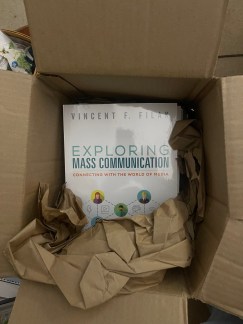
My friend’s dog, Bo, got a chance to assess the “Exploring Mass Communication” text. Add “dog bed” to “coffee coaster” and “door stop” on the list of uses for my books. (Photo courtesy of Bryce McNeil)

In closing off the blog for this academic year, I have to admit, I have not looked forward to a summer quite as much in recent years as I have looked forward to this one.

Maybe it’s because we started later so we’re finishing later.

Maybe it’s because May is finally pretending to be part of summer around here, so we’re not getting 42-degree days with a chance of sleet.

Maybe it’s because this year, 1 in 6 employees here got canned,  the university system decided to put our UWO Fond du Lac branch on hospice carethe chucklenut who basically runs the statehouse decided to greenlight every state employee pay raise except for those in the university system. The reason? Apparently we’re indoctrinating kids with the idea that empathy, equality of access and basic human decency should be valued.

Could be anything…

It’s easy to become negative at the end of a semester like this. However, I remember reading an interview with Keith Richards of the Rolling Stones once where a journalist asked him about the totality of his life in the World’s Greatest Rock and Roll Band.

He said that he didn’t think about it every day or even every week, but occasionally, he’d be on stage playing the same songs he’d played forever and it just felt great. Wave after wave of people made up a packed audience in an arena or stadium and they’d be singing along.

“And just then,” he said. “I’d think to myself, ‘Jesus, what an incredible band.'”

This semester included some truly incredible moments that to not remember them or thank people for them would be disingenuous.

It’s really real! Just ask Bo!

For starters, the Exploring Mass Communication book finally hit the market. This was one of those projects that kept growing, changing, developing and more to the point I honestly wondered if it would ever see the light of day. Somehow it did and it seems like at least a few people like it, so I’m grateful to you all.

It’s a real pain in the rear to revamp an entire class to account for a new textbook, especially one that’s a first edition. My promise to you remains solid, though: I’m here for whatever you need.

And if you’re interested in getting in on the fun, remember, I still have a T-shirt with your name on it. (OK, it’s my name, but that was more metaphor…)

Speaking of T-shirts, I found out that people outside of my university seem to have more of a use for me than those inside of it do.

When the university decided to furlough me for 11 days, I decided to pull a “John Oliver-esque” move and offer to help people at various universities as part of the “Filak Furlough Tour.”

When I pitched it, I assumed it would fall flat, as I have both the promotional appeal of a gecko-flavored lollipop and the smoothness of tartar sauce. However, it became the most popular thing I’ve done in a long time and it was an absolute JOY to see all those folks in Missouri, Illinois, Indiana, Iowa, Kansas, Florida, New Jersey, Delaware, Texas, Ohio, Maryland, Colorado and more.

I have to specially thank Julie Lewis of Central Missouri and the entire crew at Iowa State University for their hospitality when I drove out there to spend several days with these folks. It was really great feeling like what I was doing mattered enough for you to give up large chunks of your week in class as well as stockpile some Diet Coke for me.

Speaking of people who thought I had something to say, I was absolutely floored when I found out that the Scholastic Journalism Division of AEJMC considered me as a finalist for the Honors Lecture at this year’s convention in Philadelphia.

When I looked at the list of finalists, I went back in my head to my first conversation with the legendary scion of the Columbia Missourian, George Kennedy.

In interviewing me for a job, the first thing he said to me over lunch was, “I’ve got four people up for this job, and everybody is more qualified than you are.”

That was true here again, and there was no shame in losing to any of the other people up for this honor. That said, it looks like I’m going to Philly:

I also found out around that time that I was a finalist for the Oshcar Awards here at UWO. The athletic department honors the best of the best across all sports at this Oshcar event, so clearly I’d never heard of this thing, nor thought I would be at it. However, the department honors one person with an “appreciation award” for supporting student athletes in a variety of ways. It turned out the volleyball coach and team nominated me and I made the list of finalists.

No, this is not a Russian gangster named Dmitri. It’s volleyball coach Jon Ellman, a man I’m grateful I’ve been able to work with over the past several years as his team’s team fellow.

I didn’t win and the person who did win really, really deserved it. Even with the loss, it was the happiest I’ve ever been to be somewhere it was ridiculously obvious that I was the slowest, weakest and least coordinated person in the room.

As the term ends, I’ll be finishing the revisions to the third edition of “Dynamics of News Reporting and Writing,” and starting the revisions for the fourth edition of “Dynamics of Media Writing.” Sage seems to have continued faith in me, and that’s really all thanks to you folks. It’s a wonderfully strange feeling when I run into folks I’ve never met in person, only to hear them say, “Hey, I use your book in my class!”

(It really does, however, feel like I’m a total tool when I have to say, “Thanks! Which one?”)

I don’t know what next year holds, as things here have the potential to get better and/or worse at the same time over the summer. If that sentence doesn’t make sense to you, clearly, you’ve never worked in a university setting.

What I do know is that I’m grateful that things ended on a high note, that I’m still here blogging and that I’ve got a great summer to look forward to.

After the usual break, we’ll be back for the summer weekly schedule in mid-to-late-June, barring a disaster.

Have a great summer.

Vince (a.k.a. The Doctor of Paper)


It’s time to do the “but I need a better grade” dance again… (A Throwback Post)

It’s about this time of year that I realize I’m apparently a lot funnier and a lot more intelligent.

The email salutations have turned from “Hey,” to “Hello Professor” to “Dear Almighty Master of Wisdom and Knowledge…”

I am also definitely much more handsome, striking and engaging, almost to the point of being an immortal being.

Yep, grades are coming due and some folks realize they’re screwed so here comes the suck-up.

The bi-annual dance between students and professors begins once again, with finals week upon us. With that in mind, today’s throwback post takes a look at both sides of the discussion as we try to survive just a teeny, tiny bit longer…


Translating “The Dance” between professors and students over final grades

As the term winds to a close, students and professors engage in what I refer to as “The Dance” over grades. It’s a tactical, nuanced discussion that involves trying to beg without it looking like begging, trying to answer an email without promising anything and basically engaging in nuclear-treaty-level diplomacy. If we were all trapped in a “Liar, Liar” world, it would essentially look like this:

Student: Pass me and stop being a jerk, you asshat.

Professor: Oh, now you care about this class, you little twerp? Go to hell and take a left.

However, since we have to “Eddie Haskell” it on both ends, here are the legendary begging statements I’ve gotten from students over the years or variations on those themes provided by the hivemind. I’ve added a few “internal thoughts” your professors have had over the years when it comes to responding to these pleas. Enjoy:


“Could you just add XX small points to my final grade?”

First, all points are created equal. Second, that figure has ranged from 1 to about 100, depending on the level of desperation. Third, when you kept doing the same stupid thing over and over again because instead of reading my comments, you just looked at the grade and thought, “Screw you, dude” you might not need those “small points.”


“I’m graduating this term…”

Not if you need to pass this class, you’re not.


“Is there anything I can do?”

Can you invent a time machine, go back in history and tell the earlier version of yourself to turn stuff in on time, not skip every third class and generally give a better overall performance than a disinterested Jay Cutler on a trick play? If not, no.

OR

Prayer can help, although I’m not certain how strong God’s will is to help you out here.

OR

Sign up for the next semester I teach this class and give a crap a little sooner in the term.


“Is there extra credit?”

Sure, because when the syllabus said, “There will be NO EXTRA CREDIT in this class, so plan accordingly,” I clearly included a loophole for people who didn’t care about anything until the very moment they realized they were screwed.


“Could I rewrite (half of the assignments) for additional credit?”

Sure, because nothing says, “I’m ready to do a good job,” like not doing a good job on anything all term and then expecting to make all of that up in 72 hours before grades are due with no real interest in learning anything other than how many points you need to slide by.


“Could you bump me up just this little bit?”

Sure, because I’m sure that won’t tick off the six other people in your class who sweated bullets to get a passing grade through hard work on that assignment you blew off to go to Cabo and party on the beach.


“Could you possibly round me up?”

I could. Now ask me if I will. Welcome to the grammar lesson you skipped.


“I had some issues this semester…”

Yeah. No kidding.


“Your class is very important to me…”

Um… I believe a lot of things people tell me to make me feel better about myself. This isn’t one of them.


“I don’t understand why you downgraded me…”

You mean the page and a half of comments I included in the body of your paper didn’t clue you in that this random series of unattributed content, fragmented sentence, shifted verb tenses, incorrect word choices and cripplingly bad structure didn’t help? This wasn’t a news story. It was a disaster movie filmed out of sequence.


“This isn’t fair that I should have to take your course over again.”

It isn’t fair I had to grade this pile of sheep dung you referred to as “completed assignments,” but we all have our crosses to bear, I suppose…


“I need (A/B/C grade) to (pass/maintain my scholarship/keep my ego afloat)…”

This is not Burger King. You don’t get it your way.

A jar of mints and a mental-health moment can go a long way for students (and professors, too): A Throwback Post

I wanted to break this out again because this year has been an epic dumpster fire for a lot of my fellow faculty here at UWO (and I’m sure elsewhere). The furloughs, the cuts, the overloads and more just seem to have taken a toll on us here.

I don’t think I’m alone in saying that I feel like I’m failing my students in some ways, given that I’m teaching out of my area of expertise, the number of kids I’m teaching has doubled from this time last year and I’m troubled by the massive uncertainties that face us here regarding academic reorganization.

The one thing I’ve got going for me? This mint jar:


The jar was a gift from our program assistant, Cindy, who retired this year. The jar sat on her desk and whenever kids (or I) needed a refresh or a moment of zen, we would stop by, grab a mint and talk a bit. (I probably owe her about $23,205.32 worth of mints by this point in life.)

Kids started noticing it on my desk this semester and started swinging by in between classes to grab a mint. Word got around that they could also crash in the office for a bit and talk about whatever was troubling them: A class that sucked, an internship that wasn’t getting back to them, a parent who didn’t understand why they didn’t have a job already lined up for after graduation… or whatever.

Without that jar, they probably wouldn’t come in and I wouldn’t get a chance to take their temperature on how life was treating them or take the opportunity to give them a bit of positive reinforcement. I realized that those moment were among the best moments of my day. Maybe I wasn’t curing cancer or saving the planet or preventing the downfall of democracy, but those pick-me-ups mattered. I also realized maybe I wasn’t doing as terribly at all of this as I felt like I was.

In looking back at this post, I realized that I was asking most of these questions on many of those mint stops. I’m sure a lot of you out there are asking them, too. With or without the mints.

5 questions good professors will never stop asking their students

A student showed up at my office around 7:30 this morning with a case of Diet Coke and a thank you card.

“I wanted to give you something to say thank you for being the best part of my semester,” she said. “You really gave all of us such a great experience.”

I was grateful she felt that way, but truth be told, it sure as hell didn’t feel like I was giving anyone a great experience. It was less like “Top Gun” excellence and more like, “Sully landing the plane on the Hudson RIver” survival. I found it a miracle that we made it this far and that nobody lost a limb in the process.

I know a lot of us in education feel like this year flat-out kicked our asses and that maybe our students aren’t getting the best out of us because of it. In an attempt to close off this year of weirdness, I found myself struggling for answers. After about a dozen attempts to write this piece, I decided that it’s less about what we know and demonstrate to our students that matters, but rather what we want to know and how we want to serve them that matters.

With that in mind, here are five questions I think good professors ask of their students, no matter the situation or how long it has been since we shared a classroom together:

ARE YOU OK?

I think most of us have asked this question at least 30 times a day over the past 18 months and really wanted to know the actual answer every single time.

Students often enter our offices with one specific need: A question about a test, a concern about a grade or a request for some sort of special dispensation on an upcoming deadline. However, great professors can see that there is usually something else going on underneath the surface as students mentally flail about like the feet of a duck that seemingly moves smoothly across a lake. There is a job that is overworking them, there is a family member who is leaning on them or there is a roommate who is sapping them of their will to live.

The regular people in their lives give them the “regular people” advice about what to do or how to cope or why they just need to suck it up. Professors tend to have a completely different angle on things because we’ve been around the block more times than a moron with a stuck turn signal.

In the game of life, Mom and Dad see their child as a piece on the board, moving toward a goal. Friends see fellow game-players who are trying to make it through unscathed. Professors not only see the whole board, but also every game that has ever been played in front of them over years or decades. We know not only what each move will do, but the six moves that can come after that initial choice that will allow us to better predict success or failure.

Still, tapping that resource can be tough for students who often thing we have more important things to do than help them with whatever is problematic in their lives. That’s why even just opening the door a little bit with “Are you OK?” can make a world of difference.


WHAT CAN I DO TO HELP?

Professors who care put themselves out there for students because without those students, our lives would be pretty dull and relatively meaningless. Helping other people has been baked into who I am since I was a kid. If someone is working on a project, I have been taught to grab a hammer or paint brush and put myself to work. If someone is struggling, you offer assistance in whatever way you can. You don’t wait for someone to ask for help. You ask how you can make things better.

In classes, sometimes the help is easy stuff like, “Can you read my lead and see if I’m on the right track?” or “I’m not sure what I’m supposed to take next semester. Can you look over my schedule?” Around this time of year, the help can be a little more taxing, but still pretty normal, like serving as a reference, writing a letter of recommendation or reassuring a parent that, yes, Johnny or Janie will get a job and, no, he or she won’t be living in your basement forever.

I have found some of the best moments in life come from helping my students, even when it had nothing to do with this semester’s class. I’ve taught students how to change their own oil and swap their car’s battery. I’ve fixed cars for kids who were about to get shafted by some greasy weasel at a 10-minute auto repair joint. Amy and I have brought freezer-ready dinners to students who just had babies and were overwhelmed with the responsibilities of being new parents. We’ve shared tips and given some kid-equipment to these folks as well. (That vibrating baby chair is a lifesaver some days, quite literally, one student told me.)

I’ve answered questions like, “How do you refinish a piece of furniture?” and “Can you tell me how bail bonds work?” (That one was a little dicey…) I’ve moved furniture and edited cover letters. None of it was a chore and thinking back on it makes me happy because these folks trusted me with whatever it was that needed doing.

The funny thing about this question? I find that once I ask it of a kid, I tend not to need to ask it again. After the first time, they’re the ones asking, “Could you help me with something?”


DO YOU KNOW HOW PROUD I AM OF YOU?

In the early phases, I tend to ask it on the simple stuff: You asked for help. You figured out how to properly attribute a quote. You got your first story published in student media. You got an internship at a place that NEVER gives internships to people from your school.

Once you graduate, you never stop being one of “my kids” and I don’t think I’m the only professor who feels that way about our connections with “our kids.” I watch from afar as you take jobs, move up the ladder and become leaders in the field. I see you start your own businesses, fight for social justice and make a name for yourselves. I’m proud to tell people, “I taught that kid!” when you show up in the newspaper (most times… Stay out of the police blotter…) or you are broadcasting on radio or TV. I am thrilled to let people know about your accomplishments and your awards and your growth as a professional.

However, you don’t have to do any of that stuff and I am still ridiculously proud of you. I’m proud of my students who have the courage to work through their mental health issues. I’m proud of my students who courageously battle cancer or overcome sicknesses and persevere. I’m proud of you for making amazing life choices to get married or to have kids or to go a completely different way. I’m proud that you are who you are and that you can stand on your own two feet and say, “This is who I am. Take it or leave it.”

When our paths first cross, so many of the students seem like newborn deer: gangly, gawky and awkward as they try to stand on wobbly legs in a world that seems far too fast for them. Somehow they learn to steady themselves and improve their overall presence. They get stronger and faster and better as they learn from doing things right and even more from doing things wrong. We’re there to guide them, but they have to do this on their own, otherwise, they’ll never be strong enough to make it when we’re not around.

When they actually put the pieces together, it’s something amazing to behold.

And it’s worth letting them know what a big deal that is.


WILL THAT MAKE YOU HAPPY?

The people who enter my class tend to have a lot of questions. If they stick with me for the rest of the degree, they tend to have even more. I’m not sure if this means I inspire them to think critically and question their surroundings, or if I’m just confusing the crap out of them.

However, most of the questions they ask are geared toward a tangible outcome: “What do I need to know for the test?”  “Is it worth it to double major?” “Will this help me get a job?” “Is the salary for this job enough to keep me alive?”

These are all the questions we’ve been trained to ask in the college setting and they all make sense: You want to pass the class, graduate, get hired and earn enough to survive. The one thing that we tend not to think about in a real concrete way is if what we are doing will make us happy. Going through school always seems to feel like this scene from “School Ties:”


It took a long time for me to figure this out, but most of what makes life worth living and jobs worth taking is the degree to which you actually like what you’re doing. Dad always told me that if you find a job you love, you’ll never really work a day in your life. It’s mostly true, in that I have found that not every day is an Academy Award-winning performance and there are some days that are a lot better than others. However, when something makes me happy, I look forward to doing it. When something doesn’t, I tend to avoid it or do a half-assed job at it.

Students often tell me that they want to go to law school or grad school or start their own business or change majors or a million other things. The thing I immediately want to know is, “Do you think this will make you happy? If the answer is yes, plan well, hedge against failure and work like hell at it. If the answer is no, think again about why you want to do this at all.”

A lot of things that might make you happy aren’t going to be the smartest of choices, (“I want to start my own company where I blow bong hits in the lungs of people’s pets and post the videos on YouTube…”) which is where those other caveats come in. Still, we tend to consider the importance of happiness in inverse proportion to all the other things that are far less important than if we will really like what we’re getting ourselves into.


YOU KNOW I’M ALWAYS HERE IF YOU NEED ME, RIGHT?

I have now spent more of my life teaching college than I have not being a college teacher, and it doesn’t matter where I taught you or how long ago it was, you’re never really going to get rid of me.

The best part of my life is hearing back from students who have long since stopped needing my help on a test, my advice about an internship or my signature on a course override card. They have written more stories, covered more events, taught more classes, run more organizations and probably make more money than I ever have. However, when they really do need something, I’m thrilled to death when they show up in a chat or an email

A former student who is in her 40s sent me an email a few weeks back, asking if I’d support her effort to take a job at a big-name university. She has a doctorate, advising credentials that are amazing, a record as an elected public official and a lot more, so she needs me in the same way a Kardashian needs more publicity. However, I told her I was more than happy to do whatever she needed: Serve as a reference, write a letter or drive somewhere and talk to those people about why they’d be stupid not to hire her.

Another student got in touch a few years back when a source was threatening to sue him. I found the threat ridiculous and that his employer wasn’t doing more to support this kid, so I dug around and found some legal help that not only got the source to back off, but pushed the media outlet to leave the story alone.

I’ve refinished furniture for them as wedding gifts. I’ve seen their kids grow up in pictures and videos they post on social media. I’ve offered them condolences and heartfelt messages when they lose a parent or a loved one.

I’ve bought T-shirts and doodads from students who have started their own businesses. I’ve bought Girl Scout cookies from the children of former students, only pausing to think, “How in the hell are you old enough to have a kid who’s a Girl Scout?” (No matter how old they get or how esteemed they are, my students are eternally trapped in my mind’s eye somewhere between the ages of 18 and 22, showing up for an 8 a.m. bleary eyed and likely hungover.)

I’ve lit holy candles in my church for students recovering from cancer. I’ve prayed for all of them at one time or another, just because I figured they needed it.

Before we part company any time we connect, I always try to remember to let them know, “If you ever need me, you know I’m here for you, right?” I mean it every time and I know I’m not the only professor who feels this way.

If there’s one thing I hope they all know, it’s that the answer to this particular question should always be “Yes.”

Cutting it short: Remember to always check to see if autocorrect correctly corrected your copy

There’s never a good reason to be lazy, particularly when it might lead to a viral moment. A Pizza Hut in Ontario apparently didn’t bother to really read a sign workers posted to let people know the dining room wouldn’t be open. What happened next is now the stuff of legends:

This led to one of the greatest leads ever written, via the New York Post:

No tips required at this pizza shop.

The rule here, as always, is that you can write quickly, but you need to edit slowly. Also, if you aren’t sure that the autocorrect correctly corrected your work, look stuff up.