It’s all fun and games until 2,900 pages of you participating in racist, anti-Semitic, homophobic chat get leaked (and a few suggestions on how to avoid this situation in the first place)

Screenshot of the Politico header on the story about racist chats. 

THE LEAD: While we here at the blog were dealing with the Indiana University situation involving censorship and free speech, another story involving way-too-freely speaking and stuff that probably someone should have censored came to light:

NEW YORK — Leaders of Young Republican groups throughout the country worried what would happen if their Telegram chat ever got leaked, but they kept typing anyway.

They referred to Black people as monkeys and “the watermelon people” and mused about putting their political opponents in gas chambers. They talked about raping their enemies and driving them to suicide and lauded Republicans who they believed support slavery.

William Hendrix, the Kansas Young Republicans’ vice chair, used the words “n–ga” and “n–guh,” variations of a racial slur, more than a dozen times in the chat. Bobby Walker, the vice chair of the New York State Young Republicans at the time, referred to rape as “epic.” Peter Giunta, who at the time was chair of the same organization, wrote in a message sent in June that “everyone that votes no is going to the gas chamber.”

THE BASICS: Politico got its hands on nearly, 3,000 pages of chat messages that span nearly nine months of discussions among Young Republican group members. These people apparently range in age between 18 and 40 years old. Reporting on this material states that these chats feature people saying so much terrible racist, anti-Semitic and violent stuff, it’s likely Quentin Tarantino will be optioning it as a script for his next movie.

The disgust at the chat has garnered bipartisan anger, with members of both major parties stating they disapprove of this kind of language, regardless of who said it. On the other hand, Vice President J.D. Vance said he refused to take part in the “pearl clutching” over the use of language like this.

He also had a somewhat different angle when it came to giving his kids some fatherly advice in a situation like this:

The father of three said he would caution his own children, “especially my boys, don’t put things on the internet, like, be careful with what you post. If you put something in a group chat, assume that some scumbag is going to leak it in an effort to try to cause you harm or cause your family harm.”

So, kids, always remember, keep your seething racism in private, personal conversations, lest some “scumbag” out there find it and make a big deal out of it.

KEY LESSONS BEYOND THE VANCE THEORY OF “DON’T BE RACIST IN PUBLIC:” Hopefully, for most of us in here, that first lesson is kind of like me telling you, “Don’t commit a ritual human sacrifice on the break room table at work:” Even if I didn’t say it directly, I hope that human decency and public decorum would have made this concept obvious to you.

Beyond that, here are some important things to take with you:

If the only thing keeping you from saying or writing something is, “I’m pretty sure I won’t get caught,” think a little harder before you do that thing:  I remember reading a number of psych studies that assessed to what degree people were or were not willing to do things they knew to be wrong, based on a variety of factors.

In some cases, the idea was to make people feel cheated out of something they deserved and then provide them with an opportunity to do something negative to the person they believe had wronged them or some other person at random. In other cases, it was about measuring the underlying guilt built in through various social systems including things like religion.

The one thing that ran through all of these studies was perception of being caught: “If you were completely sure you would never get caught, and thus have a consequence-free outcome for your actions, would you do X?” This variable always radically shifted the way in which people chose to act, leading a lot of the scholars to debate the natural human state of decency.

In the situation outlined above, these people didn’t stop and say, “Man, we really should not be saying stuff like this because it’s wrong.” They essentially said, “Man, if we get caught at this, we will have HELL to pay here!” And then they did it anyway, meaning they thought that as long as there continued to be no consequences, they were going to be fine.

A good way to prevent consequences you want to avoid is to not do the things that could lead to those consequences. If, for example, I wake up in the morning and think, “Gee, it’d be great to have my wife bludgeon me to death and bury me behind the chicken coop,” I’d probably try to have an affair with someone. Since I know that this action is wrong and I don’t want to die, I should avoid taking that action. If I instead think, “I know it’s wrong, but I’ll be extra sneaky,” I’m setting myself up to be fertilizer.

Ask yourself, “Would I say this to someone’s face?” before you put it in the public sphere: Things can jump up a notch on social media and through digital communication. Trust me, I know I’ve bitterly complained about myriad things online that I probably would not have done if I needed to do it in public. In most cases, they involved things like people being too slow in line at the grocery store, people texting while driving and the way in which the Cubs stole my team’s World Series in 2016. (Yes, I’m still bitter.)

Digital media is like the beer goggles of communication: it warps your sense of what is and isn’t acceptable and when you’re forced to confront your choices in the cold light of day, you usually aren’t all that thrilled about them.

This is one of the reasons when a student complains about something in an email, I tell them to come by the office and chat. Part of it is that there’s a lot of bravado on their end that probably isn’t going to hold up during a one-on-one conversation and another part of it is that I don’t want to start a digital land war over a B- or something. It’s a good way for both of us to have a cool-down period and to then deal with things like two regular people, as opposed to two methed-up coyotes.

There is no such thing as privacy anywhere anymore, so act accordingly: I tend to think that this should be common sense at this point, but then again, if it were “common” sense, everyone would have it.

We have cameras everywhere, recording everything. We have GPS and tracking on our digital devices that can let anyone who wants to know exactly where we are at any point in life. We put stuff out into the world through all forms of social media that can be shared millions of times over in the blink of an eye. The concept of living a quiet, private life is as unlikely as the Cleveland Browns making the Super Bowl this year (or at any point in my life time, I suppose…)

If I wanted be EXCEPTIONALLY GENEROUS in translating some of Vance’s statements into something less dismissive of this godawful situation, I’d say that it is important to realize that people need to be more aware of how they express themselves in general because it might not fully represent the best versions of themselves.

Being an idiotic poser by trying to out do the last stupid thing someone else said is rarely a good idea in any situation, which, yes, a lot of us learned somewhere along the way before the world could record everything we did and share it with the world. However, we don’t live in that world anymore, and thanks to the ability to share everything, we have all seen the consequences of being that kind of idiot.

With that in mind, you either need to be all in on what you say or you need to make sure you’re giving yourself a beat before you let random stuff you don’t honestly mean come flying out of your head and landing on a screen.

“This was never about money, and I think that their actions prove it.” A Q and A With Fired Indiana Daily Student Media Adviser Jim Rodenbush (Part I)

Jim Rodenbush from the IU website

In the span of one week, the Indiana University attempted to censor the Indiana Daily Student newspaper, fired student media adviser Jim Rodenbush for not enforcing the censorship and killed the IDS’s print publications when it was clear the students would not yield.

The story of this has blown up beyond the confines of Bloomington, with The New York Times, NBC News, The Guardian and others following the situation. The Indiana media, including the Indy Star, and WTHR keeping track of things as well.

Rodenbush was nice enough to have about a 45-minute chat during an airport layover, as he was flying to Washington, D.C. for the college media convention MediaFest25. Instead of hearing ABOUT Rodenbush, we thought it would be better to hear FROM Rodenbush, allowing him to walk everyone through what he has gone through this week.

Below is part one of a transcription of our Q and A, with edits to the material to tighten and clarify parts of our discussion, as well as make more sense of my questions, which somehow Rodenbush understood among the many Midwestern “Yeah… Yeah… No…” interjections I put in there.


I don’t even know where the hell to start, I’ll be real honest with you, but can you give me a sense of what the last week has been like? Start me off with (Monday), the day before you got fired.

JIM RODENBUSH: “Literally, nothing happened on Monday. Not a word about anything.”

“It was Tuesday morning that I went to go get my IU fleet vehicle because I was going to drive to DC, my reservation was still active, and so I’m like, ‘Well, that’s good.’ So then I get to work, and then I learned about the email that my editors had sent, either like the night before or that day. And I didn’t actually see the email, but my general understanding was it was one of those, like, ‘Hey, we know what you’re wanting us to do. We have a print publication coming up this week. We’d kind of like for you to roll that back.’”

“So, I knew that that email had been sent, so I was thinking, I’m going to email my supervisor, the Director of Public Media, and just remind him that I’m going to be out of town the rest of the week. I sent that email to him, and then I did, just did a bunch of things to get ready to not be in the office. Around 12:30, I got an email from a human resources representative at the IU level, telling me that I needed to be in a meeting with her and (Dean) David (Tolchinsky) at 4:30 that afternoon.”

“And I wish I had connected the dots. I swear to you that, in my brain, the idea (of being fired) was a possibility. But I wasn’t locked into that, because I had literally just learned about the editors’ email. Every time, the IDS editors said anything to anybody upstairs, I had to go into a meeting to explain journalism to them. So, I just thought that maybe this whole, ‘We need you to roll this back, or else,’ email the students sent led to this situation escalating.”

“But I was wrong.”

“I did reply to the human resources person asking for clarification that maybe, could you let me know about an agenda? Could you maybe let me know what’s going on so I could be prepared? And she wrote back that David had concerns he wanted to share. So, I knew I wasn’t going to get an answer, but that’s standard reply. So, I just continue getting ready to leave town because I was scheduled to drive to Washington (Wednesday) morning.”

“When 4:30 came, I went to the meeting, and I made small talk with the HR representative. I saw that she was from the St Louis area, so we talked St Louis for a couple minutes, and then David showed up, and he began with, ‘This is going to be an uncomfortable meeting.’ Then he just read from the termination letter. That’s it. He just read from the termination letter.”

“When he was done, my response was, ‘Is that it?’ And then the human resources person, on the spot, collected my keys, collected my IU ID, told me I had to be escorted from the building and that my personal belongings would be sent to me. She also said that I needed also hand over my IU laptop, but my IU laptop was at home because I was packed to leave. So, I had I had to drive in my IU rental that I already picked up over to my apartment to pick up the laptop and then drive back to campus to give this HR representative my laptop and the IU rental keys.”


Given the way you were fired and then removed from campus, were you also given any ultimatum about not talking to the kids at the IDS or any of the staff? Were you told not to reach out or were the kids told to shun you or anything?

JIM RODENBUSH: “I wasn’t given any, ‘Stay away from campus’ statement. I wasn’t getting any ‘Don’t talk to anyone’ thing. I have a daughter who is an IU student, so the whole time I’m processing being fired, I was in the back of my brain thinking, ‘If you tell me I can’t talk to students, that might be a little weird.’ But there was (no demand regarding communication). I have been in communication with the students, and the professional staff. I stayed in touch with everybody.”

“What’s funny is that I went back on campus and the public media outlet called me for an interview, and they said they wanted to put me on camera. And I said to the guy, ‘You want me to go into the into the TV building?’ And they’re like, ‘Yeah!’ I’m like, ‘Are you sure?’ They were like, ‘Yeah! If they say anything to us, we’ll just pitch a fit.’”


The day after you get fired, the second shoe drops and the Media School folks announce that they’re killing the print edition. Every indication I’ve gotten from anything I’ve seen is that the special print editions were making money, so what does this decision really say about the school’s motives here?

JIM RODENBUSH: “This proves that this was never about money, because you have effectively killed a massive amount of revenue-generating opportunities at this time. You’ve also done severe damage to the IDS’s relationship with the housing community, a big collective of advertisers. So much of my advertising director’s foothold that he has made here has to do with some of the print products that are produced. And so, you have made his job both harder and easier in a weird way. You just eliminated half of the half of his work. That’s the easier part. The harder part is you have eliminated massive revenue opportunities. So, this was never about money, and I think that their actions prove it.”


I still can’t figure out why the school wanted to do all of this to the IDS. I never got a sense that there was a particular like moment of, “Well, you guys ran X story, so we’re coming after you.” It just kind of seemed like there was this overwhelming push to get rid of true reporting overall. Am I reading this situation right?

JIM RODENBUSH: “I was not aware of any particular story that caused this situation to accelerate. We had an update this semester on (accusations that the IU president plagiarized parts of her doctoral dissertation). The story that ran was really good, but it was nothing more than kind of an update on where we are right now. It wasn’t anything particularly scandalous or something that people didn’t know. Otherwise, I’m not aware of anything problematic.”

“Almost every media outlet is asking a version of this question because it’s rational. The immediate thought is, ‘What are they trying to squash?’ Or ‘What story are they trying to prevent from coming out?’ And there’s nothing. This just appears to be about the media school not wanting traditional newspapers on the newsstands anymore.”


Maybe my brain is going in the wrong direction, but by saying, “Get rid of the print edition,” the Media School basically made it so that everything is digital and their actions are drawing way more attention than anything that could run in the print publication. I guess the simple question is:  What is their beef with print? 

JIM RODENBUSH: “I would be speculating, because through all of this, I’ve never been in these meetings. I told people that a lot of my job toward the end was middle management. I simply took orders from the media school administration and did what I could do with them. I was not in the room when these things were being talked about.”

“So I’m lacking even some sort of explanation as to the motivation behind this. The general idea has just been, ‘We need to transform to digital, and we need to eliminate prints, and we need to coincide with the real world.’ That’s been the message, and that’s hard to take, because, of course, newspapers are still being printed, and we had already transformed the digital first.”

“Newspapers are a lot like malls. The general idea is that malls are dead, but if you go to certain communities, the malls thriving. It’s not a black and white kind of thing. And when it comes to the printed newspaper, it all depends on your community, and it all depends on your audience.”

“We were down to a weekly paper, but we still had an audience for that. We still had pickup rates. We still had a strong print audience, particularly in the general business area that’s right off campus. We couldn’t keep the paper on the stands. So, them saying, ‘You must get rid of print’ was a sweeping order that still doesn’t make any sense to me, because if it’s about money, then why would you halve your revenue?”


In looking back to the discussions we had last year, when the school was launching its media plan, I remember several of the folks involved being on a radio show, talking about money. Your editor said, “It costs us 60 grand to print and we’re making 90 grand on the deal, so we’re making money,” something (an administrator) disputed without being able to support his disagreement. Tell me, based on your experience, was the paper was making money as a standalone product? 

JIM RODENBUSH: The paper alone as a standalone product, debits and credits, looking at a spreadsheet, it’s in the black. The cuts that we made, I’m comfortable saying that the savings we actually realized from the spring was possibly $20,000 by printing seven times instead of weekly.”


By cutting print, they cut the revenue, but not all of the costs associated with running the whole operation. I mean, you still have expenses like payroll, web stuff, travel and all that. I guess the question then becomes, what other revenue streams does the IDS have that will help meet all those expenses?

JIM RODENBUSH: “You’ve got professional staff there that are working, that are still getting paid, and they’re still getting benefits. You’ve got the students still getting paid. So, salary is part of the process. And as everyone with experience knows, you don’t sell digital advertising at the same rates that you do print advertising. I don’t see an immediate replacement for what amounts to half of the revenue.”

“The blanket response has always been, ‘Think innovatively! Think new ways! Think enterprise!’ and that’s great to say, but in in reality, you’re still operating in Bloomington, Indiana.  It is a wonderful town, but it’s still a midsized town in southern Indiana. There’s only so much money available there and (the ad manager) has done a wonderful job in the advertising community, building relationships all by himself, and making more money than I would ever would have expected. But now, he can only sell a certain thing, and there are going to be people that won’t be interested in that. So, he’s really been given a difficult task at this point. And you can piecemeal some things that could bring in additional money but cutting print? That was a tremendous amount of money that you just let walk away.”

“A homecoming section that was supposed to print today was sold, and so, they’re going to have to refund people. It’s not just this issue, but the other three that were scheduled for this year. We have health and religious directories in these printed products, and these people aren’t going to want to go online, so all these things are going to have to be refunded.”


NEXT: Part II

An Open Letter to The IU Media School: Please spare us your bullshit and leave the Indiana Daily Student alone

The top of the IDS’s letter explaining how the university killed print.

(EDITOR’S NOTE: Sage has always asked me to avoid any “unnecessary cursing” on the blog, as it tends to offend the sensibilities of some delicate readers. I promised I’d only use “necessary cursing,” and today it’s called for. Sorry, guys.)

Dear Dean David Tolchinsky and the rest of the administration at the IU Media School,

You have made it clear over the past several years, and even more so over the past few days, that you have absolutely no idea how journalism, student media or the First Amendment work, or that you don’t care about these things.

Either way, nobody is buying your bullshit anymore.

The decision to demand students not print news in the Homecoming edition, then fire adviser Jim Rodenbush when he would not force this upon students and then kill all printing 24 hours later in response to the editors’ concerns has drawn negative attention from all corners of the country. The Student Press Law Center and Foundation for Individual Rights and Expression both condemned your actions. News outlets across the state and beyond are digging into this situation. Even the alumni aren’t happy.

Free press and editorial freedom can’t be a “when we feel like it” thing, or else you are supporting neither a free press nor any editorial freedom. I’m not even sure your chancellor gets this, based on his most recent statement:

“Indiana University Bloomington is firmly committed to the free expression and editorial independence of student media,” IU Bloomington Chancellor David Reingold said in a statement. “The university has not and will not interfere with their editorial judgment.”

“In support of the Media School and implementation of their Action Plan, the campus is completing the shift from print to digital effective this week,” he continued. “To be clear, the campus’ decision concerns the medium of distribution, not editorial content. All editorial decisions have and will continue to rest solely with the leadership of IDS and all IU student media. We uphold the right of student journalists to pursue stories freely and without interference.”

OK, but see, you all actually DID interfere with editorial judgment when the powers-that-be demanded that no news content be placed into the homecoming edition. Furthermore, you made it clear that you WERE trying to censor by having two editions: One on campus for the alumni that was filled with only unicorns and rainbows and Homecoming parades, and another one for the city that would be allowed to wrap a news section around it.

The IDS quotes Assistant Dean Ron McFall essentially saying that the school knew this was censorship and interference:

“How do we frame that, you know, in a way that’s not seen as censorship?” Ron McFall, assistant dean of strategy and administration at the Media School, asked in that meeting.

And Dave, you can’t throw this guy under the bus with a “poor choice of words” or “one bad apple” thing, given what people know about you and your approach to student media. People at IU know that you are “clueless” about the First Amendment and you “don’t know the first thing about journalism,” to quote a non-student source close to the IU situation.

A source also relayed a story about one of your first encounters with the IDS upon your appointment as dean. The paper had written an editorial that had ruffled some feathers and you were confused about your power over the situation.

“He wanted to know why he couldn’t just make them apologize,” the source said.

You have tried your damnedest to frame this issue as one of finance, and finance alone, because this is the best defense you have against your indefensible actions. Even if the IDS students and the rest of us who understand how media works were to grant you this premise, which we don’t, dozens of examples of censorship through financial means exist in student media. Trust me, I’ve researched this a bit.

If money were the motivating factor, there would be no reason for killing off ALL print editions, including those special ones you were so excited to force the kids to produce. In their letter from the editors, Mia Hilkowitz and Andrew Miller explained that you now refuse to let them publish the homecoming edition, which fit the bill of what say you wanted, namely a special issue that turns a sizeable profit.

In addition, the editors have pointed out that the three issues that the IDS produced to this point have turned a five-figure profit, that the IDS has advertising contracts for future publications and has contracts for advertising to be placed on public-facing news stands where the print edition is distributed.

Those things all sound like money to me, and any reasonable human being who understands how money works. And if you’re worried about money, maybe you shouldn’t piss off IU alumnus billionaire and donor Mark Cuban, who also is not happy about this situation.

The problem with all of this is that you can’t un-ring the bell. Bringing Rodenbush back or opening the door to printing won’t solve the underlying problem: A complete lack of trust between the IDS and this administration. The students aren’t stupid, so they know that anything you do right now will only be to shut people like me up for the moment. Once you feel we’ve moved on and the outrage has died down, you’ll pull another stunt like this and the cycle will start all over again.

The only solution is the simplest one: Quit. Leave. Go away.

And take your band of merry administrators with you, who apparently have no interest in actual journalism and actually have “neutered the reporting curriculum,” to quote a source. I’m sure you’ll all land on your feet at some nice, private college where they’ll overpay you to keep the kids in line as they write hard-hitting stories about a local dog named “Pooch” that barks at the campus squirrels.

In the mean time, maybe the chancellor can put his money where his mouth is and hire someone capable of restoring the IDS to its previous state as a venerable, formidable journalistic enterprise.

Sincerely,

Vince (a.k.a. The Doctor of Paper)

P.S. – No, I am not angling for your job, Dave. If this letter makes anything clear, I lack the bullshit-osity to be an administrator anywhere.


“How do we frame that, you know, in a way that’s not seen as censorship?” The IU Media School Fired Student Media Director Jim Rodenbush For Not Censoring Student Media

THE SHORT, SHORT VERSION: David Tolchinsky, dean of the IU Media School, fired student media director Jim Rodenbush for refusing to violate the First Amendment rights of the Indiana Daily Student staffers.

The powers that be in the administrators in the school have been trying to force the IDS into a series of short-sighted moves that would both damn the paper to irrelevancy and undercut the students’ rights to self-governance.  

If you would like to speak up on Rodenbush’s behalf, please email Tolchinsky at: mschdean@iu.edu or call him at: 812-856-4513 to let him know you stand with Rodenbush and the students at the IDS, who could also use your support (ids@indiana.edu).


THE LONGER, MORE NUANCED VERSION: Jim Rodenbush, who had been the director of student media at IU since 2018, was summarily fired on Tuesday after he refused to tell the staff of the Indiana Daily Student what they should publish in the homecoming edition.

A formal termination letter, signed by Dean David Tolchinsky, was making the rounds on various media outlets late Tuesday night:

DOCTOR OF PAPER FLASHBACK: The media school spent more than a year trying to force all of its student media outlets to work together, as part of a “converged” model that everyone else in the media world has figured out can’t work. We covered the rigamarole that the IDS was facing around this time last year in our “Hostile Takeover” series. 

Multiple generations of student editors at the IDS were adamantly against this approach, as well as opposing the idea that the free and independent media outlets they ran were going to be kind of “folded into” the media school.

At the time, I’d been in contact with Rodenbush, who was more than polite in his refusal to crap all over this idea, telling me he had faith in the kids and was working within the system to keep the ship afloat.


THE STUDENTS SPEAK: If you ever wonder where all the guts in journalism has gone in today’s world of media giants folding like a cheap tent in the rain, look to student journalists.

In a blistering letter on the IDS website, co-EICs Mia Hilkowitz and Andrew Miller explained exactly what happened to Rodenbush, bringing the receipts with them. In pulling quotes from emails and multiple meetings, they outlined the brazen attempts of the administration to force the students to bend to the school’s whims:

Telling us what we can and cannot print is unlawful censorship, established by legal precedent surrounding speech law on public college campuses.

Administrators ignored Rodenbush, who said he would not tell us what to print or not print in our paper. In a meeting Sept. 25 with administrators, he said doing so would be censorship.

“How do we frame that, you know, in a way that’s not seen as censorship?” Ron McFall, assistant dean of strategy and administration at the Media School, asked in that meeting.

Not to put too fine of a point on this, but if you have to ask how to “frame” something so that it doesn’t look like censorship, you’re committing censorship and you damned well know it.

And the students know it too:

IU will attempt to frame this censorship as a step toward a balanced budget. The IDS, along with the Student Press Law Center and Reporters Committee for Freedom of the Press, see it very differently.

“The Media School’s order limiting the Indiana Daily Student’s print edition to homecoming coverage isn’t a ‘business decision’ — it’s censorship,” the Student Press Law Center said in a statement to the IDS. “This disregards strong First Amendment protections and a long-standing tradition of student editorial independence at Indiana University.”

If administrators disregard our rights as student journalists now, what will stop them from prohibiting the IDS from publishing certain stories on our website and social media, should they deem it appropriate?


AN ALUMNUS SPEAKS: In looking for Tolchinsky’s contact information on the IU Media School website, I came across a familiar face in the “Proud Alumni” section of the site.

Andy Hall is a 1982 graduate of the IU journalism program and former editor of the IDS, and we worked together for a bit at the Wisconsin State Journal. The media school gave him a well-deserved write up, where he discussed the foundation of Wisconsin Watch, an investigative journalism outlet here in the Badger State.

I’m not sure if IU full grasps the irony that the Media School is literally championing a free and independent media outlet, founded by a relentless investigative journalist, at the same time it’s trying to undermine the place that helped launch his career.

(SIDE NOTE: Here is my best Andy Hall story. Every year, staffers at the WSJ were assigned a high school graduation to cover as part of their duty to civic journalism. Andy’s assignment coincided with a planned trip back to IU for a reunion of some sort, so he hit me up to ask if I could cover for him that weekend.

Andy explained that not only would I get paid for the work time and mileage, but that he’d kick in a six-pack of some Indiana beer and a bucket of Tell City Pretzels as a pot sweetener. After I agreed to do that, word got around the newsroom pretty quickly that the college kid could be bribed into taking your graduation story gig if you ponied up some free beer. I think I wrote like 10 or 12 grad stories that year and had the best beer fridge of anyone my age.)

I got a hold of Andy late Tuesday night and filled him in on the situation, asking what a guy who cut his teeth at the IDS thought of the school’s actions. He didn’t mince words:

“As a former editor-in-chief of the Indiana Daily Student, I am deeply disturbed by this apparent attempt to censor the decisions of its student editors. The IDS charter specifies that ‘final editorial responsibility for all content rests with the chief student editors or leaders.

“I hope that the Media School leadership finds ways to work productively with the IDS editors to ensure that the student news organization retains the full independence granted by its charter. Ultimately, that journalistic independence is in the best interests of the school, the students and, most importantly, the public.”

I wonder whose profile the school will be taking down first, Jim’s or Andy’s?

DOCTOR OF PAPER HOT TAKE: This is what happens when you train great student journalists and then try to play them for fools. The level of ham-handed stupidity involved in not just what was done, but how openly it was discussed in various meetings where journalism folk were present makes some of the Watergate stuff look nuanced by comparison.

I mean, even the mob knows better than to talk about how they plan to whack a guy in terms this blatant.

As far as Rodenbush is concerned, he’ll be getting the red carpet treatment on a national stage, according to Mediafest 25 Convention Director Michael Koretzky:

Jim Rodenbush is coming to MediaFest. SPJ is paying his way.

Jim will be recognized during Friday’s keynote, and we hope to get video of the room applauding him – then make sure it gets back to campus. (Two IU TV students are attending MediaFest. Hopefully, they’ll record the moment along with the rest of us.)

If you’re coming to MediaFest, please say hello to Jim at Friday’s CMA/ACP reception and around the Grand Hyatt halls.

We have other things planned for Jim upon his arrival. SPJ president Emily Bloch is excited to host him, and SPLC’s Jonathan Falk will invite Jim to speak at one of his sessions. CMA leaders haven’t gotten back to me yet, but I’m sure they’re just as excited.

Let’s stand with and for Jim.

As for what’s next for the IDS, I’ve got an email in to Tolchinsky and his admin crew asking that question. I’ve also got emails in to the co-EICs to see if they want to fill me in on anything. In the name of full transparency, I did get one reply:

I don’t know about you, but I can practically hear Langosa’s sigh of relief in that message from here. If anything else comes through, I’ll update it here.

Looking ahead, I don’t know who is going to take the job next, as this is the second adviser in a row to get canned at IU under some really awkward circumstances. Hall of Fame media adviser Ron Johnson got removed, with the university arguing it was a financial situation while the students arguing that this was an attempt to censor the publication. When news of Rodenbush’s firing hit the College Media Association’s listserv, more than two dozen folks chimed in with messages of condolence for Rodenbush and some version of “This isn’t right.”

It’s out of pure, morbid curiosity that I want to see the job posting for whoever the hell IU thinks is going to saddle up for this gig.

In the mean time, please feel free to email Tolchinsky at: mschdean@iu.edu or call him at: 812-856-4513 to let him know if you disagree with this act of censorship. Also, please feel free to offer your support to the IDS staff (ids@indiana.edu), because they definitely deserve better than they getting, but they aren’t going down without a fight.

“Record everything, always, and apologize later, if need be.” (A throwback post)

Having a literal videographic memory would really, really come in handy sometimes… 


This post came to mind after an email exchange I had with an administrator last week. Not to get too into the weeds, but a crisis hit and I was being asked to do something in exchange for a benefit of my choosing.

During a meeting, I got the verbal “OK, that’s fine,” with a promise I’d get something in writing shortly after. After a month or so, I hadn’t gotten the documentation or the benefit, so I made some inquiries.

Although things aren’t entirely settled, what bugged me the most was a line that an administrator wrote to me in an email: “I found no record that we promised (SAID BENEFIT).” 

At that point, I was reminded of the phrase I often tell students: “Record everything, always, and apologize later, if need be. In God we trust. Everyone else gets recorded.”

I’m not sure yet if I’ll be wiring my office like Nixon’s White House, but while I ponder that, here’s today’s throwback post, which looks at the issue of recording people, with or without their knowledge.


‘Can you?’ vs. ‘Should you?’ A secret recording of a Wisconsin government phone call that inspired five random thoughts for journalism students

In trying to explain ethics to my intro writing students, I often fall back on the line that, “Ethics basically deal with things that aren’t illegal, but can get you in a lot of trouble, anyway.” Another way we separate law and ethics is the line between, “Can I do X?” vs. “Should I do X?”

This concept came into focus in a strange way last week, as Wisconsin continued to put the “fun” in “dysfunction” at the state government level:

MADISON – Republican legislative leaders lashed out Wednesday at Democratic Gov. Tony Evers after his staff secretly recorded a May 14 phone conversation over how to respond to the coronavirus pandemic the day after the state Supreme Court struck down the state’s stay-at-home order.

The recording and the reaction to it all but ensures a permanently broken relationship between Evers and Republicans who control the Legislature. The two sides have rarely gotten along since Evers was elected in 2018 and Wednesday’s episode was characterized by GOP leaders as unprecedented.

Republicans referred to the recording effort as “Nixonesque,” referring to former Republican President Richard Nixon’s desire to record everything involving him at the White House. I’m uncertain if this is irony, self-loathing behavior or something just randomly laughable, but I’m at a loss for words while watching a Republican use the name of a former two-term (almost) president as an insult. I guess I’m also pretty sure that the relationship between Evers and the Republicans was permanently shattered like Waterford Crystal thrown off the top of the Empire State Building waaaaaaay before this incident.

In any case, here are a few random thoughts for journalism students that don’t delve into the political grandstanding in this case that makes soccer “injuries” look honest by comparison:


THIS SHOULD HAVE BEEN PUBLIC ANYWAY: Bill Lueders, president of the Wisconsin Freedom of Information Council, made the best point about this situation. Why the hell was this a “private phone call” among three key governmental officials?

(Lueders) said recording a conversation without alerting the other parties isn’t illegal in this state, but is in bad form — and that the nature of the meeting should have pushed the three to talk publicly instead of privately.

“I wouldn’t do that as a journalist, to record someone without them knowing,” Lueders said. “On the other hand, I don’t know what would have been said in that meeting that needed to be kept private.”

Maybe if this is a public meeting, none of this becomes an issue in the first place. Sunlight is said to be the best disinfectant, and it would appear to be so in this case.


RECORD EVERYTHING, BUT BE HONEST: According to the numerous accounts I’ve read, Richard Nixon was paranoid as hell and believed people were always out to screw him over. If you have spent any time as a reporter in this day and age, I bet Tricky Dick starts making a little more sense in that regard.

I can’t tell you how many times I have written something I got from a source, quoted a source or provide information I got about a source, only to have the person who gave me that information tell me I was wrong. And I did most of my work before the era of people in power calling everything they don’t like “fake news.”

Thus, my advice to students? “Record everything.”

That said, recording is one of those key areas where law and ethics diverge. The majority of the states in the U.S. operate under one-party consent. This means that if you are on a phone call with another person, you may record it legally without letting that other person know. The others have some version of two-party consent, which means BOTH parties on the call must know and agree to the recording before it happens. (You can read more on your state’s rules and what happens if your recording across state lines etc. here.)

The law says, “Record them all. Let God sort them out.” Ethics, however, would dictate that secretly recording people kind of undermines trust, as Lueders pointed out. This is why I always tell the students to be up front about their recording. Tell the source, “I would like to record this interview. Is that a problem?” In most cases, sources will be fine with it.

Some folks will be reticent, so I tell the students to explain WHY they want to record the interview: “I want to make sure I don’t make a mistake,” or “I want to be sure the quotes are accurate,” or “I want to protect both of us.” However, the students want to explain it is fine, but at the end of the day, it’s about having a permanent record of what occurred so if the stuff hits the fan, and suddenly everyone is pulling a “Shaggy” on this situation, you have a complete record of what happened.


STILL, WATCH OUT FOR YOU FIRST: I totally get why the person recorded the conversation: The Evers administration and the Republicans out here who will rule the assembly in perpetuity, thanks to gerrymandering the likes of which we’ve never seen before, are constantly in a bombastic struggle to define “truth” for the public. I’ll read one story one day and think, “OK, they’re doing X” only to read the next day some recasting of the situation that makes me think it was a dream.

In the end, if you know someone’s going to try to screw you, get a permanent record of reality.

Honestly, I’ve recorded people without their knowledge. I don’t say this with a great deal of pride, but this is what happens when you run a crime beat in an area where people felt no compunction about calling you up to scream at you about coverage. After I almost got smoked once, I considered it an insurance policy.

The first time this happened, a person called the main desk at the newspaper, asking to talk to the person in charge of crime stuff. The staffer sent the person to me, and the caller spent at least five minutes screaming at me about a story we ran. It turns out her kid/brother/friend/whatever was “illegally arrested” (a phrase I still love to this day) and what we wrote needed to be retracted RIGHT NOW.

After mentioning places that I could put my head, which defied the laws of physics, and questioning the lineage of my parents, this woman was not happy with my decision not to acquiesce to her demands. She wanted to speak to my boss.

I gave her his number and he got a much different treatment: A lot of “sir” mentions and some polite questions and so forth. She mentioned how horrible I was and how I said horrible and unspeakable things to her. Of course, my boss brought me in to ask me about this. He bought my version of events, but I swore it would be the last “he said/she said” thing I dealt with at that paper.

I hooked up a tape recorder to the phone and kept it at the ready. When I got the next call transferred, questioning my approach to crime news, I recorded it. After my boss got the complaint about me, I offered to let him listen to the recording. Eventually, that became our routine:

Him: “I got a complaint that you were horrible to (SOMEONE) who was complaining about (WHATEVER I DID).”
Me: “Uh… No… Would you like to hear the recording of the call?”
Him: “Fair enough…”

Still, the most important moment of recording I can recall came when I was an adviser at Ball State University. The school was in the middle of a provost search when one of the three candidates pulled out. The remaining two candidates were relatively polarizing: The president clearly favored one and the faculty and staff favored the other.

Just to back up her notes, the reporter borrowed my recorder for the phone call with the president. She asked the obvious question if the president had planned to restart the search. I can still remember to this day hearing the reporter as, “Is that even an option in your mind?”

The answer was no. We have two qualified candidates and we’re moving forward.

That was the story we ran, and then all hell broke loose.

Faculty were outraged, figuring they were going to get screwed, so they started talking. The president, clearly not wanting this to be a mess, decided the best thing to do was throw the newspaper under the bus.

She issued a statement via email to faculty and staff that basically said, “Look, the kids at the newspaper try really hard, but they’re kids and they screw up stuff. I never said we wouldn’t restart this. In fact, that’s what I’m doing right now. So, relax and don’t worry about the mistakes of children.”

Her problem was, we had it recorded. She didn’t know.

To be fair, the student SHOULD have told her we were recording her, and that was a lesson we made clear in the post-game analysis with the reporter. Thus, we gave the president a chance to do the right thing. The editor-in-chief called her and told her that she made us look stupid and that we were asking for a retraction. We’d let it go if she fessed up. She immediately went back to her talking points about the reporter screwing up and how this happens with cub reporters and how she wasn’t mad, but she had to set the record straight.

At that point, he let the cat out of the bag. She paused, said some unprintable things and then asked, “Are you recording me now?”

I remember thinking, “No, but I wish we were…”

In the end, she held firm. We ran her email alongside a transcript of the phone call along with an editorial on the whole thing. She was displeased, but that was on her. If the primary complaint someone has about you recording them is that you’ll report exactly what they said and they don’t like what they said, I have very little sympathy for them.

This leads to the next point…


IT’S NOT OUR FAULT YOU’RE A DIPSTICK: The reason we know about this recording in the first place is because the Milwaukee Journal-Sentinel put in an open records request for everything associated with a coronavirus meeting between the two sides. Once they asked for everything, including recordings of the meeting, the recording came to light.

(Good side note: In open-records requests, ask for stuff that MIGHT exist, even if you don’t think it does. You might get lucky. In this request, the reporter apparently asked for any recordings of the meeting when requesting documents from Vos as well and got nothing because he didn’t record anything. The request sent to Evers yielded the tape. Short version: It never hurts to ask for stuff.)

Evers did the right thing in turning over the file, even though I’m sure he really didn’t want to. It had to be like that scene in “Silence of the Lambs” when the moth flies out of the basement and basically the killer knew he was screwed. The game was over at that point, and he basically had to brace for impact.

The recording was what I would have expected of divorced parents who were forced into a dinner with their kid at graduation: A lot of people talking past one another, some pointed jabs and the essential “How much longer must we endure this fool?” vibe. One thing that did pop up as a story was Assembly Speaker Robin Vos blaming immigrants for the coronavirus:

MADISON – Assembly Speaker Robin Vos blamed the culture of immigrant populations for a coronavirus outbreak in Racine County, according to a secret recording of his meeting last month with Gov. Tony Evers.

“I know the reason at least in my region is because of a large immigrant population where it’s just a difference in culture where people are living much closer and working much closer,” the Rochester Republican said of an outbreak in Racine County.

Of course, Vos didn’t like the story that pointed this out and tried to move the discussion back to how shameful Evers was for recording the call. He also tried to spin this to make it about how he had a deep concern for people of color who were disproportionately suffering the effects of the virus.

(Hang on… I’m dealing with the vertigo caused by that spin… OK… Phew…)

At the end of the day, neither group looks good and Vos has to deal with what would appear to every Latino group the MJS contacted as a dog-whistle, anti-immigrant blame-fest.

What’s important to remember, however, if you record something as a journalist and someone says something stupid, it’s not your fault.

This is one of the few cases where people aren’t blaming journalists, because the journalist didn’t make the recording. Vos comes the closest, in accusing the paper of not keeping its eye on the ball with the whole “Nixon-esque” recording. However, usually, in a story in which someone records something (telling the source or not) and it turns out the source says something horrible, the outrage is more over the recording or the choice to run the story than it is the horrible thing the person said.

It shouldn’t be, and you shouldn’t feel bad about it.

Your job is to report the facts, getting as close as you can to the purity of truth, in an attempt to inform your readers of something important. Rarely are those revelations something pretty and happy, so someone will be upset.

If a state rep or a city council member or a school board president says something offensive about race, gender, sexual-orientation, socio-economic status or some dude named Chad’s little brother, and you think your readers need to know about it, that’s called editorial discretion. Use it to guide you in your choices.

ALWAYS ASK, “IS THE JUICE WORTH THE SQUEEZE?”: In looking at ethical behavior, I sometimes find myself being a pragmatist more than I would like. Still, that’s because I know I have to live in the real world and not in an ivory tower, subsisting on creeds and mottoes. What I “can” do versus what I “should” do often comes down to a weighing of my options and examination of the ramifications.

(This situation is weird, in that the journalists didn’t make recording, so whatever they picked out of the open record was less on them than it was on the person making the comments and the staffer who recorded it.)

If I record a source, and the source knows the information is on the record, and the source knows I’m recording it, I pretty much have carte blanche to do as I see fit. That’s where editorial discretion comes in. What am I trying to do here?

If I run a story based on one part of an hour-long interview that makes a long-time and trusted source look bad, will I be cutting off my nose to spite my face? Probably. Some folks would say that ethics demand the unveiling of any ill that could showcase the true nature of public figures. Others would say that, short of watching that source kill a guy, you’re not ratting him out because sources like that are hard to find.

This is where I spend more time bean-counting than I might otherwise like. Is one flashy story worth not getting another story again from this source? Is my ability to tell people important things, thanks largely to this source, going to be undermined by me taking a shot across the bow at this guy? Am I protecting a person I shouldn’t be protecting, primarily because he makes me job easier?

This is why journalists who have ethics tend to drink like fish and chew Xanax like Tic-Tacs.

As a journalist, what you do is up to you (and to that extent, your publication/boss/editor/whomever runs the show), so you need to decide for yourself if the juice is worth the squeeze.

Rudy Giuliani settles lawsuit over his claims of election fraud. No… Not that one… No… That one got settled… No… It’s… Just read the post.

It’s never a good sign when you Google someone’s name and “lawsuit,” only to see smoke billowing out of the back of your computer…

THE LEAD: Dominion Voting Services has settled its lawsuit with former NYC Mayor Rudy Giuliani over his baseless claims that the 2020 presidential election was rigged. Dominion had sued for $1.3 billion, but the actual settlement was not immediately disclosed.

The company’s suit against Giuliani was based on statements the onetime presidential hopeful made on social media, on conservative news outlets and during legislative hearings in which he claimed the company conspired to flip votes to Biden.

Dominion’s lawsuit was among a series of legal and financial setbacks for Giuliani stemming from his role in spreading election conspiracy theories.

DOCTOR OF PAPER FLASHBACK: We covered Dominion’s situation when it sued Fox News for $1.6 billion back in 2021. The sides eventually settled the suit for $800 million.

If the “meet-in-the-middle settlement principle” holds true, Giuliani might be on the hook for about $650 million, although he’s already financially crunched due to the loss he sustained for maligning two Georgia poll workers. He’s been trying to declare bankruptcy, but a federal judge tossed that out in 2024, so I’m sure the creditors will continue to circle.

A SHORT, BASIC LEGAL PRIMER ON DEFAMATION: When we cover defamation in the writing and reporting classes, we tend to keep things pretty simple. Obviously, the law is rarely as clean cut as what we’re describing below, but it does at least give you a basic look at what these things tend to require.

We usually start with what we call the “minimum basic requirements” for a viable lawsuit. In other words, you have to prove these basic things just to get on the dance floor, so to speak:

Identification: Can I figure out the person/group/company that is being subjected to this potentially defamatory action? This can be naming someone (“Mayor Bill Smith of Springfield stole money from the Veterans Affairs account.”) or through identification that is obvious to a reasonable individual (“The principal of Smithville Elementary in Smithville, Ohio, who shall remain nameless, has installed illegal video cameras in the girls locker room.”).

Publication: Has the information been sent to someone other than the person who claims to be defamed? Defamation can extend across all media. People usually think about “publication” as being something disseminated via a newspaper or magazine, but that’s not the case. Sharing information through almost any channel or platform can fit this standard. I used to say that you could libel someone on a gum wrapper if you put your mind to it. That’s not that far afield from the truth, in that defamation suits have been put forth over broadcast reports, press releases, advertising and social media posts.

Defamation: Does the statement associate the person with illegal affairs or other nasty business? In most cases, we see issues of criminality here, but it doesn’t mean that this is the only way you can cover this base. Accusing people of being associated with a “loathsome disease” also fits here. So not only could you be in trouble for stating, “Johnny Smith shot a man in Reno, just to watch him die,” you could also be in trouble for saying “Johnny Smith is the reason for the chlamydia outbreak in the Delta Delta Delta house.”

Harm: Did the statements cause damage to the person/group/whatever claiming defamation? I remember once a situation in which a group of little… student government people was trying to get me fired as the adviser of the student newspaper. One of them took to the steps of the library wearing a sandwich board sign that essentially said I helped the paper steal about $74,000 from the university. The funniest thing about it was that he ended up misspelling my name on the sign, thus leading the newsroom kids of that era to refer to me as “Dr. Vinie Filk.”

I was basically blowing it off, but I asked one of my legal eagle buddies, if, just for fun, I decided to sue this kid, what were my chances of winning?

For starters, the guy told me, you’d probably need to prove that you are Dr. Vinie Filk. After we laughed at that, he hit me with the real issue: What’s the actual harm that’s come to you in this situation?

His point was that I couldn’t point to a specific negative thing that happened based on this kid doing this demonstration, other than that the kid was annoying the crap out of me. Had I lost my job, lost a promotion, gotten removed as adviser or a number of other things that were directly related to this kid’s actions, I could show harm.

As it stood, I basically was fine, so that’s how that cookie would crumble in court.

DOMINION GOES 4-FOR-4 AND THEN SOME: In the case of Rudy and Dominion, we can check all four boxes: The company was identified repeatedly in Giuliani’s statements, he was doing it on a boatload of platforms that went out to millions of people and he accused a voting company of rigging an election, something both illegal and “loathsome.”

Harm was easy to prove as well, given they could show actual losses related to statements made about how this company was a fraud. In the Fox suit, they stated easily a $600 million loss based on this nonsense, and that doesn’t count all the pain and suffering the Dominion workforce sustained when people who were all in a lather over this went after them.

ALL OFFENSE, NO DEFENSE: When a suit gets this far, we usually see one of two key defenses applied:

  1. The statements, while clearly not nice, are actually true.
  2. The statements were merely an opinion, so not subject to a suit of this kind.

Other defenses can apply here (The one former Trump lawyer Sidney Powell tried regarding hyperbole is an amazing example of chutzpah…) but for the most part, we’re looking at these two. The truth defense was shot to hell really early in all the Dominion suits, as no one could actually PROVE that the voting company was doing anything nefarious. The opinion defense we dealt with in the previous post on this topic, but it bears repeating here.

Opinions are statements that can neither be proven true or false. For example, “Dr. Filak is a lousy professor” fits the opinion because we can’t define what “lousy” means in any legal fashion. However, “Dr. Filak takes money for grades” is a statement we can prove to be true or false. In the Dominion case, it was clear these statements were meant to be taken as fact and stated as such, despite their falsity.

THE “ONE TO GROW ON” LESSON OF THE DAY: When these things happen, they should serve as a reminder to pretty much everyone who puts content into the public sphere that there are inherent risks in doing so. Over the past decade or so, we’ve gotten more and more comfortable with more and more people saying more and more outlandish stuff in the media and essentially getting away with it.

However, when someone actually decides that what is being said is a bridge too far and sues, what you might have thought of as “provocative” or “entertaining” might end up looking “coyote ugly” in the harsh light of the courts.

Terrible tragedies occur when shots fired by armed gunmen ring out (A throwback post)

A newspaper of note sent me an alert recently that told me that police were engaged in an  “active investigation” near on the campus of my alma mater.

When I noted on social media that I’d give anything to know if police were ever in the middle of a “passive investigation,” a mentor messaged me a few more stupid terms that needed to die in the fire of journalistic hell.

(My favorite remains “armed gunman.” If you ever see a guy with no arms holding up a bank with an uzi in his mouth, I’ll back off on this one. Until then, knock it off.)

When police were investigating the Charlie Kirk killing, he sent along one more term that was getting a lot of use:

If you have a “to do” list, please add the “shot rang out” cliche. God I hate that.

The wall-to-wall coverage of Kirk’s death seemed to find as many ways as possible to weave that phrase into the mix, along with one of the problematic phrases listed below (terrible tragedy). Thus, in hopes of getting the message across this time, I dug up the list of bad terms and phrases that really need to go away immediately if not sooner.


An Unprecedented List of Radical, Breaking News Items that Need to have their Ticket Punched to the Ash Heap of History

Every so often, we hit up the Hivemind here for words that are getting used way too frequently for no really good reason. Without further ado, here is the list that emerged from our most recent visit to cliche town:

Unprecedented: Between the pandemic, the Trump lawsuits and the trend of cooking chicken with Nyquil, we are the point where the bar for something receiving the “unprecedented” label is pretty high. At this point, it better be Jesus riding a unicorn while throwing tacos to his followers.

(And thanks to the AI artists program, we actually can check this one off our bucket list of “unprecedented” things.)

You’re welcome. Now, go find something else to use in place of this word…

UPDATE NOTE: Since AI is advancing at a ridiculous rate, I gave this prompt another shot and got the image below:

(I’ve gotta say, we got a much better Jesus and unicorn, as well as some minor improvements on the followers but apparently AI is still having problems with tacos. At best, those are pitas or loaves of unleavened bread…)


Miracle (sports): I’m sure it was a great game or an incredible comeback, but unless the seas parted between third and home or loaves and fishes multiplied in the end zone, we can stop with this.

Radical (political ads): Did the candidate threaten to castrate guys with tin snips in the parking lot of an Aldi’s as part of their plan to limit the needs for abortions? THAT’S radical. The rest is just stuff you don’t like.

Squash (legal term): It is not. You quash a subpoena. You squash a bug. Or you plant a squash.

Agenda (political ads): I’ve yet to run into a politician who has a fully formed set of motives and efforts that they’ve outlined and subsequently enacted, which is the literal definition of an agenda. In most cases, it feels like this:

Punched their ticket to: Nobody punches tickets anymore. I can’t even get a paper ticket so I can keep the stub as a souvenir. I think if the bands you’re seeing are old enough to qualify for Social Security, the fans should be allowed to request paper tickets. And those will still remain unpunched.

Phone ring off the hook: Phones no longer have hooks. They rarely ring. I get that “Phone buzzing off the desk” doesn’t have the same feel, but maybe just take the next train out of Clicheville… I bet they’ll punch your ticket on the way out.

Weaponize (politics): If you accuse people of “weaponizing” race or gender, they’d better be able to launch a missile out of something. Same thing with anything else we “weaponize.”

Officer-involved shooting: Tell me the cop shot someone or that someone shot the cop. Active, not passive.

Breaking news: It’s not breaking just because you finally figured out about it. Also, it’s not breaking news just because you want to tell me something now. “Breaking news: I just started writing this blog post… More at 11…”

Parlay: By definition, it is, “a cumulative series of bets in which winnings accruing from each transaction are used as a stake for a further bet.” You did not “parlay initial success” of anything into anything else. Unless you could lose that success, stop it.

Brandish: It requires a waving with a flourish, usually in anger. The robber with the gun in his pocket didn’t brandish anything. Unless he broke out into show tunes with a dance number…

Parents’ worst nightmare: Really? We sure on that? I just finished watching the Netflix series on Jeffrey Dahmer, and I lived in Milwaukee during that whole time period, so I’ve got a pretty high “nightmare” threshold. I’m sure whatever happened sucked, but if you spent any time in my nightmares, you’d probably not be talking about a kid not answering a cell phone on time in that regard…

Iconic: A friend notes this article on Ben Affleck and a nap as the moment “iconic” jumped the shark. (Another phrase we should stop using, probably, unless this happens again…)

Unique: It means one of a kind. Unless it’s a snowflake or the Hope Diamond, find a different descriptor.

Ash Heap of History: Unless we really are burning the books, stop using this to describe things we stopped using.

Worth noting: Translation- “I don’t have this from a source, but I want to tell you something.”

Terrible tragedy: As opposed to what? Those fantastic tragedies that make us all happy to be here?

Incident (cop speak): “Police responded to an incident in which…” We know it’s an incident. Everything is an incident. Me typing right now is an incident…

“Can You Libel a Disaster?” (And several other questions that came to mind after The Atlantic gave Ruth Shalit Barrett $1 Million)

Ruth Shalit Barrett received more than $1 million after suing The Atlantic for defamation, based on its approach to retracting this story. For that kind of money, they must have said this is a photo of Barrett drowning a couple dozen kids in a pool laced with electrical lines. 

THE LEAD: When in doubt, sue somebody, because it apparently works:

The Atlantic quietly agreed to pay more than $1 million early this summer to settle a lawsuit by the writer Ruth Shalit Barrett, who had accused the magazine of defamation after it took the rare step of retracting an article she had written and replacing it with an editor’s note, according to a person with knowledge of the settlement.

Ms. Barrett, who wrote an article about youth sports in wealthy areas as a freelancer for The Atlantic in 2020, sued the publication and one of its editors in January 2022. She said the outlet had smeared her reputation and asked for $1 million in damages.


DOCTOR OF PAPER FLASHBACK: I was working on another post over the weekend when I noticed a post I wrote several years ago about Barrett’s article and subsequent lawsuit was getting heavy traffic for no apparent reason. A quick Google search of her name helped me figure it out.

At the time, I figured there was NO WAY this thing was going anywhere. The strength of my prediction powers is also why I suck at Fantasy Football.


THE DETAILS: Barrett wrote a story about niche sports that rich parents were pushing their kids to enter, in hopes of gaining an edge when the kids applied to Ivy League schools. The story had a number of problems, including an anonymous source that wasn’t that anonymous, the creation of a kid out of thin air, the exaggeration of an injury to a kid during a fencing match and more.

Eric Wemple of the Washington Post dug into this story and started finding more and more things that didn’t make sense, something the editors of The Atlantic also began to notice. At some point, they decided, “Screw it, we can’t save the patient” and retracted the story with a lengthy editor’s note about the story and Barrett’s history in media.

As a result, Barrett filed the suit, arguing that the note defamed her in several ways. She asked for it to be rewritten and that she be given the story’s publishing rights. The two sides went to arbitration, leading to some edits to the note and a lot of cash.


A FEW QUESTIONS: In reading this over and over again, I found myself asking several rhetorical questions, one of which was, “Can I sue Sage for no good reason with the hopes that they give me a squillion dollars to go away for a while?”  While the answer to that one marinates in your mind, here are a couple others:

CAN YOU LIBEL A DISASTER? I’m not calling Barrett a disaster for obvious reasons, not the least of which is I don’t have a million bucks I want to throw away. I’m more or less wondering how we started with a story so bad that it required a full retraction and ended with a pay day of this nature.

The publication stated it was aware of her history of not quite exhibiting the best level of judgment in regard to journalistic integrity. Wemple dug a bit deeper into her life and found more than a few clinkers along the way, including problems with the story on these weird sports. The fact checkers were lied to in at least two cases, with one source being encouraged to lie. (The original note said “at least one” while the new note says “one,” a distinction without merit from a language position. Also, who told you it was “only” one? The person you initially found was involved in all the lying and encouraging others to lie, so… um…)

Courts have ruled on a number of occasions that certain people and situations are “libel-proof,” in that nothing further can be done to harm their reputation. In addition, courts have stated that libel doesn’t apply if only “incremental harm” can be demonstrated. In the former, the courts basically say that someone or something is so bad, any statement that might be libelous toward any other person or group won’t qualify as libel. In the latter, it’s like a person in prison for 10 counts of murder sues you for reporting that they have a dozen unpaid parking tickets.

In looping back to this situation, I fail to see how the changes to the note or the statements regarding Barrett improved the situation to the point of avoiding libel. The distinctions in here feel to me like the quote in “Great Balls of Fire!” when someone yells at Jerry Lee Lewis that  he married his 12 year old cousin, Myra, to which she retorts, “Second cousin, twice removed!” Oh. Well.

The question of how bad was the defamation in relation to what was already out there has me pondering what level of reputation she recouped as a result of the suit. In short, do people who thought poorly of her now think better of her after this? Or did people who thought better of her before the retraction think worse of her AFTER that retraction?

Or did the big check just make things better?


WHEN DID GP GO MIA? I seem to remember a time, not so long ago, when people did things on “GP” or “general principle.” In other words, it was standing up for the right side of something or holding someone to account for something, even if it would be easier to just throw in the towel.

Case in point, my parents told me when I first got my license that if I got a speeding ticket, I’d lose my right to drive for a protracted period of time. No muss, no fuss, no BS. Just put the keys on the table. Sure enough, when I was 17, I was ticketed for speeding along a stretch of road that was a notorious speed trap. I walked into the house, put the ticket on the table, dropped the keys on top of it and that was that for a while.

What my parents DIDN’T foresee was that I was involved in about 912 activities that required me to be at various locations at night and on weekends. It would have been far easier for them to just give me back the keys and let me drive myself. However, Mom and Dad dug in and ended up driving me to and from all those things until the predetermined punishment time had ended. It was inconvenient for them, but they decided the principle of the thing mattered. I learned a lot from that and have since avoided speeding tickets, although now that I’ve said that, I’m sure I’m getting nailed on the way home.

The larger point is: When did we stop fighting just because the fights were hard? We’ve recently had the “60 Minutes” lawsuit, the ABC lawsuit, and several other lawsuits that have the “Fourth Estate” folding like a cheap cardboard box in a rainstorm. It’s like, “It’s cheaper and easier to just pay people to go away.” Well, that’s like paying protection money to the mob, assuming it’s a one-time thing.

It’s not just the news business, but it seems like we fold up everywhere: A kid threatens us, we change a grade. A social media “influencer” pulls focus onto a post we made, we take it down and apologize. Don’t even get me started about what the kids are doing in the ice cream aisle at Walmart these days. What happened to standing on principle?

There are times where I go into a situation knowing full well I’m going to lose and there are other times, where the risks are pretty damned high that I will. Still, there’s something that says, “No. You aren’t folding. You’re gonna play this hand out, because you can’t live with yourself if you don’t.”

I feel this moment so deeply

I understand that money is a predominant factor in pretty much everything in the world today and I know that it’s easy to say what I would or wouldn’t do when it’s not my money to spend. That said, I think back to the people I admire the hell out of in this business, who would never have acquiesced as easily as it seems like so many people are so willing to do.

Eight Years a Blogger: Come for the knowledge, stay for the snark

It’s hard to believe this thing is still going after eight years, kind of in the same way its hard to believe that the almond-colored refrigerator with the faux-leather texture and Bakelite handle that your parents bought in 1983 refuses to die. I always figured Sage would have decided I was more trouble than I was worth by this point, or I would have run out of bits of wisdom, weirdly effective exercises and opportunities to mock god-awful mistakes in the media.

Oddly enough, that’s hasn’t happened. And speaking of exercises, if you still want to get in on Dr. Vinnie’s Bin of Exercises and AI Joy, feel free to hit the link here.

This semester is guaranteed to be a little off as far as the blog is concerned, in that I found out last week I will need to teach a fifth class this term. It’s the second of the five that I’ve never taught before in my nearly 30 years of college teaching and the third of the five that’s not in my area of expertise.

Why, you might ask… Well..


The relative insanity that this blog provides me might be my only salvation, so let’s get started with a few thoughts to brighten your day (and allow me to blow off developing a giant roster of PowerPoints and podcasts I will likely use only once in my lifetime):


STUIPD IS AS STUIPD DOES, TOO: In digging through a ton of examples I wanted to use for the upcoming classes I am prepping, I was stunned at the level of general incompetence when it came to making sure things were edited before they went out. I’m not talking about internet memes or mom-and-pop operations posting on an AOL-Dial-Up-Friendly website. I’m talking about actual organizations with money and staff support.

The number of missing words, misspellings and generally bad writing made it tough to find quality examples for the kids. I mean, I can’t exactly say, “Here’s a great press release, if you ignore the three misspelled words in the lead and the sentence structure that makes Tarzan look like Shakespeare.” Of all the blunders out there, I had to highlight this one:

If you are in the state, promoting the state and having a fair for the state, the least you can do is spell the name of the state properly in the headline…

Also, for the sake of irony, I found this job posting for an entry-level PR position with these two key bullet-points back to back. And I SWEAR I didn’t PhotoShop this:

I looked at it three times and thought, “Is this like one of those tests where they try to trick you? Like that one speed test where you are supposed to read the whole set of directions first, so that you figure out you only need to do the first thing on the list?

Or do they just really need proofreaders that badly?

Speaking of someone who needs a proofreader:

If you really need something that big to house that item, I feel sorry for your significant other…


DID THAT REALLY JUST HAPPEN? I’ve frequently noted that paranoia is my best friend, so much so, that I often find myself doing double-takes on things I swear I saw that turn out to not be as bad as I thought. It usually comes up when I see a sign for “angus” burgers or “first-hand jobs” or something where my mind drifts to the terrible error, even if there isn’t one.

That said, this Milwaukee Journal-Sentinel headline on my phone really should have freaked out a couple people somewhere at the newspaper:

For starters, that’s not Cavalier Johnson unless I have officially gone blind from computer monitor radiation. Here’s his official city photo:

I have no idea who the dude at the podium is, but Arnold Schwarzenegger and Danny DeVito made a more convincing set of Twins than the two people in the photos above.

Second, and this is really what caught me, that has got to be the worst headline break any human or computer could have made with this story. When I saw that “Johnson speaks with black talk,” I think my brain broke, before remembering Robert Townsend’s spoof of how white people do stupid stuff in Hollywood.

I understand that everything can’t be perfect in every publication, but I also know there are certain topics that need a little more attention and care, due to their sensitivity and the long history of insensitivity associated with them. This is one of those where someone fell asleep at the wheel.

Conversely, sometimes we can really go a bit far in clarifying things for our readers:

Thanks for the clarification, CNN. Otherwise, I might have been confused…

And finally…

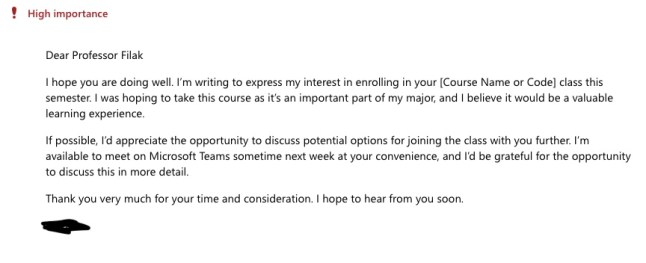
I, (FILL IN NAME HERE), AM HAPPY TO HELP (FILL IN NAME HERE): As is the case every semester, I got a series of “could you please squeeze me into your full Writing for the Media class?” emails over the past couple weeks. The excuses are usually the same (I missed my registration day, I accidentally dropped it, I died while donating my heart to my cousin, but thanks to revolutionary bionics, I’m back now…) as are the ramifications they use to nudge me in their favor (I need this to graduate, I can’t move on with out the class, I’m planning to join a biker gang but they won’t take me without a bachelor’s…)

This one came oh so close to moving me…

Look, AI can be helpful in some cases, but your really gotta meet it halfway…

And off we go on another semester-long adventure. Let’s stay safe out there…

Vince (a.k.a. The Doctor of Paper)

Journalists: If your mother says she loves you, go check it out (and then be damned sure it’s true)

As the Russian proverb says, “Trust, but verify.”

The long-held adage of journalists saying, “If your mother says she loves you, go check it out,” needs a little more updating these days, as it seems like NOTHING is as real as it seems. Thanks in large part to corner-cutting, scam-baiting and general laziness, we’re finding a lot of cases in which it never hurts to make absolutely sure you are sure. Here are a couple examples:


AT THIS POINT, JUST ASK THE MAGIC 8-BALL:  A few months back, we highlighted Rob Waugh’s story about journalists being duped by AI “experts” who churned out content that ranged from generic to highly suspect. Waugh’s latest piece found that journalists who are using supposedly “legitimate” systems to connect with sources are also now at the mercy of AI spamming, all while paying for the privilege of getting screwed:

A PR agency is selling an AI tool that automatically answers pitches from journalists on services such as ResponseSource, HARO and Qwoted.

The AI tool, called Synapse (not be confused with PR pitching platform Synapse Media), “reads” questions sent for for expert comment by journalists via the services, then analyses sources such as books, podcasts and reports per query and uses AI to draft email responses.

Journalist-request services such as HARO charge a fee for connecting PR agencies with journalists. PRs can send out story pitches to journalists and also get access to requests for expert comment.

<SNIP>

The makers of Synapse, Lithuania-based PR agency Wellstone PR, boast that it has a 7-8% acceptance rate, and that used by a human “editor”, it can answer around 20 pitches per hour with one human PR person able to do the work of five.T

The company brags in its pitch to potential clients that it will provide them with fictional content that sounds so much like the real thing, journalists won’t know the difference. I don’t know if it bothers me more that a) it would appear journalists are getting inept/lazy enough not to notice that they’re being fed total bullpucky or b) that the PR professionals are writing such average, generic stuff so often that journalists can’t distinguish it from whatever garbage an AI can produce.

The cost for this service is a one-time fee of $2,500. The only saving grace is that they apparently haven’t sold this to anyone. Yet.

The PR experts quoted in Waugh’s piece are clearly not thrilled by this breach of trust.

Andy Smith, founder of Sourcee, which aims to offer credible, video-checked experts, says that using AI tools in this way erodes trust.

Smith said: “When journalists post a journo request, there’s an implicit level of trust in the person replying. They’re hoping to hear from real people with genuine insights, experiences, and expertise that can bring their story to life.

“They certainly don’t want to receive an automated, AI-generated reply… if that’s what they were after, they could’ve just used ChatGPT themselves.

One thing that has me rethinking my “stop using these stupid “OK-Cupid-For-Quotes” sites” was a point that Smith made about how a good expert pool, like the one he says he’s built, is meant to broaden the reach of journalists. That can prevent them from only reaching out to familiar contacts and ending up with the “usual suspects” in every story. Still, if I had to pick between usual humans and a random lottery of AI word salad, I’ll stick with my boring peeps, thanks.


WSJ PLUS AI EQUALS WTF: If Cliff Behnke isn’t spinning in his grave over this situation, it’s only because he’s actively crawling out of it to come smack the shit out of somebody right now:

A story about development plans for a vacant downtown block that appeared on the front page of the Sunday, July 13, issue of the Wisconsin State Journal was removed Wednesday from the Madison daily newspaper’s website before being replaced by a “re-reported” story Thursday afternoon.

An editor’s note on the re-reported story states that the original “contained incorrect information and quotes that were created by an unauthorized use of AI, which does not adhere to the Wisconsin State Journal’s editorial or ethical standards.”

The story topic itself, both in what I can find of the original and the reboot, is a simple, boring tick-tock story about a development project, in which the material for the proposals are all easily accessible. This wasn’t like the reporter needed whatever the hell Tom Cruise is using in the latest “Mission Impossible” movie to create a miracle out of thin air.

It’s not quite clear what’s more terrifying: That a reporter decided to cut a corner on something this vanilla and didn’t bother to make sure on at least a few basic facts or that the editorial process didn’t catch something that was so wrong:

One section about “The Grove,” a proposal from Neutral, a Madison real estate development firm, outlined plans for a “food hall prioritizing minority-owned vendors” and a “community advisory board” that would shape the development’s public life. Neither of those features, nor the name “The Grove,” appear in Neutral’s proposal linked from a city press release listing the firms that responded to its RFP.

“It’s all wrong,” says Daniel Glaessl, Neutral’s chief product officer. No reporter had contacted the firm about the project before Isthmus reached out on Thursday afternoon, he says.

The Synapse people in the story above are like, “Hey, AI will write all your stuff, but don’t worry! The editor will be there to ‘create enough friction’ to prevent anything terrible from getting into the public sphere.” I’m having even bigger doubts about that concept now, especially since I know the folks involved at the WSJ and I have always respected and admired them. It always hurts a little more when it happens where you live.

And finally…

FOUL BALLS: It’s not a stretch to say that the sports memorabilia world is a multi-billion-dollar industry, in which athletes get paid exorbitant amounts of money for scrawling their names across all manner of items. What makes an athlete’s autograph worth the big bucks is a confluence of the awesomeness of the athlete and the rarity of their willingness to sign items. The more people want an athlete’s signature and the fewer of them exist, the more likely there will be fraud involved at some level.

In the 1990s, the FBI dug into the world of fraudulent autographs with “Operation Bullpen,” a multi-year investigation that took down a series of forgers who made a living faking the signatures of Joe DiMaggio, Mickey Mantle, Mark McGwire and others. In response, the major sports leagues and the preeminent autograph certification houses began using holograms, certificates, registration numbers and QR codes to assure buyers that the autographs they owned were, in fact, real.

It didn’t work as well as they had hoped:

Brett Lemieux, a 45-year-old resident of Westfield, Indiana, was the founder of sports memorabilia site Mister ManCave, which claimed to have sold millions of counterfeit items with net profits exceeding $350 million, and had “the largest framed jersey inventory on the web.”

Lemieux made the claims in a now-deleted Facebook post on the “Autographs 101” group Wednesday, saying the money was “too good” to pass up and that he wanted to stop the fraud, which had been going on for the better part of two decades.

Part of Lemieux’s post, bragging about his fraudulent creation of autographs and the holograms of multiple companies meant to prevent such fraud.

Over the past week, I’ve seen a ton of people submitting their Shohei Otani, Mike Trout, Derek Jeter and other autographs to online authentication groups, only to find that the balls, bats and photos are fakes. Many of these items have one, if  not more, authentic-looking holograms, to boot.

I know this seems far afield for journalists, but it really emphasizes an important point about how and why fraud persists in our space as much as it does everywhere else: If there’s money to be made in an easy way, people without scruples are going to take advantage of the situation.

That means we have to all be extra cautious about what we are willing to accept at face value and what we are willing to walk away from if the situation doesn’t feel right. It’s especially true when we really want something to work out, like getting that crucial source or making that tight deadline.

I’ve often said that paranoia is my best friend. Feel free to make it yours as well.


A Mob Shakedown, Chump Change or An Affront to The Foundations of The Country: Framing Paramount’s $16M Settlement With President Trump

This interview, which literally and figuratively did absolutely nothing to the outcome of the 2024 presidential election, was at the core of a multi-billion-dollar lawsuit President Donald Trump filed against “60 Minutes.” 

THE LEAD: Paramount agreed late Tuesday to pay $16 million to settle President Donald Trump’s lawsuit over the editing of a Kamala Harris interview on “60 Minutes” that Trump deemed fraudulent and deceptive.

Trump sued Paramount in November for $10 billion, claiming the editing of the interview created “partisan and unlawful acts of election and voter interference” intended to “mislead the public and attempt to tip the scales” of the 2024 election toward Harris.

Experts had long noted that the suit was frivolous and that Trump had a better shot of quarterbacking the Cleveland Browns to a Super Bowl title this year than he did of winning this case. Still, the parent company of “60 Minutes” took the settlement route, as a corporate sale of several billion dollars seemed to be at risk if it didn’t:

Many lawyers had dismissed Mr. Trump’s lawsuit as baseless and believed that CBS would have ultimately prevailed in court, in part because the network did not report anything factually inaccurate, and the First Amendment gives publishers wide leeway to determine how to present information.

But Shari Redstone, the chair and controlling shareholder of Paramount, told her board that she favored exploring a settlement with Mr. Trump. Some executives at the company viewed the president’s lawsuit as a potential hurdle to completing a multibillion-dollar sale of the company to the Hollywood studio Skydance, which requires the Trump administration’s approval.

After weeks of negotiations with a mediator, lawyers for Paramount and Mr. Trump worked through the weekend to reach a deal ahead of a court deadline that would have required both sides to begin producing internal documents for discovery, according to two people familiar with the negotiations.

FRAMING THE OUTCOME: We talked about Framing Theory a few months back, but for a brief recap, the idea is that how the media chooses to focus on an issue can shape how people in general will look at that issue. In this case, here are three I’ve seen pop up:

The Mob Shakedown: In most good gangster movies and TV shows, a scene emerges that showcases how to threaten someone without actually threatening them. It’s a pure demonstration of the power the “Don,” the “boss” or the “enforcer” has: Force someone to do something they don’t want to do out of pure fear of what otherwise might happen.

The shakedown scene usually starts with the gangster offering “friendship” or “protection” for a business owner, explaining that the world is a dangerous place and that a lot of bad things can happen. So, for a small percentage of the owner’s finances, this gangster will keep those bad things at bay.

If the owner protests, the gangster tends to get a little more specific while still being vague, offering “God forbid” scenarios like how a mysterious fire could burn the business to the ground or how a random act of violence could lead to the owner being hospitalized for serious injuries. However, fortunately, a payment to this “ambassador of goodwill” can pretty much eliminate those possibilities:

(This was the best “shakedown” scene I could find from any TV show or movie that a) didn’t use enough F-bombs to destroy an underground nuclear bunker, b) use other pejorative language regarding someone’s race, gender, ethnicity, sexual orientation or pet preference and c) didn’t actually use the violence that was suggested earlier in the clip. Still, it’s not pure enough for totally virgin ears, so watch at your discretion.)

In the Paramount case, the company had a multi-billion-dollar deal waiting in the wings, but it needed “the Don’s” blessing to go through and a lot of terrible things can happen to a deal if, God forbid, the FCC decided to look reeeeeeealllly closely at it. I mean, who knows what might happen to all that money? If Paramount lost that deal just because of a little misunderstanding it could make right with this “60 Minutes” thing? Hey… I’m just saying…

Of course, the Trump administration definitely wasn’t doing that:

Brendan Carr, the chairman of the Federal Communications Commission, has said the president’s lawsuit against Paramount was not linked to the F.C.C.’s review of the company’s merger with Skydance. Paramount has also said the two issues were unrelated.

Right. And the business owner got that black eye and broken arm after “accidentally” falling down a flight of stairs before coming to the conclusion that protection money is a small price to pay for proper piece of mind.


Chump Change: If you look at some of the more successful campaigns to get money out of people, they tend to be the ones that appear to be the least taxing or consequential. Case in point, each year, my alma mater (or maters) send me a pledge card, asking for a “gift” of between a few hundred and a few thousand dollars. Those always go right in the trash without a second thought.

That said, I have a hard time recalling the last time I refused to “round up” at the grocery store, the hardware store or anywhere else for whatever charity the business was repping at the time. It’s like, “Hell, I’m already $132.47 into the Kroeger Family at this point. What’s another 53 cents for a good cause?”

In addition, I’ve seen people drop a few coins in a parking lot and refuse to pick them up, folks at rummage sales drop the “and XX cents” on a customer’s total and other similar maneuvers that basically just round off a relatively insignificant amount of cash.

Thus, the concept of “chump change.”

I personally have a hard time thinking about $16 million as “chump change,” but everything in life is relative, as noted in this clip from “The Social Network:”

I suppose if I’m looking at it from the perspective of a multi-billion-dollar company that wants to make several billion dollars on a deal, giving up $16 million isn’t a lot to make things happen. I also suppose that if a collections company told me I owed $1,000 to a creditor, but I could pay it off today for $1.60, I’d probably avoid the argument and fork over the cash. (Trust me on this one: The comparative math is solid.)

To Paramount, this is the cost of doing business. It’s rounding up at the register to move things along. It’s chump change.


An Affront to The Foundations of The Country:  After the news broke about the Paramount capitulation, it might have felt like time stood still for a few minutes. That’s probably because when Edward R. Murrow, Katherine Graham, Walter Cronkite, Ben Bradlee and David Brinkley (among other journalists) started simultaneously started spinning in their graves, the Earth found itself dealing with that “Superman The Movie” trick:

We’ve discussed SLAPP suits here before, where people with virtually no case whatsoever sue for a ton of money to get people to back off. In many of those cases, the defendants lack the sufficient means to truly stand their ground and fight back on behalf of truth, justice and the American way, so they knuckle under.

In this situation, Paramount had the funds, the legal might and the legal precedents to stand up for all the mom and pop media operations (whatever of those are left) and tell the president where to put his suit. Paramount also had the opportunity to stand up for the free press and free speech rights that have defined the country for generations.

It’s something Graham and Bradlee did before when a president came at them. It’s something Murrow did in a time in which a demagogue rattled this country to its core. It’s something so many other journalists and journalism operations have done in big and small ways to reassure us all that our rights are not a “when it’s convenient to people in power” thing.

But a funny thing happened on the way to our current predicament. News outlets are now part of larger conglomerates with larger concerns. TV news always lost money, relative to other programming, but it was seen as part of the deal: You give us quality news, we let you use the public airwaves. Newspapers use to make money and hold sway over larger groups of people. Furthermore, they weren’t part of a collective that also did entertainment programming, sold time shares, controlled real estate and answered to shareholders. Their concern was doing the news well and defending their right to do it.

For Paramount, “60 Minutes” is a “property” of the company, just like all the other stuff they put on TV. If an episode of “School Spirits” pissed off enough people to prevent a multi-billion-dollar deal from happening, they’d kill it or edit it or pay off someone, too. Cost of doing business. That’s the company’s view. The needs of the many outweigh the needs of the one.

However, when one company lets the powerful dictate the news based on threats like this suit, it undermines the strength of those First Amendment rights for everyone else.