“It’s not a riot. It’s a large, prolonged disturbance.” Working through fact-checks and BS-checks (A Throwback Post)

When it comes to fact checking and BS detecting, I often tell students about a story I wrote involving the Mifflin Street Block Party about 30 years ago. The party got way out of hand late at night, with students setting bonfires in the middle of the street and even burning a car. When firefighters arrived to extinguish the blazes, the party participants repelled them with bottles, rocks, cans and anything else they could throw.

With the fire truck damaged and the firefighters outnumbered, the police eventually went in with riot gear and battled for control of the scene, as the party folks chanted, “F— THE PIGS!” at the top of their lungs.

The next day, I’m talking to the public information officer from Madison PD and I ask if, since it was the first time they donned riot gear since the Vietnam War, if they called out a 10-33, Riot In Progress.

“Don’t you dare call this a riot,” he told me.

I then explained I’d seen what had happened and the carnage that was left behind, so if it’s not a riot, what was it?

“It was a large, prolonged disturbance,” he told me before hanging up.

We are apparently entering another period of Jedi Mind Trick 101, in which people in power are telling the media, “Don’t call this a war. It’s not a war.” Therefore, I thought it might be a good time to pull this post the fact-checking exercise along with it out for another run.


Journalism 101: Facts matter, so don’t feel bad about forcing people to get them right

Screenshot

THE LEAD: In a blinding flash of the obvious, the Washington Post reported that politicians don’t like being told they’re wrong about things via a journalistic fact check. In other “water is wet” news, Donald Trump and his campaign seem particularly outraged by the temerity of journalists who actually researched topics and can prove he’s full of beans from time to time:

Trump nearly backed out of an August interview with a group of Black journalists after learning they planned to fact-check his claims. The following month, he and his allies repeatedly complained about the fact-checking that occurred during his debate with Vice President Kamala Harris, berating journalists and news executives in the middle of the televised debate.

And this month, Trump declined to sit down for an interview with CBS’s “60 Minutes” because he objected to the show’s practice of fact-checking, according to the show.

<SNIP>

The moves are the latest example of Trump’s long-held resistance to being called to account for his falsehoods, which have formed the bedrock of his political message for years. Just in recent weeks, for example, Trump has seized on fabricated tales of migrants eating pets and Venezuelan gangs overtaking cities in pushing his anti-immigration message as he seeks a second term in office.

THE BACKGROUND: The joke I always go back to is the familiar one of, “How can you tell when a politician is lying? Their lips are moving.” The idea that politicians fabricate situations is not a new one. Nixon’s “I am not a crook,” Clinton’s “I did not have sexual relations…” and Mark Sanford’s “hiking on the Appalachian trail” are some of the more infamous ones, as they intended to cover over embarrassing personal failings and limit political fall out.

Even more, politicians invent people they saw, they met and they heard, all in the service of some anecdote about salt-of-the-earth farmers getting the shaft, military leaders praising their brilliance or other similar moments of self-aggrandizing puffery. And of course there is the myth-making that surrounds some politicians, like George Washington’s cherry tree or Reagan’s trickle-down economics…

As far as this election is going, Tim Walz was fact-checked on his claims about his service, his presence in China during the Tiananmen Square protests and his family’s use of IVF services, each of which resulted in some disparities. Kamala Harris is also ringing up a few “false” ratings from Politifact on some of her claims regarding illegal drugs and her own previous political efforts.

Still, most of this is piddly stuff compared to what Trump does on a daily basis, both in terms of frequency and intensity. If Walz’s “carried weapons of war” statement is a leak in the truth boat, Trump is continually bashing the Titanic into the iceberg and flooding every compartment.

WHY DO WE CARE AS JOURNALISTS: Despite what the former president of the United States things, facts have a definition:  things that are known or proved to be true. The job of a journalist is to get the facts and report them, so that people can make informed decisions on important things in their lives. If you strip away everything else from journalism, that’s the beating heart at its core.

Telling journalists you will only talk to them if they promise not to fact check you is like telling me, “You can come to our party, but only if you promise to not be a bald, middle-aged white guy.” It’s what I am, so that’s going to be a bit hard to square that circle.

People rely on facts to have a shared understanding of reality, so that society can function. It’s why when we bring a shirt to the check out kid and that shirt is priced $19.99 plus tax, we understand it’s probably going to cost about $21 or $22, give or take your part of the country. If the kid says, “That price is fake news. You owe me $150 and can’t leave until you do,” that breaks the whole “shared understanding of reality” thing.

For years, journalists have been telling people, “You’re entitled to your own opinion, but not your own facts.” Somewhere along the way (I blame the internet), it actually became, “Pick your own facts and then be outraged when someone disagrees with you.”

EXERCISE TIME: Pick out a TikTok on any hot topic that’s going on today (politics, Diddy trial etc.) and write down whatever statements these people are declaring to be facts. Then, go fact check them against

UNC policy allows the U to record classes without telling professors or students, while students aren’t allowed to record at all

If you feel like this, you might be working at UNC…

THE LEAD: The University of North Carolina has implemented a policy that dictates who can and can’t record classroom content, which includes a terrifying Big Brother option for the university itself:

The University may record a class or access existing classroom recordings without the permission or knowledge of the instructor being recorded for the following purposes:

  • To gather evidence in connection with an investigation into alleged violations of University policy, when authorized in writing by the Provost and the Chief Human Resources Officer; and
  • For any other lawful purpose, when authorized in writing by the Provost and the Office of University Counsel, who will consult with the Chair of the Faculty.


BACKGROUND: The university had run into several issues related to recordings of professors over the years, only to figure out it really had no policy in place to deal with such things.

The tipping point appeared to be when UNC decided not to renew business professor Larry Chavis’s contract after reviewing recordings of his classes. Chavis noted he had no idea the university was recording him.

When called to account for this surreptitious move, the U fell back on the “well, we’re a one-party consent state” thing, which is true but a bit wobbly at best.


A FEW BASIC OBSERVATIONS: I found myself thinking about a couple aspects of the policy that either people haven’t considered very well or they just hope they won’t have to deal with in the future. Consider the following:

Rules for student recordings: I’m not sure exactly how this came into play, but the document makes it against UNC law for students to record in the classroom, except under specific circumstances:

Students may not record classes, including online classes, without express advance permission from the instructor teaching the class they wish to record. Students approved for recording as a University Compliance Office (UCO) accommodation to address a disability, pregnancy, or religious accommodation must notify instructors of their approved accommodation by sending an accommodation notification plan in advance of any recording. The approved accommodation plan must indicate the means by which the recording will be accomplished and any other details pertaining to the recording or its use.

Well, for starters, how are you going to monitor that, given students carry about 97 digital devices on them at any point in time? I guess if I’m in my computer lab at UWO with 20-some kids, maybe I might notice a kid’s phone set to record, but most likely not. In a UNC pit class, though? Not a chance in hell.

Add that to the lack of a specific “or else what” in this policy and I’m thinking this thing is going to be relatively toothless when it comes to enforcement. I’m not an expert on university policy or UNC’s policies in particular, but I don’t see a “If you do X, you will suffer Y” in this document. The document also doesn’t say, “See POLICY X for punishments” so I’m left to wonder if the kids will record anyway depending on how strict the policy and problematic the punishment.


Martyrs to the cause: Most of the kerfuffle I’ve seen in relation to classroom recordings getting out into the world is related to students trying to “expose” professorial bias. We’ve covered a few of these here, and there are dozens more cases elsewhere in which a student records a professor doing or saying something that upsets a large group of the perpetually offended. Once that match of outrage hits the kerosene of social media, the professor’s goose is cooked.

With that in mind (and the previous point in mind as well), I somehow doubt this kind of thing will stop. Even more, I imagine that a kid who “exposes” a professor via an illicit recording at UNC will now be hailed as a martyr to the cause if any punishment befalls that kid.

(“Let’s all remember the brave sacrifice of Jimmy, who recorded Professor Jones misgendering a piece of wicker in Underwater Basketweaving 385. That ‘stern talking to’ he got from the dean will haunt him always…”)

We have a world in which social media rules, “gotcha fame” is aspirational and people are way too full of themselves around the academic world. Recordings are going to happen.


To Chill or Not To Chill: I’ve studied the concept of the Willingness to Self-Censor for a number of years and found that many people have an innate sense of how willing they are to speak out or shut up when faced with controversy. Certain topics tend to spark this more in all people, but many topics spark it in specific people. In short, there are a lot of reasons why people will hold their tongues and it’s not always because they don’t have something to say.

Conversely, I’ve dealt with academics all my adult life and I found that many of them apparently have some sort of condition that makes them think everyone should hear what they have to say about everything, regardless of the circumstances.


Michael Palm, president of UNC’s chapter of the American Association of University Professors and associate professor in the UNC Department of Communication, said faculty members are aware they may be monitored by the University or even outside groups.

“My sense is that most faculty, at this point, just assume they’re being watched,” Palm said.

<SNIP>

“I think it is unquestionable that there has been a chilling effect on campus and that many more faculty now than at any other time that I’ve been a faculty member — and I’ve been at UNC for 18 years — are self-censoring out of fear for what might happen if the wrong people disapprove of the content in their classes,” Palm said.

If I’m being honest, there are days I have a “come at me, bro” vibe going on when it comes to my classroom. If you think I’ve said something stupid, childish, offensive or whatever… well… take a number, I guess. Then there are other days where, if I think about all the potential ways something like this could screw me, you couldn’t pull a needle out of my keester with a tow truck.

What I foresee here is that the students are going to lose a lot, thanks to this policy. The professors who really SHOULD be curbed a bit in regard to their histrionics and side-rambles will be the ones thinking, “Well, that’s for other people…” The folks who are more like academic prairie dogs, popping their little heads out of their holes juuuuuusssst enough to see if the coast is clear, will stay under ground for fear of getting whacked.

Journalism-related concepts that played out as well in the medical world while I was getting gallbladder surgery

My boss was nice enough to let people know I’d be out for a bit, but this is a little vague… Not like THAT’S gonna lead to speculation…

At the start of every semester, I try to come back with a “X number of things I’ve learned” or a “X years of teaching have taught me” kind of post. It was ruminating (I swear) when my second gallbladder attack in four days hit me badly enough to head to the ER at midnight the day before school started.

Although everything went well, I found myself living out little moments that had me shifting into “analogy mode” as I saw parallels between where I was (the hospital) and where I wanted to be (a journalism classroom). So, as I continue to mend and catch up with the 82,324 things that have landed on my desk while I was gone, I thought a simple slow-walk post of advice would be a good start to what has already been a shaky semester.

(Also, to be fair, I’m still on meds, somewhat hazy and worried I’d somehow come in hot on a topic like Bad Bunny or something that would end up getting me fired without me entirely knowing why.)

So, here are a couple of the maxims that ring true in journalism that kind of came home to me throughout my hospital stay and recovery:

ACCURACY ABOVE ALL ELSE: We’ve been having a lot of conversations like this around the house:

Me: Who called?

Zoe: She didn’t leave her name on the voicemail.

Me: Can I listen to it?

Zoe: She was just like “Hi, this is mumble mumble and I’m with…

Me: So she did leave a name, but you just didn’t understand it? Is it possible that maybe if I listened to it, I could figure it out?

Zoe: Well, I guess…

As much as I expect that out of my kid, I didn’t think I should expect it from a healthcare provider.

Case in point: Upon leaving the hospital, the discharge nurse is going through all the stuff I should or should do, eat or drink. She tells me to avoid fried food and fatty food like bacon. Due to the lack of the gallbladder, these things are likely to create severe gastric distress in the early stages of my recovery.

OK, got it. Most of my diet goes on the shelf.

The other night, Amy made this amazing chicken and potato thing that was part of our “healthy eating” resolution for the year. About 20 minutes after I ate it, I’m in stomach-cramp hell for about two hours. Turns out, she used olive oil on the stuff, which has the same basic effect as those other two things, even though the nurse didn’t mention it and we all usually seem to think olive oil baking is good and deep-fried drumsticks are bad.

I often think about the way in which we ask questions of people in journalism and how we get “almost” answers, or how sources provide information that’s direct but not entirely accurate. From now on, I plan to start interrogating sources like the entirety of my GI tract depends on it.


VOCABULARY MATTERS: We always talk about picking the right word, the proper descriptor or the exact phrase to help the audience understand things accurately. In news stories, it’s relatively important. In the medical field, it means a hell of a lot more.

In trying to explain what he found when he dug into my gut, the surgeon referred to the gallbladder as “angry,” “wicked” and “gnarly.” Those descriptors sound more like the tappers at a South Boston pub than a description of a human organ.

In addition, he explained that something had happened causing my gallbladder to grow a “rind” over the top of it and encase it tightly against my liver. What created said rind and what the rind was composed of, he would not venture a guess. Apparently, I just have a brie-like defense mechanism against gallstones or something.

I didn’t need the whole medical textbook explanation, but it did dawn on me that I felt like I was interviewing Nuke LaLoosh in “Bull Durham” for a bit here:

When it comes to telling people things, keep your audience in mind and use strong, clear vocabulary that helps the folks out there understand exactly what is going on and why they should care.


CONNECTIONS CUT BOTH WAYS: We talk a lot in reporting about the importance of having strong connections with good sources. Those kinds of relationships can give you an edge when it comes to a big scoop, a key interview or a sense of confidence on a topic.

They can also be a problem if sources try to ask you for things you can’t provide or they assume you won’t write about things they don’t like. I always tell students, “It’s great having the mayor feeding you tips, right up until the point his kid gets busted for a DUI and he wants you to keep it out of the paper.”

In terms of connections at the hospital, I was not only being treated at the same hospital where Amy had worked for several years, but I was actually on her old unit. This led to some significant comfort for me in terms of knowing (relatively speaking) who some of these folks are. It was also great because they had nothing but praise for Amy and wanted to know how she was doing at her new job and so forth. I also knew I had a rock-star surgeon because Amy had worked with this guy’s post-op patients over the years, so she knew him and his work.

The “cuts both ways” part really was more of my own making, in that I was groggy and gimpy most of the time, with that “gown” barely doing much of anything. As a massive social hermit, I don’t even like to be in the house when Amy has friends over, so you can imagine how I’d feel about needing their help to wander semi-bare-assed to the bathroom several times a day.

(The closest parallel I can offer is this one time when my parents and I went to a restaurant during the summer and it turned out one of my mother’s teaching colleagues was there waiting tables. She ended up as our server, which felt awkward as hell when I needed to flag her down for another Diet Coke or ask about desert. And at least I was fully clothed there…)

The nurses and staffers were totally professional, even when I managed to set off the bed alarm that Amy used to tell me would tick off the staff to no end. They were also patient with me as my body seemed to be re-calibrating all functions at the same time for no real reason. And it wasn’t like I would be flailing naked down the halls if Amy DIDN’T know these people. Still, it was a combination of comfort and clumsy.

And finally…

TRANSPARENCY IS THE BEST VIRTUE: My buddy, Pritch, used to tell me that in PR transparency is everything, even if what is happening is something you’d rather hide. Abiding by that rule, the first chance I got, I told everyone in my classes what had happened, what the doctors were saying and when we might be able to get back together.

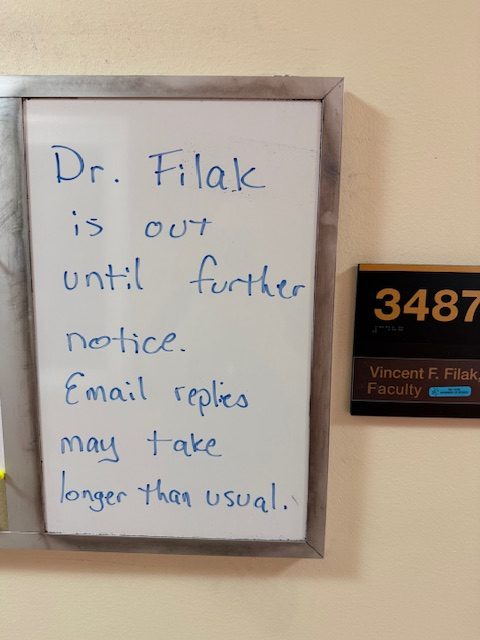
Some kids who knew me but weren’t in the classes I’m teaching got the message on the whiteboard outside my office and kind of freaked out. My boss explained he didn’t want to disclose my health issues without my permission, which is great. However, I know how the minds of journalists work and I could only imagine what it was these people thought had happened to me.

I’ve told Amy this many a’ time: When I die, put the cause of death in the obituary, no matter what. If I died when I broke my neck falling off the couch trying to complete the “bite your own toenails TikTok challenge,” tell people that. It may appear stupid and demeaning, but if I cared enough about it to die doing it, well… there you go. Besides, whatever I did, the speculation of what I might have done will be far worse, I guarantee.

I understand that some folks might be more demure or more guarded than that, which I get, but the less you tell people, the larger the space for the rumor mill to operate. It’s a good rule for PR folks putting out messages and it’s a good thing to remind sources of when they try to get weaselly.


Blog Post No. 1,000: A Bit of Heartfelt Gratitude to Sage

When Sage had me start this blog eight years ago to promote my reporting book, I did so under two strict conditions:

  1. I had total control over the content. They couldn’t demand, require or censor anything I decided to post here.
  2. This was not going to be a “rah-rah site” that just pimped out my books or blindly praised the company that published them.

With those two things in mind, I decided to dedicate the 1000th post of this blog to the company that changed my life 12 years ago and that has my loyalty for as long as they’re willing to have it. Please consider this an honest, heart-felt endorsement. 


My bookshelf the day I got my very first copy of my very first book for Sage. At the time, I couldn’t believe I had three titles with my name on them, and one with my name only on it. 


I can still see the strange confluence of events that happened at an AEJMC convention in Washington, D.C. that really altered the trajectory of my life and led me down a path that has made me ridiculously happy as a teacher, a writer and a colleague.

I was a few years into what seemed to be a terrible professional decision to come home to Wisconsin and teach at the University of Wisconsin Oshkosh. I had given up a job where people loved me, I had a sparse teaching load and I advised one of the best college newspapers in the country for a position that required me to give up rank, take a pay cut and work with at least one “colleague” who had publicly expressed disdain for my hiring.

(Another colleague told me that in the meeting where my hiring was announce, at a pay level that was a 25 percent cut from where I was coming, mind you, this individual stated, “For that kind of money, we could have gotten someone good.” Eeesh.)

The biggest problem I was facing was teaching basic media writing to students across a wide array of disciplines, including advertising, public relations, print-style news, broadcast, interactive web management and more. My background in news was seen as a bias and the books I could offer as texts basically crapped all over everything that wasn’t a newspaper reporting job. Thus, I set out to find a text that would make for a more equitable discussion of media while still imbuing students with the core elements of media writing that most news-writing texts professed.

Matt Byrnie, who was an acquisitions editor staffing the Sage booth at AEJ that year, asked me to sketch out a concept for a book like the one I needed and then meet with him later in the conference. Despite having my name on two books already at that point in time, I had no idea what to do here. That said, in the middle of an interminable panel session, I found a bit of hotel stationary and started scratching out a few concepts. The idea wasn’t necessarily WHAT needed to be taught, but rather HOW to approach this concept.

The rough sketch of what I pitched to Matt Byrnie still hangs in front of me every day in the office. It reminds me of what I promised I’d do and how important it felt to do it well at that point.

After our meeting, Matt seemed enthused, but I’d been there before with people in publishing: At first they’re all excited and then they ghost you like you owe them money. Still, I reached out to Matt and pitched the book. He not only agreed to do this one, but he also had me pitch a second book at that point as well.

He hung in there with me as I fumbled about the process of meeting the needs of his production team while I tried to stick as close as I could to the “rules of the road” I built on that bit of scratch paper. He was enthusiastic and supportive, kind and decent. He made me feel like what I was doing mattered, not just because it could sell X units for a corporate overlord, but because he thought it could add value to the field.

If it had all started and stopped with Matt showing faith in me, I would be fine with Sage, but not nearly as loyal as I am. Shortly before “Dynamics of Media Writing” launched, Matt reached out to me and told me he had been promoted and that my book would now be in the hands of some Terri person I’d never met. I lost my mind, thinking, “Here we go again. I’m totally screwed.”

Instead, Terri turned out to be every bit the partner Matt was. So was the person who followed her when she left the field, and so was the next person after that person got promoted. And on and on it went. Each editor I worked with from Janae to Lily to Anna to Charles and more gave me the sense that I was the most important thing in the world at that moment and that they’d do anything to help me get where I thought my work should go.

They encouraged me to try new things like the blog, guesting on podcasts, doing videos and more. They also provided financial support to keep the lights on at the blog, professional support to make sure the podcasts didn’t sound stupid and strong editors to make my videos look a lot less like a guy filming a hostage video in Saw’s kill room.

They also supported me in some of my more insane ideas, even as I’m sure they had to endure a few moments like this in explaining me to their bosses. When I decided to wear a bulletproof vest around for a week and write about it on the blog, they didn’t try to talk me out of it.

When I referred to promotional efforts as “book pimping,” they winced, but didn’t tell me to knock it off. When I decided to take the 11-day forced vacation from UWO and turn it into a John-Oliver-esque “furlough tour” complete with T-shirts to commemorate the event, Sage not only supported it, but they bought T-shirts for their staffers.

The person who bought the shirts for her team was Staci Wittek, probably the best person I’ve ever had the privilege of working with at any level, anywhere. Staci’s official title is Senior Product Specialist, Communication and Media Studies at SAGE Publications, but that doesn’t come close to what she has done for me (and I’m sure many others) who have books under her watchful marketing eye.

She’s had me do videos for her reps to explain the book, reach out to potential leads on behalf of reps, build additional resources for people who need them and more. She’s also so willing to do pretty much any ridiculous promotional idea that comes rolling out of the junk drawer that is my brain.

Without Staci, none of my books would have succeeded because she put so much work, energy and faith into what I’ve built. She’s the difference-maker, like Michael Jordan was with the Bulls.

The reps for Sage stop by my office for a chat every time they’re on campus. It’s always, “What can I do for you, Vince?” not “Here’s how you need to help me sell your stuff.” We laugh about various things, share stories and get to know each other. It really does have that family vibe, a rarity in a day and age where corporate culture and survival of the fittest seem to rule the roost.

Every time I part company with someone from Sage, I always say the same thing: “Thanks for everything, and if you ever need anything, just tell me what it is and you’ll get it.” It’s the same thing I say to my students, my colleagues and everyone else who matters to me in life.

And by the way, here’s that same bookshelf, 10 years later…

The books in Chinese and Arabic are two translations of one of my textbooks. You have to take my word for it, as I had to take someone else’s word for it. If you read either language, and it turns out they’re actually “Mein Kampf” or something, please tell me so I can fix this…

Thanks for everything, Sage folks. I look forward to the next great adventure.

Most sincerely,

Vince (a.k.a. The Doctor of Paper)

Tell me how to help people with money I might not actually get: A look at the Anthropic AI lawsuit and its $1.5 billion settlement

As if this semester hasn’t been weird enough, I got this email from a colleague on Monday:

In case you hadn’t seen this, Anthropic is being sued for copyright infringement.  Two of your books were swept up by them, and you are entitled to file a claim for damages: https://www.anthropiccopyrightsettlement.com/ 


Abiding by the “if your mother says she loves you, go check it out rule,”  I did a search on the site and found that he was right.

I’m honored that someone considers my work worthy of theft…

It’s Doctor of Paper 2, AI Pirates 0, apparently:

In one of the largest copyright settlements involving generative artificial intelligence, Anthropic AI, a leading company in the generative AI space, has agreed to pay $1.5 billion to settle a copyright infringement lawsuit brought by a group of authors.

<SNIP>

The settlement, which U.S. Senior District Judge William Alsup in San Francisco will consider approving next week, is in a case that involved the first substantive decision on how fair use applies to generative AI systems. It also suggests an inflection point in the ongoing legal fights between the creative industries and the AI companies accused of illegally using artistic works to train the large language models that underpin their widely-used AI systems.


BACKGROUND: Anthropic trained its AI using a ton of content, including a boatload of books and other copyrighted material. In the case of things that were open to the public or properly purchased, this was apparently fine, based on the “fair use” doctrine associated with copyright.

The argument the lawyers for Anthropic made was that the training of AI on these books was a transformative effort, meaning that the books themselves were changed into something else entirely through this process. Transformative acts have often been protected as fair use for years and it’s why Google could digitize books as part of a search-engine service and Andy Warhol could present Campbell’s soup cans to the world.

(It’s also why Roy Orbison is likely spinning in his grave over 2 Live Crew’s version of “Oh, Pretty Woman” or why we get thumbnail images before clicking on a link to visit “Perfect 10” magazine, so maybe it hasn’t always been the greatest of things… )

That worked for a lot of the content they fed the AI beast, but unfortunately some of the stuff they fed it came from sites that pirated copies of texts:

(The judge) also found that Anthropic had illegally acquired millions of books through online libraries like Library Genesis and Pirate Library Mirror that many tech companies have used to supplement the huge amounts of digital text needed to train A.I. technologies. When Anthropic downloaded these libraries, the judge ruled, its executives knew they contained pirated books.

Anthropic could have purchased the books from many sellers, the judge said, but instead preferred to “steal” them to avoid what the company’s chief executive, Dario Amodei, called “legal/practice/business slog” in court documents. Companies and individuals who willfully infringe on copyright can face significantly higher damages — up to $150,000 per work — than those who are not aware they are breaking the law.


If this dude thought getting the books the legal way was a “slog,” he should try writing a book once…

In any case, I reached out to Sage and they are on this, noting I should be getting a letter or email from them to explain what to do and how to fill out a claim form. News stories noted that authors could get up to $3,000 per text, but I’m pretty darned certain there’s no way I’m getting that.

Sage is really the aggrieved party in this, given that the folks there put in the “slog” to get this book built, shipped, marketed and in the stores in time for the Christmas rush. There’s a mention of royalty percentages, so I might get like 5-10% or whatever of whatever the actual amount is. Then again, I might get nothing.

That said, let’s do the thing we all do when we buy that Mega-Millions ticket: Plan to spend money we might never get…

FUN WITH MONEY: As I noted on the “About” page, comedian John Oliver is my spirit guide in everything I do here. One of the things I love most about “Last Week Tonight” is when Oliver does something incredibly weird to sponsor something he finds particularly important.

It’s why he bought Russell Crowe’s leather jockstrap from the movie “Cinderella Man” and stationed it in one of the last remaining Blockbuster Video stores in the country. It’s why he wrote a book about Vice President Mike Pence’s pet rabbit (Marlon Bundo) and turned it into a fundraiser for the Trevor Project and AIDS United. He even managed to buy the website “John Oliver’s Junk” and use it for an auction that raised more than $1.5 million to support public broadcasting.

I’m sure I lack that kind of star power and I might end up getting $50 and a ham sandwich out of this, at best. Still, not for nothing, but Oliver’s weird fundraising efforts got a Koala Chlamydia Ward named after him, so let’s reach for the stars on this one…

Here’s the deal: Whatever I get, I’ll see if Sage would be willing to match it. Then, whatever we scrape together, we’re gonna do something with it that you think is fun, weird, good or all three and more.

Either post below or use the contact form on the website to tell me what you want me to do with my pirate’s booty, whatever of that I actually get.

A few thoughts came to mind already:

Honestly, it could be anything, or nothing if we get shut out. The point is, let’s plan to do something to commemorate this one time where the words “Vince Filak” and “lawsuit” is a cause for celebration, as we make a point to help someone or something important in a random and oblique way.

Thanks for reading as always.

Vince (a.k.a. The Doctor of Paper)

It’s time for some unpleasant honesty for journalism folks based on the Olivia Nuzzi/Ryan Lizza/RFK Jr. debacle

Believe it or not, this post is still up on Olivia Nuzzi’s X account… 

THE LEAD: As much as I wished this weren’t the case, we aren’t finished learning all the lurid details of the Olivia Nuzzi/Ryan Lizza/RFK Jr. debacle: 

Robert F. Kennedy Jr. wrote disgraced political reporter Olivia Nuzzi an outrageously raunchy “poem,” which was dramatically revealed by her ex-fiancé and reporter Ryan Lizza in the second part of his series exposing the secrets of his ethics-challenged ex.

“Yr open mouth awaiting my harvest,” Kennedy Jr., the current Secretary of Health and Human Services, wrote to Nuzzi in undated texts recounted by Lizza in a piece published on his Substack early Saturday.

The poem was included in Lizza’s second part of his series about the affair between his former fiancee and the current Health and Human Services secretary. The post titled “Part 2: She did it again” is available on Lizza’s Substack.

I’m not linking to it here for three specific reasons:

  1. The piece is behind a paywall and I can’t in good conscience promote this as journalism or something worth spending $10 on. I would rather set fire to a ten dollar bill than pay for whatever the hell is back there.
  2. The teaser paragraphs alone introduced enough “explicit content” that would have my editors at Sage literally having aneurysms.
  3. My mother reads this blog and I don’t know what would be worse if she clicked that link: Having her asking me what certain sexual terms Lizza uses mean or having her tell tell me she completely understood everything and didn’t need a translator.

    Either way, it’d feel like this:


THE BACKGROUND: Oh, hell, where to begin?

Nuzzi was booted from her job with New York magazine after her “inappropriate relationship” with RFK Jr. came to light. Nuzzi had written a glowing profile of the Kennedy offspring, while also finding herself infatuated with him to the point of having a long-distance-messaging-with-sexy-photos-but-we-pinky-swear-we-didn’t-bang relationship.

Lizza, Nuzzi’s fiance at the time, who has his own history of icky sex allegations, broke off the engagement and made some very public statements about Nuzzi and this situation.

Both mercifully dropped off the map until this month, when Nuzzi’s “American Canto” book hit the shelves, leading to a “little girl lost” style profile on her by the NY Times. In response to some of the stuff in the book, Lizza took to his Substack to publish a response titled, “Part 1: How I found out.”  In that post, he pulled a “Sixth Sense” twist at the end to reveal his whole “I can’t believe she’s cheating on me” build up wasn’t about RFK, but instead about former South Carolina Gov. Mark Sanford.

Meanwhile, Nuzzi is now working for Vanity Fair, and media folks are a-flutter discussing this situation.


DOCTOR OF PAPER HOT TAKE: It’s too easy to crap all over Nuzzi, Lizza and everyone else involved in this situation. Right now, this feels like staring at a multiple-vehicle car wreck on the interstate. Instead of taking the easy path, consider the following difficult advice:


BASIC ADVICE TO FELLOW EDUCATORS AND MEDIA PROS: We need to be honest with ourselves, the public and our students, even though it really sucks.

Whenever a situation like Nuzzi-gate (as we’re apparently calling it now) pops up, a common refrain that emerges is, “Female journalists don’t sleep with sources.” I know a number of professors, former journalists and current journalists who hate it when this kind of thing happens, because it reinforces thread-bare stereotypes about women and it debases the work quality female journalists have done.

Here’s the problem: Lousy examples exist in almost every field and they create misery for the rest of the folks in that field. I don’t like it any more than you do, but it’s the reality of our surroundings.

Trust me, every time some jagwad professor decides to treat his undergraduates like a sexual charcuterie board, I want to die inside a little. I hate that I find myself second-guessing every interaction I have with students for at least two weeks, wondering if they think I might be “one of those.”

That said, I can’t tell students, “Professors don’t sleep with students,” because despite the ever-present blank stares they give me in class, I know they aren’t completely unaware of reality. I’ve even overheard students I know talking among themselves about skeezy professors hitting on them or their friends.

I also can’t just say, “Well, I don’t do that…” because that’s just really creepy to make them think that I’m thinking that I have to tell them that and too damned specific to make anyone feel better about it. It’s usually why I just shake my head and say, “What the hell is wrong with people?”

In regard to journalism, I’ve met multiple former and current journalists who “engaged in inappropriate sexual relationships” with people they cover. In one case, a local reporter who also worked at a local university was accused of sleeping with someone she had profiled. A friend told me that his wife worked with her years earlier, so I asked what she recalled about the reporter. The response: “Tell Vince she was a whore who occasionally wrote stuff.”

Another friend who worked with this journalist in another newsroom told me the majority of the staff knew about multiple similar indiscretions, so they referred to her by a nickname that merged part of her last name with the word “rabbit.”

In another case, one guy confessed to me that as a student journalist he “accidentally” slept with a student athlete while he was a sports reporter and editor at the student newspaper. The following is my recollection of the conversation:

Him: “Um…” Blank stare. “This is not good, right?”

Me: “Well, I wouldn’t add it to my resume… I don’t get how you “accidentally” slept with her. Did you trip and fall on something?”

Him: “No, I mean I didn’t know she was on the team until just before we… you know…”

Me: “I’ve got so many questions, not the least of which would be, ‘How did her athletic affiliation come up at that exact moment?’ ‘How little did you know about her before you decided to sleep with her that this nugget of information didn’t come up?’ and ‘Did you maybe think about not doing this when you became aware of this situation?'”

It went downhill from there…

I don’t think I’m that special that I knew at least a handful of people who had violated this basic tenet of journalism, so I imagine more than a few other folks reading this have a “Hooo boy…. not good…” story of this nature.

We need to stop pretending that this kind of thing doesn’t happen and be more on point about what we want to say here:

  1. Most journalists do not sleep with sources period, let alone to gain special access for stories. A small number of journalists are bad actors, but to paint all journalists with a wide brush because of them is unfair to those who aren’t.
  2. None of us who don’t violate the rules are thrilled by the people who do, particularly when their actions reinforce negative stereotypes against people who have already had to work harder than they should to make it in the field.
  3. Those of us who take this job seriously are not going to pretend that those people don’t exist, but we are going to make damned sure you know we aren’t like them.

I’m sure there’s a better way to say this, but at least we’re being honest and letting people we aren’t thrilled by this, either.


BASIC ADVICE FOR STUDENT JOURNALISTS:  I can’t stress this enough, but for every situation like this, where it seems like the world turns out great by flouting the rules, there are dozens more that are just god-awful disasterbacles that never get a book deal.

Colby Hall of Media-ite made the case that Nuzzi, his DM buddy, really just learned how to play the game based on the way the system has shifted, so we can’t really hold it against her:

The glamorous photo shoots, the Lana Del Rey cosplay with the white Mustang convertible on PCH, the literary ambiguity about Kennedy’s identity in her book, the defiant framing that positions her as a victim bearing witness to power.

But here’s what I’ve come to understand: This isn’t tone-deaf. It’s the only move that makes economic sense in 2025.

Nuzzi has correctly read our current media ecosystem. There is no path back to institutional credibility for her—those institutions are dying anyway, and they were never going to reward rule-following in the first place. But there IS a path forward through celebrity, through controversy, through the monetization of scandal itself.

The Vanity Fair job. The book deal. The rehabilitation tour that’s a Klieg light away from what it really wants to be. She’s not trying to rebuild her reputation as a journalist—she’s building a different kind of brand entirely, one where being interesting matters more than being ethical, where attention is the only currency that still spends.

Please don’t buy into that line of thinking. She’s the “it” thing at the moment, but that fades pretty quickly and even if it doesn’t for her, it doesn’t follow it will work for you. If you don’t believe me, ask anyone who tried to become a millionaire starting an “Only Fans” account.

As much as it might seem like a great idea to be that rule-breaking, cool-as-hell rebel in the moment, these things don’t end well. As someone who has watched almost every VH1’s “Behind the Music” episode, I can pretty much guarantee short-term career thinking leads to some long-term misery. And unlike video games, you can’t just hit the reset button once things start going bad.

Follow the rules, behave better than the attention-seeking toddler at the grocery store and do the job to the best of your ability. You might not become famous, but that’s likely to be a good thing.


BASIC ADVICE TO PROFESSIONAL MEDIA OUTLETS: Watching Vanity Fair hire Nuzzi is like watching pro sports teams picking up troubled players who have talent, arguing that, in their system, the player will thrive. What they fail to realize is that even if the talent is in there somewhere, the human foibles are going to massively undercut it and you’re essentially just buying trouble.

With that in mind, I’m begging you. Stop buying trouble.

First, the juice is rarely ever worth the squeeze. Everyone is out there thinking they are buying the next Hunter S. Thompson. Instead, they’re buying the next Ruth S. Barrett. Hiring people like this has the same internal logic of cashing in your 401K and using it to buy lottery tickets to secure your retirement.

Second, you’ll make my job a lot easier as a professor because I won’t have explain to students that to get their dream job, they should work hard, play by the rules, and then pray they don’t lose out to someone who banged a source and now has 2.3 million followers on Instagram.

I’m having a hard enough time getting them avoid bias in their writing, abide by grammar rules and attribute the hell out of things, what with all the god-awful crap that’s passing journalism these days. I don’t want to have this conversation:

ME: You can’t write a profile story about your best friend. It’s not ethically sound.

STUDENT: So, why can (REPORTER X) sleep with a profile subject and land a job with a six-figure salary?

ME: Go read your AP style book.

Third, you need to understand the “Cockroach Theory of Terrible Behavior.” When you see one cockroach in a house, rest assured it’s not the only one around, like he’s on vacation or something. For every one you see, there are several more just waiting to show up.

I remember being at my college newspaper during an editor election, where one candidate was trying to justify some bad behavior, explaining, “Oh, that was an isolated incident.” Once we retired to debate his candidacy, the one guy piped up with, “I counted 10 or 11 ‘isolated incidents.’ How many does it take to make a trend?”

Vanity Fair is already playing defense on the hiring, as they were “take by surprise” at Lizza’s accusations about Nuzzi’s nuzzling with Sanford. The magazine is “looking at all the facts” in this situation as it decides how the hell it’s going to get out of this situation before another cockroach comes crawling out of the corner.

If you want to see the best of journalism, hire good quality people. Promote and showcase them as what’s worth doing in the field. Let us in the classroom highlight the good work done in the right circumstances.

None of this will stop another Nuzzi situation, but at least you can help us point to this as a cautionary tale and not a smooth career move.

The Junk Drawer: The Big, Beautiful Edition

Hey! There’s my big, beautiful tape dispenser!

Welcome to this edition of the junk drawer. As we have outlined in previous junk drawer posts, this is a random collection of stuff that is important but didn’t fit anywhere else, much like that drawer in the kitchen of most of our homes.


SCORE ONE FOR THE GOOD GUYS

Officials in Marion County, Kansas agreed to pay approximately $3 million dollars to a small local newspaper after it assisted in raiding the paper’s office in 2023. The settlement also included an apology from the county.

We covered this back when the raid happened, but as a brief recap: City and county law enforcement executed a search warrant at the Marion County Record in search of information that a reporter had illegally searched criminal records. The raid was a blatant violation of the First Amendment and led to a series of lawsuits.

Suits against the city and other individuals are ongoing.


“QUIET PIGGY” IS GOING TO BE THE NAME OF MY “FASTER PUSSYCAT” COVER BAND:

President Donald Trump went 2-for-2 in reminding me I lack the proper restraint to be a reporter any more. On Tuesday, he went into a tirade against ABC journalist Mary Bruce for asking questions about the release of the Epstein files and the murder of journalist Jamal Khashoggi.

Aside from calling her a “terrible journalist,” he noted that she asked a “horrible, insubordinate and just a terrible question.” I’d argue that’s not possible, in that to be insubordinate, she’d have to be working for him or for Saudi Crown Prince Mohammed bin Salman, who was the target of the question.

On Friday, Trump essentially did more insult in less space when he told BBC reporter Catherine Lucey “Quiet! Quiet, Piggy!” after she asked a question on Air Force One.

In both cases, the journalists and their institutions refused to counter punch, with the BBC issuing a statement about its commitment to “asking questions without fear or favor,” while ABC remained silent.

Neither journalist has made a fuss about the situation, speaking either to their amazing professionalism, the way they’ve gotten used to these temper tantrums or both. If that happened to me, I’d probably be in the middle of a Secret Service-led cavity search due to my lack of decorum.


HEY CHATGPT, WRITE A CATCHY SUBHEAD HERE FOR ME BECAUSE I’M AS LAZY AS THIS SOURCE IN THE NEXT SEGMENT:

A former student sent me this one with a note: “This has gotta be up there with your students’ terrible chatgpt emails asking for extra credit and leaving [Enter Professor Name] at the start.”


STOP TRYING TO MAKE “FETCH” HAPPEN:

When are people going to get the message that simply repeating a phrase doesn’t make it a thing? President Donald Trump often starts a trend in how he refers to something in a weird way, only to have a bunch of imitators jump on the bandwagon, making it awkward for those of us trying to write about his stuff.

Case in point, his use of “Big, Beautiful” to describe the centerpiece of his current administration’s bill that dealt with tax cuts. He kept it up to the point that everyone, including the IRS’s own website, finds itself having to parrot this line. Now, Texas is in on this thing, as it’s referring to its redistricting attempt in a similar fashion:

“We are running under the lines lawfully passed by the Big Beautiful map and the courts will not thwart the will of Texas voters and their Representatives,” Cain said. “We are confident this temporary court obstruction will be swiftly overcome.”

<SNIP>

Texas Attorney General Ken Paxton, a Republican

“The radical left is once again trying to undermine the will of the people. The Big Beautiful Map was entirely legal and passed for partisan purposes to better represent the political affiliations of Texas. For years, Democrats have engaged in partisan redistricting intended to eliminate Republican representation.”

I’m not commenting on the intent, actions or outcome of either of these things, but I can say I feel for the reporters who have to ask questions using this nomenclature. It sounds either like we’re trying to engage a small child (“Who’s my big, beautiful boy?”) or it’s part of a particularly niche fetish site (“Click Here for Hot Videos of Big, Beautiful Bill!”)

This clearly must stop.

PERHAPS THEY’LL RELOCATE TO NEW JERERSEY:


And finally… 

A student who was doing a survey in my Writing for the Media course was chatting with me about a few things when she said she was going to be taking that class next semester.

“People who have taken this class are like, ‘Good luck with that,'” she said.

She then explained that she heard the class is hard, it requires a ton of writing and that a lot of people fail it.

I wasn’t entirely sure what to think about that, so I told the student this:

“Go back to the people who said they failed the class and ask them two questions: “Did you turn in every assignment on time?” and “Did you ask for help when you were confused?” I’d bet my house that the answer to one, if not both, of those questions is ‘No.'”

She also said something that kind of broke my brain a little bit:

“What’s weird is all the people I know who failed your class said they loved it and thought you were a great professor. They said it was really hard but they enjoyed it. It’s usually not what I hear from my friends about a class. It’s usually, ‘I got an A. It was a great class.’ or ‘I failed and the professor was an asshole.'”

So… Thanks? I guess… for whatever that says about me and my teaching acumen.

An Open Letter to the Staff of the Indiana Daily Student: Thank you for reminding us of what we used to be

Screenshot of the IDS website, announcing the paper version will print again.

Dear Mia Hilkowitz, Andrew Miller and the rest of the IDS crew,

First and foremost, I want to congratulate you on your success in demanding the press freedoms your university sought to steal from you. It was heartening to see how you refused to back down when they fired your adviser, killed your print run and tried to shut you up. After the uproar that came from every corner of the media world, IU’s leadership finally decided to back off and let you start the presses once again.

As much as I would like to call this a win, it’s clear to anyone with half a brain that this isn’t over by a damned sight and that there are still significant problems with the leadership at the IU Media School. I know you know this and I know you’ll remain vigilant against the next stupid thing these folks try to pull on you. They clearly can’t help themselves, so I hope you know that all the people who have your back now will continue to do so.

But the main reason for this open letter is that I want you to know is how grateful I am for your strength and courage at time in which media operations all around us seem to be folding like cheap tents in the rain and so-called adults are more willing to quietly acquiesce to outrageous demands than to stand up for what’s right.

There is a concept in finance that one reporter told me about called “F— You Money.” It basically meant that some people are so rich, they literally don’t have to care about what anyone thinks and they can do whatever they want, regardless of the cost.

For example, if two people in an auction setting want the same thing, the person with “F— You Money” can radically overpay to get the item, even if doing so makes no sense. Another example would be what a lot of us thought would happen when Jeff Bezos bought the Washington Post: The paper could courageously cover anyone and everyone because Bezos had “F— You Money,” and he didn’t need to worry about ad revenue or currying political favor.

However, a funny thing happened on the way to fiscal freedom. A lot of people with “F— You Money” decided it would be easier to just give up and pay off whatever loud idiot seemed to want to start a fuss rather than using it to stick up for what was right. It was ABC kicking in $15 million to avoid a lawsuit regarding who was mean to whom in a TV show, YouTube ponying up even more for suspending accounts after the Jan. 6 riots, Paramount paying $16 million for exercising editorial discretion on “60 Minutes” in a way that displeased Donald Trump and more.

Even though a boatload of legal experts said these cases had literally no merit,  these media giants came up small and just settled the cases. They essentially decided it was better to give the mouthy kid in the grocery store the candy they screamed for instead of putting a stop to this once and for all.

This is the reason we owe the IDS staff a debt of gratitude. You did what others refused to do and stood up for what’s right, even though you were at a decided disadvantage in this power dynamic. You chose not to think about all the scary things that might happen if didn’t cow tow to the powers that be. You fought for your rights, even if it meant you might get crushed by the academic behemoth that is the IU Media School, because you couldn’t live with yourselves if you didn’t.

You told the bully, “F— you. You’re not getting my lunch money. Not today. Not tomorrow. Not ever.”

The reason so many people came running to your aid and voicing support for you wasn’t just because you are right, which you are. It wasn’t just because what was happening to you is unadulterated bullying, which it is. In so many ways, we appreciate you for one simple fact:

You help us remember who we used to be, so many years ago, and what we wish we could be again.

In all honesty, I don’t miss my sleep-deprived college years of subsisting on ramen and cheap beer. I also don’t miss the rundown apartments, the anxiety-driven dating scene or cobbling together several part-time jobs to make ends meet. What I do miss, however, is the courage that all of those experiences seemed to embolden in me, a courage I feel I lost somewhere along the way to middle age.

When I was in college, I was working at the Daily Cardinal student newspaper, trying to dig the place out of $137,700 in debt with nothing but a few bucks in the checking account and a gung-ho iguana’s attitude about my odds. We did some truly adorably naive things, like asking banks for loans against future advertising sales, negotiating debts for pennies on the dollar and sending out hundreds of billing statements with a “we think this is right” letter attached.

Some of those things worked, while other failed, but we were as unrelenting as a toothache and as stubborn as an ink spot on white carpeting. As time went on, we won more than we lost, after we kind of figured out how the game itself worked. Basically, we realized that the adult on the other end of whatever we were trying to do had a job that came with a boss who had bigger bosses and nobody wanted to get in trouble. It was much easier for that person to just go along with us, make some concessions, spin it for their boss and move on.

Now, I am that adult in so many ways and so are so many of us out there. For every journalist who quits because a newsroom situation is untenable, there are dozens more who stay put because the mortgage isn’t going to pay itself. For every journalist who quits because their bosses are bowing to outside pressure that is forcing content changes, there are dozens more who know how hard it is to get another job these days, especially when you’re too old to be young, but not old enough to retire. For every adviser like Jim Rodenbush who is willing to lose a job rather than sell out their student media operation, there are many folks who would try to massage the situation in an effort to find “peace with honor” and avoid getting canned.

(SIDE NOTE: Rodenbush is suing the university over his termination and I’m pulling for him all the way. If I were running things at IU, I’d pay the man rather than have all of the blatant illegality and stupidity that happened here laid bare in the public. Then again, if I were running things at IU, this situation wouldn’t have happened in the first place…) 

I don’t know if I’m the only one who does this, but sometimes I look at myself and think, “This is a heck of a good life you’ve built here. Don’t screw it up.” I love so much of what I do and what I’ve been lucky enough to accomplish, that it feels like any risk of upsetting that apple cart might not be worth it, even if I know I’m right or even if I see something wrong happening.

The cliche of how “with age comes wisdom,” is a hollow platitude that gives us a pass when we decide not to put ourselves on the line and call out wrongdoing. The winds of time erode our certainty of purpose and wear away our willingness to fight. We learn to self-censor, rather than be censored. We bite our tongues, nod along and keep the trains running on time. It’s easier that way and guarantees less of a personal cost.

You folks at the IDS are special because you don’t just fight the fights you can win. You fight the fights that need to be fought, regardless of outcome. You understand absolute right and absolute wrong, and refuse to convince yourself that the juice isn’t worth the squeeze when it comes to standing up for what matters. You say, “I know what’s happening here. I can’t stand by and let it happen. This is the hill I’m willing to die on if that’s what it takes to fix this situation.”

When people like me see this, we can’t help but rush right in and do our best to help. We admire the hell out of your courage and wonder if we were ever that young and that brave, or if it was just a hazy bit of self-mythologizing that puts us in your company. We are grateful to see that what we really liked about ourselves back then is alive and well in this oft-maligned generation of students.

We do this for you, because we support you, but we also do it because you give us something much more important in return. You help us reach back to a time where we didn’t politely apologize and then go stand in the corner, awaiting our punishment. You help us remember that the best of us isn’t gone for good. It’s just waiting for the inspiration you provide.

Thanks for this. It means more than you know.

With admiration,

Vince (a.k.a. The Doctor of Paper)

Seven Simple Questions that Help Answer the Question: “Should I Go To Grad School?” (A throwback post)

As a lot of students around here are signing up for their final semester’s worth of classes, we’ve been hearing the “Should I consider grad school?” question a lot more often. In some cases, it’s about trying to extend the life of a college student, while in others, it’s based on fear of the unknown.

As I’ve said a million times before, if you want a good example of how to find yourself entering and exiting grad school, don’t look at me. That said, I have managed to pull together a number of good thoughts on the topic based on stuff that did or didn’t work out for me or others. Thus, the theme of today’s throwback post.

Hope these will help someone in your area.


How to answer the question “Should I go to Grad School?” when your journalism students ask it

The question in the headline has come up a lot recently, both on the Filak Furlough Tour and from my own students. The way some folks talk about grad school, it sounds like a way to delay life a bit more, or at least push back some of those student loans. For others, it’s an opportunity to become part of a cadre of lifelong learners, who will some day become the “sage of the stage” themselves at a fine institution of higher learning. Reality, as is usually the situation, will vary on a case by case basis.

As I have told my students repeatedly about so many things, you don’t want to look at me for an example when it comes to making a decision about grad school.

At the time, I had about a year’s experience under my belt as a part-time night desk reporter at the Wisconsin State Journal. When I asked if that position could become a full-time job, the answer was less than encouraging. Even more, every job that I wanted to apply for required about three years of newsroom experience.

The job market stunk and I had one actual offer from a newspaper in Kirksville, Missouri, which would have paid me less than I was making as a cashier and grease monkey back home at the Mobil station. Even worse, the paper was terrible, the publisher was chain-smoking during my interview and the job came with no insurance benefits.

At the time, if you kept up with school and didn’t stop being a full-time student, you could stay on your parents’ insurance until you were 25. Also, my boss at the State Journal offered to kind of weld two part-time positions together and give me nearly full-time hours, but not the benefits or a true salary. Add that with the potential to teach a college class, already knowing the area and figuring that I’d finish a master’s in two years, I went for it. It turned out fine in the end, but to explain the whole process requires several beers and a non-disclosure agreement.

Based on what I’ve seen others do over the years, here are some helpful questions you might want to consider if you’re thinking of grad school or to ask anyone who asks if they should consider this path:

ARE YOU CHANGING FIELDS? This is the easiest one to figure out. If you got your degree in journalism, but you took a class in computer coding, psychology or biomedical engineering and found your muse, grad school makes sense. The goal of any form of education that you are going to pay ridiculous money for is to teach you something of value that you can use somehow. Usually that means it helps you get a job. I wouldn’t hire a welder to do journalism or a journalist to do welding, so making sure you have field-specific education makes sense.

IS THERE A SPECIALTY YOU DIDN’T GET IN YOUR UNDERGRAD? In some cases, you find that you want to really dig into a specific area of a field. A “regular” journalism degree might include one class on graphic design or 3D rendering or something that really piques your interest and you only have a base-level understanding of that topic. Going to a different place for grad school where they specialize in that might make a lot of sense. I often make the case that students who go here and find that they really like design or graphic arts in media might do well to get a master’s in that area at Ball State, which has a TON of great profs and resources in this area.

IS THERE A FINANCIAL BENEFIT TO THE EXTRA DEGREE? The question of if a higher-level degree helps or hurts a candidate varies widely based on the field and the employer. However, if there is a clear-cut financial value to getting this upper-level degree, it makes sense to bite the bullet now and go for it.

Case in point, when my mom was teaching, salary bumps were determined in “steps” and “lanes.” If I recall correctly, each step was based on years of experience while the lanes were determined by level of education. Hopping into a higher-ed “lane” got you more money faster. Mom still had to take credits to keep up with something else related to her contract, but she never got a master’s, despite probably having more credits than I have now with a Ph.D. She mentioned more than once if she had just gone for it earlier in her career, the master’s would have really turbocharged her earning power.

If you know that’s the case, or if your company is paying for it in hopes of paying you more when you get it, go for the grad gusto.

DO YOU WANT TO TEACH COLLEGE AT SOME POINT? When I got my master’s it meant I could teach at a college or university in my area of expertise. Many of my family members were teachers and I thought I would like to be like them and help people learn, so the master’s was a smart call. That said, my boss in Missouri told me that the Ph.D. was basically the “union card” for getting a stable, tenure-worthy job, so if I wanted to do this for the rest of my life, I probably should bite the bullet and get the doctorate done.

Today, master’s degrees are fine for both adjunct teaching and a lot of universities have opened up teaching faculty roles that don’t require the full collection of alphabet soup after your name. That said, the master’s is the “you must be at least this tall to ride the ride” measurement, so if standing in front of a room trying to explain the difference between “farther” and “further” or why you spell the word “lead” L-E-D-E, grad school makes sense.

ARE YOU RUNNING TO SOMETHING OR AWAY FROM SOMETHING? This gets a bit deeper on the personal end, but it’s an important question to ask. I often ask this of the kids who come back to see me when they’re about 25 and they say something like, “I think I’m going to grad school” or “I think I should change jobs” or “Do you think the circus is hiring?” When a quarter-life crisis hits, a massive change in life seems like the best idea, which is why I ask them this question.

Change bothers me a lot, just because of who I am and how I feel about it. That said, I know some changes are better than others. I can also attest to the importance of understanding WHY you’re changing something, which comes down to the question above. If you are running toward something (pay raise, new educational opportunities) and the grad school question comes up, that is a good change. If you’re running away from something (I don’t want to be an adult, I’m scared of getting a job that I’ll hate) and the grad school question comes up, it’s probably not a great idea.

It never hurts to ask, “Why are you considering doing this?” and then try to figure out which way you’re running.

ARE YOU GAINING MOMENTUM OR BURNING YOURSELF TO A CRISP? When I was growing up, taking a break anywhere before the completion of all of your schooling was considered verboten. The thinking was, “If you don’t go straight from high school to college (or college to master’s or whatever), you’re never going to go back.” And for a lot of people I know, that turned out to be true.

That said, concepts like “a gap year” never really existed as a positive opportunity to plan and recharge. The “keep moving ahead” approach also conflated the idea of continual motion with positive outcomes.

I truly believe in momentum, and if you don’t, go watch this recap of the 1993 Bills/Oilers game. Thus, if you’re in the zone when it comes to studying, learning and knocking out homework, great. Keep rolling. I also believe in the concept of burnout, so if school to this point has turned you into a charcoal briquette, pouring more work on top of yourself for meager/no pay while adding to your student loan debt and living in what passes for student housing these days makes no sense.

WHAT IS THE FLIP SIDE OF THE GRAD SCHOOL COIN? Instead of saying “Should I go to grad school?” consider asking “What will I do if I DON’T go to grad school?” In other words, what’s the other side of the coin on this one.

I’m a big fan of pro-con lists in making big life decisions and I’m also a big fan of not getting myopic on a choice being either/or. It’s not “grad school or no grad school” but rather “grad school or (OTHER PLAN).” In approaching it this way, you can figure out what else might be out there and avoid thinking of grad school as the only lifeboat off the Titanic.

I’m sure there are many other good questions to ask, but these should comfortably get you out of the “deer in the headlights” mode and toward making a solid decision, or helping someone else make a solid decision.

It’s all fun and games until 2,900 pages of you participating in racist, anti-Semitic, homophobic chat get leaked (and a few suggestions on how to avoid this situation in the first place)

Screenshot of the Politico header on the story about racist chats. 

THE LEAD: While we here at the blog were dealing with the Indiana University situation involving censorship and free speech, another story involving way-too-freely speaking and stuff that probably someone should have censored came to light:

NEW YORK — Leaders of Young Republican groups throughout the country worried what would happen if their Telegram chat ever got leaked, but they kept typing anyway.

They referred to Black people as monkeys and “the watermelon people” and mused about putting their political opponents in gas chambers. They talked about raping their enemies and driving them to suicide and lauded Republicans who they believed support slavery.

William Hendrix, the Kansas Young Republicans’ vice chair, used the words “n–ga” and “n–guh,” variations of a racial slur, more than a dozen times in the chat. Bobby Walker, the vice chair of the New York State Young Republicans at the time, referred to rape as “epic.” Peter Giunta, who at the time was chair of the same organization, wrote in a message sent in June that “everyone that votes no is going to the gas chamber.”

THE BASICS: Politico got its hands on nearly, 3,000 pages of chat messages that span nearly nine months of discussions among Young Republican group members. These people apparently range in age between 18 and 40 years old. Reporting on this material states that these chats feature people saying so much terrible racist, anti-Semitic and violent stuff, it’s likely Quentin Tarantino will be optioning it as a script for his next movie.

The disgust at the chat has garnered bipartisan anger, with members of both major parties stating they disapprove of this kind of language, regardless of who said it. On the other hand, Vice President J.D. Vance said he refused to take part in the “pearl clutching” over the use of language like this.

He also had a somewhat different angle when it came to giving his kids some fatherly advice in a situation like this:

The father of three said he would caution his own children, “especially my boys, don’t put things on the internet, like, be careful with what you post. If you put something in a group chat, assume that some scumbag is going to leak it in an effort to try to cause you harm or cause your family harm.”

So, kids, always remember, keep your seething racism in private, personal conversations, lest some “scumbag” out there find it and make a big deal out of it.

KEY LESSONS BEYOND THE VANCE THEORY OF “DON’T BE RACIST IN PUBLIC:” Hopefully, for most of us in here, that first lesson is kind of like me telling you, “Don’t commit a ritual human sacrifice on the break room table at work:” Even if I didn’t say it directly, I hope that human decency and public decorum would have made this concept obvious to you.

Beyond that, here are some important things to take with you:

If the only thing keeping you from saying or writing something is, “I’m pretty sure I won’t get caught,” think a little harder before you do that thing:  I remember reading a number of psych studies that assessed to what degree people were or were not willing to do things they knew to be wrong, based on a variety of factors.

In some cases, the idea was to make people feel cheated out of something they deserved and then provide them with an opportunity to do something negative to the person they believe had wronged them or some other person at random. In other cases, it was about measuring the underlying guilt built in through various social systems including things like religion.

The one thing that ran through all of these studies was perception of being caught: “If you were completely sure you would never get caught, and thus have a consequence-free outcome for your actions, would you do X?” This variable always radically shifted the way in which people chose to act, leading a lot of the scholars to debate the natural human state of decency.

In the situation outlined above, these people didn’t stop and say, “Man, we really should not be saying stuff like this because it’s wrong.” They essentially said, “Man, if we get caught at this, we will have HELL to pay here!” And then they did it anyway, meaning they thought that as long as there continued to be no consequences, they were going to be fine.

A good way to prevent consequences you want to avoid is to not do the things that could lead to those consequences. If, for example, I wake up in the morning and think, “Gee, it’d be great to have my wife bludgeon me to death and bury me behind the chicken coop,” I’d probably try to have an affair with someone. Since I know that this action is wrong and I don’t want to die, I should avoid taking that action. If I instead think, “I know it’s wrong, but I’ll be extra sneaky,” I’m setting myself up to be fertilizer.

Ask yourself, “Would I say this to someone’s face?” before you put it in the public sphere: Things can jump up a notch on social media and through digital communication. Trust me, I know I’ve bitterly complained about myriad things online that I probably would not have done if I needed to do it in public. In most cases, they involved things like people being too slow in line at the grocery store, people texting while driving and the way in which the Cubs stole my team’s World Series in 2016. (Yes, I’m still bitter.)

Digital media is like the beer goggles of communication: it warps your sense of what is and isn’t acceptable and when you’re forced to confront your choices in the cold light of day, you usually aren’t all that thrilled about them.

This is one of the reasons when a student complains about something in an email, I tell them to come by the office and chat. Part of it is that there’s a lot of bravado on their end that probably isn’t going to hold up during a one-on-one conversation and another part of it is that I don’t want to start a digital land war over a B- or something. It’s a good way for both of us to have a cool-down period and to then deal with things like two regular people, as opposed to two methed-up coyotes.

There is no such thing as privacy anywhere anymore, so act accordingly: I tend to think that this should be common sense at this point, but then again, if it were “common” sense, everyone would have it.

We have cameras everywhere, recording everything. We have GPS and tracking on our digital devices that can let anyone who wants to know exactly where we are at any point in life. We put stuff out into the world through all forms of social media that can be shared millions of times over in the blink of an eye. The concept of living a quiet, private life is as unlikely as the Cleveland Browns making the Super Bowl this year (or at any point in my life time, I suppose…)

If I wanted be EXCEPTIONALLY GENEROUS in translating some of Vance’s statements into something less dismissive of this godawful situation, I’d say that it is important to realize that people need to be more aware of how they express themselves in general because it might not fully represent the best versions of themselves.

Being an idiotic poser by trying to out do the last stupid thing someone else said is rarely a good idea in any situation, which, yes, a lot of us learned somewhere along the way before the world could record everything we did and share it with the world. However, we don’t live in that world anymore, and thanks to the ability to share everything, we have all seen the consequences of being that kind of idiot.

With that in mind, you either need to be all in on what you say or you need to make sure you’re giving yourself a beat before you let random stuff you don’t honestly mean come flying out of your head and landing on a screen.

“This was never about money, and I think that their actions prove it.” A Q and A With Fired Indiana Daily Student Media Adviser Jim Rodenbush (Part I)

Jim Rodenbush from the IU website

In the span of one week, the Indiana University attempted to censor the Indiana Daily Student newspaper, fired student media adviser Jim Rodenbush for not enforcing the censorship and killed the IDS’s print publications when it was clear the students would not yield.

The story of this has blown up beyond the confines of Bloomington, with The New York Times, NBC News, The Guardian and others following the situation. The Indiana media, including the Indy Star, and WTHR keeping track of things as well.

Rodenbush was nice enough to have about a 45-minute chat during an airport layover, as he was flying to Washington, D.C. for the college media convention MediaFest25. Instead of hearing ABOUT Rodenbush, we thought it would be better to hear FROM Rodenbush, allowing him to walk everyone through what he has gone through this week.

Below is part one of a transcription of our Q and A, with edits to the material to tighten and clarify parts of our discussion, as well as make more sense of my questions, which somehow Rodenbush understood among the many Midwestern “Yeah… Yeah… No…” interjections I put in there.


I don’t even know where the hell to start, I’ll be real honest with you, but can you give me a sense of what the last week has been like? Start me off with (Monday), the day before you got fired.

JIM RODENBUSH: “Literally, nothing happened on Monday. Not a word about anything.”

“It was Tuesday morning that I went to go get my IU fleet vehicle because I was going to drive to DC, my reservation was still active, and so I’m like, ‘Well, that’s good.’ So then I get to work, and then I learned about the email that my editors had sent, either like the night before or that day. And I didn’t actually see the email, but my general understanding was it was one of those, like, ‘Hey, we know what you’re wanting us to do. We have a print publication coming up this week. We’d kind of like for you to roll that back.’”

“So, I knew that that email had been sent, so I was thinking, I’m going to email my supervisor, the Director of Public Media, and just remind him that I’m going to be out of town the rest of the week. I sent that email to him, and then I did, just did a bunch of things to get ready to not be in the office. Around 12:30, I got an email from a human resources representative at the IU level, telling me that I needed to be in a meeting with her and (Dean) David (Tolchinsky) at 4:30 that afternoon.”

“And I wish I had connected the dots. I swear to you that, in my brain, the idea (of being fired) was a possibility. But I wasn’t locked into that, because I had literally just learned about the editors’ email. Every time, the IDS editors said anything to anybody upstairs, I had to go into a meeting to explain journalism to them. So, I just thought that maybe this whole, ‘We need you to roll this back, or else,’ email the students sent led to this situation escalating.”

“But I was wrong.”

“I did reply to the human resources person asking for clarification that maybe, could you let me know about an agenda? Could you maybe let me know what’s going on so I could be prepared? And she wrote back that David had concerns he wanted to share. So, I knew I wasn’t going to get an answer, but that’s standard reply. So, I just continue getting ready to leave town because I was scheduled to drive to Washington (Wednesday) morning.”

“When 4:30 came, I went to the meeting, and I made small talk with the HR representative. I saw that she was from the St Louis area, so we talked St Louis for a couple minutes, and then David showed up, and he began with, ‘This is going to be an uncomfortable meeting.’ Then he just read from the termination letter. That’s it. He just read from the termination letter.”

“When he was done, my response was, ‘Is that it?’ And then the human resources person, on the spot, collected my keys, collected my IU ID, told me I had to be escorted from the building and that my personal belongings would be sent to me. She also said that I needed also hand over my IU laptop, but my IU laptop was at home because I was packed to leave. So, I had I had to drive in my IU rental that I already picked up over to my apartment to pick up the laptop and then drive back to campus to give this HR representative my laptop and the IU rental keys.”


Given the way you were fired and then removed from campus, were you also given any ultimatum about not talking to the kids at the IDS or any of the staff? Were you told not to reach out or were the kids told to shun you or anything?

JIM RODENBUSH: “I wasn’t given any, ‘Stay away from campus’ statement. I wasn’t getting any ‘Don’t talk to anyone’ thing. I have a daughter who is an IU student, so the whole time I’m processing being fired, I was in the back of my brain thinking, ‘If you tell me I can’t talk to students, that might be a little weird.’ But there was (no demand regarding communication). I have been in communication with the students, and the professional staff. I stayed in touch with everybody.”

“What’s funny is that I went back on campus and the public media outlet called me for an interview, and they said they wanted to put me on camera. And I said to the guy, ‘You want me to go into the into the TV building?’ And they’re like, ‘Yeah!’ I’m like, ‘Are you sure?’ They were like, ‘Yeah! If they say anything to us, we’ll just pitch a fit.’”


The day after you get fired, the second shoe drops and the Media School folks announce that they’re killing the print edition. Every indication I’ve gotten from anything I’ve seen is that the special print editions were making money, so what does this decision really say about the school’s motives here?

JIM RODENBUSH: “This proves that this was never about money, because you have effectively killed a massive amount of revenue-generating opportunities at this time. You’ve also done severe damage to the IDS’s relationship with the housing community, a big collective of advertisers. So much of my advertising director’s foothold that he has made here has to do with some of the print products that are produced. And so, you have made his job both harder and easier in a weird way. You just eliminated half of the half of his work. That’s the easier part. The harder part is you have eliminated massive revenue opportunities. So, this was never about money, and I think that their actions prove it.”


I still can’t figure out why the school wanted to do all of this to the IDS. I never got a sense that there was a particular like moment of, “Well, you guys ran X story, so we’re coming after you.” It just kind of seemed like there was this overwhelming push to get rid of true reporting overall. Am I reading this situation right?

JIM RODENBUSH: “I was not aware of any particular story that caused this situation to accelerate. We had an update this semester on (accusations that the IU president plagiarized parts of her doctoral dissertation). The story that ran was really good, but it was nothing more than kind of an update on where we are right now. It wasn’t anything particularly scandalous or something that people didn’t know. Otherwise, I’m not aware of anything problematic.”

“Almost every media outlet is asking a version of this question because it’s rational. The immediate thought is, ‘What are they trying to squash?’ Or ‘What story are they trying to prevent from coming out?’ And there’s nothing. This just appears to be about the media school not wanting traditional newspapers on the newsstands anymore.”


Maybe my brain is going in the wrong direction, but by saying, “Get rid of the print edition,” the Media School basically made it so that everything is digital and their actions are drawing way more attention than anything that could run in the print publication. I guess the simple question is:  What is their beef with print? 

JIM RODENBUSH: “I would be speculating, because through all of this, I’ve never been in these meetings. I told people that a lot of my job toward the end was middle management. I simply took orders from the media school administration and did what I could do with them. I was not in the room when these things were being talked about.”

“So I’m lacking even some sort of explanation as to the motivation behind this. The general idea has just been, ‘We need to transform to digital, and we need to eliminate prints, and we need to coincide with the real world.’ That’s been the message, and that’s hard to take, because, of course, newspapers are still being printed, and we had already transformed the digital first.”

“Newspapers are a lot like malls. The general idea is that malls are dead, but if you go to certain communities, the malls thriving. It’s not a black and white kind of thing. And when it comes to the printed newspaper, it all depends on your community, and it all depends on your audience.”

“We were down to a weekly paper, but we still had an audience for that. We still had pickup rates. We still had a strong print audience, particularly in the general business area that’s right off campus. We couldn’t keep the paper on the stands. So, them saying, ‘You must get rid of print’ was a sweeping order that still doesn’t make any sense to me, because if it’s about money, then why would you halve your revenue?”


In looking back to the discussions we had last year, when the school was launching its media plan, I remember several of the folks involved being on a radio show, talking about money. Your editor said, “It costs us 60 grand to print and we’re making 90 grand on the deal, so we’re making money,” something (an administrator) disputed without being able to support his disagreement. Tell me, based on your experience, was the paper was making money as a standalone product? 

JIM RODENBUSH: The paper alone as a standalone product, debits and credits, looking at a spreadsheet, it’s in the black. The cuts that we made, I’m comfortable saying that the savings we actually realized from the spring was possibly $20,000 by printing seven times instead of weekly.”


By cutting print, they cut the revenue, but not all of the costs associated with running the whole operation. I mean, you still have expenses like payroll, web stuff, travel and all that. I guess the question then becomes, what other revenue streams does the IDS have that will help meet all those expenses?

JIM RODENBUSH: “You’ve got professional staff there that are working, that are still getting paid, and they’re still getting benefits. You’ve got the students still getting paid. So, salary is part of the process. And as everyone with experience knows, you don’t sell digital advertising at the same rates that you do print advertising. I don’t see an immediate replacement for what amounts to half of the revenue.”

“The blanket response has always been, ‘Think innovatively! Think new ways! Think enterprise!’ and that’s great to say, but in in reality, you’re still operating in Bloomington, Indiana.  It is a wonderful town, but it’s still a midsized town in southern Indiana. There’s only so much money available there and (the ad manager) has done a wonderful job in the advertising community, building relationships all by himself, and making more money than I would ever would have expected. But now, he can only sell a certain thing, and there are going to be people that won’t be interested in that. So, he’s really been given a difficult task at this point. And you can piecemeal some things that could bring in additional money but cutting print? That was a tremendous amount of money that you just let walk away.”

“A homecoming section that was supposed to print today was sold, and so, they’re going to have to refund people. It’s not just this issue, but the other three that were scheduled for this year. We have health and religious directories in these printed products, and these people aren’t going to want to go online, so all these things are going to have to be refunded.”


NEXT: Part II

Verified by ExactMetrics