“He put himself in that situation:” The reason why people can justify the shooting death of Alex Pretti

In reading through the articles and posts related to Saturday’s shooting death of Alex Pretti in Minnesota, I forgot the most basic rule associated with the internet:

“Don’t read the comments.”

However, in digging into the comments and hopping amongst media bubbles, I found a few trends in terms of people who usually support the Second Amendment and the right to carry and how they squared the circle involving Pretti’s death:

  • Pretti was threatening the officers with a gun, and the officers had the right to defend themselves.
  • Pretti put himself in harm’s way as a purposeful instigator, thus leading to his untimely death.
  • Pretti had the right to carry and the right to record their actions, BUT when he chose to interfere with law enforcement, he forced the officers’ hand in terms of use of force.

(There are tons of other claims, including one weird-as-hell, AI-photo with Pretti wearing a female body suit made of tattoos and a set of curled horns, but this trio is among the most common.)

If you are asking the question right now of, “How in the hell can people believe this stuff, when we can all see the DAMNED VIDEO?” I have an answer that starts with some research I did about 20 years ago that reflected this dichotomy perfectly.

A few of the front pages that I still have from these two shooting deaths. I was the adviser for the Ball State Daily News in the early 2000s.

THE HISTORY: During my first year at Ball State University as the student media adviser for the Daily News, the campus had a number of students who died in some shocking ways. The two at the heart of this discussion are Michael McKinney and Karl Harford.

In November 2003, McKinney was  21-year-old student at BSU. He spent a Saturday night drinking with friends at some near-campus bars and had planned to stay at one of those friends’ homes, rather than driving home that night.

In his inebriated state, he went to the wrong home and banged on the back door to get let in. The home owner called 9-1-1 to report this person trying to force their way into her home and Ball State police officer Robert Duplain responded. Duplain was 24 years old and had been on the force for 7 months. He had not yet attended the Indiana Law Enforcement Academy when this incident occurred.

Duplain entered the fenced backyard of the home through the only access point and confronted McKinney, who attempted to flee. Duplain shot several times, hitting McKinney with four rounds and killing him.

Subsequent investigations found no wrong-doing on the part of Duplain, who returned to the force briefly before resigning.

Less than six months after that shooting, on March 6, 2004, 20-year-old Ball State student Karl Harford was found shot to death in his car, which was abandoned on the city’s east side.

Police investigations determined that Harford was at a campus party when he offered three individuals a ride home. Experts later stated that Harford had a blood alcohol content of 0.16, which would be twice the legal limit for driving and would have likely impaired his judgment. One of the men had a gun, which he used to force Harford to drive to an abandoned building. The three men forced Harford to his knees, robbed him of $2 and shot him to death. The trio then stuffed his body into the backseat of the car and fled.

Police eventually arrested Brandon Patterson, 18, Damien Blaine Sanders, 21, and a 14-year-old juvenile in connection with the killings. Patterson and Sanders had previous interactions with law enforcement that involved incidents of car theft and gun possession. Patterson pleaded guilty to a “robbery resulting in severe bodily injury” charge and was sentenced to 45 years in prison. Sanders pleaded guilty to robbery and murder and received 85 years. The 14-year-old was held for 15 months in a juvenile facility and subsequently released.

THE RESPONSES: The Daily News covered both shootings extensively and the online coverage drew readership that was disproportionately large in comparison to all other stories the paper had posted at that time. In addition, the comment sections under the stories for these pieces were extremely active.

Many of the responses to the McKinney story had people offering sympathy to Duplain as well as McKinney. People were saying things like, “Rest in Peace, Mikey,” but also things like, “I feel bad for that officer who has to live with this for the rest of his life.” Others noted how this was a “senseless tragedy.”

What I remember most, however, was the way in which a good number of posters were trying to hang some, if not all, of the blame on McKinney. People had commented that he was “way too drunk” and that “he put himself in that situation.” Some people speculated that he had something in his hand that could have been mistaken as a gun. Others noted that he “rushed” at Duplain, leaving the officer no choice but to fire his weapon.

Things kept getting uglier as time went on, with people saying negative things about McKinney and even how he was raised. I still remember one post that McKinney’s sister, Rosie, put on one of the stories, begging people to just stop this, as her parents were seeing all of these negative statements. The posters then turned on her.

In the case of Harford, the commenting was much more cut and dried. Harford was the victim and “those cold-blooded murderers should pay.” Rarely did any of the comments deviate from this pattern and the few that did were quickly shouted down by other posters.

THE STUDY: In all honesty, these shootings devastated the Ball State community, and I know my heart just bled for these families who lost these children. As is the case with most things, when I am in a state of difficulty, I tend to dig into the topic and do some writing (thanatology researchers call this “instrumental grieving), so I looked into doing a study. My buddy Pritch and I decided to look at why it was people reacted so differently to these killings via their online media posts.

I won’t bore you with the details of the study, but if you want to download it and read it, you can grab it here.

Sufficient to say, the statistical data bore out the general vibe we sensed: People in the Harford postings were much more dichotomous in where they placed sympathy (Harford, his family, his friends) and where they placed blame (Patterson, Sanders and the 14-year-old). Meanwhile, the sympathy and blame were much more spread in the case of the the McKinney posters who were much more willing to blame McKinney for his own demise while also feeling sympathy for Duplain.

The “why” came to us from two areas of research: Human cognitive processing and the way in which news stories (especially crime stories) tend to follow “scripts.”

The Harford situation fit a stereotypical news-as-script pattern to a T: White kid, trying to do a good thing, meets with criminal black element that is his undoing. Police find the evil-doers who are subsequently punished.

The McKinney situation doesn’t do that. McKinney was a white kid who got shot by a white cop. Nobody was arrested and nobody eventually was punished for it.

For the people reading this story, there was suddenly a cognitive disconnect: Good white people don’t get killed by white cops for no reason. Also, deaths like this need some form of resolution, in which blame and punishment are effectively assigned. This situation didn’t fit into the expected patterns of action, so people desperately sought SOMETHING the rationalize why this happened.

(NOTE: We couldn’t code for race, but a number of people did mention their own race in posts and it was almost entirely a white audience. We did see that amplification of  both the racial element between the situations as well as finding it easier to sympathize with Duplain as as well. We had a whole section on that, but any academic will tell you, a lot gets cut on the way to publication, thanks to anonymous reviewers.)

When something terrible happens and it doesn’t fit the patterns pre-established in people’s minds, they need to make sense of it and that usually means they bend reality to fit their assumptions:

O’Sullivan and Durso (1984) found that when information being processed ran counter to the established understanding of how a situation was supposed to unfold, individuals did not alter their perception of what should be happening. Instead, they attempted to cognitively reposition the new information to make it congruent with the prior script.

Goleman’s (1985) work also shows that when individuals are faced with an anxiety-provoking alteration to their standard scripts, they actively seek ways to block information or rationalize it in a manner that allows them to return to their comfort zone.

In short, people aren’t going to change their minds when something like this happens. They’re going to change reality to fit what they believe.

BACK TO PRETTI: In bringing this around full circle, a lot more of what people who want to rationalize Pretti’s death are saying starts to make sense. In this world view at least a few of these things are held as fact:

  • Law enforcement officers are the “good guys.”
  • People have a legal right to safely carry guns, as per the Second Amendment.
  • White people and U.S. citizens = good, Non-white and non-citizens = bad

So, when you have a white, citizen who is legally carrying a fire arm that gets killed by law enforcement officials, now what? The thinking has to start shifting the reality.

Just like McKinney, Pretti must have done something wrong to provoke the shooting.

Just like McKinney, Pretti shouldn’t have been there in the first place, so it’s really on him.

Just like Duplain, these officers clearly had to act defensively because they had a reasonable fear of what this individual might do.

The more I read the Pretti coverage, the more I found myself finding parallels to what happened with McKinney.

  • In both cases, stories trying to find “more dirt” on the victim hit the press: A recent story on Pretti said he had previously scuffled with the feds, leading to a broken rib. (DHS says it has no record of this.) A story after McKinney’s death said he had previous encounters with police, including one leading to a charge being filed against him. (That turned out to be a ticket he received for trying to steal a STOP sign for his room.)
  • In both cases, the families were pleading with people to stop smearing their kids. The NY Times presented this piece quoting those who knew Pretti, while I remember what Rosie McKinney went through in regard to the postings about her brother.
  • In both cases, the official narrative painted the shooters as having absolutely no choice but to respond in the way they did.

Even more, as evidence continues/continued to come out in cases like these, people continue to find ways to bend the reality to fit their narrative. For example, a preliminary DHS investigation did not state that Pretti “brandished” his weapon, directly conflicting with DHS Secretary Kristi Noem’s original statements. However, that hasn’t stopped people from pressing the point in comment sections that Pretti put himself in harm’s way or that the officers had no choice but to shoot.

Then, there are people like this guy at NewsMax who are stretching reality a little more.

This is why no matter which side of the issue continues to gain ground, there will still be people with a strong attachment to seeing things the way that best fits their prior beliefs. Expecting something different is to expect human nature to change.

Exercise Time: How did your media frame the ending of the shutdown?

(There’s not a lot of gray area in how Jon Stewart framed this, but you might find more nuance in the other media you consume…)

The government shutdown began its bureaucratic crawl toward completion this week, after eight non-Republicans in the senate joined the Republicans in approving a continuing resolution to keep the lights on here in the U.S.

The shutdown has been the longest work stoppage of its kind in the history of the federal government and it’s interesting to see how various media outlets have chosen to explain this.

As we discussed earlier, framing is a practice in which media outlets emphasize or de-emphasize various aspects of a situation to paint a picture for an audience. For example, a football game in which one team has an overwhelming lead, only to lose late in the contest could be framed as either an amazing comeback or an epic choke job.

Today’s exercise is a simple one: How did the media you consume frame the end of the shutdown? Some obvious approaches include Republican victory and Democratic caving, but there are more and more “think” pieces rolling out recently that look for a “silver lining” on this issue.

Find five or six stories on various media sites and look for stories about the shutdown. What do you see as the prominent issues emphasized in each of these? Do they match your personal viewpoint on this issue or not? What benefits and drawbacks do you see for each frame presented here?

Once you’re done, it’d be a good time for a class discussion about this.

A Mob Shakedown, Chump Change or An Affront to The Foundations of The Country: Framing Paramount’s $16M Settlement With President Trump

This interview, which literally and figuratively did absolutely nothing to the outcome of the 2024 presidential election, was at the core of a multi-billion-dollar lawsuit President Donald Trump filed against “60 Minutes.” 

THE LEAD: Paramount agreed late Tuesday to pay $16 million to settle President Donald Trump’s lawsuit over the editing of a Kamala Harris interview on “60 Minutes” that Trump deemed fraudulent and deceptive.

Trump sued Paramount in November for $10 billion, claiming the editing of the interview created “partisan and unlawful acts of election and voter interference” intended to “mislead the public and attempt to tip the scales” of the 2024 election toward Harris.

Experts had long noted that the suit was frivolous and that Trump had a better shot of quarterbacking the Cleveland Browns to a Super Bowl title this year than he did of winning this case. Still, the parent company of “60 Minutes” took the settlement route, as a corporate sale of several billion dollars seemed to be at risk if it didn’t:

Many lawyers had dismissed Mr. Trump’s lawsuit as baseless and believed that CBS would have ultimately prevailed in court, in part because the network did not report anything factually inaccurate, and the First Amendment gives publishers wide leeway to determine how to present information.

But Shari Redstone, the chair and controlling shareholder of Paramount, told her board that she favored exploring a settlement with Mr. Trump. Some executives at the company viewed the president’s lawsuit as a potential hurdle to completing a multibillion-dollar sale of the company to the Hollywood studio Skydance, which requires the Trump administration’s approval.

After weeks of negotiations with a mediator, lawyers for Paramount and Mr. Trump worked through the weekend to reach a deal ahead of a court deadline that would have required both sides to begin producing internal documents for discovery, according to two people familiar with the negotiations.

FRAMING THE OUTCOME: We talked about Framing Theory a few months back, but for a brief recap, the idea is that how the media chooses to focus on an issue can shape how people in general will look at that issue. In this case, here are three I’ve seen pop up:

The Mob Shakedown: In most good gangster movies and TV shows, a scene emerges that showcases how to threaten someone without actually threatening them. It’s a pure demonstration of the power the “Don,” the “boss” or the “enforcer” has: Force someone to do something they don’t want to do out of pure fear of what otherwise might happen.

The shakedown scene usually starts with the gangster offering “friendship” or “protection” for a business owner, explaining that the world is a dangerous place and that a lot of bad things can happen. So, for a small percentage of the owner’s finances, this gangster will keep those bad things at bay.

If the owner protests, the gangster tends to get a little more specific while still being vague, offering “God forbid” scenarios like how a mysterious fire could burn the business to the ground or how a random act of violence could lead to the owner being hospitalized for serious injuries. However, fortunately, a payment to this “ambassador of goodwill” can pretty much eliminate those possibilities:

(This was the best “shakedown” scene I could find from any TV show or movie that a) didn’t use enough F-bombs to destroy an underground nuclear bunker, b) use other pejorative language regarding someone’s race, gender, ethnicity, sexual orientation or pet preference and c) didn’t actually use the violence that was suggested earlier in the clip. Still, it’s not pure enough for totally virgin ears, so watch at your discretion.)

In the Paramount case, the company had a multi-billion-dollar deal waiting in the wings, but it needed “the Don’s” blessing to go through and a lot of terrible things can happen to a deal if, God forbid, the FCC decided to look reeeeeeealllly closely at it. I mean, who knows what might happen to all that money? If Paramount lost that deal just because of a little misunderstanding it could make right with this “60 Minutes” thing? Hey… I’m just saying…

Of course, the Trump administration definitely wasn’t doing that:

Brendan Carr, the chairman of the Federal Communications Commission, has said the president’s lawsuit against Paramount was not linked to the F.C.C.’s review of the company’s merger with Skydance. Paramount has also said the two issues were unrelated.

Right. And the business owner got that black eye and broken arm after “accidentally” falling down a flight of stairs before coming to the conclusion that protection money is a small price to pay for proper piece of mind.


Chump Change: If you look at some of the more successful campaigns to get money out of people, they tend to be the ones that appear to be the least taxing or consequential. Case in point, each year, my alma mater (or maters) send me a pledge card, asking for a “gift” of between a few hundred and a few thousand dollars. Those always go right in the trash without a second thought.

That said, I have a hard time recalling the last time I refused to “round up” at the grocery store, the hardware store or anywhere else for whatever charity the business was repping at the time. It’s like, “Hell, I’m already $132.47 into the Kroeger Family at this point. What’s another 53 cents for a good cause?”

In addition, I’ve seen people drop a few coins in a parking lot and refuse to pick them up, folks at rummage sales drop the “and XX cents” on a customer’s total and other similar maneuvers that basically just round off a relatively insignificant amount of cash.

Thus, the concept of “chump change.”

I personally have a hard time thinking about $16 million as “chump change,” but everything in life is relative, as noted in this clip from “The Social Network:”

I suppose if I’m looking at it from the perspective of a multi-billion-dollar company that wants to make several billion dollars on a deal, giving up $16 million isn’t a lot to make things happen. I also suppose that if a collections company told me I owed $1,000 to a creditor, but I could pay it off today for $1.60, I’d probably avoid the argument and fork over the cash. (Trust me on this one: The comparative math is solid.)

To Paramount, this is the cost of doing business. It’s rounding up at the register to move things along. It’s chump change.


An Affront to The Foundations of The Country:  After the news broke about the Paramount capitulation, it might have felt like time stood still for a few minutes. That’s probably because when Edward R. Murrow, Katherine Graham, Walter Cronkite, Ben Bradlee and David Brinkley (among other journalists) started simultaneously started spinning in their graves, the Earth found itself dealing with that “Superman The Movie” trick:

We’ve discussed SLAPP suits here before, where people with virtually no case whatsoever sue for a ton of money to get people to back off. In many of those cases, the defendants lack the sufficient means to truly stand their ground and fight back on behalf of truth, justice and the American way, so they knuckle under.

In this situation, Paramount had the funds, the legal might and the legal precedents to stand up for all the mom and pop media operations (whatever of those are left) and tell the president where to put his suit. Paramount also had the opportunity to stand up for the free press and free speech rights that have defined the country for generations.

It’s something Graham and Bradlee did before when a president came at them. It’s something Murrow did in a time in which a demagogue rattled this country to its core. It’s something so many other journalists and journalism operations have done in big and small ways to reassure us all that our rights are not a “when it’s convenient to people in power” thing.

But a funny thing happened on the way to our current predicament. News outlets are now part of larger conglomerates with larger concerns. TV news always lost money, relative to other programming, but it was seen as part of the deal: You give us quality news, we let you use the public airwaves. Newspapers use to make money and hold sway over larger groups of people. Furthermore, they weren’t part of a collective that also did entertainment programming, sold time shares, controlled real estate and answered to shareholders. Their concern was doing the news well and defending their right to do it.

For Paramount, “60 Minutes” is a “property” of the company, just like all the other stuff they put on TV. If an episode of “School Spirits” pissed off enough people to prevent a multi-billion-dollar deal from happening, they’d kill it or edit it or pay off someone, too. Cost of doing business. That’s the company’s view. The needs of the many outweigh the needs of the one.

However, when one company lets the powerful dictate the news based on threats like this suit, it undermines the strength of those First Amendment rights for everyone else.

Journalism, Journalism Education and Generative AI (Part III: The Human Factor)

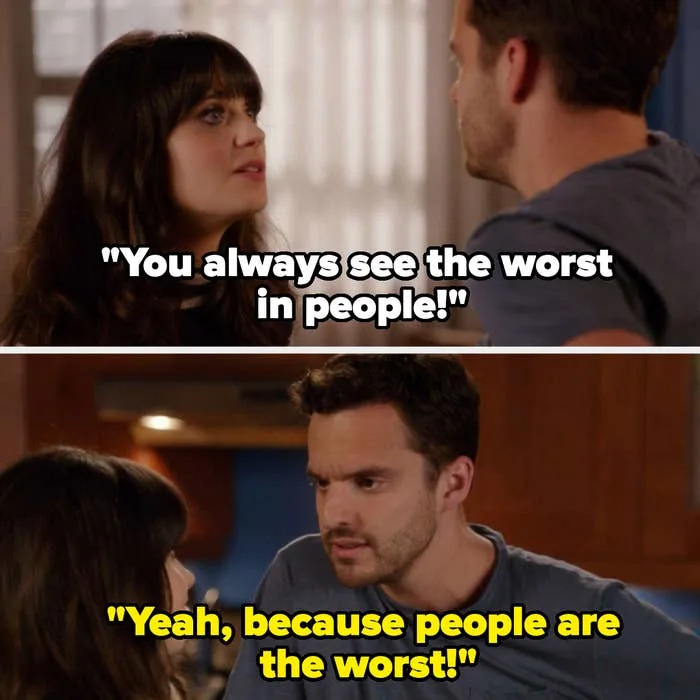
Screenshots from "New Girl"

If we could translate this into Latin, I think we’d have a replacement for the journalist’s motto.

Since AI isn’t going away any time soon, journalists and journalism educators are in a bit of a bind when it comes to how best to use it or to help students use it appropriately. This week, we’re doing a three-part series on the blog this week that take that “overhead” view of generative AI from three key angles:

You can click on the links above for either of the first two parts. The final part is below and a lot more complicated: The human factor.

As we’ve noted before, generative AI is a tool. As such, it can be used for good things or bad ones, based on the person using it and why they’re using it. Let’s consider a few aspects of human nature that can help make AI a useful friend or a mortal enemy:


WHAT’S MY MOTIVATION?: One of the luckiest breaks I ever caught in life was getting into a psych course on human motivation as part of my doctoral program. It not only hooked me up with Kennon Sheldon, a professor with an incredible history of publishing important psychological studies, but it also helped me to better view how people choose to act or not act based on motivating factors.

One of the aspects of self-determination theory (SDT) we looked at was the spectrum of motivating factors that influence people. As it is a continuum, it has a wide array of motivational forces, but scholars have identified four key “stopping points” along the spectrum that capture specific forms of motivation:

  • Extrinsic: You are motivated by an outside force to do something that you otherwise wouldn’t want to do. An example of this might be when your parents told you to clean your room or you would be grounded for the weekend.
  • Introjected: You are motivated to do something through coercive actions of others, such as guilt or shame. An example of this might be skipping a concert you want to attend so you can visit an elderly relative in a nursing home because your parents told you, “Well, she probably doesn’t have much longer to live and I KNOW how hard it would be for you to live with yourself if you didn’t at least see her a few more times.”
  • Internalized: You are motivated by finding value in the outcome of an activity, even if the activity itself isn’t all that enjoyable. An example of this would be a nursing student studying really hard for the NCLEX test. They don’t like the idea of the test, but are motivated by their desire to become a nurse, which requires them to pass this test.
  • Intrinsic: You are motivated by the natural joy of the activity. This is the purest and best form of motivation. An example of this would be Amy and her approach to knitting. She never seems to care if she finishes a project, but rather she enjoys the act of knitting as well as the joy she gets from trying new patterns, new yarn and new needles.

In looking at this, it’s a pretty safe bet that most of what students do for classes in a lot of cases comes down to extrinsic motivation, as they are required to write essays, do assignments and take tests because someone else is forcing them to do it. (Insert your favorite joke about Gen Ed classes here.)

When forced to do something, people will take the easiest way out possible, which is where generative AI comes in. If the only goal is to “get through” whatever someone is forcing you to do, you’re going to let AI take the wheel and just get it done. This is particularly true for those 800-person pit classes, where students figure they have a pretty good shot of getting away with it.

Helping students find motivation to do things that will benefit them in both the short term (pass this class) and the long term (get a better career) will be enough to move them toward a more self-motivated state.

This leads into the second human issue…


THIS MATTERS BECAUSE: We have found that people are more likely to value things if they have an understanding as to why these things are supposedly important. In short, “Why do I have to do this?” A key part of motivational research is what is called autonomy support: If you can give people choices or at least explain why they have to do something and that a choice isn’t possible, they tend to adopt the motivation as their own and do better at it.

When you give them a “Because I’m a PARENT, that’s why!” answer, well, they tend to really hate it and extrinsic motivation rears is ugly head.

I had this discussion/argument with people from our history department. The university was cutting several requirements that were making it difficult for kids to graduate on time and/or with multiple majors/minors/certificates.

One of the “forced classes” was a history one, and I overheard the history folks talking about the situation. One person thought it was a good thing, because maybe the kids would then find history on their own and choose it for a minor. A senior faculty member argued this would be a disaster because, “The kids will NEVER choose us.”

I nosed my way into the conversation and asked to what degree they explained the value of their specific classes to students who were taking them. The senior faculty member was offended: “How could you ask such a thing? Do you think history DOESN’T have value?”

Um… No… but if that’s how you approach your classes, I understand why the kids might feel that way.

The more I kept trying to explain that if you want the students to value something, you have to tell them why they should value it, the more I seemingly upset this man. Apparently, in his way of thinking, history is so damned important and he was such an expert-level vessel for this knowledge that there was no need to provide a rationale for the coursework he put forth. At the end, I left him with this:

“I know that kids can take my class because they want to or because they are forced to. Either way, I make sure to tell everyone what we’re doing, why we’re doing it and what value it has to them in moving forward in their lives. They may still dislike the thing I’m making them do, or they may disagree with my assessment of the situation, but they at least understand the ‘why’ and that tends to make them more willing to do the work than to try to weasel their way out of it.”

Understanding what motivates people to do (or not do) things can help us figure out how to help them use AI without abusing AI. Help them understand why they need to do an assignment, or understand a form of writing or complete a task and they’ll likely find a way to buy into your argument.

If we CAN’T show them a “why” answer, maybe that says more about what we’re doing wrong as educators than what is wrong with “kids today.” Is that 10-page paper really helpful to the kid, or are you just so used to grading them that it would be an inconvenience to you to change? Is the textbook you are using a good one, or do you not want to revamp your whole class and redo all of your lectures, so you stick with what you have? Is the kid really losing out on some major life skill or element of citizenry if they let AI take the wheel on an assignment, or is there a better way to make AI part of the process?

Logic has a lot to say about helping people find value in what they need to do and becoming motivated to do the right thing. Unfortunately, logic isn’t always in driving the bus, which leads to the last element…


PEOPLE ARE BASIC:  We can talk about this from a variety of angles, but the long and short of it is that humans are base-level creatures in a lot of ways.

Our minds are geared to be “cognitive misers,” which is why we find ourselves in mental ruts and often relying on stereotypes to make sense of the world around us.

We are social animals, which leads us to social dominance behaviors that tend to have some folks trying to assert their high value over other, “less valuable” individuals within the collective. If you don’t believe me, hang out for three hours in a middle school classroom and get back to me.

We’re also driven by some baser instincts in regard to our physiological needs. Or, to quote Jeff Foxworthy, a lot of people would like to get a beer and see something naked. (Pretty much every technological development related to media in the past 50 years has in some way gotten either a significant start or a major boost due to that base-level drive for naked stuff.)

Generative AI takes these base-level human drives and supercharges them in a way that other forms of technology haven’t. Whether it’s trying to prove dominance, trying to be lazy or trying to a pervert, AI puts it all and more at the fingertips of the worst among us.

AI chatbots have been linked to false claims of harassment by political figures in New York. Why would anyone think to do a prompt for the chatbot that included the term “sexual harassment?” There’s not a good argument in here, other than some idiot saying, “Hey, y’know what would be HILARIOUS? Ruining someone’s life!” (Here’s a link to a trailer for “The Anti-Social Network” that pretty much encapsulates the whole process by which general dumbassery becomes a toxic weapon when added to a digital platform.)

This is why you have stories like this one about a MIDDLE SCHOOL in California, where students were using AI to turn images of their friends into nude pictures. Or like this one about the students at a CATHOLIC HIGH SCHOOL using AI to create naked photos of their peers. Y’know, just like Jesus would have done to Mary Magdalene, if he had the technology…

Even pedophiles are getting in on the act, which is the start of a sentence that never ends well…

As with most things in the world, the worst among us will use AI to do some godawful stuff. I’m not sure we can avoid that, but we do have a need to instill in the other 90% of the world the reasons NOT to be like those folks.


DOCTOR OF PAPER HOT TAKE: Every time I think of what AI could be used to do and what it’s ACTUALLY being used for, I go back to this scene from “Idiocracy.”

The issue remaining for journalists and journalism educators is how do we go about making AI the tool in the toolbox it can be while avoiding the perils of a society that is slowly riding a Dumpster fire to hell.

The question we need to answer is this: What kind of coherent argument can we, as journalism instructors, make to the students who are in our class that it is in their overall best interest to do the work we assign them instead of letting a machine do it for them? And, how can we present that argument in a way that they will understand it, agree with it and motivate themselves to abide by it, in the face of the human frailties we’ve discussed earlier?

I don’t have an answer for this, but if you figure it out, please post the answer below.