An 8-minute video primer on Artificial Intelligence, its impact on media writers and the ethical concerns it raises for media folks

One of the biggest things I’ve tried to get across on this blog is that it’s here to help media students and professors. (If it helps other people, hey, I’m glad that works out as well…) The other big thing I’ve tried to get across is that if you need something, all you have to do is ask and I’ll probably get it done.

Case in point, a professor down in Texas and I were chatting about the “Exploring Mass Communication” textbook we’d sent her and some other issues, when she emailed me this:

I do have a question for you: Do you have any recorded lectures or videos where you talk about AI in journalism? I would love to take a look and see if I can incorporate it into my class. My current class size is 220, and the classroom is not very adaptable to an interactive Zoom call, which is why I wanted to see if I could use a pre-recorded video. I also teach an online version of this class which is just as large, and the video would be very helpful.

I reached out to Sage and asked if we could do a more “production-savvy” video than just me recording this in the pinball man cave at my house, and they were totally enthusiastic. We got it done for her with two weeks to spare and it worked well.

The nicest thing is that Sage sent me a copy, so I uploaded it to YouTube and here it is if you want to use it:


(I hate the fact I keep looking down, but this is what happens when your script glitches on the screen and you have to use the printed backup…)

If it’s helpful, let me know. Also, if YOU want something for any of your classes that fit into whatever area of expertise I supposedly have, feel free to hit me up here. I don’t care if you’re using my books or not. I just like helping people.

Have a great rest of your day!

How Jordan Love’s Injury Drove Packer Nation into a Frenzy of Misinformation and How You Can Avoid Perpetuating Viral Stupidity


THE LEAD: The Extra-Special, We-Want-You-to-Buy-Peacock-Streaming, I-Bet-Brazil-Is-Amazing Friday night game between the Green Bay Packers and Philadelphia Eagles got off to an ugly start, with terrible field conditions and ended even worse, with franchise quarterback Jordan Love writhing in pain on that lousy turf.

Love’s injury wasn’t as bad as some I’ve seen, but when you dump $220 million extra into a quarterback and he doesn’t make it for first full game, things aren’t great. Also, this situation had half the press booth doing deep dives to figure out what, exactly, Malik Willis had done in his career to this point.

What makes all of this worthy of a post today wasn’t the Friday event, but the subsequent spread of information I witnessed Saturday that became a perfect microcosm of why media literacy matters so much.

THE BACKSTORY: The first Saturday of each month, Dad and I are at the Oak Creek Salvation Army as part of the largest sports card and memorabilia show in Wisconsin. We set up a couple tables and sell our wares, which range from cheap packs of cards from the junk-wax era to old programs from the Packers glory days.

More than 700 people came through the door that day, with about 695 of them wondering about how bad Jordan Love’s injury was. Between selling stuff and looking for stuff to buy, I heard dozens of theories on what was going on with Love and his knee and what it meant to the Packers season. These included:

  • Torn ligaments, he’s out for the season.
  • It’s an ankle, not a knee. Should be able to tape it up.
  • They don’t think it’s that bad. Should be back next week with rest.
  • This could be career ending. I mean, did you SEE him limping off the field?
  • Packers KNOW what’s going on, but they aren’t saying anything until they know they can grab an extra QB.

SOURCE CHECK: Each time someone I was chatting with said one of these or the other dozen things they were saying with absolute certainty about Love’s injury, I asked a basic question:

Where did you get that?

The answers were a mishmash of things like, “I saw it on Twitter” (Sorry, Elon, nobody’s calling it X in casual conversation. I think we just call it X in the media so you won’t crash a rocket on our houses or buy our media outlets.) to “I know a guy who…” to “I saw it on my phone” to “I just heard those guys over there talking about it…” (That’s always reassuring.)

None of these people could point me to one specific source that had any kind of insight whatsoever as to the specific injury, the actual diagnosis and the expected time of recovery. Personally, I dropped a note to a former student of mine who was in Brazil covering the game and he never even got back to me with an answer. At his press conference after the event, coach Matt LaFleur straight up said he didn’t know and they expected to get an MRI when the team got back to Green Bay.

That didn’t stop everyone, and I mean everyone, from chiming in on social media about what they absolutely, positively, definitely knew had happened to Jordan Love.

Contrast those immediate “I know stuff” reactions with what the Milwaukee Journal-Sentinel put out Saturday:

GREEN BAY āˆ’ Green Bay Packers quarterback Jordan Love injured the medial collateral ligament in his left knee and is expected to miss ā€œa coupleā€ of weeks, PackersNews has confirmed.

Earlier, ESPN’s Adam Schefter reported on X, formerly Twitter, that Love ā€œis believed to have injured his MCL, pending further testing. It is not expected to be a season-ending injury, but he is expected to miss some time.ā€

Look at those two paragraphs, complete with actual sourcing. Now, you can think PackersNews is a lousy publication or that Adam Schefter is a shill for the NFL if you want, but at least you have two sources that are in the know cited in relation to this injury.

The rest of the piece continues that way, with references to sources like NFL Network’s Tom Pelissero, The Athletic’s Dianna Russini and PackersNews reporter Tom Silverstein. In each case THOSE people had sources that told them things. Again, you can like or dislike any of those sources, but at least we know who they are, as opposed to “My phone told me” or “The guy in front of me ordering a Sloppy Joe was saying…”

MEDIA-LITERACY MOMENT: One of the most important things to understand about today’s media is that literally ANYONE can participate through various channels that can spread information far and wide. This is great when it allows for a wide array of normally underrepresented voices to put forth information that matters to people. It’s also great when it can shine a light on reality that otherwise would have gone unseen, as was the case with the George Floyd incident.

That said, it can be a terrible thing when people who don’t know anything get information from other people who don’t know anything and keep perpetuating the stupidity of even less-informed people further up the food chain. In the race to be first or to just get a lot of attention, people without a true understanding of how the media SHOULD work use tools they don’t fully grasp to make a mess of reality.

One of the most important things you should do when you get information, even if it’s from a platform use a lot and even if it supports your viewpoint, is to figure out who initiated that content.

In short, always ask, “Where did you get that?” before believing (or sharing) information and you won’t get sucked into a rumor mill or some viral stupidity.

DISCUSSION STARTER: How much faith do you put in any of the information you receive through the various platforms you use? What makes you more or less likely to consider the information valid? Also, what level of certainty to you apply when it comes to information you receive to share it with other people along your social media networks?


The trolling of Gus Walz and the history of people picking on political kids

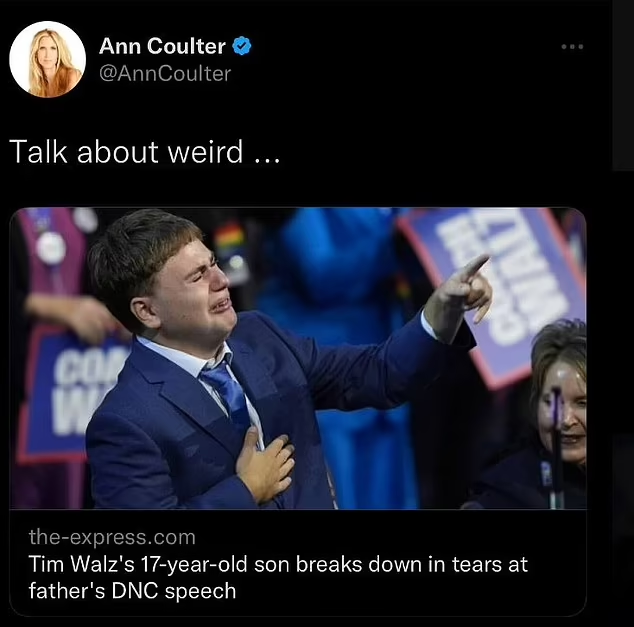
THE LEAD: Gus Walz, the teenage son of Democratic VP candidate Tim Walz, went viral during the DNC last week for his unabashed love of his father. Gus, who has a nonverbal learning disorder as well as anxiety and ADHD, yelled, “That’s my dad,” before he broke down crying during his father’s speech.

It was a sweet, touching moment of humanity that only took about six seconds for people to start ridiculing online:

Mike Crispi, a Trump supporter and podcaster from New Jersey, mocked Walz’s ā€œstupid crying sonā€ on X and added, ā€œYou raised your kid to be a puffy beta male. Congrats.ā€

Alec Lace, a Trump supporter who hosts a podcast about fatherhood, took his own swipe at the teenager: ā€œGet that kid a tampon already,ā€ he wrote, an apparent reference to a Minnesota state law that Walz signed as governor in that required schools to provide free menstrual supplies to students.


The professional media operatives also decided to get into the act:


Both Coulter and Weber issued apologies of a sort, with Coulter saying she took her post down once someone told her Tim was “austistc” and Weber notingĀ  he “didn’t realize the kid was disabled.”

(SIDE NOTE: It’s unclear exactly how serious to take an apology from anyone who a) doesn’t take the time to spell the apology appropriately, b) takes a shot at a kid and only feels bad when the kid turned out to be “disabled,” or c) uses the term “disabled” rather than learn about the condition the kid he has is mocking.)

A QUICK HISTORY OF RECENT POLITICAL KIDS AND MEDIA: Kids whose parents decide to make a run for the highest office of the land don’t always get the best treatment in the media. I remember a teenage Chelsea Clinton taking a lot of guff in news reports for her “frizzy hair” and “awkwardness.”

The late-night TV crowd got into it as well, with various skits:

An SNL cold opening that featured “Wayne’s World” once took a shot at her that was so bad, NBC edited it out of all the reruns. (Strangely enough, they didn’t edit out the “schwing” the guys gave to the Gore daughters, who ranged in age from 13 to 19 around that time…)

The Bush twins were in their teens when George W. Bush was elected the first time, with Jenna’s “minor in possession” charge becoming fodder for the news reports and tabloids. (SNL mocked the twins as well, but this time had the dignity to wait until Bush was re-elected, putting them in their early 20s.)

Conservative radio host Glenn Beck took potshots at then 11-year-old Malia Obama, as part of a 2010 diatribe about the BP Oil Spill in the gulf,Ā  a move he later apologized for making.

The Obama girls had the misfortune of being in the White House right around the time social media was becoming a thing, so their lives were not just the target of regularly stupid people using traditional media outlets, but also extra stupid ones Facebook and Twitter. In 2014, GOP staffer Elizabeth Lauten resigned after she raked the girls across the coals in a Facebook rant for needing to have “a little class.”

While Donald Trump was in the White House, teenage Barron Trump actually fared fairly well in regard to the media’s mockery machine. Most mainstream outlets considered him to be off limits, and SNL actually suspended Katie Rich for a tasteless Tweet about Barron in 2017.


DOCTOR OF PAPER HOT TAKE: I’m not sure what was worse: Picking on Gus Walz for showing human emotions toward his father or basically saying it would have been fine to mock a 17-year-old kid if he hadn’t had a neurodivergent condition. Both are deplorable, but one seems like it should put you at the gates of hell, while the other seems more like a VIP ticket to hell’s champagne room.

The underage children of political folks really have no agency, as they aren’t the ones who decided to run for office and put themselves in the public eye. When they are adults, they can choose to become more or less part of the public discussion.

Tiffany Trump was more in the background of her father’s political efforts while Don Jr., Eric and Ivanka Trump were part of the Trump political machine. Barron, now that he is 18, chose to be political delegate for Florida at the RNC, which does put him out there for public “discussion.” However, I still go back to the fact that he’s 18 and there should be at least a few guardrails people should consider in “discussing” him.

There aren’t too many hard-and-fast rules about who should or shouldn’t be put in the media spotlight and who shouldn’t but let’s consider a few points:

  • AGE: People we consider to be kids (under 18) should usually be off limits to mockery and punditry. Media professionals often take care to really avoid harming kids or generally putting them through the ringer even if they are tangentially related to a media story. The younger they are, the more protected they tend to be.Ā  (We also tend to protect the very old in society for similar reasons. What makes you “very old” is in the eye of the beholder, but it is something we think about.) I tend to broaden the age range for “being a kid” a bit, with the idea that nobody is their best version of themselves between 18 and 22.


  • LEGAL ISSUES: Crimes open the door to more things being discussed in the media than do other forms of public participation. Thus, if Political Candidate A’s 17-year-old son skipped a class to play the latest version of Madden, leave the kid alone. If the kid crashed a car while driving drunk, started a public fight at a Starbucks or shot someone, that’s getting covered. The degree of the incident, coupled with the age of the participants operate on a sliding scale of debate among journalists as to what to say about whatever the kid has done.


  • COGNITIVE ABILITY AND CULTURAL SOPHISTICATION: Protecting people who are unable to protect themselves is at the core of everything from the SPJ code of ethics to the IRB research dictates. People with cognitive limitations of all varieties should be treated with extreme care when it comes to media coverage. I often extend this to the concept of cultural sophistication as well, given that there’s a huge difference between an 18-year-old kid (yeah, I said kid) who grew up in the spotlight and has been on TV more times than Lester Holt and the 18-year-old kid who grew up in a town of 400 people and never met anyone who wasn’t from that town. How each of those people is able to handle questions from a reporter clearly varies.


DISCUSSION STARTER: What do you think about the media coverage of Gus Walz and the other political “kids” in recent memory? What is or isn’t fair? What should or shouldn’t be out of bounds? What experiences have you had in your life makes you set those kinds of standards?


Journalism, Journalism Education and Generative AI (Part I: The Tools For Your Toolbox)

One of the cool things about doing “mechanic stuff” is that parts manufacturers and tool companies would give you stickers for your toolbox when you purchased their wares. Enjoy an AI version of an AI toolbox. (via Pixlr)

After I posted about the need to smack around students who used AI to do their work, a colleague asked a really important question:

(P)lease allow me to respectfully play devil’s advocate here. AI is here to stay. We are not going to manage to get rid of it in our lives and in our classrooms. Students will keep using it no matter how many drums we beat for them not to. So, why don’t we instead embrace it and start teaching them how to properly use AI – responsibly and ethically? We can turn this into a tool for all. A friend, not a foe.

She’s definitely right in that AI isn’t going away and people will use it no matter what we say, something the folks at Arizona State University’s student newspaper learned the hard way last week. The State Press retracted 24 articles a reporter had written after staffers discovered the pieces were the work of generative AI.

It’s worth noting here that ASU is actively partnering with OpenAI to help students on campus see the ways in which generative AI could be used responsibly and ethically. That’s not to pin the blame on the university for the State Press situation, but rather to demonstrate that even with efforts to properly train and guide students, you’ll usually run into a chucklehead or two.

To take a look at AI from more of an “overhead” view, we’re doing a three-part series on the blog over the next week that will look at it from three key angles:

    • The tools
    • The potential perils
    • The human angle

Let’s start with the tools:

HOW GENERATIVE AI WORKS: According to technology experts, generative AI models take large, complex pieces of information and break them down into simple elements that the AI system can retain easily and replicate on demand. The technology is essentially “trained” by introducing it to millions and millions of pieces of content, which it uses to make sense of concepts and then generate new material.

AI scholars at MIT have noted that this approach is not new, in that computers have done these kinds of things on data sets and science hypotheses for decades. What is occurring now is just an outgrowth those early efforts, with computers consuming vast amounts of written and visual material, breaking it down into simple pieces and then recreating new things based on the ā€œrulesā€ it learned during its examination of the content.

This is also how humans learn, as we learn how to write in the inverted pyramid format or paint a picture in the style of one of the great artists, like Picasso or Renoir. Theoretically, what makes this different is that humans are taught other things like morals and ethics (as well as societal norms) that serve as kind of a traffic signal for what they “should” or “shouldn’t” do, as opposed to just what they “can” or “can’t” do, based on the requirements of a prompt.


AI TOOLS THAT CAN BENEFIT YOU AS A JOURNALIST: Of all the analogies I’ve used over the years, the concept of putting “tools in your toolbox” has been the most frequent one. As much as it seems reductive, I like to think of each talent I have, skill I develop or lesson I learn as a tool I’m putting in a toolbox for later use.

In terms of AI, there are tons of great tools out there that can benefit you as a journalist, as they can automate mundane tasks, prompt you to think of things you otherwise wouldn’t and generally make life easier on you. Consider these options:

TRANSCRIPTION: One of the most time-consuming things journalists deal with is taking audio interviews and turning them into useful text for stories. AI has made transcription services both readily available and reasonably accurate. Tools of this kind, such as VG’s Jojo and Otter.ai, use algorithms to decipher speech patterns, pick through background noise and convert sound to text.

IMAGE GENERATORS: These tools have been the source of great fun for people who want to see what kinds of strange combinations of elements they can pair and how the image generator will display their humorous whims. However, AI image generators can assist journalists who are covering serious topics.

Newsrooms have long used photo illustrations and artists renderings to accompany stories in which more traditional means of capturing visual content isn’t possible. Image generators, like Image Creator from Microsoft and versions of DALL-E from OpenAI, can use text prompts from users to generate a wide array of potential visuals. As is always the case in journalism, any kind of illustration or created work should be labeled as such.

RESEARCH: In journalism, good writing is predicated on good reporting, which means we need to dig around a lot. Finding basic facts can be easy through current search engines like Google and Bing, but several companies are constructing AI tools that will allow investigative journalists to do significant deep dives in a fraction of the time. Google introduced Pinpoint in 2024, which is meant to help journalists and other researchers dig through vast quantities of documents to find specific content within the collection. Google states that a Pinpoint collection can contain up to 200,000 documents, including written text, images and audio files.

Other AI tools, like Artifact, which was recently purchased by Yahoo, can be used to create quick summaries of articles and files for you to give you a general sense if the piece is worth digging into more deeply or if it doesn’t fit your specific needs.

FACT CHECKING: The journalistic fact-checking motto has always been, ā€œIf your mother says she loves you, go check it out.ā€ Thanks to advances in AI, that might be a lot easier than it used to be. Tools like Chequeado’s Chequeabot are capable of taking factual statements and comparing them to vast repositories of knowledge to determine the accuracy of those statements. These tools can help assess the validity of data-based statements through to public declarations that governmental officials make, in a quicker and more accurate fashion.

WRITING: A number of media organizations have attempted to use chatbots and other similar AI tools to write content for publication, with varying levels of results. Gannett attempted to automate some of its sports coverage, only to stop once it was clear the readers weren’t thrilled by the results. Sports Illustrated even went so far as to create AI staffers to augment their site, something they quickly pulled back from once the situation was discovered. This approach to using some of these content generators is often where problems occur and society at large tends to freak out. That said, it’s important to know how these tools work and that they can be exceptionally helpful. Tools like Writesonic, Notion AI and Text Blaze can assist you in restating material in new and innovative ways, offering suggestions as to how to approach a new topic and assisting you in search-engine optimization efforts. The key here is that these tools are meant to ā€œassistā€ you, not do all the writing for you.

These are just some of the tools and options out there for you as a journalist. The Society for Professional Journalists maintains a giant list of similar tools for your consideration here.


DOCTOR OF PAPER HOT TAKE: I’ve gone back and forth how best to approach AI, because, like so many other tools we use in life, it has both stated purposes and potentially problematic misuse options.

A hammer is a great tool and you can build a lot of cool stuff with it, but you can also use it to bash in someone’s head. The same concept is true of a knife: You can teach a kid to use a knife carefully and responsibly to help make dinner, while simultaneously explaining that, no, you can’t stick it into your sibling’s head because they took the last Mountain Dew out of the fridge.

(I suppose we could also argue that AI might be more like cocaine: We can’t teach you to “responsibly” use it and in merely introducing it to you, the risks outweigh the rewards. I don’t like that analogy, but given what people have been doing with AI, it perhaps merits a deeper look.)

What AI really lacks at this point that most tools have are things like an instruction manual and set of safety features to prevent unintended disasters. The instruction manuals tell you what each switch or button does on a tool and also how to avoid doing something pathologically stupid. The safety features also limit you in some ways, like putting a guard over a table saw’s blade or having a fuse blow instead of letting the whole thing catch fire. AI feels more like those sci-fi movies, where a human discovers a piece of alien technology and is just kind of winging it.

The other thing that makes AI more dangerous than other tools is that we don’t have learned masters under which we can apprentice, like we would in learning to use other tools. When I started working at the garage as a teen, I had a guy there who knew how to use every tool in the place. He helped me on everything from the basics, like which cars used SAE tools and which ones needed metric ones, to the big safety things, like how to prevent a tire machine from taking off my head with a giant iron bar. Here, we’re all relative newbies and as much as I like the idea of learning from my mistakes, I’d prefer to know if something is going to take my head off before I start playing with it.

NEXT TIME: The significant concerns associated with AI technology.


Earth to Universities: You can’t like free expression only when it’s expression you like

A print of artist Phil Hands’ cartoon on free speech hangs on the wall of my office, with a nice message from this incredibly talented person. I think this message matters now more than ever.

THE LEAD: Universities are pushing back on speech and assembly efforts in the wake of pro-Palestine protests on campuses throughout the country. Both on campuses and at the federal level, concerns regarding antisemitism and Islamophobia have led to inquires and crackdowns.

Zoom in: Tensions at Columbia bubbled over last week after university president Minouche Shafik called in the NYPD to disband a pro-Palestinian encampment at the center of campus.

  • The University of Michigan said it would draft a new policy on punishable disruptive behavior following a pro-Palestinian protest at its convocation.
  • The University of Southern California canceled its valedictorian’s commencement speech, citing safety concerns that the student called a “campaign of racist hatred.”
  • Stanford University banned overnight camping in February to end an encampment populated by dueling pro-Palestinian and pro-Israeli tents, citing student safety, extreme weather and rodents.

FIRST-AMENDMENT BASICS: The First Amendment to the Constitution allows for freedom of expression in a number of ways, including speech, press and assembly. State actors (meaning public officials, public organizations or otherwise government-ish people or groups) cannot step in and deny these rights without some exceptional circumstances.

The law requires a risk of “imminent lawless action” or “clear and present danger” to exist for the government prohibit these kinds of expressions. Examples of this kind of risk include things like inciting a crowd to destroy property or chanting “We are going to kill the chancellor” during a march. That’s why yelling “Mike Pence is a traitor” isn’t the same as yelling “Hang Mike Pence” during the Jan. 6 incident in Washington, D.C.

In some cases, the law can allow for restrictions based on the time, place and manner of the expression, but it also states that the restrictions must be content neutral. In other words, if the mayor of your town refuses to allow a “Pro-Vegetable” march at 5 a.m. because it would be disruptive to the sleeping habits of the citizens, that mayor can’t then allow a “Pro-Beef” march to occur at 5 a.m.

For a more complete view, check out this great primer at the Freedom Forum.

KEY FREAKOUT POINT: This is what happens when the vaguely educated (Congress) asks questions of the overly educated (Ivy League university administrators) and fear is a driving force in the discussion.

Back in November, the presidents of Harvard University and the University of Pennsylvania resigned after they reacted to questions of campus antisemitism the way my dog does when I present her with a physics textbook.

Congress, trying to make a point, asked if “calling for the genocide of Jews” violated the campus speech codes and neither of these esteemed educators could find a coherent answer. (As these are both private institutions, they get more leeway about what can and can’t happen on their campus than do public institutions. More on that later.)

What happened next was what always happens next at a time like this: More administrators get called to answer similar questions under a totally disingenuous guise by people who have no interest other than “pwning” these folks.

Thus, to avoid being the next university egghead on the chopping block, these folks force everything 180-degrees in the opposite direction, to the point where saying “bless you” is somehow a hanging offense. Fear drives the silencing of certain voices that people worry might not be as popular as others. The goal is to “run clock” for a while, in hopes that everything will just calm down once the kids find a new TikTok challenge or something.

Words are scary, particularly when you are being accused of certain things. Nobody likes being accused of antisemitism, Islamophobia, homophobia, racism, sexism and other such things. Certain words carry with them a permanent stain, and that can be terrifying enough to make people do or not do certain things. I often think back to this clip from “Apt Pupil” in that regard:


REALITY CHECK: As much as it would be great if we could all just get along about everything, that’s not the way life works. This is why we have laws in place to deal with what can and can’t happen when people feel the need to disagree.

The law is clear on how speech and assembly work: Unless you can demonstrate that whatever these people are saying or wherever they are going will lead to lawless action, they have the right to say what they want to say and go where they want to go. The law isn’t here to protect popular speech, but ALL speech.

This is why, as much as it can infuriate folks that a group of Nazis can march through a predominantly Jewish part of Illinois, or that a group of “religious” folks can show up with signs at a military funeral proclaiming “Thank God for dead soldiers,” speech can’t be suppressed for being repulsive alone.

The Foundation for Individual Rights and Expression explicitly explains why even calls for the genocide of a particular group remain protected under the First Amendment.

DOCTOR OF PAPER HOT TAKE: Everyone has a level at which they think a line should be drawn when it comes to speech being problematic, but quite literally, the cure for bad speech isn’t speech suppression. It’s MORE speech. It’s also been clear that there are always risks that unpopular speech may lead to violence, but we have laws to deal with that violence once it actually occurs. Stopping speech because it might end poorly has the same internal logic as the traffic cop who pulls over the Corvette driver because the car “looks like it could go fast.”

The administrators of these schools need to have stronger intestinal fortitude when it comes to supporting free speech, even if it’s going to be wildly unpopular or allow some senator from Bumbledirt, Wyoming to call them all sorts of names on the Senate floor.

Yes, it sucks when you have to deal with difficult situations, but standing for principles is supposed to be administrators’ resting pulse. If you think having people say mean stuff about you on Twitter/X is rough, read this piece by David Goldberger, a Jewish attorney who represented the Nazis in the Skokie case. Members of Jewish Defense League showed up at Goldberger’s office with baseball bats trying to beat the hell out of him. The rabbi at his parents’ synagogue gave a speech denouncing Goldberger personally for taking the case.Ā  He was threatened and called a self-loathing Jew for his troubles and yet in retrospect, he remains as stalwart in his beliefs as ever:

To this day, I have no doubt that the ACLU’s commitment to equal rights for all is a backbone of our democracy — no matter how offensive our clients are. Chipping away at this commitment will open the door to the erosion of the First Amendment as a bulwark against rule by tyrants.

In short, if you want your free speech, you have to be willing to stand up for everyone else’s speech as well.

A PROMISING POST-SCRIPT: As I was finishing this off, a friend forwarded this article about how student journalists on these campuses are not only covering the situation, but taking strong editorial stances in favor of free speech.

As we always say in student media, “Leave it to the kids to lead the way.”


With a potential TikTok ban in the U.S. looming, here are some reasons media folks shouldn’t freak out

Trying my hand at some AI image generation. (Pixlr via “TikTok Logo with Chinese Flag prompt)

THE LEAD: The U.S. House of Representatives passed a bipartisan bill on Saturday that would nationally ban TikTok if its Chinese-based parent company did not sell the popular app. The bill gives ByteDance, which owns the app, up to 360 days to sell TikTok to an owner that isn’t tied to China before a ban would kick in. The Senate will likely take up the bill on Tuesday and President Joe Biden has stated he will sign it, if the bill hits his desk. TikTok has stated it will fight this legislation.


THE RATIONALE: TikTok has more than 170 million U.S. users and government officials are worried that the Chinese government could access these users’ data via the app and create threats to national security. Both ByteDance and the Chinese government have downplayed these worries, but experts in the fields of international relations and technology have said pretty much any Chinese tech company operates under “a cloud of suspicion.”


CATCHING UP: If you are somehow completely unaware of TikTok, or have been kind of doing the “Oh, yeah, TikTok” thing when your kids or grandkids talk about it, here’s what the NY Times calls “The Basic Human Explanation of TikTok.”


WHY PEOPLE ARE FREAKING OUT: This is a simple one to explain: Habit and money.

In terms of habit, you have 170 million people in the U.S., spending an average of between 58 minutes per day and 95 minutes a day on this thing, depending on how you slice the data. If you look at any data set, you’ll notice some lighter and heavier users, but the scarier thing is the increase of usage in terms of overall users and overall use. In 2019, users averaged about 27 minutes a day and there were only about 27 million U.S. users.

Cigarettes would have been proud of that kind of habit formation…

And, just like any other addiction, once people get hooked on TikTok, it’s really hard for them to imagine life without it. Users have assailed Congress with TikTok videos that state everything from the U.S. has bigger problems than TikTok, to the idea that this is suppressing free speech. At the core of these and other arguments is basically this statement: Stop messing with the thing I like.

As for money, this thing is a goldmine for ByteDance, which has seen exponential growth in less than five years. Selling it would be financially unwise, especially if it’s forced to do so, as nothing drives down a price like every buyer know you’re over a barrel and HAVE TO sell.

In addition, TikTok influencers have created a marketplace in which they can sell products as well as their own lifestyle brand. Closing the door on the app would essentially strangle their revenue streams, they note. In addition, small businesses have used the app to promote their products and services, stating it allows them a cheap, easy and effective way to reach a wide audience of potential customers.


WHY MEDIA PEOPLE SHOULDN’T BE FREAKING OUT: As news journalists, PR professionals and advertising folks, we tend to see a lot of media shifting on a regular basis. If we wanted our lives to be nothing but smooth sailing and stable situations, we’d have taken a job in something less stressful, like defusing land mines. The point is, we’ve seen a lot of changes to the media landscape, let alone the social media landscape, over the course of our careers, so if the ban happens, we’re actually in pretty good shape to deal with it.

One of my students did a great localization story for our reporting class on this issue, and she talked to people who run a Digital Marketing Clinic at UWO about a potential ban. The people there had already expected this and had worked with clients to avoid any messaging interruptions a ban would cause. In addition, the director of the organization gave two really good bits of advice that most of us follow:

  1. Diversify your approach to reaching your audience so that one platform can’t hold you hostage.
  2. Build up your own platforms and connect with your audience through things you control

I imagine that most other quality organizations and agencies that connect people to audiences through media channels have also approached life in this fashion.


DOCTOR OF PAPER HOT TAKE: This situation isn’t likely to end up with a ban because everyone is making too much money for that to happen. If TikTok weren’t so profitable, ByteDance wouldn’t be fighting so hard to keep it. If advertisers and influencers weren’t making a living on this thing, they’d be less worried about it going away. This is going to be like a game of “Chicken” for the next couple months until some sort of compromise is hammered out.  What that is remains to be seen, but nobody kills the golden goose if they’re smart enough to realize it’s got a lot more golden eggs to lay.

Even if TikTok gets banned, life on social media will adapt and progress as it always has. Over the course of multiple textbooks in which I’ve had to incorporate social media trends, I’ve seen the landscape radically change in terms of platform supremacy. Each time I do an update, I save the social media chapter for the very, very end and then pray to St. Jude that nothing insane happens between me sending the chapter and the book hitting the press.

Here’s the perfect example: When I wrote “Dynamics of News Reporting and Writing,” I had to pitch two sample chapters and the folks at Sage told me to make one of them the social media chapter. I protested, arguing that stuff was changing so quickly, it would likely need a massive overhaul before the book would press. They argued that if I didn’t SHOW potential adopters a full social media chapter they wouldn’t believe it was going to be there, and thus show less interested in the book. So, I wrote up what was “cutting-edge stuff” at the time, only to have to fully rewrite the chapter FOUR TIMES between that draft and the final version.

We were ON THE PRESS when Twitter decided to move from 140 characters to 280 characters, sending me into a panicking dervish of phone calls and emails. We ended up having to pull the book back and have me patch holes in the social media chapter to fix that.

Fast forward three years and the number of platforms that were in that first edition that were laughably absent from that second edition included:

  • YikYak
  • Storify
  • Vine
  • Periscope
  • Ping
  • Google Buzz
  • Meerkat
  • Digg

And that doesn’t include the stuff that changed, like Twitter shifting to more content, Instagram Reels and other such things. Each time I go to revise an edition, I find myself looking at the social media chapter like when I look back at photos of my childhood in which my parents dressed me in the worst the 1970s had to offer: “Holy cow… I totally forgot about that…”

When Twitter became X and then became an Elon-Musk-fever-dream-hellscape, other stuff like BlueSky and Threads emerged in an attempt to fill the void. When Vine died, everyone wondered where we’d get our 10-second videos of fun. TikTok answered that question. As is the case with most of social media, products will continue to enter the arena with a goal of meeting users’ needs in a way that previous products haven’t or have ceased to do.

DISCUSSION STARTER: Of all the arguments people are making about a potential TikTok ban, which one makes the most sense to you? Is it an issue of free speech? Is it a financial concern about lost revenue for content creators? Is it an issue of governmental overreach? Is it the “keep your paws off my stuff” point of view? Or is there something else? (Or, if you favor a ban, why?)

Reframing O.J. Simpson: A look at the issues his double-murder trial raised for today’s media students

My chair at UWO had this and another newspaper framed on the wall of his office until he retired. Of all the things he’d seen at the L.A. Times and N.Y. Times, this was the topic he looked at on a daily basis.

THE LEAD: O.J. Simpson, a former NFL running back, convicted felon and focal point of a double-murder acquittal, died last week at age 76. In 1995, he was found not guilty of murdering his ex-wife, Nicole Brown Simpson and her friend, Ronald Goldman, but was later found civilly liable for their deaths.

MAJOR CAVEAT NUMBER 1: I’m not using this post to re-litigate anything related to the trial(s), his subsequent legal issues or the issues related to race, fame, justice or social structure in society. The goal here is to try to place Simpson and those moments into some sort of context for a generation of students for whom Simpson is as timely as the Teapot Dome Scandal and show them why the trial resonates to today.

MAJOR CAVEAT NUMBER 2: If you think there are additional pieces missing that fit that paradigm I’m using in Caveat Number 1, please feel free to put them in the comments below.

Now… On with the show…

BASIC O.J. BACKGROUND: Simpson was a star NFL running back for the Buffalo Bills and San Francisco 49ers. He became the first player to rush for 2,000 yards in a season and was inducted into the hall of fame in 1985. His professional life extended beyond football, as he did acting work in television and film, as well as serving as a football broadcaster. Above all else, he was a sought-after celebrity endorser, having done commercials for a variety of products and services, particularly at a time in which people of color did not receive many opportunities in this area. Simpson himself often noted his ability to “transcend race,” as he would say, “I’m not Black. I’m O.J.”

BASIC BACKGROUND ON THE MURDER TRIAL: On June 12, 1994, Nicole Brown Simpson and Ronald Goldman were stabbed to death at Brown Simpson’s condominium. Simpson became the focal point of the investigation. On June 17, Simpson was charged with the killings and was supposed to turn himself in to police, but that didn’t happen. In one of the most famous low-speed car chases in history, Simpson rode in the back seat of a white Ford Bronco as his friend Al Cowlings drove down the freeway, pursued by a dozen squad cars.

The trial spanned 11 months in which the prosecution presented evidence of Simpson’s guilt, including blood found in his car, a bloody glove found near the scene, shoes Simpson was known to wear and more. The “Dream Team” defense often hammered the evidence as being tainted or mishandled. In addition, the defense lawyers presented a significant narrative that both specific racist officers and a racist criminal justice system framed Simpson for this crime, which they stated he did not commit.

On Oct. 3, 1995, the jury returned a not guilty verdict against Simpson in both killings.


THE FRAMES OF O.J.: The media coverage of his cases related to those deaths was among the most intense of anything before or since. The issue was framed in a variety of ways, depending on the media lens used to view it and the underlying personal experiences that shaped people’s lives. Some frames were of a man who beat the justice system due to his fame and personal wealth. Others framed it as an issue of a racist criminal justice system, once again trying to railroad a person of color. Still others framed it as another case in which domestic violence was overshadowed by other frames, demonstrating once again that women were second-class citizens.


WHY SHOULD STUDENTS WHO WEREN’T EVEN BORN AT THAT POINT CARE: In a lot of ways, the Simpson trial was a “you had to be there” thing for a generation of people. It’s the same way that people of my parents’ age talked about the protests of the 1960s and my grandparents’ generation talked about the Great Depression. No matter how much you learn about the topic after the fact, it’s not the same thing. That said, there are key things that this case did that impact current media students to this day:

  • Fame as an interest element: Simpson’s fame was obviously a key element to what made this case as big as it was. (As Chris Rock famously said in one of his comedy routines, “If O.J. drove a bus, he wouldn’t even be O.J. He’d be Orenthal the bus-driving murderer.”) That said, the spotlight of the trial shifted people into that “name-recognition lead” zone of media coverage. Marcia Clark, Christopher Darden, Mark Fuhrman, Judge Lance Ito, Kato Kaelin, Robert Kardashian, Alan Dershowitz, Johnnie Cochran and more became household names. (Even 30 years after the trial, those names came to mind immediately for me.) Marcia Clark could cure cancer and Lance Ito could do a country album that knocks Taylor Swift out of the top spot of the charts, but their obituaries will still lead with the O.J. trial. Fame is something we still pay attention to, but what makes someone famous both then (during a pre-digital revolution) and now (in the age of internet stars) is something to consider.
  • Real-time broadcast coverage launches the “true crime” obsession: Other cases had allowed cameras and video coverage before, and even a few famous ones had drawn national attention, like the Pamela Smart case. However, just like MySpace and Friendster predated Facebook, these precursors to the Simpson trial couldn’t hold a candle to the overall coverage this received on a day-in, day-out basis. For almost a year, the country was transfixed. If ever there was a “Patient Zero” for court cases as television drama and true crime becoming a prominent form of entertainment, this was it.
  • Opinions become news: Broadcasters having an opinion was nothing new, but this case became a benchmark for what we constantly see today when it comes to “big news.” As Alex Weprin noted in the Hollywood Reporter, this trial basically established the formula for journalists using bluster to become famous and media networks using opinionated blather to draw viewers. It’s often easier to give an opinion about something than it is to do research, conduct interviews and rely on facts, which is why we see so much more opinion than we do in-depth journalism. However, as is usually the case, we need to keep our eye on the ball when it comes to providing our audiences valuable content instead of junk food.
  • The Race Card: Throughout the trial, the prosecutors accused the defense of “playing The Race Card” to overcome what they saw as obvious factual information. The defense argued that you couldn’t talk about anything in this case without talking about race, particularly in relationship to the racist history of the criminal justice system. Det. Mark Fuhrman’s testimony was particularly on point here, in that he repeatedly denied having any racial animus, only to be confronted with recordings of himself using “the N-word” repeatedly. Coverage of the verdict showed a divided America: White people watching were stunned or enraged at the verdict while Black people were shown celebrating. The analysis of this issue to this day remains a case of how race shaped the overarching views of society and how it still does. Journalists to this day need to understand the underpinnings of social and cultural history as it relates to the people and communities they cover. As much as it’s easy to grab a “Side A” and “Side B” and be done, that’s not going to work in situations where these long-festering wounds exist.
    (SIDE NOTE: I remember working on the student newspaper as the city editor when the verdict broke. I mentioned to a friend of mine who is Black that it seemed pretty obvious to me that he did it, in spite of the verdict. He responded, “Well, it was pretty obvious to me that Rodney King got his ass kicked by a bunch of cops, but that didn’t go our way, either.”)
  • The Ratings Monster: Media outlets have always measured things like circulation, audience share, market share and so forth in an attempt to track how well they are “grabbing eyeballs.” However, the Simpson case was like mainlining adrenaline in terms of how to get people to watch. According to ratings data, more than 150 million people watched the verdict live. To put that in perspective, that’s approximately EIGHT TIMES as many people who watched the Women’s NCAA championship game this year. The problem with getting a high that big is that you spend a lot of time chasing it in all the wrong ways. The question of what is good for our audience and what they are willing to watch/read to help us make our numbers look good has become a divergent one.

DISCUSSION STARTER: Take a look at how the obituaries of O.J. Simpson frame him. In terms of content ordering, where are the various elements of his life mentioned and do you agree with their overall approach? Which ones do you feel do the best job of telling the story in a solid, journalistic fashion and which ones do you think veer too much into opinion and hyperbole? What other issues do you see covered as part of his death and do you see them as being more or less relevant than they might have been at the time of his murder trial?

Putting a voice in your head: Filak’s SAGE podcasts on media trends, approaches to media education and the importance of DEI

THE LEAD: As part of the launch of the “Exploring Mass Communication” textbook, I was asked to sit down with some folks at Sage and discuss my thoughts about the field of media. These included things like where we are, where we started and what matters now.

I also talked about the importance of critical thinking, the value in being a “non-denominational skeptic” and the way in which diversity, equity and inclusion are vital in media today.


THE CATCH: Clearly, this is part of the book roll out, so there will be a few minor “book plugs” in here, but I did my best to avoid full-on book pimping. Still, I listened back to the info in here and found that it might be more helpful to folks than not, so I’m posting it.


THE VOICES IN YOUR HEAD: When I was speaking at a convention one year, a student came up to me and said, “My professor uses your book for our class, so I wanted to hear you speak. When I read your stuff, I imagine how I think you would sound because it feels like you’re talking to me instead of writing. You sound just like the voice in my head.”

I told the kid, “I hear voices in my head, too. Don’t worry too much about it until the start arguing with each other.”

We then both had a good laugh about it.

So, if you always wanted to know if the voice you imagine coming out of me is the same as the voice that actually comes out of me, hop on below:

Here is the link to podcast one, where we talk about the evolution of mass com, the state of mass com today and the importance of being a “non-denominational skeptic.”


Here is the link to podcast two, where we discuss the importance of diversity, equity and inclusion, as well as how we integrate that into my Exploring Mass Com text.

Hope they are helpful or enjoyable or maybe even both!

Vince (a.k.a. The Doctor of Paper)

As the White House presents rules pertaining to artificial intelligence in the federal government, the rest of us are still grappling with the impacts of AI

A quick example of how a free AI program can make something ridiculous look like a religious oil painting. The prompt? “Jesus Christ Rides A Unicorn.” (And, yes, based on the background here, apparently there is a unicorn for you in heaven, if you behave yourself…)


THE LEAD: The White House recently handed down its first set of government-wide policies meant to keep artificial intelligence from ruining everything, while still allowing us all to enjoy its true, helpful greatness:

The White House on Thursday morningĀ released its first government-wide policy aimed at mitigating the risks of artificial intelligence (AI), requiring agencies to take further action to report the use of AI and address risks the technology may pose.

Federal agencies will be required to designate a chief AI officer, report how they useĀ AI and add safeguards as part of the White House memo.

The policies include a requirement that governmental offices list what they use AI for, how important it is and to what degree those uses create ā€œsafety-impacting and rights-impactingā€ risks. It is completely unclear if these regulations will do anything, helpful OR harmful, as we continue to muddle through life with AI programs.


ISSUES WITH AI: You can’t throw a rock at anything these days without it likely hitting something to do with AI. Or maybe even something generated with AI.

As is the case with most technological advances, the early days of generative AI are becoming an insane wild west, in which their appear to be no limits to what people can do with it. As the law tries to catch up and corral this chaos, a lot of things are happening in the public regarding that people have trouble coming to grips with.

SO WHY NOT BAN IT? The AI genie is already out of the bottle, so a ban is unlikely to work, even if we wanted to do so. As experts in the field note, not only has AI been around for a long time, but we have gotten used to what it can do for us:

  • It automates tasks: If you like the idea of having a spellchecker, a digital calculator and a computer program that can build lines of code in a hurry, you want to keep AI around for a while. The artificial intelligence model is basically one in which machines do things that were once only thought of as being capable in the human mind. A full ban removes all that and trying to draw a specific line between important function and disgusting crap isn’t easy.
  • It personalizes content: The whole reason you get what you want online and why those “suggested purchases” actually are things you’d buy comes down to AI. The systems get to “know us” and then find ways of matching us with other things we might like. (In writing that sentence, I’m both amazed and profoundly creeped out…) Who you connect with online, what suggestions you get for places to eat and what cute puppies are available for adoption in your area often comes down to AI’s understanding of you.
  • It expands our knowledge: AI can do things we can only imagine, which gives us the chance to figure out all sorts of answers to problems that were once beyond our reach. Sure, medical advances and such might be a bit further away even with AI, but people in the field of electrical work are already seeing amazing opportunities.

These and other opportunities are on the horizon, so long as we can get people to stop making nude photos of each other for a few minutes and do something useful with this tech.

DISCUSSION STARTER: How aware are you of what generative AI can do? Have you experimented with any of the image creators or text creators out there? What has your experience been, in terms of quality and outcomes?

What kinds of limits do you think are necessary for people to co-exist with AI content? How would you go about enforcing them within the confines of the laws of the land as they stand now?


Is News Dead?

THE LEAD: The New York Times took a look back to a time when newspapers were viable media operations, in an attempt to find that fork in the road where traditional media zigged and the future zagged. This piece by David Streitfeld relies on media icon and digital Cassandra Roger Fidler as its narrative thread through the past several decades of journalistic decline.

During the salad days of the 1980s and 1990s, Fidler foresaw a world in which newspapers would be cut free from the strictures of print and digital media would make everything easier to access. Content would come more quickly, sharing would take place more easily and everyone would benefit from being more fully informed. He was pretty close, except for, of course, that last part.

It’s hard to take him to task for not foreseeing dank memes and cat TikToks.

Streitfeld notes that not every aspect of journalism has died quietly in pulp-based pages, but the essential content that is “news” appears to be the last passenger on the Titanic:

The slow crash of newspapers and magazines would be of limited interest save for one thing: Traditional media had at its core the exalted and difficult mission of communicating information about the world. From investigative reports on government to coverage of local politicians, the news served to make all the institutions and individuals covered a bit more transparent and, possibly, more honest.

The advice columns, movie reviews, recipes, stock data, weather report and just about everything else in newspapers moved easily online — except the news itself. Local and regional coverage had a hard time establishing itself as a paying proposition.

WHAT HAPPENED? If you want to know HOW and WHY traditional media is dying, put three drinks into your average journalist and make sure the kids are out of earshot before you ask the question. A few of the answers are both easy and complex:

  • Traditional media drastically underestimated/didn’t think hard enough about the impact digital media would have in the world.
  • Media outlets and owners misinterpreted the reason why ad money flowed to them so freely, only to find out too late that ads are all about buying eyeballs, not supporting an important public endeavor.
  • The once-private newspaper industry went public, with shareholder value being a driver of budget cuts and staff slashing.

These are just a couple things in that realm, but the bigger issue isn’t how the newspapers themselves came to land on the endangered species list, but rather why it is that local and regional news content hasn’t made a successful leap to the digital marketplace. Here are a couple possible reasons:

  • People are no longer as strongly tied to geographic areas as they once were, making local or regional news seem less important in their lives.
  • Journalists who once had a stranglehold on what people saw and read incorrectly assumed that what the journalists saw as valuable mattered to the readers and viewers out there. With more options now, the “I write, you read” model isn’t as steadfast as it once was.
  • News isn’t as sexy as other things that captures the public’s attention, and there are plenty more “junk food” options out there. The readers who once got a well-balanced meal from a newspaper now can just grab whatever fun or weird stuff they want like a kid in a candy store.
  • The fractured nature of our society has readers seeking out content that is supportive of their opinions and positions, rather than looking for a balanced source of information. (I can’t tell you the number of times when I’d write about an issue featuring X and Y positions, only to have X tell me that I was biased toward Y and Y tell me the opposite.)
  • News was never financially viable. Being so is important these days.
  • News hasn’t changed. We have.

That last one hit me when I was looking for a definition of news and found things like “reports of current events” and “information about important happenings” and “formal reports of events considered likely to be significant to the target audience.”

By these definitions, Taylor Swift winning Time’s “Person of the Year” award is news. It’s current, it’s a report, it’s information and it’s likely to be significant to a target audience. Traditional journalists might not LIKE that this is the case, but that doesn’t make it any less on point.

DISCUSSION STARTER: If there is one thing I think can pull a “Mia Wallace/Pulp Fiction” moment for news, it would be going back to the most basic human driver: Self-interest. If we can do a better job of telling people not just what is happening, but also WHY it matters to THEM personally in a much, much better way than we do, news has a chance.

Case in point: A few years back, our school’s foundation and fundraising arm was in trouble and was looking at a potential bankruptcy. I walked into my 8 a.m. reporting class and asked the students what they thought of all this.

Blank stares.

“How many of you are on a scholarship here?” I asked. Everyone of them raised a hand.

“OK, so WHERE do you think that money is being kept?” I asked.

The blank stared turned to terrified looks. When I gave them a break in the middle of the class, they all immediately started googling the name of their scholarship and the foundation’s role in it.

This requires us to know our audience extremely well and put in the extra work of constantly explaining “this matters because…” but in considering the alternative, it’s probably worth the effort.


How to answer the question “Should I go to Grad School?” when your journalism students ask it

The question in the headline has come up a lot recently, both on the Filak Furlough Tour and from my own students. The way some folks talk about grad school, it sounds like a way to delay life a bit more, or at least push back some of those student loans. For others, it’s an opportunity to become part of a cadre of lifelong learners, who will some day become the “sage of the stage” themselves at a fine institution of higher learning. Reality, as is usually the situation, will vary on a case by case basis.

As I have told my students repeatedly about so many things, you don’t want to look at me for an example when it comes to making a decision about grad school.

At the time, I had about a year’s experience under my belt as a part-time night desk reporter at the Wisconsin State Journal. When I asked if that position could become a full-time job, the answer was less than encouraging. Even more, every job that I wanted to apply for required about three years of newsroom experience.

The job market stunk and I had one actual offer from a newspaper in Kirksville, Missouri, which would have paid me less than I was making as a cashier and grease monkey back home at the Mobil station. Even worse, the paper was terrible, the publisher was chain-smoking during my interview and the job came with no insurance benefits.

At the time, if you kept up with school and didn’t stop being a full-time student, you could stay on your parents’ insurance until you were 25. Also, my boss at the State Journal offered to kind of weld two part-time positions together and give me nearly full-time hours, but not the benefits or a true salary. Add that with the potential to teach a college class, already knowing the area and figuring that I’d finish a master’s in two years, I went for it. It turned out fine in the end, but to explain the whole process requires several beers and a non-disclosure agreement.

Based on what I’ve seen others do over the years, here are some helpful questions you might want to consider if you’re thinking of grad school or to ask anyone who asks if they should consider this path:

ARE YOU CHANGING FIELDS? This is the easiest one to figure out. If you got your degree in journalism, but you took a class in computer coding, psychology or biomedical engineering and found your muse, grad school makes sense. The goal of any form of education that you are going to pay ridiculous money for is to teach you something of value that you can use somehow. Usually that means it helps you get a job. I wouldn’t hire a welder to do journalism or a journalist to do welding, so making sure you have field-specific education makes sense.

IS THERE A SPECIALTY YOU DIDN’T GET IN YOUR UNDERGRAD? In some cases, you find that you want to really dig into a specific area of a field. A “regular” journalism degree might include one class on graphic design or 3D rendering or something that really piques your interest and you only have a base-level understanding of that topic. Going to a different place for grad school where they specialize in that might make a lot of sense. I often make the case that students who go here and find that they really like design or graphic arts in media might do well to get a master’s in that area at Ball State, which has a TON of great profs and resources in this area.

IS THERE A FINANCIAL BENEFIT TO THE EXTRA DEGREE? The question of if a higher-level degree helps or hurts a candidate varies widely based on the field and the employer. However, if there is a clear-cut financial value to getting this upper-level degree, it makes sense to bite the bullet now and go for it.

Case in point, when my mom was teaching, salary bumps were determined in “steps” and “lanes.” If I recall correctly, each step was based on years of experience while the lanes were determined by level of education. Hopping into a higher-ed “lane” got you more money faster. Mom still had to take credits to keep up with something else related to her contract, but she never got a master’s, despite probably having more credits than I have now with a Ph.D. She mentioned more than once if she had just gone for it earlier in her career, the master’s would have really turbocharged her earning power.

If you know that’s the case, or if your company is paying for it in hopes of paying you more when you get it, go for the grad gusto.

DO YOU WANT TO TEACH COLLEGE AT SOME POINT? When I got my master’s it meant I could teach at a college or university in my area of expertise. Many of my family members were teachers and I thought I would like to be like them and help people learn, so the master’s was a smart call. That said, my boss in Missouri told me that the Ph.D. was basically the “union card” for getting a stable, tenure-worthy job, so if I wanted to do this for the rest of my life, I probably should bite the bullet and get the doctorate done.

Today, master’s degrees are fine for both adjunct teaching and a lot of universities have opened up teaching faculty roles that don’t require the full collection of alphabet soup after your name. That said, the master’s is the “you must be at least this tall to ride the ride” measurement, so if standing in front of a room trying to explain the difference between “farther” and “further” or why you spell the word “lead” L-E-D-E, grad school makes sense.

ARE YOU RUNNING TO SOMETHING OR AWAY FROM SOMETHING? This gets a bit deeper on the personal end, but it’s an important question to ask. I often ask this of the kids who come back to see me when they’re about 25 and they say something like, “I think I’m going to grad school” or “I think I should change jobs” or “Do you think the circus is hiring?” When a quarter-life crisis hits, a massive change in life seems like the best idea, which is why I ask them this question.

Change bothers me a lot, just because of who I am and how I feel about it. That said, I know some changes are better than others. I can also attest to the importance of understanding WHY you’re changing something, which comes down to the question above. If you are running toward something (pay raise, new educational opportunities) and the grad school question comes up, that is a good change. If you’re running away from something (I don’t want to be an adult, I’m scared of getting a job that I’ll hate) and the grad school question comes up, it’s probably not a great idea.

It never hurts to ask, “Why are you considering doing this?” and then try to figure out which way you’re running.

ARE YOU GAINING MOMENTUM OR BURNING YOURSELF TO A CRISP? When I was growing up, taking a break anywhere before the completion of all of your schooling was considered verboten. The thinking was, “If you don’t go straight from high school to college (or college to master’s or whatever), you’re never going to go back.” And for a lot of people I know, that turned out to be true.

That said, concepts like “a gap year” never really existed as a positive opportunity to plan and recharge. The “keep moving ahead” approach also conflated the idea of continual motion with positive outcomes.

I truly believe in momentum, and if you don’t, go watch this recap of the 1993 Bills/Oilers game. Thus, if you’re in the zone when it comes to studying, learning and knocking out homework, great. Keep rolling. I also believe in the concept of burnout, so if school to this point has turned you into a charcoal briquette, pouring more work on top of yourself for meager/no pay while adding to your student loan debt and living in what passes for student housing these days makes no sense.

WHAT IS THE FLIP SIDE OF THE GRAD SCHOOL COIN? Instead of saying “Should I go to grad school?” consider asking “What will I do if I DON’T go to grad school?” In other words, what’s the other side of the coin on this one.

I’m a big fan of pro-con lists in making big life decisions and I’m also a big fan of not getting myopic on a choice being either/or. It’s not “grad school or no grad school” but rather “grad school or (OTHER PLAN).” In approaching it this way, you can figure out what else might be out there and avoid thinking of grad school as the only lifeboat off the Titanic.

I’m sure there are many other good questions to ask, but these should comfortably get you out of the “deer in the headlights” mode and toward making a solid decision, or helping someone else make a solid decision.