As student journalists, how do you report on rape allegations? Pretty much the same way you report on anything else.

A friend of mine sent me a link to an article posted on a writing website that had her seriously concerned and had me grateful that I wasn’t in her shoes.

The college-aged woman who wrote the article stated that the head of a university’s student government had raped her. She outlined the history of their relationship, including previous consensual sexual interactions, discussed her own history of sexual encounters and detailed the incident in which she states the man had sex with her without using a condom and without her consent to do so.

In addition, she outlined specific allegations including:

  • She was not the only person with whom this man had non-consensual sex: “It appears that there are many more young women than just myself who have been assaulted or harassed by him,” she wrote.
  • She heard from another woman that this man had infected multiple partners with chlamydia. (She wrote that she underwent testing and her test came back negative.)
  • She heard from that same woman that this man had cheated on her with multiple partners.

My friend advises the student publication at the university where this woman attends (or attended) school and where this man serves as the head of the student government. In other words, this has massive ramifications for the audience her paper serves.

The question then becomes, “How does a student media outlet go about reporting on a rape allegation, made in this fashion, in a decent, fair and ethical way while also keeping a watchful eye on any legal ramifications?” The answer in the headline is a bit glib, but it is more true than not: Basically the same way you report on anything else.

Consider these basic building blocks:

Background research must come first: Nobody wants to look like an idiot when they get into a story where they have no prior knowledge of the topic. While really bad reporters kind of fake their way through a topic, good reporters dig deep to fully understand it well enough to speak intelligently on it. Consider this the first thing you must do for ALL stories, whether you’re trying to explain how the sport of curling works (my first “what the hell do I know about this?” story that required ridiculous amounts of research) or trying to figure out how to ask questions in an interview with a rape survivor.

No matter how scary the story, you are not the first person to cover any given topic. That means there are experts out there who can help you figure things out. In the case of a story on rape, the people at the Rape, Abuse & Incest National Network (RAINN) and the folks at the Dart Center can provide you with information on the topic at hand and how to navigate your reporting. In many cases, organizations like these have put together guides, tips and hints, such as the Dart Center’s guide to covering sexual violence and trauma or its step-by-step outline of how to report on campus rapes and sexual assaults.

The best way to not feel like you’re going to do something stupid in your reporting and writing is to make yourself as smart as possible on the topic.

If your mother says she loves you, go check it out: This is the first rule of all good journalism. In other words, go do some digging for yourself before you rely on anything you hear second hand. Ask for an interview with the woman who wrote the story so you can hear her story first hand. Ask for an interview with other people directly attached to the story, such as the man accused in this story. Look for things elements of the story that can be verified without traumatizing anyone or making it look like you have already decided who is right and who is wrong.

Cases involving false rape allegations are quite rare, but the premier example of a story like this that went off the rails in a horrifying way was the Rolling Stone story, “A Rape on Campus.” The piece told the story of “Jackie,” a University of Virginia student who told the writer she had been gang raped at a fraternity party. “Jackie” also stated that the administration wouldn’t do anything to help her and that it was more concerned in protecting the image of the school than investigating her situation.

The piece ended up being retracted and it led to multi-million-dollar lawsuits against the magazine. The fraternity reached a $1.65 million settlement with the magazine, while the administrator made out to be the “chief villain” of the story reached a confidential settlement, after a federal jury awarded her a $3 million judgment that the magazine was appealing.

A post-mortem analysis of the story by the Columbia Graduate School of Journalism and commissioned by Rolling Stone found that the magazine had failed to do basic reporting to verify the claims asserted in the story and that the piece had basic facts wrong. The report stated the reporter never interviewed the friends “Jackie” had mentioned, instead relying on her recollections of what they told her. It also noted that specific parties and dates of events didn’t fit with actual events or parties, something that would have been easy enough to verify. The report also outline other similar things like this that could have been done to help put the magazine on a stronger footing or better decide how to proceed with the piece.

Simply put, you are a reporter, so report. That doesn’t mean you don’t believe someone, but you have to make sure you can support the content you publish to the best of your ability.

Check your legal liabilities: The Student Press Law Center provides student journalists with free legal advice on a wide array of topics. If you have concerns that a story might libel someone, a call or email to SPLC is worth your time. The “Dynamics” textbooks list off the key elements of libel as:

  • Publication: Did you disseminate the content to someone other than the person claiming to be libeled?
  • Identification: Is the person claiming to be libeled named or otherwise easily known based on how he or she is described in the story?
  • Harm: Can the person claiming to be libeled demonstrate serious damage to his or her reputation? This usually involves being accused of a crime or associated with “unsavory” illnesses.
  • Fault: Can the person claiming to be libeled show that the person publishing the content either did something wrong or failed to do something that should have been done to prevent the libelous content from being published?

In case you’re wondering, a story like this would go four-for-four in terms of these items. That means you’re into the defenses against libel, including truth, privilege and so forth. What also makes this interesting is the issue of what level of fault the man in this story would have to prove. Ordinary citizens only have to prove negligence, which is easier to show, while public figures have to demonstrate actual malice. In that instance, the public figure has to show the material was false and that the publisher had a reckless disregard for the truth. The SPLC is your friend, so give the folks there a call with questions before you publish.

The duty to report is not the same as the duty to publish: If you do your reporting and you aren’t certain you have enough of the story to tell the story, wait until you can gather enough content to feel more secure. If you find that your reporting hasn’t revealed enough to support or refute conclusions crucial to the story itself, don’t feel pressured to publish something because you are worried about “how it would look.” You are responsible for what you publish, so you need to feel confident you can stand behind what you put out there.

It’s always better to be late than wrong.


Once you get deeper into the writing, you should pay additional attention to style, word choice and clarity to avoid creating problems for your sources and your readers. In addition, having a legal eagle and an expert in the field give you a quick review for some thoughts and polish points to consider won’t hurt either.

This is obviously a serious and delicate topic, which means tact matters as does basic human decency. That said you can do all of this and adhere to quality reporting standards to make sure you put your best possible story forward.

Dumb, stupid or idiotic? Questioning the questions we ask in interviews

The line I use when it comes to interviewing is, “Ask a stupid question, get a stupid answer.” However, it dawned on me this week in reading through some students’ analyses of press conferences that some distinctions should exist regarding the specific level of “duh” related to questions journalists ask.

Dumb questions: Journalists fear looking like they don’t know what they’re talking about. I know that I sweated out more than a few interviews with the only thought running through my head being, “Please, don’t think I’m dumb.” Dumb questions, as outlined in Jason Feifer’s article here, aren’t questions that should embarrass you, provided you have prepared well for an interview.

In this sense of the word, these are basic questions that the source has easy answers for on topics that are common in his or her field. In some cases, people avoid asking a source to clarify what an abbreviation means or how a process works for fear of looking dumb (and thus avoiding asking a “dumb question.”).

Feifer is right that you should feel free to ask for clarification and to ask the person to explain things like he or she would to a 5-year-old. I always try to research a topic before I go there, but there are things that will come up that I don’t understand. If the source balks at explaining this or tries to treat you like a dummy, simply explain, “You are the expert at this. This is why I’m asking you these questions. I don’t know this stuff as well as you do and I want to make sure I get it right so we both don’t look dumb.”

Stupid questions: These are the questions that you want to avoid because they are flat-out goofy, incorrectly phrased, rely on misinformation or otherwise make the sources question the size of your brain pan. Here’s a list of the stupidest questions asked in court and it covers a lot of those areas of concern. Perhaps the best one is this:

Q: What happened then?
A: He told me, he says, ‘I have to kill you because you can identify me.’
Q: Did he kill you?

The legendary question of this variety is the one that so many people swear didn’t happen, even as others swear it did. In the lead up to Super Bowl XXII, the press focused on Washington’s Doug Williams, who was poised to be the first African American to start at quarterback in the NFL title game. At one point a reporter was said to have asked Williams, “So, how long have you been a black quarterback?” Despite frequent attempts to debunk this myth, the story lives on as an example of a question that was really, really stupid.

In most cases, you can avoid stupid questions by doing a few things:

  • Research your topic well. The more you know about something, the less likely you will be to ask something that sounds really stupid.
  • Read your questions aloud to someone else before you ask them of your source. A lot of times, questions sound good in your head but somewhere between your brain and your mouth, a translation issue occurs. This is why it’s always a good idea to ask them aloud. It also doesn’t hurt to have a second person go over them with you to make sure you’re asking what you think you’re asking.
  • If you’re not sure how something will sound, try to come up with a better way to ask it. If you can’t get at it that way, at least explain in advance to the source that you’re struggling to come up with a way to ask for some specific information. At least that way it won’t come out of left field.


Idiotic questions: These are the ones you should never ask at any point for any reason. They lack any semblance of decency and they often come across as really asinine. The question that got me rolling on this post was one a sports journalism student brought up that I had missed. A reporter asked Russell Westbrook if fellow basketball player James Harden was worth a “max contract.” In NBA speak, that means “Is he worthy of being one of the highest-paid players in the game?”

It isn’t easy talking about how much money you make, let alone commenting on what you think someone else should make. It’s an idiotic question and Westbrook dealt with it as such.

In other cases, it’s simply a rude question that no one should be expected to answer. Consider this one asked of actress Scarlet Johansson in an interview about her role in “The Avengers” films:

Because nothing says, “serious journalist” like asking an actress if she was “going commando.”

A similarly idiotic question came out when another male journalist decided to ask Anne Hathaway about her body:

(This blog could fill up the entire internet with nothing but idiotic questions male journalists asked of female athletes, actors and celebrities, so we will move on.)

It’s not always just what the question is but how it’s asked that can make it idiotic. Prior to the 1981 Super Bowl, a reporter was asking quarterback Jim Plunkett about his family’s unfortunate health history, including his father’s progressive loss of vision. However, he asked it this way: “Lemme get this straight, Jim. Is it blind mother, deaf father or the other way around?” Think about how you would react if that question were asked of you in that fashion.

When it comes to asking questions, you always want to put your best foot forward. At the very least, you don’t want to step barefoot into a steaming pile of cow dung. Do your research, look at your material, review your questions and ask them out loud before you get to your source. Then, you’ll likely be in better shape to conduct an interview that doesn’t embarrass you or your source or both.

“I don’t think there is ever an easy way to go about covering sexual assault:” Reflections on and Advice for Reporting on Sexual Assault in Student Media (Part II)

Today, we have the second part of our Q and A with Harley Harrison, the former news editor at Ferris State University’s student newspaper, The Torch. Harrison, who graduated in 2018 with a degree in technical/professional writing and Spanish, served as the news editor at the paper and helped shepherd some extensive and in-depth looks at sexual assault issues on the campus.

For a look back at Part I, click here.

As a journalist, and as a Title IX-affiliated individual, what advice can you give to student journalists who want to get started on a piece about sexual assault, but don’t know where to start or are worried about what might happen if they do? How did you get started and how did you avoid creating problems for yourself and your sources in your work?

I love this question because I don’t think there is ever an easy way to go about covering sexual assault. But first, I think student journalists need to realize that there are many, many basis to cover.

When we talk about campus sexual assault, we often think about victim vs. campus administration vs. accused (especially after stories like Nassar). But in reality, it is more like a web of communication. You not only have administration, but you also have housing, campus police, advocacy groups, women’s shelters in the area, and hospitals. All of these organizations can impact a case or how cases are generally handled.

For example, the hospital in Big Rapids didn’t always have nurses on staff who could conduct rape kits, so survivors had to go all the way to Grand Rapids to get testing. This meant that a lot of survivors weren’t getting tested in time and, therefore, there was a lack of evidence. Another example is that the women’s shelter started collecting clothing donations so that survivors wouldn’t have to return to the dorms from the hospital in hospital gowns or scrubs (clothes are collected as evidence). These organizations all function together to support students, but when one organization isn’t helping survivors, it can lead to the mishandling of the situation.

The other aspect that student journalists have to realize is that the way a story about sexual assault is conveyed could have negative impacts on other survivors. For example, a story that accuses the Title IX Office of not believing survivors is going to discourage other survivors from seeking the Office as a resource. You really have to contemplate if it’s worth it. You have to ask yourself if the story will do more harm than good.


What suggestions would you have for student journalists who want to talk to victims of sexual assault without doing more harm than good? My great fear as a reporter would be (and probably still would be now) that I’d fumble over myself too much or that I’d ask a question that I shouldn’t be asking/a question that would really hurt the person. What advice do you have here?

I think my experience as a survivor is going to be more influential for my advice than my experience as a journalist. I naturally knew how to talk to survivors because I am a survivor. Some aspects are really simple and standard across the board for all survivors.

For example, don’t use the term “victim” when speaking to them. Always use the term “survivor” because that’s what they are. Using the term “victim” only victimizes them further and can be construed in so many ways. For legal reasons, you may have to write in the article “accuser”, depending on the story, but don’t blatantly interview a survivor only to remind them that they are a victim.

Another example of a broad standard is that reporters should not blame the survivor while asking them questions.  A common question that survivors get asked is “Were you drinking?” or “What were you wearing?” But the truth is, it doesn’t matter because what happened to them is still wrong.

Sexual assault is the only crime where the victim of the crime is also the one accused. You wouldn’t ask those questions to someone who just had their laptop stolen, so don’t ask those questions to someone who has been sexually assaulted. As a journalist, you want them to feel empowered to speak freely with you, rather than feeling ashamed of their story.

Yet, there are also a lot of aspects about interviewing survivors that are quite complex because every survivor is different. The majority of survivors experience a type of PTSD and sharing their story can be extremely traumatizing for them, but it varies for each survivor.

For example, writing is always very personal for me, so it’s a lot harder for me to write my story than to share it face-to-face. But I have met survivors who can’t fathom the idea of verbally sharing their story and they would prefer to write it. It can be really hard as a journalist to determine what is going to be triggering for a survivor so it’s important to keep all options open.

You have to be really patient and soft when asking questions. Allow the survivor to share their story at their own pace and to make decisions about how the interview will be conducted.. Ask only open ended questions and stray away from putting words in their mouth. If they need a break, give them a break. If they need a friend there to hold their hand, allow it. Most importantly, be prepared to hear details that are very difficult to hear.


What would you most want to tell people about your experiences with these pieces and what would you most want to have student journalists know if they had an interest in going after this topic on their campuses? Any words of wisdom?

My general advice, which coincides with any topic a journalist is covering, is to do your research first. There are many resources out there that have statistics about sexual assault on campus that can provide great credibility to your story. Fortunately, there is probably a consent-driven or bystander group on campus that has a lot of experience with talking to survivors that can coach a journalist more thoroughly.

Most campuses also have at least one medical professional who is trained to speak with a survivor, and they may also have tips on what kinds of questions to ask. Don’t forget the importance of including resources in the article because roughly 25 percent of the women who read the article are survivors and many of them may need help.


Anything you think I missed or anything you’d like to say beyond what I covered?

I think the most humbling idea to keep in mind is that approximately one in four women and one in ten men (even more for transgender and non-gender conforming individuals) have been sexually assaulted in the United States.

If you (the journalist) are not a survivor, keep in mind that someone you love, someone you sit next to in class, or even someone on your staff is a survivor – even if they haven’t told you. How you write the article will have a major impact on how that individual trusts you.

“We couldn’t miss the opportunity to cover a shift in campus culture:” Reflections on and Advice for Reporting on Sexual Assault in Student Media (Part I)

One of the most difficult and yet relevant coverage topics for college media outlets is sexual assault. From deep data dives to survivors’ stories, collegiate journalists must find a way to approach this topic with a sense of determination and yet maintaining a delicate nature.

The Torch, the student newspaper at Ferris State University in Michigan, developed some of the broadest coverage I have seen on this topic, and not just in the wake of #metoo or the Kavanaugh hearings. Advisers Steven Fox tipped me off to the work of his staff and the “strong voice” of his former news editor Harley Harrison.

Harrison worked at the Torch during her time at Ferris, serving as a news reporter in 2016-17 and a news editor during her final year on campus. You can find some of her favorite pieces here and here. Additional coverage, such as the look at the Title IX department itself and the process of reporting sexual assault, demonstrated the paper’s wider view of the issue itself.

During her time in school, Harrison also worked as a writing consultant at the campus writing center and as a student assistant in the Title IX office. She graduated May 2018 with a double major in technical/professional writing and Spanish and now works as a technical writer at Centria Healthcare Autism Services in Novi, Michigan.

A journalist, an advocate and a sexual assault survivor, Harrison has a distinctive perspective on the topic at hand, and she was willing to share her thoughts the subject in an email interview. Below is a Q and A with minor edits for clarity and focus:


What kind of drove you and the staff to look into this topic? Was it the national trend of statistics or was something happening on your campus at that point that got you involved in this area? What made it important to you to cover at this point and in this time?

I think that I was always naturally drawn to the topic of sexual assault because I am a survivor myself. It didn’t start to influence my work at the Torch until I started working at the Title IX Office with other survivors who inspired me to raise awareness. When I became News Editor, I started having my reporters write more and more about sexual assault. Everything I have written is mainly opinion pieces and editorials because I feared that my work at the Title IX Office would make me biased towards sexual assault coverage. I also outsourced a lot of the coverage to my reporters and my EIC, Angie Graf, to maintain unbiased coverage.

That being said, I think the Me Too movement really launched our coverage into the next gear because, for the first time, everyone around us actually wanted to talk about a topic that is usually shunned and private. We realized that we couldn’t miss the opportunity to cover a shift in campus culture.

In January, I had a survivor reach out to me because her case was mishandled by the school and she wanted to make it public. I had to outsource the story to the EIC and one of my reporters because I knew too much from the Title IX standpoint. Due to an open-records issue, it never ended up being published before my graduation, but it was the first time we actively interviewed survivors and their supporters. Finally, by the spring, the Larry Nassar case was a huge topic that we tried to cover.

It put me in a very difficult position because the Title IX Office became a critical topic and I couldn’t share any confidential details with my staff at the Torch. I also knew that it had to be covered because I knew many survivors at Ferris would see everything happening at MSU and wonder if the same thing would happen at Ferris.

Bringing awareness to sexual assault became a constant goal in every aspect of my life. It was natural for me to find it essential to be covered at the Torch.


How hard were these stories to do and which ones were more or less difficult to do? I’m asking because in some cases, the difficulty comes from administrators who don’t want the “numbers to get out” and have people think of the campus as unsafe. In other cases, it’s victims who want to come forward and make people aware, but the trauma is so difficult, they just can’t speak to journalists at all. How tough was this to do for you, the staff and the campus as a whole?


I’ve actually experienced difficulties with both administration and survivors, but I wouldn’t go as far as to say that one is more difficult than the other. The Title IX Office at Ferris has always been open to sharing numbers and the Campus Climate Survey was public for anyone to see. In fact, the Title IX Office was very transparent up until the Larry Nassar case. At this point, administrators asked that the Title IX Office only communicate with the media through a spokesperson.

It was quite the struggle for me because I knew the Title IX Office had good intentions, but they came across as if they were hiding something because of the new lack of transparency. I’ll never forget sending my reporters from the paper to speak with my superiors at the Title IX Office and have them being turned away.

As for speaking with survivors, I wouldn’t use the term “difficult.” While it is traumatic for survivors to share their stories, they usually want to if they are coming forward to the press. We weren’t seeking them out. They were coming to us. We also had a lot of survivors on staff, so I think everyone was quite sensitive to how interviews and confidentiality were to be handled. Because of my work at the Title IX Office, I never interviewed survivors for the Torch, however, I did coach my reporters to do so with sensitivity.


What was the reaction to your publication of these pieces? Was there some sort of increased awareness? Did people tell you to knock it off? Was the school more attuned to the issue after your work or did everything kind of go on as business as usual?

We had really inspiring reactions to the publication of our pieces. I even had survivors come up to me and confide in me after we published. I like to think that our work at the Torch is partially why more students reported sexual assaults that year in a higher rate than ever before and why more students were open about taking the Campus Climate Survey. For the first time, students were having open conversations about assault and they were learning about how to access the resources they needed.

5 simple things Bob Woodward does in his interviewing that you can do, too

Few hard and fast rules exist in journalism, but one I would bet the house on is this: If Bob Woodward says something works, it probably does.

Woodward first came to national prominence in 1972 when he and fellow Washington Post reporter Carl Bernstein dug deep into the Watergate scandal. Historians and journalists largely attribute much of President Richard Nixon’s downfall to the reporting of Woodward and Bernstein.

(Here’s a neat fact: Woodward only had about two years of professional journalism experience when he caught this story of a lifetime, working first at the Montgomery Sentinel before getting a job at the Post in 1971.)

In 40-plus years that followed, Woodward became the consummate political reporter, digging into daily work and writing books that profiled presidents. He was the standard for all other reporters, even as his name became less of a cultural touchstone for younger generations.

Woodward is back in the news these days for his book, “Fear,” which looks at the presidency of Donald Trump. As Post releases excerpts of it, Woodward is making the talk-show rounds to talk about his book and his experiences writing it. Last night, he sat down with Stephen Colbert on “The Late Show,” to talk about what he found and how he found it.


Normally, these interviews between authors and talk-show hosts center on humorous anecdotes, some vapid chatter and a hard plug for the book. Woodward, however, gave all of us a beautiful look at how he goes about his job, especially when it comes to conducting interviews. Within his conversation with Colbert, Woodward provided beginning journalists with at least five solid interviewing tips that anyone can use:

Conduct deep research on your interviewee: One of the tenets outlined in both textbooks is to research your subject before you interview him or her. The idea of entering an interview without a full grasp of who the person is and what that person might have to say should scare the heck out of you as an interviewer. Woodward explains that he researches his subjects so well that he can even surprise them with information he found:

“Let’s say your an assistant secretary of defense and I come to interview you… and I say, ‘Oh, you wrote this article in 1986,’ and you’re going to think, ‘Oh, only my mother read that article!’ … You don’t just Google them.”

His point was that the more you know, the more you feel like you are ready to do the job and the more your source will respect you. If you walk in looking like a kid who lost his mom at Walmart, you’re not going to get very far.


Enter the lion’s den: One of the biggest mistakes young journalists make in conducting interviews is to avoid contact with the sources. Text interviews, email interviews and phone interviews have replaced the face-to-face encounter. Woodward talked about how he would go to his sources’ homes and knock on their door, even when he felt uneasy about the potential outcome:

“I remember going to one general’s house, and he opened the door. We didn’t have an appointment. I was afraid I might get shot and he looked at me and said, ‘Are you still doing this (expletive)?’

Woodward hits on three key things there:

  1. He went to conduct a face-to-face interview. Eventually the general let Woodward in and they talked, but if he had called or emailed the general, he could have much more easily ignored Woodward. If you are present, it’s hard to ignore you.
  2. He went into the lion’s den. Many beginning journalists will attempt to meet a source at a neutral location, such as a coffee shop or a restaurant. Even worse, the writer might ask the source to come to the newsroom. If you are willing to go where the source is, you show strength and conviction. You also put the source in a familiar environment where he or she will feel more comfortable and thus will be more likely to be open to speaking.
  3. He was afraid. Bob Woodward is 75 years old, has written 19 books, covered every president from Richard Nixon to Donald Trump, was instrumental in bringing down Nixon’s White House, contributed to two Pulitzer-winning journalistic efforts and won nearly every conceivable journalism award available. Still, he was afraid when he went knocked on the general’s door. He didn’t hide it or bluster past it in the Colbert interview. He was honest. Fear (the emotion, not the book) happens, and if it can happen to a journalist like this, it’s perfectly acceptable that it would happen to a college-age, cub reporter. You need to do what he did: Accept the fear and push past it to get the story you want.


Silence is golden: I always tell students that silence is a vacuum and nature abhors a vacuum. When both the interviewer and the subject are silent, it gets awkward and there exists a desperate need to break that silence. You need to use silence to your advantage in an interview by staying quiet once a source completes an answer or offers only a little information at first.

The longer the quiet lingers, the more likely your source is going to want to jump in and add something. I never knew what Woodward explained was the source of this “silence as a tool” approach to interviewing:

“In the CIA they teach people let the silence suck out the truth, so just be quiet and people want to talk.”

If you can feel confident enough to let the silence do the heavy lifting for you, the source will usually come around a bit and give you a little more than you got at first.


Explain why the source matters: Woodward explains his ability to get people to talk comes from his ability to help them understand why they matter to him. In many cases, sources will view themselves as inconsequential or having “nothing really to say.” Thus, they turn down interviews, seeing no benefit in putting themselves in a position where they can see nothing good coming from talking to the journalist. Woodward noted that he never tells people that he’s going to write the story anyway, so they might as well talk. Instead, he tries to show how he’s taking them seriously and how they matter to his work.

As a writer, you will run into sources who feel like they are way too important to waste time talking to you. On the other hand, you will run into people who think they have nothing to contribute. Neither extreme is true, so a big part of trying to get sources to talk to you is to have them see why you chose them for an interview and what it is you think they can contribute to the bigger picture.


Get documents and support: The sheer volume of people who have lied to Bob Woodward throughout his career must be large enough to populate the state of New Jersey at this point. In addition, I’m guessing more than a few people remembered things inaccurately or got confused while sharing information with him. To that extent, the ability to find documents and notes matters a great deal to him and it should matter to you as a writer:

“What you want to do is say do you have any documents or notes… and they say no, no and about the third visit, they say, ‘Oh yeah maybe I have something upstairs,’ and then they come down with three boxes of documents. And documents and notes make it authentic.”

People have an uncanny ability to shift reality while documents codify what really happened. If you can get notes people took at the time or documents that support their memories, you can write a much better piece. In addition, you can use that data to question other sources later from a much stronger position.

Woodward also noted that he often has to go back multiple times to get the goods from people who might have been initially reticent to share things. Although he said daily reporters often can’t do the “ninth interview” with a source, nothing says that reporters can’t go back at least one more time. A “no” now might become a “sure, why not?” later.

On the record, off the record, unnamed and anonymous: Understanding terms associated with shielding sources in the wake of the NYT’s “resistance” Op-Ed

The New York Times took a rare step in journalism Wednesday, publishing an op-ed piece from a staff member of the White House in which the person declared he or she was “part of the resistance” that was working against President Donald Trump. What made the decision to run this piece different from other exposes over the years is that the Times allowed the staffer to remain anonymous to the public, thus shielding the person’s identity from public scrutiny.

As the president slammed the paper and the staffer, other people posited theories and suppositions as to who this person is and what he or she was attempting to do with this essay. The Times also offered some insight, explaining how this worked and providing the public the opportunity to question the paper’s vetting process on this source.

Journalists will have to decide how to handle reticent sources and inside information. Although this kind of piece is rare in media circles, reporters will likely run into frequent requests from sources to have information remain private or to not have their names attached to content. To help you understand what is and isn’t fair game and what these terms mean, here’s a short excerpt from the upcoming book, “Dynamics of Media Editing” that covers a few of the basics terms in this area:

On the record

This is the most common form of interview standard. When a writer and a source engage in a series of questions and answers regarding a topic, the interview is said to be on the record. This means the source can be quoted and information provided can be used and attributed to the source. When journalists identify themselves as such and begin asking questions, convention dictates the material obtained at this point is on the record.


Off the record

This term is often misunderstood and has caused a great deal of consternation for journalists and sources alike. In the most basic sense, deciding to go off the record is an agreement between a source and a journalist to discuss something that will not be attributed in a way that on-the-record information will be. What will be used and how it will be used needs to be clarified.

In some cases, the people will agree the material is “not for direct attribution,” meaning the material can be used but not attributed to the source by name. The reference to a “senior White House official” would fit an indirect attribution. In other cases, the material is said to be “not for attribution,” meaning the material can’t be attributed to the source, but can be used. Finally, the term “deep background” is used to describe material that is only to be used to foster further reporting. This is more of a news tip than anything else.

The interviewer and source should agree upon the rules and the way in which the information is to be used before the interview. They must also agree what is on and off the record. A source cannot unilaterally decide to go off the record, and journalists should remind a source of this. A clear understanding of how the interview and the material that is discussed will be handled can prevent bruised egos and hurt feelings.


Unnamed source

Journalists often converse with people who do not want to have their names used. The reasons can vary, but it is up to the journalist to determine whether the information the source will provide is worth keeping that person’s name a secret. When someone has important and unique information, you might agree to use that person as an unnamed source. When the person is talking about whether he or she is enjoying the county fair and yet doesn’t want to give his or her name, make sure the reporter knows enough to find another source.


Anonymous source

This term has tended to blanket unnamed and unknown sources, but in its purest definition, it skews more toward the latter. An unnamed source is someone the writer knows but who has received anonymity from that writer. In other words, the writer wants to use the information from the source and has agreed to do so without naming that source.

An anonymous source is often someone who is unknown to the writer. An email tip or a phone call from someone who will not give his or her name fits this definition. Although using unnamed sources can be risky, using anonymous sources can be dangerous. When discussing the situation with your staff members, make sure you understand if the source is anonymous or just unnamed. In addition, you need to determine the truthfulness of the information and value behind it. Finally, you will want to have the reporter get on-the-record information to verify and support the information from the unnamed or anonymous source.

4 tips to avoid having Mike Rotch and Seymour Butts as sources in your story

The traditional “person on the street” interview has given way to the “tweet on the information superhighway” when it comes to getting a public perspective on big news. Journalists used to head out to a bustling area of town to talk to random citizens about issues ranging from who would win the World Series to what the upcoming year would bring:

I remember having to do a few of these things for localizations or reaction stories on things like the arrest of a person suspected of murder to the fans thoughts on Green Bay winning the Super Bowl. I can honestly think of nothing more pointless than trying to get drunken Packer fans on State Street in Madison, Wisconsin, to tell me something about their emotional state after winning The Big Game. The only person who had it worse than I did was Rick Blum. This poor guy from Channel 3 was standing on top of his van trying to go live at 10, as drunks pelted him with snowballs and chanted, “RICK BLUM SUCKS!” over and over again.

Interviewing the general public on any topic can be dicey, but it can get worse when you find out you are the victim of a horrible practical joke, as was the case in 2001 when the New York Post’s Neil Graves interviewed a local real estate developer:

HeywoodJablome

If you don’t get the joke, Google Mr. Jablome or ask the closest pervert you know. Making this worse, I found this article again just last night and his quote is STILL THERE. Either the Post doesn’t get it or someone on the copy desk SWEARS he knows the guy.

It could always be worse, as this KTVO-TV morning team in Kirksville, Missouri, came to realize during a simple “Happy Birthday, Viewers!” segment that went horribly, horribly wrong:


The reason I bring this stuff up was because the descendants of Heywood Jablome and Dixie Normous showed up in KTVU-TV’s coverage of the Nike/Colin Kaepernick discussion. Check out the source for the quote at the bottom:

Barry

Honestly, I missed it the first time, but fortunately, I have plenty of well-trained former students out there, such as Alex Nemec, who basically had to walk me through this with four text messages until I saw it. (If you’re still missing it, read it aloud and also realize anything with the word “cock” in it has a really good chance of being dirty.)

I could spend all day looking up the various media outlets that got stung by quoting “Mike Rotch” or “Seymour Butts,” (and if the afternoon gets slow, I probably will), but the point here is to help you figure out how to protect yourself from these kinds of twerps. Consider the following advice:

  • Watch “The Simpsons.” Or at least this compilation. If Bart Simpson called Moe’s Tavern looking for your source, it’s probably a good idea to go interview someone else for that scintillating, “Do you like sweet corn?” quote at the county fair.


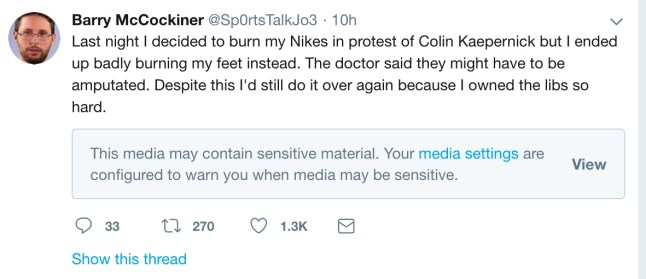
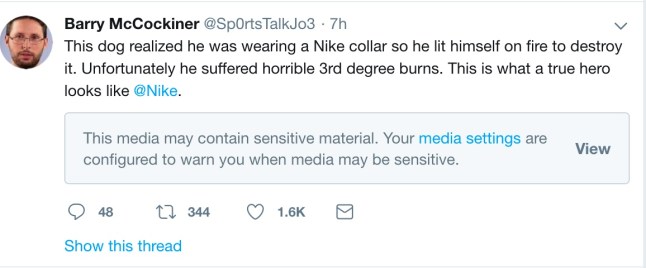
  • Go a few tweets deep: If you feel the best way to weave in that “man of the people” vibe into your writing is to find people on Twitter who you don’t know but are blathering on about your topic, look at a few tweets. “Barry” has a few interesting tweets on his timeline on a variety of topics. If I posted the ones here related to his quote about how Kaepernick’s Nike ad is affecting his marriage, I’m sure half the SAGE marketing team would have heart attacks. (Let’s just say he noted that his marriage was harmed when he caught his wife being unfaithful to him with a man wearing only Nike socks.) Here are a few tamer tweets he posted:

BurnNikes

DogNike

He also has a wonderful diatribe about how he has been constantly on heroin… Long story short: Is this REALLY a source you would want to represent anything you’ve written? If you are going to use a Twitter user, try to find someone who a) you recognize, b) has something important to say and c) doesn’t look like a loon in everything he or she is saying

  • Trust, but verify: The Russian proverb works wonders here, as not every double entendre of a name is a prankster. The Cleveland Indians once had a pitching coach named Dick Pole. I’m not kidding. Here is a doubly unfortunate card of his when he pitched for a minor league team in Portland:

DickPole

I knew a weird guy who used to show up at baseball card shows with a binder full of cards like this called his “Book of Dicks,” containing cards of Dick Allen, Dick Pole, Pete La Cock, Woody Held and others. The point is, those are real names, so it’s not always an attempt to punk you if you get a weird name.

However, it’s up to you to go take a look around and see if there is any supporting evidence that guys like Barry McCockiner exist. One of the downsides of Twitter is that you are limited to what people tell you about themselves, so it’s a little more difficult to verify the source. In the case of Mr. Jablome, a check of area real estate developers could have limited the embarrassment. In either case, you obviously can’t “card” a source to verify his or her name, (although some jokesters have gone to great lengths to prove their identity) but you can do some Googling and social media checks to see how likely it is that Jack Mehoff is a real person.

  • Ask for help: As we noted in earlier posts, it pays to have a person in your organization with a demented mind. The old saying of “it takes a thief to catch a thief” rings true in this type of work as well. You should read the name aloud, have others do the same and then eventually hit up Jimmy The Crime Guy or whoever in your organization has the ability to turn anything into a dirty joke. If Jimmy can’t figure it out, you’re probably safe.

From “first big interview” to felony charges: A journalist reflects on his former chancellor

Each week, we will strive to post content from a guest blogger with an expertise in an area of the field. This week, Alex Crowe, the news and social media director for WMDC in Mayville, Wisconsin, reflects on his student media experience interviewing former UW-Oshkosh Chancellor Richard Wells as a “first big interview” subject. Last week, Crowe covered the latest development in an ongoing financial scandal in which Wells and former Vice Chancellor Tom Sonnleitner were each charged with five felony counts. Interested in being our next guest blogger? Contact us here.
—-
My interviews with then Chancellor Richard Wells were always good, but I never got more than a few words in before he started talking. Wells loved to talk to anyone who would listen, especially about things that were being done around the UWO campus. And, as I told myself at the time, why wouldn’t he? The projects being done at UWO were all massive, and all of them seemed to start at the same time.
My interviews with him were a informal sit-downs during the Chancellor’s Breakfast, an event that comes around at the end of every semester. Students can take a break from studying to get a free breakfast at Blackhawk Commons, served by some of the higher-ups at UW Oshkosh. I usually met with and interviewed Athletic Director Darryl Sims, Wells and maybe one or two other people. The interviews were very informal, me in a radio polo and my guests usually in aprons and hats fresh out of the kitchen.
I remember distinctly asking Wells about the projects at UWO. There were so many going on that it was hard to keep track. My freshman year (2011-12) was the final year of construction for the new Horizon dorm and it seems like the floodgates opened after that. New lecture halls and classrooms in Clow, renovations at Halsey, new dorm rooms and renovations in Fletcher Hall, the brand-new Alumni Welcome and Conference Center and so on. As soon as I would bring up the construction projects on campus, Wells would begin beaming with pride, then start talking.
Wells would tell me of the great public-private partnerships that the University had formed under his leadership, such as renovating the downtown Best Western hotel with the intentions to implement a hospitality major at the University. He would also talk a lot about the newly constructed bio-digesters in the area, and how public-private partnerships helped him to secure the funding to make it all possible.
I suppose a more seasoned journalist would have asked those tough questions, probing him in exactly where the money suddenly came from to begin all of these projects at once. As a college student and head of the campus radio station, I was mainly concerned with studying for finals and getting everything set up and on-air.
Now that Wells and his former Vice Chancellor have been charged with five felonies each, it’s easier for me to look back on the situation and see things differently. More information is sure to come out in the criminal complaint and during courtroom proceedings, but right now I’m left with a lot more questions than answers. If Wells did what he’s accused of doing, there would be a lengthy paper trail leading right to him. Why, then, would he go on media tours (albeit small, campus media outlets) to tout the projects themselves? Was there just an assumption everyone would be as naive and wide-eyed as me?
A lot more information will come out about this, and everyone will have the opportunity to form their own opinions about what happened. As a student, I feel glad that a certain level of attention was given to improving campus resources, especially with cuts to education funding throughout my time in the UW System.
As a taxpayer (I held many jobs throughout college for which I paid state and local taxes, as I do now) I feel proud that the state is doing all it can to follow the money and see exactly who paid for what, and if the law was broken. And as a journalist, well, I learned to prepare for everything and always ask the tough questions, even if your guest is coming straight from cooking pancakes for the entire student body.

Royal Dozen: KU’s sports journalism class covers spring training baseball live

RoyalDozenGroup

Sportswriting students at the University of Kansas got the opportunity to take their classwork outside a few weeks back when they covered the Kansas City Royals franchise during spring training. Professor Scott Reinardy gathered a dozen students with extensive media experience and took them down to Surprise, Arizona for a live-action exercise that challenged them to create media packages in multiple formats.

“It was our first foray into training camp,” Reinardy said. “Associate professor Max Utsler has been talking about it for years. He had spoken with other academics who had provided similar opportunities for students. Max has connections with the Royals – he’s a backup MLB official scorekeeper for the Royals – so it appeared it’d be a natural fit for our first attempt. Mike Swanson, the Royals vice president for communications and broadcasting, was our liaison. He provided tremendous assistance in coordinating our efforts prior to arriving and while we were on sight.”

RoyalDozen1Once there, the students spent a week in the training camp where they gathered information, recorded video and built a social media presence. (@RoyalDozen on Twitter) Reinardy said the team was helpful both before the event and during the reporting process.

“The Royals provided a workroom, which was incredible,” he said. “We were able to use that as a staging area throughout our time in camp. Royals officials were incredibly generous with their time and assistance. Mike Swanson went above and beyond to provide everything we needed to be successful. And, we were given full access to set up the interviews and shoot video of the minor league players in camp.”

Reinardy said KU’s foray into this kind of coverage wasn’t the first time university students have done the spring training approach. To distinguish this effort from other similar trips, the Royal Dozen shifted its focus away from the star players and divvied up the coverage in an innovative way.

“We wanted to provide a professional experience for students but covering a Major League team seemed redundant to what other media were doing,” Reinardy said. “So, we focused on the minor league players. We conducted a draft in class, requiring the students to conduct secondary research before drafting six players in the Royals system. The students are required to produce mini-profiles of their three players that include a written story and a video story. The students drafted six players because we realized not all those players would still be in camp by the time we arrived.”

Students were also required to tweet at least three times during the day, with some of those efforts breaking some Major League news. The amount of work the students put into preparation for their tasks was also impressive, Reinardy said.

RoyalDozen2“The students were incredibly professional,” he said. “Several players said they enjoyed having the opportunity to sit down for extended interviews, something that does not happen after games during the season. The students were well prepared to ask questions that had several players asking with surprise, ‘Who told you that?'”

Beyond the individual successes, Reinardy said, another key aspect of the excursion was to teach the students how to work as a team.

“We want to prepare young journalists to do well in their professional careers,” he said. “This opportunity provided a glimpse into the professional world. The logistics of working with others – professional athletes and colleagues — attempting to develop original content, and grind through 10-hour days is a small sample of the life as a sports journalist. Students need to be challenged. In that challenge they will fail. Failure and adaptation is where actual learning occurs.”

Reinardy said a return to spring training is possible next year, but due to the shrinking pool of minor league players in the Kansas City, the Royal Dozen will likely be no more. He said the school would likely choose another team.

The biggest take away, Reinardy said was that the students learned that journalism requires more than writing and editing.

“Doing journalism is difficult,” he said. “Anytime we can place students in a professional environment to do so, they experience all the nuances and complications that cannot be replicated in a classroom. When a player was cut, the students had to adapt by finding a new player to feature. When an interview fell through, the students had to find a way to re-schedule. When audio failed during a 15-minute interview with a player who was in an unpleasant mood after being demoted, the student had to figure out a way to re-do the interview.

“Adaptation and problem-solving is instrumental in producing good journalism. For one week in Surprise, Arizona, the students received an opportunity to learn that lesson first hand.”

The students are still in the process of turning their work into top-notch stories. To see what they are up to, click here.


Explore the lore for stories (or do more people get a snip-off before March Madness tipoff?)

I have to hand it to Jim Stingl and the staff at the Milwaukee Journal-Sentinel, because the opening on this story border on magical, so much so, I’ll ignore the AP style error in the lead:

Well-timed vasectomies put lots of guys on the couch for March Madness basketball

Jeff Kopesky is synching his surgical snip-off with the first round tipoff of March Madness.

Stingl takes a look at the lore behind men who get a surgical procedure that has a lot of guys doing the “SSSSS…. AAAAHHHHH….. MMMMPHH…” noises in their heads and how it can be used as an advantage. I have to admit, this story felt like I was watching a car wreck: I literally found myself gaping at it, unable to look away while thinking, “This is so, so, so wrong…” That said, I marveled at it for a few key reasons:

  • That lead is just… well… damn. To call it memorable is an understatement. I will likely be watching the games this weekend, thinking “snip-off” each time I hear “tipoff.”
  • The number of sources that go into this is amazing. Men have a hard time talking about almost anything, let alone something like this. Still, he had four sources (five if you count his aside about his own surgery) and it was a relatively short piece.
  • He uses facts to support the legend of “everybody has heard about…” The doctor says he’s doing double the number of surgeries of this type that he normally does around this time of year. Other information about medicine and so forth supports the narrative.

This story is a great launch point for story ideas based on urban legends, campus myths and “stuff EVERYBODY knows.” Explore the lore so to speak with things like this:

  • GENERAL CAMPUS LEGENDS: There are long-held, erroneous beliefs about college life that go beyond individual campuses. The movie “Dead Man on Campus” touches on the biggest one: If your roommate dies during the year, you automatically get straight A’s. What other myths are out there regardless of if you attend school in Maine or Arizona? What commonalities do they have and how real are they?


  • YOUR CAMPUS LEGENDS: Each campus has a specific legend that is germane to something that happened or didn’t happen on campus. A certain dorm is haunted by a kid who died there. A book exists in the library that has all the dirt on every administrator ever to threaten a certain frat. A system of tunnels run under the school that allowed students to avoid going outside in hot or cold weather, but they were sealed up after “an incident.” What are the specific legends on your campus and how did they get started? Are they rooted in fact and then spiraled or are they just old wives’ tales that got blown out of proportion?


  • THEMES OF LEGENDS: Maybe you could take a look at the broader ideas of legends themselves and what they say about the people on college campuses. Certain themes continue throughout various legends, even though they are campus-specific. For example, sex is always a hot topic on campus, which is why the legends relate to people who have or haven’t had it yet. At UW-Madison, the large statue of Abe Lincoln, seated in front of Bascom Hall, was said to stand up if a virgin walked by. The angelic “Beneficence” statute on Ball State’s campus was said to flap her wings if a similarly chaste individual walked by. Concrete lions on Penn State’s campus were believed to roar if student who hadn’t “done the deed” passed by.
    There are also legends of luck: If you rub the nose of a statue or throw coins into a certain fountain, you were more likely to pass your midterms or finals. For example, the “Tecumseh” bust on the campus of the Naval Academy is dubbed “the God of the 2.0” as in grade point average. Cadets offer a left-handed salute and toss pennies in front of the statue for luck prior to exams or athletic events.  What other themes exist? How do they matter and what does it say about what we all value.

Have a great spring break (if it’s coming this week like ours is) and enjoy March Madness (with or without a bag of frozen peas, as is the legend).

Vince (a.k.a. The Doctor of Paper)

Obituary Writing: Telling truths, not tales, in a reverent recounting of a life

In a discussion among student media advisers, one person noted that obituaries are probably the second-hardest things journalists have to do frequently. (The hardest? Interviewing family members about dead kids.) When a person dies, media outlets often serve as both town criers and official record keepers. They tell us who this person was, what made him or her important and what kind of life this person led. This is a difficult proposition, especially given that people have many facets and the public face of an individual isn’t always how those who knew the person best see him or her. Couple these concerns with the shock and grief the person’s loved ones and friends have experienced in the wake of the death and this has all the makings of a rough journalistic experience.

The New York Times experienced this earlier in the week when it published an obituary on Thomas Monson, the president of the Mormon Church. The Times produced a news obituary that focused on multiple facets of Monson and his affect on the church. This included references to his work to expand the reach and the population of its missionary forces as well as his unwillingness to ordain women and acknowledge same-sex marriages. The obituary drew criticism from many inside the church, leading the obituary editor to defend the choices the paper made in how it covered Monson. (For a sense of comparison, here is the official obituary/notification of death that the church itself wrote for Monson.)

You will likely find yourself writing an obituary at some point in time if you go into a news-related field.  Some of my favorite stories have been obituaries, including one I did on a professor who was stricken by polio shortly after he was married in the 1950s. I interviewed his wife, who was so generous with her recollections that I was really upset when we had to cut the hell out of the piece to make it fit the space we had for it. Still, she loved it and sent me a card thanking me for my time.

Some of my most painful stories have also been obituaries. The one that comes to mind is one I wrote about a 4-year-old boy who died of complications from AIDS. His mother, his father and one of his siblings also had AIDS at a time in which the illness brought you an almost immediate death sentence and status as a societal pariah. I spoke to the mother on the phone multiple times that night, including once around my deadline when she called me sobbing. Word about the 4-year-old’s death had become public knowledge and thus she was told that her older son, who did not have AIDS, would not be allowed to return to his daycare school. Other things, including some really bad choices by my editor, made for a truly horrific overall situation in which the woman called me up after the piece I co-wrote ran and told me what a miserable human being I was. She told me the boy’s father was so distraught by what we published that he would not leave the house to mourn his own son and that she held me responsible for that. Like I said, these things can be painful.

No matter the situation, there are some things you need to keep in mind when you are writing obituaries:

  • Don’t dodge the tough stuff: Your job as a journalist is to provide an objective, fair and balanced recounting of a person’s life. The Times’ editor makes a good point in noting that the paper’s job is to recount the person’s life, not to pay tribute or to serve as a eulogist. This means that you have to tell the story, however pleasant or unpleasant that might be. One of my favorite moments of honesty came from hockey legend Gordie Howe who was recalling the tight-fisted, cheap-as-heck former owner of the Detroit Red Wings:

    “I was a pallbearer for Jack,” says Howe. “We were all in the limousine, on the way to the cemetery, and everyone was saying something nice, toasting him. Then finally one of the pallbearers said, `I played for him, and he was a miserable sonofabitch. Now he’s … a dead, miserable sonofabitch.'”

    It’s not your fault if the person got arrested for something or treated people poorly. If these things are in the public record and they are a large part of how someone was known, you can’t just dodge them because you feel weird. Check out the Times’ obituary on Richard Nixon and you’ll notice that Watergate makes the headline and the lead. As much as that was likely unpleasant for the people who were closest to Nixon, it was a central point of his life and needed to be discussed. In short, don’t smooth off the rough edges because you are worried about how other people might feel. Tell the truth and let the chips fall where they may.


  • Avoid euphemisms: This goes back to the first point about being a journalist. You don’t want to soften the language or use euphemisms. People don’t “pass on” or “expire.” NFL quarterbacks pass and magazine subscriptions expire. People die. Also, unless you can prove it, don’t tell your readers that the person is “among the angels” or “resting in the arms of Jesus.” (Both of these euphemisms ended up in obituaries I edited at one point or another. They obviously didn’t make it to publication.) Say what you know for sure: The person died.


  • Double down on accuracy efforts: People who are reading obituaries about loved ones and friends are already on edge, so the last thing you want to do is tick them off by screwing up an obituary. I don’t know if this was just a matter of newspaper lore or if it was a real thing, but I was told more than once at a paper where I worked that there were only two things that would get us to “stop the presses:” 1) we printed the wrong lottery numbers and 2) we screwed up an obituary.
    True or not, the point was clear to me: Don’t screw up an obituary.
    Go back through your piece before you put it out for public consumption and check proper nouns for spelling and accuracy. Do the math yourself when it comes to the age (date of birth subtracted from date of death) and review each fact you possess to make sure you are sure about each one. If you need to make an extra call or something to verify information, do it. It’s better to be slightly annoying than wrong.


  • Accuracy cuts both ways: As much as you need to be accurate for the sake of the family, you also need to be accurate for the sake of the public record. This means verifying key information in the obituary before publishing it. The person who died might told family and friends about winning a medal during World War II or graduating at the top of her class at Harvard Law School. These could be accurate pieces of information or they could be tall tales meant to impress people. Before you publish things that could be factually inaccurate, you need to be sure you feel confident in your sourcing.
    Common sense dictates that you shouldn’t be shaking the family down for evidence on certain things (“OK, you say she liked to knit. Now, how do we KNOW she REALLY liked knitting? Do you have some sort of support for that?”) but you should try to verify fact-based elements with as many people as possible or check the information against publicly available information. Don’t get snowed by legends and myths. Publish only what you know for sure.


  • Don’t take things personally: Calling family, friends and colleagues of someone who just died can be really awkward and difficult for you as a reporter. Interviews with these people can be hard on them as well as hard on you. I found that when I did obituaries, I got one of three responses from people that I contacted:
    1. The source told me, “I’m sorry, but I really just can’t talk about this right now.” At that point, I apologized for intruding upon the person’s grief and left that person alone.
    2. The source is a fount of information and wanted to tell me EVERYTHING about the dead person. I found that for some of them, it was cathartic to share and eulogize and commemorate. It was like I was a new person in their circle of grief and they wanted to make sure I knew exactly why the person who died was someone worth knowing.
    3. The source was like a wounded animal and I made the mistake of sticking my hand where it didn’t belong. I have been called a vulture, a scumbag and other words I’ve been asked to avoid posting on this blog. One person even told me, “Your mother didn’t raise you right” because I had the audacity to make this phone call. I apologized profusely and once I hung up, I needed a couple minutes to shake it off. I knew it wasn’t my fault but it wasn’t easy either.

Your goal in an obituary is always to be respectful and decent while still retaining your journalistic sensibilities. It’s a fine line to walk, but if you do an obituary well, you will tell an interesting story about someone who had an impact on the world in some way. I like to think a story about this person who died should be good enough to make people wish they’d known that person while he or she was alive.