(I know adviser Doug Pils probably DIDN’T approach the situation this way, but I still like to imagine this is how he and his newsroom reacted when the administration dropped the bomb on them, declaring their print days to be over.)
Good news seems to be in short supply these days, so it’s nice to see a reminder that once in a while, the good folks win.
The Battalion at Texas A&M University celebrated the fact they are still printing one year after the university declared print on campus dead and demanded the paper stop putting out a dead-tree edition.
The editors wrote a fantastic piece on their opinion page recently to commemorate the one-year anniversary of the event by showcasing all the great stuff they had done since that point in time:
Our own coverage of the Memorial Student Center losing its status as an early-voting location last year informed the local community and directed eyes from all across the state to College Station and the importance of ballot access.
But The Battalion, and student journalism more broadly, is about so much more than the headlines that reach national proportions — it’s about telling the story of our community, Aggieland, authentically.
Being run by students, for students, allows us to pinpoint the stories that matter most to our audience, explore these issues with passion and sharing it to Aggies everywhere.
Pils said the continued support from a variety of sources has helped buoy the staff members’ spirits as they persist in their efforts to save the print edition. He also said he doesn’t know what it will take to get Banks to fully retract her order.
“Do I have honest hope for it? I don’t know I think we raised enough ruckus that we might have a chance, but not knowing this person at all, and only knowing a few people who do know her, I’m not certain… but I certainly do hope.”
After getting a brief reprieve to the end of the semester, the situation kind of just kept on keeping on. The editorial reflects that and it’s a great way to capture everything student press should entail:
While our staff is committed to embracing new mediums and ways to reach our audience, make no mistake; Print is not dead until we say it is.
The Battalion has been printing for 130 years, and today, we are committing to yet another. So here’s to another year of print journalism, of commemorating Aggieland and telling stories about students, by students, for students.
Here’s to another 130 years. Congratulations and thanks for the inspiration!
Amazon spent somewhere in the neighborhood of $14 million during the Super Bowl for a minute-long teaser trailer of “Air,” a movie that tells the story of how Nike came to land Michael Jordan as a client. The Ben Affleck/Matt Damon flick follows a familiar trend these days, as it is “inspired by true events,” which is just a fancy way of saying, “We made up a bunch of stuff.”
Movies like “Elvis,” “Blonde,” and “I Wanna Dance With Somebody” have seen varying levels of post-hoc fact checking that call into question certain parts of the films, with film buffs rebuffing these concerns as mere “dramatization of controversial and contested historical events.” Still, these situations are small potatoes when compared to how some films and limited series have taken liberties with reality.
“Winning Time,” HBO’s look at the late 1970s/early 1980s rise of the L.A. Lakers, created massive amounts of controversy with the way in which it played fast and loose with the truth. Given the relatively recent era in which the events took place, the degree to which sports information is retained and a quality text from which to draw, it seemed almost purposeful that the series got so many things factually wrong, including places, dates, opponents and scores. This isn’t even accounting for how the athletes, including Magic Johnson and Kareem Abdul-Jabbar , publicly denounced the way in which they were portrayed.
Even more, Jerry West and his legal team have demanded an apology and retraction for the way in which the series portrayed the Laker legend, noting that the producers engaged in “legal malice.”
The New York Times did a deep dive on the cottage industry that has streaming services building mini-series around actual events, but then jazzing up reality to make life seem cooler than it was. The piece cites West’s portrayal as a “rage-aholic” as one of the more egregious cases of taking liberties with reality. It also points out that Linda Fairstein, the prosecutor in the “Central Park Five” case, is currently engaged in a lawsuit against HBO for its portrayal of her in the series “When They See Us.”
The defamation attorneys the Times quoted made it clear that these cases aren’t always easy to win, because the First Amendment does provide folks with the ability to create fiction based on true people. However, there are limits to this kind of thing:
Sometimes disclaimers are enough to protect a studio from legal liability, especially if they are prominently displayed in the opening credits and offer detail of what has been fictionalized — beyond a generic acknowledgment such as “based on real events,” legal experts say. The First Amendment offers broad protections for expressive works like film and television productions that depict real people by their real names.
But if someone can convincingly claim that he or she was harmed by what screenwriters made up, that is grounds for a strong defamation suit, said Jean-Paul Jassy, a lawyer who works on media and First Amendment cases in Los Angeles.
“A disclaimer is not a silver bullet,” he said.
This is in some ways akin to the way courts have afforded opinion pieces and reviews protection under the fair comment privilege. This allows writers to provide “pure opinion” that cannot be proven true or false without fear of falling afoul of defamation laws. That said, merely stating something is opinion isn’t a silver bullet either.
If you say, “In my opinion, Vince Filak is a lousy professor,” it falls into that opinion realm. It’s stated as such and there’s no way to define “lousy” so that a court could determine if I fit that definition or not. Plus, in defamation suits, the plaintiff (in this case, me) would have to show harm: Did I get fired? Did my classes shrink to the point I had to teach Medieval Basketweaving to maintain the course load in my contract? Did a group of random professors follow me around and mock me to the point I needed therapy? Probably not, so I’m not going anywhere with this.
However, if you say, “In my opinion, Vince Filak stabbed a student in the face with a fork during his 8 a.m. Writing for the Media Class on Feb. 20,” now you’re in trouble. It’s not an opinion, for starters, as we can prove it either happened or didn’t happen. It’s accusing me of a crime, which furthers my case. Plus, if that thing gains steam, I’m likely to get fired.
Writers, editors, producers and directors have always taken SOME liberties with reality when it comes to how they portray real people in fictional or semi-fictional stories. What makes this recent set of efforts more concerning is the degree to which they are bending the truth and the ways in which the fictionalization has the ability to warp public perception of real people in some harmful ways.
As for me, I’m looking forward to “Air” for the bad 1980s clothing and the Affleck/Damon banter that most of their collaborations pull off quite well. I’m also looking to see if anything gets dinged on a fact check, especially because, as anyone with any experience with Michael Jordan will tell you, he’ll take it personally.
What I have come to realize over all of those years is that I love student media. It has become my life, my passion and my purpose. Student media gave me the life I love so much now, and the venue it provides me to help others find their way to the life of their dreams. I also learned that I’m not alone in how I feel.
Today’s throwback post takes a look at a situation involving the potential death of a student media outlet brought about by short-sighted administrators and stupid budgeting. Beyond that, it gave people from many walks of life a chance to learn, laugh and love in an environment that gave them freedom and responsibility.
According to former Doane student media adviser David Swartzlander, the cuts don’t go into effect until July 1, which gives Stout and others about nine months to raise unholy hell about them, something we’ve asked you all to do throughout the week.
If you’re thinking, “None of this makes any sense. She’s graduating in a month, so she’s done with this place. And why are you dedicating so much time and energy blathering on about student media cuts at a university the size of your high school? You don’t have a horse in this race….,” well, I get it.
From the outside, this looks pathologically stupid.
If you’ve ever spent any time in student media, this makes all the sense in the world.
I asked people I know who have gone in myriad directions after their educational careers came to a close if they ever worked in student media and, if so, why it mattered to them. One of the best journalists I’ve ever been lucky enough to work with, a wordsmith and a storyteller unlike any other, didn’t disappoint:
My high school had no paper. I started one, called “The Cardinal Chirps.” There was news, sports and jokes on four mimeographed pages. (Smelled great!) It may have lasted three issues. The jokes were filler and I learned that not everyone has the same sense of humor. Don’t print jokes. Working at that paper was a revelation. I could find something that didn’t make sense – a section of the lockers were inexplicably located in a dark room with one narrow door – and write about it. It wasn’t safe for those who had their lockers in there. The principal and school board took note and changed it. No had ever brought it to their attention. The learning was true: You can’t fix something if you don’t know it is broken.
I expected a few responses from a few other people, but not much.
I was stunned when I got dozens, like this one from a journalism professor with a background in news:
I graduated from a small rural high school that didn’t even have a school paper. My interest in news grew from my mom’s obsessive consumption of newspapers (we subscribed to two and sometimes three), news magazines (I think we got four), news talk radio (on constantly), morning/noon/evening local and national TV news, public affairs shows on PBS and all the Sunday morning news talk shows, and my own growing awareness that there were other places in the world far from Tonganoxie, Kansas, that I dreamed of seeing someday. It seemed wise to understand what was going on in them before going. And before going, I had to have money. I understood from my good friend that one could be paid actual money for fixing errors in news writing by being something called a copy editor. The University Daily Kansan and my professors with newsroom experience showed me how to be that.
Another higher-ed friend who works as a student media adviser had a similar life experience:
Working in college media was the step for me that solidified how I could attain my dream to work as a professional journalist. Before my college media experience, the concept was very abstract. Moving from dreaming to doing via my student newspaper made it real for me. I am forever grateful to those who gave me the opportunity and helped me see I could do it.
Folks who took the path out of news and into corporate communications, consulting and other similar fields found that student media benefited them as well:
I wanted to write books before I signed up for journalism class in high school on kind of a whim. In that class, I found that I had a knack for journalistic writing, most likely from reading the local paper and my dad’s influence as a TV journalist. Taking that class and continuing that path led me to attend J-School at MU and altered my career path. It also gave me an understanding of and appreciation for the importance of LOCAL journalism.
These responses made sense: Student media was like an internship and a training center for going on to do great and mighty things in the field itself. However, I also saw how the people who went into fields that had nothing to do with news or PR still found amazing value in student media:
I draw from my experience at the DN almost every day. I’ve worked for two law firms and a dental office since college. I’m comfortable asking questions, I’ve learned how to build relationships and I have a better understanding of how government works. The most important thing I have learned is that no matter how much effort you put toward your day, something could change and you need to be ready to shift your priorities and maybe undo all you’ve just done.
My boss at SAGE, who puts up with an awful lot from me, apparently found her muse through student media as well:
Basically shaped my entire college experience. Learned the basic responsibilities, ethical implications, and work ethic of a journalist. Being on the paper motivated me to write about things I was interested in, when I already had to write so much for school…Also I got to interview some really interesting people!
The one common thread, I saw overall, however, was that student media was more than a thing people did. It was who they were. The newsroom wasn’t like a classroom where they HAD to go. It was a place that gave them something special and they WANTED to be there:
It was my happy place. The place where I always knew what I was doing, and why. The place where everything just made sense. Why else would someone finish a shift, go home, get their books and go back to the newsroom to study. Because that’s where I was always focused.
And…
It was my home away from home. And it allowed me to experiment with what I wanted to do.
And…
Genuinely don’t know where to start. The friends, the experiences, now I’m working in media. Joined junior year of high school and haven’t looked back since. It gave me a purpose and quite literally saved my life a few times. I could go on and on.
And so many other people did as well, sharing stories of life-long friendships that developed thanks to pressure-packed deadlines, no sleep and a sense of belonging they never found before or since. At the risk of becoming hyperbolic, student media provides people with something that borders on magical, a familial bond forged in a way that never truly seems to break.
I understand why Meaghan Stout is fighting like hell, against all common sense, for her student media family, because 25 years ago, I was her.
I remember sitting in my journalism adviser’s office six weeks after our student newspaper closed under the weight of $137,700 in debt. My adviser was also my teaching assistant for Media Law, a course I was essentially flunking because I had poured all of my time into fixing the Daily Cardinal.
“You need to quit the paper,” she told me. “You’re going to fail.”
In retrospect, I think she meant the law class, but that’s not how I heard it.
I then listened as she told me how when she was in college, her student newspaper was moving from a weekly to a daily and how she was pressured to put the paper first and everything else second. Instead, she stuck with her classwork and got her degree. Besides, she explained, even if I managed to fix the problems, the paper was likely to shrivel up and die after I left, so what was the point?
In the abstract, she was right. Take care of yourself. Get the grades. Besides, there was another student newspaper on campus I could work for, so what made this Quixotic journey so important? I couldn’t explain it, but even if I could, I doubt she would have understood.
So, I let her finish, told her I’d think about it and then I went back down to the newsroom and kept working on fixing the paper. By the next semester, we’d pulled it back from the brink of collapse and started printing again.
It’s still running to this day.
For me, my student media experience wasn’t about the articles I wrote or the editorial positions I held or the arguments we had. (We often joked that we were a family in the newsroom, in that we drank a lot and hurt each other…)
It wasn’t that, without that paper, there’s no way I would have gotten this far in life, and I’d probably have had a heck of a career as a fairly decent auto mechanic. It also wasn’t the life experiences it gave me either, although without the paper my kid would likely have different godparents and I would have been deprived of the opportunity to return the favor.
I still can’t adequately explain what it is that makes student media matter so much, whether it’s the paper I worked for, the papers I advised or the papers I never ever knew of before a crisis threatened them.
What I can say is that I love reading the articles the students write, as I wonder how much blood, sweat and tears went into just getting that inverted-pyramid piece to hold together. I love seeing those 20-somethings I knew through my media conference presentations or newsroom visits doing great and mighty things as reporters, editors, copy editors and more. I love it even more when I see them finding joy in life outside of the field, moving into politics, social work or psychology.
I treasure the photos I see of engagements and weddings that bloomed from seeds planted on a production night. The houses they buy, the babies they have, the lives they develop… Somehow, it all comes back to that moment they found someone else who had the weird sense of humor that grew from spending too much time in a windowless bunker that smelled of old newsprint and burnt coffee.
In all my time at all these institutions of higher learning, I’ve yet to come across another student organization or activity that even came close to what student media does, both for the campus and for its practitioners. This is something people like Jacque Carter don’t understand, because to them, it’s a pain in the ass that costs money and points out things they don’t want pointed out.
To us, it’s life.
P.S. – I passed law with a C that semester. Even if I hadn’t, I wouldn’t have changed a thing.
If you’re unfamiliar with the concept of Smart Brevity, it’s the bread-and-butter approach Axios takes to telling stories. The goal is simple: Tell people what they need to know right away, tell them why they should care about it, give them the option of going deeper without making it mandatory and move on with life.
With that approach in mind, here’s the best brief review I can do:
“Smart Brevity” forces writers to economize their work for the sake of their readers. This audience-centric approach cuts through the content deluge readers receive each day and improves multiple communication experiences. “Smart Brevity” won’t work in as many places as the authors state, but the underlying tenets can be helpfully adapted to various situations. It’s a quick read and worth the time, especially for non-journalists.
In the tradition of Axios, if you want more than that, here’s a deeper dive:
POSITIVES
IT’S BRIEF: Axios talks the talk and walks the walk on brevity. The book weighs in at 218 pages, but it is easy to read and the pages fly by. Anecdotes are limited to those that really emphasize the point, examples hit the point before quickly moving on and the bullet-point structure familiar to Axios readers makes for bite-sized chunks that are easy to consume.
IT’S HELPFUL: The hard part about being a writer is that writers love to write, almost to a fault. Axios sympathizes with that instinct, but shows key ways to do more with less. A lot of what the authors emphasize (NVO structure, get to the point immediately, tell me why I care, focus on the audience) is at the core of good journalism. The book serves as an entry point to non-journalists who need to write clearly and succinctly while providing journalism-style folk with a reminder to avoid falling in love with our own prose.
(The focus group was interesting in that we had journalism faculty, PR faculty, broadcast faculty and business/marketing faculty. The business person gushed about how amazing and revolutionary and special this was. She went on and on about how the business school was adding this book to its curriculum and making it a must-read and how her life was essentially changed by this book, as she Post-It noted the thing to death. The journalism and broadcasters in the room were looking at each other like, “Um… Yeah… This is kind of what we do already…”)
IT’S ENGAGING: The writing in here is clear and direct but also conversational and engaging. One of the best compliments a student ever paid to my textbook was, “I can hear you in my head when I’m reading this.” I don’t know what any of these guys actually sound like, but I felt the same way here. This wasn’t a preacher’s sermon. It was a valuable chat.
IT’S HUMBLING: These guys didn’t emerge from the womb as smart-brevity writers. It took a while for them to get here and they explain that backstory in places. The examples range from VandeHei’s interaction with a demanding Washington Post editor to Mike Allen’s experience developing his newsletter and show how they moved from the “It’s gotta be long to be good” paradigm to the “Brevity is confidence. Length is fear” motto that Axios espouses.
NEGATIVES
IT’S A ONE-TRICK PONY: The latter half of the book shows how you can apply the smart brevity model to everything from emails and presentations to meetings and speeches. In each case, there’s a ton of repetition without much nuance. In addition, as we discussed here before, the Axios model can fall into the “Law of the Instrument” problem, in which they pitch it like a 1980s infomercial:
We can all use tighter speeches, presentations and emails to be sure, and I would give real money if someone could find a way to make meetings no longer than five minutes. However, the smart brevity model can come across as abrupt and blunt in some of these situations. (If I got a “smart brevity” email from my boss like the example in the book, I’d immediately think he’s pissed at me.)
IT’S AUDIENCE-CENTRIC, BUT NOT UNIVERSAL: One of the things that the Axios crew knows better than anyone else is how to serve its audience. The book hits on audience-centricity repeatedly, and for good reason: Writers often write for themselves, which is where we get into trouble. The audience for Axios, and the authors’ previous home of Politico, was a group of on-the-go political junkies who were well-versed in the language, culture and vibe of D.C. scene. The writers were part of that scene as well, so it was easy to “speak the language” of the sources and make points quickly.
(When I mentioned this in the group discussion, VandeHei noted how they’ve helped BP, CitiGroup and other organizations to implement this form of writing . He also mentioned that each time he brought this format up to various groups, ranging from scientists to lawyers, they all said it would never work for their field, but it did. My point was still that these people had a shared culture and vocabulary so, yes, it does work in that way, but not if you’re bringing folks into the fold on something new or talking to people outside of this area. I got the sense he disagreed.)
The “Smart Brevity” approach works in this format, but not in situations like teaching someone a new skill, laying out a detailed plan or other things that require writers to bring along people who don’t have the foundational knowledge Axios knew its audience had. That’s not to say the content of the book can’t help improve the writing in these situations, but the writer has to know the audience well enough to adapt the “Smart Brevity” approach to the needs and acumen of that group.
I dug this one out for Throwback Thursday for two reasons:
It’s the end of the semester and I’ve got a lot of kids dragging out there who are operating under the overbearing expectations of some truly stupid professors, bosses and other alleged adults. I’ve heard “I must really suck” more often these days than I would at a vacuum cleaner self-affirmation conference.
My kid just got into the college of her choice.
The first one is pretty obvious: When people like this Everett Piper dude decide to make themselves out to be the second coming of perfection, while simultaneously crapping all over you, all for their own personal benefit, you need to know there are folks out here who want you to know you’re fine. Hang in there. Don’t give up.
The second one needs more context: Last year, Zoe sat down with her high school guidance counselor and talked about what she would like to do after graduation. She listed off several schools she wanted to attend, two of which were pretty heady picks, but not Ivy-League places or schools with a 0.0001 acceptance rate. These out-of-state places had strong accounting programs, an area for which she has a passion that defies explanation.
The counselor told her not to bother. Pick a couple UW branch schools because, “Nobody from Omro ever leaves the state for school.”
There is nothing wrong with a UW branch school. Her first acceptance letter came from a UW branch school and she was totally happy with that opportunity before her dream school came calling. Hell, I’m TEACHING at a UW branch school, despite what the marketing folks here will tell you through their branding.
(The rule in the marketing department, I’m told, is that they use hyphens with all UW schools except for us and the flagship campus because they need to set the tone as being a quality institution, not a second-rate branch. Never once have I met a student who told me, “I was considering UW-Stevens Point, but then I saw that hyphen and thought it had to be a total crap hole.” Then I saw the hyphen-free UW Oshkosh, and realized, “This is the place for me!”)
The point is, why would this person think it’s acceptable to tell a kid, “Look, don’t bother trying for stuff you want. It’s kind of a waste of both of our times.” Who does that?
Quite a few chuckleheads, including the one we’re covering in this post below. Enjoy the burn…
Dear students, Don’t let Everett Piper tell you that you suck.
For reasons past my understanding, this thing is making the rounds again:
The President of Oklahoma Wesleyan University gave a lecture to students they’ll never forget. Recently a student complained about a sermon that made him feel guilty and blamed the school for making students feel uncomfortable. This is not uncommon. Many universities now are so afraid of offending even one student, that political correctness has run amuck.
However, this University is based on religion and so one would expect that discipline, good character and personal accountability would be a big part of the curriculum.
Everett Piper, who is the President of the school, wrote a letter to the students admonishing them that playing the victim, blaming others and not admitting mistakes is not a way to live a productive and meaningful life. Here is the letter titled “This is Not a Day Care. It’s a University!”
Piper’s open letter originally made waves in 2015 when he first posted it and it suddenly went viral, thanks to his leveraging of social media and the talk-show circuit. Every so often, someone finds it again and posts it to a listserv or a Facebook feed and it starts to catch fire again.
Professors often deal with a wide array of students, but it is usually the best and worst ones that make the greatest of impressions. Thus, we tend to recall the kid who skipped seven weeks of class and then showed up for the final or the guy who swears his grandmother died 19 times in the semester to justify his frequent absences. Get about four professors in a room around this time of year and a game of, “I bet you can’t top this” will inevitably happen, as we tell tales about student baffling student behavior.
That said, this letter is total crap for a number of reasons. For students out there reading this, and who are tired of getting dumped on, here are a couple points to ponder before you let a guy like Everett Piper make you feel miserable during finals week:
Recall the Johnny Sain Axiom on Old Timers Day
Johnny Sain, a longtime pitcher and pitching coach, had a disdain for Old Timers Day, when out-of-shape old players would return and tell stories of their glory. He captured the reason perfectly and with a phrase you should always remember:
“The older these guys get, the better they used to be.”
I don’t know Everett Piper personally, but if he’s like every other human adult I ever met, I’m fairly confident he wasn’t perfect at the age of 19. If I had a nickel for every mistake I made, stupid thing I said, dumb question I asked and wrong position I held in my college years, I could buy Earth and evict Piper from it. The point is to learn from those mistakes and help other people who are likely to make those mistakes as well.
I occasionally get a question that goes something like, “Wow, you work with college students? Don’t you ever feel jealous of them for (whatever freedom they supposedly have to drink like a fish, hook up every night or just have a metabolism that doesn’t reflexively add inches to my waistline every day)?”
The answer, “No and HELL no.” I remember living off of buckets of Ramen and those frozen chicken things that were probably part cat, but were 10 for $5 at the local convenience store. I remember having to decide between another beer and laundry money. I remember the anxiety associated with asking people out, trying not to screw up a relationship and having to listen to The Cure for hours on end after each break up.
Would I care for a return to crappy apartments where the heat was controlled in only one unit, brown water that came out of the tap and a basement that smelled of god-knows-what? No thank you. I survived the first time and I’m lucky I got out with 10 fingers and 10 toes. Remembering that is what drives me to help you get better.
Too many people eventually get older and develop selective amnesia, thus allowing them to tell kids, “When I was YOUR AGE, I (never/always) did (whatever)…” and really believe it. I’d bet every dollar in my pocket against whatever Piper has in his that there were times when he whined as a student or groused about something being unfair or complained about how he felt without thinking about how it would sound to other people.
It’s not that we have too many trigger warnings or that too much stuff is gluten free or that we can’t say “Merry Christmas” to anyone without starting a culture war these days. Those are all strawmen, just like Piper’s student at the front of his letter.
The fact is, there have always been good things and bad things that people exalted or wailed about in life. It’s just the people doing it now have forgotten how much they hated hearing about their grandparents explaining how ungrateful “kids in your generation are these days,” which is why they do it to other people.
Keep that in mind if you ever end up the president of a university and you have an urge to yell at a kid for standing on your lawn.
Consider the Source
In journalism, we teach people to look at the source of the information before we consider how much weight to give it. Sure, from the outside, Everett Piper may look like the shining beacon of greatness upon the hill of glory, but consider the following information before you worry what he thinks about you:
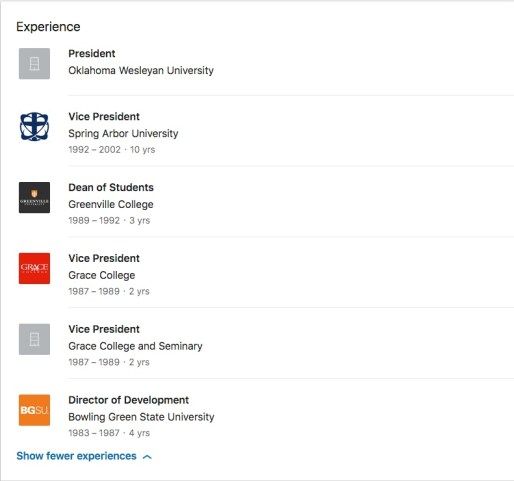
He grew up in a town of about 8,000 people and attended a nearby private school of about 2,000 people in late 1970s/early 1980s, when you weren’t required to hock an internal organ to pay tuition. Upon graduation in 1982, he took off for the work world, as you can see below:
So he graduated at the age of 22/23, immediately went into academic administration and never left. Not exactly the story his university tells about him:
A native of Hillsdale Michigan, Dr. Piper grew up in a family that valued hard work, a mindset he carried with him as he moved from industry into pursuing a college degree.
Not sure how much “industry” work he did between the ages of 18 and 23 while in school, but he wasn’t a returning student, or a single parent, or a GI Bill kid, or any of those other kinds of folks I see on a daily basis who work their asses off to survive. He might or might not be the prototypical example of a guy who thinks he hit a triple when he was actually born on third base, but he’s also isn’t a latter-day “Rudy,” either.
Piper’s proud defense of his university not being a daycare seems a bit suspect, as he is making money off the deal. He turned his “catchphrase” into a nice cottage industry of castigating the youth and yelling about the snowflakes on his lawn.
Also, consider this line from his letter to the masses:
If you’re more interested in playing the “hater” card than you are in confessing your own hate; if you want to arrogantly lecture, rather than humbly learn; if you don’t want to feel guilt in your soul when you are guilty of sin; if you want to be enabled rather than confronted, there are many universities across the land (in Missouri and elsewhere) that will give you exactly what you want, but Oklahoma Wesleyan isn’t one of them.
(The emphasis on those two statements is mine.)
If the irony of that first line doesn’t send your hater-ade filled soul into laughing fits, I don’t know what will. It’s easy to “arrogantly lecture” people, as Piper has clearly shown with his letter doing exactly that. Also, instead of dumping all over the kid who came to you with this concern about a Bible passage you likely understood far better than he did, why not help that little snowflake “humbly learn” what it meant instead of using the kid as a strawman to bolster your self-serving position?
(Side note:When someone tells me that something “actually” happened and “I am not making this up” in successive paragraphs at the front of a story, I’d bet money that person is making something up.)
(It’s even more amazing than when you have the ability to monetize your grousing…)
The second line (and any other similar phrase) always annoys me when it comes from people in a position of advantage. When is the last time University President and Almighty Deity of Knowledge Everett Piper was called out for his horsepucky? Probably back when people were rocking popped collars and jamming out to Duran Duran. It’s easy to say that people need to be confronted when you possess the power and position to do so, without fear of retribution.
The problem isn’t that Everett Piper exists or that he has created a nice little business out of shaming college students with the tone of a high-strung school marm. The problem is that he isn’t alone.
Each generation likes to blame the one before for its problems and dump all over the one after it for not being perfect. As mentioned earlier, people like to get together and complain about how “a student did something you wouldn’t believe…”
Like any other stereotype, it contains a kernel of truth. Like any other stereotype, you can beat it. And like any other stereotype, you should call it out when you hear it.
Don’t let Piper and his ilk decide that you damned kids and your hippity-hoppity music are ruining this world and that if we could just get “Happy Days” back on the air, life would be good again. Don’t let this guy sell books off of the assumption that you will crumble or melt or whatever the comparative is that Piper or the next chucklehead uses to deride your generation. When someone decides to grump in your general direction, use your finely honed interviewing skills to pick apart their self-serving rubbish and demonstrate your intellectual journalistic superiority.
Sure, there are self-absorbed twerps in college who will claim their goldfish’s death merits a six-week extension on an already late paper. There are also dingleberries out there who misapply triggers and trigger warnings to mean anything they would prefer to avoid, as opposed to the actual medical situation they are. There are plenty of examples of students that make us shake our heads until we develop neck cramps.
However, when you see something like this, written by someone like Piper, take a moment and smile. Think to yourself, “Gee, it must be so sad to think so little of the people you are supposed to help that your best approach to dealing with ONE QUESTION is to publicly rip AN ENTIRE GENERATION to shreds with a letter and then go write a book to pat yourself on the back for being superior to anyone under the age of 22.”
Then, go back to working hard to be better than this guy is. Commit yourself to being the antithesis of what he purports you to be. In other words:
The use of simple language is the bedrock of what we do in journalism. Introductory writing courses pound the idea of eliminating complex terminology, removing unknown acronyms and generally cutting anything that might be considered jargon.
This approach makes a lot of sense when it comes to general-interest, mass-media publications, in which a wide array of readers who might be unfamiliar with the verbiage of a particular field come together to understand a complex topic.
However, the media isn’t always so “mass” these days, which means writers are serving thinner slices of narrower target audiences with content on niche topics. To that end, what might be “jargon” to a broader group of readers is merely “vocabulary” to the people who are reading, watching or hearing it.
Here’s a fun example from one of my favorite movies, “Dazed and Confused:”
In less than 15 seconds, Wooderson (Matthew McConaughey) proudly describes his beloved car, Melba Toast, to Clint (Nicky Katt) in a form of shared “gear head” language. Clint clearly isn’t impressed, but he’s also not confused.
(If you are confused, here’s a general translation of what he said. If you don’t care, skip past the bullets and pick up after them to get to my point):
“750 double pumper” The carburetor is oversized for the car, that offers 750 cubic feet per minute. It’s got basically four openings through which fuel and air can enter the engine (four-barrel) and it has two acceleration pumps that dump more fuel into the car, making it more responsive for racing situations.
“Edelbrock intake” The part of the engine upon which the carburetor sits has been replaced with a racing style “intake” manifold from the Edelbrock company.
So, how do you know if you’re relying on shared vocabulary or burying people in jargon? Here are some helpful hints:
WHO IS YOUR AUDIENCE?
When it comes to writing for your readers, you need to have a strong sense of who is out there and what they know or don’t know about your subject. This might require you to do some additional research about the people who are in your target audience before you start whipping around insider terminology. It might also require you to write various versions of the same piece for different groups of readers.
For example, in public relations, you might do some internal PR that explains some changes to the way in which your company’s factory will be dealing with the creation of certain product lines. If the readers are all coworkers who fully understand the ins and outs of the old process, some company-based shorthand and shared verbiage is probably fine. However, if you then have to put that information in a press release for general media outlets or shareholders who don’t have those same insights, you need to rework your writing to meet their needs.
In the blogging class, I find myself working with students who write about competitive swimming, sorority recruiting, offensive line play, k-pop and “mumble rap.” In each case, I am reading at a level well below what the expected audience will be, but I’m still expected to be able to help the writers reach those readers.
Thus, I often ask, “Is this a word/concept/process your readers would understand?” I then ask them other questions, like “At what level of swim do you learn this concept?” or “Is this a term that sororities use outside of UW-Oshkosh or even outside of Wisconsin?” After we poke at that idea for a little bit, it either stays or it gets a rewrite.
Not every reader will be able to follow everything you write, regardless of what that topic is or for whom you are writing, but knowing who you’re trying to reach can help you make the first cut on the jargon versus vocabulary decisions.
HOW EDUCATED IS YOUR AUDIENCE ON YOUR TOPIC?
Probably my favorite story about this came when I was reading a draft of a final project story one of my reporting students was doing on the concept of raw milk. The student was a farm kid, who saw firsthand the various people who had angles on the topic, including farmers who wanted to sell it, organic fans who wanted to buy it, legislators who were for its legalization, legislators who were against its legalization, milk conglomerates who opposed, food-safety administrators who had concerns about its safety and more.
I’m reading through this thing and I’m learning a ton about this, as the writing was complex and yet clear. I had heard about this concept before, as the local newspaper had covered it, but not to this extent. With that in mind, I suggested to her that she should get it published, but that she should target one of the farm publications that dotted the newspaper racks around here.
When I mentioned those publications, she looked at me the way that a parent looks at a small child who just said something adorably innocent.
“Um…” she began. “This is a little… basic for people who read those papers…”
I still laugh thinking about that moment because it perfectly captures the concept of writing at the acumen level of the audience. For me, she had to make certain things a bit less (OK, a lot less…) complicated in how the farming stuff worked. She get more detailed with the legislative stuff, because it was more universally understood. However, she used the right words to make her point based on how educated her audience was on the given topic.
As mentioned in the earlier point, not every reader is going to be at the same level as every other reader in your audience, but understanding the level at which you should be writing will make life easier on everyone involved. For example, if you’re writing about something like car repair, you might be targeting people with Wooderson-level acumen or people who want to be able to solve a few basic problems to avoid going to the repair shop for everything.
So, if you’re writing about what to look at when it feels like the gas pedal isn’t working, you need to determine how much knowledge your audience has in advance. For the regular folks, you might say, “Open the hood of the car and look at the right side of the engine, next to the big plastic piece that says ‘NISSAN’ on it for a small half-circle of black plastic with a silver cable attached to it. Have a friend step on the gas pedal and see if this moves at all. Also see if the cable moves but it doesn’t rotate that half-circle.”
For a gearhead, you might say, “Look to the right side of the engine block and find the throttle body. Rotate it to see if the engine responds. Check the throttle cable to see if it has become dislodged or detached.”
This kind of thing applies a lot for student media outlets because some things are universally understood by students from the first minute they hit campus while others might be common knowledge to seniors but new concepts to freshmen. (I once went to a summer camp at a university where I was the only person from outside of that state. The students kept saying “I’ll meet you at the duck,” so I went looking for a statue of a duck or a pond. Eventually, I found out it was the DUC, which stood for Dobbs University Center.)
Everything from what you call the transcript of your classes as you move toward graduation (the STAR report at UWO) to the nearby off-campus housing (the J-Slums at Mizzou) is up for grabs based on how well your readers know your topic.
IS THIS READABLE CONTENT OR ALPHABET SOUP?
Regardless of how much you know about your audience or how smart those folks are, you still want to create readable content. When you start tossing around a boatload of acronyms, abbreviations and inside lingo, you can really find yourself sounding less like a storyteller and more like this scene from “Good Morning, Vietnam:”
As with most things in writing, the discretion of the writer and the editor come into play here, but make smart decisions when it comes to which items get the shorthand and which ones get some additional explanation. For example, “mph” is pretty much understood university as “miles per hour” so that car blog would be fine using it regardless of any user. However that CFM abbreviation might need expansion for some audiences and almost no explanation for others. Either way, when you find yourself writing something like, “The CFM determines the MPH or KPH based on the RPMs, IMA, MJ, CAT and the presence of an HIC.” you want to do a significant rewrite.
With Thanksgiving mercifully two weeks away, I’m sure most of us are ready for a well-deserved break in the semester. What we’re probably less ready for is the deluge of cliches that accompany it, and the rest of the holiday season.
Given that we’ve just gone through an election in which well-worn phrases have pelted us like a hail storm (red wave, radical agenda…) that it feels like we won’t get a break from this kind of stuff unless we all pitch in to prevent this kind of thing.
With that in mind, here is a throwback post to the cliches we tend to see the most this time of year:
—-
‘Tis the season to kill these 17 holiday cliches that will land you on the naughty list and get you coal in your stocking
The holiday season brings a lot of things to a lot of people, including family, gifts, joy and faith. Unfortunately for journalists, it also brings a ton of horrible, well-worn phrases that sap your readers’ will to live.
I tapped into the hivemind of jaded journos who were nice enough to come up with their least favorite holiday cliches. Avoid these like you avoid the kid in class with a cough, runny nose and pink-eye:
Turkey Day: The event is called Thanksgiving, so give thanks for journalists who don’t use this cliche. In fact, it took almost 300 years for turkey to become a staple of this event, so you might as well call it “Venison Thursday,” if you’re trying to be accurate.
T-Day: Regardless of if you are “turkey perplexed” or not, you’re compounding the problem with the above cliche with simple laziness. That, and you’re really going to create some panic among distracted news viewers in the military.
On the naughty list:The toys “on the naughty list” in this story“all have some type of hazard that could send a child to the hospital. The majority pose a choking hazard but parents should be aware of strangulation, burns, eye injuries, and more.” Including a cliche diminishes the seriousness of this a bit. Also, don’t use this with crime stories around the holidays: The first person to find a story that says Senate candidate Roy Moore, Harvey Weinstein, Louis C.K. or Kevin Spacey landed “on the naughty list,” please send it to me immediately for evisceration.
“Christmas starts earlier every year…” :Easter, maybe. Christmas, no. It’s the same time every year. Check your calendar and stop this.
War on Christmas: Be a conscientious objector in this cliched battle, please.
“… found coal in their stockings”: Apply the logic of “on the naughty list” here and you get the right idea. The story on the Air Force getting coal for Christmas after tweeting that Santa wasn’t real could have done without the cliche. Then again, maybe we’d all be better off if the Air Force was right, given the picture included with the story.
Making a list, checking it twice: A all-knowing fat man has a list of people who are naughty and nice and will dole out rewards and punishments accordingly. Sounds cute when it’s Santa, but less so when an editorial is using this to talk about Steve Bannon. Let’s be careful out there…
Grinch: There is probably an inverse relationship between the number of people who try to use this cliche and those who actually get it right. Let’s let John Oliver explain:
The true meaning of…: Nothing says, “I understand and want to engage with my readers” like lecturing them on “the true meaning” of something, whether that is Christmas or a VAD.
Wishing you all the best in this season of cliche…
(“I just want to warn you that when I wrote this song, I was watching TV during the 2022 midterm campaigns so…”)
Avoiding political advertising this time of year is like trying to stay dry in a hurricane: Despite your best efforts, it isn’t going to happen. Candidates, political action committees, outside organizations, issue-oriented groups and anyone else who has a bone to pick will flood your mailboxes, newspapers, inbox, digital devices, fax machines, billboards and more with a torrent of advertising geared toward shifting the vote total just a smidge more in favor of their candidate.
If you think this year is worse than most, you’re probably right. This piece from NPR outlines the way in which both major parties are pounding the heck out of us with paid speech at a cost and speed unlike any previous midterm election. It has gotten so bad that I’m practically begging my TV to show me Tom Selleck hawking a reverse mortgage or out-of-control Xentrex ads.
Anything but another frickin’ ad about the radical, unhinged, wrong-for-us, out-of-touch, elitist, self-serving, corrupt candidate that will ruin my life, destroy our country and probably get me hooked on Xentrex…
Despite a seemingly universal disdain for deluge of political ads (especially negative ones), they’re not going away for three simple reasons:
In some cases, the law says the ads must run
We might not want to see U.S. senate candidates and individuals seeking office in the U.S. House of Representatives on our TV every 16 seconds, but federal law sure does. Section 312(a)(7) of the Federal Communications Act states that a broadcast license can be revoked if a station does not provide legally qualified candidates for federal office with access to the airwaves. The stations are required to “permit the purchase of reasonable amounts of time for use of a broadcasting station” to reach the public.
This only covers the federal offices, which means that this only applies to people running for the positions of president, vice president, U.S. senator and U.S. representative. It also doesn’t state what accounts for a “reasonable amount” of advertising time, thereby allowing candidates to stretch the bounds of reasonability like it’s a Stretch Armstrong doll on speed…
Beyond that, Section 315 of the communications act provides what are known as equal time rules or equal time doctrine. This simply means that if a station allows one legally qualified candidate for an office access to its facilities, it must provide an equal opportunity for the other candidates for that office. So, if I’m running for Waushara County Dog Catcher and I am allowed to buy a 30-second spot on the local ABC affiliate for $500, any other legally qualified candidate for that office must be able to get the same amount of time for the same price on that station.
Now, the station can decide it doesn’t want to get involved in this nonsense, and thus make the statement that it won’t allow me, or any other candidate for that office to run ads. That’s fine. Also, the station that allowed me to run that ad doesn’t have to go looking for all the other candidates and tell them they have this opportunity. However, if one of my many fine opponents comes to ABC and wants to run a 30-second ad for $500, that station is duty-bound to do it.
Can television stations not air an ad because it is violent or has harsh language in it?
Matt Rothschild: “The Federal Communications Act of 1934 was so worried that stations were going to be censoring political candidates that they said essentially, you can’t do anything about the content except run it.”
Technically, the stations could sit out everything except for the federal races, although they often pitch the advertising for those non-federal offices as being tied to the “general public interest standards” that govern their license. Still, that’s not the main reason why broadcast stations run these things…
Political ads make serious money for the stations:
As much as the public tends to hate election season, it’s practically a lottery win for broadcasters. The law dictates that stations must charge candidates equal amounts for equal time, so they can’t charge me $500 for my Dog Catcher campaign ad and then charge my opponent $20,000 for the same type of ad. The law also dictates that political candidates must be charged the lowest rate available for advertising.
Kantar Media Intelligences Inc. expects TV stations to realize some $4.2 billion in political ad revenue, though cable, digital and connected TV will also benefit from increased political outlays, according to Steve Passwaiter, Kantar’s vice president and general manager for North America.
It’s actually tough to figure out how much money actually will go into this election until everything is said and done. If you have ever bid on something through eBay, you know why: The pace can be stable and normal for the majority of the auction time, but when the last few seconds come around, everyone who is desperate to win will jump in with insane final bids and jack the total expenditure through the roof. The estimated amount spent on ads of all kinds, or even just in broadcasting ads, for this campaign season might vary widely based on who is counting, what they’re counting and when they did their projections, but they all say the same thing: People are pouring money into this like they’re trying to drown democracy with buckets full of cash.
And TV folks are bemoaning the loss of accuracy and integrity among advertisers all the way to the bank.
Still, people wouldn’t be offloading cargo ships full of Benjamins if it weren’t for the final reason the ads aren’t going away…
Political advertising works in many distinct ways:
So many people say they hate political advertising that it’s a wonder it actually exists. Then again, to be fair, so many people say that pornography is abhorrent, terrible and should never be viewed, but PornHub is in the top 10 most visited websites, with an average of almost 3 billion views a month…
In short, what we say and what we experience are usually two different things.
Some analyses across multiple election cycles have found mixed overall results in terms of how much ALL ads impact voting and to what degree positive or negative ads creates specific outcomes. However, a vast swath of research shows that the more politicians beat on us with their ads, the more likely we are to do SOMETHING in relation to that race, whether we like it or not.
The one saving grace? Election Day is just two weeks away…
His criminal trial ended in a non-guilty verdict, as the jury found he did not use his computer to disrupt police functions. However, Novak planned a civil suit, arguing that his civil rights were violated, but lower courts dismissed his claims.
Now he’s going before the Supreme Court with some support from “America’s Finest News Source:”
One of Mr. Novak’s lawyers, Patrick Jaicomo, said in an interview Monday that last month he contacted Jordan LaFlure, the managing editor of The Onion, which is based in Chicago, to make him aware of the case and see if he would be interested in helping raise attention.
“They heard the story, and they were like, ‘Oh my god, this is something that could really put all of our people in the crosshairs if we rub someone the wrong way with one of our stories,’” Mr. Jaicomo said.
In a filing that read in places like one of its articles, The Onion laid out why it believes the authorities in Ohio had acted unconstitutionally, sprinkling in sincere arguments in defense of parody while riddling the rest of the text with moments of jest and hubris — claiming, for example, a readership of 4.3 trillion, and also boasting that it “owns and operates the majority of the world’s transoceanic shipping lanes.”
I’m having a hard time imagining the 5-4 stick-up-the-keester majority being persuaded by this brief, although I guess I could envision Justice Brett Kavanaugh paging through this while drinking a beer and taking a dump. (Sorry to my more “visual” readers…)
(Of course, there’s also the Dobbs v. Jackson Women’s Health decision. I’m not getting into the weeds on that, but let’s just say the Court seems to be relying on this precedent in dealing with the whole concept of “stare decisis.”)
I have yet to meet anyone who enjoys being mocked, but most folks know to take it in stride and get over it. I have met plenty of people who enjoy mockery as a form of humor, which is why insult comics get some of the biggest laughs and any man over the age of 40 can probably tell you which copy of Mad Magazine was the first one they ever purchased. (June 1987, Star Trek IV cover for me…)
At the college level, as much as I broke out in hives every time a student said, “Hey, let’s do an April Fool’s Edition!” I would prefer them to operate under the blanket of protection afforded them by the decision in the Flynt case. (One year, the student newspaper here Photoshopped the chancellor’s head onto the famous Demi Moore Vanity Fair image. Something tells me that didn’t go over too well…) Of all the thin-skinned, hair-trigger-offended, self-important people I’ve met in my life, far too many of them reside in academia, so having no protection for parody would put the kids directly in the soup far too often.
One of the best explanations of why speech that people don’t like came through in yet another clip that focuses on the apparent patron saint of this blog:
If George Washington can handle the donkey cartoon, Reagan didn’t jail Trudeau and the highest court in the land could see value in mocking Jerry Falwell, the police in Parma, Ohio could have just let Anthony Novak be. The fact they didn’t should earn them some form of punishment.
Welcome to this edition of the junk drawer. As we have outlined in previous junk drawer posts, this is a random collection of stuff that is important but didn’t fit anywhere else, much like that drawer in the kitchen of most of our homes.
Let’s get going:
LET’S BE POSITIVE: For nearly two years, I managed to dodge, dive, dip, duck and dodge COVID, thanks to masking, my predilection toward isolation and getting every shot the doctor would put into me.
Last week, the streak ended, when I “started feeling weird” and Amy ran a test on me. It was supposed to take 15 minutes to post a result. Mine showed up in 3.
I spent the next seven days hunkered down in the milk house, trying to keep my family from getting it, which turned out to be a futile exercise, as Amy got it two days later. The initial cough was followed by full body aches, dry cough, fever dreams and more.
At one point, I woke up after 8 hours of sleep and my body literally wouldn’t move. I couldn’t command it to do anything, which naturally freaked me out. I fell back to sleep for another 8 hours and when I woke up I could move. It hurt like hell, but at least I was ambulatory.
I’m still half a mess, although the main symptoms have gone away. My mind doesn’t exactly work the way I’m used to yet and I’m exhausted by things like unloading the dishwasher or walking to the mailbox. I suppose this is a long way of saying, this is why the blog has been quiet these past couple weeks and please give me some latitude if I say something stupid on here.
HOT “SAID” SUMMER: I’ve wanted to share this for quite some time, as it captures the perfect feeling I get in reading intro media writing pieces when it comes to attributions. Shout out to Steve Chappell for his brilliance and meme skills:
MURDER-TRIAL JURY IS IN! FOR RESULTS SEE PARAGRAPH 128: I often quibble with professional journalists when it comes to lead-writing or the inverted pyramid. Pros tell me it can get boring to just tell people what happened or that there are more ways to tell a story than cramming everything into a 25-35 word lead.
I often push back with, well, you’re not writing to amuse yourselves, but rather to inform the people. Sometimes, we just want to know what the heck happened. And, yes, there are other ways to tell a story other than the 5W’s and 1H, so long as you are serving the audience.
I think we’re both right in some cases, but as the friend who sent me this article noted, “You have to actually know what you’re doing if you’re not going to use the inverted pyramid:”
I get that the story’s headline does tell the tale, but that’s not an excuse to basically pull a “Johnny from Airplaine!” in explaining what is going on.
PLEASE TELL ME WE DON’T HAVE A VIDEO OF THIS: I get that not every headline can be perfect, but you have GOT to be careful in structuring these things when they touch on delicate topics:
There are several ways to read this, and most of them are not good…
WHEN A BAD BREAK MEETS A BAD PAIRING: I get that some “junk drawer” type columns mix a lot of stuff from various parts of the news, but it’s probably always best to keep serious news in the serious bin and the more feature-y stuff in the feature bin.
At the very least make sure your headline break doesn’t send people who wish to end a pregnancy to Milwaukee’s Big Gig:
And Finally…
THAT’S THE SPIRIT! At the end of June, I finished up the main writing and editing on my latest textbook, “Exploring Mass Communication.” It’s an intro text that took about three years and 1,942 revisions to get to this point. With that in mind, I figured I’d take a little break until the semester started.
Two weeks later, we lost one faculty member to a gig in the dean’s office, another to a private sector job and I’m suddenly teaching mass com law. Of all the things I didn’t want to do, teaching law came in second (Chairing the department came first, so that’s how I got law, I s’pose… Well, that and I’m sure my department realized sending me out into the real world to talk to academics on our behalf made as much sense as peanut-buttering your car…)
With two weeks left before school starts, I need to build an entirely online version of a class I never taught, powering through on the reduced mental capacity of a COVID patient, all while making sure I’m getting ready for the rest of the term. Oh, and did I mention we’re up for our accreditation visit this fall?
I have been told it’s important to have the proper spirit throughout this, so here you go:
Needless to say, we’re going on break until after Labor Day unless something really dramatic happens. If you control dramatic things, please make sure they don’t happen until then.
A colleague posted a venting missive about a student’s grade-grubbing attempt at extra credit that caught my eye:
No I won’t negotiate your grade. No you can’t have “extra credit” considering you failed to do all of the 15 extra credit assignments during the semester. No, you’re not “ridiculously close” to an A with an 88.11%.
I promise you a news director when you graduate will not Grade your stories on a curve either you did it or you didn’t.
Also, I still don’t have obituaries from the two students who had grandmothers die and they couldn’t take the final, which was open for 50 hours.
The missive clearly hit a nerve, as many of us decided to chime in with our own, “OK, I can top that…” versions of student chutzpah.
In honor of the end of the semester and the myriad insane things professors are dealing with, I decided to bring back this classic that covers a lot of weirdness with some mirth and a few tips.
Enjoy.
The five conversations journalism professors have in hell.
Growing up as a Catholic kid, who spent way more time near nuns than is now recommended by the FDA, I found the concept of hell horrifying. Conceptually speaking, it was a place of fire, brimstone and evil where you went after you had sinned without repenting, angered God through evil acts or accidentally ate a Slim Jim on a Friday during Lent.
Later in life, I asked a priest who was a little more “new school” about the faith for his views on eternal damnation. He told me it was probably more of never-ending sorrow and sadness than the torture outlined by those who grew up before the Vatican II era. It was a a longing and pain for better things and regret over what we should have been. In other words, hell is more individualized and accounts for what we did and who we were.
If hell hits somewhere in that “sweet spot” between those points, I’m sure I know exactly what I’ll be getting myself into if I’m not a decent human being. Since I’ve invested most of my life in teaching and journalism, I know that hell will involve reliving certain conversations I’ve had with students over the past 20 years that continue to sap my will to go on.
So without further ado, I bring you the five conversations journalism professors have in hell and how you can help us avoid them while we’re still alive:
CONVERSATION 1: SO WE NEEDED THE BOOK?
Look, I get it. Textbooks are expensive. In fact, the entire premise of this blog is that textbooks cost too much, change too often and usually have the lifespan of a mayfly. That said, we assign them for a reason: They actually contain stuff you’ll need to know. This is particularly true for books like the AP style guide. Here was an actual conversation I had with a student half way through the semester:
Student: How much are these books?
Me: What do you mean?
Student: This AP book, how much does it cost?
Me: About $20-25. Why?
Student: It must not have been listed on the criteria for the class. I think I’ll go buy it though.
OK, let’s pretend that I hadn’t mentioned it about 10,002 times already and that I didn’t include it as a required book in the syllabus and that I didn’t mention this as a MUST HAVE for the class (as in, “If you are broke, don’t buy the textbook, but buy the AP book.) AND that it wasn’t stocked at the book store.
Every other student in that class had the book. What, they were clairvoyant and just figured I wanted them to have it?
Making things weirder, a student in the very next section of that class, sitting in that very same seat asked the EXACT SAME QUESTION about the AP book, swearing he had no idea that this thing would be important. I think I need to call in some sort of holistic medicine person to burn sage on that chair or something…
Still, this pales in comparison to the year I told the students in WEEK 12 that they should bring their AP style guides to class, only to have one student reach into his backpack and whip his out. “GOT IT!” he said, proudly displaying the book he was supposed to have read by that point in time.
It was still shrink wrapped.
HOW TO PREVENT THIS: Buy the books and read them. If you are REALLY broke (as in, stacking pennies for Ramen broke) and you CAN’T afford them, talk to the professor and see what is absolutely essential and what you might be able to dodge. However, do this somewhere before the midterm.
CONVERSATION 2: I LOOKED EVERYWHERE!
The constant yelling of old people (read: me) about “damned kids these days” come from the fact that we often wonder how hard students really tried before giving up all hope and saying, “Just give me the answer.”
Case in point, here was a conversation I had about a midterm question in which students were asked to rewrite a lead on one of four stories. Each story included a specific time peg, so I told students to use the day specified in the story (e.g. The game happened Saturday, so use “Saturday” as your “when” element.) when they wrote their lead. About an hour into the test, here was the conversation:
Student: I know you said that there is a time element we need to use with each of these stories, but I honestly can’t find one in this story I’m using.
Me: OK, pull it up and let me see. (he does)
Student: I looked through this whole thing and there’s no time element.
Me: Really?
Him: Yes, I can’t find it anywhere.
Me: Read the first sentence out loud for me.
(Silence)
Him: Oh.
Yep. Right there in the lead was that elusive time element he sought. I suppose I was lucky the student didn’t have trouble finding his pants before showing up in class…
HOW TO PREVENT THIS: Don’t give up so easily on figuring things out. There is something to be said for figuring stuff out on your own. Print it out or magnify the text or whatever you need that will help you consume the content. Also, if you really CAN’T find the content, when you ask, do so in a way that doesn’t immediately insinuate your professor is an idiot who failed to include the content.
Trust me, this is a great fear of many instructors and there are days we can’t remember what we ate for lunch, so screwing up a test is always a possibility. We then panic when you are “so sure” that whatever it is you’re looking for isn’t actually there. Finding out that, no, it actually is present and, no, we don’t have early onset dementia, is both a relief and a moment of “What the hell is wrong with kids these days?”
CONVERSATION 3: I KNOW YOU SAID X, BUT…
Rules are put in place to assure fairness, standardize procedures and give everyone guidance on how to proceed with a test, an assignment or a project. If you want to curdle a professor’s soul, explain to him or her that, yes, you understand rules exist for all those reasons, but the rules really only apply to other people.
Student: I know you said we can’t interview relatives for this assignment, but I was wondering if I could interview my mom.
Me: OK, what does your mom have to do with (the story topic)?
Her: Well, she’s a parent of a college student…
Me: But that’s really not what the story is about and even if it was, there are like 14,000 students on this campus, many of whom have parents. Does she have some special insights that none of the others would have had?
Her: Um… I don’t understand what the problem is. Why can’t I just interview my mom?
Me: Again, she has nothing to do with the story and I need you to get out of your comfort zone and interview people that you don’t know. It’s a skill you’re going to need as a reporter.
Her: So that’s a no?
Me: Yes. That’s a no.
HOW TO PREVENT THIS: Start by assuming that the rules, however arcane, have a reason behind them. Envision that “Karate Kid” moment where Daniel realizes that he hasn’t just been an indentured servant, but rather has been learning karate:
Also, realize that we WILL give people special dispensation for certain things, but it has to be germane to what we’re doing and provide a rare glimpse into something no one else could provide. If you’re doing a story on what it’s like to be an NFL referee and your uncle is an NFL referee, we might think, “That would actually work.” However, if you’re doing a story on how bad parking is on campus and you want to interview your best friend because he owns a car, think twice before asking on that one.
Nothing sounds worse to a professor than a student essentially saying, “Look, I know you told me what to do here, but you have to understand that rules don’t really apply to me because I want to do it my way and obviously that’ll be better for me, so can you just rubber stamp my demands? Thanks!”
CONVERSATION 4: HEY, DID I MISS ANYTHING?
Professors have a ton of stuff to do and most of them feel like they’re not doing it well enough to make anyone happy. The ability to focus well enough to deliver a two-hour lecture on something you will need to know to succeed in the class is the Educational Dream of the Millennium.
When you blow it off, fail to take notes or get way too into a SnapChat battle with your roommates during lecture, it can be irritating to us. When you then ask us to “fill you in” on what you “missed,” We tend to have this reaction:
Actual email:
I was just wondering what exactly the group interview project is again and what needs to be turned into you by Friday! I don’t quite remember everything you said at the end of class yesterday so if you could remind me that would be great.
At least that guy showed up, unlike the student who blew off class, skipped an assignment she knew about and then sent this:
Sorry, I was not able to attend class today. What did I miss? When is the interview paper due?
Perhaps my favorite one was years ago when I had a student tell me she spent six hours in the ER with a kidney infection and that she was way too sick to attend my 3 p.m. class. I explained I understood and that these kinds of things happen.
Later that night, my wife and I were at the local journalism bar and guess who walked in? Yep. The student.
She saw me, got a freaked-out look on her face and practically dove into the party room next to the entrance.
The conversation that followed the next class period was epic:
Her: Hi, I was wondering if I missed anything in class…
Me: Well, it’s been said that the appearance of impropriety is worse than impropriety itself, which is what I thought about when I saw you walk into the Heidelberg the other night, four hours after skipping my class.
Her: Oh! I can explain that!
Me: I’d love to hear it.
Her: Well, it was my friend’s birthday and I was feeling much better at that point so I just stopped by for a drink.
Me: With a kidney infection?
Her: Oh, yeah! I have my doctor’s note for you. Let me get that!
Me: (feeling aneurysm building in my brain, fueled by her complete lack of self-awareness) Um… That’s OK… Let’s just start class.
HOW TO PREVENT THIS: Go to class. If you don’t go to class, get notes from somebody before asking us to rebuild a lecture for you. If you went to class and forgot to write something down, ask a classmate. If you are going to class, writing stuff down and still failing to remember major things, seek help immediately.
CONVERSATION 5:
Me: Hello? Anyone out there?
Voice: Welcome to hell. I am Lucifer, the fallen one, evil incarnate, the lord of the underworld. Do you know who you sinned against to land you here?
Me: Do you mean, “Do I know against WHOM I sinned to land here?”
Voice: Oh great. Another journalism professor. Y’all are down the hall, third door on the left.



 Last week, the streak ended, when I “started feeling weird” and Amy ran a test on me. It was supposed to take 15 minutes to post a result. Mine showed up in 3.


