Ask a generic question, get a generic answer: The perils and promise of letting ChatGPT build your interview questions

Believe it or not, we actually used to sell beer like this. Try not to let AI make your interview questions as generic as this marketing approach.

As I noted in previous posts, I wasn’t significantly worried about ChatGPT or other AI programs taking over journalism at this point. The writing wasn’t clean, the material we cover is too specific and the nuances of the language tended to create more problems than solutions.

That changed a bit when a former student told me people in her orbit were using ChatGPT to create interview questions for everything from press releases to profiles. My concerns ranged from students becoming lazy to ChatGPT asking some pretty offensive questions that ill-prepared or inexperienced writers would use to their own detriment.

To see what would happen, I relied on a situation a friend found herself in last week while teaching at Missouri Boys and Girls State. One of the guest speakers was Barbara P. Bush, daughter of former President George W. Bush and granddaughter of former President George H. W. Bush. She has also been a significant figure as an author and global health care activist.

My friend noted that one of her students had an exceptionally good interview moment with Barbara P. Bush, which we’ll get to in a moment. Before that happens, I decided to let ChatGPT take the wheel and build me a set of interview questions for the former First Daughter:

Here are five thoughtful and engaging questions an interviewer could ask Barbara Pierce Bush, daughter of former President George W. Bush:

  1. Your work with Global Health Corps has been widely recognized—what inspired you to focus on global health, and how has that mission evolved over the years?
    (This connects her personal passion to her professional work.)

  2. Growing up in one of America’s most prominent political families, how did you navigate forming your own identity outside of politics?
    (This explores the personal challenge of living in the public eye.)

  3. You and your twin sister Jenna have often shared stories of your childhood—how has your bond influenced your adult life and careers?
    (This taps into her well-known relationship with her sister and could elicit warm, relatable stories.)

  4. What lessons did you learn from your mother, Laura Bush, that have shaped how you approach leadership and service?
    (This allows reflection on legacy and values from a female role model.)

  5. In today’s divisive political climate, how do you think members of prominent political families can help encourage civility and understanding?
    (This invites her to speak thoughtfully about public discourse without diving into partisanship.)

It’s a solid list, but here are a couple key problems I noticed:

  1. Bush has been asked and has answered most of these questions at length before. This means she probably has a pretty standard answer for them, so you’re not getting anything new.
  2. Not one of them directly attaches itself to the idea of your dad being the “most powerful man in the world.” (I always believed my dad to be the “most powerful man in the world” back when I was a kid, as I’m sure a lot of kids my age did back in the day. That said, my dad didn’t have Seal Team 6 or the 82nd Airborne to deploy when my room got too messy for him to tolerate.)

The question my friend’s student asked perfectly dealt with those two problems:

“How did your dad change after Sept. 11?”

Bush teared up immediately, not expecting a question like that, nor one phrased exactly that way. She gave a great answer about how he changed but he would always be her dad. She also thanked the student for asking that question and really tapping into something different.

Even in that scenario, it’s hard to pick on ChatGPT’s effort. These are good questions, and the bot does a good job of rationalizing what each question should provide the interviewer. I could clearly imagine being flustered if I were to interview someone famous like a former First Daughter, who has carved out an impressive career of her own. ChatGPT’s questions would put me on some better ground than, “So what’s it like to be a twin?” or “Was it weird having your high school dates pick you up at the governor’s mansion?”

That said, ChatGPT struggles a bit more when it comes to people who aren’t internationally famous. I picked a Facebook friend at random and tried the same thing, ending up with one of my favorite high school teachers, Greg Frederick, as the guinea pig for this situation (Sorry in advance, Mr. Frederick…):

Here are five thoughtful and respectful questions an interviewer could ask Greg Frederick, former teacher at Pius XI High School in Milwaukee, Wisconsin:

  1. What initially inspired you to pursue a career in education, and what led you to Pius XI High School specifically?

  2. How did your teaching philosophy evolve during your time at Pius XI, and what impact did that have on your students?

  3. Can you share a memorable moment or experience from your teaching career that still resonates with you today?

  4. How did you approach balancing academic rigor with the values and mission of a Catholic high school like Pius XI?

  5. What advice would you give to new educators entering the profession, especially those teaching in faith-based schools?

A couple of these are solid “opener” questions that could get the ball rolling for a decent interview. Why you wanted to be a teacher and why you ended up teaching at Pius for as long as you did could establish report. The third question is always a good one, in allowing the person to open up about something important and not forcing the interview subject to feel pigeonholed.

A couple of these feel problematic: The second question is a bit iffy in that we assume he changed over time (not always a guarantee) and that it impacted his students (again, not a guarantee). The fourth question could be taken poorly, as someone might read it as the values and mission of the faith are at odds with educational rigor.

The bigger thing, again, is that they’re generic. These could be asked of any biped who spent an appreciable length of time teaching any subject at any religious-based high school. In short, there’s less out there on Mr. Frederick because he’s not a president, a pope or a Kardashian.

I don’t know him as well as a lot of other people, I’m sure, in that I was a student at the school for four years during a specific time period, and I haven’t kept up with his life like a stalker in a made-for-TV movie. That said, I do know certain things that might have led to different questions:

  • He taught English at the school, including upper-level courses like honors English and a course in science fiction and fantasy literature. Sci fi seems to predict the future in a lot of ways, so I’d love to ask a question relating his work in that area with what we are seeing now (social media, phones glued to our souls etc.). I’d also like to know what thoughts he would have on how best to inspire his best writing kids to do good work these days, given AI’s rampant use in generating essays.
  • His wife was also a teacher at the school for a time, although not in the same department. A question about what it’s like working in the same place as a spouse, including benefits and drawbacks, would be interesting to me and probably a lot of people who face similar issues. I know how weird it was when Amy was working for the MU police department and I was running the crime beat for the local newspaper. I wonder how people who actually work closer than that find themselves coping with it.
  • His kids went to that school, including his son, Chris, who was in my grade. This opens up a ton of real estate for questions, particularly for me as I was also a teacher’s kid. After kindergarten, my mom and I were not at the same school ever. I’d be interested in finding out what discussions led to the Frederick kids going to school where mom and dad worked. I wonder if they’d do it the same way again, based on how it all worked out for the kids and the parents.

(SIDE NOTE: Chris and I participated in a number of musicals together, which speaks more to the desperation the directors felt in getting males into the productions than it did to our musical acumen. In preparing for one such musical, the choral director actually told both of us to just “mouth the words” during the songs as we were not only godawful at singing, but we were screwing up everyone else who could carry a tune. Good memories…)

  • I’d be interested on his take on things like homeschooling, which really beefed up its presence over the past few decades, in terms of teaching your own kids or being able to have other people teach them. I’m sure I could blather on forever here, but let’s move on…
  • It never hurts to ask the “So what are you doing now that you retired?” question, in that it opens the door to something people who learned from Mr. Frederick or taught with him probably want to know.

Again, this is just based on some basic stuff that I know that ChatGPT doesn’t. If I were to end up doing a profile on Mr. Frederick, I’d take my normal “build the donut around the hole” approach and interview his family, some people I know who taught with him, some of his students who have gone on to work in specific fields and so forth. The goal would be to figure out what kinds of questions to ask that are more on point about him specifically as opposed to Generic Catholic High School Teacher X.

This is why it’s important to use ChatGPT as a tool in your toolbox and not view it as a panacea for completing your work. If you don’t go beyond the basics that ChatGPT can offer, you will never create anything better than a basic piece.

Goodnight, Cliff Behnke. There will never be another one like you.

I bogarted this photo of Cliff from the obit. I’d argue “fair use,” but I probably wouldn’t argue it with Cliff.


Cliff Behnke, the former managing editor of the Wisconsin State Journal and generational journalist, died Sunday in Madison at the age of 80.

The irony of this piece is that it’s impossible to explain Cliff without resorting to cliches, a writing failure the man himself disdained.

Cliff despised lazy writing and wasn’t above telling writers how much redundancies, passive voice and unneeded descriptors displeased him. However, if there is one thing anyone who worked under him knew he hated most, it was cliches, so much so that the concept led his obituary this week:


Spring never sprung under Cliff Behnke’s watch.

“White stuff” didn’t fall in winter, and no reporter ever dared refer to Thanksgiving as “Turkey Day.”

Behnke was a stickler for detail and standards during his four-decade career at the Wisconsin State Journal.

(I managed to pull off a minor miracle once in a weather story when I used the phrase “a white, wintery mix” and Cliff never said a word.)

The cliches really did tell the tale of Cliff, as everyone in Barry Adams’ fantastic obituary seemed to use one now that Cliff could no longer stop them.

He was an “old-school editor,” in that he prized big-picture accuracy, clarity and value while simultaneously picking at the details that would rob a piece of any of those things. He was “no nonsense” in that staffers knew him to be serious and direct, focused and fair as he kept the newsroom moving forward. He was a “newspaperman in the best sense,” spending far more time in his college newsroom than his classes and helping to shepherd the state’s official newspaper throughout the salad days of print journalism.

In reading Cliff’s obituary, one fact discombobulated me: His age. I was in my early 20s during the three years I spent working the night desk at the State Journal. That would have put Cliff in his early 50s back then, which is where I find myself now. I can’t square those numbers, given that I have neither the skills, the seriousness or the stature that Cliff had at this age, never mind how he terrified staffers in a way that is almost impossible to explain.

I feared Cliff, as did a number of the folks quoted in Adams’ piece, but not in the cliche way usually associated with “old school” editors. He never yelled at me, nor did he have a large physical presence that had me afraid of violence. He didn’t break out a string of colorful curse words when dressing me down.

(Cliff was always on the lookout for stray curses making it into the paper. I remember him calling out a sports story that contained a quote like, “We played a hell of a game.” Cliff’s restrictions on cussing in print would make a 1950s all-girls boarding school look like a biker bar. It took at least three phone calls for us to run a quote in one of my stories about a riot with the quote “F— the pigs!” in it. And, yes, that was WITH the dashes.)

Listening to Cliff’s assessment of my screw ups was like watching a ninja throwing razor blades at me. It was just slice, slice, slice until I fell into 1,000 pieces. It could be about something big or about something small, but I still remember (and refer to) a number of them.

In one case, it was a redundancy. I was writing a photo caption about a model train railroad show when I felt the presence of Cliff lurking behind me. He began simply enough:

“Can you imagine if there were 88 model railroad layouts that were EXACTLY the same?” he asked.

“Huh?” I replied, unsure as to if I was having an out-of-body experience because Cliff was talking to me.

“Do you think it would be possible for a group of people to build 88 IDENTICAL model railroad layouts?” he said in that calm, metered voice of his.

“Uh… No?”

“Right. So why are you telling me that there are 88 DIFFERENT model railroad layouts in this cutline? Of course they’re different. That’s redundant.”

He then disappeared almost as quickly as he showed up and I still haven’t forgotten that lesson.

I also never forgot the time I should have been fired for screwing up a brief, in which I reported that a guy was dead when he wasn’t.

It wasn’t bad enough that I screwed it up, but then the local radio stations did their “rip and read” journalism on the air, letting EVERYONE know the guy was dead when he wasn’t. Our competing paper also used to love to crib our stories and then claim they had an “unnamed source” that confirmed the info, so those folks also amplified the story. It turns out everyone was wrong because I was wrong.

The man’s wife was getting condolence calls from people who saw or heard the “news” and she freaked out that the news people knew about his death before she did. After a complete clustermess of a situation, I got called into Cliff’s office for what I assumed would be the end of my journalism career.

After slowly and calmly walking me through every stupid thing I had done and every way a reasonably competent biped could have avoided that stupidity, he told me that the woman wasn’t going to sue us, but she had several demands. Aside from a correction for the paper, I had to write a letter apologizing to the man’s children for screwing up and then I had to hand-deliver it to his wife and talk to her for as long as she wanted.

“You need to go to the hospital at 10 a.m.,” Cliff said. “You will not justify your mistake. You will not discuss your feelings. If anything comes out of your mouth other than, ‘Yes, ma’am,’ ‘No, ma’am’ or “I’m sorry, ma’am.’ You are gone. Do you have any questions?”

I was both young and stupid enough to have one: “Yeah. Why don’t you just fire me now instead?”

His response was perfectly Cliff: “I honestly don’t know, so get out of my office before I figure it out.”

What he taught me that day was responsibility for my actions, the importance of paranoia-level accuracy and that I needed to tough out this painful lesson if I was ever going to be much of anything in this world. As another editor explained to me when I said I should just quit, “How are you ever going to teach a student to do something tough if you won’t do it yourself?”

I didn’t work for Cliff as long as many other people did, nor did I spend much time in contact with him during my time at the paper. In reading some of the online tributes to him, he was both everything his obit said and so much more. He was generous with his time to Daily Cardinal kids, serving on the board and kindly mentoring staffers as they gained their legs in journalism. He was a giving person to friends and family who knew him less as a mythological editor and more as a human being.

What I can say is that there will never be another editor like Cliff, as the confluence of events that made him could not exist today. Nobody is going to spend four decades in journalism anymore, least of all in one state or at one publication. That means we won’t have someone like Cliff who can capture the culture and soul of the audience the media outlet serves. It also means no one will have a firm grasp on all the details that add clarity to local stories, such as if Devil’s Lake gets an apostrophe or where the East Side stops and Downtown starts. He was like Google in a shirt and tie.

Accuracy, the driving force behind Cliff’s work at the State Journal, now seems to be as antiquated as the term “newspaperman,” with people caring more about being first, getting views and making sure “their side” is winning. In the days of newspapers, mistakes were permanent and you couldn’t undo your failures. That fact helped Cliff drive the rest of us to obsess over being right. As much as I still obsess, I know that if someone finds a mistake in this thing, two quick clicks and it’s like the error never happened. As nice as it is to be able to erase public errors, it does make for some lazy journalism.

Above all else, I do wonder how this generation would take to Cliff’s brand of leadership, as to cause fear these days is hate crime and to criticize is a soul-crushing micro-aggression. I wonder how Cliff would work with people who have been known to bring a parent with them on a job interview. Not every 22-year-old who rolls off the college assembly line these days is the stereotype of an entitled snowflake, but I’ve seen a significant crop of emotional hemophiliacs who complain about everything from making deadlines to not getting enough praise for things they’re just supposed to do. The amazing thing about working for Cliff was that we knew he was reserved with his praise and generous with his critiques. That’s why his praise really meant something, unlike the vast sums of participation trophies that line the bookshelves of “kids these days.”

What I do know is that if anyone could have found a way to make all of this work well and get the best out of people in this current environment, it would have been Cliff. He just wouldn’t quit until he did.


Gone Fishin’: End of the Semester Blues Edition

If your semester felt anything like this, I’m right there with you.

As is the tradition around here, we’ll be taking a break now that the semester is ending. If something crazy comes up (read: crazier than the usual crazy we’re all living with right now), we’ll hop on it pronto. If not, we’ll be back probably in mid-June for the weekly summer schedule.

I’ll keep you all updated on the exercises I’m building as well as how a few projects that got left on the wayside are coming back to life.

Have a great break.

Vince (a.k.a. The Doctor of Paper)

The Art of the Deal: A few suggestions for end-of-term grade debates

More than a few friends are posting online over the past week or so about the end of the semester and the “great grade debates” students tend to engage in with professors. One of them noted that a student demanded a passing grade because, “I’m graduating in a week.”

Um… Doesn’t it usually work the OTHER way around?

As I’ve written on more than a few syllabi over the years, “Instead of telling me at the end of the semester, when you have no hope of passing, that ‘I need this class to (graduate/move on/continue my program/whatever), wake up every morning before class, look in the mirror and say it to the person you see there. Then, behave accordingly.”

Still, if the kid who couldn’t be bothered to prove they were sentient in your class has now become a mix of Clarence Darrow, Jack McCoy and Daniel Kaffee while arguing for a better grade, here is a throwback post that looks at a few options.

Potential solutions for grade debates between students and professors

As the end of the semester draws near, grades tend to become a topic of consternation among students and professors. Students tend to worry about the outcome of their course work as it relates to their ability to graduate, move on or keep that ever-important GPA on the up-slope.

Professors, on the other hand, find themselves buried in grading, often wondering why we didn’t just show movies and mark attendance for 15 weeks. As we slog through the work we brought upon ourselves, students are questioning, begging and cajoling, all in desperate hopes of nudging grades just a little (or in some cases, a lot) higher.

I can’t solve every problem (or most of them) on the blog , but here are a few random ideas I have for making life a bit easier on all of us in regard to the grade debate.

Take them as seriously as they seem…

The “Peace with Honor” grade: I’m sure most students have failed to put in an appropriate amount of time on an assignment at some point in time. I’ve noticed this usually happens on essays or longer-form writing pieces, where the student figures if they pour enough BS into a Word document, the professor will decide to give them at least a few points.

The problem is that professors are often stuck when it comes to grading these papers, even with a quality rubric. We don’t know if you were having difficulty with the assignment, so we need to point out the errors in detail to help you for the next one, or if you just didn’t give a crap, so we’re wasting time telling you things you knew, but just didn’t do.

Thus, I propose a “Peace with Honor” grade approach.

When a student knows they are behind the 8-ball on an assignment, instead of BSing us to high heaven and having us wade through your BS, a student can write something simple like, “I know I should have dealt with this assignment better, but I’m not wasting your time trying to fake it.”

The professor, in gratitude, will fail the student with a specific amount of points (I’m a fan of 40-50%), with the idea that not having to comment on every stupid thing the student could have written will save time and defer carpal tunnel surgery.


The “I’m Better Than This” cease fire: In journalism, we care what you can do, not what your grades are once you graduate. To that end, many professors will encourage students to participate in student media to sharpen their skills and gain experience.

In more than a few cases, this is like encouraging someone to “just try” some cocaine so they can get a bunch of stuff done quickly. The students quickly become addicted to the newsroom and their GPA heads downhill like a stock market graph of the Great Depression.

Professors often start getting weaker work from those students because they’re running the paper or the radio station or the TV station. Suddenly, classes have become something of an fifth or eighth priority in their lives.

For some professors, this can become irritating because we KNOW you can do better at this work. For some students, this can also become irritating because they KNOW they are better than what the grades they get keep reflecting.

A potential solution is this cease-fire approach: I’ve told more than a few students, “Look, I get it. I once skipped six weeks of classes because I was dedicated to the student newspaper. I know why you’re disappearing like a kid running after a red balloon in a Stephen King novel. I also understand I’m not a top priority, so let’s try to make peace with this.

“I will promise not to ride you mercilessly about how crappy your work is in here, if you promise not to piss and moan about your lousy grades. We’ll get you through this alive, and once you end up running a professional newsroom, just make sure you keep your alma mater in mind for potential internship candidates. And don’t make GPA a requirement for successful applications when you’re running the show.”


The “One-Point, Death-Grade, Elevator-Pitch Shimmy” Approach: At the end of a semester in which we grade hundreds of papers across multiple sections and various courses, the computer will eventually spit out a number that correlates to your grade. In more than a few cases, that number will be riding juuuuuuuusssst on the line of a potentially life-altering edge.

For example, if 75 is the demarcation line between a C and a C-, and you need a C or better to continue in your program, you might find yourself sitting at 74.89. The difference between having to start all over with a course or be able to take what you’ve likely scheduled for next semester hangs in the balance of a professor’s attitude regarding rounding, grade-grubbing and the degree to which they want to tolerate you again.

Here’s the best I got for what I would consider “death grades,” the line between pass/fail, advance/retake or B-/C+ (It’s hard to sleep at night knowing you were THAT close to a B of any kind and came up short.): If you’re within a point or two of that death grade, we professors promise to tell you before we file. You have 24 hours to make up a 30-second elevator pitch that would convince us to buy your argument for a better grade.

If you use the words “deserve,” “worked hard,” “need this to graduate,” or any other whiny bull-pucky, you’re done. Gimme at least one or two concrete reasons that I told you were relatively important to this class that you learned or did that make you worthy of me shimmying  up your grade a tad.

My discretion in the end, but I gave you a chance.

And finally…


The “But I Tried Really Hard In This Class” Resolution: When your grade is somewhere in the vicinity of the Mendoza Line and you missed so many classes that I almost called in an Amber Alert on you , it’s kind of ballsy to make the claim of effort.

That said, numerous students do this every year, so here’s the best solution:

Good luck with finals and we’ll see you next time!

’60 Minutes’ leader quits, citing lack of editorial freedom and limited backing from his bosses


THE LEAD: Bill Owens, one of only three people to run “60 Minutes” over its lengthy stay on CBS, resigned this week, telling his staff that he felt the show’s editorial independence was compromised.

“Over the past months, it has also become clear that I would not be allowed to run the show as I have always run it. To make independent decisions based on what was right for 60 Minutes, right for the audience,” Owens wrote. “So, having defended this show- and what we stand for – from every angle, over time with everything I could, I am stepping aside so the show can move forward.”

Much of the concerns related to what “60 Minutes” is or isn’t doing is, spoiler alert, related to President Trump’s attacks on the show, network and parent company. He has filed a $20 billion lawsuit against anything that breathed within the vicinity of the program, stating it was fraudulent in its actions as they related to an answer on the Middle East that Kamala Harris gave.

Trump sued CBS, which is owned by Paramount, a few days before the November election, alleging that the “60 Minutes” interview with Harris was deceptively edited and therefore violated a Texas consumer protection law. He then expanded the lawsuit earlier this year, alleging an additional claim under the federal Lanham Act and seeking at least $20 billion in damages. In March, Paramount and CBS filed two motions to throw out the lawsuit, calling it an “affront to the First Amendment.” And on April 7, their lawyers filed another motion asking the plaintiffs to produce the documents requested in discovery.

“Despite their insistence that discovery move forward, Plaintiffs have shown very little desire to produce their own documents, relying on unfounded objections and delay tactics,” the Paramount and CBS legal team said.

Paramount is in negotiations to sell the company, which requires FCC approval and that means it’s a really awkward time to be in a pit-sticking match with the administration. Therefore, trying to settle the suit and trying to keep its watchdog on a leash is in the financial best interests of Paramount.


SECOND VERSE, SAME AS THE FIRST: This isn’t the first time that independent media outlets have gotten the muzzle treatment out of fear of Trump.

The Washington Post, owned by billionaire Jeff Bezos, had several tussles between speaking truth to power and trying not to piss off power. Artist Ann Telnaes quit the paper after Bezos spiked one of her political cartoons about how the corporate interests in the country worshiped Trump.

Ann Telnaes says the rough version of the cartoon she drew for The Washington Post , shown above, was rejected by the paper's editorial page editor.

Bezos also took heat during the election season when he spiked the paper’s editorial endorsement of Harris for president. The L.A. Times had a similar situation, in which its editor resigned when the paper’s owner killed a Harris editorial prior to the election.

Yep, this is the hard-hitting journalism I’m getting these days from Bezos media….

DOCTOR OF PAPER HOT TAKE: We can call this situation a number of things (disgusting, nauseating, terrible, autocratic), but we shouldn’t call it surprising. Money isn’t everything, but it always beats the hell out of whatever comes in second, so when doing the right thing and speaking truth to power get between a money-person and a payday, it’s pretty obvious what’s going to occur.

We also shouldn’t lay this all at the feet of Donald Trump, as if he were the sole factor in the squelching of public debate and awareness. Sure, he can wave a bigger stick at bigger institutions, but let’s not pretend that this kind of thing hasn’t happened long before he came down that escalator.

A former student of mine worked at a newspaper along the East Coast where he was doing business journalism. The woman who owned the paper had no interest in journalism, as she had inherited it from her publisher husband. When my student wanted to do investigations into local businesses doing shady stuff, she shut him down because she didn’t want him “bothering my friends.”

Another former student worked at a radio station where he found out about a police chief behaving badly. After the station published its stories on the web, the police chief and his lawyer threatened all manner of things. The message was simple: Pull the story down or we’re suing you out of existence.

Had it not been for some legal help from the Reporters Committee for Freedom of the Press, he likely would have folded under the pressure of the threats. The story stayed up and won an award, while the chief moved on and the threat of the suit went away.

And, not to put too fine of a point on it, student newspapers always find themselves dealing with some level of “external pressure” as it relates to covering things administrators, athletics or student “leader” don’t want mentioned. Just because it’s happening to “grown-up journalism” doesn’t mean it hasn’t happened before elsewhere.

As we outlined in various posts before, the First Amendment doesn’t protect against all the stuff people tend to think it protects against. It also doesn’t help people hoping to turn a profit grow a spine.

DISCUSSION STARTER: Is there a difference in your mind between the government stepping in and prohibiting speech and an organization self-censoring for fear of negative external outcomes?

Also, is resigning from the show the best thing Bill Owens can do, or is it not? It’s easy to make the argument in both ways, but focus on the WHY you think what you think about this and what it says about his ability to leave a job like this in this way.


I lost, but it doesn’t suck, and that’s thanks to you all


It can be ridiculously hard not to be a hypocrite some days.

I spent the previous weekend at the Missouri College Media Conference, where among other things, I presented the evening’s keynote address. Because the speech was just before the awards were presented, I decided to keep it short and focus on the topic at hand.

I told the students there something I’ve told every student in every newsroom I ever advised that I honestly believe to be true when it comes to awards:

“Awards are great things, and you should be proud to win one. However, they aren’t the end-all and be-all of life. When you win something, you should be honored, but don’t let it get to your head. When you don’t win something, you should NOT let it make you feel inferior, as you have more than plenty to offer now and in the future.”

The minute I said it, I realized I had essentially jinxed myself. My new textbook, “Exploring Mass Communication,” had been nominated for the Textbook & Academic Authors Association’s “Most Promising Textbook” back in late October and the winners were set to be announced any day now.

Sure enough, the results came out shortly after I got home and I didn’t make the cut.

After I checked the list a couple times to be sure, I emailed my friends at Sage and told them I was sorry I let them down. They spent time and money putting together an extensive application for this thing, not to mention about five years of their lives helping me build this opus, so I felt they deserved this award more than I did.

The answers came back pretty quickly and identically: We don’t know what the hell was wrong with the judges, but we think we have a winner here. The response to the book has been overwhelmingly positive and adoptions are beyond our most optimistic expectations. We’ll take that over a plaque.

That made me feel better, as did thinking about the award itself. I didn’t know the TAA existed six months ago, so being really upset about not winning something from them seems pretty stupid. It also helped that this was one of those “best newbie” awards that often feels like a kiss of death. In scrolling back through my mind, I thought of all the “Rookie of the Year” award winners (Joe Charboneau comes to mind) and “Best New Artist” Grammy winners (A Taste of Honey comes to mind) who became part of that one-hit wonder crowd.

Awards ARE great and winning IS great, but I was right that they don’t mean what people think they mean. Hell, the Starland Vocal Band won two Grammy awards more than a decade before the Rolling Stones even got nominated for one. If you asked me whose career I’d want, you better believe I’d want to be with Mick and the Boys as opposed to Taffy Nivert.

The thing that really made me OK with all of this was my boss, who put a different spin on things when he told me, “You need external validation more than any human being I’ve ever met.” In other words, it wasn’t the award that mattered. It was someone telling me I did something right.

Which is where you all come in and why I’m writing this post today.

Steve is one of the best friends I could ever ask for. He’s put up with me for far longer than the AMA’s recommended lifetime allowance…

The one goal I have in everything I do is to try to make life a little better for the person who is interacting with me. I want a student to learn something. I want an advisee to get through the program more smoothly. I want people who attend my sessions at conferences to feel like they didn’t waste their time. If you’re reading this blog, I never want you to say, “Well that’s 20 minutes of my life I’m never getting back.”

The same is true for my books. I don’t write them to supercharge my ego or to win an award. I write them for other people. I hope that they can help instructors reach kids and help kids learn something that matters in a way that doesn’t feel arduous. The best external validation I get is knowing that people trust me to help them help their students. That validation is much better than any award I could ever receive, and it shows up when I least expect it.

Case in point, a few student media advisers were on a listserv, discussing which media-writing text would be good for their classes. “Dynamics of Media Writing” came up three times. That was amazing to me. I also got a few messages after MCMC from people asking if they could get a desk copy of my “Dynamics of News Reporting and Writing” text, as they wanted to adopt it in the fall because they heard good things.

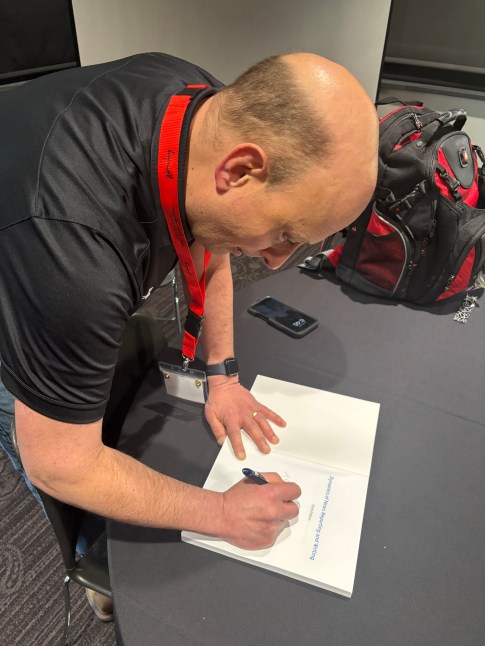
Even the kids, who I have been told a jillion times hate textbooks and never use them, have been amazingly kind to me over the years. For example, I brought a bunch of swag to the MCMC, including “Filak Furlough Tour” T-shirts and a “trophy bat” for the organization to give away.  At the end of the MCMC, the students on the board got copies of my reporting book as a thank you, when one of the kids came up to me and asked if I would sign the book.

“You don’t want me to sign that,” I explained. “If you keep it shrink-wrapped, the bookstore will pay you a chunk of change for it.”

She gave me a “why the hell would I do that?” look and then peeled off the wrapping. I ended up signing all three of the books that day.

Actual proof that someone wanted my autograph on something other than a check or a grade-change form.

When I got back and told the story to my reporting class, one young lady told me, “I read your book. I still think it’s the best textbook because I could understand things from it. It felt really… human.”

In the age of AI, I’ll take the hell out of that.

Perhaps this is the longest way I can think of to say thank you for everything you do for me in the “external validation” department. My goal with each edition of the book and each blog post is to make sure I earn it.

If there’s anything you need, please let me know.

Vince (a.k.a. The Doctor of Paper)


6 thoughts for new journalism graduates on the job hunt that have nothing to do with actually getting a job (A Throwback Post)

It’s not quite graduation time yet, but given the palpable anxiety I am sensing from my students, the job hunt for soon-to-be graduates is clearly underway. A young woman with a great set of experience showed up in my office this week with that “frustrated nnnnnggghhhh” vibe about her, as she had put multiple resumes into the field and gotten few responses.

“Should I call them or something?” she asked. “They’re not getting back to me and I’m worried.”

“When did you apply?” I asked.

“Last week…”

So that was a “No” on my end, as well as a reminder that as to how she needed to look at this whole situation. As I began to say it, she cut me off.

“I know, I know,” she said. “You were right. This is like bad dating. I need to be patient.”

Along with that pearl of weird-dom, here are a few other thoughts for your graduates looking for some help on life beyond the ivory towers and dive bars that formed their college experience.


6 thoughts for new journalism graduates on the job hunt that have nothing to do with actually getting a job

Graduation swept through town this weekend, and along with it came the speeches, the pomp, the circumstance and academic regalia (When I wear mine, I look like Henry the VIII got a Mr. T starter kit for Christmas).

img_5057.jpg

I no longer have the beard, but the medals are still pretty sweet…

Along with all this comes the anxiety of, “OK, now what?” Some students have jobs and they’re worried about how well they’ll do at them. Others have no jobs and wonder if they’ll ever get one. Parents worry that their children will be happy. Some probably also wonder if they’ll have to give up the home gym or a spot in the basement for a returning grad who hasn’t “found it” yet (whatever “it” is). What comes next?

For journalism grads, the anxiety can be even more palpable, as everyone seems to be telling you that your field is dead and you should have gone into business. Other fields can spend months or even years cultivating students for a job that’s waiting for them upon graduation. Journalism? I’ve been told once during a first interview, “We’d like to offer you the job today (Saturday). Could you start Monday?”

I asked the hivemind of pros and profs what advice they had for you all and it was really a mixed bag this time. Usually, everyone chimes in and it’s all in the same vein. This time, things were all over the place. One professor friend of mine noted:

My adult daughter just moved back home, soooo I got nuthin’.

I have often relied on the famous William Golden quote about Hollywood as well: “Nobody knows anything.” Whoever tells you, “This is how to get your perfect job” is either lying to you or trying to recruit you into a cult. Unlike all of those multiple-choice tests you’ve taken over the years, this question doesn’t have a right answer. That said, here are a few to think about as you try to game up for the next stage of life:

  • You have to be idealistic, but you have to be practical: U.S. Olympic hockey coach Herb Brooks once said this in explaining his team’s chance to do well in the 1980 Olympics. His point was you should shoot for the best possible outcome, but you shouldn’t do so without a reality check. In the case of the job search, take a shot. You want to work at a top five newspaper, in a top 10 TV market, a Fortune 500 company or whatever right away? Toss an application out there. What’s the WORST that can happen? They say no and you don’t get the job, which is right where you are right now.
    That said, a 22-year-old journalism graduate with five clips from an internship at the Tamany Tattler and a year’s experience at the student newspaper isn’t likely to land at one of those spots right away, so feel free to look elsewhere. Apply to starter jobs, smaller firms and other places that have openings and you think would be worth a shot. You have to eat. You have to pay rent. And, as they mentioned in “Bull Durham,” it beats selling Lady Kenmore’s at Sears.


  • Don’t become a desperate psycho-hose-beast: As Tom Petty noted, the waiting is the hardest part. For you, this is the most important thing ever, especially if you’re searching at this time of the year. Even if it’s not cold, snowy and gray where you are, a winter job search can be danged depressing. You know that you don’t want to go home for the holiday where every well-meaning relative will ask, “So, what are you doing now that you’re graduated? Do you have a job?” (Side note 1: When you say “No” and they look at you like you just came down with an incurable disease, remember that look so that you never give it to anyone else ever. Side note 2: Realize that these people will always ask you questions like this that will sap your will to live, even after you get a job. “Do you have a job?” will become “Are you dating anyone special?” will become “So when are you getting married?” will become “Don’t you two want kids?” will become “Are you sure you only want (1, 2, 3…) kids?” Your only hope is to outlive this person so you don’t have to hear, “Are you sure you want to be buried here?”)
    This can drive you crazy and it can manifest itself in a number of ways, none of which are good. The worst thing you can do is take it out on potential employers as you decide to call, email or text repeatedly to find out exactly WHERE they are in the hiring process. Most people can smell desperation a mile away and it naturally repels them. Think about the guy at the bar who is insistently trying to buy a gal a drink, a shot, an appetizer, a game of darts or a 1979 Chrysler Cordoba. Does that interaction ever end well for that guy? If you ever need a reminder of how bad this can get, catch the classic “Mike from ‘Swingers’” scene (NSFW- some cussing) or the “Wayne’s World” look at Stacy’s unrequited love.
    In short, don’t push it. Breathe.


  • Look more deeply into your toolbox: The premise of both of these books is that we’re putting tools in your toolbox that you can use in a variety of ways. If you can find the perfect job that  makes you happy right away, that’s great. If not, don’t be afraid to apply those tools elsewhere. A recent grad sent me this note, which touched on something I never considered:

    After I graduated while I was looking for work I hooked up with a temp agency. It’s a great way to try different stuff without major commitment, you gain experience (and interview skills), you get to network, and you get a weekly paycheck. And some positions are temp-hire.

    A journalism professor noted something similar:

    Think creatively about ways you can use your journalism skills for other professions, such as PR, teaching, trade publications, advertising, web producer and social media manager jobs. Many more people cross back and forth into journalism and other careers these days than they did back when we were journalists.’

    Look around you and see what kinds of places need your skills and don’t fret if they don’t have your exact degree specified in the requirements. You will bounce a lot in this day and age (sometimes by choice, sometimes by necessity, sometimes against your will), so look for things that you think might pay the bills and give you a leg up the next time your perfect job comes around.


  • Remember the Johnny Sain Axiom on Old-Timers Day: Sain, a longtime pitcher and pitching coach, used to disdain Old-Timers Day. It wasn’t the concept he opposed, but rather that banter among the older players. Sain used to note that “The older these guys get, the better they used to be.”
    The same thing can be true for you when dealing with people who are more than happy to tell you that when they were “your age” they got a job right out of school or they had a perfect job waiting for them or whatever. In their mind, they had it all figured out perfectly and made a seamless transition between their education and a career, so why can’t you?
    The truth is, it wasn’t that easy for most of them. Some people just got a fortuitous bounce, a lucky break or a family connection. Others don’t work in your field, so comparing your search to theirs is like comparing apples and Hondas. It’s not that they’re better or stronger or faster or whatever. It’s just the way it happened for them. Each search and each job is unique (and I mean that in the truest sense of the word), so don’t let what other people tell you about how great life is get you down.
    Even more, don’t presuppose that people you see as your role models nailed the perfect job on the first take. I met with a couple students last week who kept referring to a recent grad as “having it all worked out.” She was their role model who, according to them, interned at Company X, graduated into a full-time job at Company X and then got promoted at Company X in less than a year. She was their Golden Goddess.
    What they didn’t know was all the anxiety she had about getting ANY internship, how she had been rejected twice by Company X for an internship and how she ended up sobbing in my office multiple times after that. They also didn’t know about the office fights and other less-pleasant aspects of Company X. In short, the grass isn’t always greener.


  • Don’t keep up with the Joneses: The easiest way to make you hate yourself and your job search is to compare yourself to other people in a constant game of one-upmanship. If Billy gets a job in a top 75 market, you shouldn’t try to get one at a top 50 market. If Jane gets a job as a writer at a 50,000 circulation newspaper, don’t just go looking for a job at a 100,000-circ paper to prove a point.
    I watched this happen constantly among peer groups of students at several of my previous stops, in which it wasn’t enough to get A job, but rather it was crucial to get a job that was better than someone else’s job. Here’s the problem: Just because a job is at a bigger place or somewhere with more cachet, it doesn’t follow it’s a good fit for you. This was how one of my former students ended up in Kentucky doing night-cops, despite not wanting anything to do with Kentucky or a night-cops beat, simply so he could look more impressive. It didn’t work out and he was miserable, before eventually going back to a job that was more “him.”
    I know it’s hard to push back against that competitive thinking. (Trust me, it happens everywhere, even in my gig. Former professors will tell their former doctoral students, “Oh, I see you’re at (less prestigious university)… Did you know that James is now at (mega-university) and he’s a dean?”) However, if you find something you like doing, you’ll never really work a day in your life.


  • Never forget this moment: You will eventually get a job and  you will do well. You will get older and get more responsibility. You might change jobs or careers or whatever. However, what should never change is your memory of this moment right now, when you’re scared out of your mind about getting any job at all, making rent, dodging Aunt Ethyl and her questions at the family holiday party, trying to avoid calling the Beaver County Tidbit 1,002 times to find out if they are still interested in you and everything else you feel.
    If you can remember the feeling you have at this moment, you will never lose your empathy for the future generations who are going through it. It might help you in little ways like not asking the “Aunt Ethyl” questions of your younger family members or hustling a bit more to get through that stack of resumes you need to read. It might help you in big ways as well, like thinking a little better about the next generation instead of a little worse of it. (People  more than occasionally ask me if being around younger people all the time doesn’t make me kind of envious of their youth. My answer is always, “Hell, NO!!!!!” I survived my 20s the first time and made it this far. There’s not enough of anything in the world to make me want to go back to that point in time).
    When it comes to getting employed, things almost always work out. I know that sounds ridiculous, but my batting average on things like is pretty good and in the end, you’ll have some great stories to tell.
    And thanks to your journalism education, you’ll tell them well.

It’s all fun and games until someone sues you for being an idiot: Pat McAfee Edition

ESPN forced to put out 'don't sue us' disclaimer as Pat McAfee show launches on live TV as NFL icon apologizes at start | The US Sun

The disclaimer on the front of Pat McAfee’s show.

THE LEAD: Pat McAfee, former NFL punter and current podcast maven, amplified an internet rumor on his show about Ole Miss quarterback Jaxon Dart and his girlfriend, Mary Kate Cornett. The unsupported allegation was that the 18-year-old freshman student was involved in a “triangle” of sexual relations with Dart and Dart’s father.

After suffering weeks of abuse, threats and other unpleasantness via the Online Idiot Brigade of Dude-Bros, Cornett plans to sue for defamation:

Now she is looking to hold accountable those who contributed to ruining her life, with McAfee and his network, ESPN, clearly in her sights.

“I’m not a public figure that you can go talk about on your show to get more views,” Cornett said on NBC.

BACKGROUND: McAfee is one of several larger “main-stream” media outlets that amplified this rumor. Barstool Sports folks promoted the rumor, along with a meme coin of Cornett. Former NFL player Antonio Brown posted a meme about the rumor. And this doesn’t count the number of other yahoos and local “shock-jock” idiots who did their own hot takes on the topic.

As a result, Cornett’s life has become a literal living hell:

As the rumor spread, Cornett removed her name from outside her dorm room, but she still had vile messages slipped under her door. Campus police told her she was a target, and she moved into emergency housing and switched to online courses.

Houston police showed up to her mother’s house, guns drawn, in the early hours of Feb. 27, in an apparent instance of “swatting” – when someone falsely reports a crime in hopes of dispatching emergency responders to a residence. According to security camera footage and a police report reviewed by The Athletic, the homicide division responded to the call.

After her phone number was posted online, Cornett’s voicemail was filled with degrading messages. In one, a man laughs as he says that she’s been a “naughty girl” and cheerfully asks her to give him a call. Another male caller says that he has a son, too, in case she’s interested. Several people texted her obscene messages, calling her a “whore” and a “slut” and advised her to kill herself.


UNDERSTANDING THE LAW: I talked to a couple Legal Eagle friends about this and they’re pretty much in agreement that anything from a defamation suit to an invasion of privacy case would likely tilt in Cornett’s favor. The key things to consider are this:

  • Cornett is not a public figure by any reasonable definition of the term, which means defamation is easier to prove. Yes, she’s dating a high-profile college athlete in the days of NIL money, but that doesn’t make her fair game. If she were a high-profile athlete or if she were promoting her personal brand of something or other online with a “brought to you by Jaxon Dart’s girlfriend,” McAfee’s actions would remain despicable, but the law could be a bit murkier. As a private individual, the standard she has to prove is negligence, not actual malice.
  • The rumor and the people spreading it (especially McAfee) have offered no proof for the allegations they are making about Cornett. As far as anyone can tell, this started out as a random post on YikYak and just kind of spread all over the place. Truth is one of the best “silver bullet” defenses against libel, which is why accuracy is so vital in journalism. If you accuse your university president of running a cocaine ring out of the basement of the student union, and you can prove it, you’re likely up for a Pulitzer, as opposed to a multi-million-dollar legal bill.
  • McAfee is not protected by the word “allegedly,” despite him and his panel of merry men slathering it about like mayo on a BLT. As we’ve discussed before, “allegedly” offers no legal protection.
  • McAfee is also not protected by his stupid disclaimer about it just being a joke-y show with a bunch of “stooges” just throwing bull around. If simple disclaimers like that worked, I’d put one on the back of Amy’s truck that says, “Disclaimer: I have a lead foot and a total disregard for my speedometer, so don’t pull me over to ticket me. I won’t change my behavior.”
  • Hyperbole doesn’t protect him either. The concept of hyperbole is that something has to be so outlandish that no reasonable person would believe it to be true. That’s why the Flynt v. Falwell case ended up in the favor of the porn producer, not the televangelist.

DOCTOR OF PAPER HOT TAKE: The first and most obvious thought is that Pat McAfee should know better than to do this. He’s 37 years old, so he’s been a grown-up for quite some time. He graduated with a communications degree from West Virginia University, so it’s likely he ran into some course at some point about what is and isn’t legal to say on air. He’s got a listener base of nearly 3 million people, so he should know that anything he says has a real chance to have a significant impact.

Even if he were none of those things, basic human decency plus the ability to observe the carnage that has befallen this poor kid* should have clued him in that it’s time to call off the dogs and apologize about this. (*Yes, the law considers her an adult, but she’s still basically a kid. Tell me you felt like a fully formed adult ready to deal with the world at large and I’ll be hard-pressed to believe you.)

Life as a teenager is ridiculously hard as it is. People are angry, petty and stupid. You feel lost and unable to control anything. Your mind races and wanders all at the same time as you try to figure things out for yourself, as every adult around you seems to be asking, “So, what are you going to do next?”

That doesn’t even account for the way in which social media has amplified the “Mean Girls” aspects of life, in which rumors spread more quickly, people get more vitriolic and anxiety can become amplified many times over. The crap teens say to their peers on a daily basis on social media channels could peel paint and give a truck driver the vapors. Now, imagine that it’s the entire world seemingly aligning against you for no good reason other than some chucklehead thought it would be funny to tell people you slept with someone’s dad.

I can’t imagine a way out. Actually, I can and others have as well, which is devastating beyond belief.

When the marketing pitch is juuussst a bit outside (A throwback post)

In spite of what the optics suggest, my goal in life is not to write a book for every possible subject I might ever teach. In fact, I’m often on the look out for a good book for certain courses, including blogging, principles of advertising and feature writing (the one I have been using is discontinued).

So, when a company pitches an email at me about a book I’ve requested (usually through an online form or as a “standing order” in case they find something), I’m all ears. That said, here’s an email I got this morning that isn’t going to cut the muster:

Here are a couple reasons why this pitch isn’t going to work:

  1. I’m not teaching a convergent media class any time soon, nor have I taught a class in a while that might fit this bill for this book.
  2. I didn’t actually request this book, or access to it.
  3. Most importantly, if I wanted to peruse the book for any reason, I wouldn’t need a special code for this, as it’s my book.

Look! It’s got my name on the cover and everything!

I understand that publishers are in need of reaching out to sell stuff, and I’m glad that my other publisher (Focal) is doing something to try to connect people with this book. However, it does make me question their overall approach when they a) couldn’t bother to eliminate the author from the sales database and b) approach the selling like those scam texts that are “just providing you with information that you requested on this exciting opportunity!”

So, for the last Throwback Thursday before Spring Break, here’s a look back at another time where the pitch a publisher threw was juuuuuuusssssst a bit outside….


So… No, then? (or why it’s important to research your readers before you pitch to them)

I understand this blog tends to skew more toward news than some folks might appreciate, given that my entire pitch for the “Dynamics of Media Writing” is that ALL disciplines of media (news, PR, Ad, marketing etc.) can get something of value out of it. The skew is due to trying to cover both the media-writing text and the news reporting and writing text in one spot. It also also comes from the idea that a lot of things people perceive as “news” things are actually valuable for all media, including skills like interviewing, research, inverted-pyramid writing and so forth. Finally, it seems that news folks tend to make more public mistakes than do some of the other disciplines, so I get more content there. (If you want me to hit on more topics in the PR/Ad/Marketing stuff, feel free to pitch me some thoughts. I’d love to do it.)

That said, occasionally there is a specific foul up in a specific part of the field that bears some analysis. Consider that when you look at this email I got the other day. I redacted the identifiers as best I could:

Dear Professor Filak,

​Greetings from (COMPANY NAME)! ​I hope this finds you well. In the coming months, (AUTHOR NAMES) will begin to revise the twelfth edition of their introductory journalism text, (REPORTING BOOK NAME). ​This text strives to give students the knowledge and skills they need to master the nuts and bolts of news stories, as well as guidance for landing a job in an evolving journalism industry.
Right now we are seeking instructors to review the twelfth edition of (REPORTING BOOK NAME) ​a​nd provide feedback. This input is invaluable to us, ​as it ​giv​es​ us a greater sense of how to best address both instructor and student needs. ​If you are currently teaching the introductory news reporting and writing course or will be teaching the course soon, would you be interested in offering your feedback?
If you would like to review, please respond to this email and let me know if you will need a copy of the printed text. You should plan to submit your comments via TextReviews by 2/6/18. In return for your help, we would like to offer you (MONEY).
At your earliest convenience, kindly respond to this e-mail to let me know if you are available and interested in participating. ​Again, please let me know if you will need a copy of (REPORTING BOOK NAME)
I’m always happy to help people and I’m not averse to making a buck by pretending to know what I’m talking about, but this felt both awkward and ridiculous. One of the things both “Dynamics” books push a lot is the idea of making sure you know what you’re talking about before you ask a question. The books also push the idea of researching your audience members so you know how best to approach them. Either the person writing this email didn’t do that or just didn’t care.
Here’s how I know that: It’s called “Google.”
Had this person done even a basic search on me she would have learned several things:
  • I am teaching the courses they associate with this book. I teach nothing but these courses, as you can find on the UWO journalism department website. The line of “If you are currently teaching the introductory news reporting and writing course or will be teaching the course soon…” tells me I’m on a list somewhere and this is a form email at best.
  • I wrote several books, including one that is likely to be some form of competition for this book. (I’m not saying it will be as good or better or anything, but my title includes words like “news,” “reporting” and “writing,” so it’s a pretty safe bet we’re vying for the same students.) This was literally one of the top five items on the first page of my Google search. She also sent her message the same day I got this alert from Amazon:NumberOne
    (I have no idea how Amazon quantifies “#1 New Release in Journalism” but I’ll take it.)

    The point is, it wasn’t a secret, so it appeared that she didn’t look me up and was like the guy at the bar telling me, “Hey, see that babe over there? I’m totally going to score with her!” and I’m like, “Uh, dude, that’s my wife…”
    On the other hand, maybe she did look me up, found the book and asked anyway, which is like the even-worse guy at the bar who’s saying, “Hey man, your wife is pretty hot. Any chance you can give me some tips on how to score with her?”

Thinking about all of that for a moment, I did the polite thing and emailed back, explaining how I felt this would be a conflict of interest (it is), and that any advice I gave her would be likely be somewhat problematic as the author of a competing book (it is).  I also noted that I know the book she is pitching well (I do) and I know the authors well (I do), so this would also be a bit awkward for me (it really is). Here was her email back to me, which again made me think she wasn’t actually reading this:

Hi Professor Filak,

Thanks so much for letting me know. We will certainly keep you in mind for future projects!

So, again, the point of the blog isn’t to beat people up for doing things poorly but rather to offer advice on how to do things better. Here are a few basic tips:

  • Research first, then write: You don’t have to do an Ancestry.com profile on every person to whom you market or with whom you engage in outreach, but it’s not hard to Google someone. Most people put more social-media stalking effort into learning about the “new kid” at school than this person put into finding out about me. In marketing, you often have access to proprietary data as well, so you can find out if this person had any previous engagement with your organization. In my case, I used that book for more than a decade and still keep up with it, so that might have been something she could have found.
  • Personalize when possible: If you are sending out 100,000 requests for something like a survey and you are expecting a 10 percent response, you will not have the ability to personalize all of the information on everyone’s card or email. That makes sense. However, when you are microtargeting a group of people with a specific set of skills or interests and that group isn’t going to overwhelm a data center, work on personalizing your content. That line about “If you are currently teaching the introductory news reporting and writing course or will be teaching the course soon…” could have easily been tweaked to say something like, “I see you have taught writing and reporting courses at UW-Oshkosh…” and it wouldn’t have taken much. Making these minor tweaks shows that you have done your research. Engaging in some personalized communication shows your readers you care enough to see them as individuals as opposed to a wad of names on a spreadsheet.
  • Try not to screw up, but if you do, don’t ignore it: The one thing that stuck with me when I got that response email from her was that I didn’t think she figured out what she was actually asking me or why it was weird. I had that feeling that if I had written her back and said, “I’m sorry I can’t do this because I’ve just been placed in an intergalactic prison for the rest of my life for murdering a flock of Tribbles with a phaser I set to ‘kill’ instead of ‘stun,’” I would have gotten the exact same email back. The whole exchange really reminded me of this scene:
 The thing that is important to realize is that you are going into a field that has two important and scary things going for it:
  1. It’s small enough that you’re really about two degrees of separation from everyone else, so people know other people.
  2. People in the field love to talk.

If you end up screwing up because you didn’t do the first two things suggested above, don’t compound the problem.

I have no idea if I’ll ever get approached by this publisher to review anything, but I know I will always carry with me the memory of this interaction. Had it been a great interaction, that would have been good for the publisher. Unfortunately, that wasn’t the case.

It’s the first sentence of your story, not a clown car: Learn to make choices in your leads


The goal of good lead writing is to tell people two basic things:

  1. What happened?
  2. Why do I, as the reader, care about this?

While many leads fail to do one or both of these when they don’t include enough information, some leads do almost the same thing when they give the readers too much stuff all at once.

Here’s one about the death of a former NBA player who became an incredible businessman:

Junior Bridgeman, a former NBA sixth man who rose from modest means to forge one of the most successful post-playing business careers of any professional athlete, becoming a billionaire philanthropist and, recently, a minority owner of the Milwaukee Bucks team for which he once played, died Tuesday after suffering a medical emergency during an event in Louisville, Kentucky.

This 58-word monstrosity gives me way too much information and I find myself struggling to keep up with everything the writer is trying to say. The writer decides not to make any choices about what to keep in the lead and what to relegate to lower paragraphs, thus making this a difficult read.

Let’s take a look at how you can avoid this kind of problem when you have a lot of things happening and they might all seem lead-worthy.

First, let’s lay out all of the facts in the “One Piece at a Time” approach to this lead:

  • Junior Bridgeman died Tuesday.
  • He suffered a medical emergency while at an event in Louisville.
  • He was an NBA player.
  • He won the Sixth Man of the Year award.
  • He was born of modest means.
  • He had a successful post-player business empire.
  • He became a billionaire.
  • He was a philanthropist.
  • He was a minority owner of the Milwaukee Bucks. (meaning he wasn’t the main owner, for folks who are unfamiliar with concept)

That’s a heck of a lot of stuff, even when you consider that it doesn’t include at least one thing most obituary-style stories like this tend to have (age of the deceased). That means we need to make decisions.

Second, start off with the most direct Noun-Verb-Object kind of approach we can take here to what matters most:

Junior Bridgeman died after a medical emergency.

We have a good noun, a solid verb and a solid prepositional phrase with a crucial object of the preposition that tells us how he died (at least somewhat).


Third, start looking for ways that you can condense some of the statements above, removing redundant elements or reshaping them in a more direct way.

For example, we basically say he was rich three ways:

  • Successful business empire
  • Billionaire
  • Team owner

Maybe there’s a way to either eliminate one of those or to recraft the sentence to shrink up what is there to tighten the sentence:

Junior Bridgeman, a billionaire philanthropist and minority owner of the Milwaukee Bucks, died after a medical emergency.

We also say he was an NBA player in two ways:

  • Former Sixth Man of the Year
  • He played for the Bucks

We could rework that to both of those things into this as well with some tightening and structuring:

Junior Bridgeman, a former NBA Sixth Man of the Year  who became a billionaire philanthropist and minority owner of the Milwaukee Bucks after his playing days ended, died after a medical emergency.

I’m at 32 words here, so if I’m going to add anything else, I’m probably going to need to make some changes. Let’s see what we add and what we cut:

Junior Bridgeman, a former NBA Sixth Man of the Year  who became a billionaire philanthropist and minority owner of the Milwaukee Bucks after his playing days ended, died Tuesday in Louisville, Kentucky, after a medical emergency.

If we add the where and the when, we’re at 36. We could go one of two ways to make a cut here. We could remove the phrase “after his playing days ended” if we think it’s obvious that he didn’t become those things before or during his playing days. We could also cut the award and replace it with “player,” which would swap five words for one. We could do both if we wanted to find a way to weave his age in.

Junior Bridgeman, a former NBA player who later became a billionaire philanthropist and minority owner of the Milwaukee Bucks, died Tuesday at 71 after a medical emergency in Louisville, Kentucky.

This gets us to 30 words, adds in the age and allows for development later. We could swap out the age and put back the Sixth Man of the Year award, if we felt it was more valuable to the audience than his age. I’m also not a huge fan of three prepositional phrases in a row, as that starts to make this a little sing-songy. It’s a judgment call at this point. Either way, we basically have a congruent amount of information to the original lead in half the space.

The one thing to remember about lead writing is that there’s nothing wrong with pour out all the info you have into a sentence, but you then have to go back and make decisions. In most cases, the writing of the lead is in the editing, so make sure to give your lead those additional looks that can make the difference between one that’s tight and right and one that’s bloated and confusing.

EXERCISE TIME: Find a lead in a publication that you read that goes way over that 35-word limit. (The longer the better) and use this approach to get it under control. If you need to use other elements from the story to do so, feel free to dig into the body of the piece a little bit.

Then, see what other people think about your changes and be able to justify your actions as you go along.


A Brief Follow-Up on Fact-Checking A Flaming-Fart Claim

Apparently, I wasn’t the only one who saw the claim that Gorman Thomas once lit a fart and took off one of Alfredo Griffin’s eyebrows in the process:

Clearly, I hit a nerve…

This was the most traffic I got on a single post in one day since the opening of the blog. By 6 a.m. Thursday, I had more visitors than I have on most normal days. A former student hit me up on Facebook to let me know his friends had found it while Googling this topic and that my post was pretty high on the list. So, I took a look on Google and found this:

I’m now famous for all people who Google “Gorman Thomas” and “fart.” Mom would be so proud…

My post was at the very top of a Google search, something I never thought could happen on anything not sponsored. Apparently, I should have pivoted the blog away from journalism years ago and focused primarily on fact-checking retro-claims of the farts produced by athletes…

I guess if there are a couple key points to make about all this, they are:

  • I’m thrilled that so many people took the time to try to fact check the claim about Gorman Thomas, as it gives me hope that maybe we aren’t all digital lemmings. I’d be even more thrilled if folks were digging into things with a little more societal gravitas, but we all have to start somewhere, so let’s be happy for a moment on this one.
  • Oddity still remains a key interest element. Every time I rework the books for subsequent editions, I try to make sure that they’re aging well. When I pitched the FOCII mnemonic for knowing what tends to draw people to information (Fame, Oddity, Conflict, Immediacy and Impact), I could point to specific examples I was seeing to support each element. In each subsequent edition, things in the world kept getting weirder and weirder, so it wasn’t always clear if we had become kind of numb to Oddity. Apparently, we haven’t. Or we all just like the idea of lighting farts.
  • If someone out there knows Gorman Thomas and is reading this, tell the man I’ve got his back.

And tell him I’ve still got the ball he signed for me.

Until next week,

Vince (a.k.a The Doctor of Paper)