Filak Furlough Tour Update: Hanging Out With The University of Central Missouri (Part I)

This week’s stop along the Filak Furlough Tour was an actual stop, meaning Amy and I packed up the truck and drove to Warrensburg, Missouri to visit the University of Central Missouri. Julie Lewis is the adviser of The Muleskinner, the student newspaper down there, and arranged for me to meet with her kids.

Initially, it was going to be a “get-to-know-ya” session where I did some newspaper critiquing and hung out in the newsroom. Then, she mentioned something about talking to high school kids and advisers, which was fine.

Then, I got this promo piece she was sending around to drum up attention for the event:

Great… No pressure… In any case, welcome to the next stop on the tour:

University of Central Missouri, Warrensburg, MO

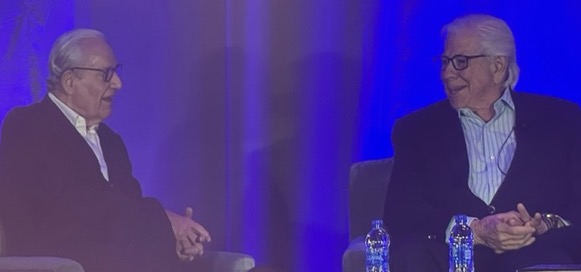
I’m apparently channeling my “Karate Kid” training to help the students learn something important. Photo courtesy of Ellie Whitesell, UCM Muleskinner

THE TOPIC: Given the current state of journalism, what does it take to be good at this job?

THE BASICS: I know we’re all taking a beating these days in the field of journalism, and I’m sure many students have family members wondering why the heck they’re going into this field in the first place. I believe in the future of journalism in the same way I believe in the future of pretty much anything: If it’s done well, provides a valuable service and connects with people who need it, things will be fine.

To help the students and advisers get a better handle on what I meant by that, here are four things I talked about that I thought could help journalists thrive in today’s media ecosystem:

Know Your Audience: One of the biggest things that we have seen over the past ten or fifteen years is a shift in how journalists need to conceive of their craft. Back when I was in school, we learned the 5Ws and the 1H, a handful of newsvalues and were told, “Get this into your story and everything will work out fine.”

The approach we took was one of “I, as journalist, want to tell you, the fawning mass of readers, what you need to hear from me.” That worked out pretty well for a long time, when we had one or two newspapers that served a certain area and three or four TV stations that did the same. If you’re the only game in town, you can set the rules as you see fit and it doesn’t matter what anyone else thinks.

Today, we have more choices than ever before when it comes to what we get from myriad media outlets. The sheer volume of content we get on a minute by minute basis could stun a team of oxen in its tracks. People can pick and choose as they see fit, and we need to acknowledge that and adapt to it.

To that end, it’s more important than ever to know who is out there, what they need to know and how we can best give it to them. It isn’t about “I want to tell you something” anymore, but rather, “What do you want to know and how can I get it to you in a way that you’ll understand it?”

Spend time getting to know the people who you want to reach and you’ll do much better at reaching them.


Be Nosy: A lot of journalist bandy about the concepts of “deep dive stories” or “critical thinking paradigms” which all sound really serious and important. At the heart of these things, however, is a simple concept: Be nosy.

A teacher once asked me if I could teach her kids to be nosy, which I said I wasn’t sure about. After all, you’re either the kind of person that noses around in stuff or you’re not. And once you have that nosy gene, it’s really hard to shut it off. As a reporter, I learned how to read things on people’s desks upside down so I could get news scoops. Today, my boss is constantly covering things up on his desk when I show up in his office, because I still do that.

What I can say is that we all start off in life with a sense of wonder. If you think about it, what’s a 4-year-old’s favorite question? WHY! They are constantly trying to figure out why something is the way it is, how something works, what someone is doing and why they’re doing it.

Yes, this can get annoying after a while and you probably want to give the kid a fork and tell them to go play with the toaster, but that instinct they have is one of just pure nosiness.

Somewhere along the way, we lose that sense of wonder. Maybe it’s when we’re in middle school and teachers get exasperated with us. Maybe it’s in high school when it’s no longer cool to ask questions in class. I don’t know.

What I do know is that the way to get back to great journalism that is fun, valuable and engaging is to find that sense of wonder again. We have to find joy and passion in the idea of trying to learn something because we are just so darned curious. Once we learn that thing, we can’t wait to share it with everyone else around us. That can lead to a great number of fantastic stories.


Become a Non-Denominational Skeptic: This is a simple idea that has become much harder to do these days because everyone seems ready to jump all over you if you are perceived to be on the “wrong side” of an issue.

The goal of journalism is to report and reporting requires that we dig into a situation and we ask a lot of questions, many of which may seem rude or problematic to people who don’t like the questions we ask. I can’t tell you the number of times someone took offense to a question I asked, calling me a vulture or a scumbag or other things I won’t repeat here. I even remember someone once telling me, “Your mother didn’t raise you right if you think this is appropriate.”

Ouch.

Granted, sometimes I wasn’t exactly the most skilled interviewer and I tended to cover a lot of crime and such, so there wasn’t always a good way to ask a particular question. That said, in most cases, people were taking umbrage at the idea that I wasn’t just taking their word at face value.

Being a non-denominational skeptic means doing exactly that, regardless of the source or the topic. It could be your best friend or your worst enemy. It could be a topic you totally support or it could be a topic that you would spend a lifetime opposing voraciously.

It doesn’t matter. Either way, you should be skeptical until you are given enough context, sourcing or support to make you believe the information at hand.

This isn’t always easy and it isn’t always fun, but it’s what we signed up for as journalists.


Be Brave: It is so easy these days to be afraid of so many things. Thanks to social media and arm chair warriors, any single thing we do can be dissected, analyzed, criticized and more. We are constantly at a heightened tension that a mistake, a joke, a misunderstanding or more could lead to a firestorm of controversy and irreparably harm us.

It’s a scary time to be in the public eye, particularly if we’re digging around on something that someone doesn’t want us digging around on.

It’s easy to be brave when there’s nothing to fear. It’s easy to write stories when they bandwagon on trendy topics or that hammer on people, places or things that are extremely unpopular. What’s harder is doing the right thing, regardless of the odds or the enemy.

I go back to this story that Baseball Commissioner Happy Chandler once told about his decision to integrate baseball, despite having owners voting 15-1 not to. He said, “I’m going to have to meet my maker some day and if he asks me why I didn’t let (Jackie Robinson) play, and I say because he’s black, well, I don’t think that’ll be a satisfactory answer.” Chandler was not a perfect man by any means, but when it came time to put up or shut up, he was brave.

If each of us can do just a little bit of that, I think journalism will be just fine.

BEST QUESTION OF THE DAY (PART I): Has there ever been a time where you struggled to maintain journalistic objectivity? And, if so, how did you go about handling that story?/ How do you, as a journalist, stay unbiased on hot topics that you may a strong opinion towards?

BEST ANSWER I HAD AT THE TIME (PART I): I try to practice what I preach in terms of being a non-denominational skeptic when it comes to interviewing people or listening to what they have to say about a topic. I tend not to think of my approach like a light switch, where I’m either on or off, either for or against something.

Instead, I like to think of it like a door. It can be wide open or totally closed, but it can also be partially open to a variety of degrees. To that end, I like to think that I’m giving people at least a chance to convince me of something before I totally slam the door on them.

Granted, there are times where it’s easier to keep the door really open, like when two equally qualified candidates are running for political office. I’ll keep that door open on both of their thought  processes, regardless of how I personally feel about their positions on taxes, land use or how Diet Pepsi doesn’t taste like melted tin and cat urine. Keeping that door open allows me to show both people to my readers effectively.

It’s a lot harder, and thus a lot more narrow of an opening if I’m talking to a white supremacist leader, for example. That door is pretty much closed, but I have to at least keep it open to some degree.

The door is open in regard to things like free speech: As long as you’re not inciting imminent lawless action, you can publicly say whatever you want as part of a protest on a city street corner, so if we’re talking about that, the door needs to stay open because that’s an important truism.

That said, I’ve had to listen to some pretty vile stuff over the years due to these folks making the news and me having to interview them, and I’m not putting up with that crap. So, when he starts veering into “the superiority of the white race….” yeah, that door’s getting slammed pretty damned quick and hard.

Those are obviously the extreme examples, but the point is, you can’t reflexively close a door on a topic just because you don’t like it. If you do, you might miss something important or fail to serve your audience appropriately.

BEST QUESTION OF THE DAY (PART II): What do you feel is the biggest benefit that your books have brought to campuses that other books haven’t?

BEST ANSWER I HAD AT THE TIME (PART II): I’m glad someone out there who is actually reading my books thinks there’s some benefit to them, so that was nice to find out. Usually the three questions students ask about my books are:

  1. How much does this cost?
  2. Do I actually have to read it to pass this class?
  3. Can I sell it back at the end of the semester?

If I had to boil down my books to a simple concept, I’d say I try to treat students like they’re actually people, instead of drones who are lucky to be fed the knowledge I have gathered. I have found that tone goes a long way in terms of how much I like what I’m reading.

For example, there is a textbook that is pretty much the only game in town for a specialized area of journalism and I refuse to use it because it just feels so arrogant in its tone. It’s like, “I, the author, am a golden GOD and you are fortunate to be in my presence to garner the knowledge I feel you are capable of receiving, given your limited mental capacity.”

When I started writing the books, I thought back to the people I enjoyed reading. I loved how certain columnists would put me in a place and time by writing like we were just equals, sitting together, having a chat. I loved how authors would weave humor into moments of a book that helped me laugh and helped me remember things. I really loved it when writers would take a complex topic and boil it down to some simple, memorable elements for me, without making me feel inferior for not knowing the stuff to begin with.

Whether I’m successful or not is in the eyes of the readers, but that’s what I’m trying to do.

NEXT STOP: Part II of the visit to UCM.

Two helpful tips to help explain massive stories in 30 words or less

Many of my students look forward to the time in their journalism careers when they can move beyond the the inverted-pyramid, paraphrase-quote structure of meetings, speeches and news conferences. The idea of sinking their teeth into something much longer, more complex and multifaceted feels like a rite of passage from beginner to expert.

Most of them, however, find themselves exceedingly frustrated when they attempt to ply their trade to those bigger pieces, as it can feel like juggling Jell-O while trying to herd cats. The pieces don’t fit together right, the focus seems to drift and the overall concept of the story becomes one blurry mess.

The key thing to writing any story is being able to answer two questions:

  1. What am I trying to explain here?
  2. Why should anyone care?

That is as true for basic meeting stories (“The city council made it illegal to park on the streets overnight, which means State University students will need to find private parking and pay a premium price.”) as it is for major investigations. (“Banks were improperly incentivized and got greedy in the subprime mortgage market, leading to  risky decisions that tanked the U.S. economy.”)

I remember catching a session at a college media convention many years ago, in which an investigative journalist for a popular sports magazine told the students in the room that if they were writing a story, they needed to be able to explain it in less than 30 words.

“If I ask you what your story is about and you tell me, ‘Well… It’s complicated…’ that tells me you really don’t know what your story is about,” he said.

After the session, I introduced myself, told him how much I liked his presentation and then I pressed him a bit on the “30 words” thing. I made the point that if we’re talking about a game story or a speech story or something, I could see his point. However, the work he did? That’s got to be impossible to capture in 30 words.

“No,” he said emphatically. “You need to nail it down like that or you don’t get the message across to the readers.”

To push back, I asked him about what he was working on at that point. This was in the early 2000s when baseball was starting to sniff around the issue of steroids and performance-enhancing drugs. He was digging through records, leaked emails and other things that explained who knew what, when and where and how. He also had information on individual players, suppliers and owners who all found a way to kind of absolve themselves of the sin of cheating.

“How in the hell can you boil that kind of thing down to 30 words,” I asked him.

“As far back as the mid-1990s, players were taking steroids and everyone knew, but no one did anything because everyone was making too much money,” he replied.

25 words. Bam.

So how do you get to the point of being able to do something like that with your stories? Here are some simple ways to make it happen:

FOCUS ON THE CANDY: When we talk about basic writing and sentence structure in the book, we start with “The Holy Trinity” of noun-verb-object. The sentence starts with those three elements and then builds outward from that core. This ensures us that we’ve got the main idea at the heart of what we’re trying to say. As we add more content, it has to support and augment that, or it’s no good.

The same thing is true for when we write basic inverted pyramid stories: The lead is the essential foundation of what we’re doing in the story. Each subsequent paragraph has to support or augment that element or it needs to go away.

Writing longer and more complicated stories is no different. Just because you gathered 20 times the material you would normally gather for a simple news story, it doesn’t follow that all of that can or should be added to the piece. In fact, you want to strongly resist the urge for “notebook emptying” when it comes to bigger pieces.

Focus on the core element of what you want to say and get rid of everything that isn’t that. One of my favorite scenes from Aaron Sorkin’s old “Studio 60” show exemplifies this perfectly: Two rookie writers are trying to a sketch about the world’s worst criminal who takes hostages in a bank.

They try so hard to do so much with it, it doesn’t work. Once they essentially realize that problem, the do addition by subtraction and start eliminating stuff that isn’t about their premise. That’s where they get it to work.

FOCUS ON YOUR AUDIENCE: For generations, journalists have operated under the mantra of, “I write, you read, because I know what you need.” The fact was that the audience read the stuff or watched the stuff because they lacked for better options. When there’s one or two newspapers and three or four TV channels, well, you’re stuck with whatever is there.

Today, that’s not the case as not only do we have an almost infinite number of media platforms from which to choose, but we also have exponentially more content providers than at any point in time. The thing that’s going to make you stand out, and thus your story stand out, is understanding what your audience needs from you and then providing it in a clear, coherent and helpful fashion.

In big pieces, we try to show how everything we have gathered can affect everyone who might ever come across our work. It’s like we’re trying to be everything to everyone.

This is where audience centricity really comes into play. For WHOM are you writing this piece? What are the demographic, psychographic and geographic elements that you can use to tailor your piece to a specific group of folks that will benefit from your work?

In talking with my class the other day, we were going through the issues hammering our university right now, including an $18 million budget hole. In that, we started parsing specific audiences and what they would want to know:

  • Students care about their majors getting cut, the classes they need to graduate being available, tuition going up etc.
  • Faculty worry about increased teaching loads, the length of furloughs, the potential elimination of majors.
  • Non-academic faculty worry about getting fired, as we’re cutting about 200 jobs, and those that remain worry about what their jobs will look like after the culling.

In each case, you can create a solid focus based on the audience and then really know what your story is about. It can’t be about all of these things in depth, but it can be several stories that each focus on one key set of stakeholders and the issues that matter to them.


How to cover a shooting or other chaotic event as a beginning journalist (A Throwback Thursday Post)

The front page of the Daily Tarheel, the student newspaper at the University of North Carolina, captured the chaos of the active-shooter situation on that campus this week through an amazing “type-attack” approach comprised of text messages sent during the event:

The staff’s efforts on this are commendable, even as the situation that spurred their efforts has become far too common. I realized this when I typed “shooting” into the search engine for the blog and came back with far too many posts on the topic.

For today’s “Throwback Thursday” post, we go to late 2021 and go through a primer on covering shootings and chaos I put together at an educator’s request. As much as I hope it will help folks who need it, I really hope a lot fewer people will need it in the future…


How to cover a shooting or other chaotic event as a beginning journalist

After I ran Thursday’s post on the mass-shooting event in Michigan, a fellow journalism educator posted a note and a request:

I want to get your Dynamics of News Reporting and Writing to read your thoughts on covering shootings.
I teach near Philadelphia, the City if Brotherly Love, that surpassed an annual record of 500 people shot and killed—in 11 months. I am very sad a Temple University student returning from Thanksgiving weekend was shot twice in the chest in broad daylight by a 19-year-old who was trying to carjack him.
Whether shootings are individual or en masse, we must be sensitive to victims and families while seeking answers to curb the killings.
As I’ve said before, if someone asks for something, I will gladly blog about it, so here we go…
I teach crime reporting and breaking news as part of my junior-level reporting class, but I always include a caveat up front:

Reporting on things like shootings, hurricanes, car crashes and other sorts of mayhem doesn’t really lend itself to a lot of guidelines. I can tell you what I’ve done or what I’ve seen, but at the end of the day, how you react to something is entirely your own doing. While we can read press releases and talk about crime, you never know how you’ll react once you’re on the scene of something.

Until you’ve seen a man get pulled out of a thresher or stood 3 feet from a shooting victim’s dead body, you really don’t know how it will impact you in the short term or the long term.

That said, experience has been a pretty good teacher for me, as a crime reporter, a criminal justice editor and a student media adviser, so here is my best advice on how to work a shooting or other chaotic event for the first time.

We’ll look at what to do (or not do) during your reporting phase, your writing phase and your “afterward” phase.

REPORTING PHASE:

PRIMARY REPORTING ADVICE:

Here are two key pieces of advice when it comes to covering these types of events:

Stay Calm: Things can be blowing up all around you or you might never have seen that much blood before in your life. You may be fighting the urge to throw up. Whatever it is, you need to keep your head about you.

A panicking reporter is a useless reporter. You need to take a deep breath and focus on the task at hand.

Stay Safe: Police and fire rescue folks are trying to do their job. You are trying to do your job. Sometimes, those efforts conflict with each other. Regardless of how important you feel you are, you need to realize that their needs trump your needs at the scene of a shooting or other similar event. In many cases, they put up special tape to keep you out of harm’s way. In other cases, they tell you where to stand or where not to stand.

You need to understand that the shooter might still be out there, which can be dangerous or deadly for you or other people. Even if the shooter is dead or captured, police are likely still in a state of high tension, looking for other shooters or dangerous devices. You wandering around where you’re not supposed to be can create serious problems for them and you might be mistakenly viewed as a danger to them or others.  Adrenaline and watching too many “journalism movies” can make us feel emboldened to break the rules to get a major scoop.

Don’t.

Even when the authorities aren’t there to tell you what to do, you need to make sure you use common sense. Don’t stand up against a burning building to do your stand up. Don’t drive into a flood zone and then expect people to bail you out.

Whatever is going on around you, you need to make sure you’re safe and sound. A dead reporter isn’t much more useful than a panicking one.

OTHER REPORTING ADVICE

Use official sources when possible: When we talk about privilege in law, what we are talking about is the right to quote official sources, who are acting in their official capacity, without fear. This generally applies to judges rendering verdicts, congress-folks making proclamations from the floor and probably the pope. In some cases, it also applies to law-enforcement officials and fire folks who are working the scene of what’s going on. Relying on those folks can keep you out of trouble if facts turn out to be less than accurate.

(The law can get squishy here, so it’s always wise to check the rules.)

Even if the law itself isn’t providing you with a shield, interviewing these folks can be better than relying on witnesses or participants when it comes to the big-picture items. Regular folks get rattled when a shooting occurs or a car slams into a wall in front of them. They’re pumping adrenaline and freaking out, so their version of reality isn’t as solid as a crime scene investigator who has seen all this before. Even more, officials tend to have more of the entire picture in hand before they speak, which is beneficial to you as you try to make sense of this.

(Again, this doesn’t mean you won’t get screwed over by the officials at some level, especially if they’re hiding something. However, you can REALLY get screwed over if a regular citizen decides to accuse someone of murder on live air. Yes, that actually happened…)

Engage in empathy during interviews with those involved: Trying to interview someone who is the victim of a shooting, a bystander/would-be victim of a shooting or those who are essentially collateral damage (family, friends etc. of a victim) is a ridiculously difficult proposition.

It can feel ugly and vulture-esque to bother people who just went through a chaotic and traumatic event. In some cases, a reporter’s desire to get the story can get them to push sources for information and exacerbate the trauma. Some publications have lousy editors who lean on reporters to dig into the situation with grace and dignity of frisking a dead body for valuables.

I have had a number of interviews in which I’ve had to approach a family member or friend of someone who just died or was injured in a terrible way. In one case, it was the family of a 13-year-old boy who was accidentally shot by his best friend. In another case, it was the mother of a 17-year-old girl who died after slamming her car into a tree while drunken driving. The first family wanted nothing to do with me; the second talked to me at length. Neither was a pleasant experience.

Empathy and caution go a long way to making this less painful for everyone involved. I tell my students that we’re like waiters at a fancy cocktail party who walk around with hors d’oeuvres on a tray: We offer people something and if they don’t want it, we walk away quickly and politely.

The best example of how to think about this came from Kelly Furnas, a professor of journalism, who was advising student media at Virginia Tech during the 2007 campus shooting. More than 30 people died during an attack in which a student opened fire on campus. Furnas and his staff at the Collegiate Times had to not only cover the story, but eventually write obituaries for each of the fallen.

A quote he gave me years ago still sticks with me:

“The students I talked to were terrified of the fact that they would need to call these families and I said, ‘You don’t assume that these families don’t want to talk.’ That’s a very important thing to these families to tell the story of their son’s or daughter’s lives. That’s a very important thing. A lot of people not only want to do it, but expect to do it.”

He said the students were told to do their best and just give people a chance to speak. If they were outraged by the reporter’s questions, the reporter was to apologize and walk away.

In the end, however, very few people rejected the request for an interview, he said.

Don’t bail out on your duty to report because you are afraid of what people might say. Give them the chance to say no before you do it for them.


WRITING PHASE

Primary Writing Advice

The duty to report is not the same as the duty to publish: When you are working against the clock, trying to break news and pushing back against competitors and social media folks, it can feel like the weight of the world is on you to get SOMETHING out there.

In the olden days, as in before everyone could be online in 3 seconds after they saw something, we could hang on for a bit before having to produce content for public consumption. Broadcasters got the 5, 6 and 10 p.m. newscasts to inform folks. Print journalists could wait until press time to get the best version of reality, or update things between editions.

Today, you are live 24-7, so it can feel like you’re always under pressure to convert whatever you gathered into something for the public.

In the case of chaos, you need to balance that urge against your journalistic training to be accurate above all else. Fast and wrong isn’t doing anyone any good.

If you don’t have something you feel is accurate, supported and clear, don’t pump it out there and figure you’ll fix it later. You can always publish something later. Once you toss something out there, you can never really get it back.


Additional Writing Advice

Play it straight: You are likely living through an emotionally turbulent situation, one unlike anything you’ve faced to this point in your career. Your emotions can run the gamut of fear and anxiety to the sense that you’re about to write the Greatest Piece of Journalism Ever ™ so it’s time to shine.

There’s a reason we teach you the Driver’s Ed Rules of Journalism, namely so that when faced with something completely out of the ordinary, you can rely on your training to do things right. This is one of those times, so don’t overdo anything.

Tell the people what happened and why they care in the most direct way possible. It’s what good pros do:

A 15-year-old opened fire at his Michigan high school Tuesday, killing at least three people and wounding eight others, authorities said, in what appears to be the deadliest episode of on-campus violence in more than 18 months.

Don’t start slathering on adverbs. Don’t hype it with opinions. Don’t turn this into a narrative lead that shifts the focus toward “dig my writing” and away from what happened.

Tell people what happened in the most direct and clear way possible, based on what you can prove.

Speaking of which…


Stick to the facts: In the film “And the Band Played On,” researchers at the CDC are trying to pinpoint the cause of a strange malady that is killing primarily gay men. Their quest to identify the AIDS virus as well as its cause and spread had the virus  hunters relying on a simple mantra: “What do we think? What do we know? What can we prove?” Unless they could hit the “prove” stage, they refused to state something publicly with certainty.

This approach is a good one for anyone covering chaos, especially something that continues to unfold, like an active shooter situation.

If you can stick to the facts and the material provided to you from reliable sources, you can keep your readers informed and avoid spreading misinformation. If you don’t know how many people were shot, don’t guess. Don’t rely on terms like “arguably” to cover over your limited knowledge, saying things like “This is arguably the worst shooting in U.S. history.”

Say only what you can prove at the time, and that also means taking care with how you are stating something.

For example, police can say something like, “The shooter is no longer a threat.”

OK, does that mean he’s been captured? He was killed? He ran out of bullets? Also are we sure the shooter is a “he?” (Make sure in the reporting phase to check these things, as well as other details before publishing.)

Good work on the front end and sticking to what you know on the back end can lead to simple statements like: “Police Chief John Smith said the shooter, a 15-year-old male student at the school, is ‘no longer a threat.’”


Attribute everything you can: One of the key things you should note in the Washington Post lead was the attribution. Even though “authorities said” is vague, the rest of the story was able to fill in specifically who those authorities are and why we should trust them.

I always try to make the point that attributions are like anchor points when you’re climbing a rock formation: You might not need all of them, but it’s better to have them and not need them than need them and not have them. I also note that I’ve never met anyone who has been fired or sued for over-attributing, but more than a few people have ended up on the short end of the stick for under attributing.

When you are writing a story like this, it’s important to look at each statement you type and ask, “Says who?” If the answer is a specific person, include that in the attribution (County Coroner Jill Smith, Police Chief Doug Jones, Superintendent Raul Allegre etc.). If the information is more general, as in you got the same story from multiple people or documents, make that clear as well (Several police officers said the hallway was littered with spent shell casings from an AR-15; Court documents state Principal Helen Carter repeatedly filed reports with the district on this issue; An email chain between the boy’s parents and teachers show that while school officials were worried about his behavior, the parents said ‘Guns are part of his life, so back off.’”)

If you DON’T have a specific source or collective source, where did you get this stuff and how sure are you that it’s right? That’s where people usually screw up, because they assume they know more than they do and they fail to look it up or find a source worthy of attribution.

If you can’t find a source worthy of an attribution, wait until you can before you publish it.


Have someone else read it before it goes out: After you read and reread and reread something again, you can find yourself blind to your work. You also probably cut and pasted a half-dozen things in a half-dozen spots and then undid at least half of that. By the time you think you’re done, you lack any sense of what is actually in there and what you SWEAR you wrote instead.

A fresh set of eyes are a godsend in this kind of situation.

An editor or a colleague who hasn’t read this before will give you a good chance of catching things like if you swapped the name of a victim and the shooter or if you skipped a first reference to a source. It’s something worth doing because you want to make sure you’re right.

My personal stupid thing was that I always got the day wrong for every story I did. For reasons past my understanding, I always wrote that something happened Monday. Didn’t matter what day, week, month or year something happened, I always made it a Monday.

I caught a lot of those on second or third reads, but it was usually up to my editor or a colleague to ask, “Are you sure this happened on Monday?”

Again, you can’t beat a fresh set of eyes.


AFTERWARD PHASE

Never assume you’re done reporting: The thing about chaos is that it doesn’t operate on a schedule. It doesn’t show up as expected or finish up neatly at the end of an hour, like a TV crime drama. You have to make sure you’re frequently checking in to see what’s going on and if you’re still telling people the most accurate and up-to-date information.

Whatever was right as rain at 9 a.m. is completely wrong at 2 p.m.

The arrest that happened last night turned out to be a case of mistaken identity the next morning.

An early body count ends up being much larger or smaller than once was thought.

Assumptions become facts or become worthless as police continue to investigate.

I remember once following up on a story for a fellow reporter who had filed and gone home after her shift was done. The story was about a toddler clinging to life after falling into a creek. The whole story was about hope and prayer and this boy’s will to live. She was a great reporter and a great writer and this was one of those amazing stories she always told.

My job was “just to make sure” if something changed, so about 10:30 p.m., I called the hospital to get an update that might or might not make the paper.

The PR person was kind of half talking to me and half talking to someone nearby when I heard her say, “So… We can tell him then?”

The kid died five minutes earlier when they took him off life support.

I asked about four really bad questions, that ended up having this woman shouting at me something like, “Everything possible was done to save this child’s life!” (which sounds a lot better in print without the anger in her voice). As she’s talking/yelling, I wrote “KID DIED” on a legal pad and held it up for my editor who was across the room.

He saw it and came rushing over as I finished the interview.

“Oh shit,” he told me. “You have four minutes to rewrite the story.”

Long story short, it got done and we got it subbed in for the first edition of the paper. I didn’t get a byline, but I got a hell of an experience and a valuable lesson: Chaos doesn’t operate on your schedule. Make sure you’re constantly checking in.

Engage in self-care activities: One of the easiest things to forget when you’re in the middle of a chaotic event is that you are human and that things do affect you. The job allows you a kind of shield against feeling things or coming to grips with what you’re witnessing at the time.

Don’t kid yourself. You’re taking a beating, whether you know it or not, and you need to heal yourself a bit.

The truth is, you will see things that will gag a maggot, horrors that will haunt you for years and truly inexplicable acts that have you asking “Why?” more times than a 4-year-old after ingesting a pound of sugar. Those things DO leave a scar, whether you want them to or not. They’re there, whether  you realize it or not.

You will need to do some serious self-care activities to keep from sustaining serious damage.

This can be simple decompression things like clearing your mind or coming to grips with things you’ve seen or written. It can be talking through your feelings and emotions with colleagues or looking for things that can help you reset your mind and body.

These things can also include therapy or professional help. Acknowledging and coping with what your work has done to you does not make you weak or soft.

It makes you a human being who wants to take care of their own needs before they can take care of their audience’s.

Three tips to help you think harder about your word choices as a journalist

(EDITOR’S NOTE: We’re back for the year, applying the new model for the blog with the Wednesday post being about writing and/or reporting. If you missed Mass Com Monday, you can find it here. Please continue to  send suggestions for improvement  or lists of things you need covered here. — VFF)


Students have often told me that when they are writing a story and they hit a lazy patch, a dumb phrase or something else that doesn’t make for good copy, they hear my voice in their heads, barking at them to fix it.

I, too, have a voice like that in my head and it belongs to Cliff Behnke, the former managing editor of the Wisconsin State Journal. Even today, decades since I last saddled up at a terminal in that newsroom, Cliff still scares the hell out of me.

He had the ability to parse words in such a way that made you feel horribly inadequate for not seeing your failings before he did. I can still remember the first experience I had where he did this. I had written a caption for a photo that noted there were “89 different model railroad train layouts” at the expo center.

Cliff made the point that, of course they’re different. Could I imagine if there were 89 of them and they were ALL IDENTICAL? So why bother with “different?”

That kind of insight became a big part of my writing, not just in shedding the word “different” (another one of Cliff’s peeves was “new” as in “They built a new school.” Has anyone ever built an OLD school?), but also in learning to challenge every word I wrote, and more than a few of them that I read. Take this headline from Deadspin for example:

Sexual assault is a horrible, terrible, absolutely no-good thing, so do we need the word “disturbing” to describe the details? I really went through pretty much every iteration of any potential detail I could think of to find one that wouldn’t fit in the realm of disturbing. I came up empty.

The headline could have used any one of a dozen other relatively meaningless words that could draw in a reader. For example, the writer could have gone with “shocking” details that might involve some really weird stuff this idiot tried as compared to the more banal details like he reeked of Polo and drove a Tesla. At least in that case, we wouldn’t have a “new/different” kind of situation here.

With that in mind, here are a couple hints on how to challenge your word choices in journalistic writing:

Addition by subtraction: In the case of “new” or “different” or “disturbing,” you find that the word really doesn’t add anything by being there. No  one would think they built an old school, had 89  identical model railroad layouts or had some fun and exciting details about a sexual assault. Thus, feel free to eliminate the word.  Occasionally, when I challenge a word in this  fashion, I go back to this scene from “A Few Good Men:”

“I felt his life might be in danger…”

“Grave danger?”

“Is there another kind?”

If you lack the internal level of sarcasm to make this work on a daily basis, I’m sure you have a  friend, colleague or definitely a professor of journalism who can help you sharpen that part of your personality.


I do not think that word means what you think it means:  Looking up words is always a good idea,  as not every definition fits the intended meaning. I’m sure one of my students would like to have back about two years of his music reviews in which he kept using “penultimate” to mean “super-extra-ultimate” when it really means “second to last.”

However, I’m even looking at words that people tend to use interchangeably that can add opinion or shift the truth of an issue in an unforeseen way. Consider the words “change” and “improve.”

Both can be true,  but they don’t mean the same thing, even if people involved in a situation kind of wish they did:

“Mayor John Smith said the construction will change the traffic flow along Interstate 21.”

“Mayor John Smith said the construction will improve the traffic flow along Interstate 21.”

An improvement always presupposes change. That said, a change CAN be, but isn’t NECESSARILY an improvement. EXAMPLE:

CHANGE 1: Your landlord has installed a set of handrails on your staircase to make it easier and  safer for you to get into the house. 

CHANGE 2: Your landlord has removed the steps from your house and replaced the lawn with a moat full of starving alligators.

Clearly, both change your housing situation, but only one is an improvement.Keep an eye on words that couch reality like “development,” “benefit” and other such things that really need a look to see if they’re really just a “change” kind of thing.


Go back to the Holy Trinity: Most of the reason we get into a jam in writing is because we don’t have that solid noun-verb-object core that makes for the start of a strong sentence. If you can start with those three elements, most sentences will dramatically improve.

Even more, the quality of each element can eliminate the need for those ineffective descriptors that we’ve discussed above.  In the Deadspin headline you get “Details emerge from complaint” as your noun, verb and object elements. “Emerge” makes it sound like something out of a sewer-monster horror movie at best. “Details” couldn’t be more vague if you tried.

Stronger focus on the noun-verb-object structure could really make for a stronger headline:

Texans’ minority owner sexually assaulted women through groping, digital penetration, court complaint states

If that feels too forward, you could go with something a little less active and a little more tame:

Texans’ minority owner accused of sexual assaults, including digital penetration and groping a woman through her underwear

Think about how concrete your noun can be and how vigorous your verb can be. In some cases, if you have to go with a weaker verb, adding clarity and value to the noun and the object can draw the readers into the piece.

Three things student journalists can learn from the Texas A&M Kathleen McElroy hiring debacle

THE LEAD: Texas A&M screwed the pooch when it came to the Kathleen McElroy hiring and is now literally paying for it:

Texas A&M University reached a $1 million settlement with a Black journalism professor who said her tenured position offer fell apart after backlash to her work on diversity and equity efforts, the university announced Thursday.

The university’s leadership apologized to Kathleen McElroy for “the way her employment application was handled” in June when the terms of her proposed contract changed dramatically.

The CNN lead is a bit “sanitized,” but things got ugly as hell in the middle of this saga, that led to the resignation of both the interim dean who would have overseen McElroy and the university president, whom we’ve discussed here before. The Texas-based press was more damning, if not long-winded:

The Texas A&M University System reached a $1 million settlement with Kathleen McElroy and made a public admission that then-President M. Katherine Banks derailed the potential journalism director’s hiring after alumni, including a conservative-leaning group called The Rudder Association, voiced concerns about McElroy’s experience in diversity, equity and inclusion.

The system’s Office of General Counsel released a lengthy report about its internal investigation Thursday, following mounting pressure from faculty who fear that outside interference at the university has infringed on their rights in the hiring and promotion process and chilled their speech in the classroom.


BULLETS AND GUNS: Despite saying she was unaware of everything going on, text messages between Banks and interim Dean José Luis Bermúdez proved otherwise. The incongruity between what Banks said publicly and privately proved to be a “smoking gun” in this whole mess:

While then-President M. Katherine Banks told faculty leaders in a public meeting that she did not know of any regressive changes to McElroy’s contract, the texts prove otherwise. They show her and José Luis Bermúdez, then-interim dean of the College of Arts and Sciences, orchestrating a plan to move the journalist to a multiyear nontenured professorship and multiyear at-will directorship, which they said would be necessary to get her approved by Texas A&M’s Board of Regents.

The texts show the pair drafting a public defense as to why the changes made sense for McElroy’s purposes. Banks told Bermúdez, “If you get this done, you get a bonus.” They also indicated that nothing would be guaranteed for McElroy.

Banks also used a weapons-based analogy in how lucky TAMU got in making McElroy’s job offer so lousy that McElroy had to back out:

Bermúdez later apologized to Banks, who told him not to worry.

“I think we dodged a bullet,” Banks said. “She is an awful person to go to the press before us.”

“A terrible journalist too,” Bermúdez said.”Completely self-serving.”

Bermúdez said McElroy lied in much of her interview with the Tribune, and Banks responded that she had already told A&M’s chancellor that was the case.

“Just think if she had accepted!!! Ugh,” she texted.

When it came to “dodging a bullet,” I think Banks saw herself this way in this situation:

But it was really more like this…


SHORT SUMMARY: McElroy landed relatively well, in that she has a job back where she was, an apology from the people who messed with her and $1 million settlement to boot. One good friend of mine who is a professor down there noted that the bigger concern is how political pressure came to bear on the academic world in this truly terrible way, and she’s right. That needs some serious overhauling, but for a one-person, one-situation thing, this arc has now closed.


KEY LESSONS FOR JOURNALISM STUDENTS: The whole point of the blog is to help you learn something from everything we see or do, so here are three key things journalism students can take with them in analyzing this mess.

DON’T ACCEPT THE PUBLIC NARRATIVE: We’ve said this a dozen different ways on the blog, including “Trust but verify,” and “If your mother says she loves you, go check it out,” but it bears repeating here: When people tell you something, don’t take it at face value until you are satisfied that it is accurate.

The image Banks put out of being as innocent as a newborn kitten when it came to all of this basically fell apart once people started digging into what she knew and when she knew it. It also didn’t help her case that she put a lot of her “less-pleasant opinions” in writing via text messages.

As a reporter, you should listen to what people tell you and you should definitely record and report what they say. That said, you can’t just rely on that alone, or else your less reporter and more stenographer. Take what they say and use other people, documents and resources to challenge what you have learned. In some cases it will support that narrative, but in many others, you’ll find significant deviations from the public script.


SOURCES MATTER: This whole situation started to unravel in early July when the Texas Tribune published the key story about the situation unraveling. Texas has literally scores of outstanding major media outlets in print, broadcast and web that are capable of handling a story like this, but the Tribune got there first.

Why? They had McElroy as a source and a connection:

Disclosure: Kathleen McElroy, Texas A&M University, The New York Times, the Texas A&M University System and the University of Texas at Austin have been financial supporters of The Texas Tribune, a nonprofit, nonpartisan news organization that is funded in part by donations from members, foundations and corporate sponsors. Financial supporters play no role in the Tribune’s journalism. Find a complete list of them here.

This is in no way a rip on the Tribune, the staff there or anyone else involved in this really important and well-crafted story. It’s merely to point out the fact that a source found the Tribune to be a trustworthy media outlet that would tell a story and do so in a way that gave the source faith. McElroy could have picked up the phone and called the Dallas Morning News, the Houston Chronicle, the Austin-American Statesman, WFAA or a dozen other places and probably been fine. However, when she and the Tribune connected, an appropriate level of trust and understanding between source and media outlet emerged and we all benefited from this symbiosis.

This is why getting to know sources and developing trustworthy relationships with people we cover can matter so much. I don’t know if I’d trust a random reporter who called me about a story, but there are specific reporters I’d gladly help in many ways because I know who they are and we have established a strong relationship over the years. This is the bedrock of good journalism, and it needs to be something we get back to, now that we don’t have to do every interview on Zoom, for fear of COVID.


JOURNALISM HAS INFLUENCE: There are plenty days in this field when it seems like we don’t do a lot or that we don’t matter for much, but stories like this reinforce the value we have as a profession. Had it not been for the media spotlight and subsequent digging, this situation would have likely gone away in a quiet fashion and no one would have really been the wiser.

However, because someone decided to put the public eye on this issue, a number of changes have occurred. (You can argue if those are big enough changes or the right ones, but that’s not the argument I’m going for here…) You had leadership change, you had a report on this issue, you had the exposure of outside influence on this, you had a financial settlement and you had an apology. It might or might not be enough, but it’s more than it would have been, if not for the role of journalism.

You don’t have to overthrow a government or right a social wrong through your student newspaper to have influence. My favorite story was one in which the student newspaper I was advising got wind of the university’s decision to start charging students 10 cents for a cup of ice water at the campus eateries. They reported on the issue and the students made such a stink about it, the admin backed off. You can say it’s just a dime, but it’s another example of local journalism having a direct impact on a situation in favor of its readers.


FINAL SIDE NOTE: During the debacle that was, I wrote an open letter to Dr. McElroy, tongue mostly planted in cheek, telling her to “drop those zeroes” and get with the heroes over here at UWO because everything here was amazingly cool. In the intervening week, we some how managed to make Sam Bankman-Fried look financially well-balanced:

UW-Oshkosh plans to cut about 200 non-faculty staff and administrators this fall, while furloughing others, UW-Oshkosh Chancellor Andrew Leavitt said Thursday, as the university faces an unprecedented $18 million budget shortfall. The cuts amount to about 20% of university employees.

“It is no longer sustainable for us to operate without dramatic reduction in expenses,” Leavitt said in an email to employees.

Long story short, I clearly have the predictive power of Jim Cramer these days, so trust me on the journalism and less so on the future.


Four things that can kill a personality profile and how to avoid them

All about me Memes

If this is your approach to profile writing, try something else with your life…


I got a note from a former student regarding her dissatisfaction with some big-wig publications and their approaches to personality profiles:

Question oh esteemed journalism professor: why are so many writers inserting themselves (“my impression” “I first encountered”) into features and profiles about other people? I absolutely hate it and it takes me out of the story I am reading but it’s been happening so much more. Today is the NYT but I’ll also see it in WaPo and occasionally the Sun Times. What is it?

After I washed off the sarcasm from that first line, I responded in a way that can’t be repeated here, thanks in large part to SAGE folks reminding me that “certain words aren’t for everyone.” Let’s just say I made the case that the writers tended to like themselves too much for their own good and in a way that would have the average Catholic priest requiring 14-year-old boys to say five “Hail Marys” before heading home with a promise not to do that again.

That said, I’ve found similar complaints over the years in regard to perfectly good profiles turning to trash, thanks in large part to writers making bad choices. With that in mind, here are a few things that can damage a profile and a couple ways to avoid those problems:


PROBLEM 1 – First-Person and Second-Person Writing: Even though profiles are less hemmed in by the strictures of the inverted pyramid and paraphrase-quote structure, it doesn’t follow that you can just cut loose with all the bad habits you picked up in a creative writing class.

One of the first casualties of the war on quality writing is the use of first and second person. Suddenly, “you” wouldn’t imagine how cool it is to be a firefighter or “you” would really love to eat at this vegan restaurant. The writer becomes ultra-omniscient and knows what every single reader is thinking, liking, doing or imagining. This can serve as a major turnoff for readers, who like most humans of a certain intellectual acumen, don’t like being told what to do or think or feel.

An even bigger war crime kicks in when the writer decides to shift into first-person writing. There are clearly degrees to this, as we discussed with the Woody Harrelson and Adam Sandler profiles earlier. That said, even an occasional lapse into first person can distract the reader, who is trying to “get into” the profile and feel engaged with what is happening at that point.

SOLUTION: Don’t be lazy. First and second person often show up when the writer wants to get something across to the reader but can’t figure out exactly how to describe it or failed to gather enough information to report it properly. Thus, they show up like a weird tour guide and force a transition on the readers through the use of “I was curious” or “I caught up with” or “I had to know…”

Think about it like this: Let’s say you’re watching the new Indiana Jones movie (yes, I’m obsessed, but watch the trailer. The odd-numbered movies in the franchise are the best.) and at the height of a car chase, the director pops on the screen: “Hey, folks! I bet you’re thinking, ‘I wonder how Indy’s gonna get out of this one!’ Well, get ready because I put this cool moment in where you get to see how he can use his whip in a way he hasn’t before in four other movies!”

Now, you’re taken entirely out of the scene and instead of experiencing something, you realize it’s just a movie and Harrison Ford’s stunt double is in no way at risk.

If you’re not being lazy, you’re instead being self-centered, which is probably worse. Here’s the unvarnished reality of your surroundings: Nobody gives a damn about you, reporter-person. They came to learn about Selena Gomez or The Weeknd or Bob Woodward or Elmo. You are inconsequential, other than for your ability to provide that information. Stop thinking you matter and just give the readers what they came for.


PROBLEM 2 – Source Conformity: We tend to equate quantity with value when it comes to a lot of things in this world, and sources are no different. To that end, a lot of beginning writers tend to slather on a heavy dose of sources that provide very little in terms of quality information.

For example, let’s say someone is profiling me for some reason. A weak profile would have the writer interview all 15 kids in my Writing for the Media class and ask, “So, what do you think of Dr. Filak?” They all might say things from how great I am to things that SAGE will not allow me to print here, but in the end, all these sources do is act as one-trick ponies. They give the writer one basic quote, based on spending four hours per week with me in one classroom environment.

What this does is allow me, the primary source, to blather on for pages and pages before the writer tacks on a couple, “Dude doesn’t suck as much as most professors” quotes from three or four people. It’s a profile, but not a good one.

SOLUTION: I often refer to the idea of building the donut around the hole. I forgot where this concept came into being, but we were talking about how you don’t know how big a hole really is until you define it by the things that surround it (dirt, wood, donut). To that end, you want to find sources that each add some special insight to the profile regarding this person.

Here’s how it looks:

This is the “me” that is completely undefined by anything:

Now, with each source, you kind of “wall off” part of me, as they explain different things about me. Some have more say while others have less:

This is now how I’m defined or explained by these sources. If the donut thing bothers you, you can always think about it like each of these people represent one facet of a gem, through which the rest of the stone is viewed. Each angle shows or hides different aspects of what’s inside.


PROBLEM 3 – Welcome to Clicheville: Profiles are long and involved pieces that ask a lot of investment from a reader. Like most things, people will decide whether they want to make that investment in the first couple paragraphs, so it’s in everyone’s best interest to make those paragraphs interesting. An opening of “Jane Smith is not your average college student…” does not inspire a great deal of investment.

Neither does the use of a wide array of well-worn phrases that attempt to put the person into a specific frame of reference. (“…a friend to all who meet her…” or “… she has a fun, engaging personality…” or “… clearly (fill in any word that follows this adverb)…”) If this person is worth profiling, you probably need to do more than tell me they’re not average or just like a dozen other people who all could meet the same basic cliche standards.

SOLUTION: Writing that has a formula doesn’t have to be formulaic in the worst sense of the word. Start the piece with an experience, such as this one about the go-to photo fixer in the fashion business:

For a charity auction a few years back, the photographer Patrick Demarchelier donated a private portrait session. The lot sold, for a hundred and fifty thousand
dollars, to the wife of a very rich man. It was her wish to pose on the couple’s yacht.

“I call her, I say, ‘I come to your yacht at sunset, I take your picture,’ ” Demarchelier
recalled not long ago.

He took a dinghy to the larger boat, where he was greeted by the woman, who, to his surprise, was not wearing any clothes.

“I want a picture that will excite my husband,” she said.

Capturing such an image, by Demarchelier’s reckoning, proved to be difficult.

“I cannot take good picture,” he said. “Short legs, so much done to her face it was
flat.”

Demarchelier finished the sitting and wondered what to do. Eventually, he
picked up the phone: “I call Pascal. ‘Make her legs long!’ “

The story picks up at that point with a solid nutgraf that tells me why this Pascal Dangin is the secret weapon for making photos look amazing without making them appear inauthentic.

A source talking about the main subject, a scene setting that establishes the subject’s bona fides or whatever else puts people in a place and time can work well here.

The same thing can be said for other parts of the piece. Let the sources do the heavy lifting for you instead of you trying to cliche your way to the finish. If the person is truly “a friend to all” let a source give you an example of how that manifested itself. If the person is really “a tough SOB,” let a source give you a “for instance’ on that topic. This helps provide more depth and value while also avoiding you trying to tell the story in a generic fashion.

PROBLEM 4 – Generic Language: Speaking of generic, when it comes to language, we can really rely a lot on things that don’t mean a lot.

Think about descriptors people use and how little value they have, like referring to someone as “tall.” What does that mean exactly? I’ll often put kids in my class through this simple exercise to illustrate the pointless nature of generic descriptors like that:

Me: Are you tall?

Kid: Not really.

Me: How tall are you?

Kid: about six feet tall.

Me: So if I stick you in a kindergarten class, you’re a giant, right?

Kid: Well… yeah…

Me: And if I stuck you on the Bucks basketball team?

Kid: Uh…

Me: Yeah. You’re Shorty the Towel Boy.

I’ll also ask kids in class what they think “a lot of money” is, or what an “expensive dinner” is. Not only do the numbers vary among the students, they’re variable to what a professor, a chancellor or Donald Trump would consider to be “a lot of money” or an “expensive dinner.”

The point is that everything is perspective and context, so saying someone is beautiful or ugly or tall or short or skinny or fat doesn’t really give someone a lot to go on. Instead, we need to be able to see the situation in our mind’s eye when we read the profile.

SOLUTION: Paint word pictures for your reader. The goal of good writing is to help your reader see a scene, a character or a specific object in a way that feels like the reader was standing next to you as you wrote down what you’re observing.

Some of the best descriptions came from comparisons. I remember reading someone describing a double to the gap in Yankee Stadium as being “a white pea, skittering across a lush green table cloth, under a black Bronx sky.” THAT is something I can see.

A student who profiled a Hollywood makeup artist described him as being “5-foot-2, both tall and wide, having bright orange Hawaiian shirts stretched over his ball-like torso.” She also noted that his voice “sounded like Michael Jackson after ingesting helium.”

Not sure if it works for everyone, but at least I knew he wasn’t a typical anything.

Don’t tell me that “concerned citizens” engaged in “heated discussions” and “tensions rise”: An explanation of “weasel voice” and how to avoid it in journalism (A Throwback Post)

A teaching colleague posted this “ask” recently regarding the blog:

This kind of phraseology tends to show up in media writing from time to time, in which one news organization figures out a relatively soft euphemism for something and others then co-opt it. The ones I recall were “concerned citizens” and “urban renewal,” neither of which really did much in the way of explaining what was going on.

“Tensions rise/are rising/continue to rise” is just another example of this kind of “weasel voice” that tries to say “Group A and Group B are not happy about X, Y and Z and here’s why.” As my colleague noted, it also is impossible to quantify how much tension there is, what it might lead to or why we should care.

Today’s post reintroduces us to the concept of “weasel voice” and why it’s terrible. We also go into the ways in which we can improve on this kind of writing and make things better for our readers. (If you want to take a look at a second post on “weasel voice,” this one is one of my favorites: A 3,000-word story basically tries to describe what is essentially prostitution in a happy and sunny way as “sugar dating.”)

Hope it helps.


The concept of “weasel voice” in writing and several ways we can avoid it in journalism

The “holy trinity” of noun-verb-object that we discussed at length in both books is all about trying to effectively communicate in an active-voice format. The structure of “who did what to whom/what” makes a lot of sense and clearly provides key information to readers. However, writing in active voice doesn’t always guarantee you are meeting the needs of your readers.

The Economist took a look at how it’s not passive voice or active voice that creates the biggest problem for writers and readers. It’s “weasel voice” writing that does the most damage. The article makes several key points about clarity and information that you can use, even if you aren’t covering political insurgencies or violent insurrections. Consider what weasel voice does and what we can do to fix the problems:

Weasel voice hides the identity of the person committing an action: Passive voice provides readers with a limited amount of information because we lack crucial information about the “who” in the sentence. For example:

The bank on Appleton Avenue was robbed at gunpoint Wednesday afternoon.

The “who” in here is not only unclear but missing as “by a criminal” is implied. However, writing this sentence in active voice doesn’t help things any if we don’t have specific information on that person doing the robbing:

A gunman robbed the bank on Appleton Avenue on Wednesday afternoon.

What people want to know is WHO robbed the bank, which is usually information that isn’t available in crime stories so we tend to give the reporter a pass on this. Where this becomes more problematic is when journalists let vague statements slide into their copy or fail to push sources for more specifics. Here’s a “weasel voice” approach in both active and passive voice structures:

Passive: Sen. Carl Jones said he and his colleagues were sent complaints about voter fraud, which is what made the ID law necessary.

Active: People sent complaints to senators regarding voter fraud, Sen. Carl Jones said, which is what made the ID law necessary.

Let’s do some “weasel analysis:”

  • In neither sentence do we know HOW MANY complaints were lodged.
  • In neither sentence do we know HOW ACCURATE those complaints are.
  • In neither sentence do we IDENTIFY the PEOPLE who complained.

As a journalist, you want to press for these details so you can see how big of a deal this is:

Of the 720 poll workers in his state, 653 reported finding multiple cases of voter impersonation in the 2016 presidential election, Sen. Carl Jones said as he backed a voter ID law Tuesday.

OR

Despite only one case of alleged voter impersonation in the 2.8 million ballots cast in his state, Sen. Carl Jones said a voter ID law is crucial to the democratic process.

Weasel voice allows for unproven allegations: The rumor mill is always robust in politics, small towns and junior high school. As I have to deal with family members in all three of these areas, I find myself saying “says who?” a lot in my daily life. Here’s an actual conversation I had last year with my seventh-grader:

Zoe: Daddy, one of the boys at school was expelled for threatening to beat up the principal.
Me: Who told you that?
Zoe: (NAME) said at lunch that she heard…
Me: Wait, is that the kid who keeps telling you every year since fourth grade that she’s moving to California? And she still hasn’t?
Zoe: Yeah, but…
Me: Uh-huh…

The weasel voice approach hides sources, so readers have no way of knowing how likely something is to occur. Political writers and sports journalists often start sentences with “Sources have told me that…” and then they explain something that nobody wanted to say on the record. I had conversations with high-end reporters in both sports and politics who said they couldn’t operate any other way.

First, I find that a bit weak, as it’s the grown-up, journalistic version of “Everybody does it!” If I didn’t get to stay out past curfew or get a purple mohawk with that excuse when I was a kid, I’m not buying it now from professional journalists.

Second, it’s often a case of just letting accusations slide without pushing back on them. Don’t let anyone tell you “everybody is saying” or “I’m hearing that X is the case” or whatever else. CNN pulled this together from a series of statements President Trump made before and after the election and you can see why this is a concern:

Weasel voice allows me to say pretty much anything with a vague attribution of “people said” or “sources said” or “everyone is saying.” When you have a source providing you with information based on those vague attributions, do more to get concrete answers or consider not publishing the statements without additional proof.

Weasel voice falsely emboldens you to make hyperbolic claims: Here are a few key terms I’d include in the “weasel voice” lexicon that you should avoid:

  • Allegedly
  • Arguably
  • Supposedly
  • Said to
  • Mostly
  • Traditionally
  • In recent memory
  • Believed to be
  • Might
  • Uncertain

Now, not all of these words are bad words, but they tend to lend themselves to creating bad sentences more often than not. When you use these words in “weasel voice,” you allow yourself to make bigger claims than you can prove because you feel like you hedged your bet. Consider this:

Springfield High School Principal Beth Barlenga allegedly took $15,000 from the school’s milk money fund to purchase an ostrich coat for her 30-year high school reunion.

OK, who is doing the alleging and how likely are we to believe this person?

Springfield High School Principal Beth Barlenga stole $15,000 from the school’s milk money fund to purchase an ostrich coat for her 30-year high school reunion, prosecutor Dan Standford told a jury Wednesday.

In some cases, you can’t wrap it all up in a single attribution, but that doesn’t give you the right to avoid telling people where you got this stuff. Here’s an approach that takes a bit longer to get the scenario in place, but it’s worth the wait:

Springfield High School Beth Barlenga wore a coat made of ostrich to her 30-year high school reunion this weekend, according to former classmates Carla Jackson and Marty McKeeper. McKeeper said she bragged that it cost more than $15,000 and that “nobody here could afford it.”

Meanwhile, district accountant Carl Spackler filed a report stating that the milk money fund at Barlenga’s school came up $15,000 short during a recent audit. Springfield police spokesman Adam Bronzer said the department filed charges against Barlenga, accusing her of the theft.

Don’t try to write around the hard work of reporting. Do the job and show people how you know what you know. Here’s another example of how weasel voice can eliminate your responsibility as a reporter:

Brett Favre is arguably the most durable player in the history of the National Football League.

Again, who is doing the arguing and why is it we should believe this person? In most cases, it means that the reporter wants to say it to be true, but knows he or she can’t without being accused of relying on opinion to make the point.

How do you fix this? It’s called looking stuff up:

Brett Favre set a record for durability in the National Football League, starting 297 consecutive regular season games despite suffering multiple serious injuries. According to an ESPN report on his streak, Favre sustained a first-degree shoulder separation, severely sprained his left ankle, coughed up blood, sprained his right thumb, sprained  his lateral collateral ligament of the left knee, broke his left thumb, sprained his right hand, tore his right biceps and sustained a stress fracture of the left ankle but kept playing.

Looking stuff up can be annoying, but it’s better than faking it, as too many weak writers are willing to do:

The collapse of the Highway 441 bridge killed 12 people and injured 43 more, making it the worst disaster of its kind in recent memory.

Who’s doing the remembering? Probably the reporter who didn’t want to bother to look something up. “In recent memory” is one of those wonderful safety nets that allows for hyperbole without responsibility. When an editor says, “Hey what about X disaster?” the writer can say, “Oh, I didn’t remember that…” Good grief. Also, in most of the student newsrooms I have encountered the term “back in the day” usually means about a year and a half ago.

Just look stuff up:

The collapse of the Highway 441 bridge, which killed 12 people and injured 43 more Wednesday, was the deadliest disaster of its kind since Minneapolis’ I-35 bridge fell into the Mississippi River in 2007, killing 13 and injuring 143.

Not perfect, but at least the facts are there.

Keep an eye out in your writing for spots where vague statements need more support, weasel words provide a sentence with a crutch or allegations randomly occur without the proper backing. Once you learn the ways of the weasel, you can use your writing skills to defeat them.

Police accuse Bryan Kohberger of killing four in Idaho, while news outlets allow random acquaintances to accuse him of being weird and mean

(EDITOR’S NOTE: We’re still on break for a few weeks, but for those of you who go back early and are looking for a timely topic in a reporting class, this seemed to have some potential.  We’ll return to the regular posting schedule in late January. — VFF)

In the race to fill in some important personal details about the man accused of killing four college students in Idaho, a few news outlets seem willing to let almost anyone step up to the microphone and call Bryan Kohberger an asshat:

Consider what ABC, a national media outlet, just did:

  • It relied on a first-name-only source, who was apparently interviewed over the phone, to provide “new details” about this guy.
  • It relied on “Thomas,” a former childhood friend, to provide key insights on a guy who is now 28 years old.
  • It then gave us the major insight that Kohberger was “mean” as a kid and apparently put “Thomas” into a headlock at some point.

The New York Times, which at least gave Thomas a last name, did similar digging into his life and strung together a series of random anecdotes that, when placed in the context of a guy accused of quadruple homicide, sound downright damning:

Jack Baylis, who became friends with Mr. Kohberger in eighth grade, said Mr. Kohberger had long been fascinated with why people acted the way they did and had seemed to enjoy his job as a security guard for the Pleasant Valley School District, where he worked for several years until 2021.

The last time Mr. Baylis saw Mr. Kohberger was in 2021, when they shot airsoft guns together in the Poconos. At the time, Mr. Baylis said, Mr. Kohberger drove a white Hyundai Elantra, the same model of car that the police in Moscow said had been spotted near the Idaho victims’ home on the night of the attacks.

Hmmm… the “he liked being a security guard and did gun stuff” accusation… where have we seen this kind of reporting before… Oh yeah! Now I remember!

Also, Hyundai sold more than 650,000 Elantras of the 2011-13 model that Kohberger drove, and a goodly number of them were probably white…

The Times then set about painting a picture of him through facts that essentially say, “Here’s some random crap we found. Feel free to make it feel as chilling as you want…”

At Washington State, Mr. Kohberger was continuing with his studies, his classmates said. B.K. Norton, who was in the same graduate program as Mr. Kohberger, said his quiet, intense demeanor had made some classmates uncomfortable.

That’s right… he was quiet… You have to watch out for the quiet ones… Especially the quiet ones that get loud and argue…

The fellow student, who spoke on the condition of anonymity because he feared that speaking publicly could jeopardize his safety, described Mr. Kohberger as the black sheep of the class, often taking contrarian viewpoints and sometimes getting into arguments with his peers, particularly women.

The classmate recalled one instance in which Mr. Kohberger began explaining a somewhat elementary criminology concept to a fellow doctoral student, who then accused him of “mansplaining.” A heated back-and-forth ensued and the doctoral student eventually stormed out of the classroom, he said.

Look, I love the people I went through the doctoral program with at Mizzou and still stay in touch with many of them more than 20 years later. That said, there were more than a few occasions in which we were spending all day, everyday with each other and it got to a point where I’m sure at least one or more of us felt like throwing a chair at one or more of the rest of us.

I probably even “mansplained” something, long before we had a term for that and just referred it as “being a dink.”

That said, students also had some key insights regarding Kohberger:

Mr. Kohberger was also a teaching assistant in a criminal law class during the fall semester, said Hayden Stinchfield, 20, one of the students in that class. He said that Mr. Kohberger often cast his eyes down while addressing the students, giving the impression that he was uncomfortable.

TA fails to make eye contact. How did investigators miss this? Also, why didn’t they study his pattern of grading for clues that he was likely to murder four people?

Students said Mr. Kohberger had a strong grasp of the subject matter but was a harsh grader, giving extensive critiques of assignments and then defending the lower marks when students complained as a group. Later in the fall, roughly around the time of the killings, Mr. Stinchfield said Mr. Kohberger seemed to start giving better grades, and the assignments that once had his feedback scrawled across every paragraph began coming back clean.

Apparently when you have just killed four people, it makes you less judgmental of your students, so A’s for everyone! It also apparently makes you “chattier” according to a fellow doctoral student that the New York Post managed to locate:

“Bryan seemed like he was on the knife’s edge between exhaustion and worn out and at the time it was extremely difficult to tell which was which,” he told the outlet.

But Kohberger’s behavior changed markedly after he allegedly killed Kaylee Goncalves, 21, Madison Mogen, 21, Xana Kernodle, 20, and her boyfriend Ethan Chapin, 20, on Nov. 13 in their off-campus home in Moscow, Idaho, Roberts said.

“He did seem to get a little chattier going into the later parts of the term,” the fellow criminal justice doctoral student told NewsNation.

“On the knife’s edge…” Even for the Post that was a bit much.

Still, this pales in comparison to the breathless game of “Six Degrees of Serial Killer Weirdness” that News Nation played in this report:

So, let me see if I follow this: You interviewed serial killer Dennis Rader’s daughter about her thoughts on Kohberger because Kohberger took undergrad classes from a professor who wrote extensively about her dad? Her insights include that she has no idea if Kohberger actually contacted her father, was influenced by her father, admired her father or  otherwise thought twice about her father.

We could spend days here going through the incredibly insightful coverage from myriad news outlets that have managed to track down Kohberger’s dentist from first grade who always knew he was a bad seed because he failed to floss twice a day. Instead, consider this a reminder of the “the duty to report isn’t the same as the duty to publish” mantra journalists should rely upon when deciding how best to tell a story.

The giant pile of “friends,” “colleagues” and other people who showed up in news reports with tidbits about how Kohberger wasn’t the greatest guy they ever met can seem damning when presented in the context of his arrest on suspicion of killing four people. However, if you go back and watch “Judging Jewell,” you can see a similar pattern of storytelling and anecdote stacking. This is not to say Kohberger is innocent, but it’s not the job of journalists to say he’s guilty, either.

Here’s a good classroom exercise: Go through your own past and pick out several facts that if applied to a story about you being accused of a significant crime would look damning even if they aren’t. For example, here’s mine:

I’m sure I could go on, but I’m already worried about running into myself in a dark alley somewhere…

Washington Post Senior Editor Marc Fisher took time out of his busy schedule to crap all over student journalists at the University of Virginia for being humane in the wake of a mass shooting

Marc Fisher of the Washington Post has more than 30 years in at the paper, a fistful of Pulitzer Prizes and a resume that would leave most journalists, and journalism students in awe.

Which is why it’s a damned shame that he decided to punch down at the staff of the Cavalier Daily at the University of Virginia for what he considered to be a terrible approach to their coverage of a mass shooting on their campus:

If you haven’t been following the news, UVa student Christopher Darnell Jones, Jr. is accused of killing three Virginia football players and wounding several other students while returning from a class field trip Sunday. Jones was on the run for about half of a day and the school was on lock down during that time. Following his arrest, the campus went into a state of mourning, with multiple tributes made to the victims and sports activities being cancelled.

The school’s paper, the Cavalier Daily, had dutifully and professionally covered the initial incident and the subsequent fall out with stories like these:

Apparently, that wasn’t good enough for Fisher, as he lambasted the students for not going door to door, rooting out grieving fellow students and demanding answers as to how they’re feeling about all of this. When the twitterverse asked him to look at what he was ACTUALLY doing (punching down, pontificating, acting like an arrogant jerk), Fisher doubled down with a loud sniff:

In a situation like this, there are MANY ways to gather and assess information. In the case of the ongoing investigation, the students are doing just that: finding out what is going on and telling people on campus about it. In less than three days, they’ve punched out at least a half-dozen good stories on this issue, including a breaking-news piece. That’s on top of all of the other things that the Marc Fishers of the world no longer have to do, like attend class, work a service-industry job to pay the rent, study for tests and keep up with their other school responsibilities.

And, of course, they spent time calming down their own parents, who are likely freaked out of their minds that their kids are on a campus in which a fellow student seemingly randomly stood up on a bus and killed three people and shot at several others.

It’s also worth noting that this is not whiny snowflake of a paper. It’s one of the best in the country, in which its student journalists have repeatedly put themselves in harm’s way to get the story. For example, here’s a look back at the series we did on how the Cav Daily covered the “Unite the Right” rally back in 2017, gathering information among marching white supremacists,  while dodging public brawls and gagging on tear gas.

Y’know, journalism.

It’s really hard not to curse like a sailor with his hand caught in a blender right now, primarily because these students deserve praise for behaving like professionals, covering an untenable situation with dignity and providing their readers with both important information as well as a respectful amount of space to process their own grief.

To that end, here are three key points I’ll end with:

COVERING DEATH TAKES PRACTICE: I have told every student I’ve taught that it’s impossible for me to adequately teach them how to cover crime and breaking news because we can’t emulate it. I can take them to a city council meeting to practice meeting stories or a ball game to practice sports stories, but there is no parallel for crime journalism. Until you have to ask someone about a dead friend lying on the ground in front of them or approach the parent of a dead kid in the hospital for a quote, you have no idea how you’re going to do at it.

I started covering things like that when I was the age of these Cav Daily kids and it really messed me up a lot. I can still remember the name, age and cause of death of every dead kid I ever covered. I can remember how some people would want to talk to me for hours about their loved ones and how others would say such foul things about me and how “your mother didn’t raise you right,” that I wanted to shrivel up and die myself.

I got better at it and one piece of advice stuck with me, years later, from Kelly Furnas, the adviser of the Virginia Tech newspaper back when that campus experienced the deadliest mass shooting of its kind: When you have to cover something like this, you offer people the opportunity to speak. If they choose not to, that’s fine, but you offer. That’s what the kids did here, even if it wasn’t exactly the way that Marc Fisher thinks he would have done it.

JOHNNY SAIN WAS RIGHT ABOUT GUYS LIKE THIS: The Johnny Sain Axiom on Old Timers’ Day applies perfectly here: “There sure is a lot of bullshit going on around here. The older these guys get, the better they used to be.”

I have no doubt that Marc Fisher is a fantastic reporter, editor, writer and more. That said, when you get to a certain point in life, you can really forget what it’s like before you became all of those really great things.

According to his bio, Fisher graduated with an AB in history from Princeton in 1980. That would put him there roughly in the latter half of the 1970s, which means we don’t have a true sense of what he was actually writing or reporting on back then. (I lack the time and resources to head to New Jersey, pull down some old dusty bound volumes of the Daily Princetonian and dig around for his clips.)

What I can say is that I know a ton of award-winning journalists who I had as students or worked with at college media outlets who were nowhere near as good back when they were in school as the kids at the Cav Daily have been in their coverage of this situation. I can also say that I’d rather look back at photos of me in god-awful polyester suits as a kid than go back and read what I wrote for the student newspaper in college.

We all sucked at some level as student journalists, which is totally understandable. We were learning the craft by making the mistakes that made us better. We were trying things because we saw other people doing them in their writing and we found out the hard way that it wasn’t easy to emulate the great ones. We made choices we’d cringe at in our later years, asking ourselves, “What the hell were you THINKING?”

If Marc Fisher is honest and actually took a look back, I bet he’d find out he wasn’t as great as he remembers himself being.

DON’T BE A DICK: I have yet to come up with a better way of expressing this, so I apologize to those with more sensitive disposition. However, it’s the best way I can get at the core of what’s bugging me the most about this.

Marc, believe it or not, you are an aspirational figure for a lot of these kids. I bet they’ve read your stuff, seen your books, caught your act on some round-table show or in some other way come in contact with what you do. What you say MATTERS to these people because you have done a lot with your career and it is a hell of a career at that. A snotty tweet, picking on a staff of students for what you perceive to be a journalistic faux pas (which it actually isn’t) does absolutely no good.

When you hold a position of value, people remember their encounters with you, even long after you have forgotten about them. I still have students to this day tell me things I’ve told them that meant a lot to them, even when I have absolutely no recollection of having said those things.

I also know what it’s like to be on the other end of this, and how a kind and supportive word from a person  you deeply admire can make all the difference. In 2000, I was working the night desk at the Columbia Missourian when we got a tip that Gov. Mel Carnahan’s plane had crashed during his campaign tour for a U.S. Senate seat. I had about two years of experience as an editor at that point and I was scared to death that I was going to screw everything up.

I scrambled to get staffers in, connect the dots and build the story. In the middle of all of this, my boss, George Kennedy, called in to find out what was going on. George wrote the book I learned from and the book I taught from. He had decades of experience and he was like a god to me. The first words out of his mouth that night were, “So… you’ve got kind of an interesting night, don’t you?”

He asked me to fill him in, which I did, before I asked him if he was coming in. I figured he would want to take the wheel on a story like this and make sure it was exactly perfect, especially since we were tearing the front page to shreds on deadline and we still weren’t sure if the governor was alive or dead. I’ll never forget what he said next:

“Why? I’ve got you.”

Then he hung up.

To this day, nothing meant more to me than that did in terms of building my confidence and making feel like I could do this job. Kennedy could have said, “Well, if you promise not to suck like you normally do, I suppose I could stay home,” or “Sure. I doubt you could do this without me.” Instead, he made me feel like a professional and an equal. I STILL would step in front of a bus if George Kennedy asked me to because of this.

THAT’S the kind of impact people like you have, Marc, over people who are still finding their way. What you might see as a tweet in passing has a lot more of an impact than you might ever know.


UPDATE: A friend forwarded me this while I was driving home with the line “Looks like his bosses pressured him to delete his tweet.”

For such a gifted wordsmith, Marc Fisher really sucks at saying, “I’m sorry for being a chucklehead.”

Hey YOU! A brief discussion of using second-person writing in news stories

My subdued reaction when my students use second person in their news stories…

One of the more difficult habits to break for beginning journalists is the use of second person in news stories. Although they tend to mix first, second and third person into their work, it’s usually easy to kick “I,” “We” and “Us” to the curb after a few sessions. Third person generally becomes the default option for them, based on the years of research papers that demand the detachment not found in first or second person. However, for some reason, second person seems to show up without rhyme  or reason within news stories, particularly news features.

This concept took on new relevance for me this weekend when Terry Pluto of the Cleveland Plain Dealer wrote an epic story about his colleague, Mary Kay Cabot. Cabot has covered the Cleveland Browns for 31 years and was recently inducted into the The Press Club of Cleveland Journalism Hall of Fame. His story begins this way:

CLEVELAND, Ohio – Thirty-one years.

You’re Mary Kay Cabot, and you’ve been covering the Cleveland Browns for 31 years – the same team you watched on TV every Sunday while growing up in Lakewood.

Your dad was Joe Cabot, a Lakewood fireman and a Korean War veteran. He always had a game on of one of the local pro sports teams. But the Browns … the Browns were special. Your father “lived and died” with the Browns.

To see his daughter cover the Browns, that was as meaningful to him as if you had played quarterback for the orange helmets.

“If I ever run into that (Mike) Trivisonno, I’ll take care of him,” your father told you. He had heard the late WTAM talk show host rip you on the radio. To this day, you love that story.

Now, they’re your Browns, the team and the job that has loomed over you for three decades.

“It’s the Browns and our three kids,” is how you describe your life with Bill Murman, your husband of 29 years.

I’m not going to second-guess Terry Pluto, who has won more awards, published more books, covered more sports and done more amazing writing than I could ever hope to, when it comes to the use of a literary device. What I will say is that when I read this thing, I found the approach mentally jarring. It was like my brain was fighting against the way the whole “you” thing kept trying to make me a married, middle-age woman in Cleveland with a dead father.

The first time I ran into this kind of cognitive dissonance was when I was about 17 and I was going through an “’80s nihilistic authors phase” in my reading habits. Jay McInerney, a brilliant writer who has penned some of my favorite novels, used the second-person approach for the entirety of “Bright Lights, Big City,” which begins this way in a chapter titled: “It’s Six A.M. Do you know where you are?”

“You are not the kind of guy who would be at a place like this at this time of the morning. But here you are, and you cannot say that the terrain is entirely unfamiliar, although the details are fuzzy. You are at a nightclub talking to a a girl with a shaved head. The club is either Heartbreak or the Lizard Lounge. All might become clear if you could just slip into the bathroom and do a little more Bolivian Marching Powder. Then again, it might not…”

So there I was, a teenager from the Midwest who had yet to take an illegal drink, trying to put myself into the shoes of a coked-up magazine copy editor who is trying to get laid in a New York City night club at the crack of dawn. It didn’t work out all that well, despite my best efforts.

In both cases, the writers were skilled professionals who were taking calculated risks, based on a variety of factors they seriously considered before stepping into the “you-niverse.” As we have said here before, if you learn the rules well enough, you can figure out when it’s best to break them. (In short, you earn the fungus on your shower shoes.)

That said, most of my students haven’t earned that right yet and tend to use second-person missives as a writing crutch.

To figure out if second person is the way to go, consider these questions:

  • How will your audience respond to this? Like most things we talk about in media writing, the audience should be front and center when you decide if you should go with second person or not. If the readers aren’t at the forefront of the decision-making process, a lot can go wrong with second person. People don’t like being told what to do, especially if it seems like you’re coming at them from a higher moral position. Thus, telling them “You should give money” or “You should donate blood” or anything along those lines can feel off-putting. Second person is also something that readers aren’t used to in certain formats and platforms, so using it can be really jarring to some folks. In thinking about my experience with Pluto’s story, I would be really interested in what the general Cleveland sports audience thought about the Cabot piece and the use of “you,” especially because Cabot is such a rare gem in the field.


  • What is the tone of your media outlet? “You” has become a staple of television news over the years, as has “I,” because broadcast is an interpersonal medium. When done well, broadcasters make viewers feel a one-on-one connection that is less like a news report, and more like shared information from a trusted friend. Columnists and bloggers often get away with “you” as well, in that the format is less formal and more conversational. To pretend to carry some sort of objective detachment feels fake or even snobby. More traditional or general-interest outlets still need that sense of detachment, primarily because the audience is so varied and the tone of formality has been ingrained over time.


  • What is the tone of your piece? Standard news stories tend to have multiple angles and facets, thus it’s hard to know which one  “you” the reader will connect with. Even a story about a landlord evicting poor tenants on Christmas Eve has multiple facets, and second person can make it look like you’re taking sides. Conversely, “how to” pieces on niche blogs or websites might need a lot of “you” moments to guide readers along and reassure them that they can fix the garbage disposal or Bedazzle a jean jacket.


  • Are you just being lazy? In the case of the two authors noted above, the use of second person was a clear, conscious choice that they stuck with all the way through the piece. They decided to ride or die with second person. Most of the pieces I’ve read that contain second person don’t take things to this extreme with this kind of forethought. It’s a case of a writer shifting into second person because they don’t want to take the time to rewrite a sentence in third person. Using second person as a literary device is worth a shot here and there. Using it as a writing crutch is just plain lazy. If you can easily rewrite a sentence into third person and the majority of the piece is in third person, take the time to do it. If you have a clear and coherent reason to go into the “you-niverse,” take the risk if you have worked your way through the points above.

Like most tools in your writing toolbox, second person can be useful in certain situations. If you use it for the right reason, you can do a lot of good for your readers. If you use it for the wrong ones, you can undermine the value of your piece and annoy your audience.

5 simple axioms Bob Woodward and Carl Bernstein relied on throughout Watergate that any student journalist can use, too

Journalism legends Bob Woodward and Carl Bernstein have a moment of levity Friday at the Media Fest 22 keynote event in Washington, D.C.

At this year’s Media Fest, media legends Bob Woodward and Carl Bernstein provided a new generation of journalists with a glimpse of how they broke one of the biggest stories in news history and brought down the Nixon White House. The Friday keynote address helped commemorate the 50th anniversary of the Watergate break in and the subsequent reporting the Washington Post duo undertook to unravel the “Dirty Tricks” campaign the president and “all his men” engaged in prior to his reelection.

The most fascinating thing about these two men was not the lengths to which they went to find the truth or the volume of stories they wrote on this topic between the break-in and Nixon’s resignation two years later. Instead, it was the way in which they plied their trade in a fashion that any student journalist in that audience could mimic in at any student media outlet in the country.

To that point, here are five basic reporting axioms they followed that can make you successful as a beginning journalist:


GRAB THE OPPORTUNITIES WHEN THEY COME: The legendary story of Watergate began with a simple break-in at the Democratic National Headquarters. Five men were arrested on June 17, 1972 and going to be charged with burglary and wiretapping the next day, a Sunday.

The editors at the Post knew someone needed to cover that story and they chose Bob Woodward, but not for the reason you would think.

“(People in the newsroom asked) ‘Who would be dumb enough to come in today?’ and the editors thought of me,” Woodward said.

At the time, Woodward was 28 years old and had about two years of journalistic experience under his belt. Instead of complaining that he had to come in on a Sunday or that it was the kind of garbage story that would be lucky to yield a byline, Woodward went to court where he noticed something amazing: The men accused of the crime were all dressed in suits.

“I’ve never seen a well-dressed burglar,” Woodward said Friday.

His curiosity got the better of him and he began down a two-year road that would turn him into a household name. It all started with taking the opportunity he received from people who thought lesser of him.

When it comes to opportunities, don’t let them pass you by.


SHOW UP: Woodward and Bernstein repeated this mantra Friday throughout their keynote, which actually felt more like two old friends shooting the bull over a couple beers. As they recalled key moments throughout the evolution of their reporting, they kept noting how they got the stories by going places and meeting people.

Bernstein said the biggest break in the early days was finding a bookkeeper for the slush fund used to pay the Watergate conspirators and finance the dirty tricks. He went to her house and knocked on her door, only to be met by the woman’s sister, who wanted to get rid of him as fast as possible. Still, he persisted:

“I sort of kept my foot in the screen door,” he said. “(The bookkeeper) said ‘Don’t let him in,’ but she eventually let me in. The bookkeeper was intimidated but wanted to talk.”

From there, Bernstein hung with the bookkeeper and kept asking questions until he managed to get a big piece of the puzzle. Had he called her instead of showing up, it would have been much easier to get rid of him, but since he was literally face to face with her, the bookkeeper acquiesced.

That lesson stayed with the pair over time. Woodward said he realized he had “gotten lazy” during his later years as he was tracking down sources for one of his more recent books. After repeated attempts to reach a military official who had successfully evaded his requests, Woodward came to a simple realization:

“We’re not showing up enough,” he said.

Thus, he went to the general’s door at 8:17 p.m. on a Tuesday (“the perfect time” to get a source to talk, he noted) and knocked. The general answered the door and asked Woodward the first question of what would be an in-depth interview:

“Are you still doing this shit?”

Yes, he was, and apparently, it still works.

As much as it seems easier to shoot a text or an email to a source, it often isn’t as effective when you really need to get the bigger story. I know that I have leaned a little too much on the phone or email while I’m blogging, as opposed to going to someone’s place of business or knocking on an office door. However, I also realized that if I REALLY wanted to get something done, I had to physically go somewhere and be in someone’s presence. That still yields the best results, whether I’m trying to find out if someone got fired or if a person actually will be fulfilling my request to approve an HR document.

As uncomfortable as it might feel to go and “bother” someone, it feels much more uncomfortable for that person, which means they’ll usually give you what you want just to get rid of you.


WHEN IT COMES TO SOURCES, GO LOW: During their collaboration, the pair developed a solid working relationship, drawing from each other’s journalistic strengths and experiences. Woodward said the most important thing he learned from Bernstein was what kinds of people made for the best sources:

“Find people at the lower level,” Woodward said. “That’s what Carl taught me. We can’t go to the White House and ask people about this so we have to knock on doors and that’s the Bernstein method.”

In the early days, the sources who let the cat out of the bag were the desk workers, low-level employees and other people who weren’t in the positions of power. They were the people who knew what was going on because they were the ones who had to do the banal work of typing up documents, filing forms and moving information from one important person’s desk to the next.

It warmed my heart to hear this, because I’ve always found that my best contacts were the people who weren’t really high on the food chain. I knew the night-time deputy coroners, the secretary at the police department who kept trying to set me up with her grand-daughter, the janitor at the city-county building and other folks like that. At first, I figured it was because I wasn’t much of a reporter, so those “more important people” didn’t need to bother with me. I later realized what Woodward and Bernstein knew all along: These are the people who know everything and are more willing to tell you about it.

That’s the reason I tell my reporting students, “Never diss a desk jockey. They’re the folks who run the world.”


BE HONEST AND FAIR IN YOUR WORK: When the moderator introduced these two titans of journalism, she listed two resumes that would be the envy of anyone in the room: Multiple books, Pulitzer Prizes, important jobs at major publications and more. However, when they started working the Watergate story 50 years earlier, they were a couple unknown “kids” in the newsroom.

Each story they wrote contained unnamed sources, claiming the president and the people around him had done things no one in that office had ever been accused of doing before. The editors in the newsroom had faith in them, but many of their colleagues weren’t as sure.

“Who are these two kids?” Bernstein said, recalling the popular newsroom sentiment at the time. “This stuff can’t be true. Nixon is too smart. There was skepticism about us in this newsroom.”

As the White House continued to deny the allegations and assail the Post with criticism, the men kept at the story because they knew they were right.

“There comes a moment if you’ve done your reporting right, you understand the dimensions of the story you are working on,” Bernstein said.

However, they realized the most important thing about telling the story was that they had to make sure they weren’t trying to make reality fit what they thought was going to happen. At one point, even amid the nay-sayers around them, they figured out that this whole thing was leading on the path to Nixon likely being impeached. In explaining this to the crowd on Friday, they said it was crucial that they keep their reporting above board and not jump past where they facts had led them.

“People can’t think you have an agenda,” Bernstein said.

In today’s media, that statement might seem as quaint as if he said you needed to make sure your typewriter ribbon was fresh before starting a story, but it really shouldn’t. Journalistic fairness isn’t about finding fake balance, like publishing a story about how the moon isn’t made of green cheese but only after you find a “lunar cheeser” source to provide “the other side” of the argument. It’s about going into a situation well prepared and yet open minded.

The goal both of these guys had for their reporting wasn’t, “Let’s go get Nixon and stick it to The Man!” It was to draw the truth out of the people who knew it and present that information to their audience.  When they stuck to that, they were able to tell the stories more effectively.

When you decide to cover anything at all, try to start with that idea of being open minded about your topic and your source. That should be guided by your research that prepared you for the piece. If you think the whole goal of the parking department on your campus is to fleece college students out of their hard-earned money, OK, fine. However, when you go in to interview those folks, actually keep an open mind and listen to what they have to say. They might change your mind, or they might not, but if you go in there with an agenda, nothing good is going to happen.


STAY HUMBLE: These two guys basically ended a presidency, took home every conceivable accolade in journalism and became journalistic nomenclature for exceptional reporting. Every journalist in that room, and all the overflow rooms, would give any body part they had to be 1/10th of what these guys have become. However, both in their demeanor and their presentation, Woodward and Bernstein never seemed to smack of ego or self-importance.

Woodward said the most important thing he learned throughout the Watergate saga was being humble and remaining the person he was before all of this happened. He said that Katharine Graham, the publisher of the Washington Post, helped him keep himself grounded after the Watergate scandal had ended:

“I got a note from Katharine Graham… It said, ‘Don’t start thinking too highly of yourself. Beware the demon pomposity. That demon wanders the halls of too many institutions,'” he said.

If Bob Woodward and Carl Bernstein can keep their egos in check, it’s safe to say any of the rest of us should be able to manage it as well.