
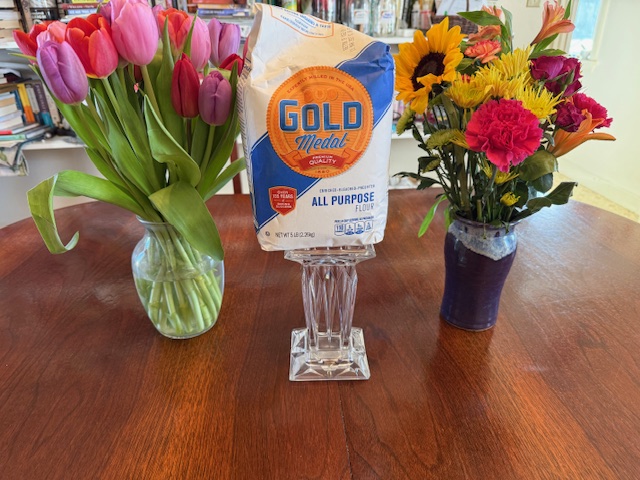
When it comes to quotes, consider the difference between how you buy flowers and how you buy flour. Also, imagine them sitting in a nice vase…
In media writing courses, we talk about quotes being the spice that zips up the story or the sparkly diamond that draws the attention of the reader. However, not all quotes actually do this, because simply slapping quotation marks around a pedestrian set of words doesn’t get the job done.
PR practitioners tend to write press releases that have at least one block quote in them, with some releases being nothing but one giant “statement from X Person” quote. News writers tend to build the bodies of their stories with at least a few paraphrase-quote pairings that are meant to give readers varying views of a topic and a wide array of people a chance to speak. In a lot of cases, those quotes are either relatively pointless or they offer little in the way of quality.
How is it that so many people are proud, happy and thrilled to be there in EVERY PRESS RELEASE, ALL OF THE TIME, even when the writer can craft the quote for the person being quoted? How is it that reporters who get to interview sources also manage to come back with such “meh” quotes from sources who really SHOULD be so proud, happy and thrilled that they can’t shut up about their subject?
Here are the reasons why:
People are afraid to do anything different, lest they offend someone: The phrase, “It is better to remain silent at the risk of being thought a fool, than to talk and remove all doubt of it,” is usually where most people want to be when the chips are down.
To that end, it’s a lot easier to do a bland, mediocre quote than to state something important with your name attached to it. Interview subjects with experience tend to lapse into cliches to avoid really upsetting people, while the press release quotes also tend to play to the middle of boring to avoid controversy.
Writers aren’t as creative as they need to be: One of the things that differentiates PR from news is the concept of quoting sources. If there’s one area where I’ve seen people have the MOST difficulty in making the shift, it’s here.
News requires you to go out, find someone and get something out of their mouth in a word-for-word format. PR in many cases allows for practitioners to write up something on behalf of the client and then just get a “sign off” on it.
Even though you CAN do this, it doesn’t always follow that you SHOULD, primarily for the reason we’re noting here: You don’t know enough about your source, the topic or the non-data stuff to really come up with that whiz-bang quote that will make the difference here.
The same thing can be true of news writers, who don’t put enough time into their research to ask questions that probe or engage the source. If you ask a generic question, you tend to get a generic answer.
Writers aren’t pushing for quality: I can’t tell you how many times I was told to “get a quote” for a story. It was basically like this scene from “The Paper” where Michael Keaton just wants “something:”
I say this as a fellow sinner who often was on the hook for getting a quote, any quote I could from any source, just so that we could say we quoted someone. However, it seems like “get a quote” is a general resting pulse for how we do business.
With those things in mind, here are a few ideas on how to get better stuff:
Don’t shop for flour. Shop for flowers: In the middle of pierogi season at our house, Amy often sends me out for supplies, the most common of which was flour. The direction was simple: “Go to the store and get a bag of flour.” I dutifully comply by driving to the closest place I could and grabbing a five or 10 pound bag off the shelf that resembled the bag she had just emptied.
When I got sent into the field as a journalist, I often felt that was how I was supposed to get quotes. It was like “Go to the store and get a bag of flour.” OK, if that’s all I’m doing, all I care about is going there, picking something off the shelf and coming home.
That’s part of the problem with quotes: You don’t just want something off the shelf.
Instead of shopping for flour, think about shopping for flowers for someone you love. Think about what it is that makes that bouquet special, beautiful and different for them. Think about how you want the reaction to be when they see it. Think about doing more than grabbing whatever is convenient.
Research better beforehand to ask better questions: As we’ve said here repeatedly, the key to everything good we do in journalism is in the preparation. The more work we do at the front end of the process, the better things will be at the back end of the process.
One of the reasons PR quotes are so “meh” is that practitioners don’t dig into the topic or the organization to find things that make it special. When all we have to work off of is a baseline understanding of the concept, which usually comes from a buzzword-laden mission statement, we’re operating in Generic-ville.
The benefit of doing the research before crafting that quote is to make it feel genuine and informed. In adding special touches based on detailed information you found, you not only have a better chance of making your source sound good, but you also have a much better chance of drawing a reporter’s attention.
In the case of reporters and practitioners who rely on interviewing, the research ahead of time can help you shape more pointed and engaging questions that will elicit stronger responses. When you ask that, “So what can you tell me about X?” question, the source will lapse into their “greatest hits album” answer, with all the generic info and cliches. If you can ask something that shows you’ve invested time and energy in the question, you’re likely to get that source to be more engaged.
Change the source’s perspective: Most of the time, the sources we interview either play to us as media practitioners or play to a perceived audience of peers. Those quotes tend to be more jargon laden or otherwise disengaged, and they usually don’t do much for an actual audience that will eventually read their quotes.
Put the source in a different state of mind, based on your full understanding of who you see as the readership. Try asking a question like, “So how would you explain this to a worker on the assembly line?” or “What would you say to a parent in the school district about X?” or even “Could you explain this to me like you are talking to a child?”
In shifting the perspective of the source in terms of understanding the audience, you can get them to shuffle the deck a bit and deal you a better hand. I’m a particular fan of the “child” quote when I’m talking to a source who is clearly exceptionally well-versed on their subject, to the point of assuming everyone else knows as much as they do.
I also like the idea of thinking about who else might be a source in my story to shape the questions. For example, if I’m talking to a product seller, I like to ask them to shift focus to being a product consumer. If they’re a superintendent, I like to get them to shift to think like a parent, a teacher, a custodian or a kid.
In getting them to move, they tend to get out of the rut where cliches live and give me something different.
