

An early photo of Chris Quinn reacting to criticism of his views on AI, journalism schools and journalism professors.
THE LEAD: Chris Quinn, the VP of content for the Cleveland Plain Dealer, must have a really tired arm from patting himself on the back, or whatever else he does for self-congratulations, as he’s back with another column about the awesomeness of his staff’s use of AI:
The first wave of responses was from regular readers, and most were positive. Several thanked me for showing how we use AI to expand our offerings while maintaining quality.
I suspect I receive little negative feedback about AI now because I’ve written about it so often. I know the anxieties it causes. That’s why I explain how we use it, assure you we are not replacing jobs and promise that humans stand behind everything we publish.
As for anything that might challenge his assumptions, well, Quinn doesn’t have time for that crap:
(A) cranky journalist in another state took offense and on Monday ranted on social media about my practices being the ruination of journalism. Much bombast by others followed.
Or, so I’m told. I didn’t read any of it. I have no time for uninformed outrage on social media channels.
(EDITOR’S NOTE: I was not the “cranky journalist” Quinn spoke of, clearly, because my “bombast” and “uniformed outrage” was published Thursday. Just want to clear that up.)
In the end, Quinn gave all of his supporters a good pat on the head before trying to shame anyone who wasn’t fully on his side:
For those who wrote to say they understand and admire what we’re doing, many thanks. To those who wrote to criticize it, I suggest you look to history to understand that the only path forward is adaptation.
Or, keep stomping your feet until you don’t have a leg to stand on.
CATCHING UP: Quinn wrote an extensive column last week, praising the use of AI as a tool that allowed his staffers to do more reporting and zero writing in some under-covered enclaves of the paper’s circulation area.
In doing so, he decided to take several potshots at colleges, college professors and college students, saying they were doing everyone on Earth a massive disservice by decrying the value of AI, or outright ignoring it.
This led to at least some of the backlash against him, including the piece I wrote here that made what I consider to be three clear, well-reasoned and well-supported arguments:
- Quinn is wrong about journalism programs not teaching AI or telling students that AI is the devil.
- AI is a tool that still has a lot of kinks to work out, and it has proven to need some extensive oversight in its current form.
- The content the PD is producing from its “Report it all, let AI write it up” leaves something to be desired in terms of quality.
In his most recent missive, Quinn didn’t deal with almost any of these criticisms, but then again, I really didn’t expect him to. In reading through his 14 previous letters on AI, I’ve found kind of a pattern in his views on AI. Two broader underlying premises really underscore why I’d love to play poker against this guy:
The Law of the Instrument: The concept has been around for generations, but it’s often attributed to Abraham Maslow, and it basically states that if the only tool you have is a hammer, you treat everything like it’s a nail.
Quinn has so bought into the premise that everything can be done with a strong set of reporters and an AI grist mill, that it’s clear all stories are getting done this way on those beats. The underlying problem is that not all stories can be done well this way.
Quinn mentions things like people wanting to know the score of the Browns game or the outcome of a vote from some board in Lorain. These stories are great for AI to just crank out.
OK, fine, but what about that story of the teacher who donated bone marrow? Or obituaries? Or other stories in which details matter and storytelling can make a difference? These things get ground up and spit out in a bland way that really undermines the quality of the work the reporters have done.
Quinn isn’t alone in this, as I remember having an argument with a broadcast professor during the “convergence phase” of journalism. I noted that some stories were better done in print or online while other stories were better done in broadcast. He argued anything I could do for a newspaper, he could do just as easily for broadcast.
I mentioned things like budget stories that needed mathematical depth and lacked a lot of visuals for video. He told me how he would take video of people typing on keyboards or how he would throw a copy of the budget on the table and film that.
The underlying point in both cases is the same: Yes, you CAN do a story this way but it doesn’t follow it’s the BEST way to do that story.
Often Wrong, Never In Doubt: I heard this phrase in a documentary on financial investors, where a short-seller explained that certain people are very good to bet against because they lock in on an idea and refuse to be dissuaded, regardless of the reality surrounding them.
When they are wrong, but overly confident, they’ll pour vast sums of time and money into risky things that end up going wrong, thus benefiting the people who clearly saw the inherent flaws in those things. Quinn fits this to a T.
In reading through all of his letters to the public, never once did he demonstrate one iota of caution. It was, “This is the greatest thing since sliced bread, so you better get on board.” I seem to remember that same pitch being used to market Theranos, cryptocurrency and MLMs.
Even when I’m really certain on something, I’m always open to the option that I might not be right. If Chris Quinn brought me to the PD, showed me all the great stuff he’s doing, demonstrated how they’d backstopped AI to prevent any catastrophic failures and presented data on how great this was serving his readers, I’d be happy to give this whole experiment another look. I believe paranoia is my best friend, so I’m looking out for risks and willing to say I’m wrong.
Quinn’s most recent letter just drips with hubris, belittling anyone out there who hasn’t fallen in line while ignoring the issues a bunch of us have raised here (particularly those about how crappy J-school is). It’s telling that after a letter in which he basically said professors suck and J-schools suck, he added this tidbit to the end of his latest missive:
Note: I mentioned a student last week who withdrew from job consideration because of our use of AI. Some readers concluded the student attends Syracuse University. That’s not the case. Actually, Syracuse’s Newhouse School of journalism, a valued partner for us, teaches about AI in journalism. Leila Atassi, one of our editors, will be on the Syracuse campus in a few days to help coach students in how we use AI.
That’s exceptionally tone deaf for two key reasons:
- You spent an entire column telling everyone that college journalism programs ignore or hate on AI and then without an ounce of irony, mention how great Syracuse is and that they’re doing some awesome AI stuff.
- You crapped all over journalism degrees and how they’re worthless, yet you’re dispatching Leila Atassi to Syracuse to teach these kids. I wonder what her background is… Oh… Yeah…
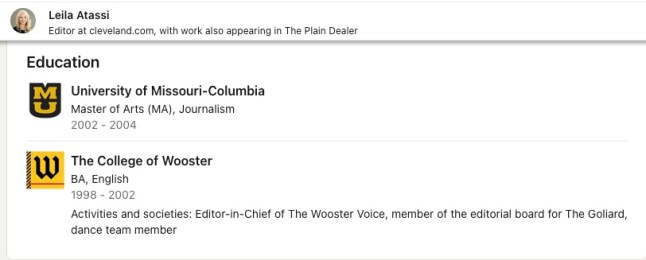
And, I’d like to say I believe in Leila and her abilities, if for no other reason, than she went to a hell of a good journalism school for her master’s (and she was actually one of my students for a while.)
In any case, while Chris Quinn thinks I’ll be here stomping my feet until I don’t have a leg to stand on, I’ll actually be watching to see what happens as the PD’s Icarus keeps flying higher and higher on his AI wings.
