
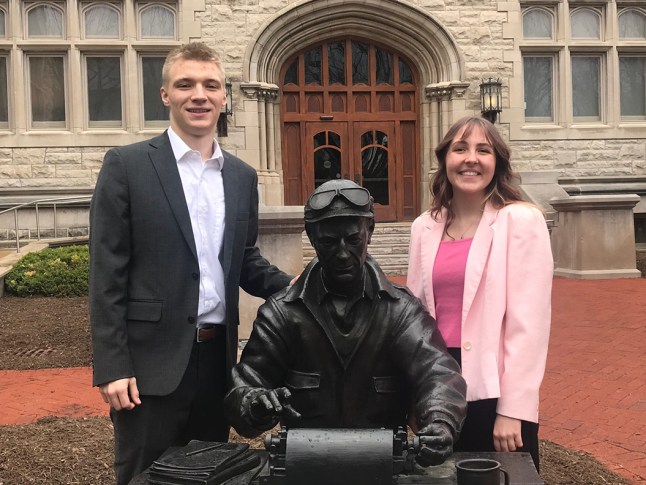
Jacob Spudich and Marissa Meador pose next to the famed Ernie Pyle statue outside Franklin Hall after speaking to the Student Media Board during the application process to become co-EICs. Photo courtesy of Marissa Meador.
(EDITOR’S NOTE: This is the second part of a multi-part series on the decision of the IU Media School to unilaterally converge its student media outlets, the Indiana Daily Student, WIUX and Indiana University Student Television. Part of the plan calls for the elimination of the final print edition of the IDS, something upsetting to the students.
If you want to help the students keep their print paper, they have listed this link as a way to do this: https://forms.gle/cisJyhvAxuQbC4co7.
If you want to tell Dean David Tolchinsky what you think about this situation, you can email him here: mschdean@iu.edu
If you missed Part I, you can find it here.)
THE ANNOUNCEMENT
Trevor Emery, the president of WIUX at Indiana University, knew something was going to change for his radio station in a fairly substantial way.
He just didn’t know what it would be or how fast it would hit.
“On Monday, we all get an email in the early afternoon, and it was three, four o’clock,” he said in an interview. “It said, ‘We’re all gonna meet Wednesday and talk about some big news for student media.’ And then Tuesday I’m my home… I get out of the shower and I look at my phone, and I have four missed calls from one of the IDS editors, and I call him back, and I’m like, ‘So what’s going on?’ He was like, ‘Have you seen what the media schools posted?’ I’m like, ‘No.’ Then they bugged me for a quote.”
The editors had received a leaked copy of a plan about massive changes coming to student media. The Media School stated it would merge the student media under one umbrella operation. It would also kill the final print edition of the IDS, shift the professional staff around to cover all the media branches and create additional media options, including a newsletter and an all-encompassing digital app.
“Then Wednesday, the next day, we all go into this meeting, and the dean starts off with, ‘Oh, the IDS got this report in a leak, and we just preempted them by posting it directly,’ The whole meeting felt like they were telling us, ‘We are here to inform you of this decision anyways, whether you like it or not,'” he said. “So then that says to me I was never going to be asked about anything in the first place.”
The mood at the IDS wasn’t any better, as the staff scrambled to make sense of what they had seen and tried to inform their readers about the issue. Co-editors-in-chief Marissa Meador and Jacob Spudich had planned to attend a meeting on Wednesday, where they thought they’d be asked for some input on a plan people had been working on since April.
“I think there was kind of like an assumption from Marissa and I that this meeting was going to be more of a constructive meeting where Marissa and I’s input would be valued somewhat, and I think that became clear that that was not the case that Tuesday,” Spudich said in an interview.
Meador said they found out the school had planned to meet with faculty Wednesday at 2 p.m. to clue them in, speak to her and Spudich at 3 p.m. and then make the formal announcement at 4 p.m.
“It’s hard to believe that anything we said was going to have an impact on their final decision if they had planned to release it right after our meeting,” she said.
With that in mind, and a copy of the plan in hand, the IDS crew went to work as reporters. They built both a story that provided the news of the plan and people’s reactions to it as well as a letter from the editors in which they expressed “no confidence in the Media School’s plan.”
“I feel we should have been considered in this decision,” Spudich said. “This is about more than just the money aspect. It’s about staffing, the abundance of our newspaper stands around town, and the visibility that we have there. There’s just a lot of things that we don’t feel were taken into consideration. And really the only way they would have been is if a representative from our newsroom was there to voice those concerns early on in this process.”
Emery said the radio station also felt let down by the plan and the approach the administration took in announcing it.
“It did come out of nowhere, and it would have come out of nowhere on Tuesday, or would have come out of nowhere on Wednesday,” he said. “I don’t really have a difference on the day of the week that I’m getting screwed over. But it was very confusing.”
AT LEAST 99 PROBLEMS
When it comes to the financial aspects plan itself, the members of the IDS had several, specific concerns:
- The cutting of the print edition didn’t make sense. The paper version of the IDS was revenue-positive, and it was a key way to reach the community, both for older people who still preferred that platform and as a signal on news stands that the paper was still publishing. Furthermore, the original committee’s recommendations did not include cutting print. The plan calls for the retention of special issues, but how those are done and which ones will happen remain a mystery, the students said.
- Continual cutting had not solved any significant problems for the IDS to this point. As its name indicates, the IDS once published a daily print edition, but over the years, in response to dwindling revenue and loss of print readership, the staff had cut the paper and print run. The race to the bottom of printing still left them in debt.
- This plan was created without transparency and then forced upon the staff. As Meador noted in an interview, the previous cuts or changes the IDS undertook to fix the finances were done by the IDS itself. This would be the first time print cuts or organizational changes were mandated by an external agency.
- The resources aren’t there to make this work. Much like the convergence efforts of yesteryear, this one looked to get fewer people doing the work of more people. The comparatives the Media School was drawing to other converged student media operations involved far more professional staff and much higher buy-in from the institution, they noted.
- It’s unclear who will be paying for what. The specifics about cuts are clear, but the revenue-generation portion and such are exceptionally vague. The radio and TV stations do not generate revenue, so the cost of the professional staff will have to come from somewhere else. Currently, the IDS pays their salary and benefits, but it’s unclear how that burden will be spread moving forward.
As far as WIUX was concerned, the problems were even bigger.
“The newspaper really is like the elephant in the room,” Emery said. “They’re consistently $300,000 over budget… The newspaper as a thing works, and they know that it is profitable. What isn’t profitable is paying like five or six adult-level salaries to people with health insurance and whatever else. And we don’t have any of that. We have a faculty adviser, and she does the work of like 10 people, and she gets paid a small stipend from the school just to help out.”
Emery said the three organizations rarely interact, primarily because they all have different interests, different needs and different purposes. The student newspaper produces local news content, while music and community events drive the radio station. (A representative from IU Student Television did not respond to requests to participate in this series.)
“I sit in these meetings with the media school, with the staff and the dean at times, and I point out that we are definitely much more student-life based,” he said. “We connect with the community. We were trying to get people out in public by doing events, things like that. We just finished up our whole week of events and a fundraiser to keep our station going. None of the two other clubs that we’re talking about do that.”
With both broadcast groups run as student clubs, Emery said they were not allowed to do certain things to earn money. In exchange, they both used to receive money through student life via student fees. However, around 2020, he said, the stations got cut off from that funding without much explanation.
“We were getting, at one point, like 70 cents a student, undergraduate student on the Bloomington campus,” Emery said. “So that ended up being like $30 or $40,000 a year. And we managed that to where we had a pretty big surplus. By the end of where that landed, like three or four years ago, we had like $150,000 to $200,000… Over the past four or five years, that’s dwindled down.”
With the Media School calling for a three-year phase in, Emery said he’s worried that time and funding might run out for the station.
“They also are like, you’re going to have three years to implement this, and it’s obviously not going to make money in that meantime while we figure out what systems to use and build a client base, etc., etc., and they won’t tell us how much money we’re going to be supported with during that time,” Emery said. “I’m assuming that they’ll cover the salaries of the newspaper, and they’re like staff, the pro staff. But for us, I don’t know what that means. That’s essentially the time when we run out of money in our account.”
NEXT TIME: The problems with convergence and the background of the guy trying to make it happen at IU.
